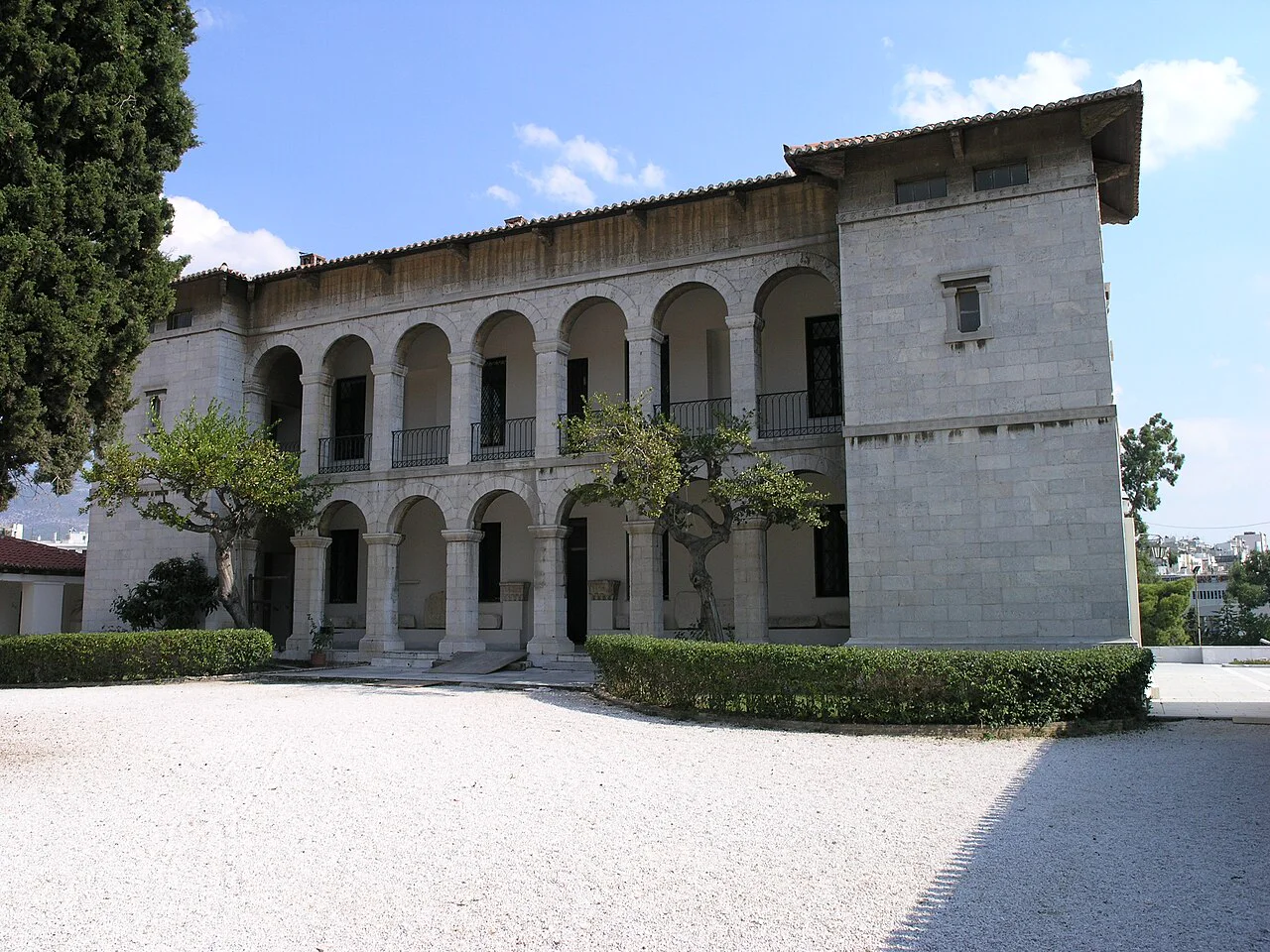
Stanza · Audio guide
Βυζαντινό και Χριστιανικό Μουσείο Audio Guide
A place to remember. A story to take with you.
The Byzantine and Christian Museum is a museum in Athens, Greece. It is located at Vassilissis Sofias Avenue in the city.
Download Stanza, then search for “Βυζαντινό και Χριστιανικό Μουσείο”.
About the tour
One guide. Your kind of visit.
The Byzantine and Christian Museum is a museum in Athens, Greece. It is located at Vassilissis Sofias Avenue in the city.
The Βυζαντινό και Χριστιανικό Μουσείο guide tells the stories of 19 artworks, including Vision of Constantine (Stavarkis) (Stylianos Stavrakis), Jacob’s Ladder (Elias Moskos), The Vision of Constantine (Elias Moskos), Lady the Lambovitissa (Emmanuel Tzanes), Jesus Hominum Salvator (Andreas Ritzos), Virgin Glykofilousa (Karantinos) (Andreas Karantinos), Tribute to the Eucharist (Damaskinos) (Michael Damaskinos), and The Dormition and Assumption of the Virgin (Moskos) (Elias Moskos). Every artwork is free to hear in the Stanza app until 1 January.
Ready when you are.
- 01Get the free Stanza app.
iOS & Android
- 02Find your guide.
“Βυζαντινό και Χριστιανικό Μουσείο”
- 03Download before you go.
Works offline
Audio guide / 19 artworks
Inside the guide
Get to know a few of the stories before you go. Open a stop to read more.
01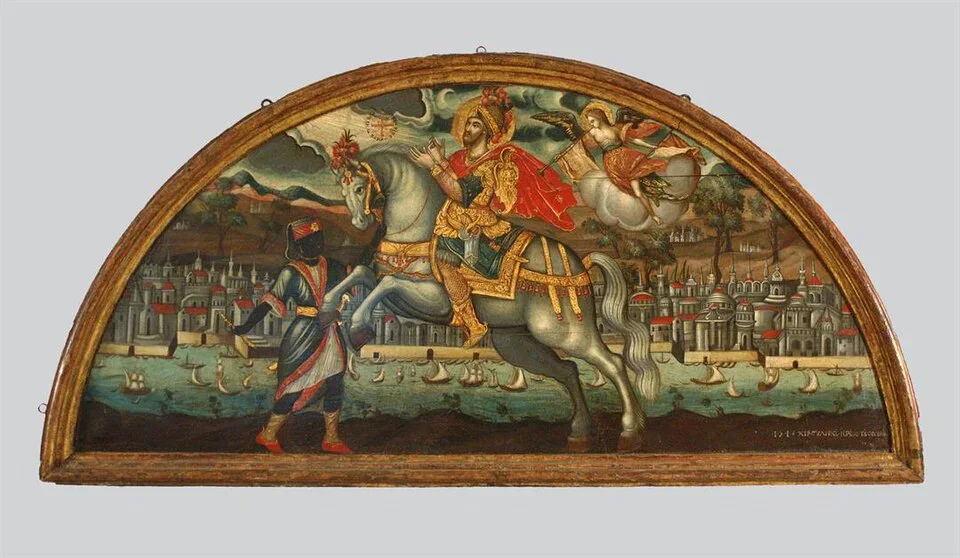
Vision of Constantine (Stavarkis)
Behind the emperor, an angel plays a horn. That is part of the sign that left Constantine and his army amazed. In the legend, he prayed with his troops before fighting Maxentius, and a cross appeared in the sky. With it came Greek words, a promise that under this sign he would win. He went on to win the Battle of the Milvian Bridge, was crowned emperor, and the persecution of Christians came to an end. Stavrakis painted it in the shape of an arch. It once closed an archway in a church on Zakynthos, one of the Ionian Islands. On the emperor's military dress, the gold stands for the heavenly realm he came from. His hand makes a prayer, the same gesture found in a painting by Elias Moskos and in Bernini's statue of Constantine. Moskos's painting influenced this one, and it hangs in this same museum. The city behind the battle may be Rome.
Listen in the appStylianos Stavrakis · Public domain
02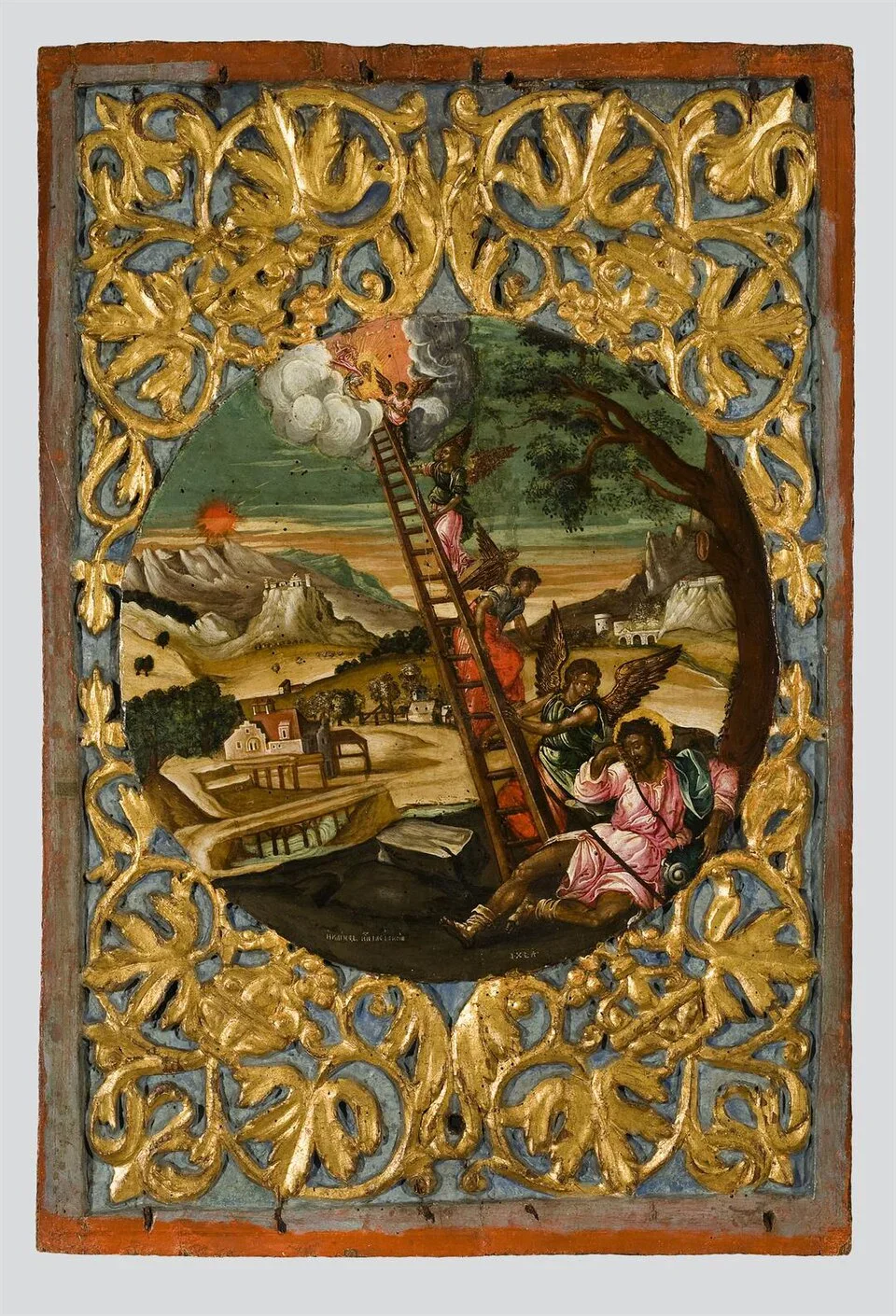
Jacob’s Ladder
Elias Moskos wanted a flat printed image to breathe. The picture he worked from was a Flemish engraving, not a painting. Rafael Sadeler made the print, borrowing the scene from a painter, Maerten de Vos, who had pictured Jacob's ladder first. In the print, Jacob slept and dreamed of a ladder reaching up to heaven, with angels moving up and down it. Moskos gave that printed sketch colour, and it became this. The angels, now more human, float in a weightless space. Jacob is smaller than in the print, his legs almost carved, his garments falling in fluttering folds. He kept the castle on the mountain and the landscape at the right, though he changed the landscape a little. And he set a sunset behind it all. He was living on Zakynthos, and this came from a church there, one panel of an iconostasis.
Listen in the appElias Moskos · Public domain
03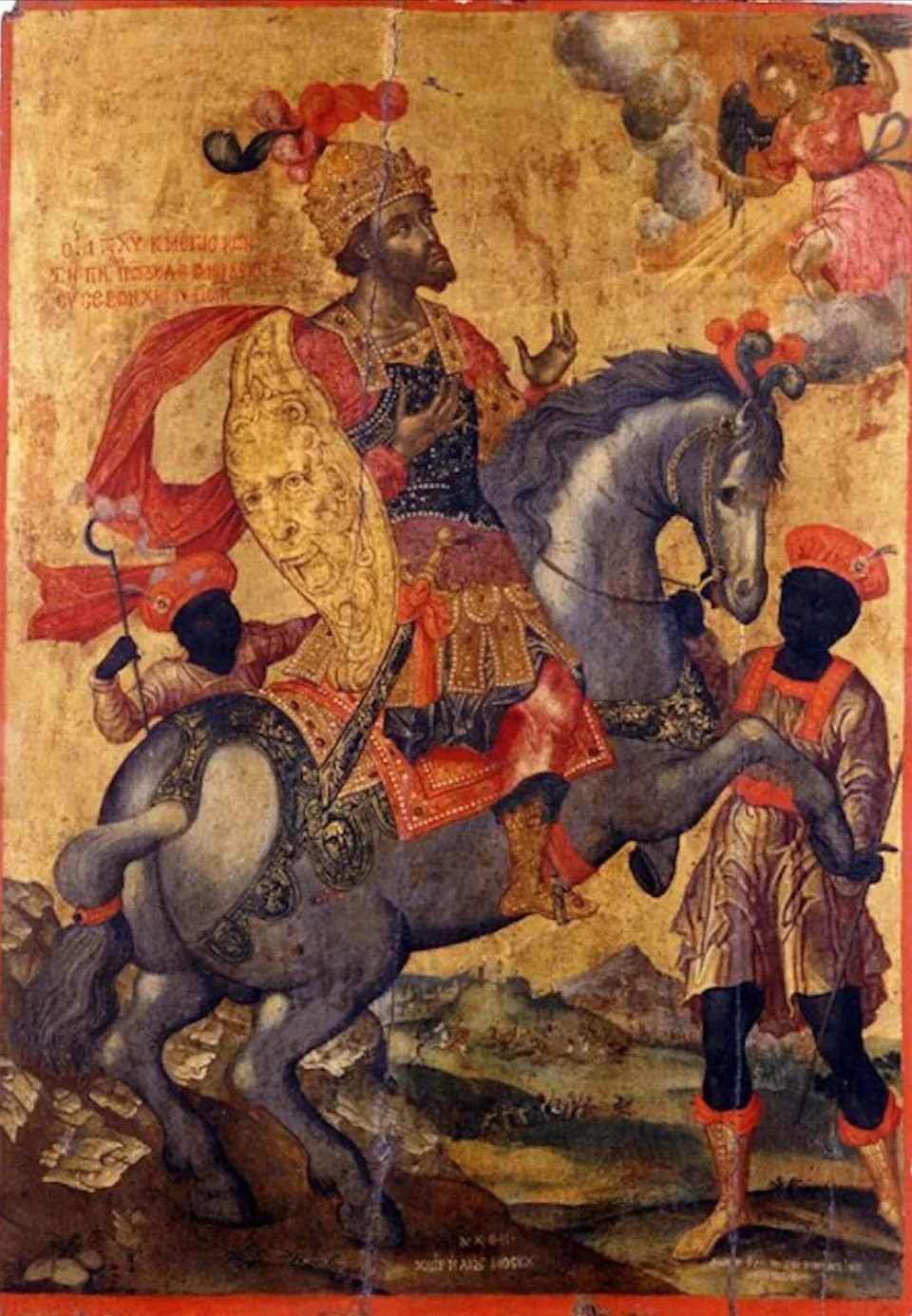
The Vision of Constantine
An emperor holds his hands open, and an angel appears in the clouds. Two soldiers greet him, both carrying weapons, and one holds a spear topped with a crescent moon. This is an army at prayer in the middle of a war. Constantine and his troops were facing the emperor Maxentius, and had been praying together when the vision came. The story tells of a cross above the sun, and the words, by this sign you will conquer. Elias Moskos, a painter from Crete, shows an angel delivering that message to the emperor, and the troops are astonished at the miracle. Then, in the background, outside a fortified city among the hills, a battle is under way, and Constantine appears a second time. That is the victory the angel promised. Constantine won the Battle of the Milvian Bridge, entered Rome and ended the persecution of Christians.
Listen in the appElias Moskos · Public domain
04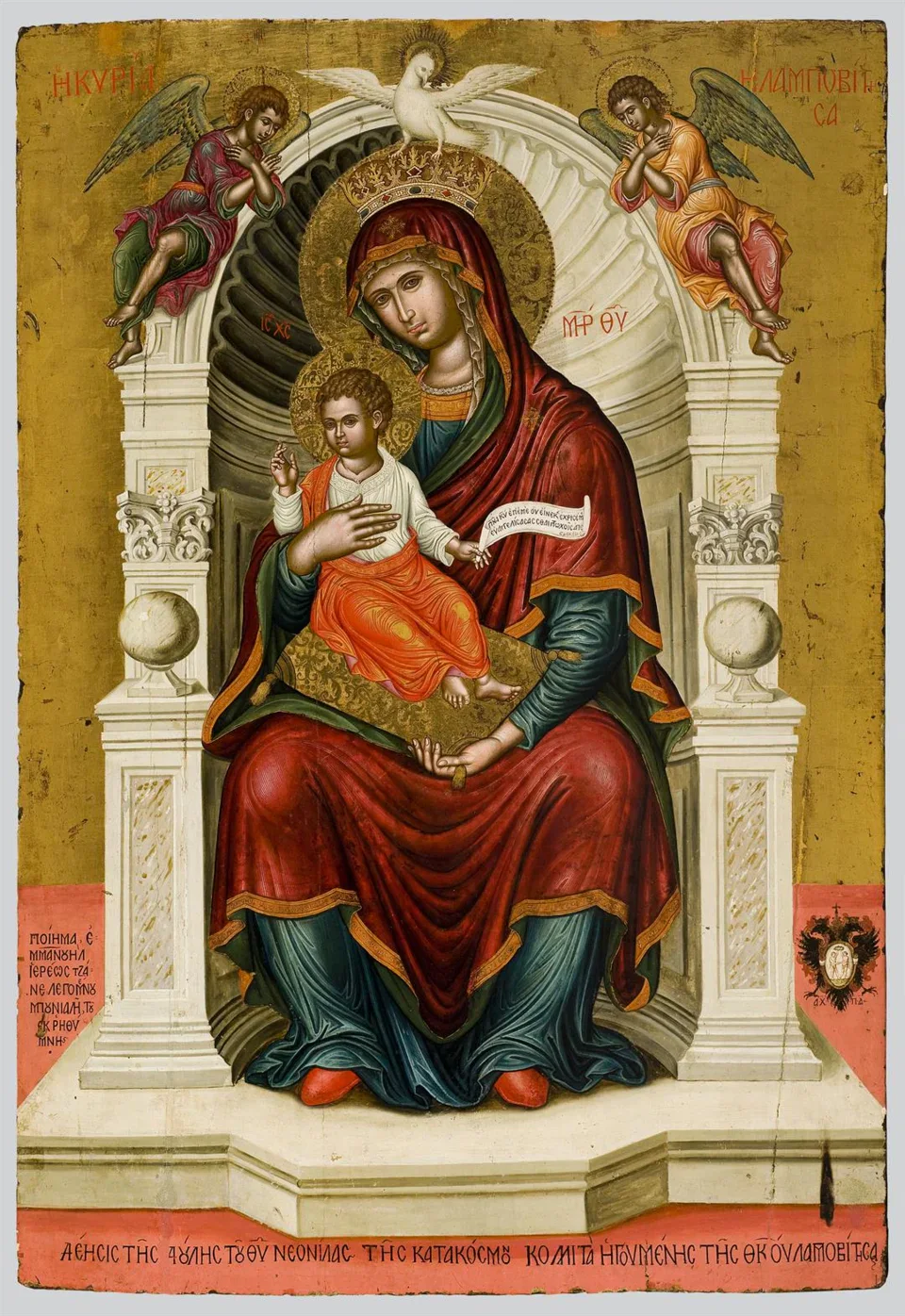
Lady the Lambovitissa
A white dove is crowning the Virgin as she sits on her throne. Angels look on, marveling at her and at the child. The child looks out at you, holding a banner in his left hand, where Cretan painters would more often give him a scroll. Their throne is shaped like a shell, with columns above two round orbs. Emmanuel Tzanes painted this in 1684. His brother Konstantinos had painted the same subject thirty years earlier, around 1654, on the island of Corfu, the Virgin and Child enthroned. That picture still stands in the cathedral of Saint James and Saint Christopher. The two thrones are much alike, and both are richly decorated. But Emmanuel set a dove above the Virgin's head, where Konstantinos set two angels, and he left the shell out. The name Lady the Lambovitissa comes from a monastery in Corfu, an island where both brothers had painted many works. Emmanuel made this one in egg tempera on wood, finished with gold leaf.
Listen in the appEmmanuel Tzanes · CC BY-SA 4.0
05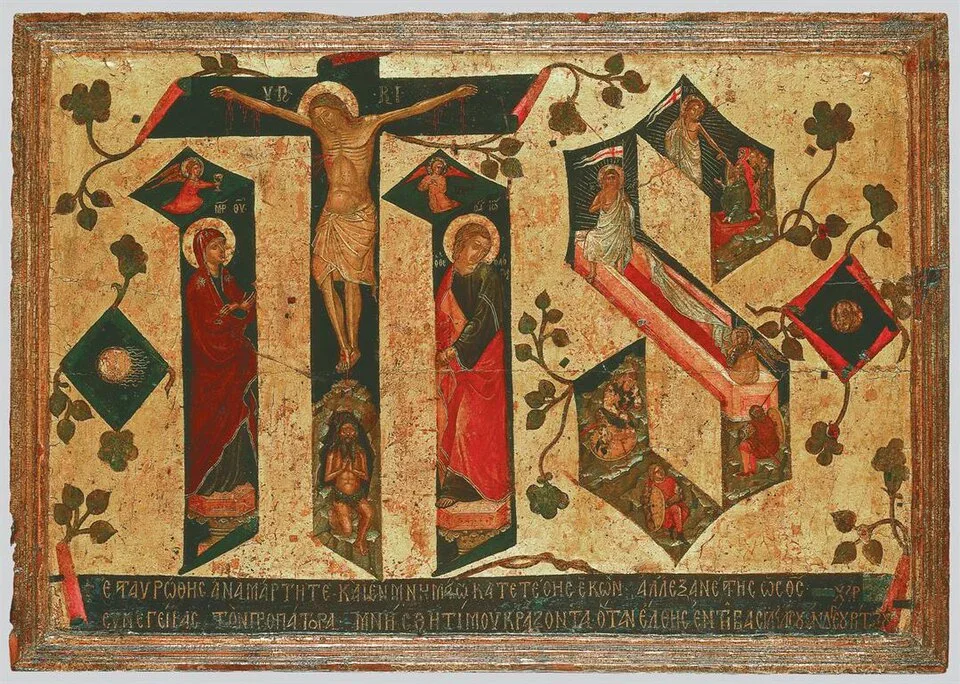
Jesus Hominum Salvator
Nobody knows just when this was painted. It is dated between 1440 and 1492, and the first we hear of it is a will from 1611, leaving it to someone in Venice. The picture in front of you is built from three letters, I, H and S. They are a short form of Jesus's name, and Ritzos, an icon painter from Crete, chose to put the whole story inside them. Artists almost never used such a symbol in a fine art painting. In the I, the Virgin Mary stands weeping on a pedestal. Above her, an angel with a cup is about to collect the blood seeping from the wounded Christ. The H holds his crucified body, folded over at the top. Below it, outside a cave, stands Adam, and farther along John the Evangelist stands on a pedestal like Mary's, looking away. The S carries what comes after. Three guards with shields are stunned by the escape. The one closest to the angel sits on a rock, holding a sphere. Diagonal lines give the sarcophagus depth, and a bright aura surrounds the risen Christ embracing a group of biblical figures. Along the bottom runs a Greek inscription. It says Christ was crucified without sin, laid in a tomb and raised as God. The last words ask to be remembered when he comes into his kingdom.
Listen in the appAndreas Ritzos · Public domain
06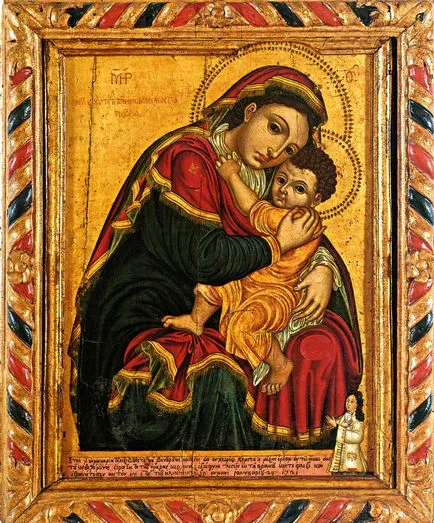
Virgin Glykofilousa (Karantinos)
Shadow is worked into the clothing here, and it makes the scene feel more natural. That way of painting came from Titian and Raphael. It shows in the Virgin's gown, gold, with rich patterns and folds. The gold stands for the heaven she has come down from. She holds young Jesus close, and both faces have strongly curved features. The child's hair is very curly. At the bottom on your right is a small figure in a Venetian garment and a noble wig. That is Bernardo Aninos, a lawyer. His garment shows his high position. Beside him a short Greek inscription says that at the sixth hour of the day he was sitting in his house in Komitata. A thunderbolt fell suddenly from the sky and killed him on January twenty fourth, 1723. He was thirty five. Those few lines helped trace this painting back to the Aninos family. They commissioned it and were one of the leading families of Kefalonia. Andreas Karadinos worked closely with them, and they kept the painting until the twentieth century. It is still not known whether this picture was copied from another work on Kefalonia that no longer survives.
Listen in the appAndreas Karantinos · Public domain
07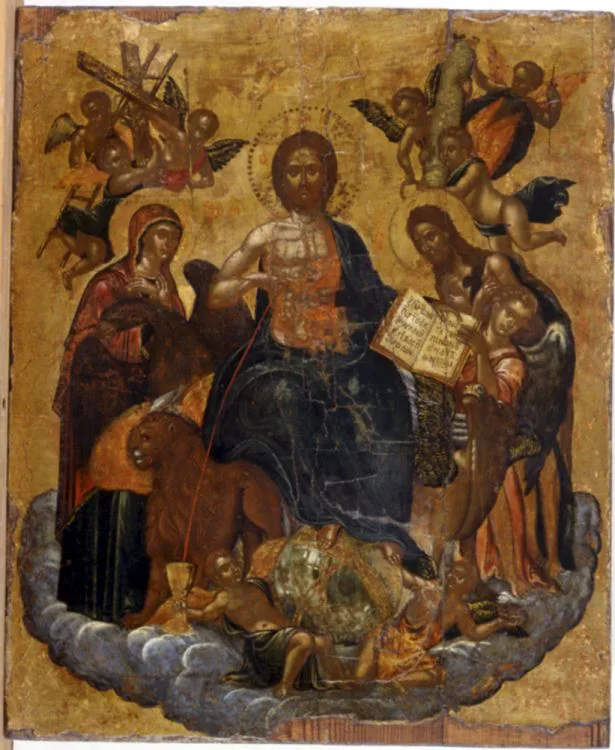
Tribute to the Eucharist (Damaskinos)
At Jesus's legs, one angel holds a holy cup receiving his blood, and another holds a piece of bread. Those are the symbols of holy communion. This icon is attributed to Michael Damaskinos, a Cretan who traveled all over Italy for more than twenty years and spent much time in Venice. In the Vatican he had seen Raphael's Disputation of the Holy Sacrament, a fresco of church figures debating the Eucharist. He made his own version of it here. Christ floats on a cloud, much as in the work he had seen. Mary is on our left and John the Baptist on our right, in the traditional pairing. An eagle in front of Mary stands for John the Evangelist. The figures seem weightless in a spaceless setting, and he paints them in a three dimensional style, an Italian manner he had adopted. A second version survives at the Platytera Monastery in Corfu. Other Greek painters copied his version, among them Andreas Karantinos and Konstantinos Kontarinis. A well preserved copy is at the National Gallery of Athens.
Listen in the appMichael Damaskinos · Public domain
08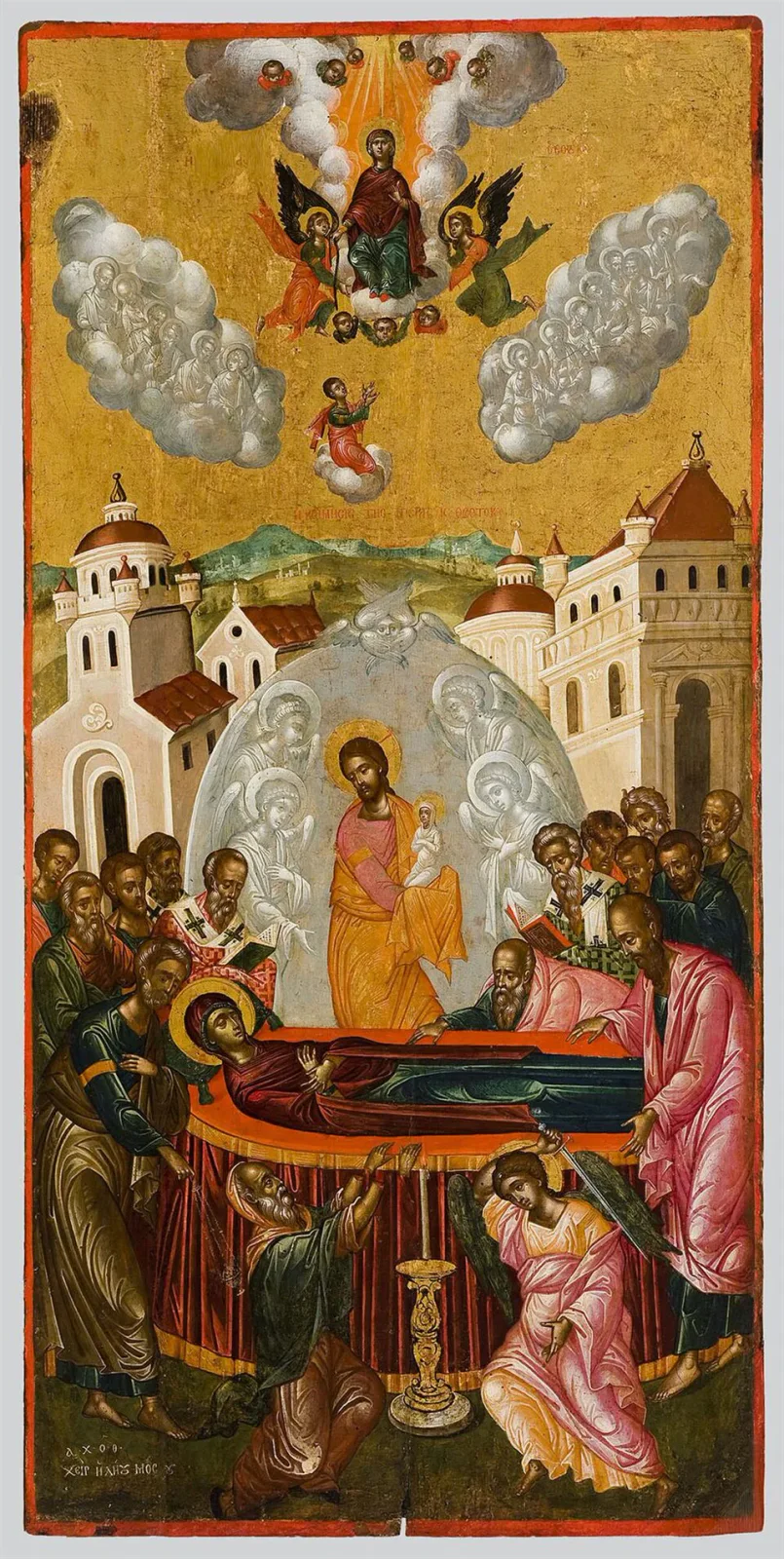
The Dormition and Assumption of the Virgin (Moskos)
The Virgin lies dead, and the apostles gather around her, grieving. Peter holds an incense burner over her head, and Paul bends at her feet. On the left, one man has grabbed the cloth she lies on. He is Iefonia, a priest of the sanhedrin, trying to disturb her body. The sanhedrin feared her body would disappear and that she would rise again. An angel to his left wields a sword to stop him, and a candle stands between them. Jesus holds a small swaddled infant. It is Mary's soul, entering heaven pure and born again, the way a newborn begins a new life. Above, she floats on a cloud surrounded by angels, with a beam of light behind her. She holds her belt, and Thomas waits on a cloud to receive it. Moskos built the scene in layers, a foreground, a middle ground and a background, with buildings and mountains behind the mourners.
Listen in the appElias Moskos · Public domain
09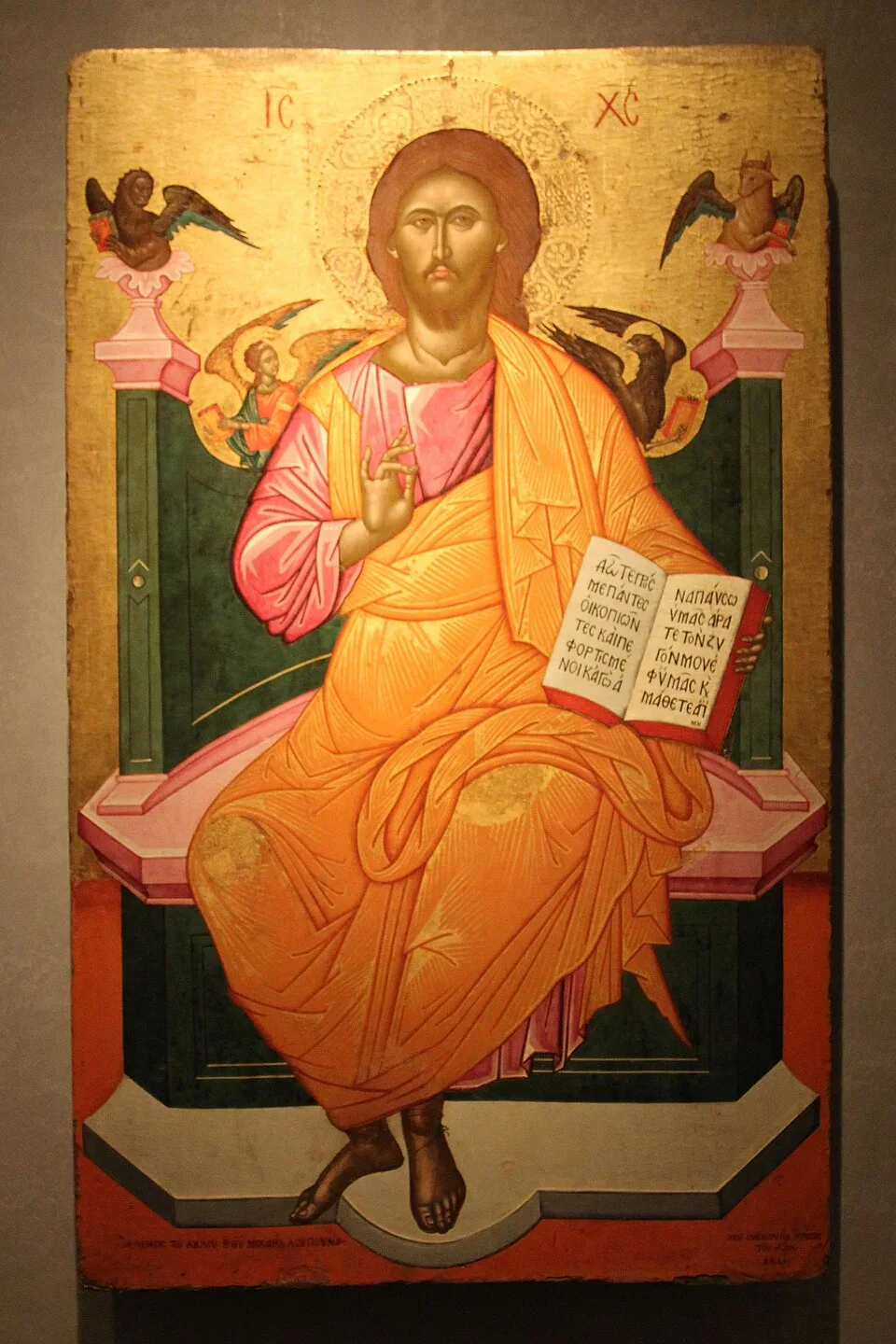
Christ Enthroned
Christ sits on a deep green throne, his figure broad, his garments gleaming, with an open book resting on his lap. Four figures frame him, and each one holds a book. They are the symbols of the four Evangelists. Two sit above the back of the throne, and two appear above his shoulders. The passage in his open book is from Matthew, chapter eleven, verse twenty-eight. The icon was finished in 1664, painted to stand on the screen before the sanctuary in the Monastery of Saint Philothea in Athens. On the floor in front of the throne, large letters give two names. On the left is the man who dedicated it, a servant of God named Michael Lopounas. On the right is the painter's own hand, Emmanuel Tzanes, who signs here as a priest.
Listen in the appEmmanuel Tzanes · CC BY-SA 2.0
10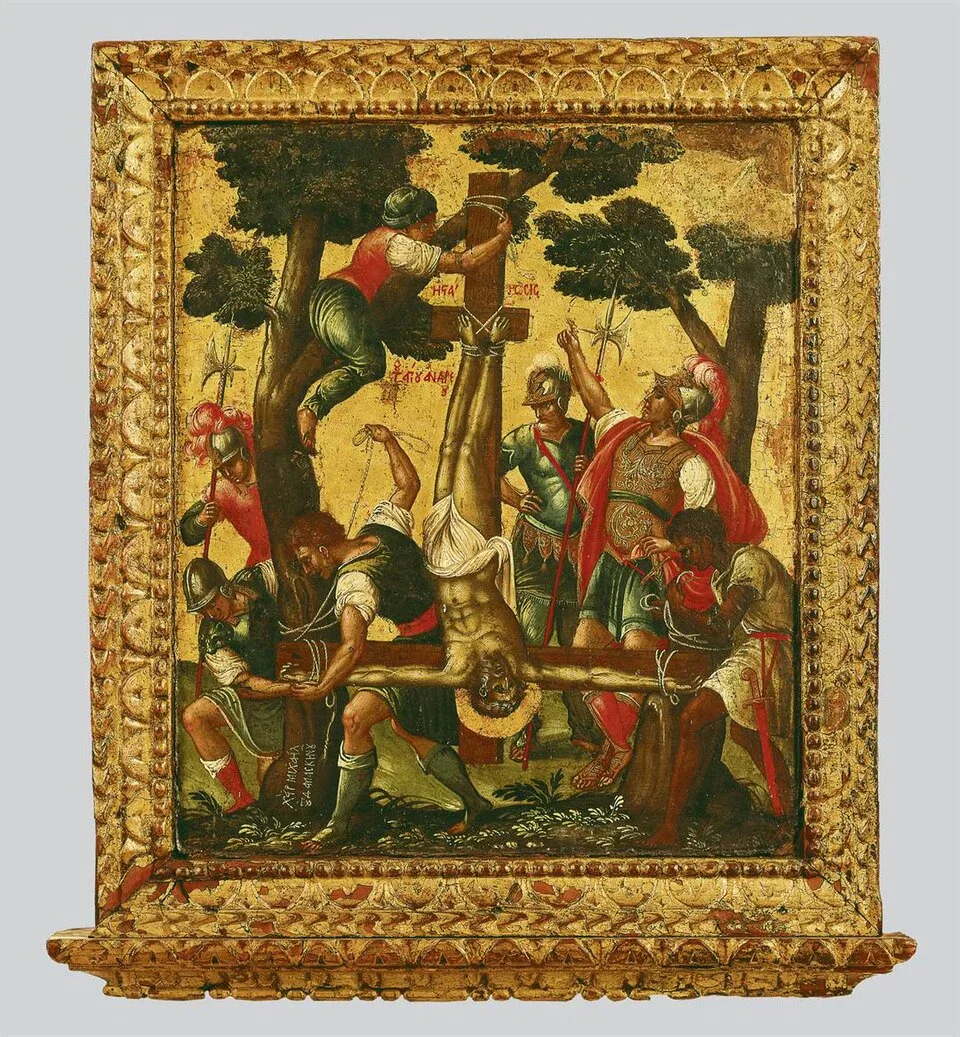
Upside Down Crucifixion of Saint Andrew
Michael Damaskinos set out to show Saint Andrew dying as his brother Peter had. Peter had refused to be crucified the way Jesus was. He was crucified upside down. Andrew is usually shown on a cross shaped like an X. Here he hangs upside down, ropes around his arms and legs, on a cross sunk into the ground between two olive trees. On the left, a man ties that cross with the help of a soldier in a helmet. High in one tree, a man in long leggings and a cap fastens the top, while a Roman officer gives the order. Two soldiers stand further back with spears, watching to their left. Andrew was crucified at Patras, and his remains are kept today in the cathedral that bears his name.
Listen in the appMichael Damaskenos · Public domain
- 11
Saint Theodora
Emmanuel Tzanes · 1671
- 12
Saint George and the Dragon
Georgios Klontzas · 1550–1608
- 13
Nikolaos Tsafouris, The Virgin and St. Francis of Assisi. Exhibited in the Byzantine and Christian Museum in Athens.
Nikolaos Tzafouris · 1490
- 14
1826 - Byzantine Museum, Athens - Good Shepherd (4th century) - Photo by Giovanni Dall'Orto, Nov 12 2009
Unknown Artist · 4th century
- 15
1829 - Byzantine Museum, Athens - Orpheus (4th century) - Photo by Giovanni Dall'Orto, Nov 12 2009
Unknown Artist · 4th century
- 16
Eastern Orthodox icon of Jesus Christ as the True Vine
Unknown Artist · 1550
- 17
Theotokos Glykophilousa
Unknown Artist · 1350
- 18
Metal armor of a warrior on horseback (13th-15th century)
Unknown Artist
- 19
Byzantine and Christian Museum, Athens, Greece (8384428908)
Unknown Artist
Βυζαντινό και Χριστιανικό Μουσείο
Frequently asked questions
How much does the guide cost?
Free app download. Free until 1 January. Listed guide price: $0.99. Audio guide only. Venue admission is separate.
Can I listen without internet?
Yes. Download the guide’s audio, images, and maps in the app before your visit. Your downloaded content is then available offline.
Can I listen in my language?
In English for now. More languages soon.
Do I need to follow a schedule?
No. This is a self-guided experience. Choose your stops, pause whenever you like, and return to a story at your own pace.
Which artworks are in the Βυζαντινό και Χριστιανικό Μουσείο audio guide?
19 artworks, including Vision of Constantine (Stavarkis) (Stylianos Stavrakis), Jacob’s Ladder (Elias Moskos), The Vision of Constantine (Elias Moskos), Lady the Lambovitissa (Emmanuel Tzanes), Jesus Hominum Salvator (Andreas Ritzos), Virgin Glykofilousa (Karantinos) (Andreas Karantinos), Tribute to the Eucharist (Damaskinos) (Michael Damaskinos), and The Dormition and Assumption of the Virgin (Moskos) (Elias Moskos). The full list is on this page.
Is this the museum’s official audio guide?
No. Stanza is an independent audio guide app and is not affiliated with Βυζαντινό και Χριστιανικό Μουσείο. Museum admission is separate.
At your own pace
Explore Βυζαντινό και Χριστιανικό Μουσείο.
Download Stanza, then search for “Βυζαντινό και Χριστιανικό Μουσείο”.
Free app download · Guide price shown in the app
Keep exploring
Nearby audio guides
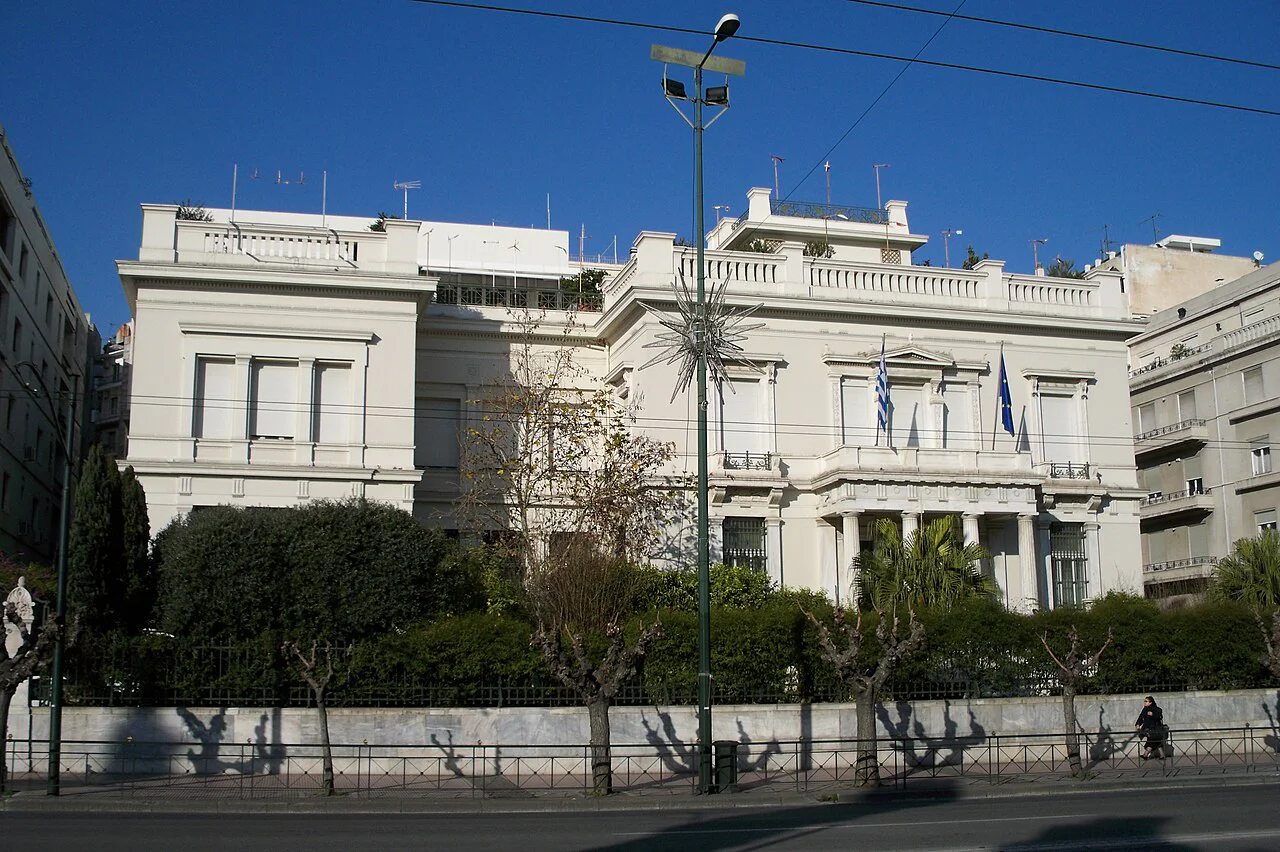
Athens · 1 km
Μουσείο Μπενάκη
Content & sources
Photo: Dimboukas · CC BY-SA 3.0
Athens · 1 km
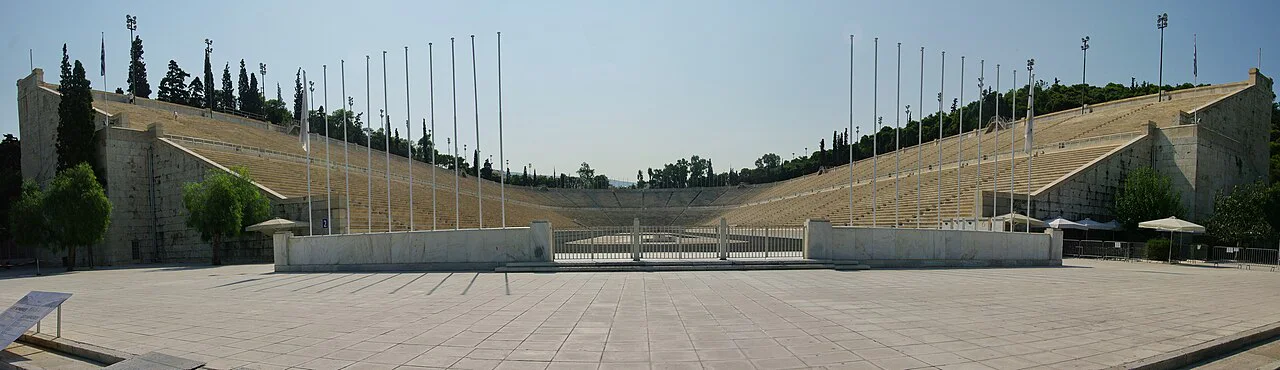
Παναθηναϊκό Στάδιο
Content & sources
Bgabel · CC BY-SA 3.0
Athens · 2 km
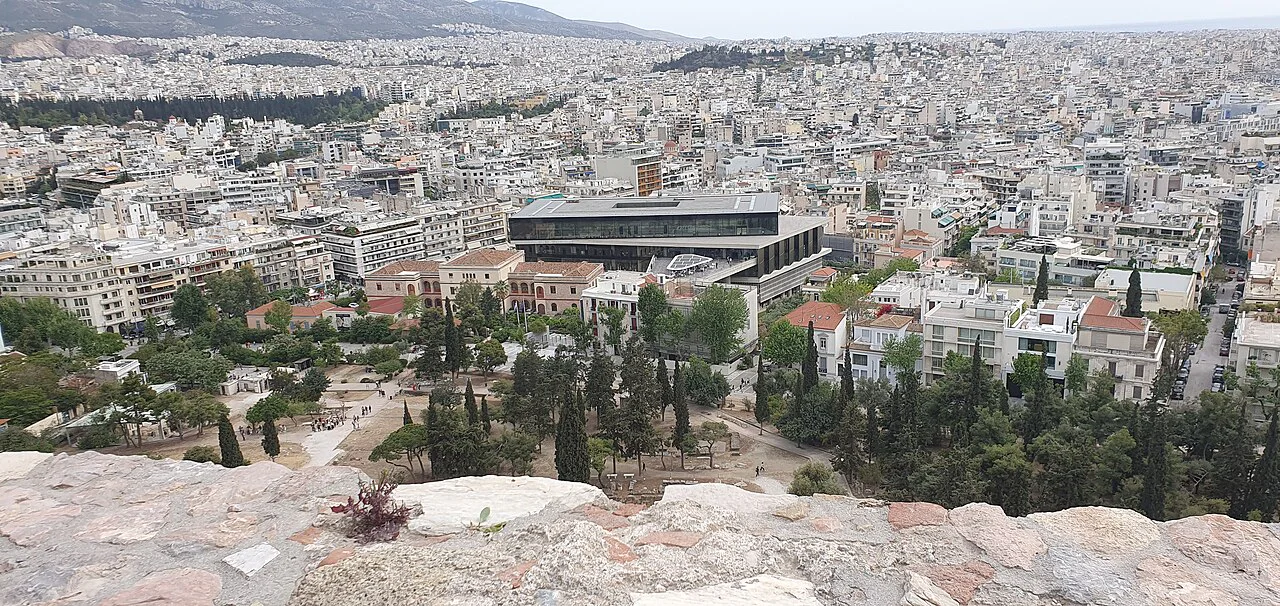
Μουσείο Ακρόπολης
Content & sources
Photo: Yair-haklai · CC BY-SA 4.0
Athens · 2 km
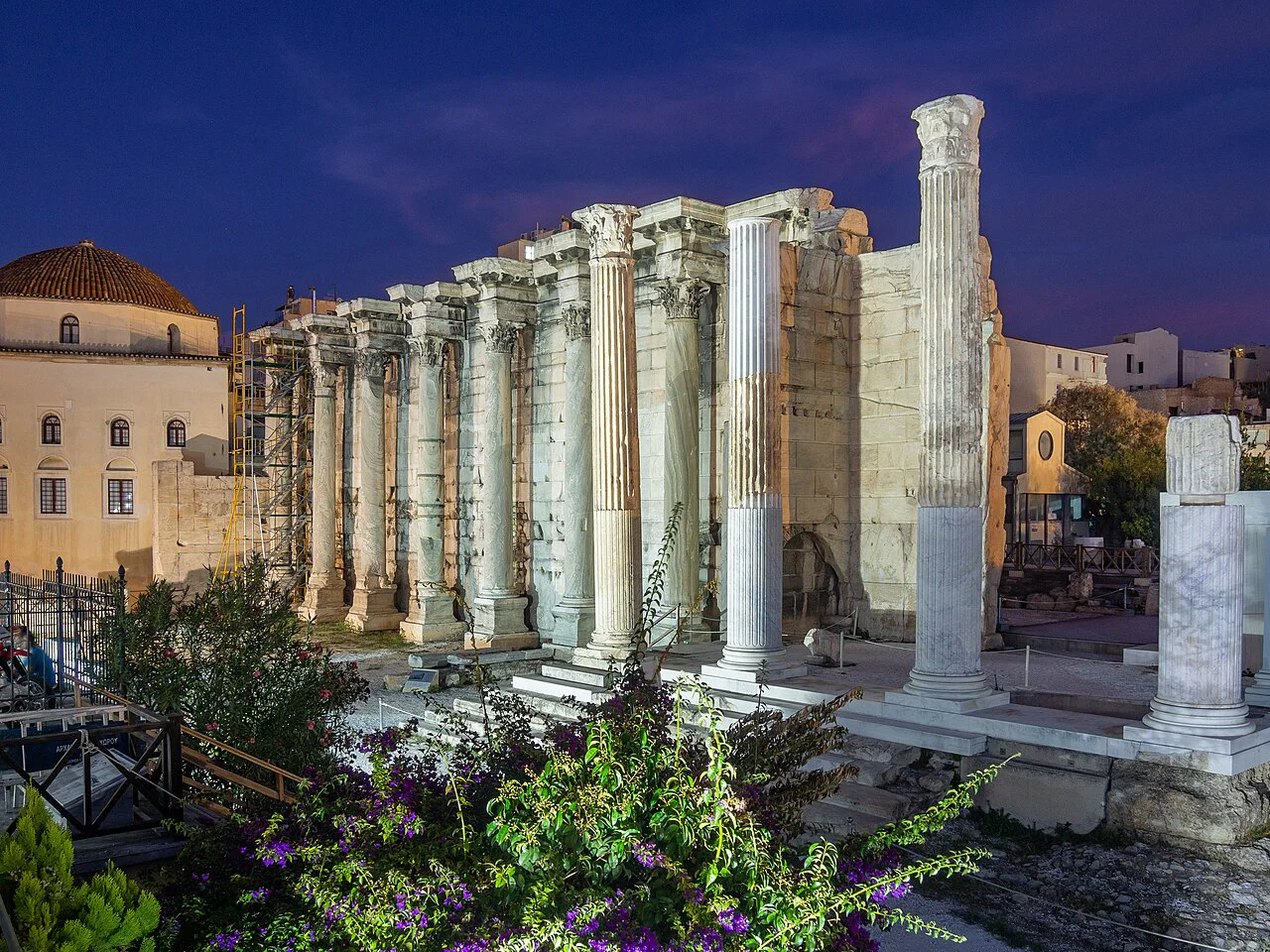
Βιβλιοθήκη του Αδριανού
Content & sources
Photo: C messier · CC BY-SA 4.0
Municipality of Marathonas · 37 km
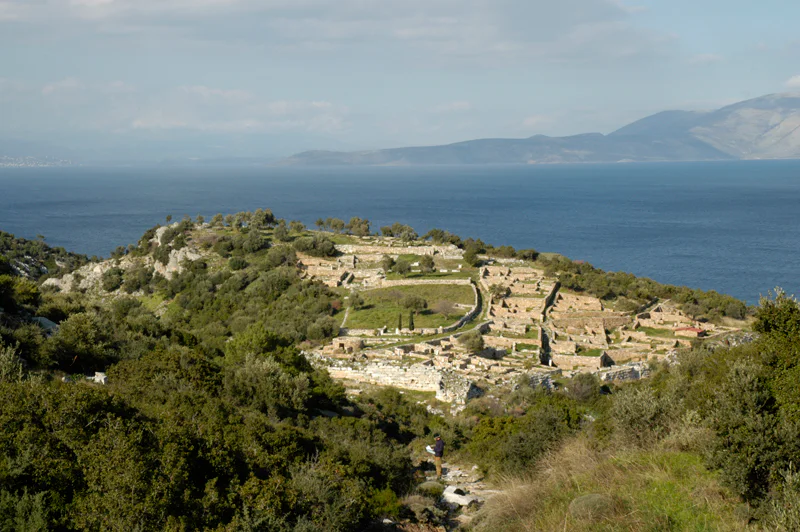
Ραμνούντας
Content & sources
Nefasdicere at English Wikipedia · CC BY 2.5
Art museums
More art museum audio guides
Athens · 17 artworks
Μουσείο Μπενάκη
Content & sources
Photo: Dimboukas · CC BY-SA 3.0
Athens · 35 artworks
Μουσείο Ακρόπολης
Content & sources
Photo: Yair-haklai · CC BY-SA 4.0
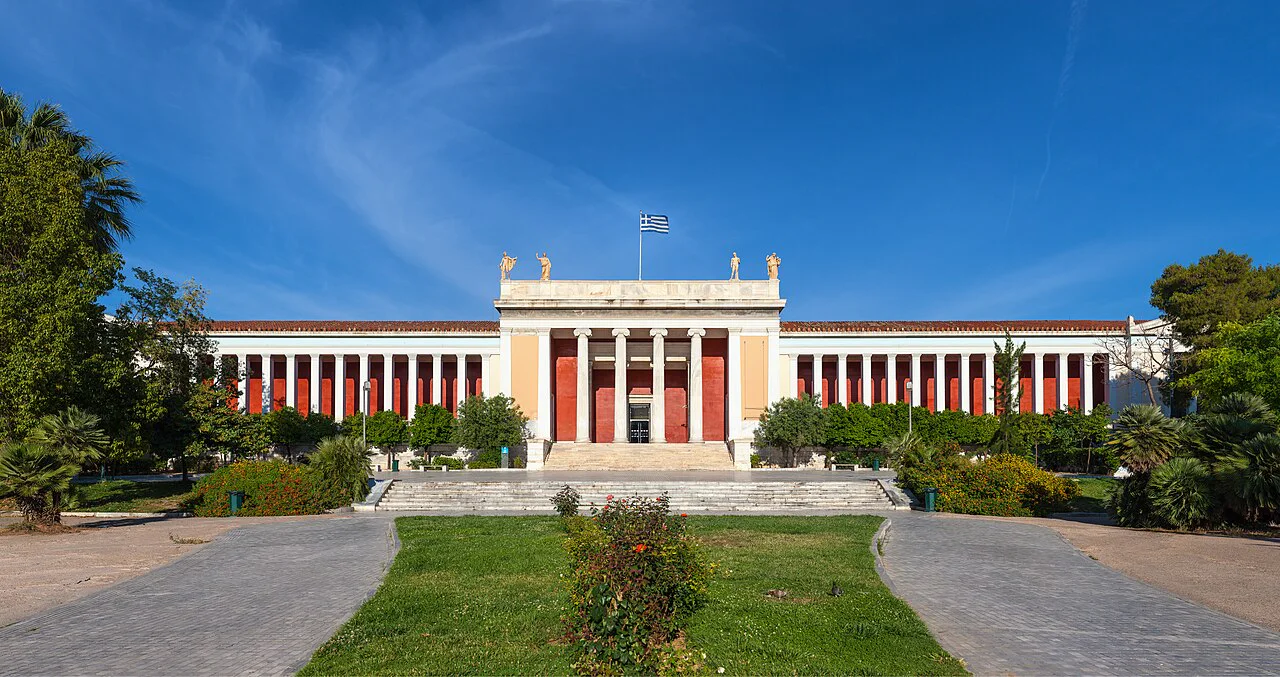
Athens · 91 artworks
Εθνικό Αρχαιολογικό Μουσείο
Content & sources
Thomas Wolf, www.foto-tw.de · CC BY-SA 3.0 de
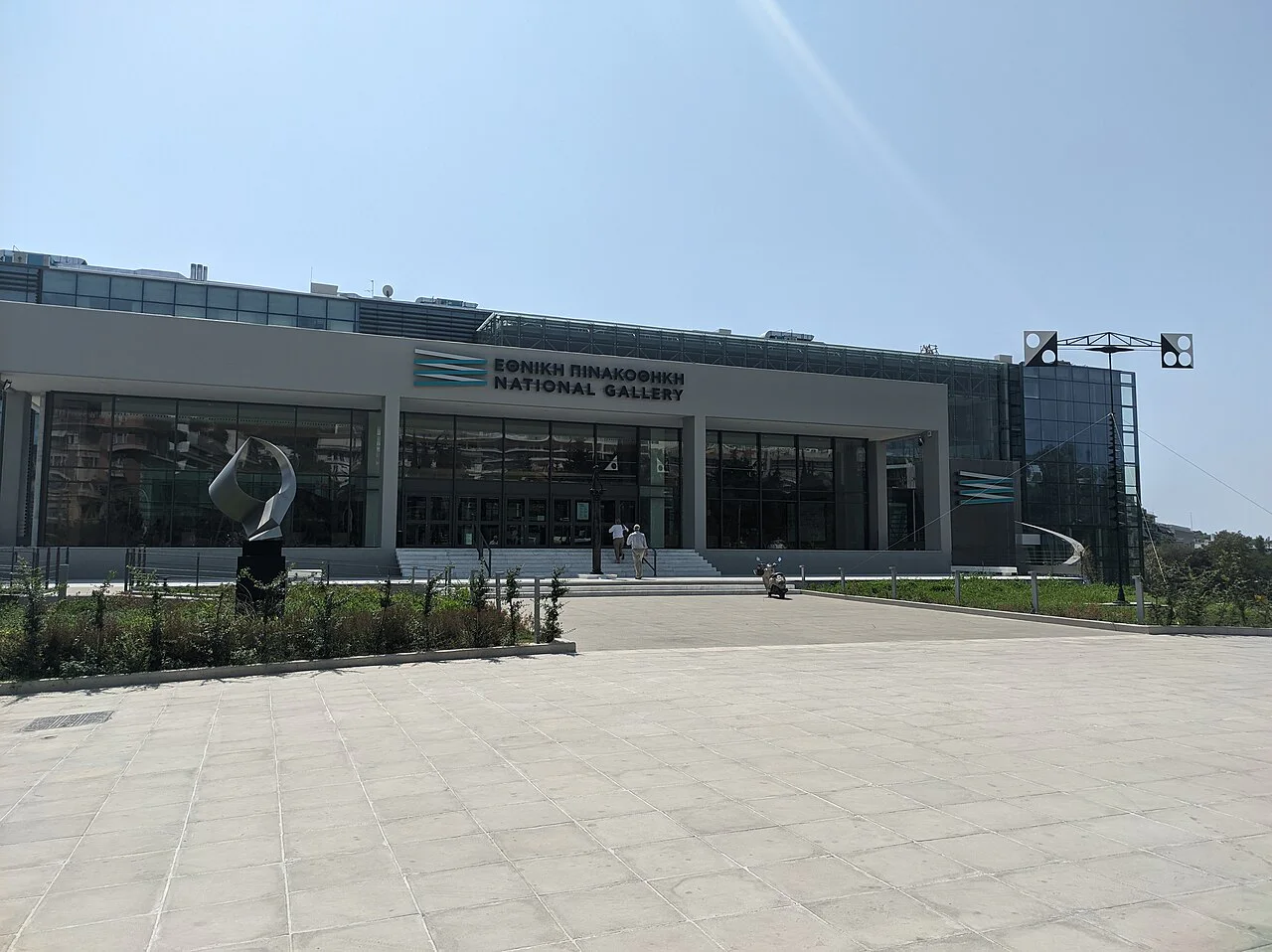
Athens · 25 artworks
Εθνική Πινακοθήκη-Μουσείο Αλεξάνδρου Σούτζου
Content & sources
Photo: Leeturtle · CC BY-SA 4.0
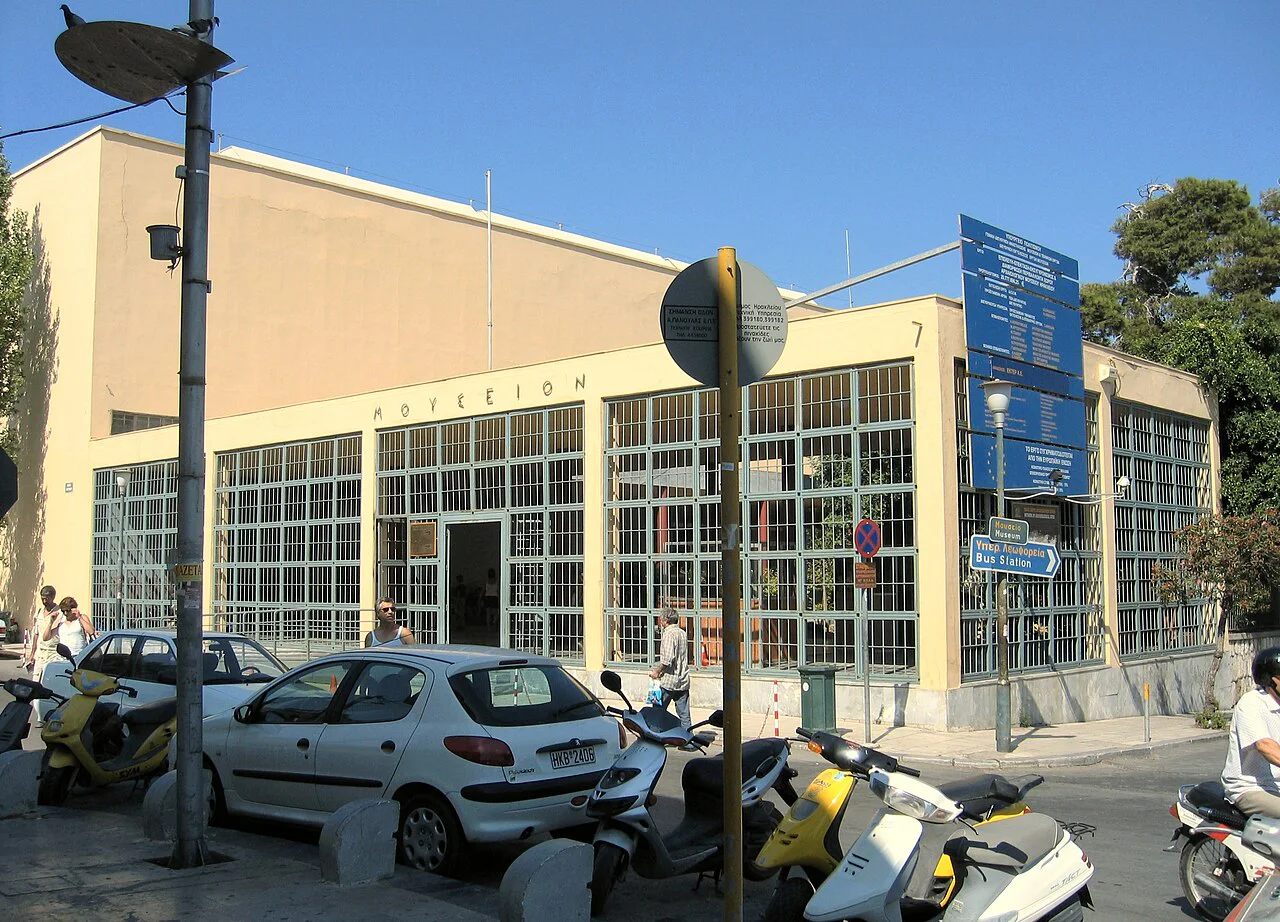
Heraklion · 13 artworks
Αρχαιολογικό Μουσείο Ηρακλείου
Content & sources
Photo: Zde · CC BY-SA 4.0
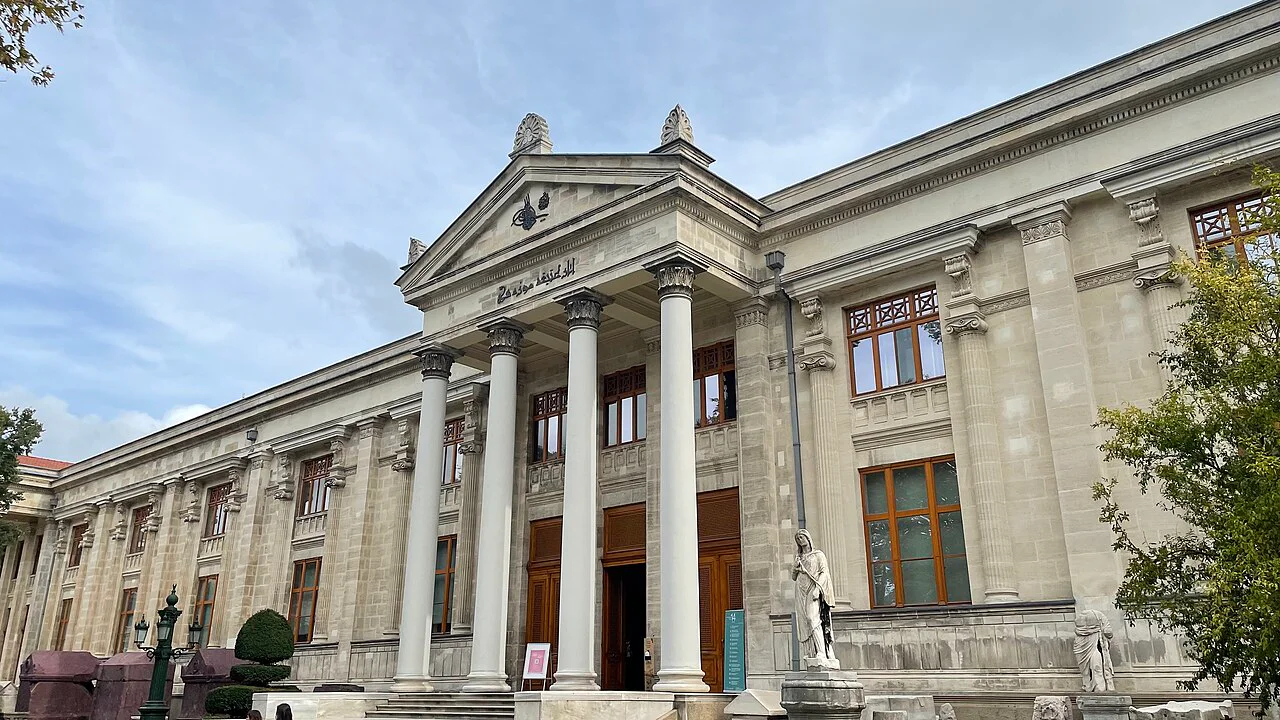
Istanbul · 16 artworks
İstanbul Arkeoloji Müzeleri
Content & sources
Photo: Metuboy · CC BY-SA 4.0