Stanza · Audio guide
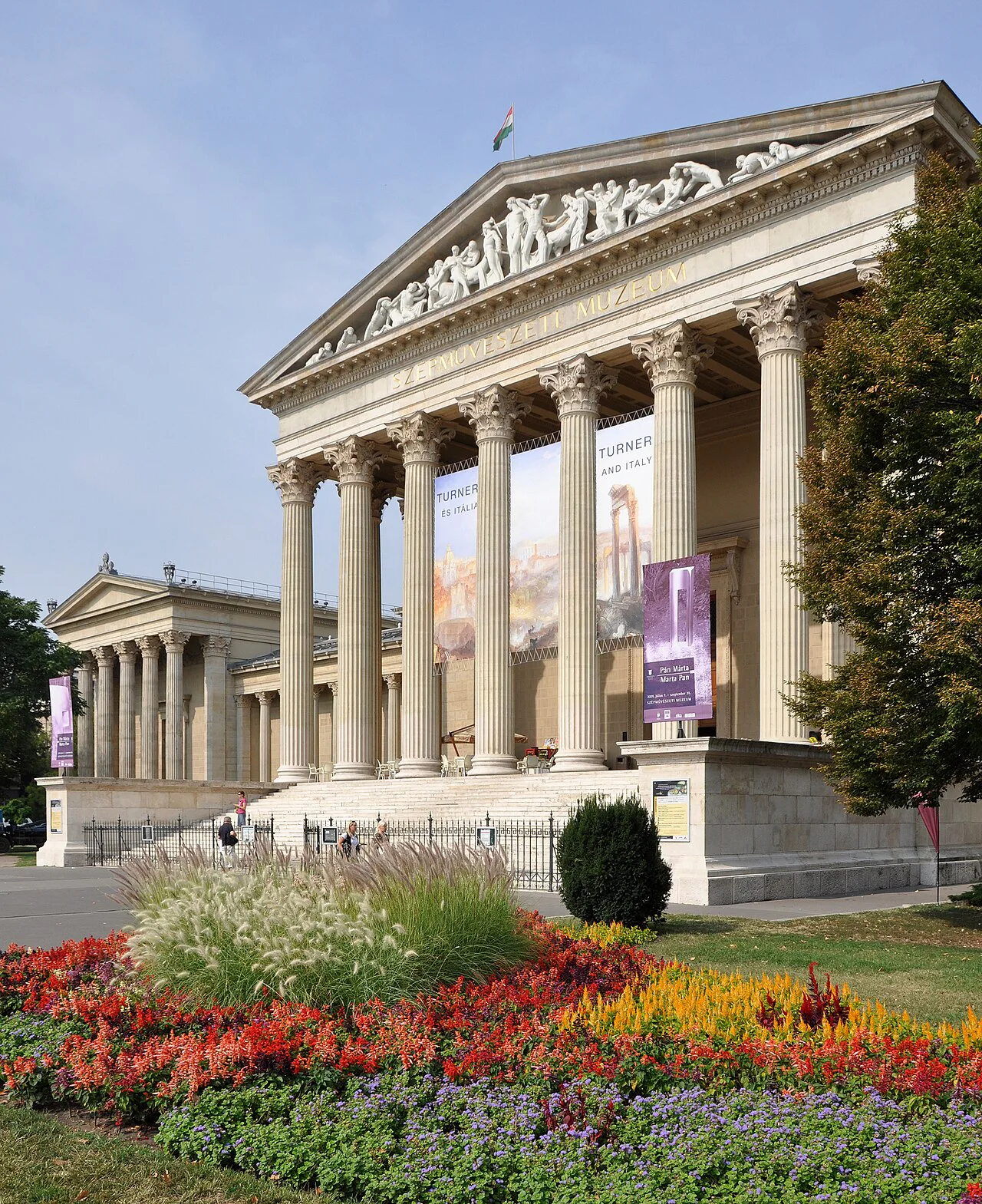
Museum of Fine Arts Audio Guide
A place to remember. A story to take with you.
The Museum of Fine Arts is a museum located in Heroes' Square in Budapest, Hungary. It is situated facing the Hall of Art.
Download Stanza, then search for “Museum of Fine Arts”.
About the tour
One guide. Your kind of visit.
The Museum of Fine Arts is a museum located in Heroes' Square in Budapest, Hungary. It is situated facing the Hall of Art.
The Museum of Fine Arts guide tells the stories of 212 artworks, including Melencolia I (Albrecht Durer), The Penitent Mary Magdalene (El Greco), The Farmers' Lunch (Diego Velázquez), The Age of Bronze (Auguste Rodin), Jael and Sisera (Artemisia Gentileschi), Portrait of Pietro Bembo (Raphael), Esterhazy Madonna (Raphael), and The Water Bearer (Francisco Goya). Every artwork is free to hear in the Stanza app until 1 January.
Ready when you are.
- 01Get the free Stanza app.
iOS & Android
- 02Find your guide.
“Museum of Fine Arts”
- 03Download before you go.
Works offline
Audio guide / 212 artworks
Inside the guide
Get to know a few of the stories before you go. Open a stop to read more.
01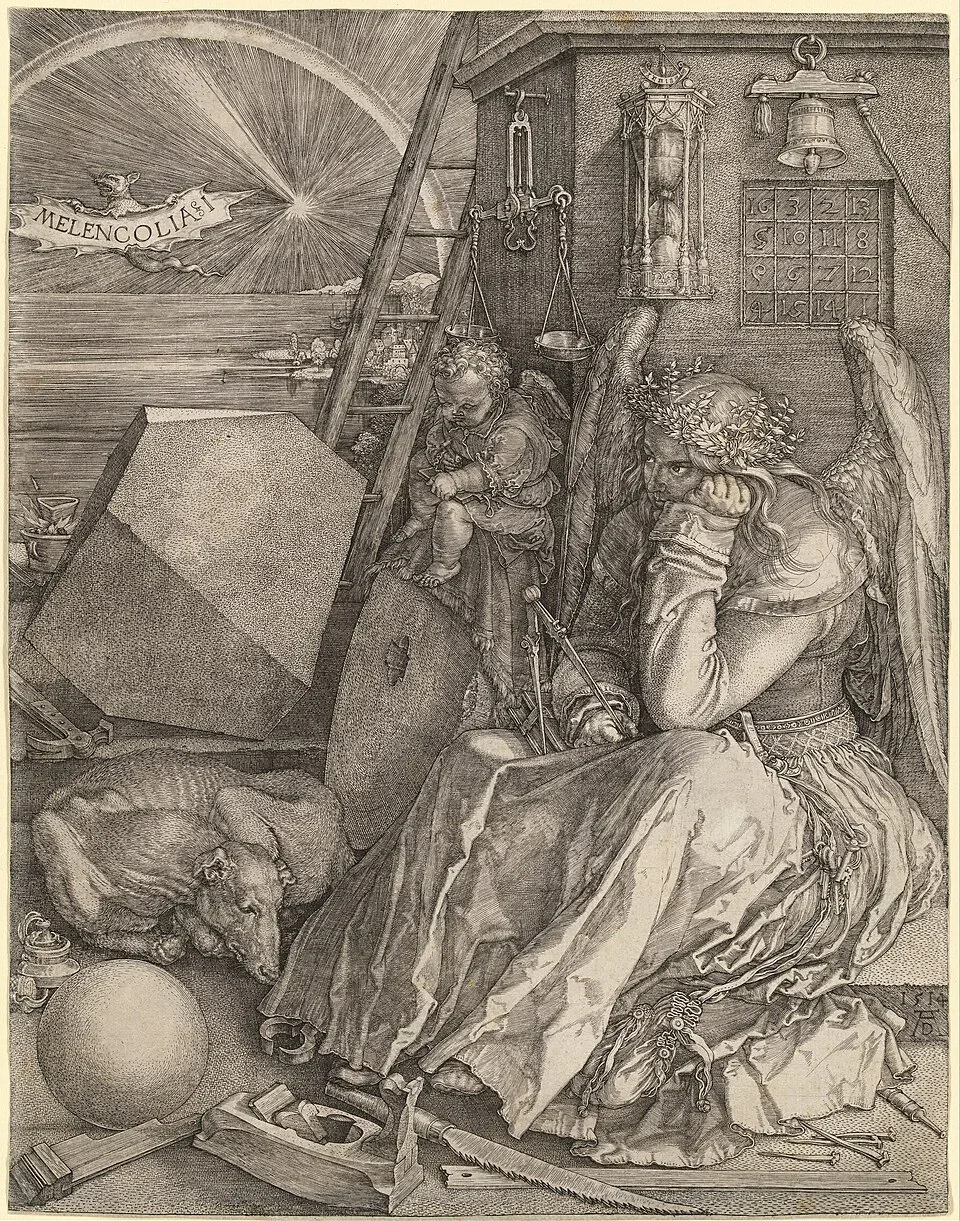
Melencolia I
Dürer made this print by cutting lines into copper with a burin, the tool an engraver uses to cut the lines. Light passes through the hourglass, then behaves differently on the rainbow and the geometric stone. At the center, a winged woman rests her head on a closed fist, a compass held loosely, a closed book on her lap. She gazes into the distance and pays no attention to the objects near her. The tools of building and measuring lie scattered around her, among them a hammer, a saw, a plane and a straightedge. In her, melancholy is both a force that drains the will and a mark of the creative mind. She has the means to measure and make, and the inability to begin. On the wall behind her, sixteen numbers form the first magic square printed in Europe. A magic square is one where rows, columns and diagonals all add to the same total. The total is thirty four, and the two middle numbers along the bottom give the year, 1514. In 1513 and 1514, he lost friends and then his mother, and that grief may be here too. He left only a few notes about the print, and what the whole image means is still not known.
Listen in the appAlbrecht Dürer · Public domain
02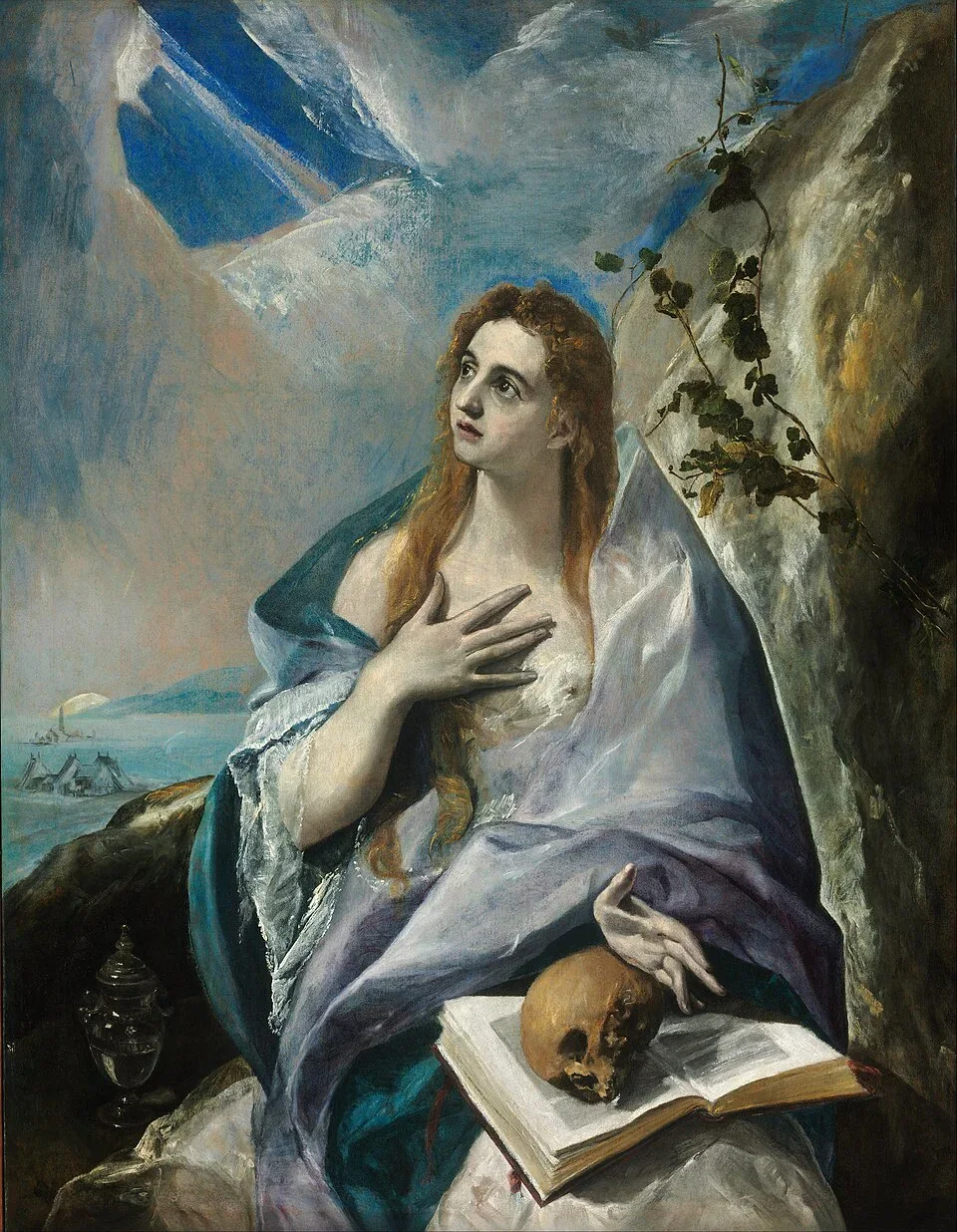
The Penitent Mary Magdalene
Mary Magdalene is in the wilderness to repent, thinking about death and about what lasts forever. The Church was promoting this subject, and saw in this beautiful sinner someone who stood for the sin of everyone. El Greco painted her early in his time in Toledo, still close to Titian, in whose Venice studio he had worked. At first she might be one of Titian's beautiful women. Then a dazzling light falls across her, seeming to wash her clean, to free her from her body and lift her upward. The skull that speaks of how little earthly life lasts has rolled out of her hand. Behind her ivy climbs toward heaven, the sign of what is eternal. And the landscape is a cold, moonlit dawn, answering the change taking place inside her.
Listen in the appEl Greco · Public domain
03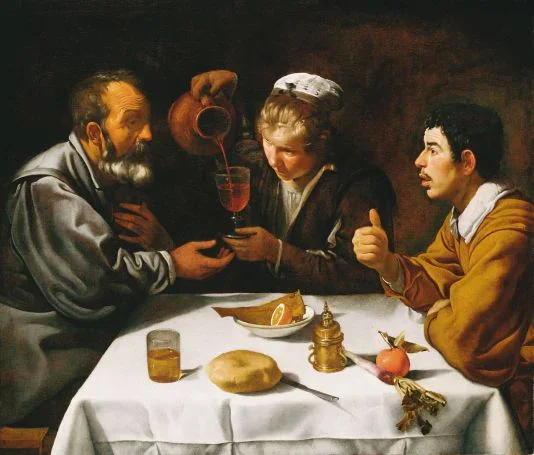
The Farmers' Lunch
On the white tablecloth lies a metal salt cellar, finely worked. The glass the woman fills is Venetian crystal. Neither belongs on a humble table. These three seem closer to people of standing, what the Spanish call hidalgos, than to the farmers the title names. The food is laid out before them. There is fish, bread, a carrot, a lemon, a copper jar. In French, a still life like this is called a dead nature. But the name sits badly on these objects, which seem almost alive. On the right a young man, lips parted, gestures with his raised hand to press home his story. The old man listens and holds up his cup to be refilled. The woman pours so carefully that not a drop should spill. Details like these tell you who they are to one another. This kind of picture was new in Spain, a bodegón, everyday people and objects at a table. The painter, probably the young Velázquez, helped make it popular and drew criticism. Another painter called such work low and shameful, dragging noble art down. But his own teacher, who married his daughter to him, said no one painted it better. It was, he wrote, the true imitation of nature. X rays show he painted the young man's raised thumb a second time, a sign of how careful he was.
Listen in the appDiego Velázquez · Public domain
04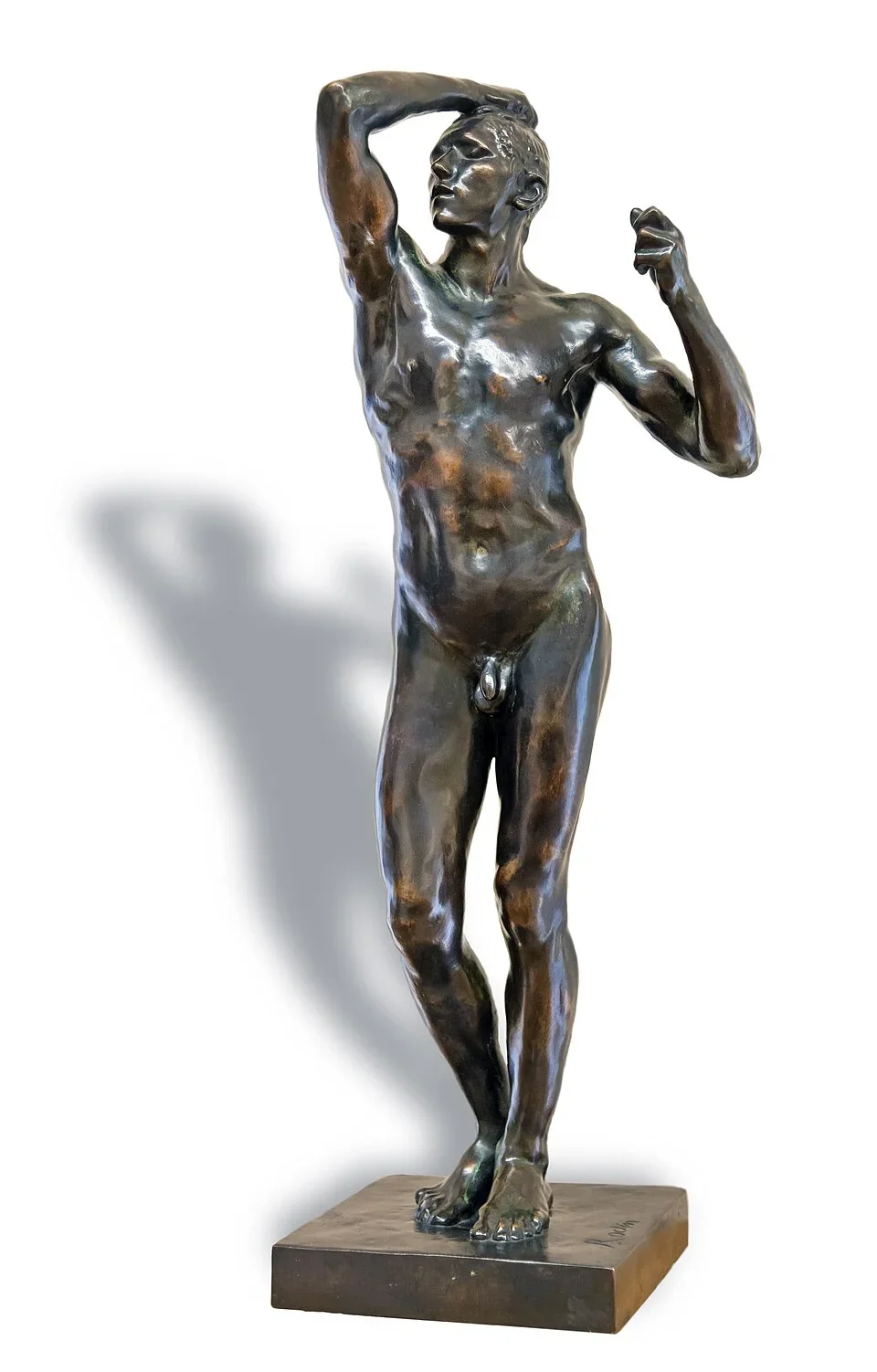
The Age of Bronze
When this figure was first shown in Brussels, no one could say who he was. He stands life size and naked before you, his weight shifted to his right side, his lips relaxed, his head resting on his shoulders. Those details suggest suffering and an inner life, but none of them names him. Rodin had once put a spear in the man's hand, the sign of a warrior close to defeat. He took it away before the figure was shown, so nothing was left to say what he was. For the pose, he chose a Belgian soldier named Auguste Neyt, twenty two years old, instead of a professional model, whose poses he found too conventional. He kept photographs of the soldier. And the man looked so real that people refused to believe any sculptor could have made him by hand. They said he must have been cast straight from a living body, even from a corpse. But the accusation only drew people in. They came to see for themselves, and it made Rodin's name. Official commissions followed soon after. The elbow is raised above his head. Rodin took that pose in part from Michelangelo's Dying Slave. He had studied Michelangelo's work in Italy, drawn to its naturalism.
Listen in the appDidier Descouens · Public domain
05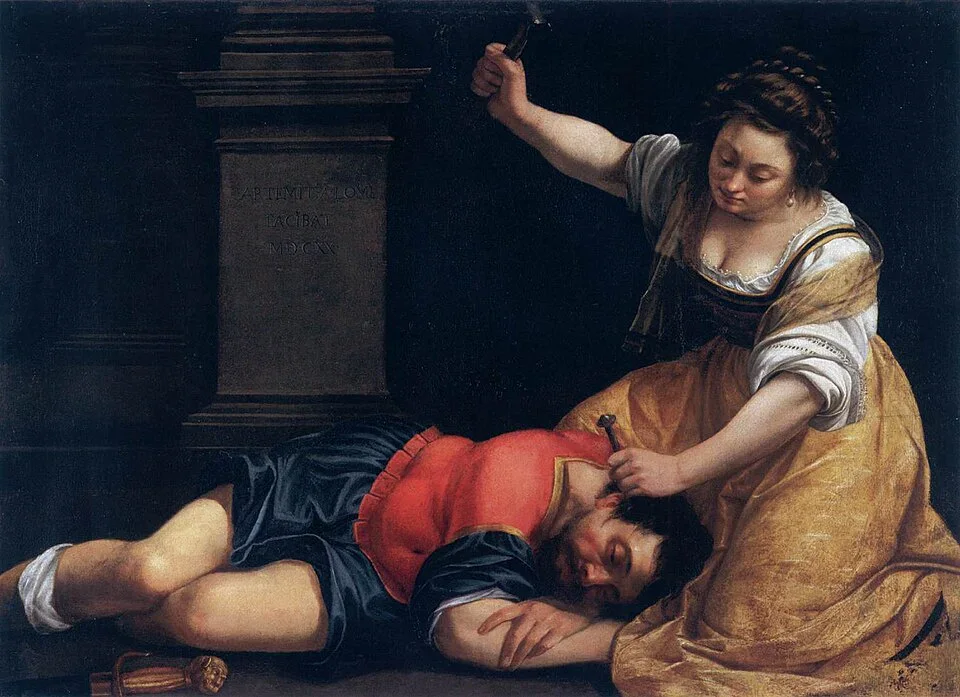
Jael and Sisera
A man sleeps. A woman is about to drive a tent peg into his temple. He is Sisera, a Canaanite leader whose charioteers were defeated. He fled for safety. She is Jael, who took him in and promised to hide him. The prophetess Deborah had foretold that a woman would kill him. But this is not Jael's tent. Artemisia Gentileschi set the scene in a palace interior, with a large pillar and only the two figures. That pillar carries her name. Jael's right hand sits at an awkward angle, perhaps so that it draws the eye to her name. She signed as Artemisia Lomi, the surname she took in Florence after her uncle Aurelio, to win patrons there. The signature runs to three lines, with 1620 at the bottom. The middle line is a form of the Latin word for made, which she had never used before to sign a work. Perhaps she had Michelangelo's Pieta in mind. Women had few chances as artists then, and she made sure her name was seen. The painting first appears in records in 1781, in Vienna's imperial collection. It went to Buda and may have been lost in 1856. In 1974 it turned up at a Budapest auction, where its present owners bought it. When it was restored in 1978, the name on the pillar was still intact.
Listen in the appArtemisia Gentileschi · Public domain
06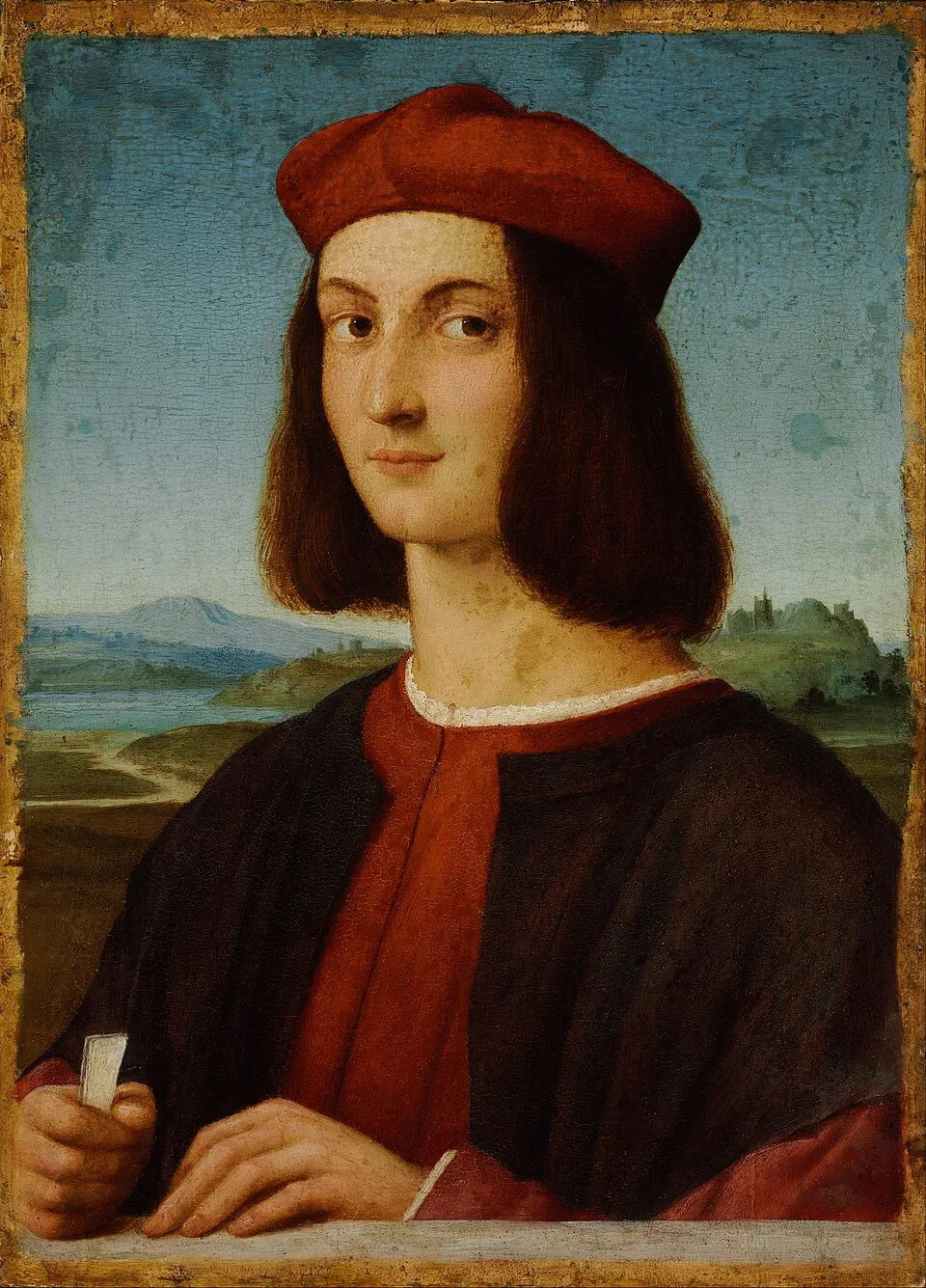
Portrait of Pietro Bembo
In November 1983, thieves took this painting from the museum in Budapest. Six other Italian paintings went with it, including a Madonna by Raphael. The thieves were Italians and Hungarians. A young man in a red gown and cap, his long hair falling around a gentle face. Both hands rest on a ledge, and his right hand holds a folded sheet of paper. Behind him are the gentle hills of Umbria, a road leading toward the water, and a wide blue sky. Raphael painted this around 1504, one of his earliest portraits. For a long time the Esterházy family owned it, believing it showed Raphael himself, painted by another hand. The thieves were all arrested the next year. The paintings were found in the garden of a Greek monastery.
Listen in the appRaffaello Santi (1483 - 1520) – Artist Born in Urbino. Died in Rome. Details on Google Art Project · Public domain
07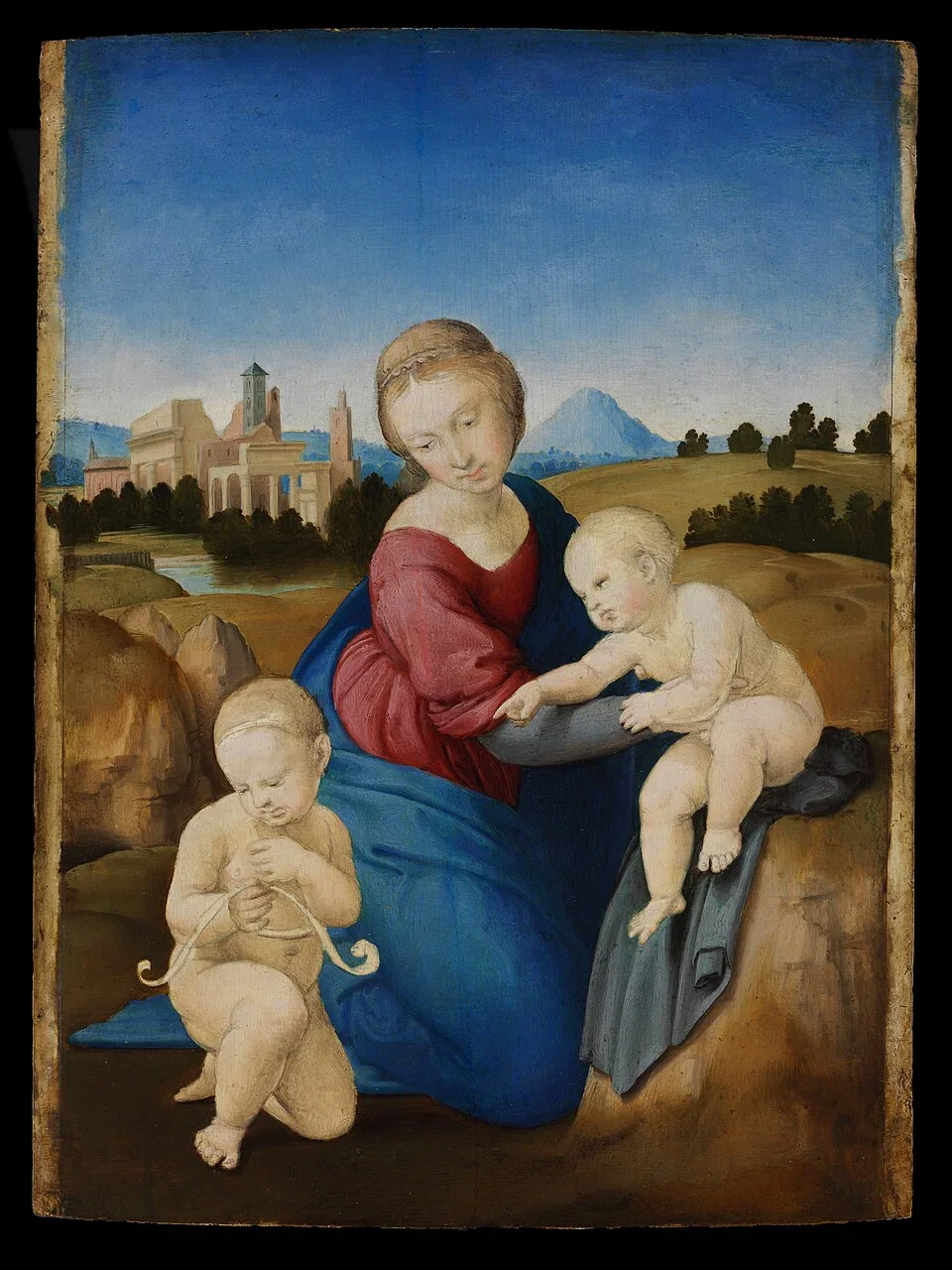
Esterhazy Madonna
The child on the rock leans out toward the infant Saint John. John kneels at the left, studying the paper in his right hand. Christ points at it. Mary keeps him steady, her face turned the other way, toward John. Raphael drew these three figures first in Florence, on a sheet kept in the Uffizi. When he painted the panel after reaching Rome, the figures stayed almost exactly the same. But the drawing has no ruins behind them. There he widened the panel on the left and painted Roman ruins into the background. Only Mary's figure was worked up fully. In the others you can still see the drawing beneath the skin. No one knows who asked for it, or who owned it before Pope Clement the Eleventh.
Listen in the appRaphael · Public domain
08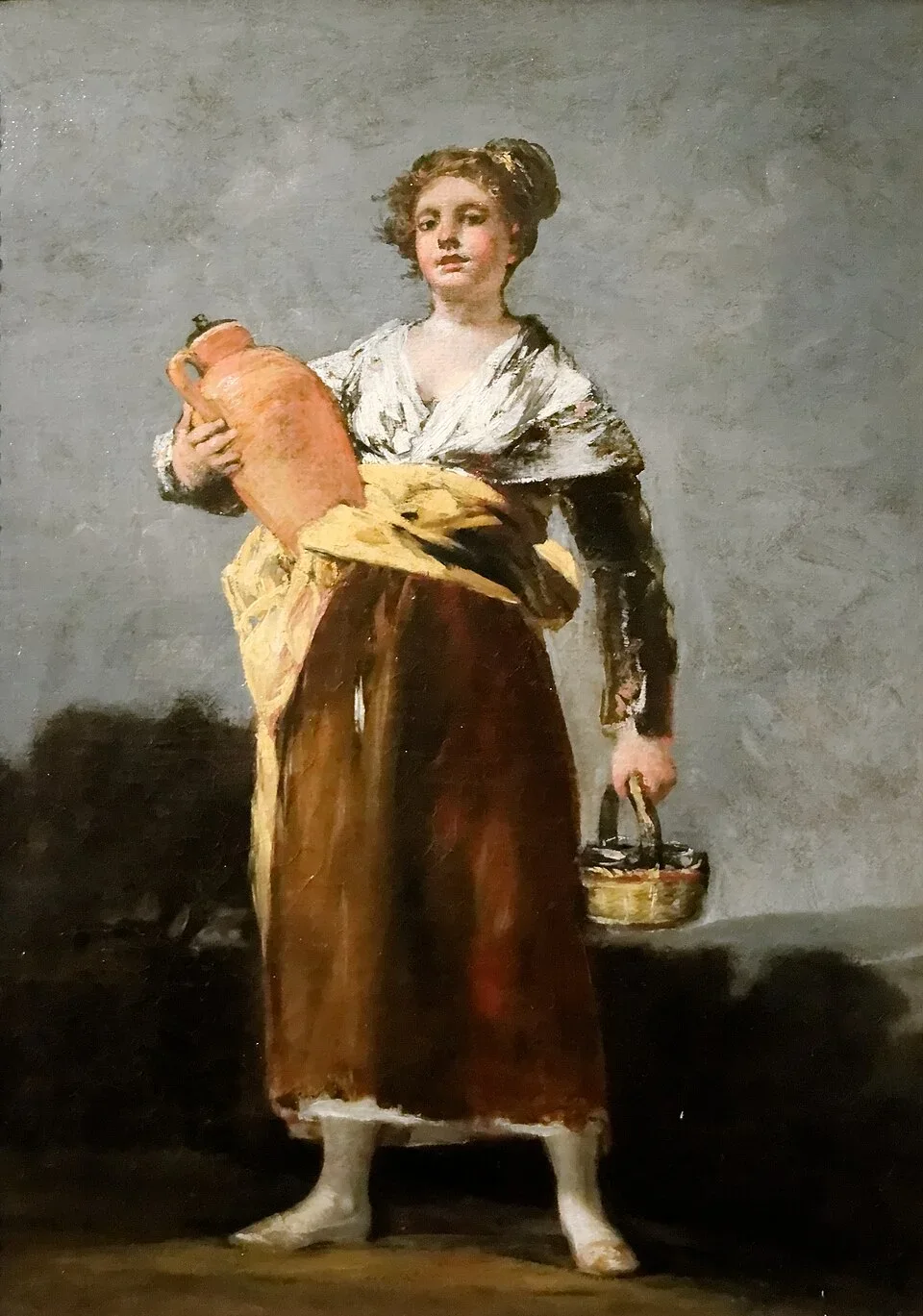
The Water Bearer
Why does a woman carrying a water jug look so grand? Goya painted her from slightly below, which makes her seem tall and important. The filled jug is pressed into her hip, and in her left hand she carries a basket of glasses. The white at her shoulder and the white hem of her petticoat stand for purity, set against dark browns and black. She is serious, determined and proud, painted as she really might have looked. At first this seems a simple scene of a working woman. But she stands for the defence of Saragossa against the French, in the War of Independence. She is probably a real woman, María Agustín, a Spanish heroine who brought the defenders brandy instead of water, to raise their spirits. The companion painting shows a knife grinder sharpening the fighters' weapons. The painter had spent years making light tapestries for the court. Now he turned to ordinary working people, and to what was happening in Spain. General José de Palafox y Melci organized that defence. He invited the painter into the damaged city to see the situation and paint what its people had done. It may have been painted to hang in the painter's own house in Madrid, and it was still there in 1812.
Listen in the appPhoto: Yelkrokoyade · CC BY-SA 3.0
09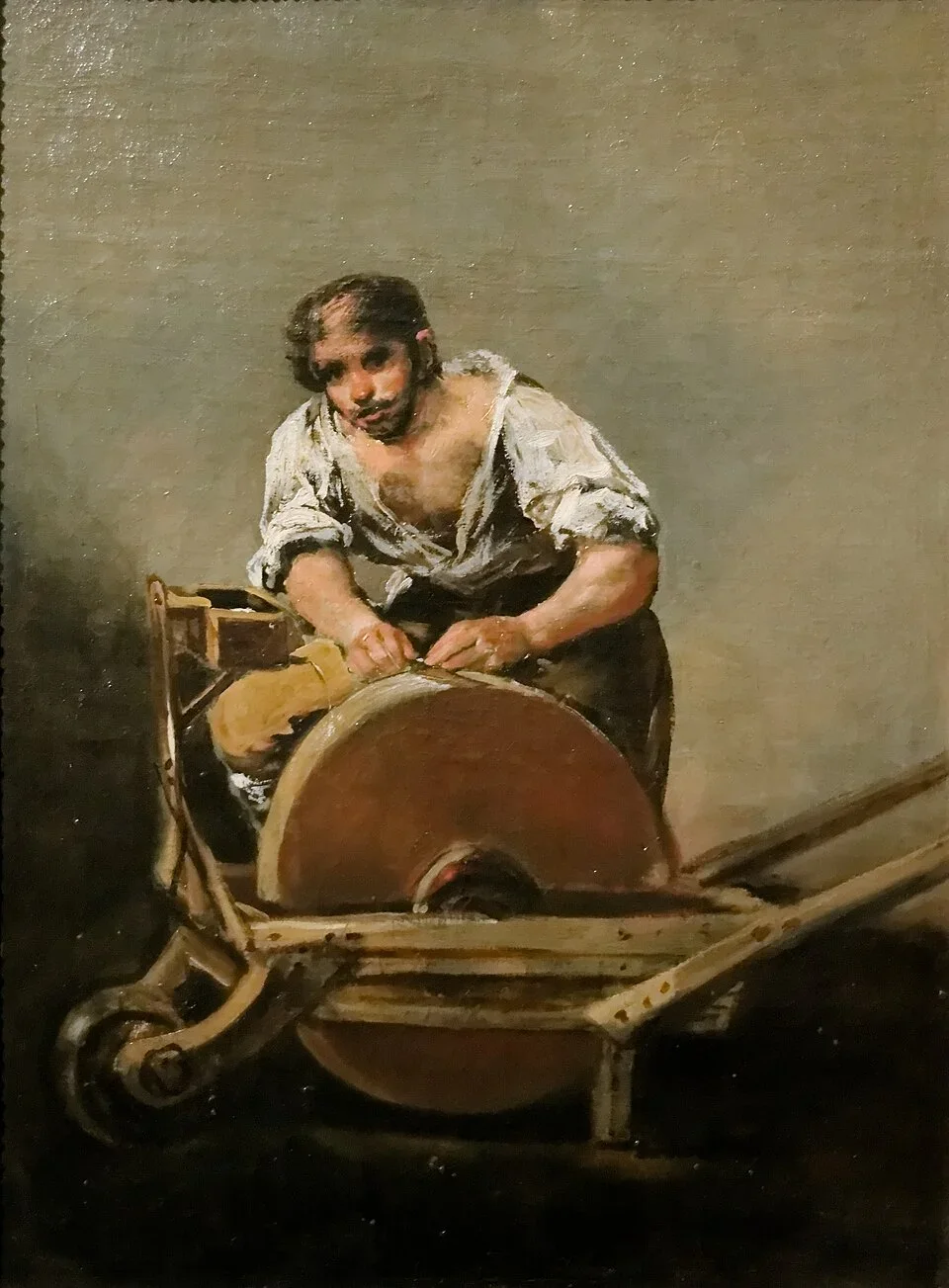
The Knifegrinder
A single stream of water falls onto the wheel. It is there to cool the wheel, which spins so fast that it gets hot. Red strokes near the wheel catch that speed and heat. He leans forward with a knife held in both hands against the wheel, his right leg resting on a wooden post. His white shirt is open at the chest, sleeves rolled up, arms bare to the elbows. He looks up at you as if you have come into the workshop just when he cannot stop. His face tells how hard the work is. Goya painted this between 1808 and 1812, in the war against Napoleon, and he kept turning to ordinary working people. The grinder may stand for the unnamed fighters, preparing the knives the guerrillas used. Knives were sometimes the only weapon ordinary people had. Goya still had the picture in 1812. He painted it over an older canvas. In his inventory that year he valued it at three hundred reales, the same as much larger paintings. His pose at the wheel echoes an ancient sculpture Goya had drawn in his Italian notebook, the Belvedere Torso. He gave this working man the monumental stance he gave his religious figures.
Listen in the appFrancisco Goya · CC BY-SA 3.0
10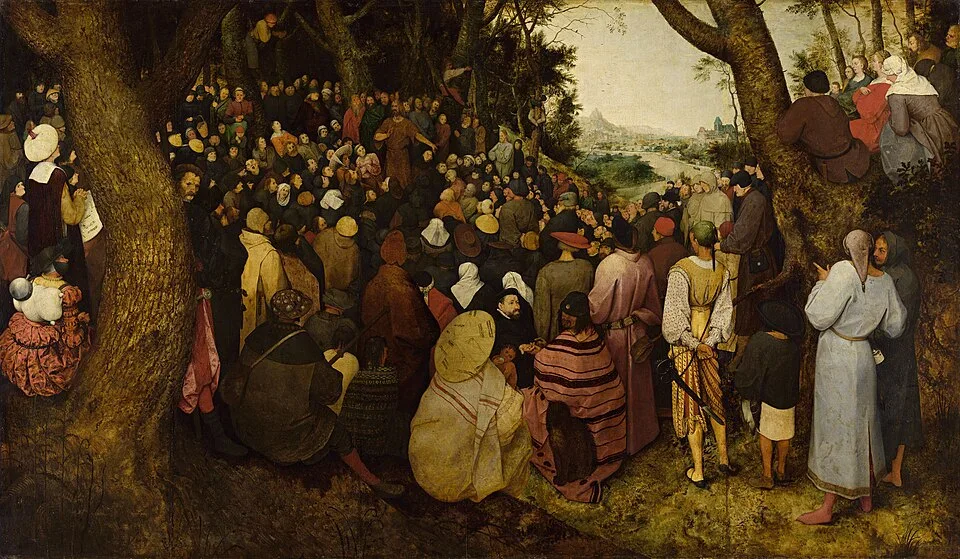
The Sermon of Saint John the Baptist
A crowd fills a clearing in a wood, hundreds gathered to hear one man. In a brown robe, he is easy to miss. Only the way the others face picks him out. One man has turned away to have his palm read. Boys have climbed into the trees to see and hear better. A few faces look straight out at you, as though you had just joined them. Some are gripped, some bored, some lost in thought. The man in the brown robe is Saint John the Baptist. He points to a smaller figure behind him, in blue, with his arms crossed. That is Jesus, still unknown to this crowd. John is answering the Pharisees. He baptizes with water, he tells them, but someone they do not know comes after him. John says he is not worthy to loosen that man's sandals. Bruegel painted this in 1566. That year, Protestant worship was banned in the Dutch cities and preachers went into fields beyond the king's men. It was also the year of the iconoclasm. He probably had one of those gatherings in mind, though he was no Protestant. His sons copied it again and again, and it probably ended up with a devout Catholic ruler. Afterwards it disappeared, until it was found in an old castle in Hungary in 1896 and its identity confirmed only in 1905.
Listen in the appPieter Bruegel the Elder · Public domain
- 11
Rearing Horse and Mounted Warrior
Leonardo da Vinci · c. 1516–1519
- 12
Portrait of a Youth
Giorgione · c. 1500–1510
- 13
Virgin and Child with an Angel (Madonna del Latte)
Antonio da Correggio · 1522–1525
- 14
Horse Frightened by Lightning
Eugène Delacroix · 1824–1829
- 15
Martyrdom of Saint Andrew
Jusepe de Ribera · 1628
- 16
Joseph's Dream (Studio of Rembrandt, 1650-1655)
Rembrandt · 1650–1655
- 17
Holy Family with St. John the Baptist
Bartolomé Esteban Murillo · 1601
- 18
The Chess Players
Cornelis de Man · c. 1670
- 19
Portrait of Luís Gonzaga
El Greco · c. 1582
- 20
The Annunciation
El Greco · 1595–1600
- 21
Mucius Scaevola before Lars Porsenna
Possibly Anthony van Dyck / After Peter Paul Rubens / Workshop of Peter Paul Rubens · 1618–1628
- 22
Saint Andrew
Francisco de Zurbarán · 1631–1640
- 23
Self-portrait
Giorgione · c. 1510
- 24
Portrait of Queen Caterina Cornaro
Gentile Bellini · c. 1500
- 25
Portrait of a Man
Paolo Veronese · 1551–1560
- 26
The Agony in the Garden
El Greco · 1605–1614
- 27
Portrait of Senora Ceán Bermudez
Francisco Goya · 1785
- 28
Portrait of José Antonio Marqués de Caballero
Francisco Goya · 1807
- 29
Saint James the Younger
El Greco · c. 1595
- 30
Portrait of Marcantonio Trevisan, Doge of Venice
Titian · 1553
- 31
David Garrick as Jaffier, Susannah Maria Cibber as Belvidera in Venice Preserved, or The Plot Discovered
Johann Zoffany · 1763
- 32
Thalia
Michele Pannonio · 1456
- 33
The Infant Christ Distributing Bread to the Pilgrims
Bartolomé Esteban Murillo · 1678
- 34
Esther and Mordecai
Arent de Gelder · 1685
- 35
Bathsheba at Her Bath
Sebastiano Ricci · 1720–1724
- 36
The Adoration of the Shepherds
Gerard David · 1485–1490
- 37
Cows in a River
Aelbert Cuyp · c. 1650
- 38
Lamentation of Christ
Maarten van Heemskerck · 1540–1543
- 39
Madonna and Child
Giovanni Antonio Boltraffio · 1495
- 40
The Holy Family
Francisco de Zurbarán · 1659
- 41
The Immaculate Conception
Francisco de Zurbarán · 1661
- 42
View of Binnen-Amstel in Amsterdam
Jacob van Ruisdael · 1656
- 43
Sleeping Girl
Domenico Fetti · 1615–1620
- 44
The Celebration in East Bergholt of the Peace of 1814 Concluded in Paris between France and the Allied Powers
John Constable · 1814
- 45
Merry Company
Willem Pieterszoon Buytewech · c. 1620–1622
- 46
Lucretia
Andrea Casali · c. 1750
- 47
Christ and the Adulteress
Lucas Cranach the Elder · 1532
- 48
The Adoration of the Shepherds
Bronzino · c. 1539–1540
- 49
St Ladislas Presents Wladislav II and his Sons to the Virgin
Bernhard Strigel · 1511–1515
- 50
Judith in the Tent of Holofernes
Johann Liss · 1624–1625
- 51
The Flagellation of Christ
Guercino · c. 1644
- 52
Ecce Homo
Pedro Ruiz González · c. 1670
- 53
The Head of Christ with the Crown of Thorns
Guercino · 1620–1622
- 54
Portrait of a Man
Sebastiano del Piombo · 1512–1520
- 55
Hercules Expelling the Faun from Omphale's Bed
Jacopo Tintoretto · 1585–1590
- 56
Pair of Lovers
Altobello Melone, Girolamo Romanino · 16th century
- 57
Salome with the head of Saint John the Baptist
Lucas Cranach the Elder · 1530
- 58
Saint James Matamoros
Giovanni Battista Tiepolo · 1749–1750
- 59
Madonna
Petrus Christus · c. 1445
- 60
Adoration of the Magi
Master of the Vienna Adoration · c. 1410
- 61
The Assumption
Sebastiano Ricci · 1731–1734
- 62
The Mystic Marriage of Saint Catherine of Alexandria with Saints Dorothy, Margaret and Barbara
Lucas Cranach the Elder · c. 1516
- 63
Portrait of Jacopo Foscarini
Giovanni Battista Moroni · 1575
- 64
The Lock at Dolo
Giovanni Antonio Canal · 1763
- 65
Saint Stephen Protomartyr
Domenico Ghirlandaio · 1490–1494
- 66
The Dismissal of Hagar
Jan Victors · 1650
- 67
Salome with the Head of St John the Baptist
Lucas Cranach the Elder · 1526
- 68
The Piazza della Signoria in Florence
Bernardo Bellotto · 1740
- 69
Madonna with Child, St Anthony of Padua, and a Friar
Filippino Lippi · 1477
- 70
The Virgin Suckling the Child
Lucas Cranach the Elder · 1512–1515
- 71
Cut-out Crucifix
Lorenzo Monaco · 1410s
- 72
The Penitent St Jerome in the Wilderness
Giovanni Battista Cima da Conegliano · c. 1495
- 73
Portrait of a Girl
Sebastiano del Piombo · c. 1515
- 74
Portrait of a man
Girolamo Romanino · 1520–1525
- 75
A World
Maximilian Lenz · 1899
- 76
Cornelia rejects the crown of the Ptolemies
Laurent de La Hyre · 1646
- 77
Portrait of a Young Man
Albrecht Durer · c. 1504
- 78
The Apostle Saint Andrew
El Greco · c. 1610
- 79
Christ Carrying the Cross
Sebastiano del Piombo · 1535–1540
- 80
Group of Five Figures
Albrecht Durer · c. 1515
- 81
Portrait of a man
Frans Hals · 1634
- 82
Portrait of a man
Frans Hals · 1650s
- 83
Road in the Dunes
Salomon van Ruysdael · 1631
- 84
Room Corner with Curiosities
Jan van der Heyden · 1712
- 85
Diana and Actaeon
Giuseppe Cesari · 1603–1606
- 86
The Merry Family with Cats
Jan Steen · c. 1660
- 87
The Virgin with the Infant Christ Drinking Wine
Joos van Cleve · 1520
- 88
Madonna and Child with Five Saints and Two Angels
Biagio d'Antonio · 1470–1475
- 89
Saint John the Evangelist on the Island of Patmos
Domenico Ghirlandaio · 1480–1485
- 90
The Prophet Elisha and the Woman of Shunem
Gerbrand van den Eeckhout · 1664
- 91
The Infante Don Baltasar Carlos
Alonso Cano · 1635
- 92
The Way to Calvary
Jacopo Bassano · 1550–1555
- 93
Virgin and Child with Saints Catherine of Alexandria and Barbara
Bernardino Luini · 1522–1525
- 94
Clio
Pierre Mignard I · 1689
- 95
Portrait of Philip II of Spain
Antonis Mor · 1549–1550
- 96
Portrait of the British Admiral Sir Edward Hughes (1717/1720–1794)
Joshua Reynolds · 1786
- 97
May Queen Festival (or The Flower-Feast of Whitesuntide, or Pentecost)
Richard Brakenburgh · 1700
- 98
The Holy Family
Girolamo Siciolante da Sermoneta · 1544
- 99
The Annunciation
Bernardo Strozzi · 1643–1644
- 100
The Supper at Emmaus
Jacopo Tintoretto · 1540–1543
- 101
The Dormition of the Virgin
Hans Holbein the Elder · c. 1490
- 102
The Seven Children of the Winterking
Cornelius van Poelenburgh · 1628
- 103
Adam
Hans Baldung Grien · 1524
- 104
Eve
Hans Baldung Grien · 1524
- 105
The Courtesan
Jan Steen · c. 1668
- 106
Portrait of an Officer
Gerrit Dou · 1630–1635
- 107
The Fishwife in her Marketstall
Adriaen van Ostade · c. 1672
- 108
Old Man Mending his Pen
Adriaen van Ostade · 17th century
- 109
Peasant Family by a Hearth
Adriaen van Ostade · 1647
- 110
Riding School
Philips Wouwerman · 1668
- 111
The Angel and the Young Tobit with the Fish
Pieter Lastman · c. 1625
- 112
Cardsharps and Fortune Teller
Nicolas Régnier · 1623–1626
- 113
Portrait of Charles V, Holy Roman Emperor
Bernard van Orley · 1519–1520
- 114
Ruins at the Sea
Jan Both · 17th century
- 115
Christ and the Woman in Adultery
Polidoro da Lanciano · 16th century
- 116
Woman Reading a Letter
Pieter de Hooch · 1664
- 117
Italian Landscape with Santi Giovanni e Paolo in Rome
Jan Asselijn · 17th century
- 118
St John the Baptist
Bartolomé González y Serrano · 1621
- 119
Portrait of Jacob Trip
Nicolaes Maes · c. 1660
- 120
Christ before Pilate
Leendert van Beijeren · 1649–1650
- 121
Infanta Margarita Teresa
Juan Bautista Martínez del Mazo · c. 1660
- 122
Portrait of Doge Agostino Barbarigo
Marco Basaiti · 1518
- 123
Portrait of a Family
Gillis van Tilborgh · 1667
- 124
The Quack's
Jan Victors · c. 1650
- 125
The Autumn
Jacob Grimmer · 1550
- 126
Portrait of a Family
Jacob Ochtervelt · 1670
- 127
Self-Portrait
Christian Seybold · 1764
- 128
Country Inn
Cornelis Dusart · 1690
- 129
Peasants in a Tavern
Cornelis Pietersz Bega · 1664
- 130
Venus, Cupid and Jealousy
Bronzino · 1548–1550
- 131
The Adoration of the Magi
Luis Tristán · 1620
- 132
The Violinist (The Allegory of Hearing)
Jacob Adriaensz Backer · c. 1635
- 133
Saint Elizabeth of Hungary Distributing Alms
Giambattista Pittoni · 1734
- 134
Portrait of a Benedictine Monk as Saint Placidus
Moretto da Brescia · 1530
- 135
Peasant Interior
Isaac van Ostade · 1640
- 136
Christ and the Woman Taken in Adultery
Benvenuto Tisi · 1540
- 137
Soldiers Playing Cards in a Guardroom
Jacob Duck · 1630
- 138
Portrait of Hans Heinrich Pilgram
Nicolas Neufchatel · 1561
- 139
Portrait of a Knight of the Saint James Order
Antonis Mor · 1558
- 140
The Annunciation
Rueland Frueauf the Elder · c. 1495
- 141
The Garden of Eden with the Fall of Man
Jan Brueghel the Elder · 1616
- 142
Supper at Emmaus
Pedro Orrente · 1620s
- 143
Portrait of Countess Nákó
Friedrich von Amerling · 1855
- 144
The Flagellation
Il Sodoma · c. 1510
- 145
Portrait of a Woman at Her Toilet
Angelica Kauffmann · 1795
- 146
Portrait of the Duarte family
Gonzales Coques · c. 1664
- 147
The Annunciation
Ventura Salimbeni · c. 1605
- 148
Travellers before an Inn with a Maypole
Salomon van Ruysdael · 1664
- 149
The Presentation in the Temple
Gerbrand van den Eeckhout · 1671
- 150
Portrait of a Cardinal
Jacopo Bassano · c. 1545
- 151
Lucretia Romana
Master of the Holy Blood · c. 1530
- 152
Merry Company in a Garden
Dirck Hals · 1621
- 153
Saint Florian, Saint John the Baptist and Saint Sebastian
Ivo Strigel, Hans Strigel · c. 1480
- 154
Abraham Sacrifying Isaac
Franz Anton Maulbertsch · 1755
- 155
Danaë
Antonio Bellucci · 1700–1705
- 156
Portrait of a Family
Gerbrand van den Eeckhout · 1667
- 157
Queen Mary Tudor
Antonis Mor · c. 1554
- 158
The Flagellation
Nicolò Grassi · c. 1720
- 159
Saint Anthony of Padua with the Infant Jesus
Antonio de Pereda · 17th century
- 160
Pig Slaughtering
Isaac van Ostade · 1642
- 161
Vertumnus and Pomona
Gerbrand van den Eeckhout · 1669
- 162
Fisherfolk in a Landscape
Pieter de Molijn · 1630
- 163
Flea Hunting at Candlelight
Andries Both · 1630
- 164
The Death of Lucretia
Il Sodoma · 1513
- 165
The Winter
Lucas van Valckenborch, Jacob Grimmer · 1550
- 166
Wooded Landscape with a Dead Tree
Jan Wijnants · 1667
- 167
Portrait of Count Ferdinand von Plettenberg with his Family
Robert Tournières · 1727
- 168
The Judgement of Paris
Cornelis van Haarlem · 1628
- 169
The Virgin Appearing to Saint Jerome
Francesco Fontebasso · 1745
- 170
Portrait of a Man, Selfportrait
Jan Kupecký · c. 1690
- 171
Portrait of a Girl
Palma Vecchio · 1510
- 172
A Prince's Yacht (Statenjacht) and other Vessels
Simon de Vlieger · c. 1650
- 173
The Nativity
Master of the Rajhrad Altarpiece · c. 1430
- 174
The Holy Trinity
Franz Anton Maulbertsch · 1785
- 175
Market Farmer and his Wife
Pieter Aertsen · 1561
- 176
Madonna and Child with the Infant Saint John the Baptist
Martino Piazza · c. 1515
- 177
Self-portrait
Ádám Mányoki · 1711
- 178
The Virgin of Sorrows (Mater Dolorosa)
Hans Baldung Grien · c. 1516
- 179
The Entombment
Daniele Crespi · 1620s
- 180
Assumption of the Virgin
Defendente Ferrari · 1500
- 181
The Body of Christ Anointed by Two Angels
Alessandro Allori · c. 1600
- 182
Travellers before an Inn with the View of Beverwijck
Salomon van Ruysdael · 1649
- 183
Villa in the Roman Campagna
Claude Lorrain · 1645–1646
- 184
Seascape with fishermen
Jan van Goyen · 1646–1650
- 185
The Kaunitz Palace and Garden in Vienna
Bernardo Bellotto · 1759–1760
- 186
Ancient Ruins
Jan Baptist Weenix · 17th century
- 187
Harbour with Ruins
Salvator Rosa · c. 1640
- 188
The Crucifixion
Master of Budapest · c. 1500
- 189
David Playing the Harp for King Saul
Jan van den Hoecke · c. 1635
- 190
The Ecstasy of Saint Theresa
Giuseppe Bazzani · 1745–1750
- 191
Saint Roch Cured by the Angel
Moretto da Brescia · c. 1545
- 192
The Vision of Saint Francis of Assisi
Vincenzo Carducci · 1631
- 193
Moses Defending the Daughters of Jethro
Sebastiano Ricci · 1720s
- 194
Saint James the Great in the Battle of Clavijo
Juan Carreño de Miranda · 1660
- 195
A Scholar in his Studio
Gerbrand van den Eeckhout · 1671
- 196
Saint Augustine as Bishop
Master of Budapest · c. 1500
- 197
Noli me Tangere (Christ Appearing as a Gardener to Mary Magdalene)
Alonso Cano · c. 1640
- 198
Bridge at Dolo
Francesco Guardi · 1780
- 199
Riverside Landscape
Jacob Philipp Hackert · 1778
- 200
Saint John the Evangelist on Pathmos
Alonso Cano · 1646–1650
- 201
"What Does Man for Money!"
Adriaen van de Venne · 1625
- 202
The Ill-matched Couple
Lucas Cranach the Elder · 1520–1522
- 203
The Ford
Johannes Siberechts · 1672
- 204
Silvio and Linco with the Wounded Dorinda
Pieter van Lint · 1642
- 205
The Death of St Anthony the Hermit
Antoni Viladomat i Manalt · 18th century
- 206
Mary and Child with Angels Playing Music
Bartolomé Esteban Murillo · 1675
- 207
The lamentation over the dead Christ
Ambrogio Bergognone · c. 1485
- 208
Diana Turns Actaeon into a Stag
Bernaert de Rijckere · 1582
- 209
St Cecilia and her Fiancé
Cornelis Engebrechtsz. · 1518–1520
- 210
Silvio and Dorinda
Bartholomeus Breenbergh · 17th century
- 211
The Annunciation
Unknown Artist · c. 1410
- 212
Josaphat
Unknown Artist · 1485
Museum of Fine Arts
Frequently asked questions
How much does the guide cost?
Free app download. Free until 1 January. Listed guide price: $1.99. Audio guide only. Venue admission is separate.
Can I listen without internet?
Yes. Download the guide’s audio, images, and maps in the app before your visit. Your downloaded content is then available offline.
Can I listen in my language?
In English for now. More languages soon.
Do I need to follow a schedule?
No. This is a self-guided experience. Choose your stops, pause whenever you like, and return to a story at your own pace.
Which artworks are in the Museum of Fine Arts audio guide?
212 artworks, including Melencolia I (Albrecht Durer), The Penitent Mary Magdalene (El Greco), The Farmers' Lunch (Diego Velázquez), The Age of Bronze (Auguste Rodin), Jael and Sisera (Artemisia Gentileschi), Portrait of Pietro Bembo (Raphael), Esterhazy Madonna (Raphael), and The Water Bearer (Francisco Goya). The full list is on this page.
Is this the museum’s official audio guide?
No. Stanza is an independent audio guide app and is not affiliated with Museum of Fine Arts. Museum admission is separate.
At your own pace
Explore Museum of Fine Arts.
Download Stanza, then search for “Museum of Fine Arts”.
Free app download · Guide price shown in the app
Keep exploring
Nearby audio guides
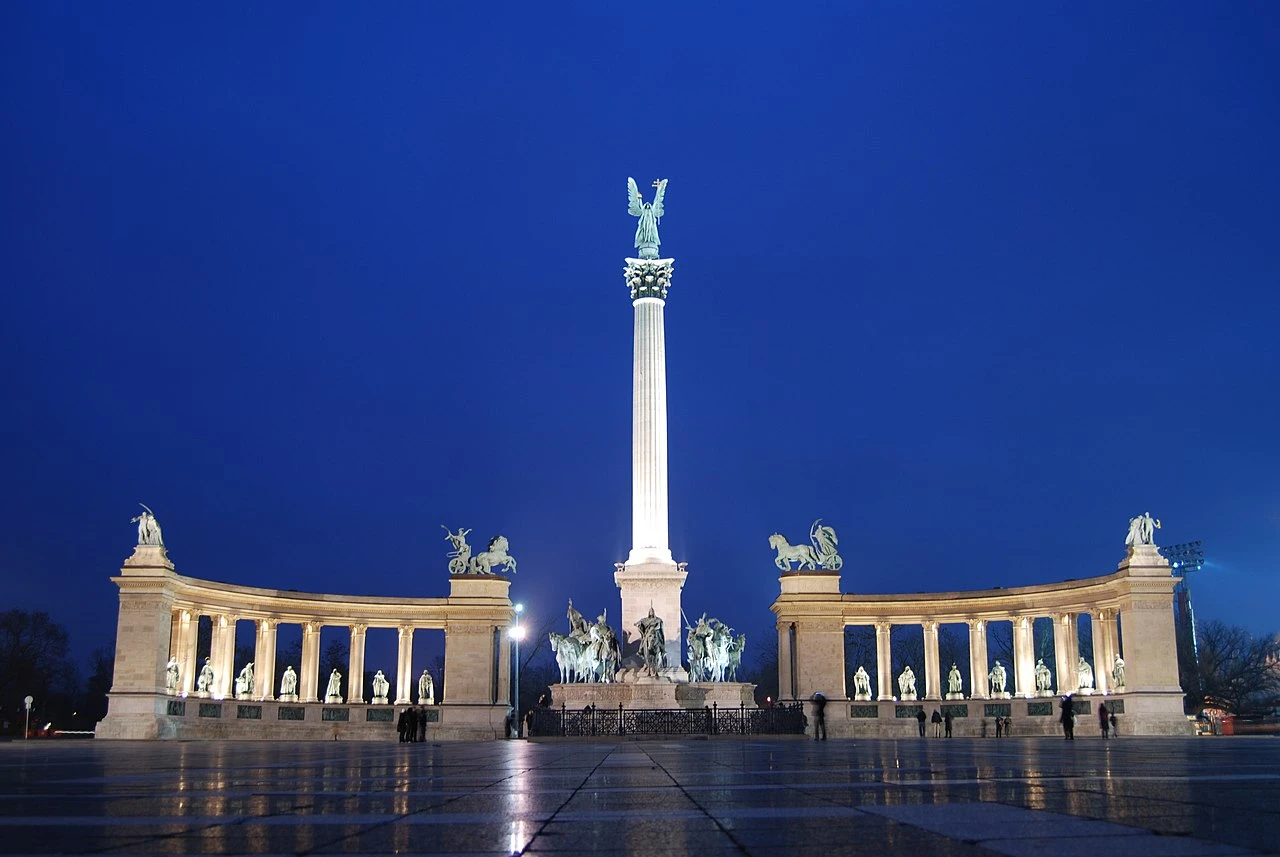
Budapest · 1 km
Millennium Monument
Content & sources
Paul Mannix · CC BY 2.0
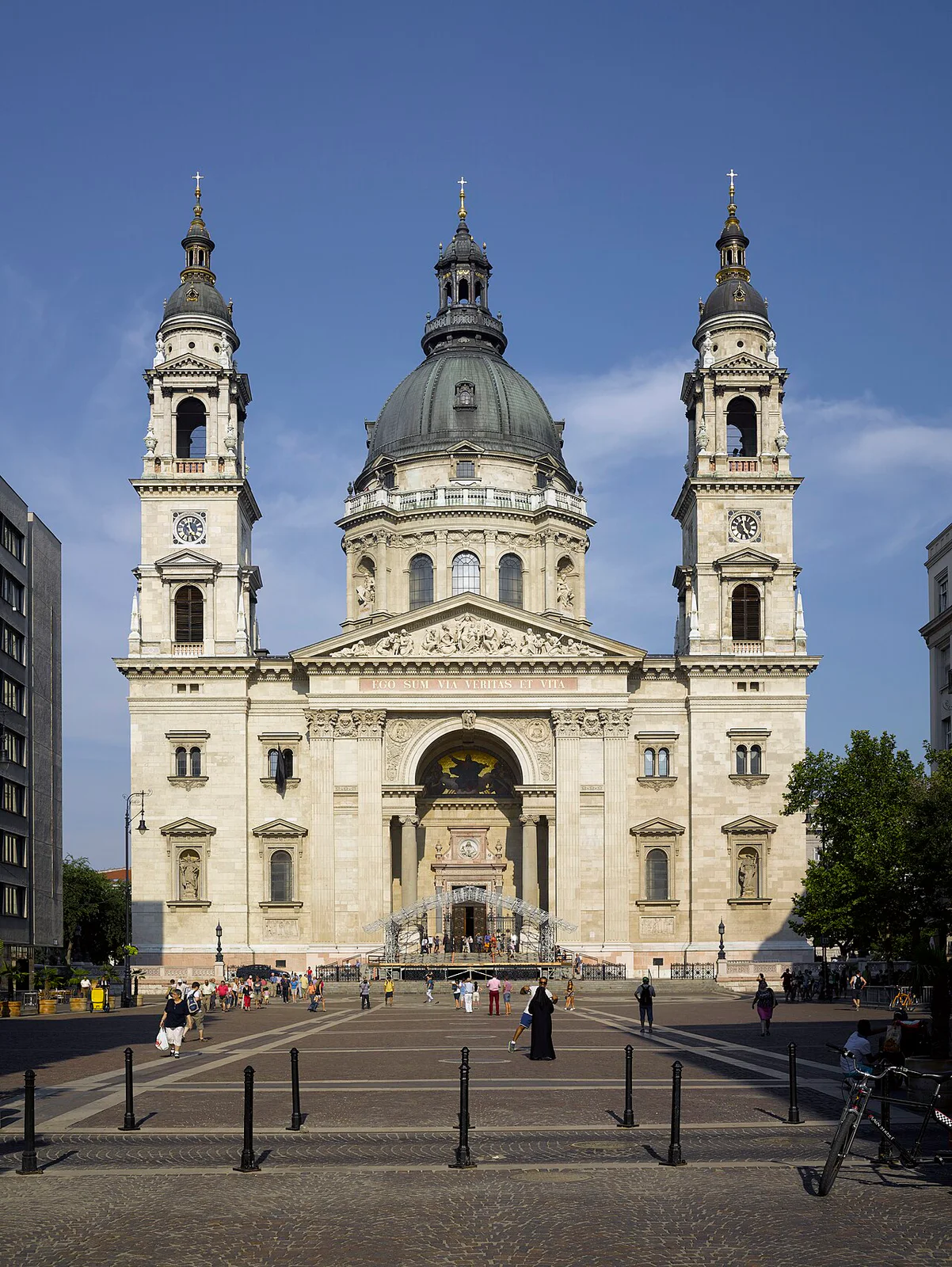
Budapest · 2 km
St. Stephen's Basilica
Content & sources
Photo: Godot13 · Attribution
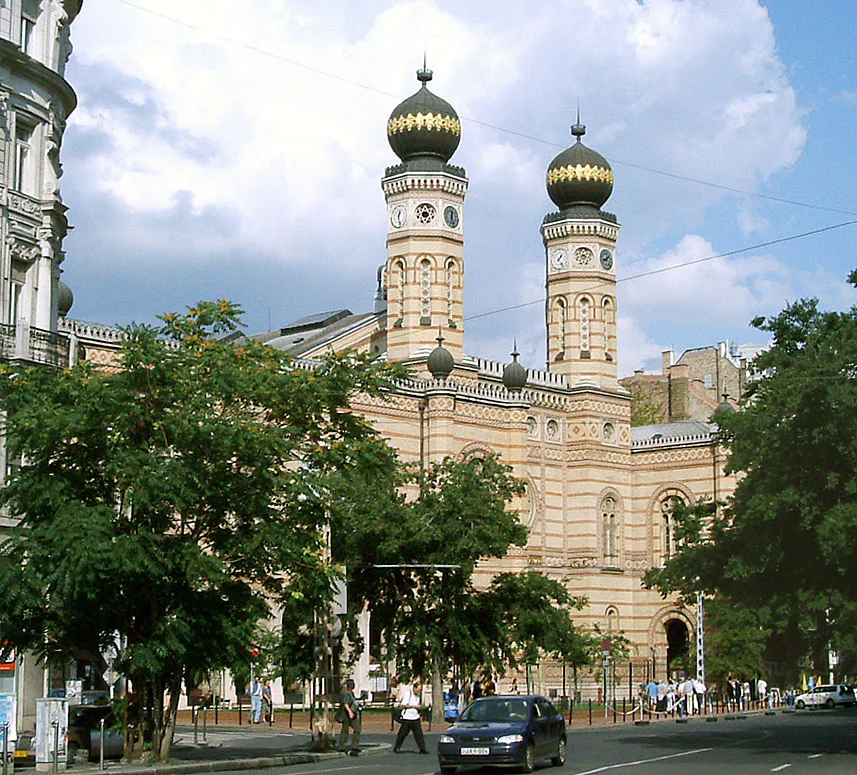
Budapest · 3 km
Dohány Street Synagogue
Content & sources
The original uploader was OsvátA at Hungarian Wikipedia. · CC BY-SA 3.0
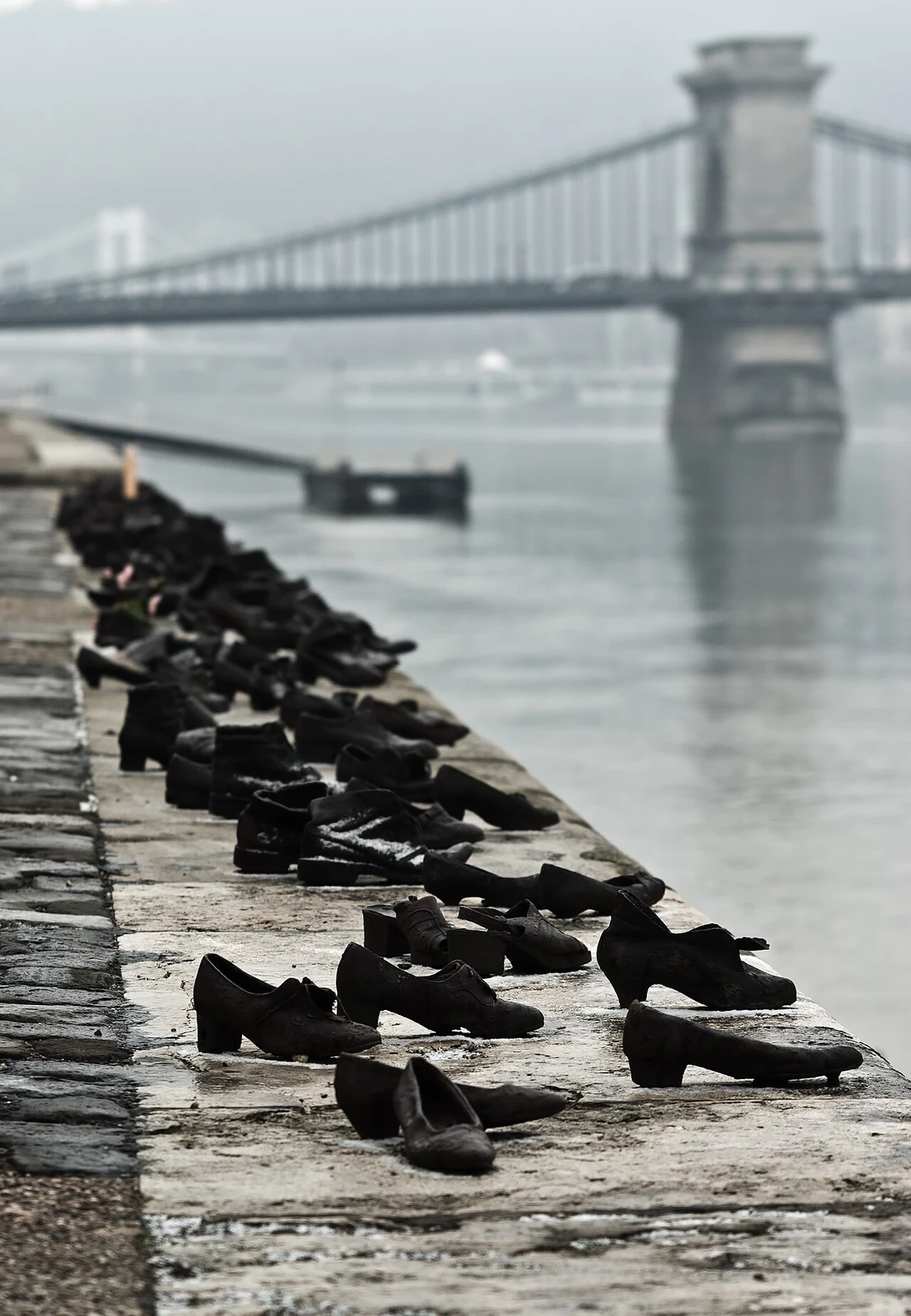
Budapest · 3 km
Shoes on the Danube Bank
Content & sources
Photo: Nikodem Nijaki · CC BY-SA 3.0
Art museums
More art museum audio guides
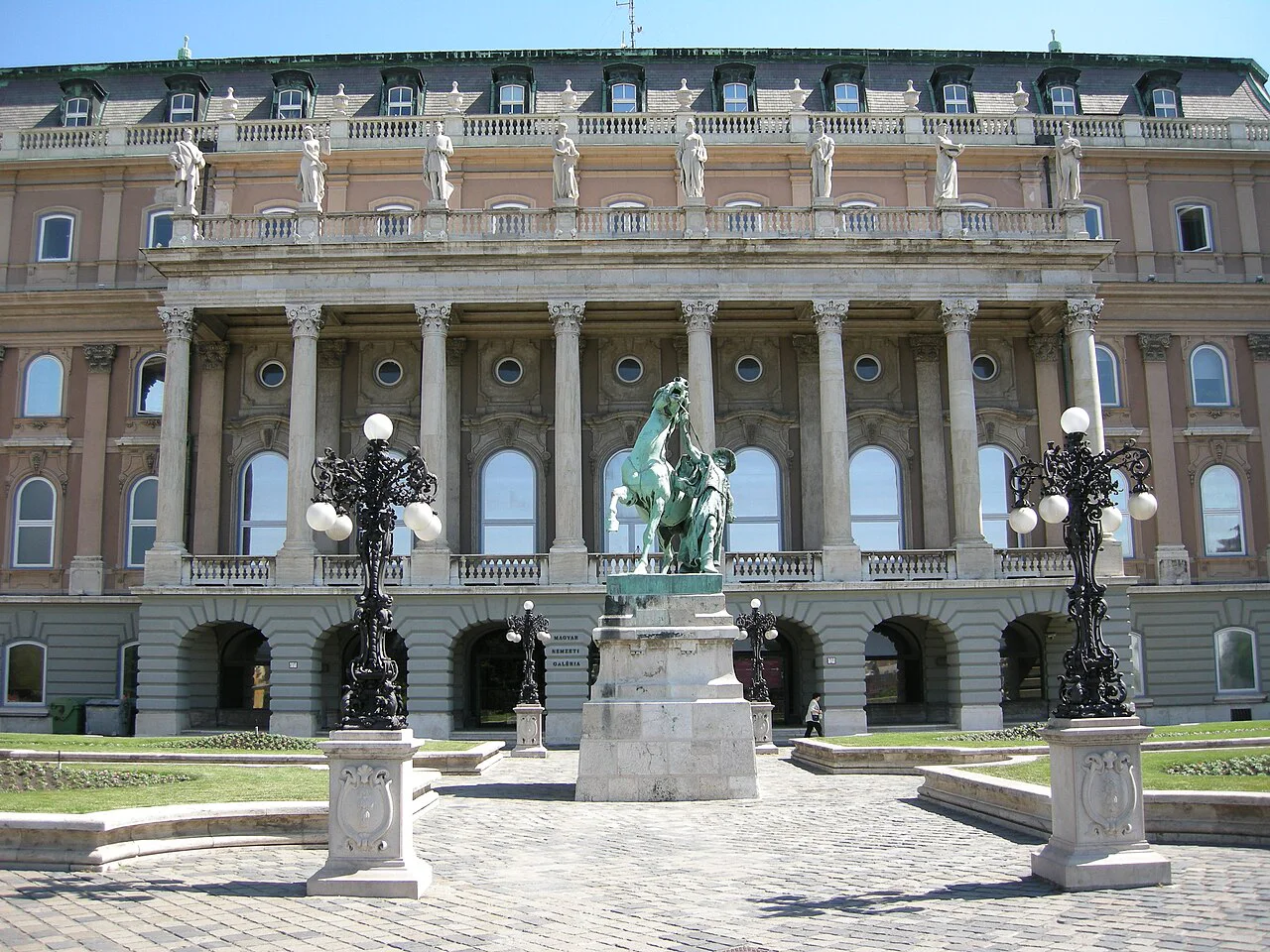
Budapest · 29 artworks
Hungarian National Gallery
Content & sources
Yoav Dothan · Public domain
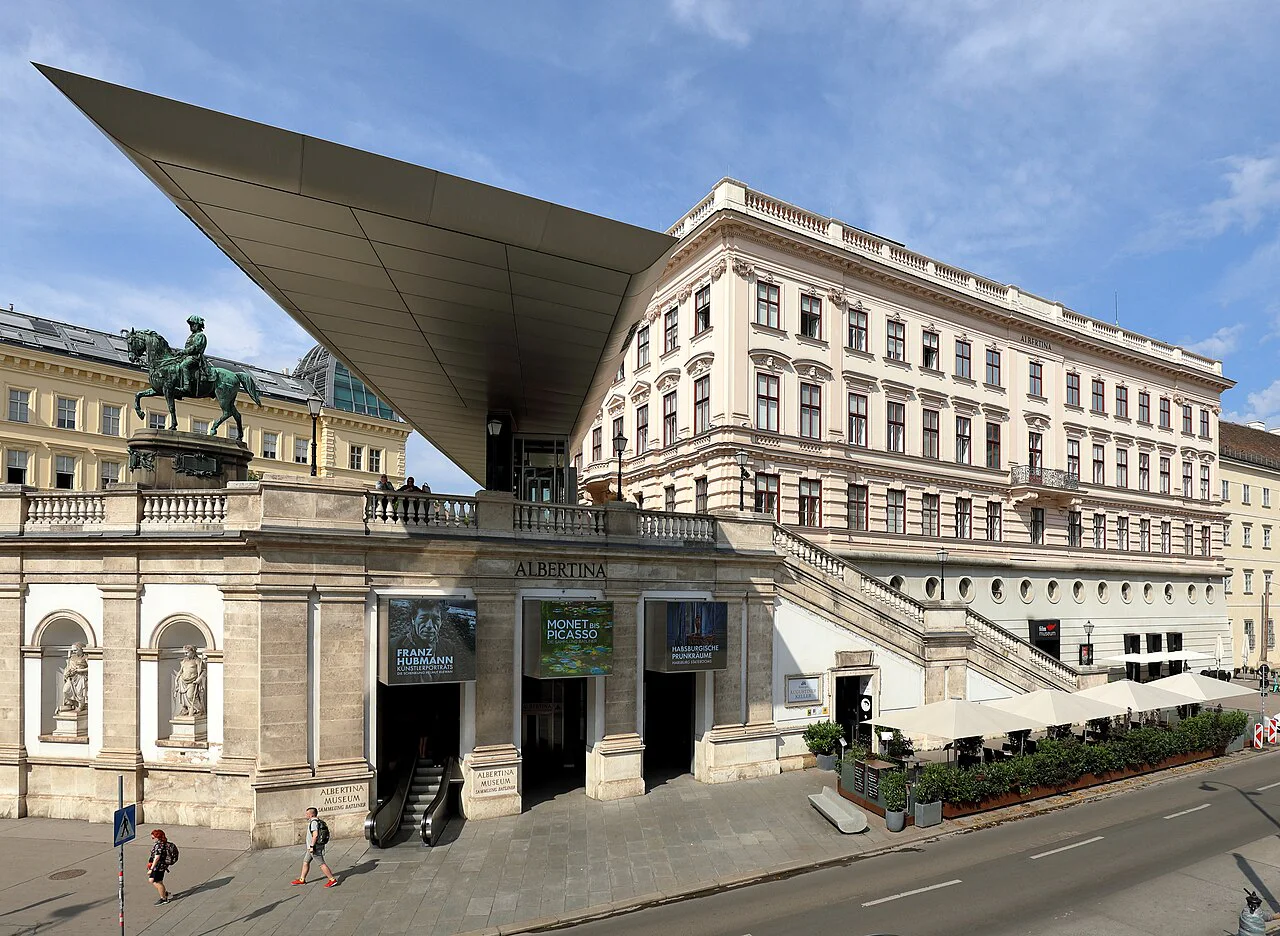
Vienna · 46 artworks
Albertina
Content & sources
C.Stadler/Bwag · CC BY-SA 4.0
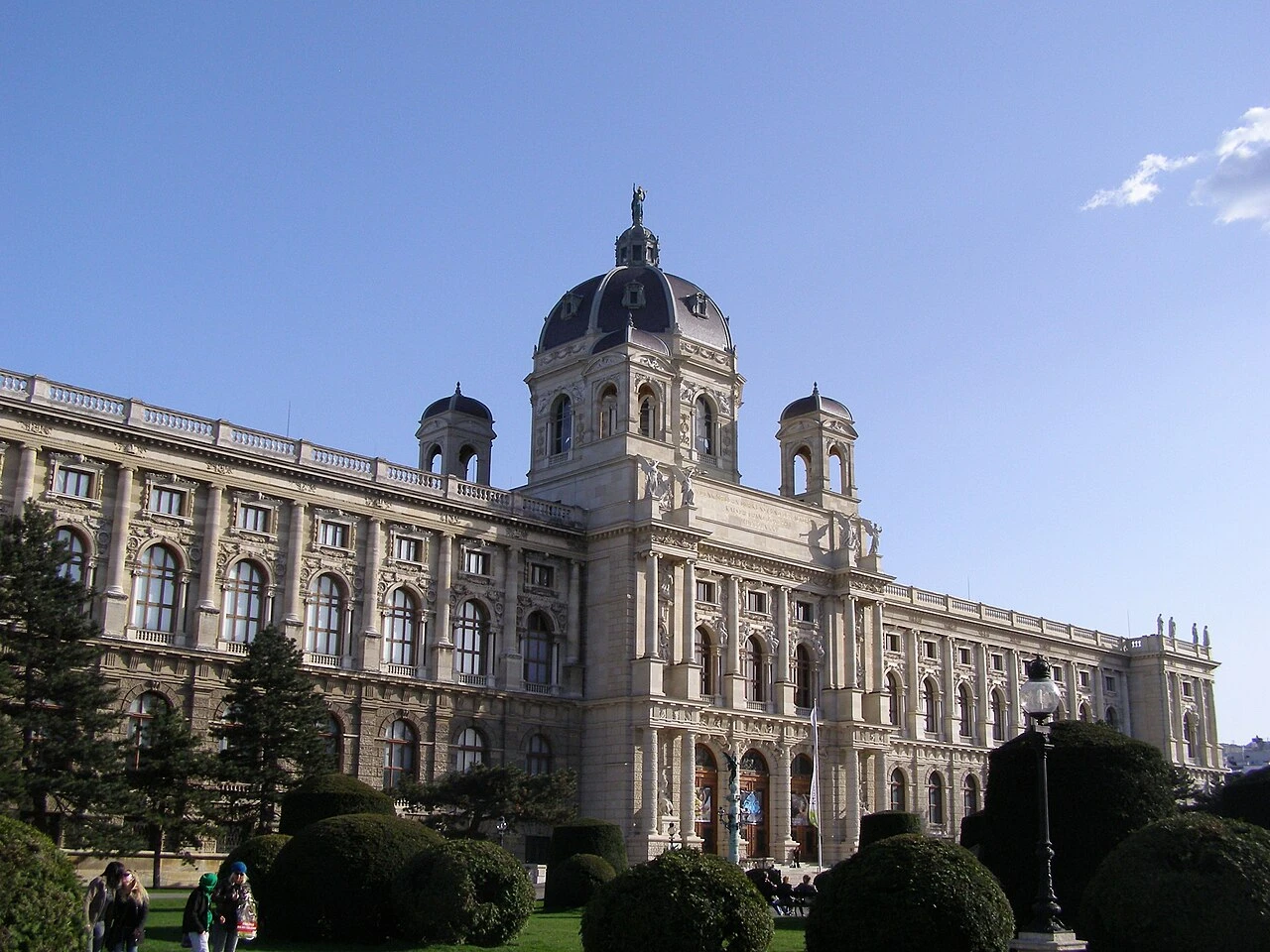
Vienna · 790 artworks
Kunsthistorisches Museum
Content & sources
Andrzej Otrębski · CC BY-SA 3.0
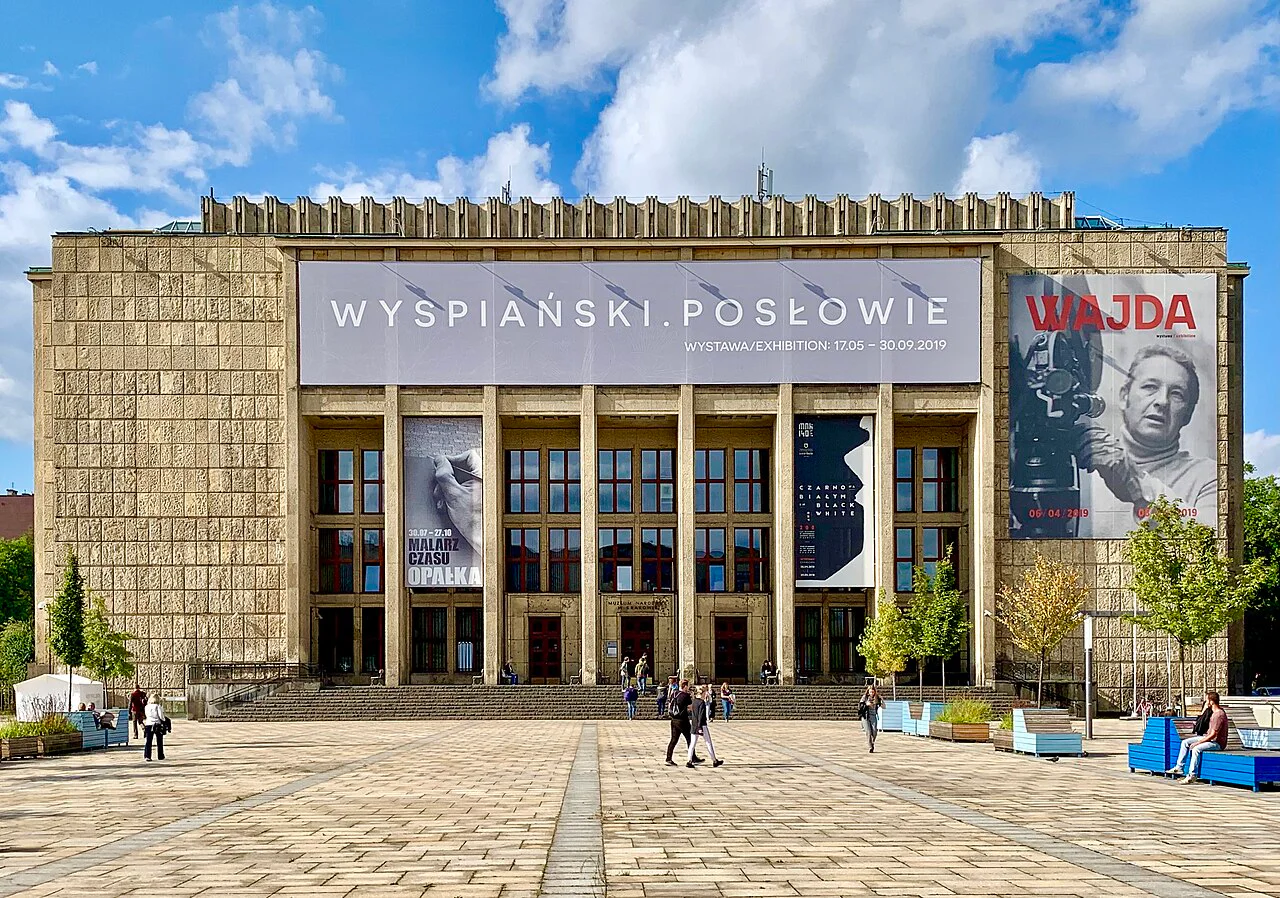
Kraków · 146 artworks
Muzeum Narodowe w Krakowie
Content & sources
Chris Olszewski · CC BY-SA 4.0
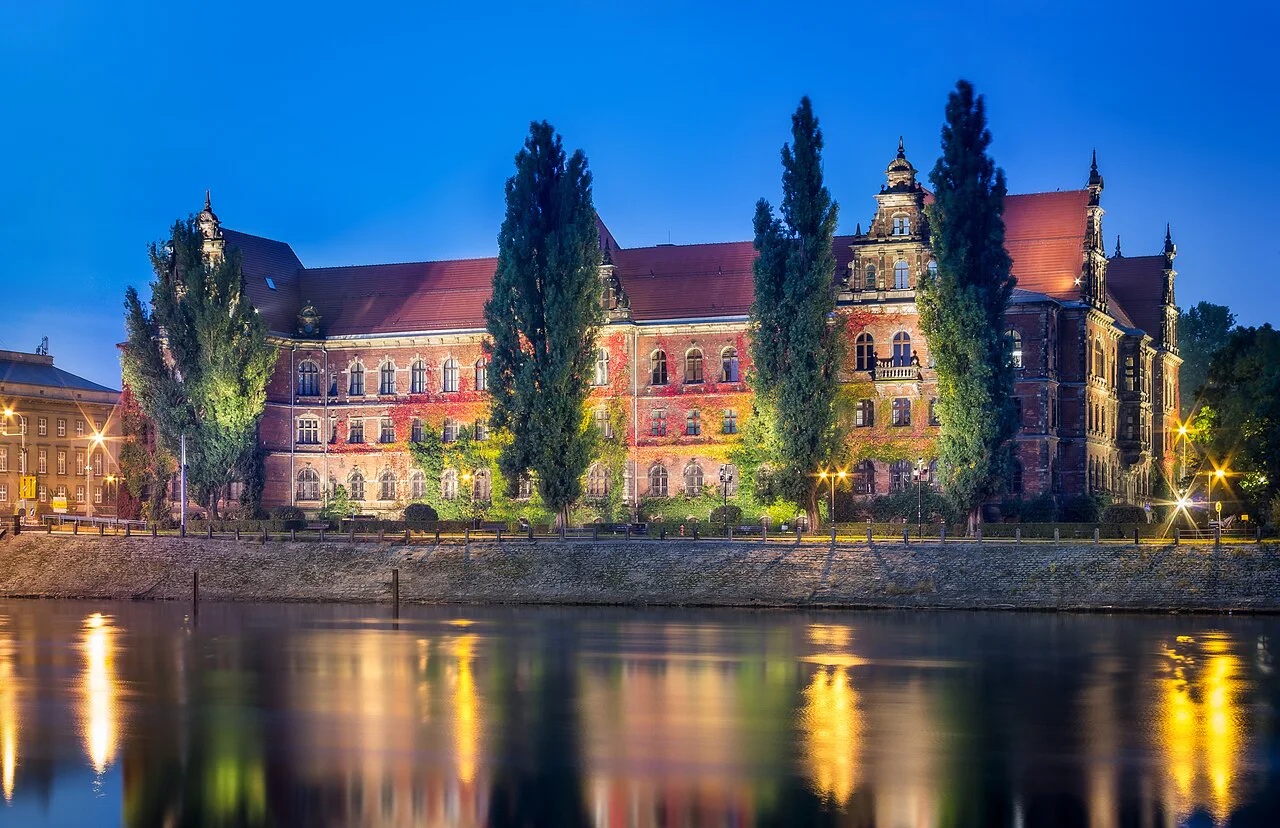
Wrocław · 44 artworks
Muzeum Narodowe we Wrocławiu
Content & sources
Photo: Jar.ciurus · CC BY-SA 3.0 pl
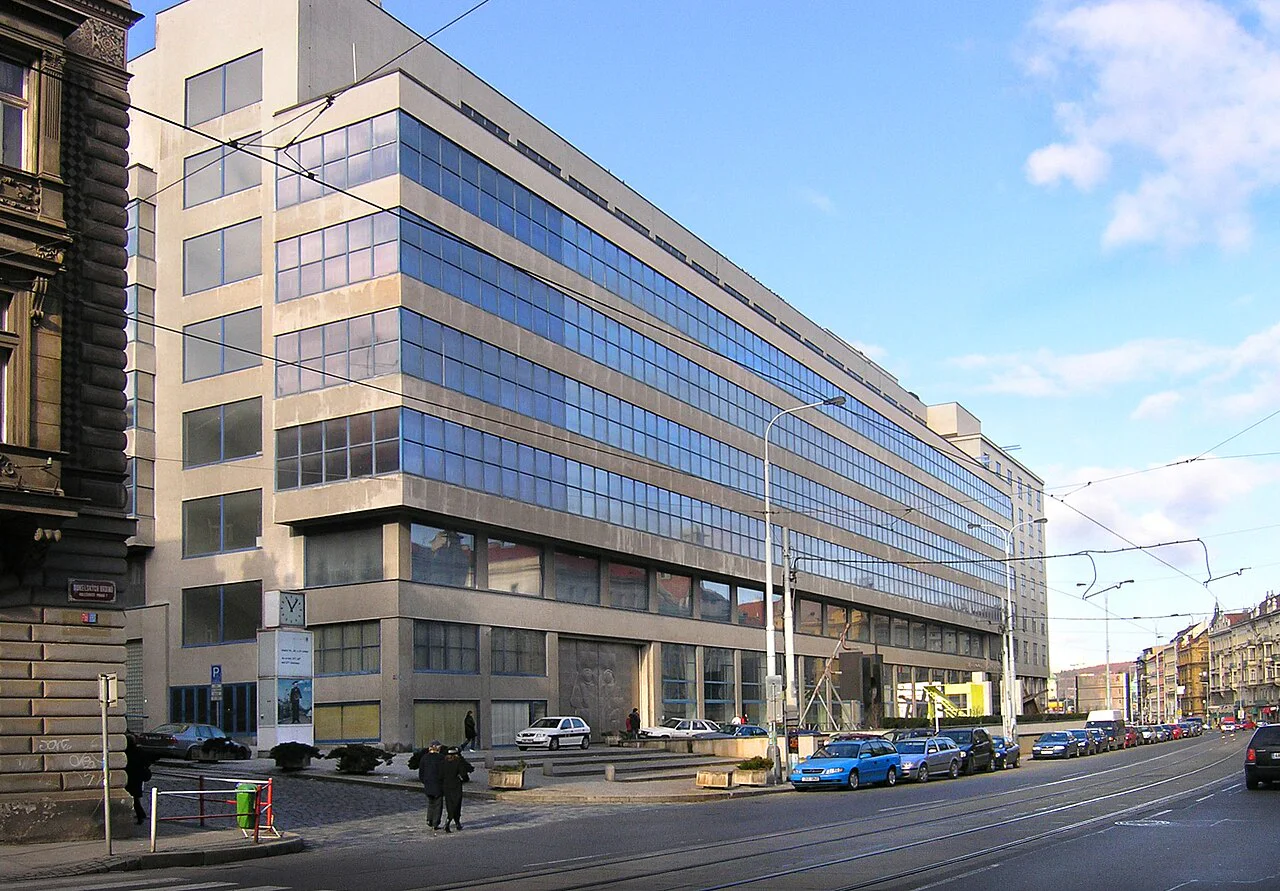
Prague · 93 artworks
National Gallery Prague
Content & sources
Czech Wikipedia user Packa · CC BY-SA 2.5