Stanza · Audio guide
Muzeum Narodowe w Krakowie Audio Guide
A place to remember. A story to take with you.
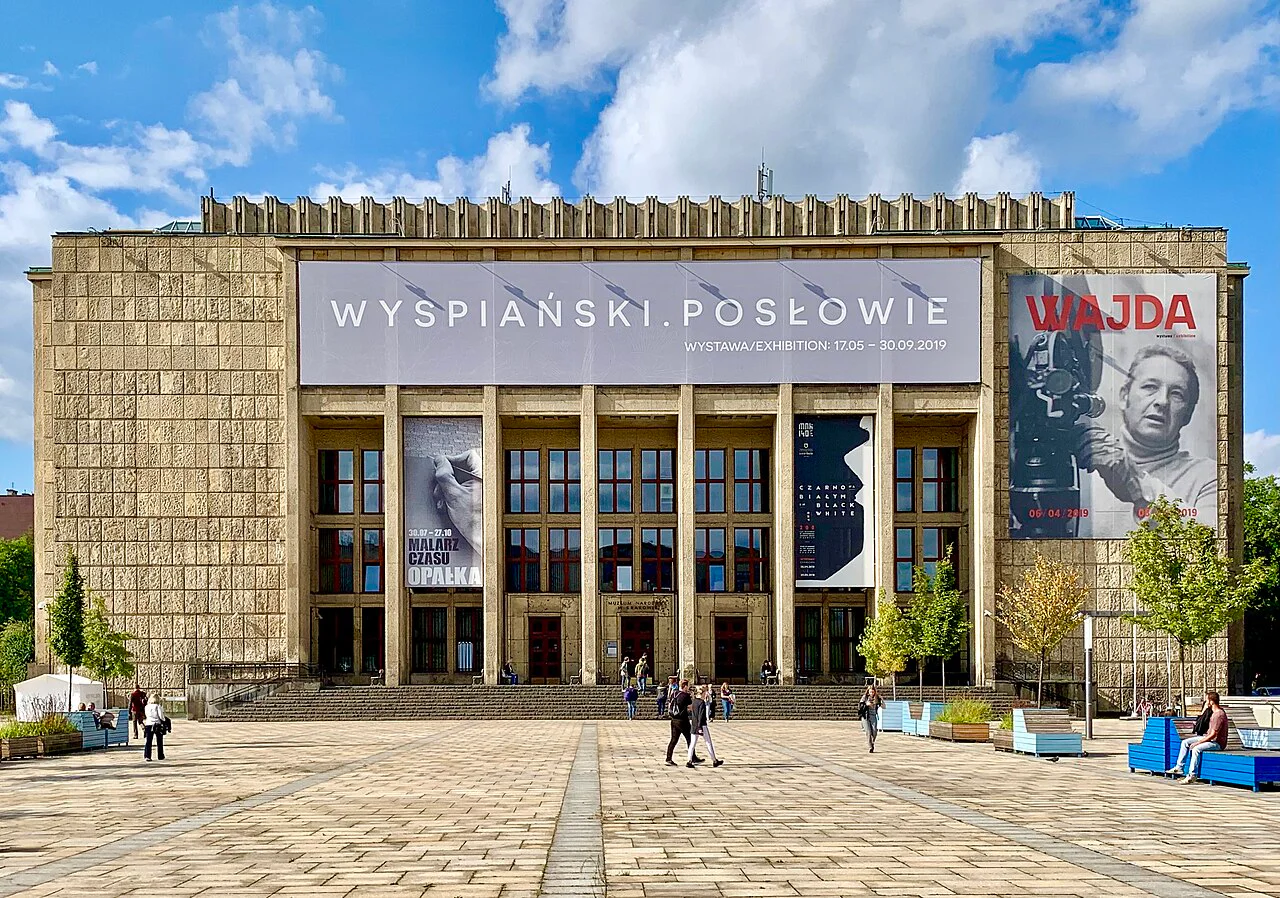
The National Museum in Kraków is the largest museum in Poland. It holds approximately 780,000 art objects ranging from classical archeology to modern art, with a special focus on Polish painting.
Download Stanza, then search for “Muzeum Narodowe w Krakowie”.
About the tour
One guide. Your kind of visit.
The National Museum in Kraków is the largest museum in Poland. It holds approximately 780,000 art objects ranging from classical archeology to modern art, with a special focus on Polish painting.
The Muzeum Narodowe w Krakowie guide tells the stories of 146 artworks, including Lady with an Ermine (Leonardo da Vinci), Portrait of a Young Man (Raphael), Prussian Homage (Jan Matejko), Frenzy of Exultations (Władysław Podkowiński), Girl with chrysanthemums (Olga Boznańska), Landscape with the Good Samaritan (Rembrandt), Privilege of Koszyce (Louis I of Hungary), and Łaski's Statute (Jan Haller). Every artwork is free to hear in the Stanza app until 1 January.
Ready when you are.
- 01Get the free Stanza app.
iOS & Android
- 02Find your guide.
“Muzeum Narodowe w Krakowie”
- 03Download before you go.
Works offline
Audio guide / 146 artworks
Inside the guide
Get to know a few of the stories before you go. Open a stop to read more.
01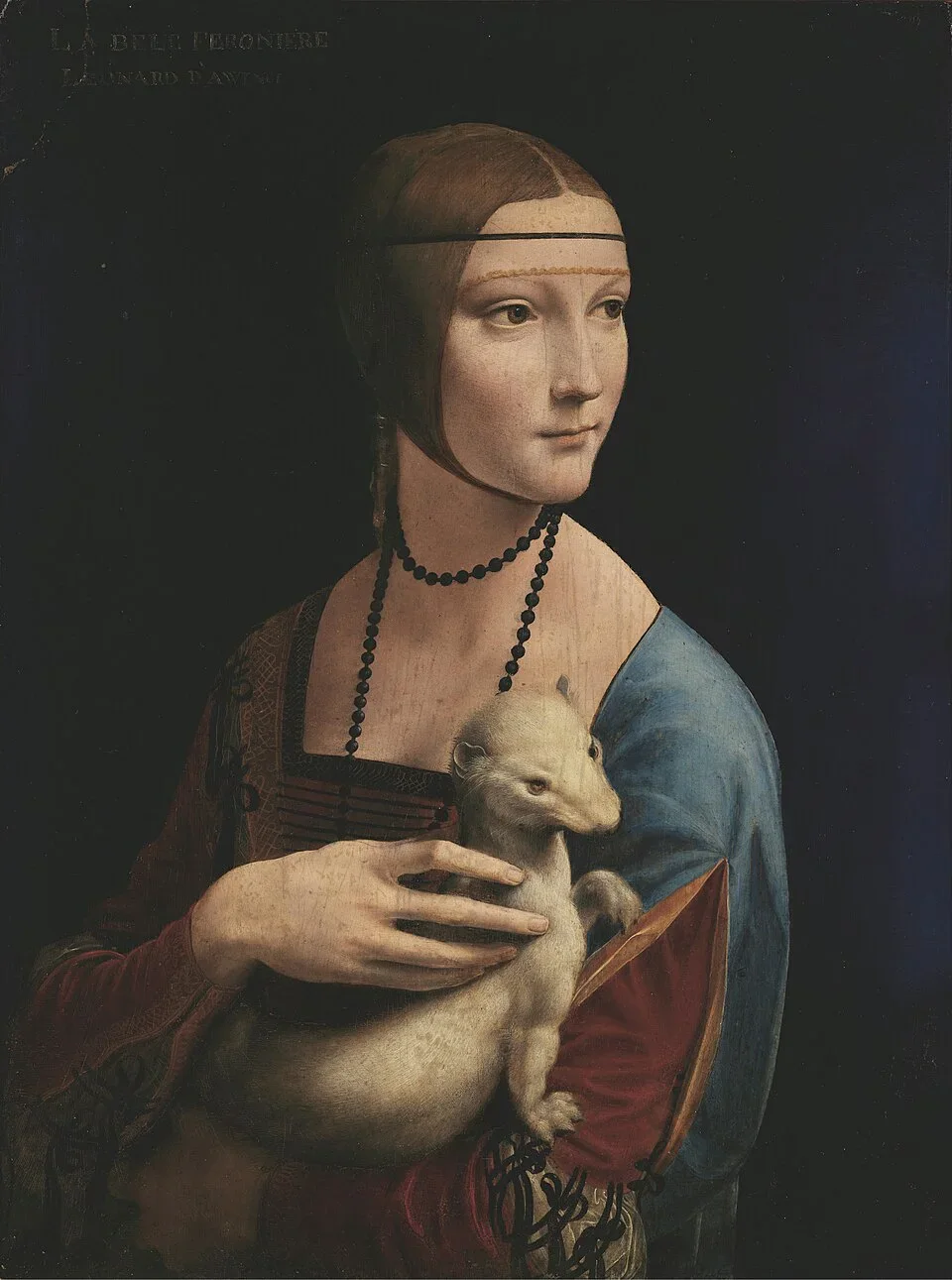
Lady with an Ermine
Most portraits of the time held still. This one is built out of a turn. The woman's body goes one way, her face the other, and the animal in her arms twists along with her. Her outstretched hand is painted down to each fingernail, and the tendon in her bent finger as it bends. It was the first painting Ludovico Sforza, the Duke of Milan, ordered from Leonardo, who was working at his court. The woman is Cecilia Gallerani, his favourite. She seems to be listening to someone beyond the frame, turning toward the light. The animal is Ludovico's own emblem. He called himself the Ermine. Its white coat made it a symbol of purity, and people believed it would die before letting itself get dirty. Cecilia kept the portrait until she died in 1536. The Germans seized it in 1939, and it hung in Hans Frank's offices at Wawel. Allied troops found it at his country home in Bavaria and brought it back to Poland in 1946.
Listen in the appLeonardo da Vinci · Public domain
02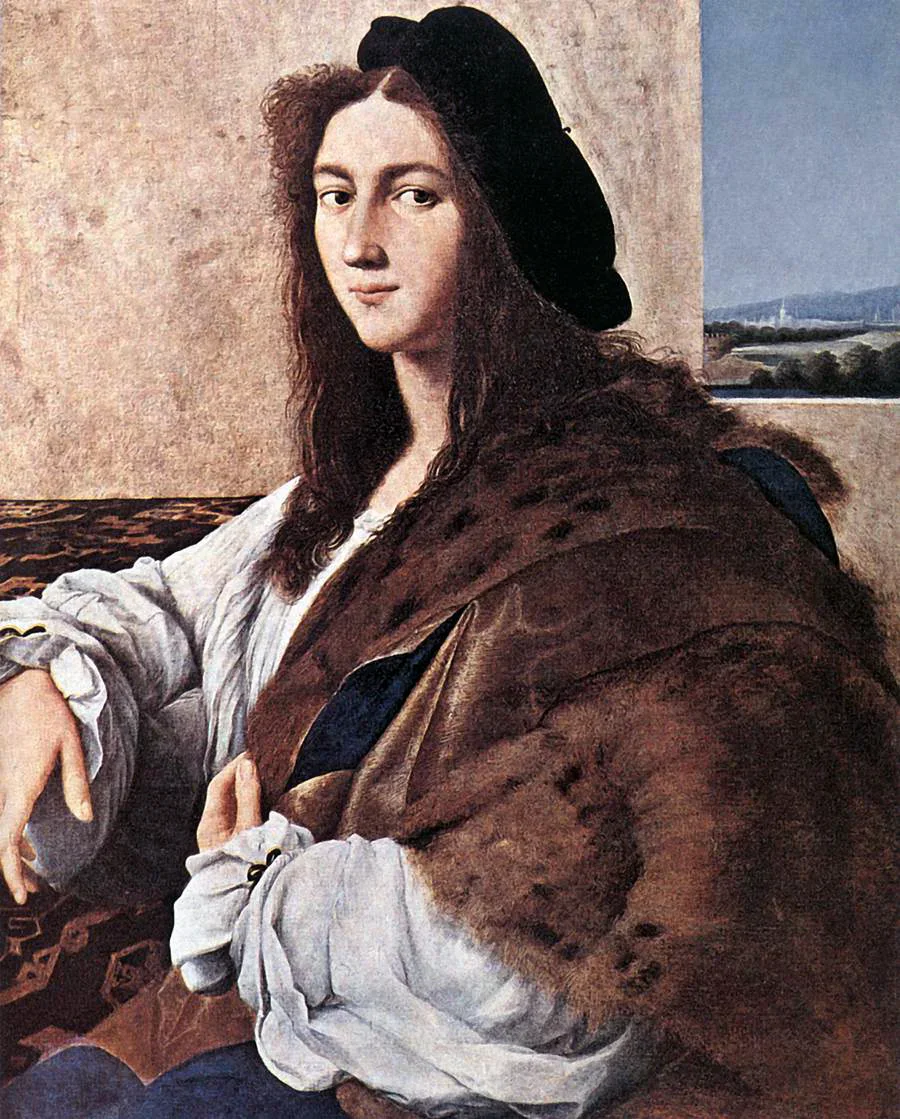
Portrait of a Young Man
Where has the face in this empty frame gone? Only a photograph hangs here now, in the frame that once held the painting. In it, a young man looks straight at you with a faint smile. His hair is long and chestnut, and he wears a black beret. His left hand lies near his heart, holding a fur coat lined with blue. Behind him, a window opens onto trees, walls and misty mountains. That face is known to us only from photographs, taken before the First World War, in 1930 and again in 1934. People once believed Raphael had painted his own face here. It was never proved. In 1939, the Czartoryski family packed three paintings into one crate, marked Leonardo, Rembrandt and Raphael, and hid it at Sieniawa. The Gestapo found it, and the paintings ended up with Hans Frank, who kept them at Wawel in Kraków. As the Germans fled the city in January 1945, he sent them away. His art agent may have mixed this portrait up with another painting. Leonardo's Lady with an Ermine and Rembrandt's Good Samaritan both came back after the war. This one has never been found.
Listen in the appRaphael · Public domain
03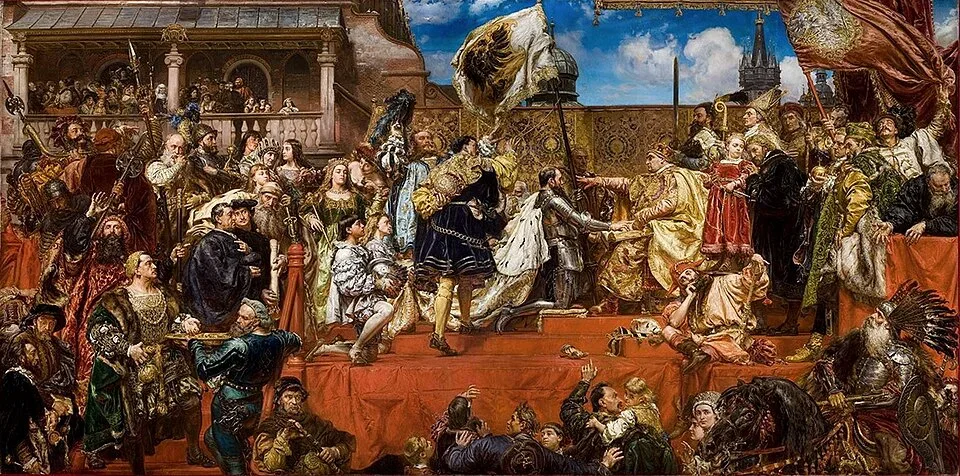
Prussian Homage
On the ground lies a gauntlet. It is Albrecht's challenge to King Sigismund the Old. In 1525, the Duke of Prussia knelt in Kraków's market square and swore allegiance to that king. But the duke only looks beaten. He kneels on both knees, which a duke should bend only before God, never before a sovereign. He grips his standard hard and touches the Bible only lightly. The standard flies from a military lance, a sign that Prussia had further ambitions. Jan Matejko painted this between 1879 and 1882, when Poland had ceased to exist, and he wanted the triumph to look hollow. Sigismund receives the homage lightly, as a passing victory rather than a lasting one. Below the king, the jester Stańczyk has a doubtful face. No one in the crowd smiles, except one court lady caught up in gossip. In 1882, in Lwów, Matejko gave the painting to the nation to begin a collection for rebuilding Wawel Castle. Prussia would later become one of the powers that divided Poland and ended its independence. The meaning of the boy in a red dress playing with the chain the king meant for the Grand Master is not certain.
Listen in the appJan Matejko · Public domain
04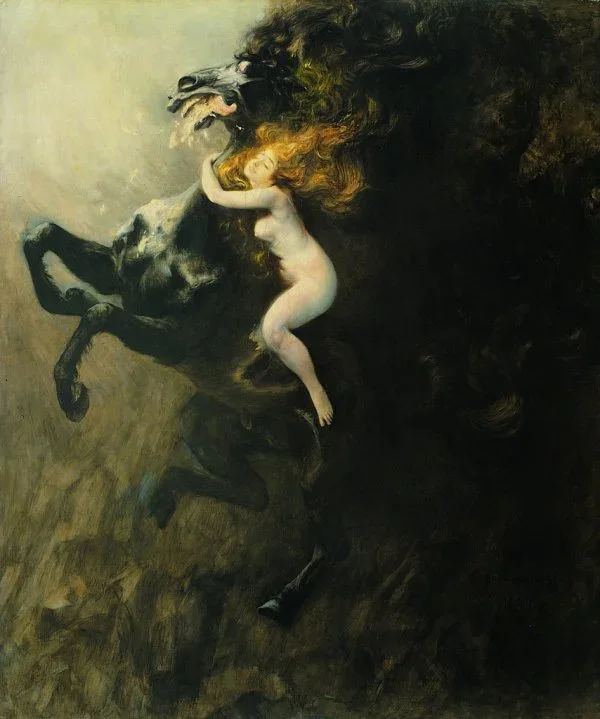
Frenzy of Exultations
A naked redheaded woman rides a black horse that rears. Her eyes are closed, her arms clamped round its neck, her hair streaming upward into the mane. The horse bares its teeth, tongue out, foam at its mouth. The upper left is lit on the woman and the horse's mouth. The right side is a whirl of darkness, its hindquarters and tail sinking into black. Those closed eyes and that look of pleasure lead back to a love the painter could not have. The longing deepened through 1893. He was dying of lung disease and finished the huge canvas from his bed. In his vision, erotic ecstasy was the highest value, a cosmic power. It went on show in Warsaw on the eighteenth of March 1894, on its own. Twelve thousand people came, but no one bought it. As the show neared its end, Podkowiński asked the caretaker for a ladder, saying he wanted to make small corrections. He climbed with a knife and struck the canvas sixteen times, twelve of them on the woman. Afterward he said he had sacrificed something dear to him. The show was ending, he said, and the picture had let him down. The ruined canvas and its bare frame restored his balance. After his death the slashed painting was restored and traveled to Łódź, Kraków, Moscow and Saint Petersburg before coming to rest here.
Listen in the appWładysław Podkowiński · Public domain
05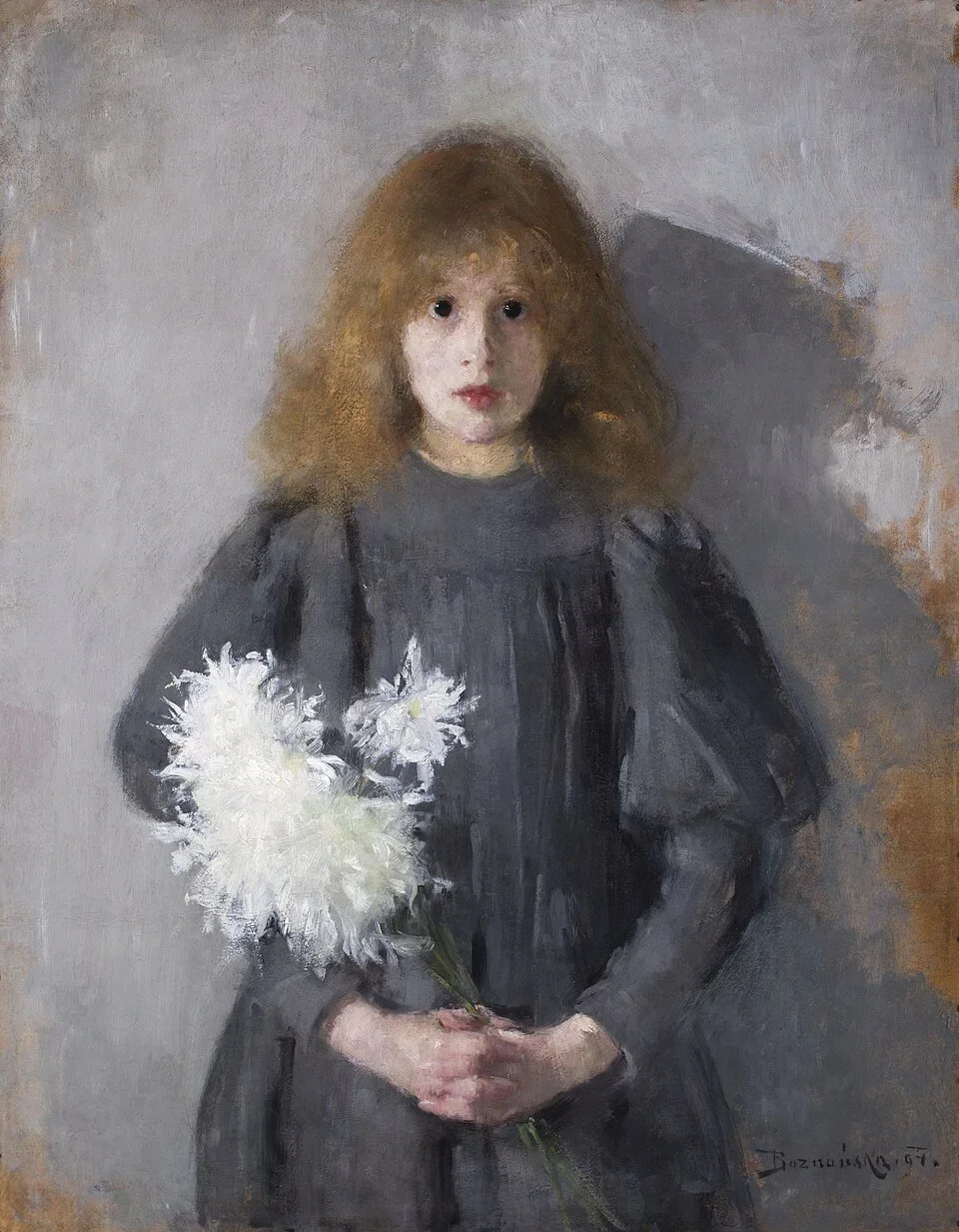
Girl with chrysanthemums
A girl stands alone, and her eyes are the first thing that holds you. They are large and black and slightly shining, and they meet yours directly, as though she is asking you to make her feel safer. Her face is pale, her lips small and red, her bright red hair loose. The expression is serious, almost anxious. Olga Boznańska painted this in Munich in 1894, deliberately against the customs of children's portraits. Children were often shown in their finest clothes, in decorated rooms or against a landscape. She gave this girl a plain blue and grey dress and only a bare wall behind her. She had been looking at Whistler's atmospheric pictures and at new work coming from Paris, and she was done with the Munich School's traditions. She loved the poetry of Maeterlinck, and this child's face has something of that same sadness. There are almost no outlines here. The girl and the wall are built from small patches of colour. In 1896 William Ritter wrote that the longer you watched this child, the more she unsettled you. In her joined hands she holds a bunch of white chrysanthemums, and they complete the melancholy of the whole picture.
Listen in the appOlga Boznańska · Public domain
06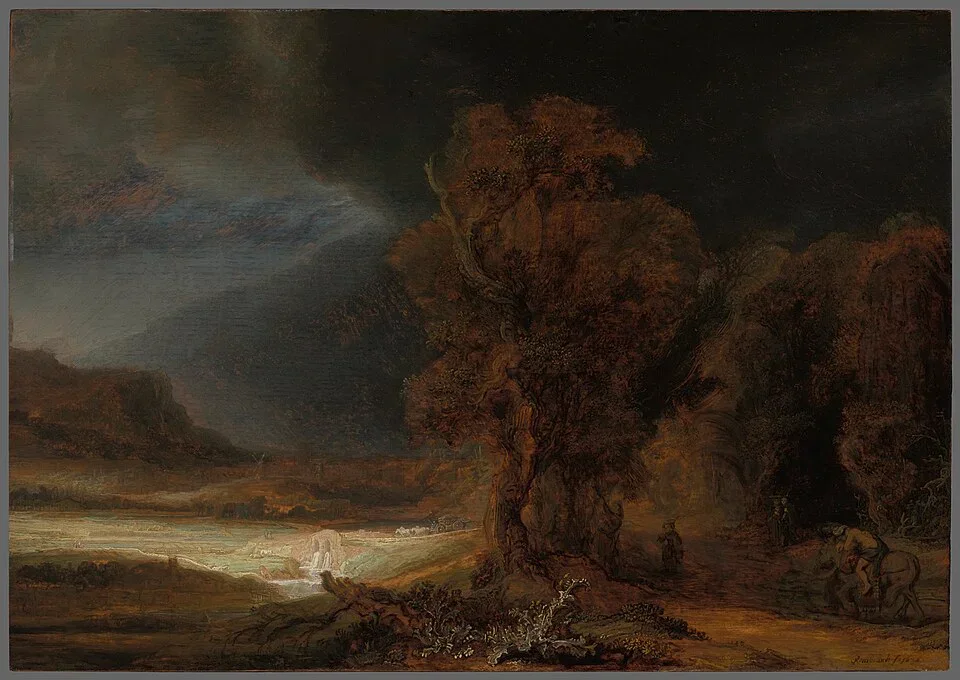
Landscape with the Good Samaritan
In 1939 the Germans looted this painting from Kraków. Karol Estreicher got it back in 1946. What came home shows a man being lifted onto a horse. The wounded traveler lies face down across the horse's back, half naked and limp. The Samaritan keeps his left hand on the man's back, so he will not slide off. It is the moment from the story Jesus tells in Saint Luke's Gospel. A man is robbed and left half dead beside the road. A priest and a Levite walk off, and a carriage goes past. They are the ones who passed him by. But the Samaritan, of all people, stops and lifts him up. Above them, storm clouds are breaking apart, and sunlight falls on the plain. The dark stands for evil, the light for good. As the storm clears, the traveler finds rest. The road runs on toward a walled city in the distance. Beside the city Rembrandt set a Dutch windmill, though the road he is showing runs from Jerusalem to Jericho.
Listen in the appRembrandt · Public domain
07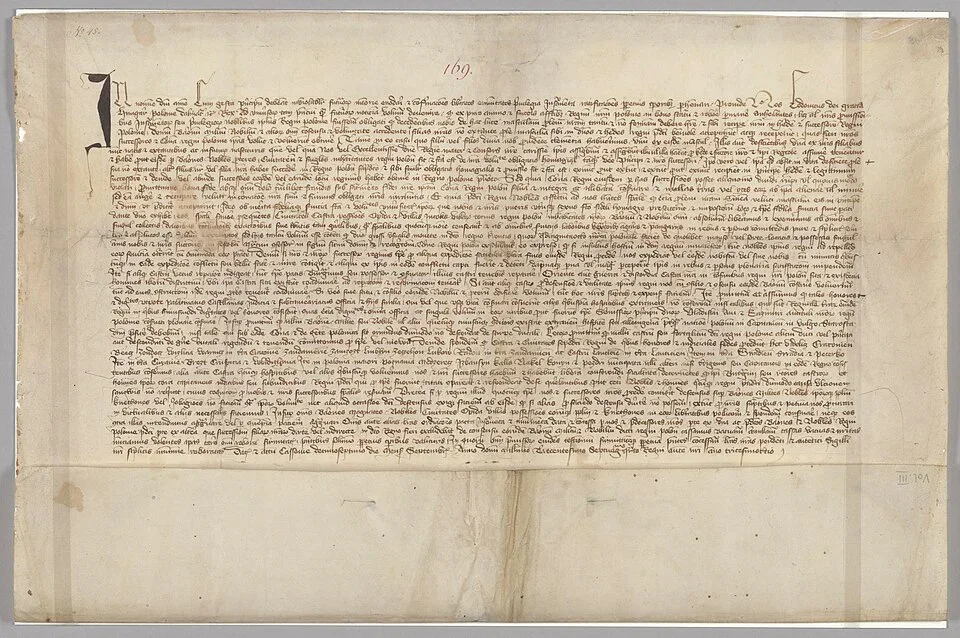
Privilege of Koszyce
A king gave up his own powers to put a daughter on the Polish throne, and this document is the record of the deal. In 1374 Louis of Hungary granted the Polish nobility a long list of privileges. In exchange, they had to accept that one of his daughters would rule Poland after him. The crown chancellor, Zawisza z Kurozwęk, drew up the text. It was granted at Koszyce. You can read the price in the terms. The tax on a field fell from twelve groschen to two, and no new tax could be raised without the nobles' consent. They were freed from building and repairing castles, except in the east, where Lithuania threatened. They no longer had to feed and house the king and his court as he travelled. Offices were kept for Poles rather than foreigners. A noble who fought beyond the kingdom was to be paid. Yet the document never said which daughter. After the king died in 1382, the nobility chose the youngest, Jadwiga, who married Władysław Jagiełło and began the Jagiellonian line. Louis may have meant to take the privileges back, but his death prevented it, and they went on shaping Polish government for centuries.
Listen in the appPhoto: MNK Agata · CC0
08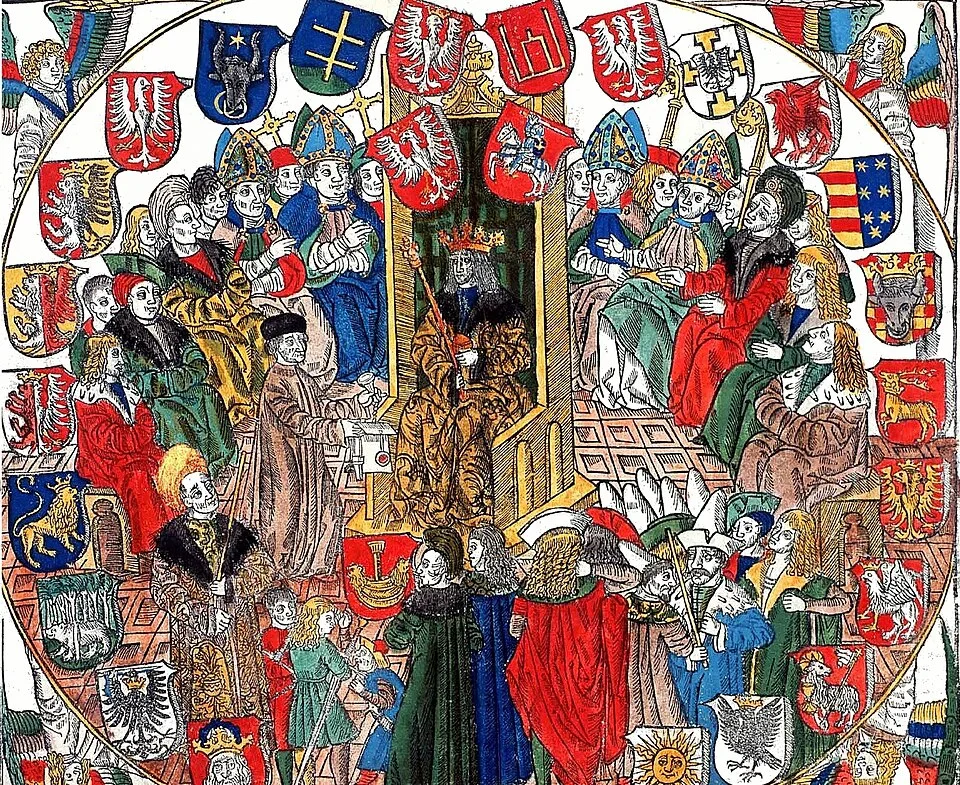
Łaski's Statute
Could you fit all the law of a kingdom into one book? This one tries, and runs to more than seven hundred pages. It was the first illustrated book printed in Poland, and the fifth page holds the oldest printed text of the Bogurodzica. The Sejm asked for it, meeting at Radom in 1505. Jan Łaski, the Chancellor and Primate, gathered nearly all the earlier laws. He also left some out, on purpose. The laws of Mielnik are missing. Passed in 1501, they would have given decisive power to the senate and the great lords. He wanted the reverse, a stronger king and the lesser nobility, with the magnates weakened. The quarrel went back to the king's election. Before it, the king and the magnates had each made promises, and after it neither would confirm them. The book was printed by Jan Haller in Kraków and sent to all the courts in Poland. It stayed the fundamental law of Poland until the Partitions in the late eighteenth century.
Listen in the appJan Haller · Public domain
09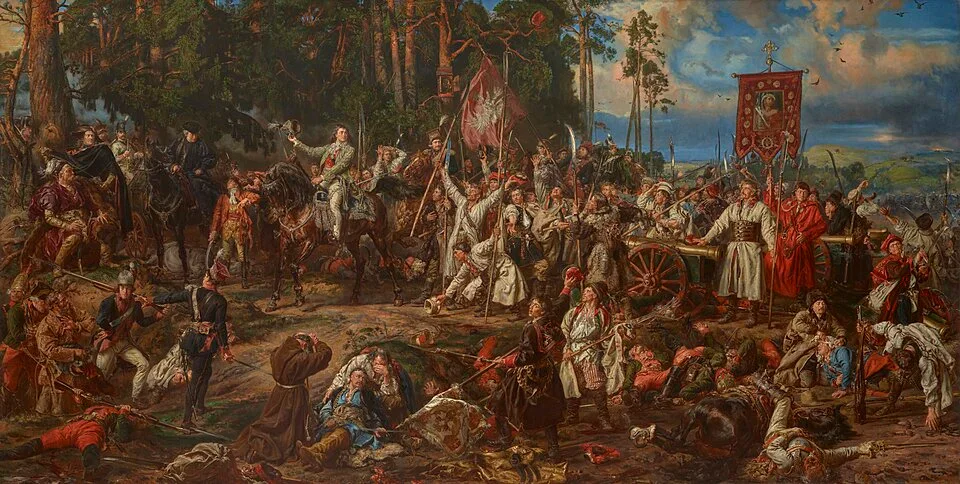
Battle of Raclawice
A commander in a fashionable uniform tailcoat, his staff around him, and a captured cannon. The battle is Raclawice, in 1794. But not every man here fought that day. Jan Matejko chose who had earned a place in the picture. Some of these men are here for what they represent, not for what they did. Hugo Kolontay sits in black on a black horse. He helped organize the uprising, but he was not at the battle. At the head of the staff stand two generals, Antoni Madalinski and Jozef Zajaczek. Matejko believed they deserved to be shown. Zajaczek wears a Napoleonic cap and leans against a tree. Even the commander's face is borrowed. The priest Antoni Gruszecki served as the model for it. Stefan Dembowski wears a noble costume. He was meant to take over if Kosciuszko died. That costume stands for the Polish nobility's reluctance to join the uprising, and especially to follow the commander's orders, which were regularly sabotaged.
Listen in the appJan Matejko · Public domain
10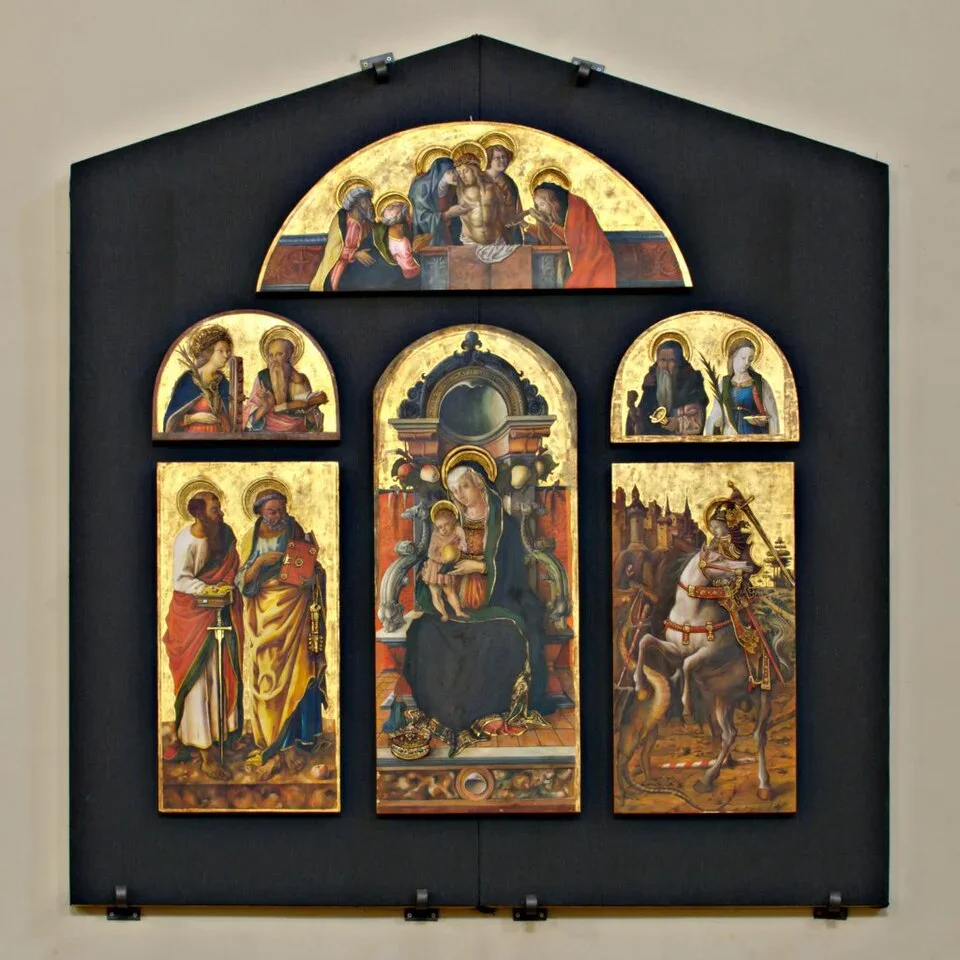
Porto San Giorgio Polyptych
Two saints share this small panel, Anthony Abbot and Lucy. On its own, it seems a complete little picture. But this was the top of the right side of a far larger altarpiece. It sat above Saint George and the Dragon, in the church of San Giorgio in Porto San Giorgio. The Salvadori family owned it for centuries. In 1835 they carried the whole thing to Rome and sold it in pieces. It passed through several collections, and in 1876 it was dispersed. Its panels ended up in museums on both sides of the Atlantic. Reassembling it took decades. Slowly, panels in London, Washington and Detroit were linked to the same altarpiece. Yours was the final piece to be found, in 1956. In 1961 everything was brought back together for an exhibition in Venice. In Porto San Giorgio today, there is only a copy. The man who ordered it in 1470 was Giorgio Salvadori. He was an Albanian who had fled to Italy after Skanderbeg died in 1468 and the Ottomans advanced. He asked Carlo Crivelli to paint it for the church there.
Listen in the appCarlo Crivelli · CC BY-SA 2.0
- 11
Treaty of Kraków
Unknown Artist
- 12
Nero's Torches
Henryk Siemiradzki · 1876
- 13
Poland – The Year 1863
Jan Matejko · 1864
- 14
Beautiful Virgin Mary from Krużlowa
Unknown Artist · 1400
- 15
Four-in-Hand
Józef Marian Chełmoński · 1881
- 16
Adoration of the Christ Child
Lorenzo Lotto · 1508
- 17
Students Leaving Krakow in 1549
Jan Matejko · 1892
- 18
Moonrise
Stanisław Masłowski · 1884
- 19
Cranes
Józef Marian Chełmoński · 1870–1871
- 20
The Interior of the Tomb of King Casimir the Great
Jan Matejko · 1869
- 21
Jagiellonian Dynasty
Lucas Cranach the Younger · 1554
- 22
The Annunciation
Master Georgius · 1517
- 23
Polyptych of Lusina
Unknown Artist · c. 1510
- 24
Phryne.
Artur Grottger · 1867
- 25
Self-Portrait with Apron and Brushes
Anna Bilińska-Bohdanowicz · 1887
- 26
Portrait of Helena Modrzejewska
Tadeusz Ajdukiewicz · 1879
- 27
Portrait of the artist and his wife
Stanisław Wyspiański · 1904
- 28
Augustinian Polyptych
Nicolaus Haberschrack · 1468
- 29
On the Farm
Józef Marian Chełmoński · 1875
- 30
Allegory of Satan (Lord of the World)
Ludwik Stasiak · 1900
- 31
Melancholic
Wojciech Weiss · 1898
- 32
Self-Portrait with Masks
Wojciech Weiss · 1900
- 33
Castellan's Daughter
Jan Matejko · 1934
- 34
Self-Portrait from the Month Before Dying
Stanisław Wyspiański · 1907
- 35
Motherhood
Stanisław Wyspiański · 1905
- 36
The Demon
Wojciech Weiss · 1904
- 37
Portrait of a Boy (Józio Feldman)
Stanisław Wyspiański · 1905
- 38
Little Helen with a Vase
Stanisław Wyspiański · 1902
- 39
Winter in a small town
Maksymilian Gierymski · 1872
- 40
Self-Portrait in a White Attire
Jacek Malczewski · 1914
- 41
Ahasuerus
Maurycy Gottlieb · 1876
- 42
Woman Combing Her Hair
Władysław Ślewiński · 1897
- 43
Portrait of Izabela Czartoryska
Alexander Roslin · 1774
- 44
The Starry Night
Józef Marian Chełmoński · 1888
- 45
Montmartre Cemetery in Paris
Julian Fałat · 1893
- 46
Forest Truck
Józef Marian Chełmoński · 1887
- 47
Girl at the Well
Henryk Siemiradzki · 1889
- 48
Dawn
Józef Marian Chełmoński · 1892
- 49
Shepherd
Józef Marian Chełmoński · 1897
- 50
The Dniester River at Night
Józef Marian Chełmoński · 1906
- 51
Clouds in Finland
Konrad Krzyżanowski · 1908
- 52
Christ Praying in Gethsemane. From the Cemetery at St Mary's Church in Krakow
Veit Stoss · c. 1480–1485
- 53
Holy Kinship
Unknown Artist · c. 1510–1515
- 54
Fisherman with a Net
Leon Wyczółkowski · 1891
- 55
Charge in the Somosierra Gorge
Piotr Michałowski · c. 1837
- 56
St. Matthias (or St. James) and St. Hedwige (or St. Elizabeth or St. Clare)
Unknown Artist · 1420
- 57
Three Marys at the Tomb
Nicolaus Haberschrack · c. 1470
- 58
Maccabees
Wojciech Stattler · 1842
- 59
The Unknown Note
Jacek Malczewski · 1902
- 60
Polonia
Stanisław Wyspiański · 1892–1894
- 61
Halny wind
Stanisław Witkiewicz · 1895
- 62
Young Poland
Jacek Malczewski · 1917
- 63
Painter's inspiration
Jacek Malczewski · 1897
- 64
Portrait of a Woman (Gypsy)
Olga Boznańska · 1888
- 65
Kościuszko on horseback
Jan Styka, Wojciech Kossak · 1893
- 66
Portrait of Stanislaus Augustus Poniatowski (1732–1798) Dressed as Henry IV
Élisabeth Louise Vigée Le Brun · 1823
- 67
Saint Andrzej Żurawek
Rafał Hadziewicz · 1834–1839
- 68
Evening on the Seine
Aleksander Gierymski · 1893
- 69
Portrait of Paul Nauen
Olga Boznańska · 1893
- 70
Portrait of Jan Kasprowicz
Leon Wyczółkowski · 1898
- 71
Portrait of Stanisław Witkiewicz with Wojciech Roj
Leon Wyczółkowski · 1902
- 72
Nude Woman Lying
Leon Wyczółkowski · c. 1908
- 73
Portrait of Erazm Barącz
Leon Wyczółkowski · 1909
- 74
Portrait of Jadwiga Sapieżyna née Sanguszko
Olga Boznańska · 1910
- 75
Portrait of Jarosław Odrowąż-Pieniążek
Jacek Malczewski · 1911
- 76
Portrait of Eugenia Dunin-Borkowska
Stanisław Ignacy Witkiewicz · 1912
- 77
Self-Portrait in the Trenches
Stanisław Janowski · 1918
- 78
The Finished Song – Portrait of Róża Aleksandrowicz
Jacek Malczewski · 1919
- 79
Portrait of the Reverend Jan Jasiak
Jacek Malczewski · 1925
- 80
Temptation of St. Antony 2
Stanisław Ignacy Witkiewicz · 1921–1922
- 81
Little Girl in Red Dress
Józef Pankiewicz · 1897
- 82
Buckwheat Field Landscape
Stanisław Masłowski · 1922
- 83
Lauryshava Gospel
Unknown Artist · 1400
- 84
Wernyhora
Jan Matejko · 1884
- 85
Greeting to the insurgent
Artur Grottger · 1865–1866
- 86
The poisoning of Queen Bona
Jan Matejko · 1859
- 87
Gedymin’s funeral
Kazimierz Alchimowicz · 1888
- 88
Death of Ellenai
Jacek Malczewski · 1883
- 89
Flower Gardens
Olga Boznańska · 1889
- 90
Portrait of a Girl – Zofia Sokołowska
Olga Boznańska · c. 1900
- 91
A Cossack
Józef Marian Chełmoński · 1882–1892
- 92
Thunderstorm
Józef Marian Chełmoński · 1896
- 93
Relaxation
Jacek Malczewski · 1899
- 94
Plowing in the Ukraine
Leon Wyczółkowski · 1892
- 95
French retreat from Moscow in 1812.
January Suchodolski · 1854
- 96
Battle of Zboriv.
Jean-Pierre Norblin de La Gourdaine · 1780
- 97
Animals in the yard.
Gijsbert d'Hondecoeter · 1632
- 98
Eastern Rider I
Aleksander Orłowski · 1807
- 99
Stańczyk (Puppet Show; Puppets)
Leon Wyczółkowski · 1898
- 100
Rising of the Kościuszko Mound
Jan Nepomucen Bizański · 1838
- 101
Portrait of Jan Kanty Maszkowski
Artur Grottger · 1860
- 102
An Apple Tree at a Stream
Maksymilian Gierymski · c. 1868
- 103
On the Dniester River
Józef Brandt · 1875
- 104
Water Nymphs
Witold Pruszkowski · 1877
- 105
Pastoral Scene
Witold Pruszkowski · 1880
- 106
Powiśle (Bank of the Vistula in Warsaw)
Aleksander Gierymski · 1883
- 107
Petrified Druid
Leon Wyczółkowski · 1892
- 108
Beet-Lifting
Leon Wyczółkowski · 1893–1898
- 109
My Models
Jacek Malczewski · 1897
- 110
Mill
Ferdynand Ruszczyc · 1898
- 111
The Sea in Brittany
Władysław Ślewiński · 1904
- 112
Nest of Winter
Stanisław Witkiewicz · 1904–1907
- 113
Interior with the Chimera Playing the Lute
Jacek Malczewski · 1908
- 114
Head of an Old Man with a Grey Beard
Jan Matejko · 1858
- 115
Study of a girl (bust in a blue hat)
Stanisław Wyspiański · 1895
- 116
Red Umbrella
Józef Mehoffer · 1917
- 117
Portrait of Mikołaj Zyblikiewicz
Jan Matejko · 1887
- 118
Judith with the Head of Holofernes
Lavinia Fontana · 1590–1595
- 119
Joyful Baśka
Olga Boznańska · 1891
- 120
Morning Star
Józef Marian Chełmoński · 1891
- 121
Stud in Podolia
Juliusz Kossak · 1886
- 122
Portrait of the Fiancée
Jacek Malczewski · 1887
- 123
Portrait of Joanna Dzierzbicka
Józef Pitschmann · 1790–1800
- 124
Self-Portrait at the Easel
Henryk Rodakowski · 1858
- 125
Breton Woman (Version II)
Olga Boznańska · 1890
- 126
Girl from Bronowice
Aleksander Gierymski · 1893–1894
- 127
Peasant from Bronowice
Aleksander Gierymski · 1893–1895
- 128
Świętosław Codex page 03
Mikołaj Suled · 1449–1450
- 129
Surrender of Mikhail Shein to King Władysław IV Vasa in 1634 in Smoleńsk.
Unknown Artist · 1634–1659
- 130
Bohdan Zaleski on His Deathbed
Anna Bilińska-Bohdanowicz
- 131
Study of the armor of Stefan Batory
Jan Matejko · 1871
- 132
Ivan the Terrible
Jan Matejko · 1875
- 133
Boleslaw the Brave with Svyatopolk at the Golden Gate in Kiev
Jan Matejko · 1884
- 134
Portrait of the Wife (At the Summer Residence)
Józef Mehoffer · 1904
- 135
Stork's parliament
Władysław Malecki · 1879
- 136
A Painter's Apprentice
Jacek Malczewski · 1890
- 137
Planty Park at the sunrise
Stanisław Wyspiański · 1894
- 138
Włocławek Chalice
Unknown Artist · 1000
- 139
Battle of Kalisz
Unknown Artist · 18th century
- 140
Romance of the Rose
Unknown Artist · 1500
- 141
Jan III Sobieski (1629–1696) at Vienna in 1683
Unknown Artist · 1750
- 142
Stańczyk's hood
Unknown Artist · 19th century
- 143
Wierzbieta of Branice
Unknown Artist · 1425
- 144
The Crucifixion
Unknown Artist · 1440–1450
- 145
Portrait of Wanda Siemaszkowa as the Bride in "The Wedding" by Stanisław Wyspiański
Stanisław Wyspiański · c. 1901
- 146
Evangelistarium - Płock Gospel Book [Pułtusk Codex, so-called Codex aureus pultoviensis]
Unknown Artist · c. 1080
Muzeum Narodowe w Krakowie
Frequently asked questions
How much does the guide cost?
Free app download. Free until 1 January. Listed guide price: $1.99. Audio guide only. Venue admission is separate.
Can I listen without internet?
Yes. Download the guide’s audio, images, and maps in the app before your visit. Your downloaded content is then available offline.
Can I listen in my language?
In English for now. More languages soon.
Do I need to follow a schedule?
No. This is a self-guided experience. Choose your stops, pause whenever you like, and return to a story at your own pace.
Which artworks are in the Muzeum Narodowe w Krakowie audio guide?
146 artworks, including Lady with an Ermine (Leonardo da Vinci), Portrait of a Young Man (Raphael), Prussian Homage (Jan Matejko), Frenzy of Exultations (Władysław Podkowiński), Girl with chrysanthemums (Olga Boznańska), Landscape with the Good Samaritan (Rembrandt), Privilege of Koszyce (Louis I of Hungary), and Łaski's Statute (Jan Haller). The full list is on this page.
Is this the museum’s official audio guide?
No. Stanza is an independent audio guide app and is not affiliated with Muzeum Narodowe w Krakowie. Museum admission is separate.
At your own pace
Explore Muzeum Narodowe w Krakowie.
Download Stanza, then search for “Muzeum Narodowe w Krakowie”.
Free app download · Guide price shown in the app
Keep exploring
Nearby audio guides
Kraków · 1 km
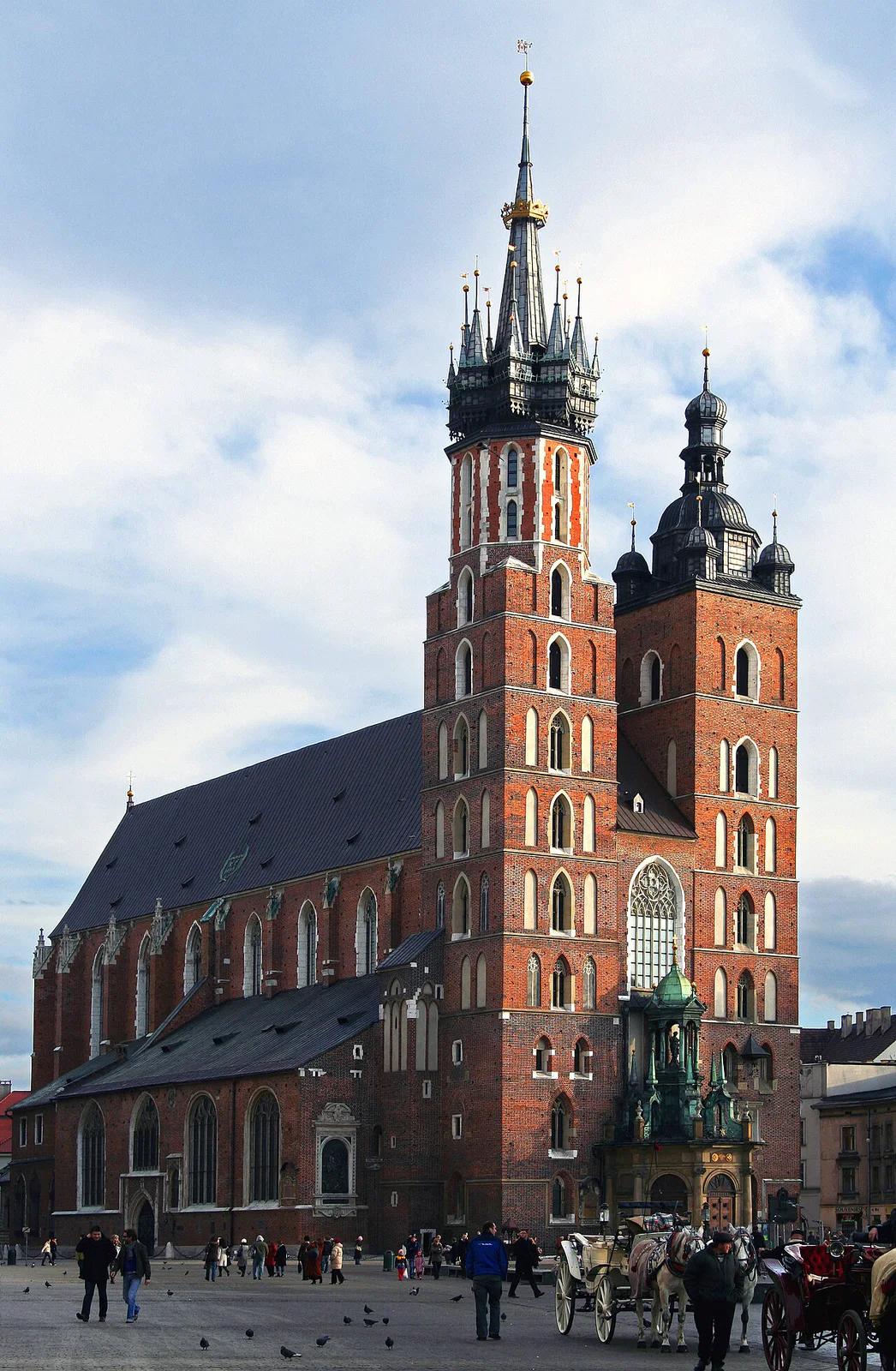
Kościół archiprezbiterialny Wniebowzięcia Najświętszej Marii Panny w Krakowie
Content & sources
Pgkos · CC BY-SA 4.0
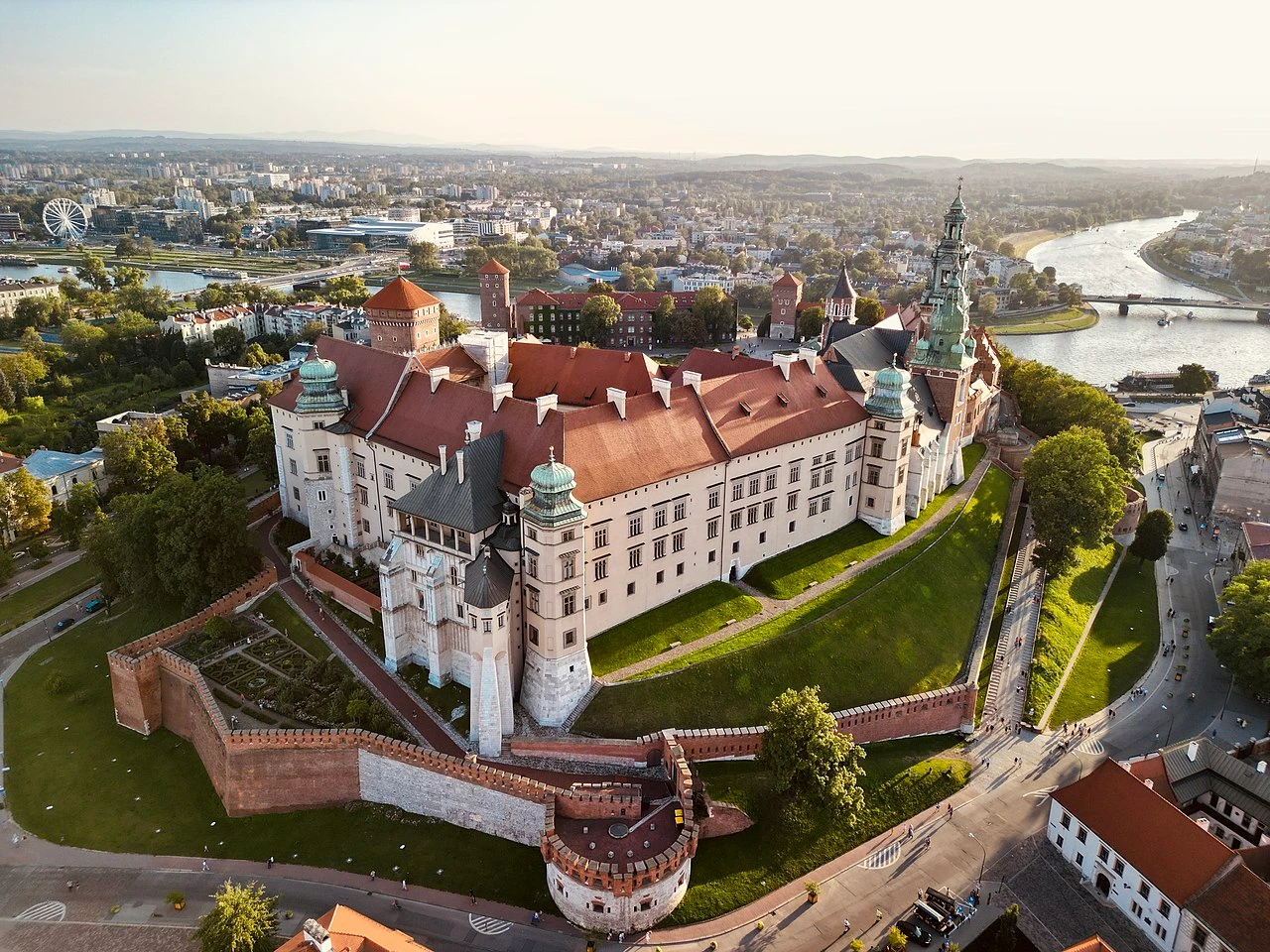
Krakow · 1 km
Wawel Royal Castle
Content & sources
Photo: Monika Towiańska · CC BY-SA 4.0
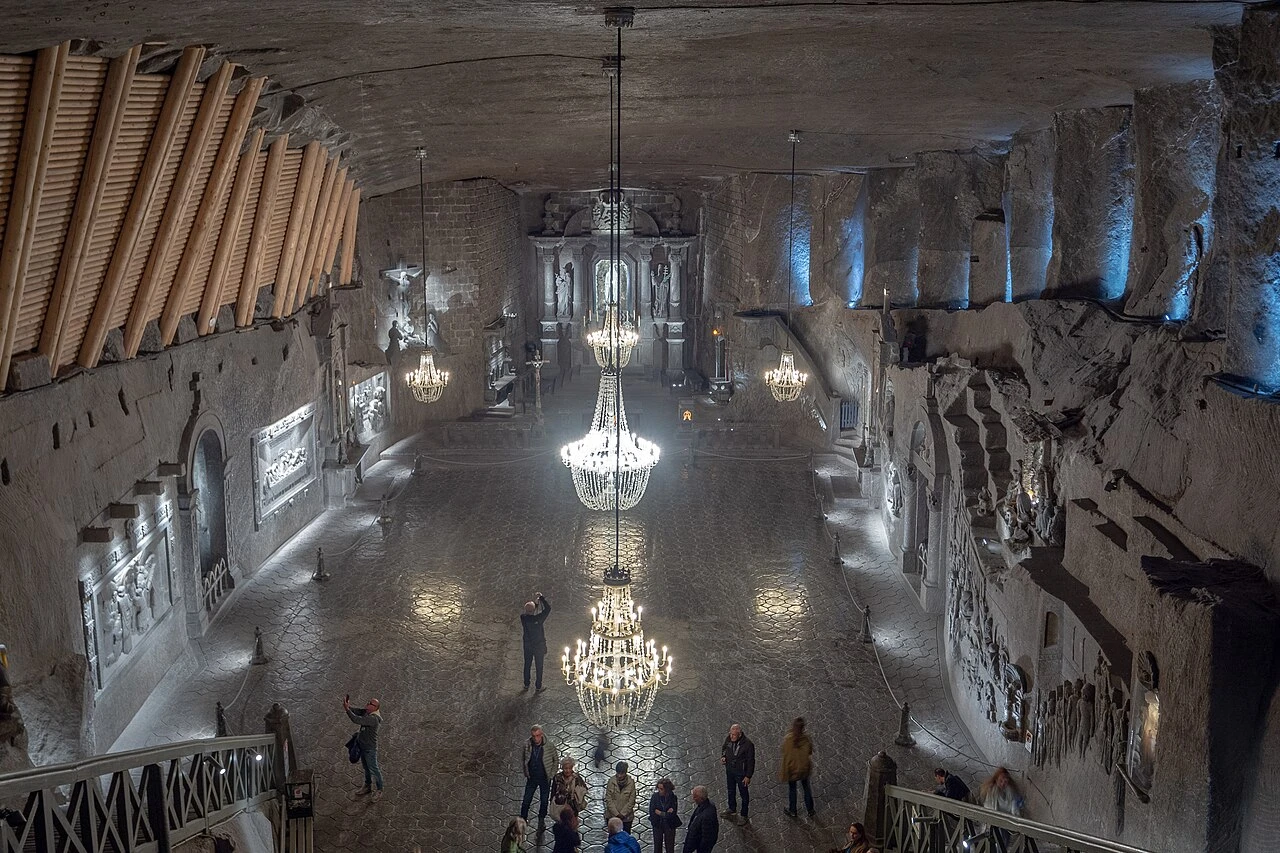
Wieliczka · 13 km
Wieliczka Salt Mine
Content & sources
Photo: C messier · CC BY-SA 4.0
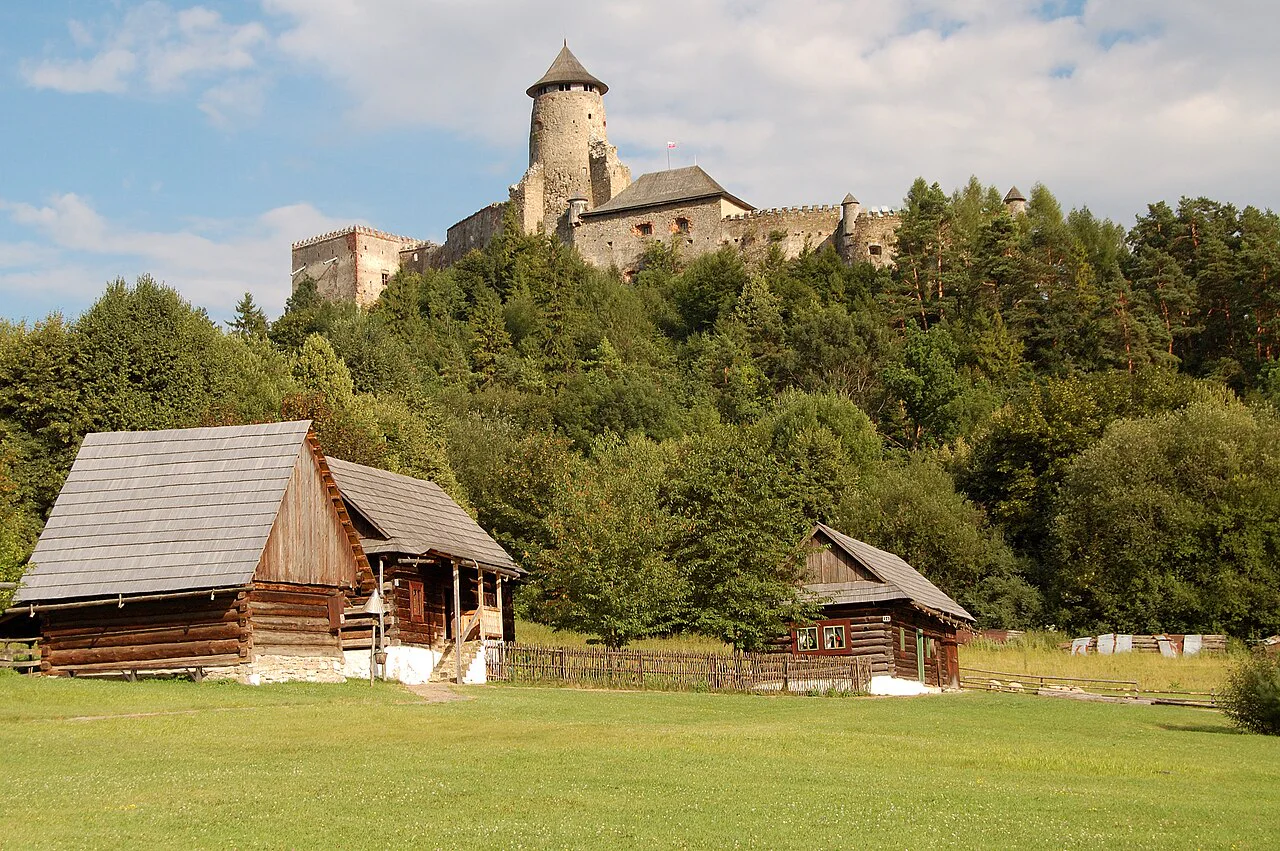
Stará Ľubovňa · 100 km
Ľubovňa Castle
Content & sources
Miro Svorc · CC BY-SA 3.0
Art museums
More art museum audio guides
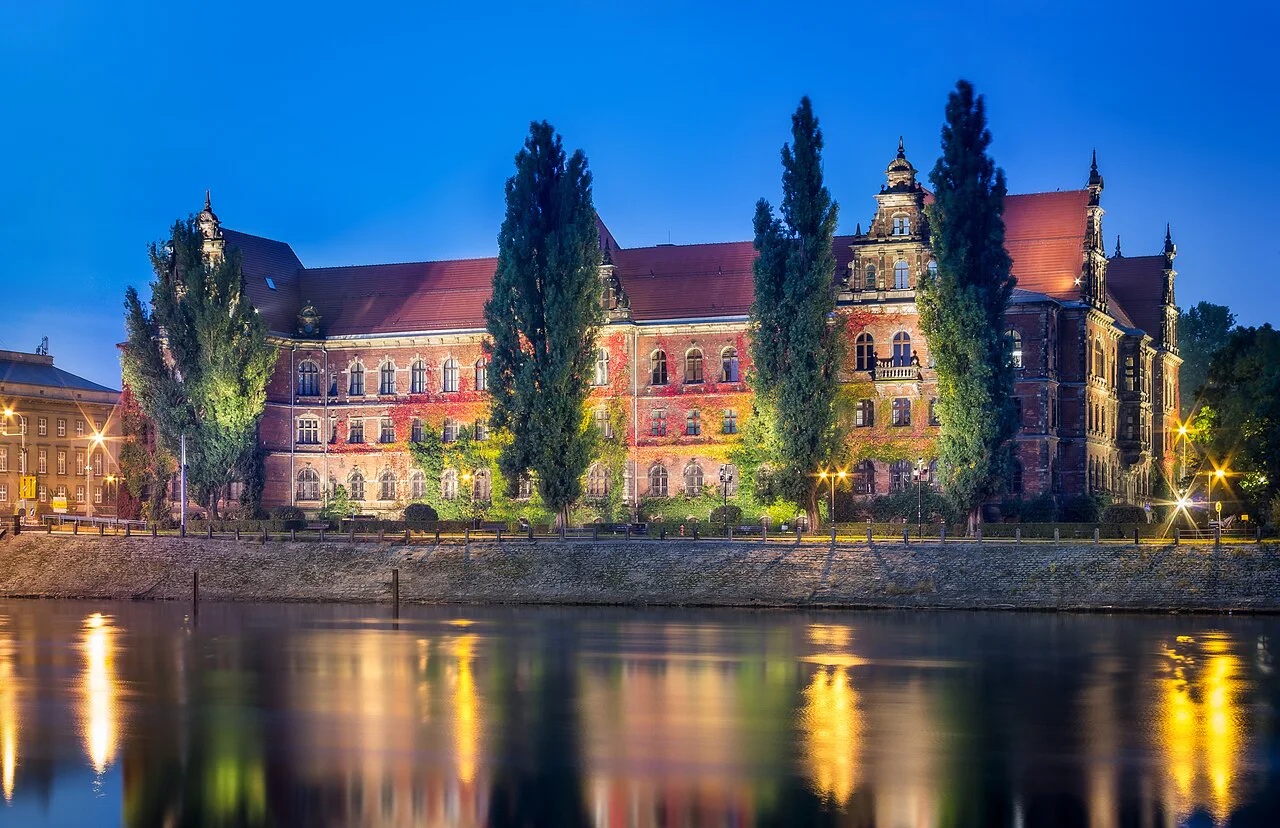
Wrocław · 44 artworks
Muzeum Narodowe we Wrocławiu
Content & sources
Photo: Jar.ciurus · CC BY-SA 3.0 pl
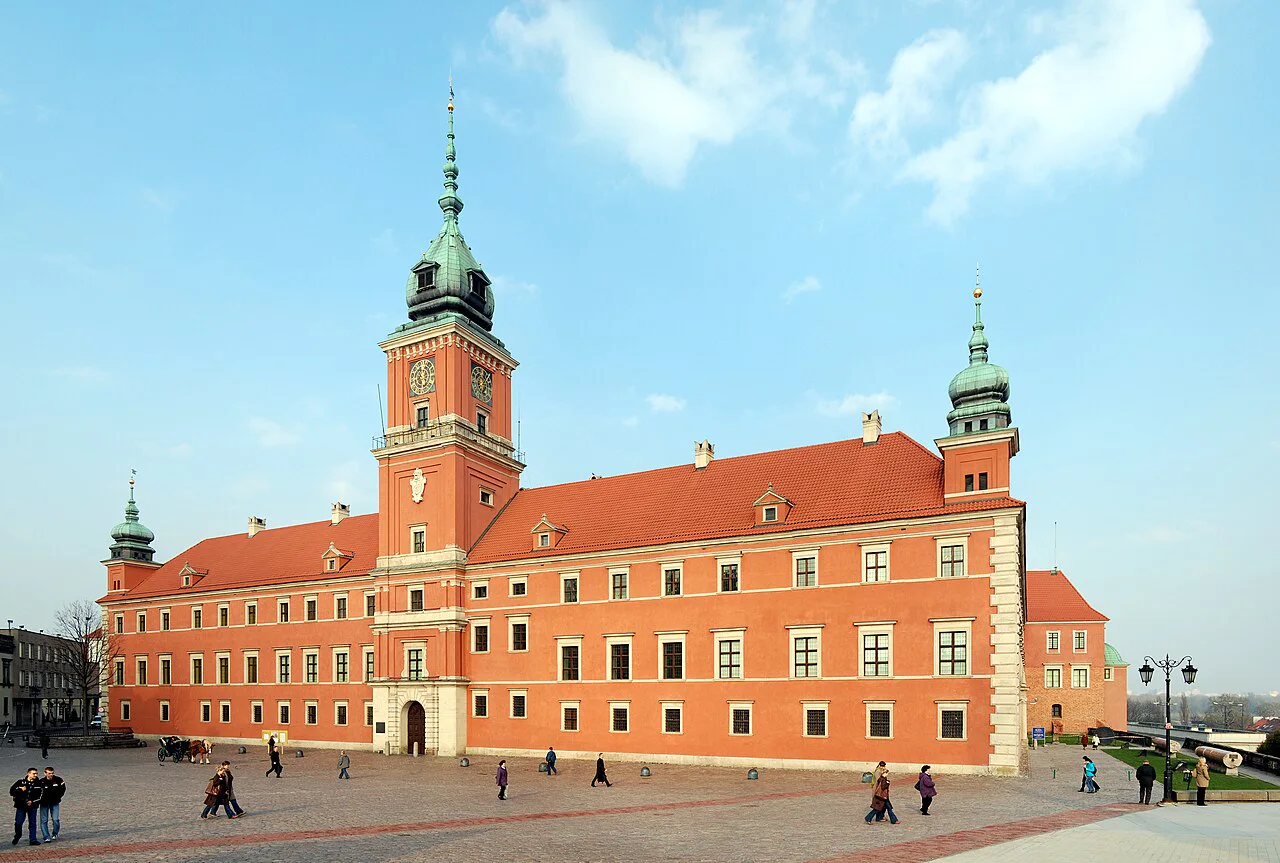
Warsaw · 17 artworks
Zamek Królewski w Warszawie
Content & sources
Marcin Białek · CC BY-SA 3.0
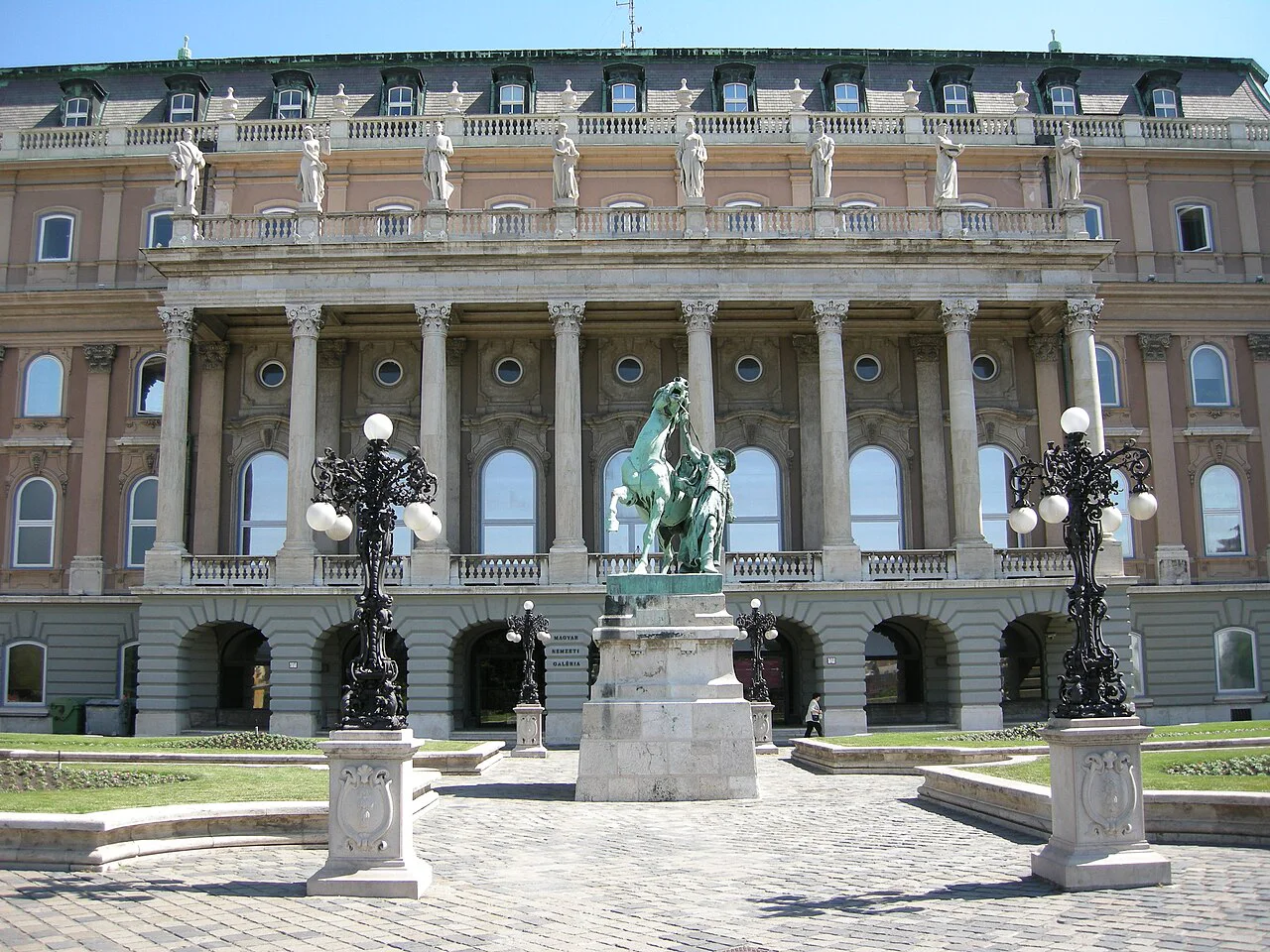
Budapest · 29 artworks
Hungarian National Gallery
Content & sources
Yoav Dothan · Public domain
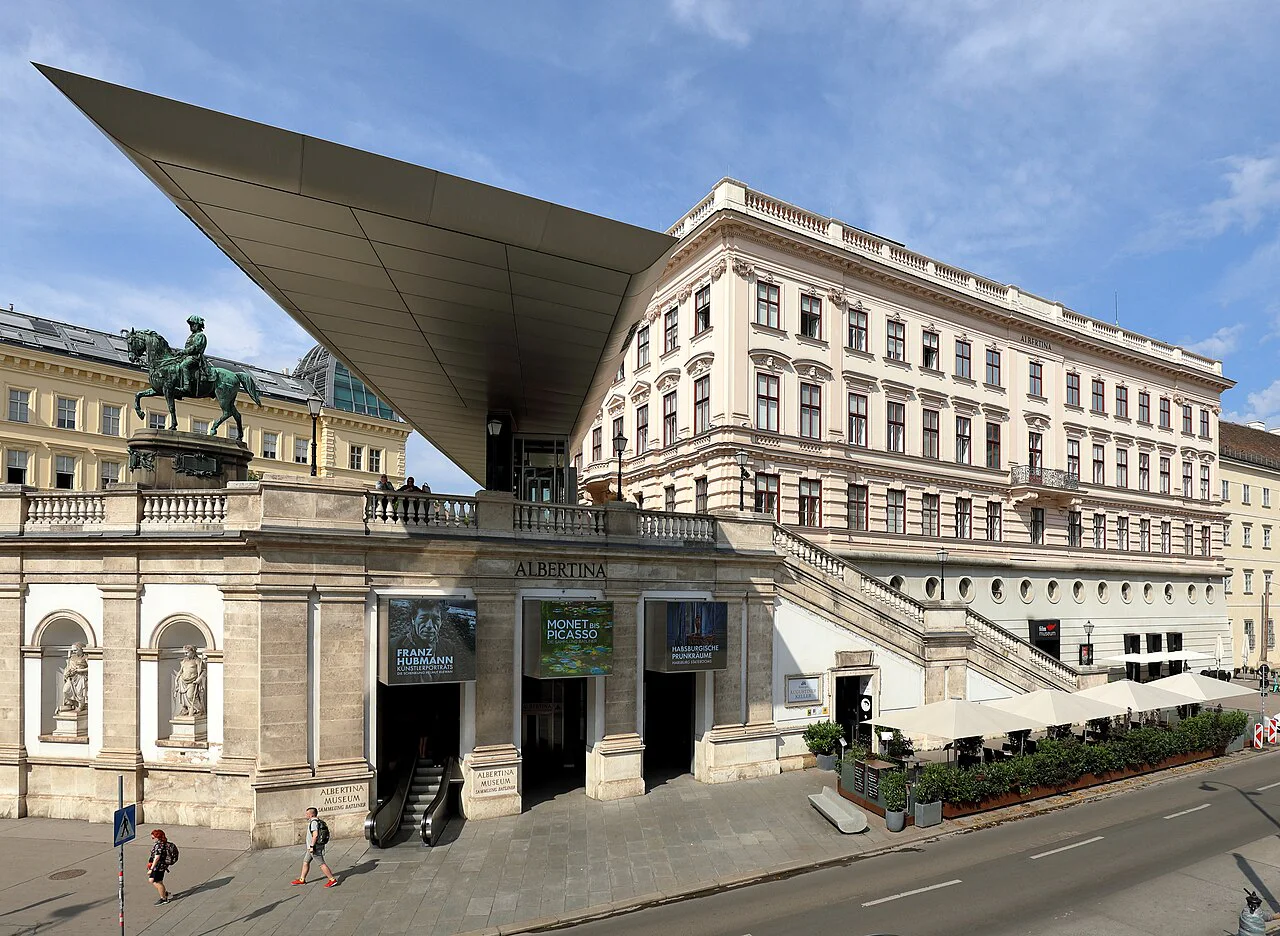
Vienna · 46 artworks
Albertina
Content & sources
C.Stadler/Bwag · CC BY-SA 4.0
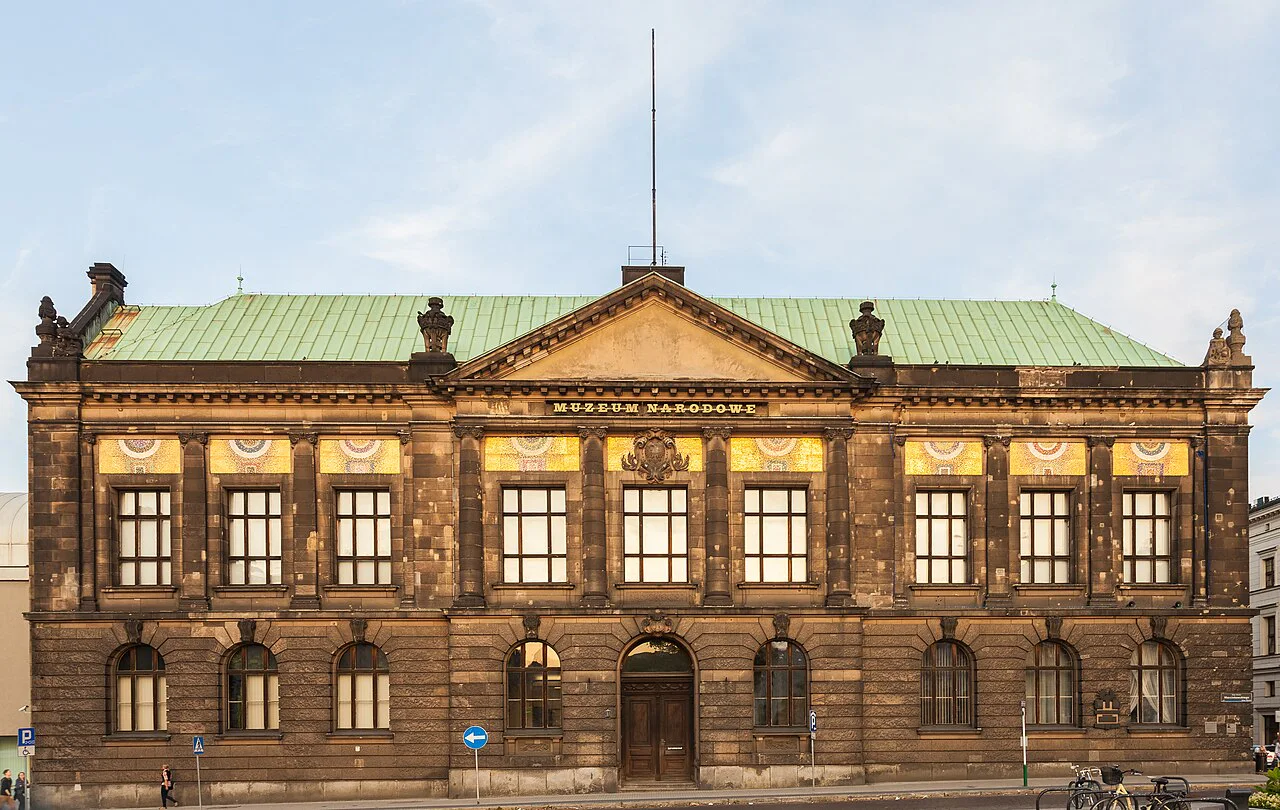
Poznań · 28 artworks
Muzeum Narodowe w Poznaniu
Content & sources
Diego Delso · CC BY-SA 4.0
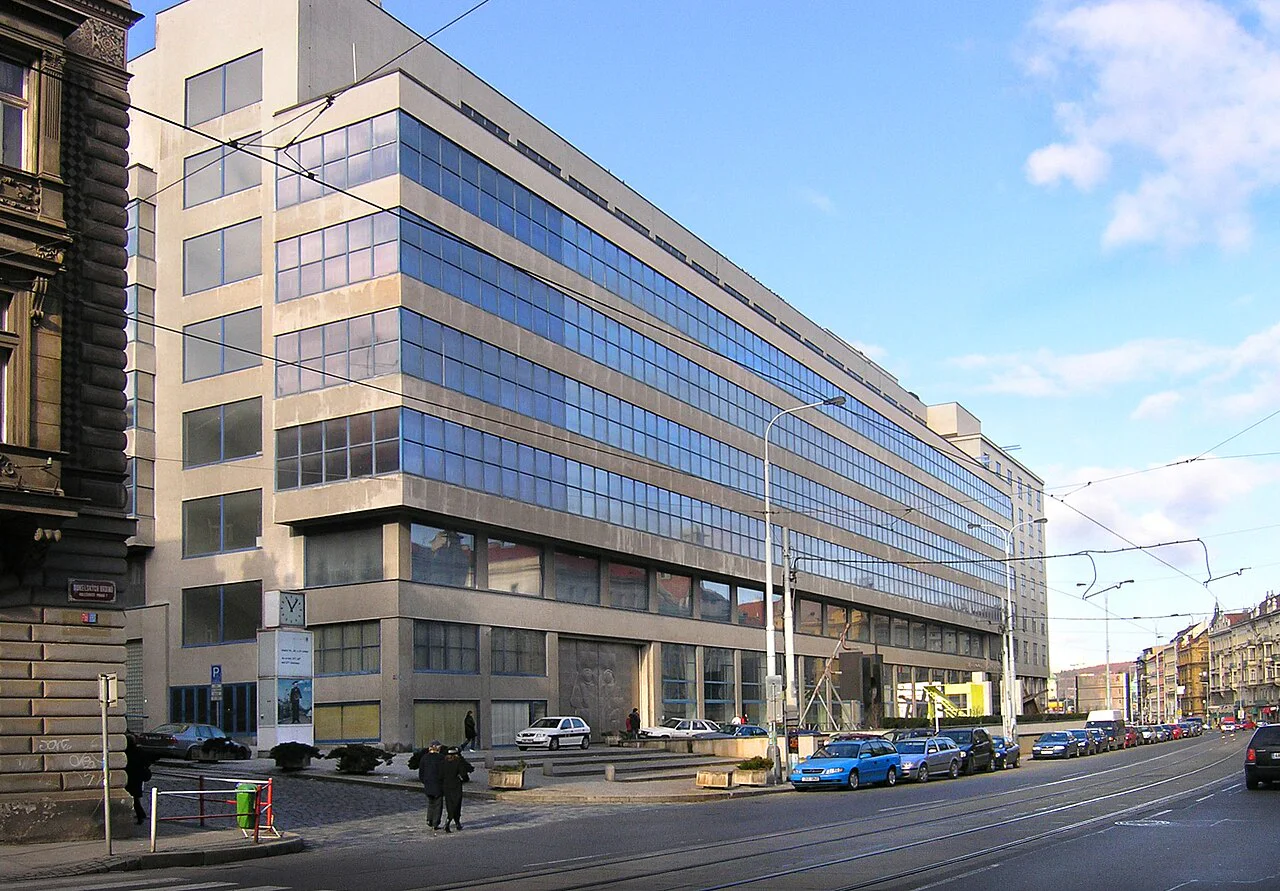
Prague · 93 artworks
National Gallery Prague
Content & sources
Czech Wikipedia user Packa · CC BY-SA 2.5