Stanza · Audio guide
Derby Museum and Art Gallery Audio Guide
A place to remember. A story to take with you.
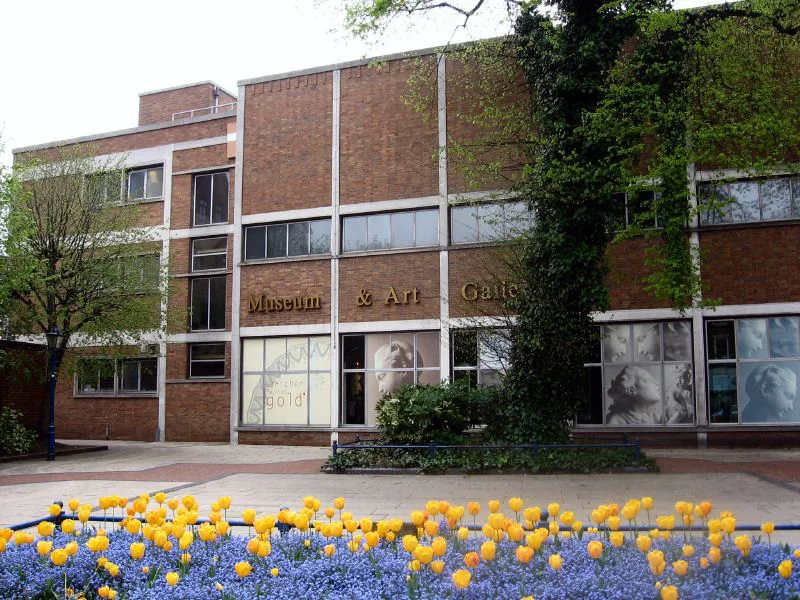
Derby Museum and Art Gallery is a museum and art gallery in Derby, England, established in 1879 along with Derby Central Library in a building designed by Richard Knill Freeman and given to Derby by Michael…
Download Stanza, then search for “Derby Museum and Art Gallery”.
About the tour
One guide. Your kind of visit.
Derby Museum and Art Gallery is a museum and art gallery in Derby, England, established in 1879 along with Derby Central Library in a building designed by Richard Knill Freeman and given to Derby by Michael Thomas Bass. Its collections include many paintings by Joseph Wright of Derby, a large display of Royal Crown Derby and other porcelain, and displays of archaeology, natural history, geology, military collections and world cultures, with the Art Gallery opening in 1882.
The Derby Museum and Art Gallery guide tells the stories of 18 artworks, including A Philosopher Lecturing on the Orrery (Joseph Wright of Derby), The Alchemist Discovering Phosphorus (Joseph Wright of Derby), Indian Widow (Joseph Wright of Derby), Romeo and Juliet: the Tomb Scene (Joseph Wright of Derby), Whitehurst & Son sundial (Clem Rutter, Rochester, Kent.), General Johnson Saving a Wounded French Officer from the Tomahawk of a North American Indian (Benjamin West), A Philosopher by Lamplight (Joseph Wright of Derby), and Miravan Breaking Open the Tomb of his Ancestors (Joseph Wright of Derby). Every artwork is free to hear in the Stanza app until 1 January.
Ready when you are.
- 01Get the free Stanza app.
iOS & Android
- 02Find your guide.
“Derby Museum and Art Gallery”
- 03Download before you go.
Works offline
Audio guide / 18 artworks
Inside the guide
Get to know a few of the stories before you go. Open a stop to read more.
01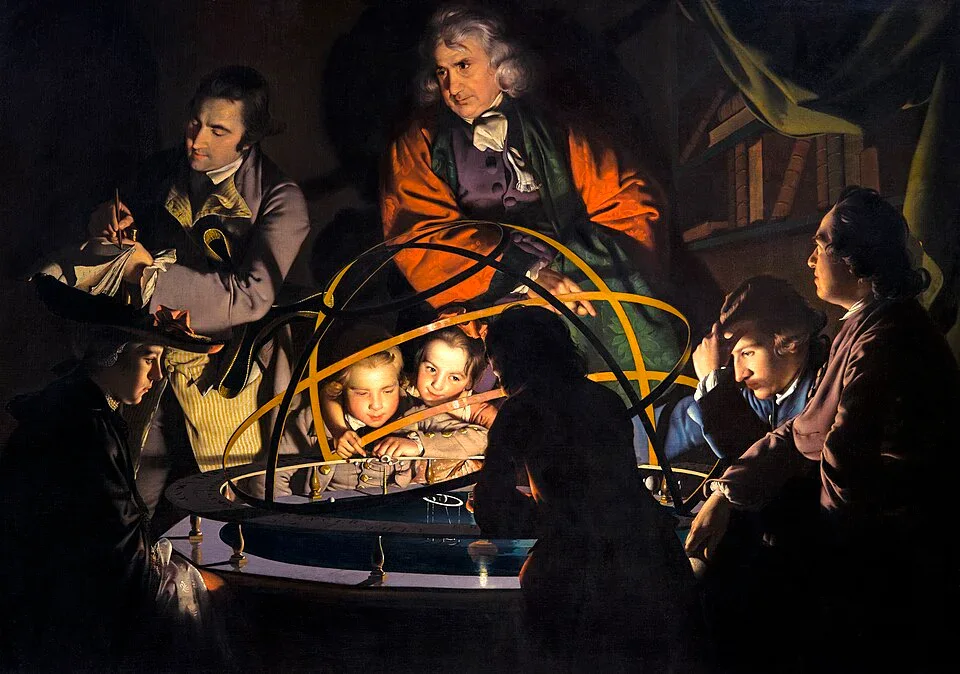
A Philosopher Lecturing on the Orrery
Why does a lamp fill this small audience with awe? A man is demonstrating an orrery, a mechanical model of the solar system. The lamp stands in for the Sun, and the shadows it casts are part of the display. The year before, this painter had shown three men studying a small copy of a Classical statue by candlelight, and people admired it. This one caused a greater stir, because he put a scientific subject where the Classical one had been. He wanted the awe that religious painting had kept for miracles. To him, the wonders of the new technology were just as amazing. He painted it without anyone asking him to. He probably hoped the buyer would be Washington Shirley, the fifth Earl Ferrers, a navy officer who owned an orrery. And it was, for two hundred and ten pounds, when the picture went on show in 1766. Each adult face shows a phase of the Moon, from new to full.
Listen in the appJoseph Wright of Derby · Public domain
02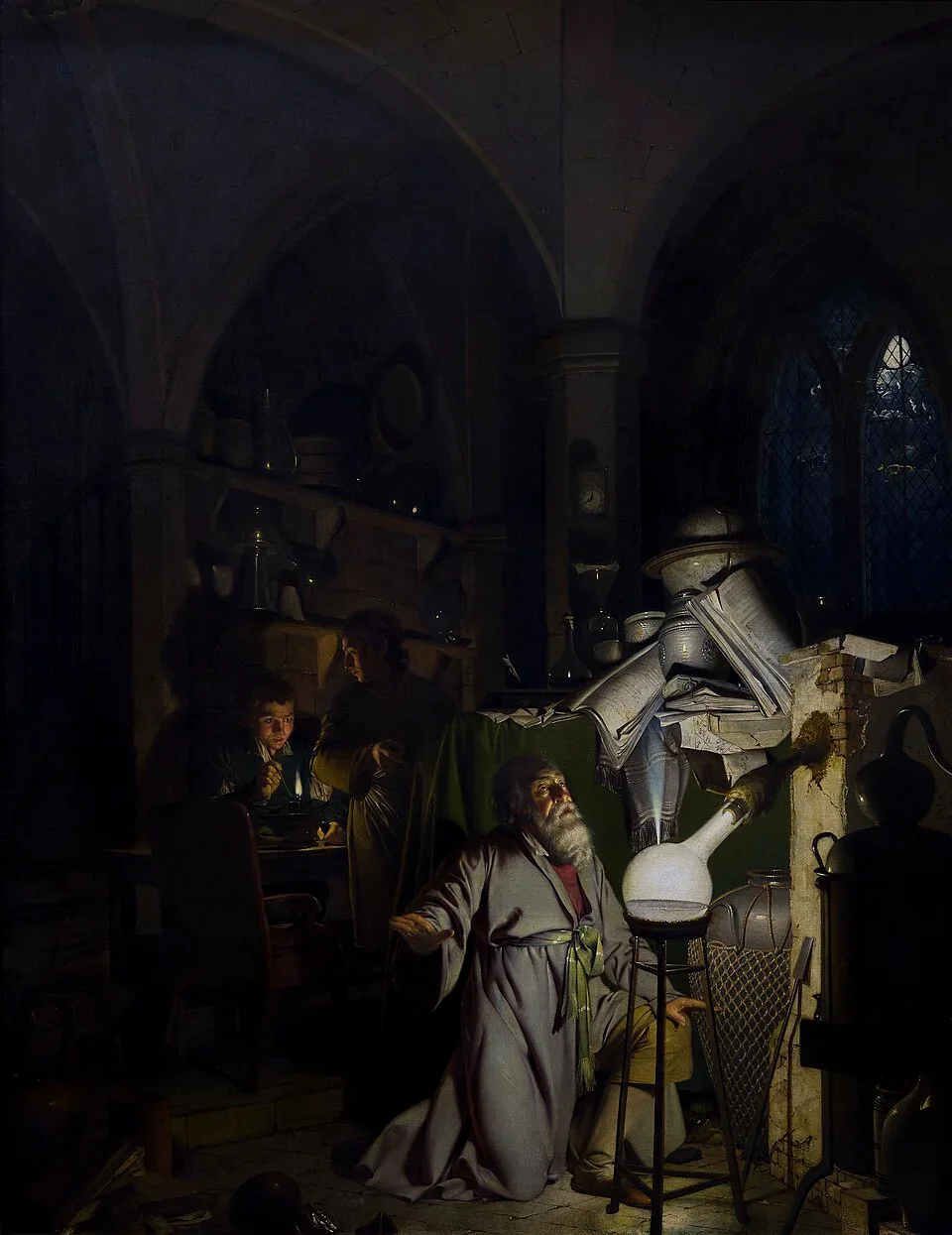
The Alchemist Discovering Phosphorus
The alchemist kneels before a shining vessel and stretches out his hands. The gesture is like a saint in prayer, or a disciple receiving communion. Wright imagined the room with medieval Gothic arches and high pointed windows, as if the man were inside a church. What he is after, though, is the philosopher's stone, the stuff that would turn ordinary metal into gold. Instead he discovers phosphorus. The picture may refer to the discovery of phosphorus by Hennig Brand, an alchemist in Hamburg, in 1669. The story was often printed in chemistry books of Wright's day and widely known. The real work was nothing like this. To make phosphorus you boiled down urine, fifty or sixty pails of it, putrid and full of worms. The painter made the whole thing look far nicer than that. His friend Peter Perez Burdett had a strong hand in the design. His sketch of 1771 shows the vaulting and the glass vessel at the centre, and he fixed the figure's place. Burdett had already sent the painter to Matthew Turner, so he could fully understand the science behind the scene.
Listen in the appJoseph Wright of Derby · Public domain
03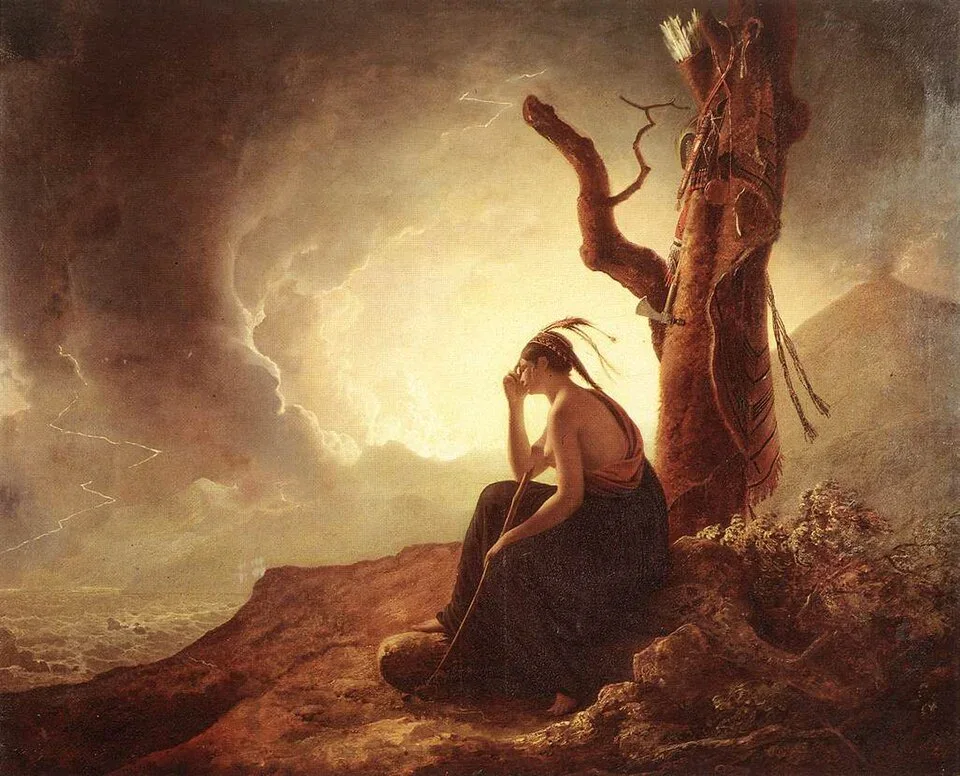
Indian Widow
For the first month after her husband died, this woman kept watch beneath his mourning war pole. She is a chief's widow, watching over the arms of the man she lost. Her bearing is that of an antique statue. But Joseph Wright never crossed the Atlantic. He found that vigil in a book on the American Indians, and painted her from the account. Her headband, her feathers and the buffalo robe painted on its skin side are authentic. They show a knowledge of Native American making that reaches as far west as the upper Great Lakes. But her drapery is the standard clothing of any grieving woman. She is silhouetted against sunlight and a stormy sky, unlike his candlelit scenes. He meant her to stand with three other pictures of women made strong by virtue, love or loyalty. The shore behind her, with its volcano, has more to do with Naples, which he had seen as a young man, than with America.
Listen in the appJoseph Wright of Derby · Public domain
04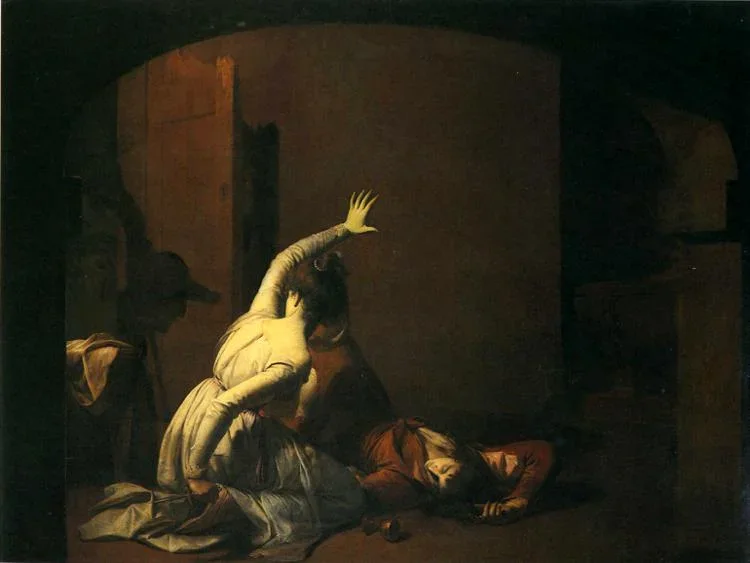
Romeo and Juliet: the Tomb Scene
Why is there a dagger in her hand? Juliet kneels beside Romeo's body. She hears a footstep, and draws his dagger to kill herself. It is the instant in Shakespeare when she calls the dagger happy, just before she kills herself. Her arms stretch outward, and the tomb is lit by candle, one of Wright's night scenes. Wright first proposed the subject in December 1776, Juliet waking in the tomb. It was for a Shakespeare Gallery that Alderman John Boydell was putting together. Then Wright learned Boydell had sorted his painters into two classes, and put him in the lower one. Three hundred pounds for this painting, while others were paid a thousand. What angered Wright was not the money. It was the damage to his standing as an artist. Boydell would not budge. The painting was ready on time. But Boydell took two other Shakespeare scenes from Wright instead, and this one stayed with him. Shown at the Royal Academy in 1790, then reworked and shown again the next year, it still did not sell. There was no buyer at Christie's in 1801, or in Derby in 1810. Rejected by Boydell, it passed through the Oakes family and reached this museum only in 1981.
Listen in the appJoseph Wright of Derby · Public domain
05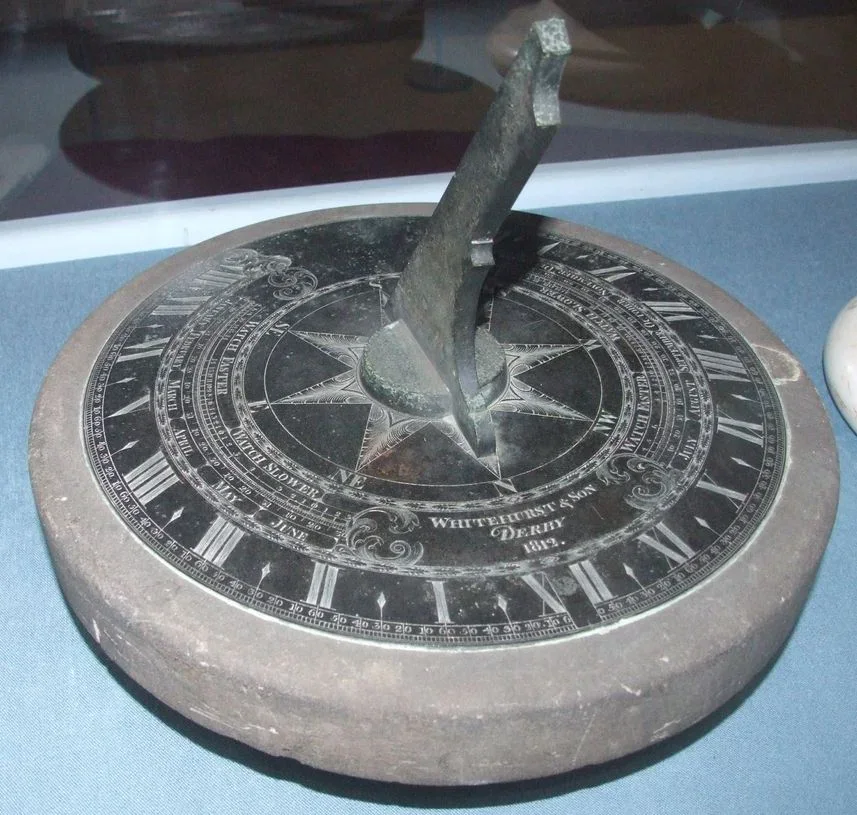
Whitehurst & Son sundial
The shadow falls across this dial, and at noon it lies right on the line that runs north and south, not a little to one side. John Whitehurst's nephew, who carried on the family clock business in Derby, made this dial in 1812. He cut it for the latitude of one place, Belper. Its pointer rises there at fifty three degrees, one minute, forty nine seconds. Because noon sits exactly on that line, this dial gives Belper time and not the time at Greenwich. The pointer is thick, with one edge throwing the shadow before noon and the other after. A sundial shows the sun's time, a clock shows an average, and the gap between them can reach sixteen minutes in November and February. This dial was made to bridge it. It carries a pair of scales. One gives the day and month. The other, marked Watch Slower, Watch Faster, tells you how many minutes fast or slow your pocket watch is that day. The fifteenth of April needs no correction. In 1812 a watch did not always keep true time, and this was how you set it. Who it was made for is not certain, though it was probably George Benson Strutt, for his home at Bridge Hill House.
Listen in the appClem Rutter, Rochester, Kent. · CC BY-SA 3.0
06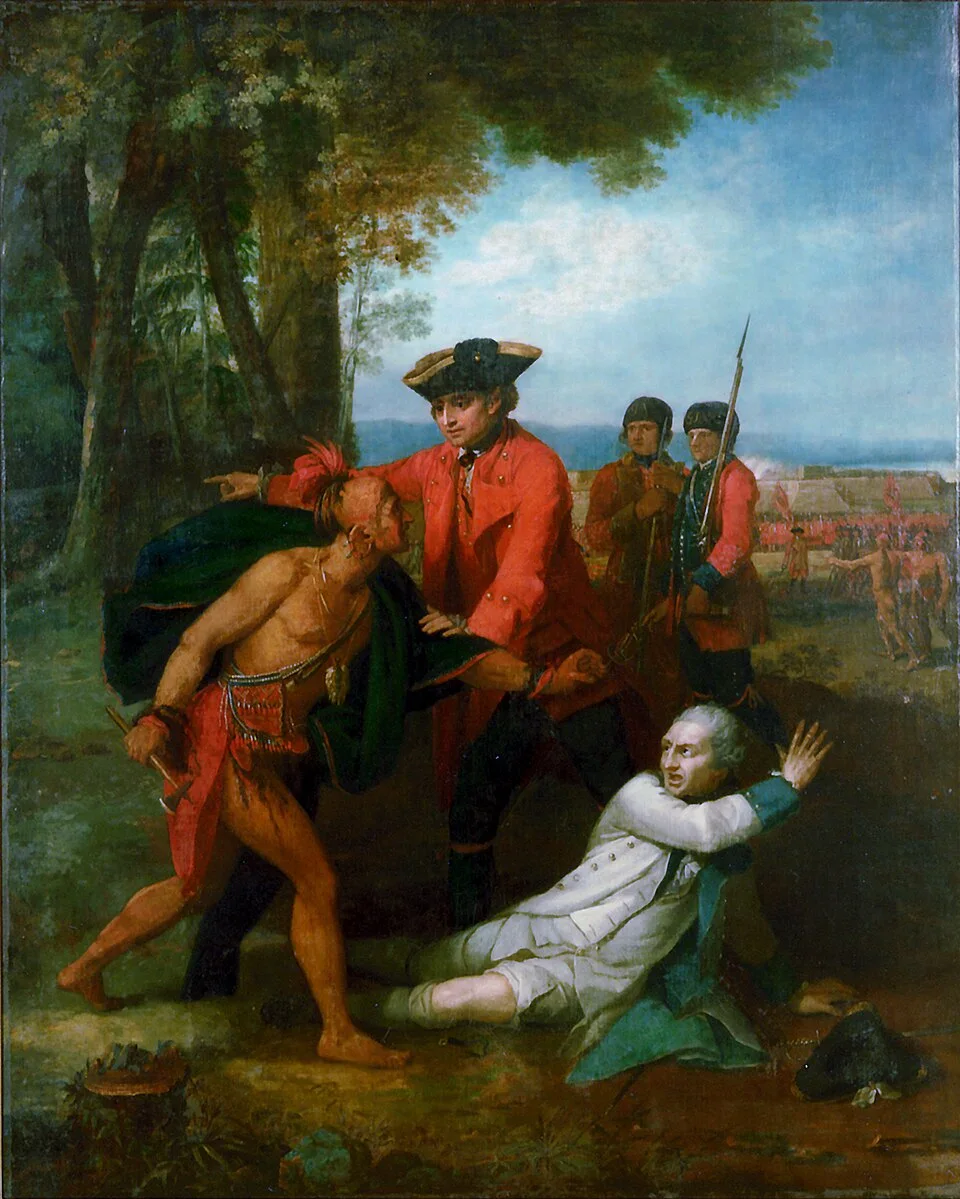
General Johnson Saving a Wounded French Officer from the Tomahawk of a North American Indian
No one can say for sure which battle this scene comes from. It is usually linked to fighting around Lake George in 1755. Yet West took care to show the proper dress and equipment. Benjamin West probably began it soon after he came back to London in 1763, after three years in Italy. In The Indian Family, from about 1761, he used the same care to show Indian life in general. Here it reports something that really happened. On the ground lies Baron Dieskau, the French commander, wounded three times. A Mohawk warrior, wanting revenge for kinsmen who had been killed, is about to take his scalp with a tomahawk. Sir William Johnson, the British commander and an Irish soldier, holds the warrior back and saves the Frenchman's life. Dieskau lived. He was taken prisoner to New York, then London, then Bath, where a wound would not heal. When the Seven Years' War ended in 1763, he was sent back to France, and he died there in 1767. The warrior's plucked scalp and tattoos are painted in more detail than the European uniforms. West kept a collection of North American artefacts and used them in his paintings.
Listen in the appBenjamin West · Public domain
07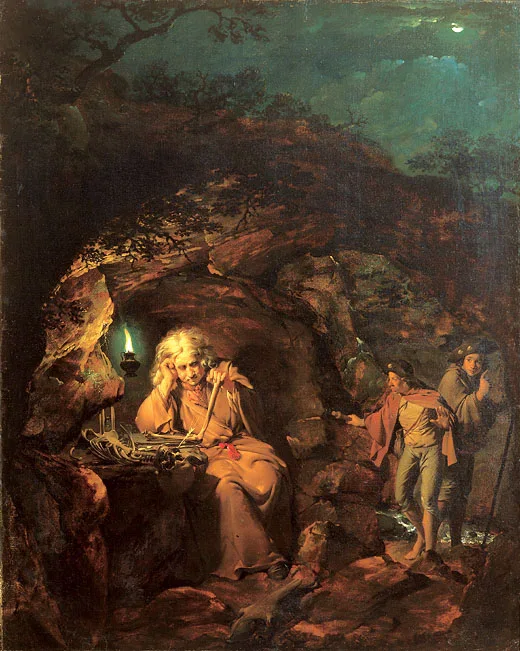
A Philosopher by Lamplight
A lamp, not daylight, lights this whole cave. Shown first in London in 1769, this was among the earliest of the lamplight pictures Wright made, the kind he would become known for. The light falls on an old man holding a collection of human bones. He is usually called a philosopher, and the picture has another name as well, A Hermit Studying Anatomy. But he does not hold those bones the way a man truly studying them would. There is an hourglass, and beyond the cave a moon that must be born again every four weeks. The lamp will burn through all its fuel. Every one of them is about how short a human life can be. The moon was the emblem of the Lunar Society, a circle of scientists he kept close to but never joined. The scallop shells in the two small pilgrims' hats are the badge of Saint James, and they were also the emblem of the Darwin family. Erasmus Darwin was a leading member of that society. The philosopher is deep in thought, and the pilgrims seem uneasy as they come closer. That may be the worry stirred up by the new science of his time.
Listen in the appJoseph Wright of Derby · Public domain
08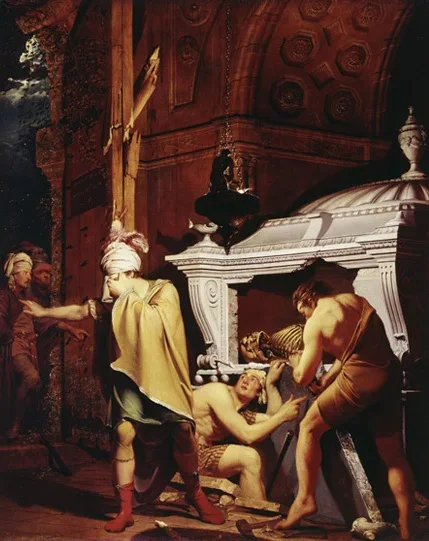
Miravan Breaking Open the Tomb of his Ancestors
A second inscription lies inside the opened tomb. It tells Miravan he will find no lasting rest, because he has disturbed one of his own ancestors. He was a Persian nobleman who had discovered the tomb of one of his forebears. On the tomb he had read a promise of more wealth than Croesus ever possessed. Greed drove him to have it broken open. The painting holds his disgust and dismay at the moment he understands he has been tricked. Wright, known for his studies of unusual lighting, lights the scene with a single oil lamp and a little moonlight. The story came from a book of letters published in 1755. Its author, John Gilbert Cooper, claimed it was Persian, though no original source for it is known.
Listen in the appJoseph Wright of Derby · Public domain
09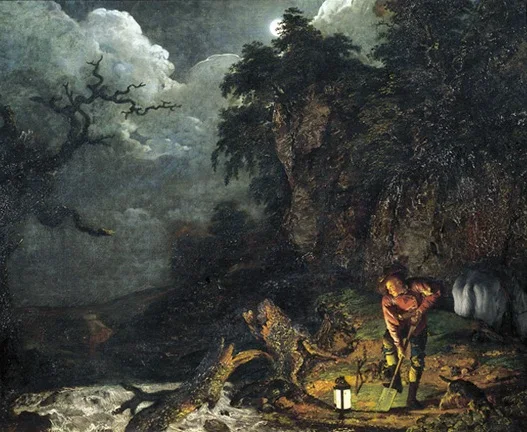
Earthstopper on the Banks of the Derwent
On the bank of the River Derwent in Derbyshire, a man is digging at night. He is blocking the entrance to a fox's den. The next day, a foxhunt will come this way. With the den closed, the fox cannot take refuge underground. It will have to stay above ground, where the hunters can reach it. A man who did this work had a name. He was called an earthstopper. Joseph Wright liked to paint scenes lit in unusual ways. Here he took that interest into a landscape, as he did in only a few paintings before his journey to Italy. The painting may have inspired a poem by Francis Noel Clarke Mundy. The poem appeared in a collection that sought to preserve Needwood Forest. Wright had built pictures of his own on literature, and now a poet was writing in answer to one of his. Mundy later commissioned six portraits from Wright, of himself and five friends, all in the uniform of Mundy's own private hunt.
Listen in the appJoseph Wright of Derby · Public domain
10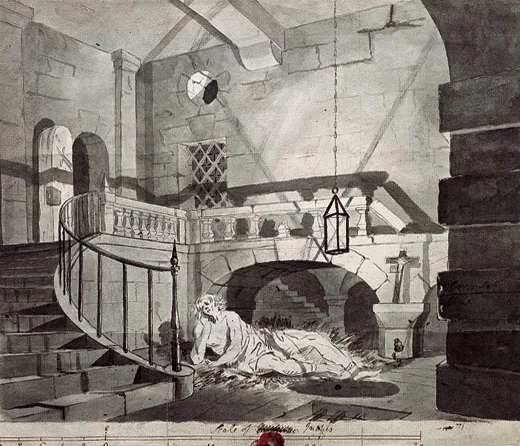
The Captive King
The writing on this drawing was put there by a friend, not by the artist. The friend was Peter Perez Burdett. Burdett had given Joseph Wright lessons in perspective, and Wright asked his advice about how a painting was constructed. His comments sit right on the sheet that Wright drew. This was one of at least three sketches he made before painting the captive king. In the winter between 1772 and 1773, he sent them to Burdett in Liverpool, to hear what his friend thought. The prisoner is Guy de Lusignan, held by Saladin. He had become King of Jerusalem by marrying Sibylla. In 1187 Saladin defeated his army and took him prisoner. The true cross relics were probably lost in the fighting too. Saladin later set him free, and Lusignan went on to rule Cyprus. The sketch is thought to have prepared a painting that is now lost.
Listen in the appJoseph Wright of Derby · Public domain
- 11
The Captive
Joseph Wright of Derby · 1778
- 12
Hanson Log Boat
Unknown Artist
- 13
Thomas and Ann Borrow
Joseph Wright of Derby · 1762–1763
- 14
Vesuvius in Eruption
Joseph Wright of Derby · 1774
- 15
Self Portrait at the Age of about Forty; Verso: Study for 'An Experiment on a Bird in the Air Pump'
Joseph Wright of Derby · c. 1772
- 16
Jedediah Strutt
Joseph Wright of Derby · 1790
- 17
Richard Arkwright (1732–1792), English inventor
Joseph Wright of Derby · 1790
- 18
Portrait of Samuel Ward
Joseph Wright of Derby · c. 1781
Derby Museum and Art Gallery
Frequently asked questions
How much does the guide cost?
Free app download. Free until 1 January. Listed guide price: $0.99. Audio guide only. Venue admission is separate.
Can I listen without internet?
Yes. Download the guide’s audio, images, and maps in the app before your visit. Your downloaded content is then available offline.
Can I listen in my language?
In English for now. More languages soon.
Do I need to follow a schedule?
No. This is a self-guided experience. Choose your stops, pause whenever you like, and return to a story at your own pace.
Which artworks are in the Derby Museum and Art Gallery audio guide?
18 artworks, including A Philosopher Lecturing on the Orrery (Joseph Wright of Derby), The Alchemist Discovering Phosphorus (Joseph Wright of Derby), Indian Widow (Joseph Wright of Derby), Romeo and Juliet: the Tomb Scene (Joseph Wright of Derby), Whitehurst & Son sundial (Clem Rutter, Rochester, Kent.), General Johnson Saving a Wounded French Officer from the Tomahawk of a North American Indian (Benjamin West), A Philosopher by Lamplight (Joseph Wright of Derby), and Miravan Breaking Open the Tomb of his Ancestors (Joseph Wright of Derby). The full list is on this page.
Is this the museum’s official audio guide?
No. Stanza is an independent audio guide app and is not affiliated with Derby Museum and Art Gallery. Museum admission is separate.
At your own pace
Explore Derby Museum and Art Gallery.
Download Stanza, then search for “Derby Museum and Art Gallery”.
Free app download · Guide price shown in the app
Keep exploring
Nearby audio guides
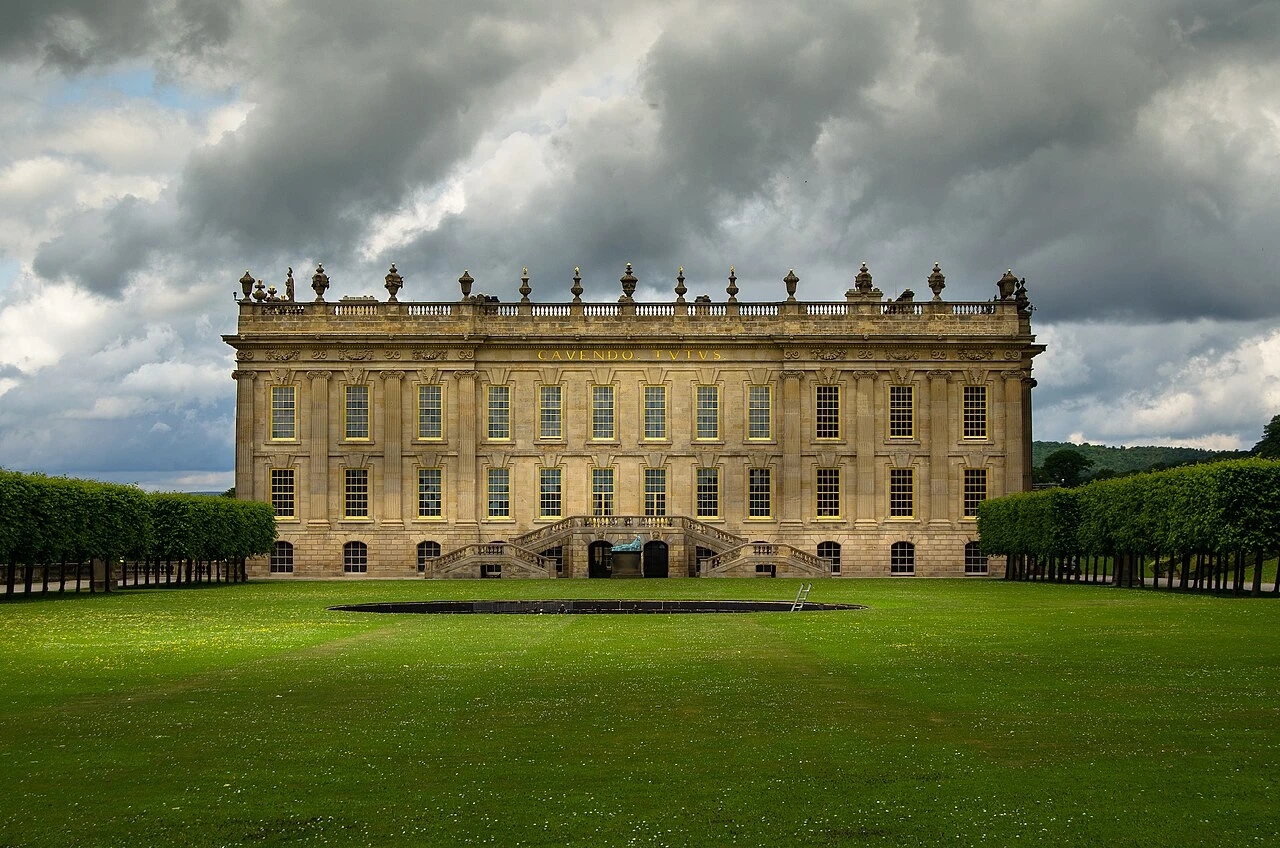
Derbyshire Dales · 35 km
Chatsworth House
Content & sources
Photo: Rprof · CC BY-SA 3.0
Elmton with Creswell · 42 km
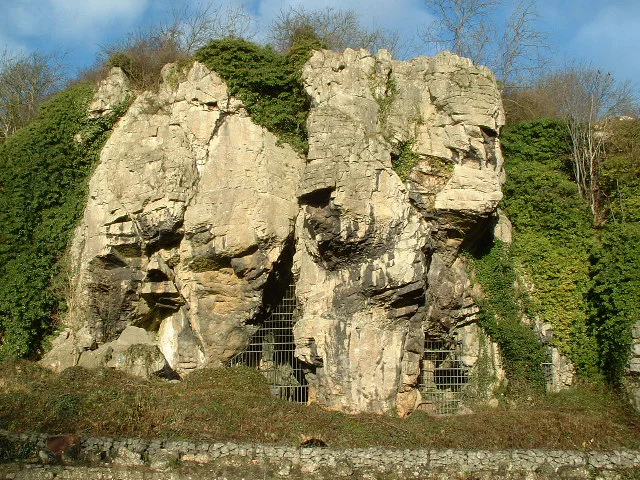
Creswell Crags
Content & sources
Nigel Homer · CC BY-SA 2.0
Birmingham · 57 km
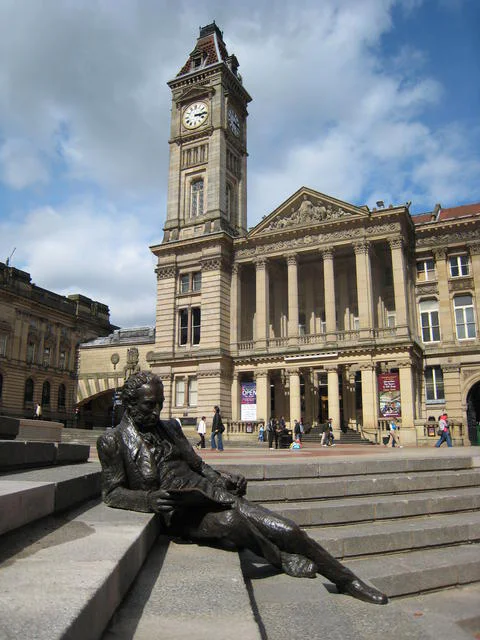
Birmingham Museum and Art Gallery
Content & sources
David Stowell · CC BY-SA 2.0
Kenilworth · 64 km
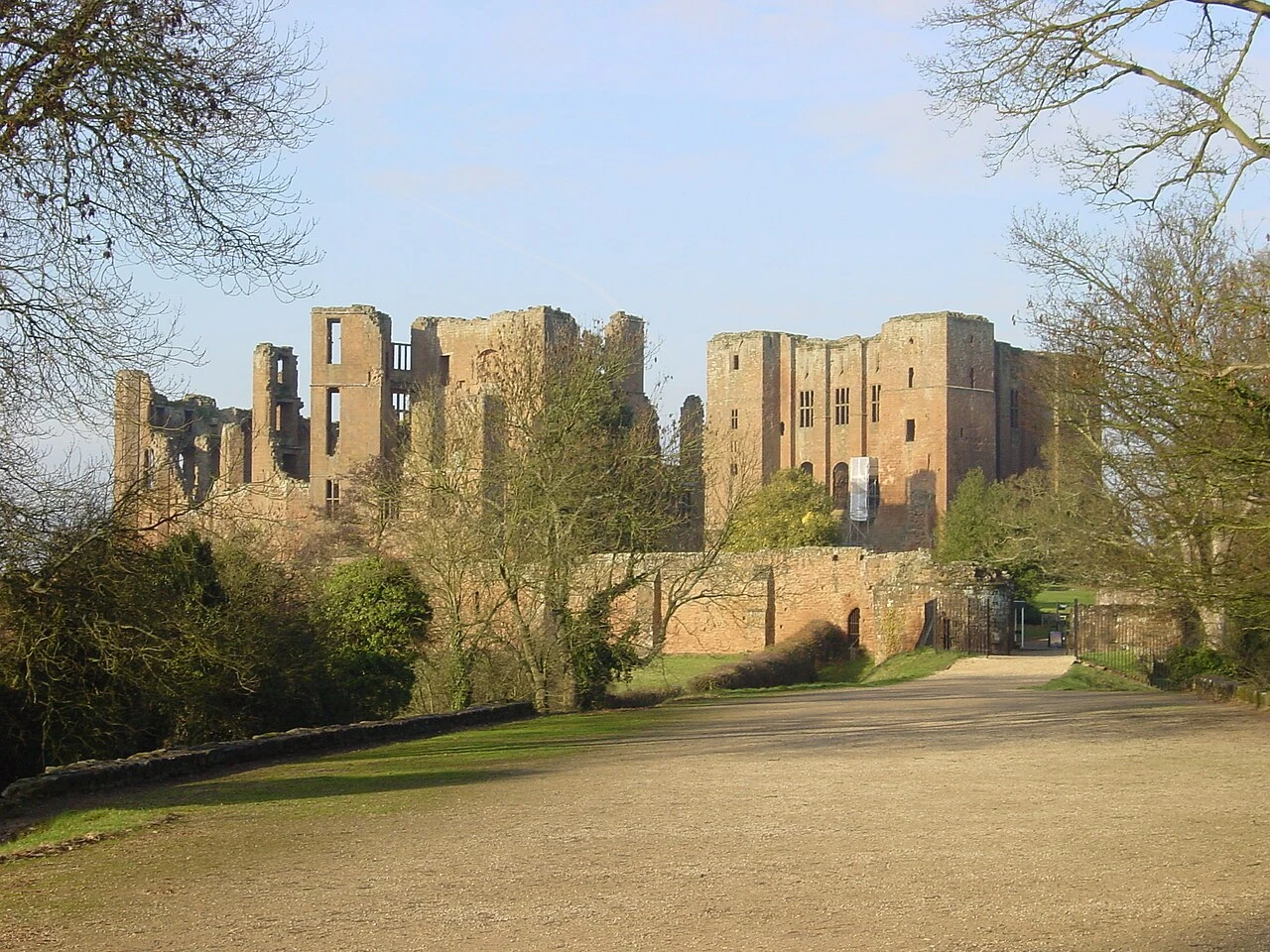
Kenilworth Castle
Content & sources
Photo: Jdforrester · CC BY 1.0
Art museums
More art museum audio guides
Birmingham · 42 artworks
Birmingham Museum and Art Gallery
Content & sources
David Stowell · CC BY-SA 2.0
Manchester · 65 artworks
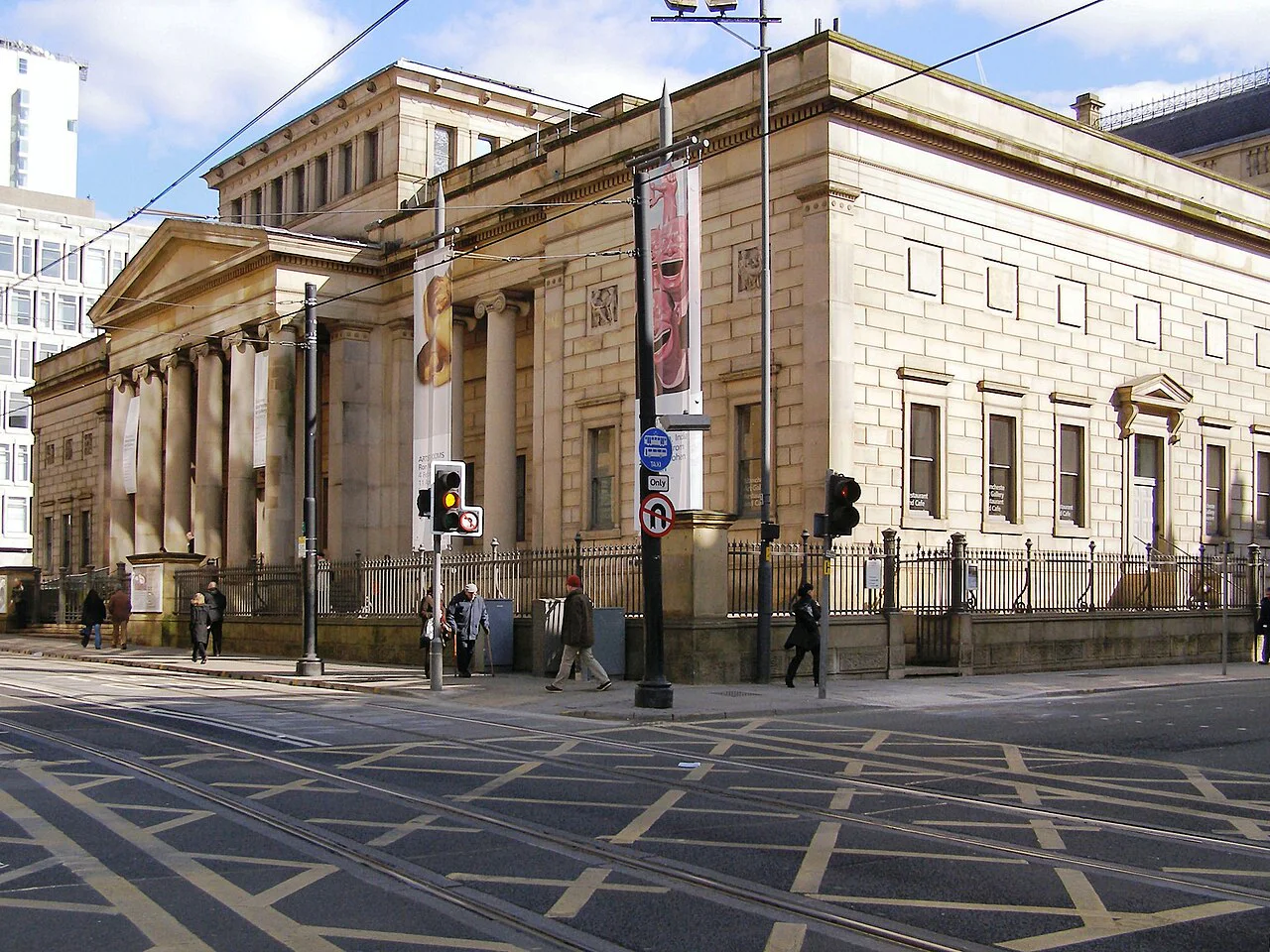
Manchester Art Gallery
Content & sources
David Dixon · CC BY-SA 2.0
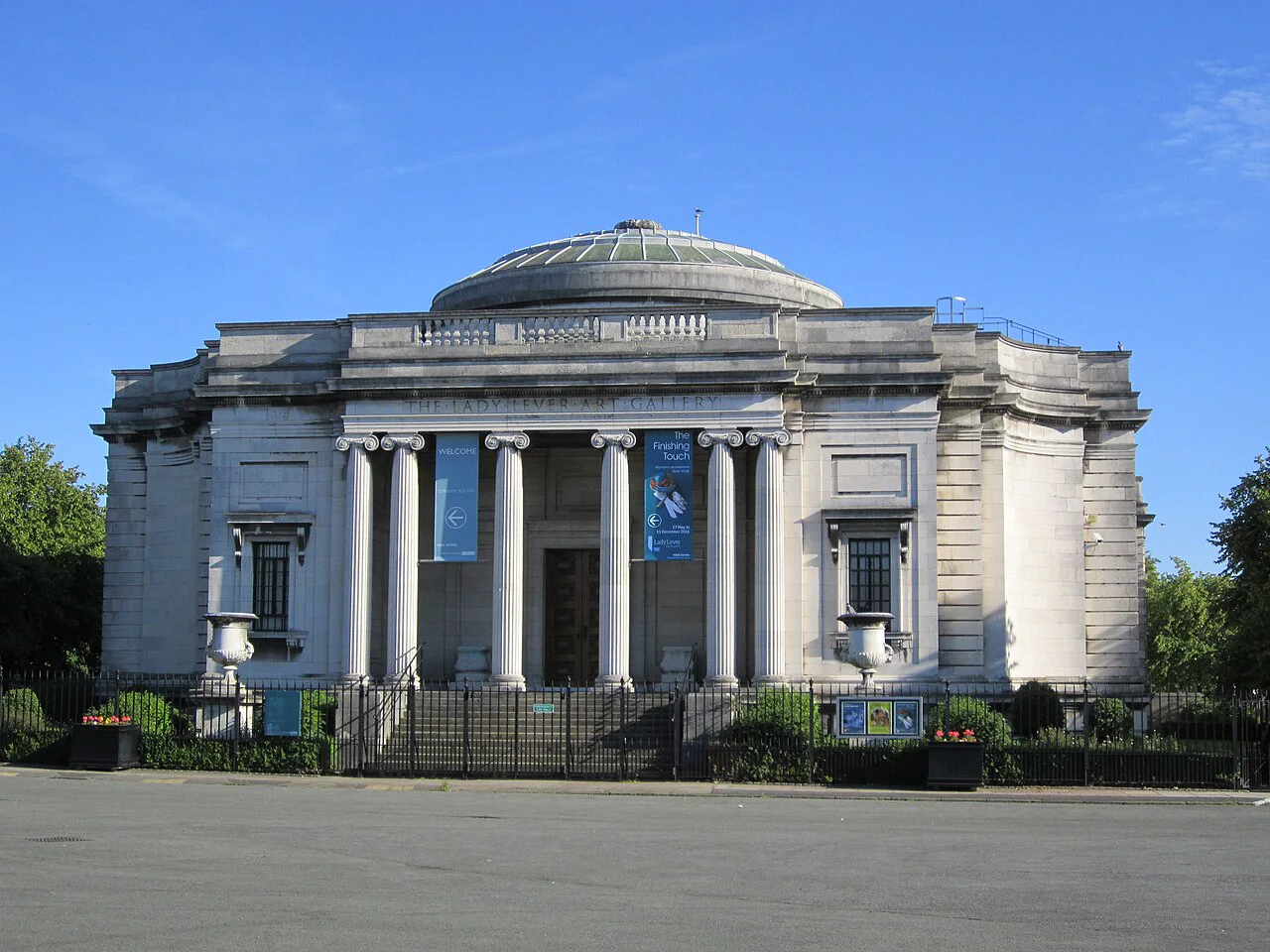
Port Sunlight · 28 artworks
Lady Lever Art Gallery
Content & sources
Rept0n1x · CC BY-SA 3.0
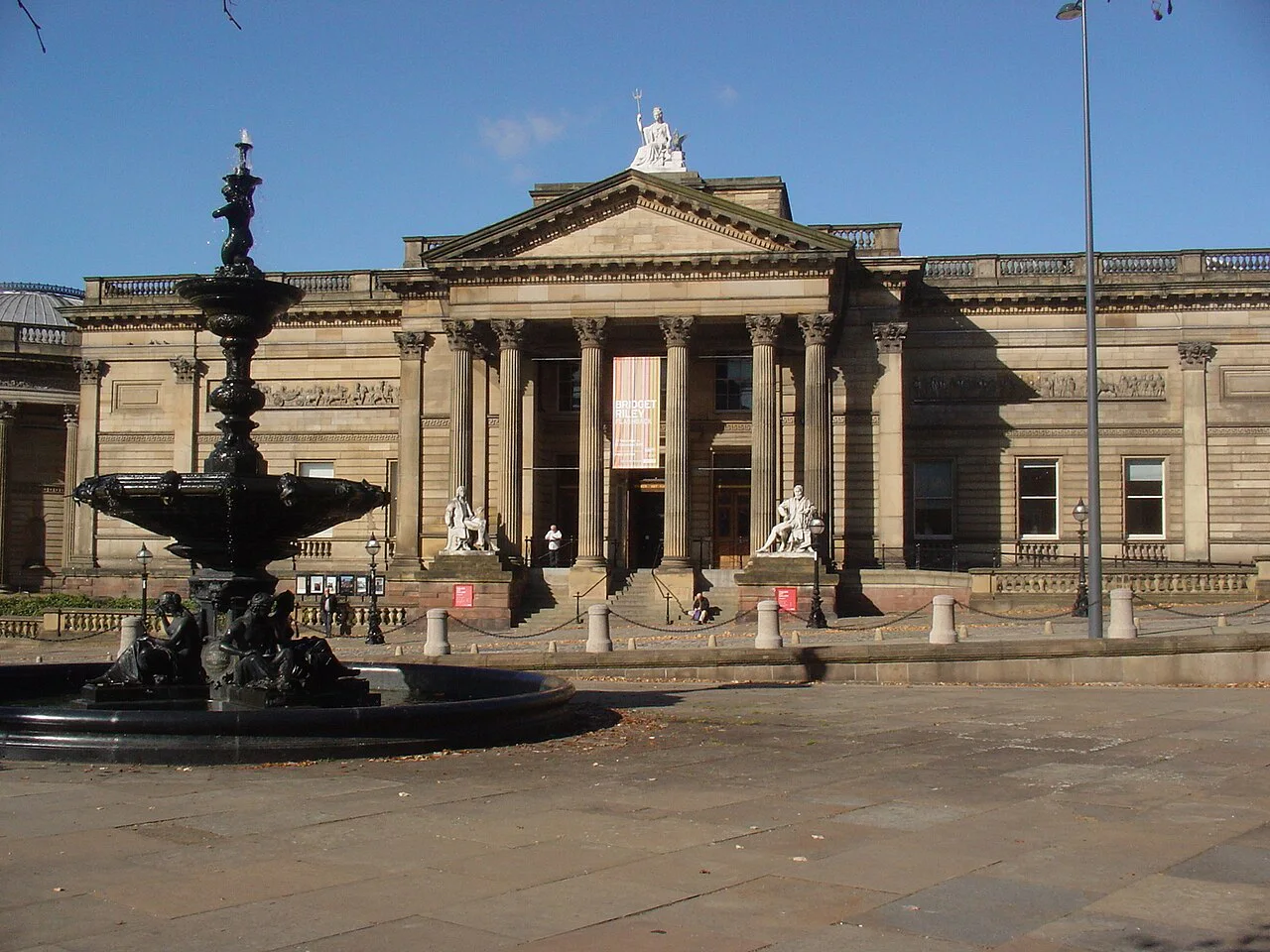
Liverpool · 54 artworks
Walker Art Gallery
Content & sources
Rept0n1x · CC BY-SA 3.0
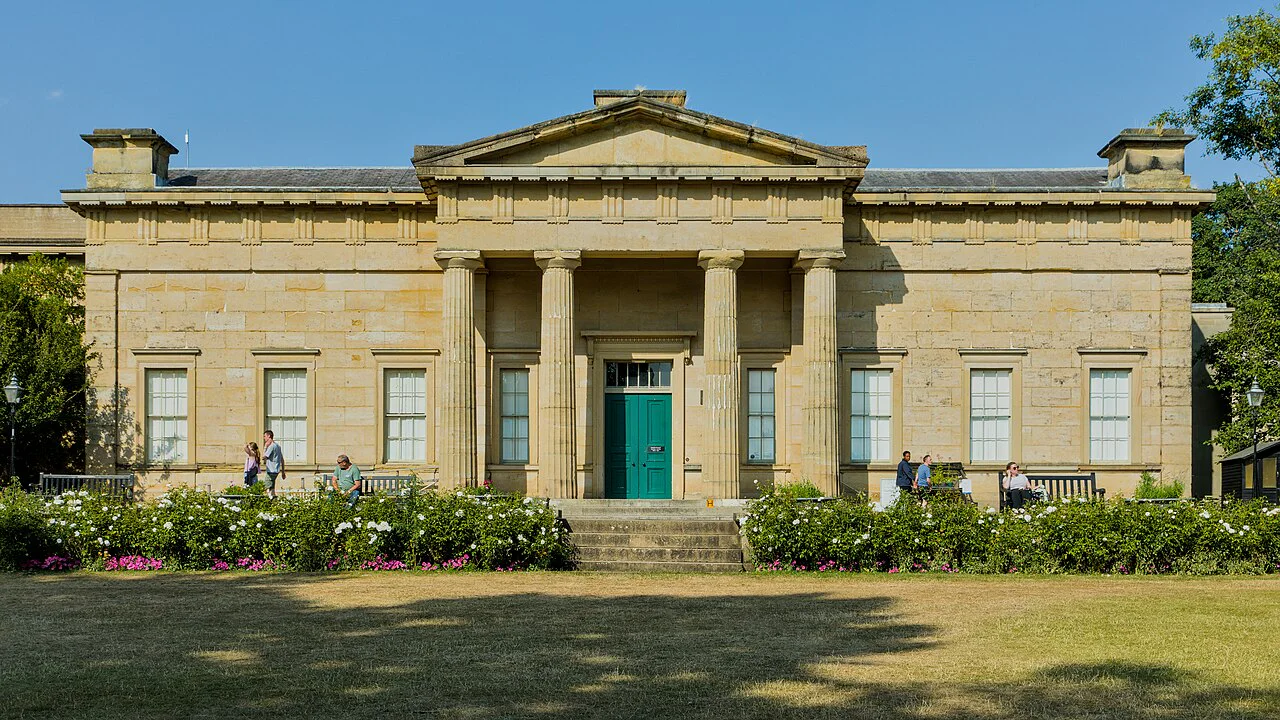
York · 27 artworks
Yorkshire Museum
Content & sources
Benjamin Smith · CC BY-SA 4.0
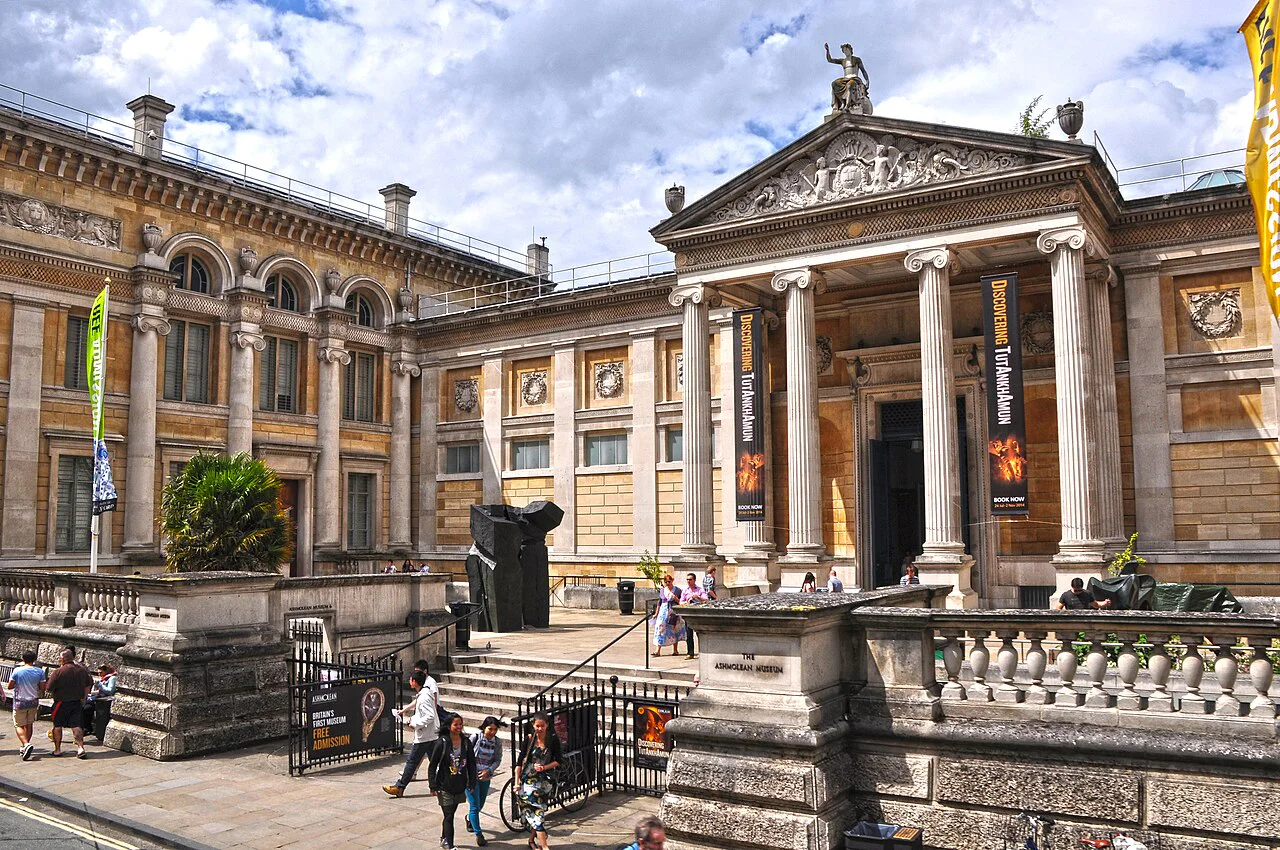
Oxford · 68 artworks
Ashmolean Museum
Content & sources
Lewis Clarke · CC BY-SA 2.0