Stanza · Audio guide
Paphos Archaeological ParkAudio guide
A place to remember. A story to take with you.
This major archaeological site contains the remains of the ancient city of Nea Paphos, featuring well-preserved Roman mosaics and various ancient structures. It is a UNESCO World Heritage site known for its…
Download Stanza, then search for “Paphos Archaeological Park”.
About the tour
One guide. Your kind of visit.
This major archaeological site contains the remains of the ancient city of Nea Paphos, featuring well-preserved Roman mosaics and various ancient structures. It is a UNESCO World Heritage site known for its significant historical ruins.
Ready when you are.
- 01Get the free Stanza app.
iOS & Android
- 02Find your guide.
“Paphos Archaeological Park”
- 03Download before you go.
Works offline
Audio guide / 31 narrated stops
Inside the guide
Get to know a few of the stories before you go. Open a stop to read more.
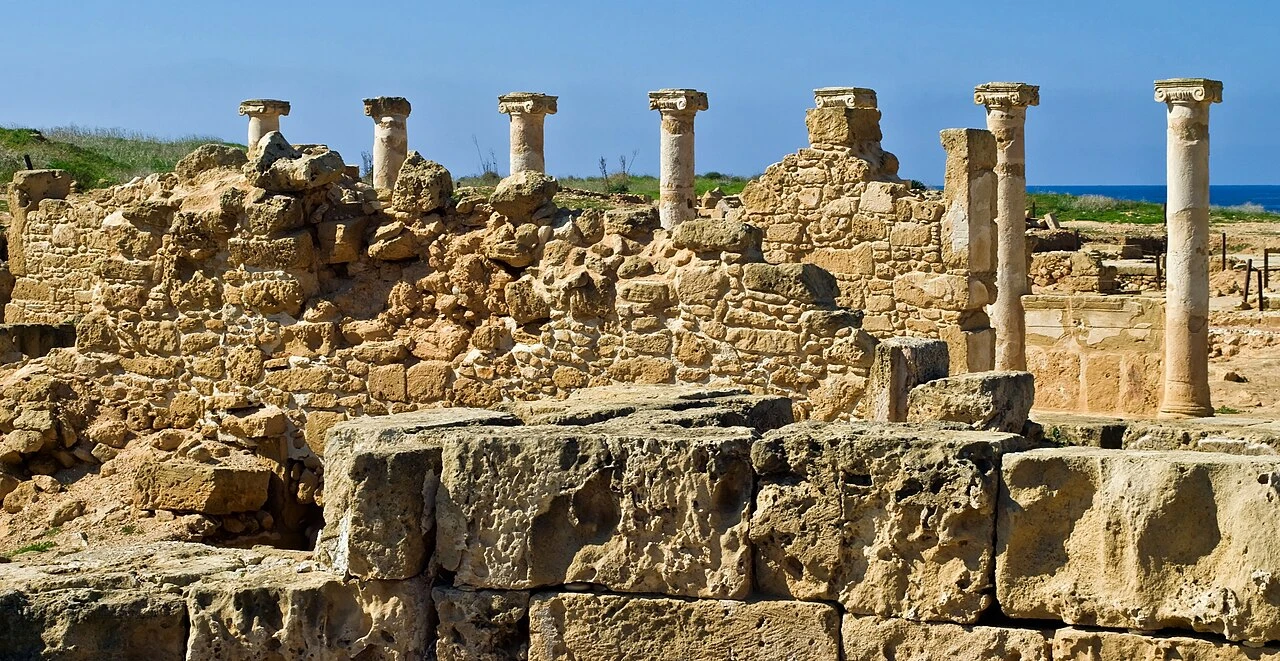
01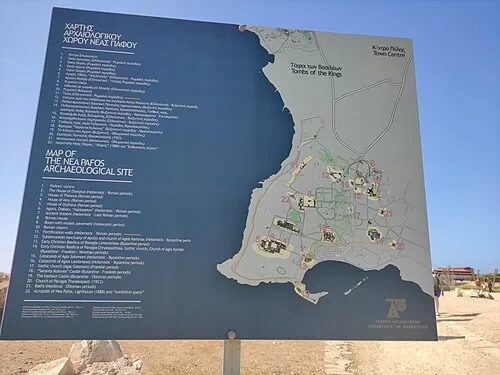 Visitor CentreVisitor Centre
Welcome to the Paphos Archaeological Park. You are standing within a sprawling complex that covers over 100 hectares, effectively an ancient urban landscape preserved for over two millennia. During the Hellenistic and Roman periods, this was Nea Paphos, the official capital of the island. Unlike many ancient cities that grew organically, Nea Paphos was meticulously planned with a rigid grid-like layout, which you can identify on the site maps here. This precision reflects its status as a vital administrative and military hub. The city was founded in the late 4th century BC by the Ptolemies of Egypt, who recognized its harbor as a strategic necessity for controlling the eastern Mediterranean. Think of the site as a massive archaeological puzzle. Many areas remain unexcavated, while those that have been revealed—ranging from grand villas to public monuments—showcase the wealth and planning of a Mediterranean powerhouse. The sheer scale of the city plan suggests a population that lived in a highly organized and sophisticated environment.
Fry72, Karel Frydrýšek · CC BY-SA 4.0
02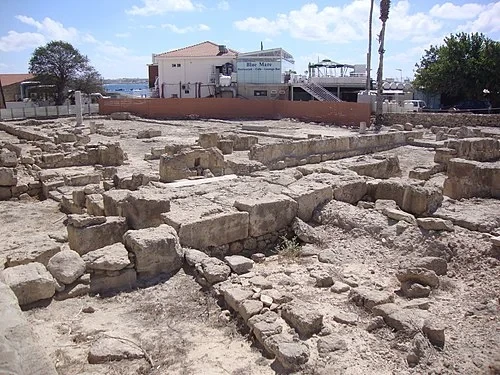 Basilica of Panagia LimeniotissaBasilica of Panagia Limeniotissa
This site represents a turning point in the city's history, as pagan Roman Paphos began to transform into a Christian center during the 5th century. Dedicated to 'Our Lady of the Harbor,' the Basilica of Panagia Limeniotissa was once a grand, three-aisled church. Although now mostly foundation walls and scattered stones, it was originally paved with colorful floor mosaics that displayed the craftsmanship of the era. Its location near the port made it a significant landmark for sailors and travelers arriving by sea. However, the church’s history was cut short by a series of disasters. It suffered greatly during the Arab raids of the 7th century, which targeted the coastal defenses and religious structures of the island. After being partially restored, the final blow came in the year 1159, when a massive earthquake leveled the structure completely. You can see the surviving fragments of its stone columns and the layout of the nave, which offer a glimpse into the architectural transition of the city before it was reclaimed by the earth.
Photo: Роман Курносенко · CC BY-SA 3.0
03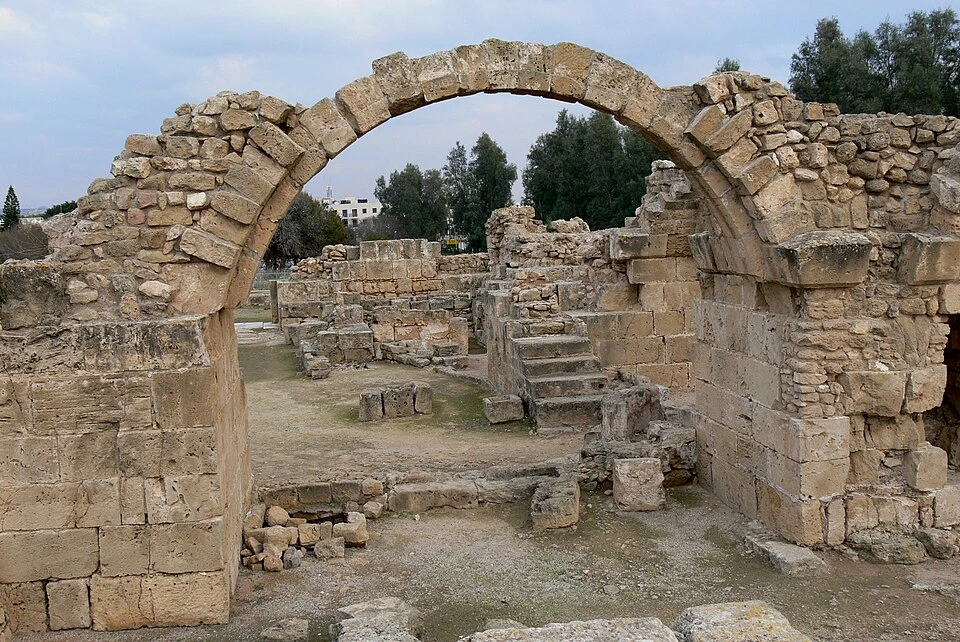 Saranta Kolones CastleSaranta Kolones Fortress
Rising from the ruins of the lower city is the Saranta Kolones Castle, a name that translates to 'Forty Columns.' This Byzantine fortress was constructed in the 7th century as a direct response to the threat of Arab maritime raids. Its design was meant to be imposing and utilitarian, securing the harbor that made Paphos so valuable. One of the most interesting aspects of its construction is the origin of its building materials. Rather than carving new stone, the Byzantine engineers scavenged granite pillars from the nearby Roman Agora and older public buildings. These grey granite columns were incorporated directly into the castle's walls and arches. This reuse of materials, known as 'spolia,' was a common practice during the period, saving time and resources while creating a fortress of mismatched but sturdy elements. The surviving reconstructed arch gives you a sense of the scale of the entrance. It was a place of high security, featuring a deep moat and thick walls that protected the garrison stationed here to watch over the Mediterranean.
Listen in the appWolfgang Sauber · CC BY-SA 3.0
04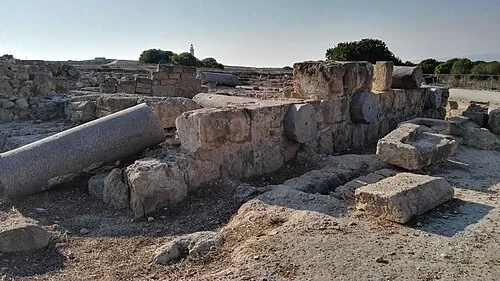 Saranta Kolones CastleAsklepieion
The grey granite columns lying horizontally on the ground reveal a fascinating story of ancient military engineering. When the Byzantines built the Saranta Kolones Castle, they didn't just use these pillars for aesthetic support; they laid them horizontally into the very foundations of the fortress walls. These columns acted much like modern steel rebar, intended to bind the masonry together and provide flexibility against the frequent earthquakes that plague the region. Despite this reinforcement, the power of nature eventually won out. In 1222, just thirty years after the Lusignans had completed modernizing and upgrading the fortifications, a massive earthquake struck the island. The force of the tremor was so great that it completely leveled the castle, leaving it in the state of ruin seen today. It was never rebuilt, serving instead as a quarry for later residents. These fallen pillars remain exactly where the disaster dropped them, marking the moment the fortress finally succumbed to the ground it was built to stand upon.
Listen in the appPhoto: Bukvoed · CC BY 4.0
05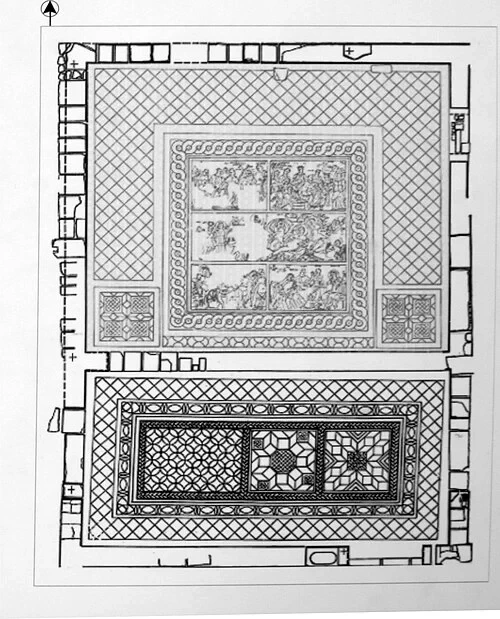 House of AionHouse of Aion
The House of Aion contains some of the latest mosaics found in the park, dating to a period when the Roman Empire was undergoing a radical transformation. By the 4th century, the state was officially turning toward Christianity. However, the floor plans and artwork here suggest that not everyone was ready to abandon the old ways. The wealthy owner of this villa used his floors to display complex scenes from traditional Greek mythology, likely as a form of intellectual and religious protest against the new state religion. By surrounding himself and his guests with images of the gods, he was making a clear statement about his cultural heritage and beliefs. The diagram shows the traditional Roman 'peristyle' layout, with rooms arranged around a central courtyard to provide light and ventilation. The reception hall, where the most important mosaics are located, was the public face of the house. Here, guests would dine and discuss philosophy while walking over artistic masterpieces that celebrated the classical past in an increasingly changing world.
Listen in the appPhoto: Rjdeadly · CC BY-SA 4.0
06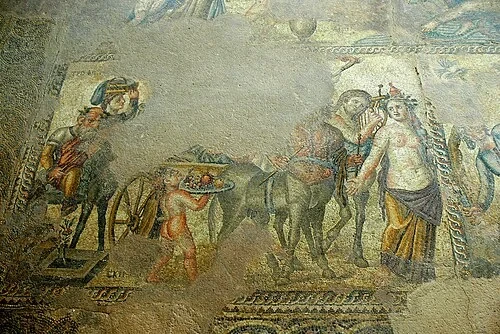 House of AionTriumph of Dionysos Mosaic
Look at Dionysus, the god of wine and revelry, in his triumphal procession. He sits in a chariot pulled by a centaur and a young satyr, accompanied by a group of followers. The level of detail here is extraordinary, particularly in the expressive faces of the figures. This was achieved using a technique called 'opus vermiculatum,' which utilizes exceptionally tiny stone cubes, or 'tesserae,' to create subtle gradations of color and shading. This wasn't merely a decorative choice for a dining room floor; it was a deliberate projection of the homeowner's values. For a Roman aristocrat, Dionysus represented the 'good life'—the enjoyment of wine, culture, and high-status entertainment. By commissioning such a work, the owner was showing off his sophistication and wealth to his dinner guests. The fluid movement of the centaur and the intricate patterns of the chariot wheels were meant to be admired for hours during banquets. It serves as a permanent record of the festive atmosphere that once filled these halls, celebrating the divine patron of the vine.
Listen in the appWolfgang Sauber · CC BY-SA 3.0
07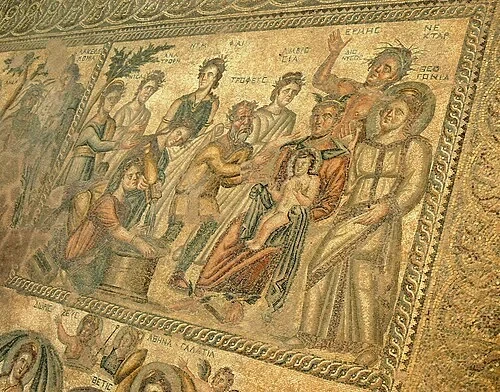 House of AionBirth of Dionysos Mosaic
This panel depicts a crucial moment in Greek mythology: the birth and survival of Dionysus. According to the myth, Zeus’s wife, Hera, was notoriously jealous of his children with other women. To protect the infant, he is shown here being handed to Hermes, who will take him to Mount Nysa to be raised in secret by nymphs. The figures surrounding the central action are personifications of virtues and nymphs who will care for the young god. One detail that makes this mosaic special for historians is the use of Greek text labels for each character. This transformed the floor into a high-class 'picture book.' During a banquet, guests could use these labels to identify the various mythological figures, sparking intellectual discussions about poetry and religion. It demonstrates the high level of classical education expected of the Roman elite in Paphos. The arrangement of the figures and the clarity of the labels ensured that the stories of the gods remained central to the social life of the villa.
Listen in the appWolfgang Sauber · CC BY-SA 3.0
08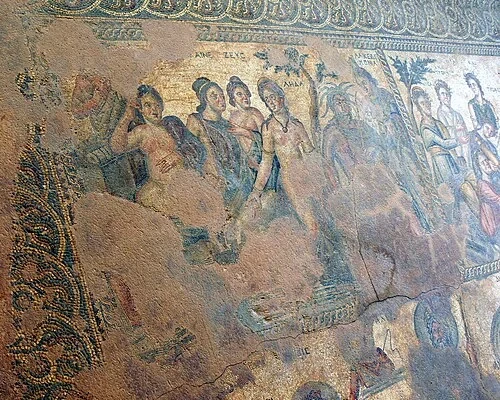 House of AionLeda and the Swan Mosaic
This mosaic depicts the myth of Leda and the Swan. In the story, Zeus transforms himself into a swan to seduce the Spartan queen Leda. The artist focused on the moment of encounter, capturing a scene that would have been a provocative and stimulating conversation starter for Roman aristocrats during their evening banquets. What makes this piece technically impressive is how the artist managed to convey the soft, layered texture of the swan's feathers using only various shades of white and grey stone. Despite the limited color palette for the bird, the subtle placement of the 'tesserae' creates a sense of depth and realism. Leda is the central focus, her figure rendered with the graceful lines typical of high Roman art. This type of mythology was common in private homes of the era, reflecting a culture that valued wit, storytelling, and the constant presence of the divine in everyday life. The scene is framed by a decorative border that isolates the myth like a framed artwork on the floor.
Listen in the appWolfgang Sauber · CC BY-SA 3.0
09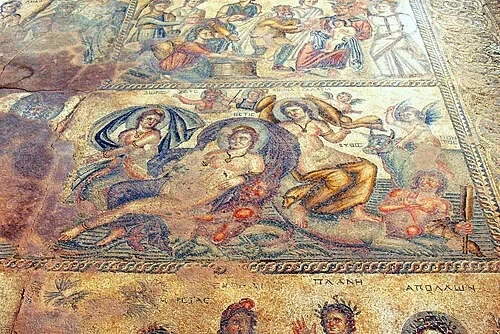 House of AionCassiopeia and the Nereids Mosaic
The scene shown here captures the high-stakes moment of judgment in a beauty contest. Cassiopeia famously boasted that she was more beautiful than the Nereids, the daughters of the sea god Nereus. The mosaic shows the goddess Aion or a similar figure presiding over the competition. This particular panel is regarded as a masterpiece of Roman art because of its technical sophistication. Pay close attention to the skin tones of the figures. To create a realistic, three-dimensional effect, the artist used a palette of pink, tan, and cream-colored stones for shading. The anatomical correctness and the use of highlights and shadows were advanced for the era, achieving a level of realism that wouldn't be seen again in Western art until the Renaissance. It demonstrates the immense wealth of the homeowner, who could afford the most skilled craftsmen in the eastern Mediterranean. For the original viewers, it was a reminder of both human beauty and the dangerous consequences of mortal pride when compared to the perfection of the gods.
Listen in the appWolfgang Sauber · CC BY-SA 3.0
10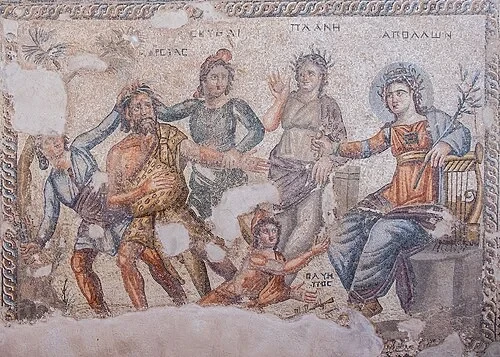 House of AionApollo and Marsyas Mosaic
The figures in this panel depict the dark conclusion of the contest between Apollo, the god of music, and the satyr Marsyas. Marsyas was a master of the flute who grew so arrogant that he challenged Apollo to a musical duel. Apollo, playing his lyre, was the inevitable winner. As punishment for Marsyas's 'hubris'—the Greek sin of excessive pride—Apollo ordered him to be flayed alive. In the mosaic, you can see the satyr being led away to his fate, while Apollo sits calmly holding his instrument. His expression is cold and detached, emphasizing his divine superiority. For the guests who dined in this room, the mosaic was a grisly but clear reminder that challenging the gods always ends in disaster. It highlights a common theme in Greek and Roman culture: the absolute power of the divine and the necessity of human humility. The contrast between the beauty of the art and the violence of the story reflects the complex nature of the ancient gods, who were both patrons of the arts and enforcers of a harsh moral order.
Listen in the appJules Verne Times Two · CC BY-SA 4.0
Paphos Archaeological Park
Frequently asked questions
How much does the guide cost?
Free app download. Listed guide price: $3.99. Guide price shown in the app. Audio guide only. Venue admission is separate.
Can I listen without internet?
Yes. Download the guide’s audio, images, and maps in the app before your visit. Your downloaded content is then available offline.
Can I listen in my language?
Stanza supports 15 languages. Check the app for the languages available for this guide.
Do I need to follow a schedule?
No. This is a self-guided experience. Choose your stops, pause whenever you like, and return to a story at your own pace.
At your own pace
Explore Paphos Archaeological Park.
Download Stanza, then search for “Paphos Archaeological Park”.
Free app download · Guide price shown in the app
Keep exploring
Nearby audio guides
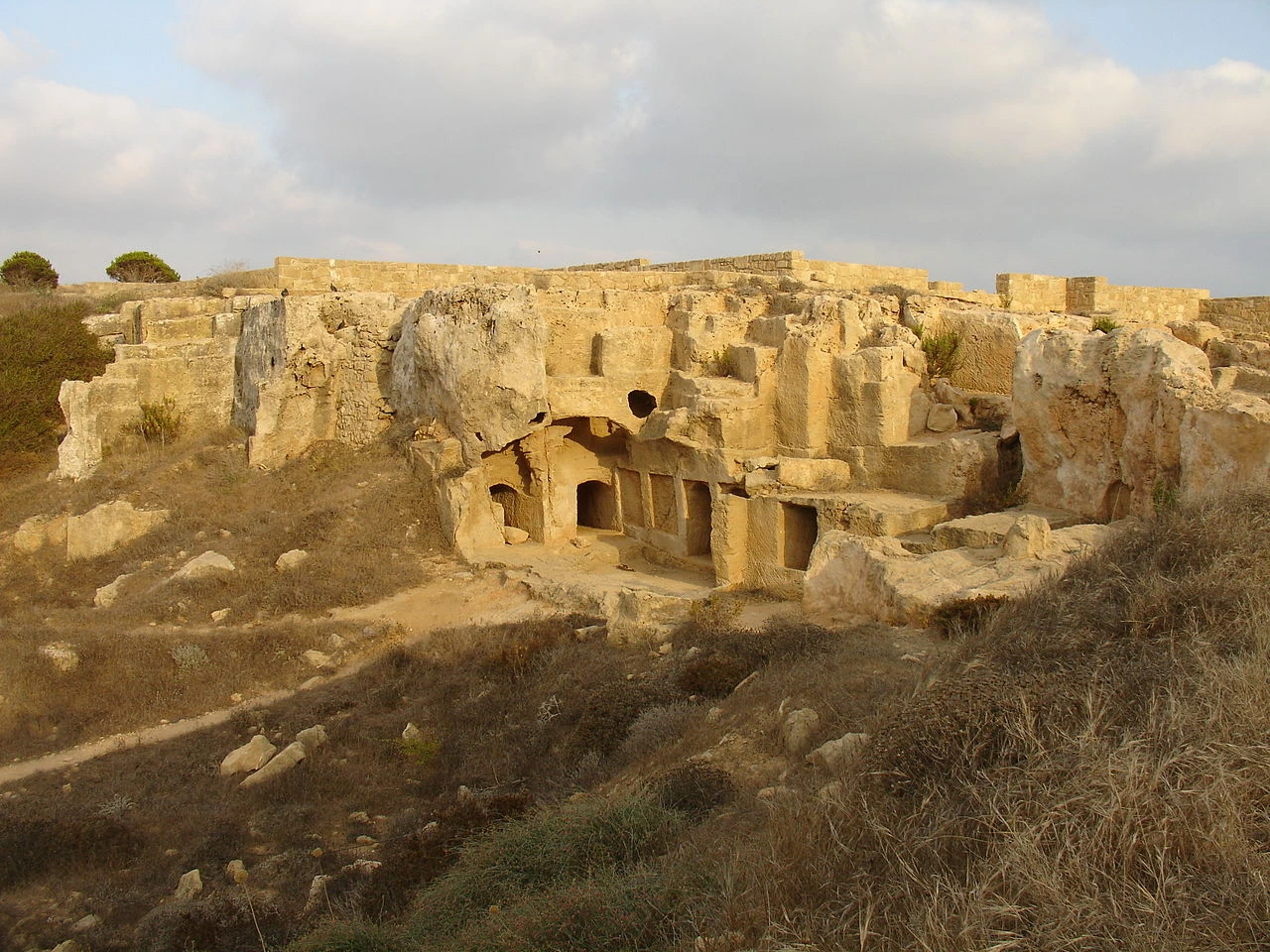
Paphos
Tombs of the Kings
Content & sources
Mgiganteus1 at en.wikipedia · CC BY-SA 3.0