 Stanza / Audio guide
Stanza · Audio guide
Palais des PapesAudio guide
A place to remember. A story to take with you.
The Palais des Papes is a historic fortress and palace that served as the residence of the popes during the 14th century. It is one of the largest and most significant medieval Gothic buildings in Europe.
Download Stanza, then search for “Palais des Papes”.
About the tour
One guide. Your kind of visit.
The Palais des Papes is a historic fortress and palace that served as the residence of the popes during the 14th century. It is one of the largest and most significant medieval Gothic buildings in Europe.
Ready when you are.
- 01Get the free Stanza app.
iOS & Android
- 02Find your guide.
“Palais des Papes”
- 03Download before you go.
Works offline
Audio guide / 30 narrated stops
Inside the guide
Get to know a few of the stories before you go. Open a stop to read more.
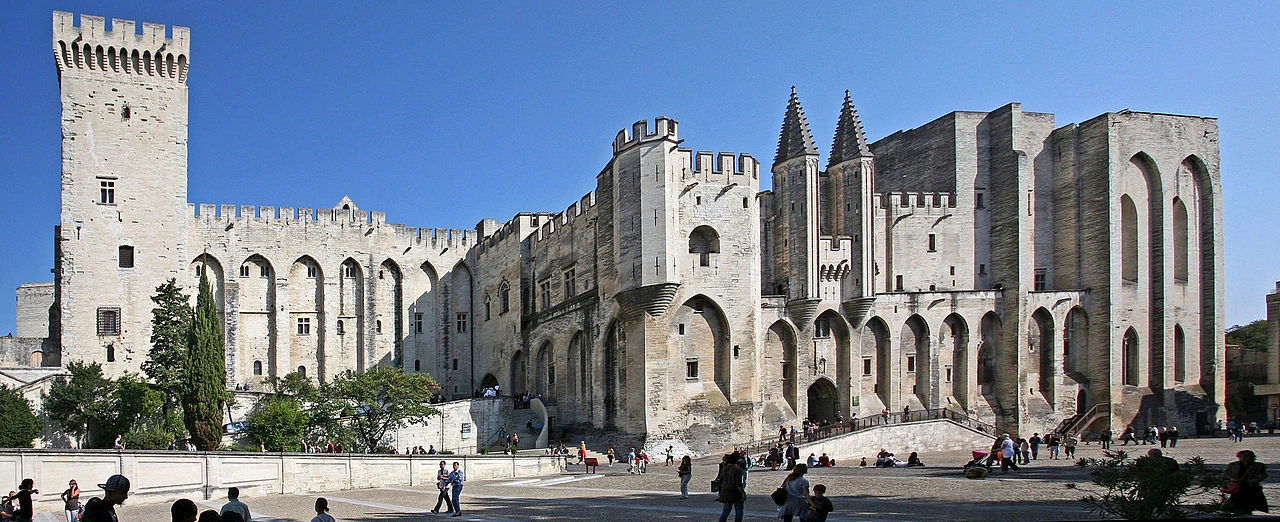
01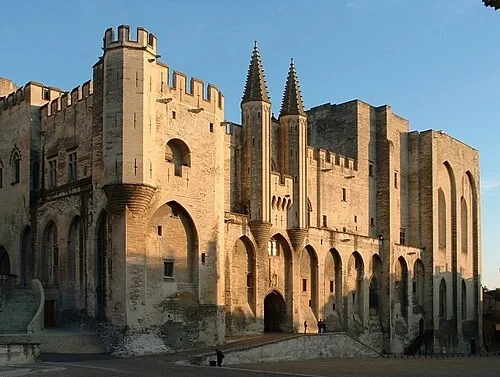 The Place du Palais and the Grand FacadeThe Main Facade
Covering 15,000 square meters, this fortress-like residence served as the seat of Western Christianity for nearly a century. As you look at the facade, you can see the clear architectural divide between two distinct building phases. On one side stands the "Old Palace," commissioned by Pope Benedict XII. Its design is austere and fortress-like, reflecting his monastic background and the need for security during a turbulent era. Contrast this with the "New Palace" commissioned by his successor, Clement VI. This section showcases the flamboyant Gothic style, featuring more decorative window tracery and elegant proportions that signal a shift toward courtly splendor. These architectural variations tell the story of the papacy's evolution in Avignon, from a temporary refuge to a settled, luxurious center of power. Look for the difference in the stonework and the size of the windows; the later additions are significantly more ornamental than the functional, defensive walls of the earlier structure. This massive stone monument remains a peak achievement of 14th-century engineering and design.
Chimigi · CC BY-SA 2.0 fr
02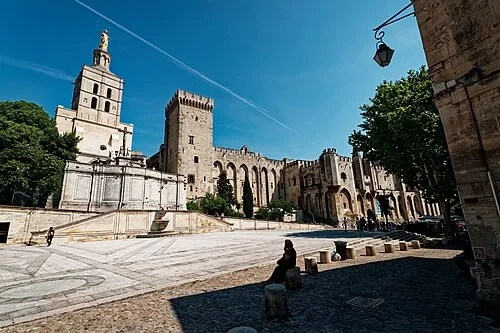 The Place du Palais and the Grand FacadePalace Square View
The transformation of this site began in earnest in 1334 under Pope Benedict XII. For the next three decades, thousands of stonemasons and laborers worked around the clock to create a palace capable of housing the entire papal administration. While it looks like a single, unified fortress, it grew in organic stages to accommodate the growing bureaucracy of the Church. From this vantage point, you can also see the Palais's neighbor: the Cathedral of Notre-Dame des Doms. Its gilded statue of the Virgin Mary overlooks the city. The physical proximity of the cathedral to the palace is no accident; it serves as a visual representation of the union between spiritual authority and secular power in 14th-century Avignon. This square was once crowded with pilgrims, merchants, and diplomats from across Europe, all seeking audience with the most powerful man in Christendom. The sheer height of the walls was intended to intimidate and impress, making it clear that the papacy had found a new, permanent home outside of Rome.
Photo: Txllxt TxllxT · CC BY-SA 4.0
03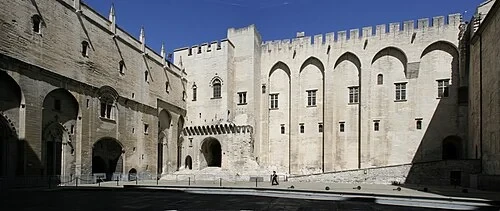 The Main Courtyard (Cour d'Honneur)The Main Courtyard
This central courtyard was the heart of the palace's administrative life. Surrounding you are massive stone buttresses that support the weight of the enormous halls above. High up on the southern wall, look for the "Windows of the Indulgence." It was from these openings that the Pope would appear to bless the crowds gathered below, granting them spiritual favors. In the 14th century, this area would have been anything but quiet. It was a hub of activity where visitors were vetted before entering the more private sections of the residence. Soldiers patrolled the upper galleries while clerks and cardinals hurried between offices. Today, the noise of medieval bureaucracy has faded, leaving behind a space that allows you to appreciate the rhythmic pattern of the Gothic arches and the sheer verticality of the stone walls. The transition from a busy administrative center to the silent, preserved monument you see today highlights the architectural mastery required to create such a durable structure. Notice the wear on the stone flags underfoot, smoothed by centuries of footsteps.
Listen in the appIngo Mehling · CC BY-SA 3.0
04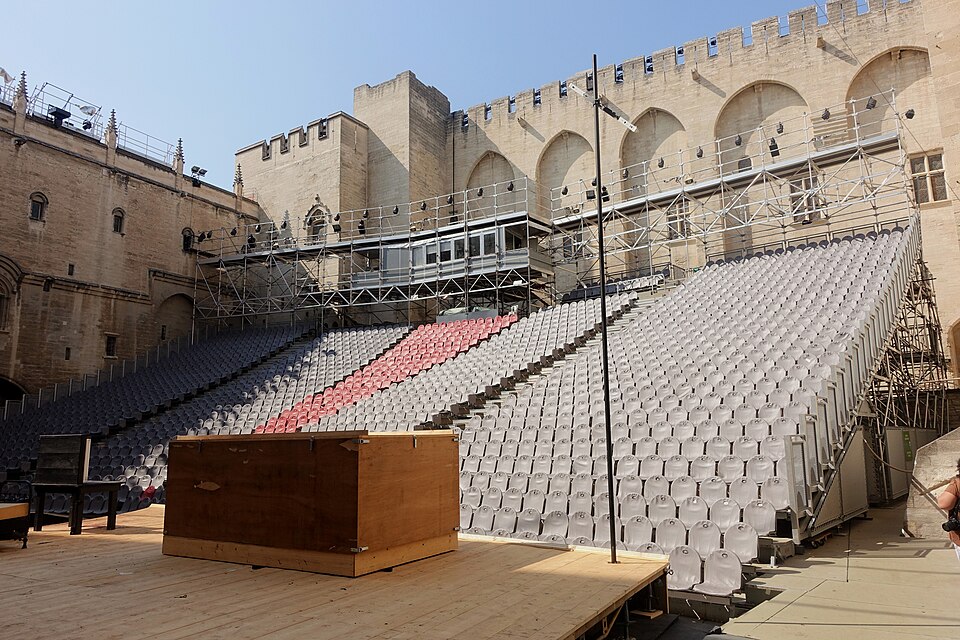 The Main Courtyard (Cour d'Honneur)The Great Stage
While these walls were built for popes, they have found a new life in the modern era as a temple of theater. Every July, a massive temporary stage and seating for thousands are erected right here for the Festival d'Avignon. Founded by Jean Vilar, the festival chose this courtyard for its extraordinary acoustics and its overwhelming historical presence. The 14th-century stone walls provide a dramatic, natural backdrop that no scenic designer could ever replicate. Watching a world-class performance under the stars here, with the high Gothic windows glowing above, creates a unique dialogue between medieval history and contemporary art. The sheer scale of the architecture demands a specific kind of performance, often pushing actors and directors to match the intensity of their surroundings. This modern use of the space ensures that the Palais des Papes remains a living cultural institution rather than a static museum. It is a place where centuries of history meet the cutting edge of modern stagecraft, proving that these ancient stones still have a powerful role to play in the city’s identity.
Listen in the appPhoto: FramaKa · CC BY-SA 4.0
05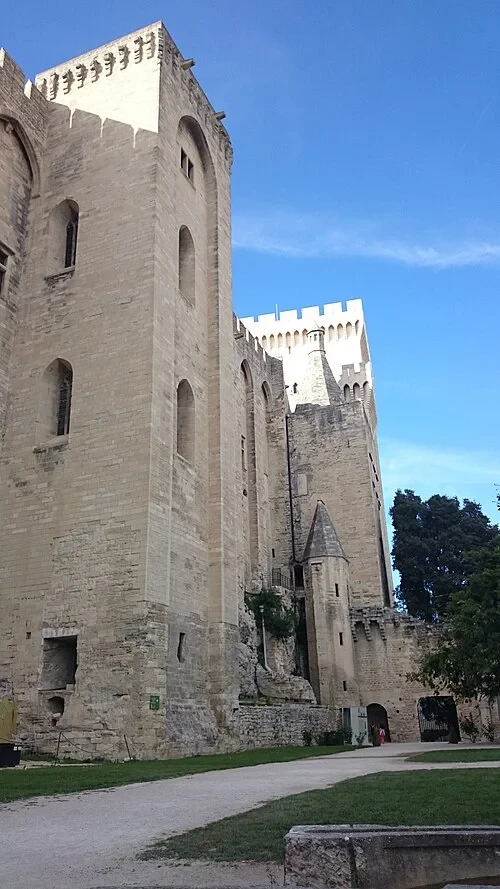 The Consistory HallThe Consistory Wing
The palace complex is reinforced by twelve massive towers, each with a specific purpose, and this wing houses some of the most critical administrative spaces. In the Consistory Hall, the Pope convened with his advisors to discuss theological disputes, political alliances, and the appointment of bishops. It was here that the day-to-day governance of the Western Church took place. These rooms were designed to be both functional and impressive, reminding every cardinal of the central authority they served. The walls would have originally been covered in rich tapestries or frescoes to provide warmth and color, a sharp contrast to the bare stone we see today. Because this was a place of high-stakes decision-making, security was paramount. The thick walls and limited access points ensured that the secrets of the papal court remained behind closed doors. As you move through this section, consider the global reach of the decisions made within these four walls. From here, orders were dispatched to every corner of Europe, shaping the political and religious landscape of the 14th century.
Listen in the appPhoto: CharlèneChtl · CC BY-SA 3.0
06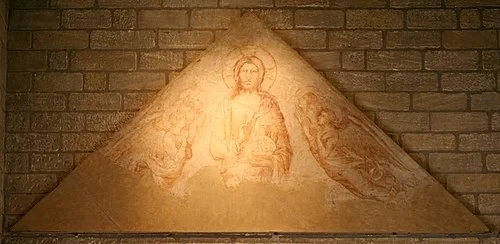 The Consistory HallChrist in Glory Sinopia
A sinopia is a preliminary underdrawing used by medieval fresco artists. It was created using a reddish-brown earth pigment called 'sinopia,' which gives the drawings their name. These lines served as a guide for the master artist before the final layer of wet plaster and pigment was applied. The example here, depicting Christ in Glory, provides a look at the artistic process of the 14th century. During the Avignon Papacy, the city became a magnet for top-tier talent, including Italian masters like Simone Martini. Martini brought the elegant, expressive Sienese style from Tuscany to the French court. This fusion of Italian naturalism with northern Gothic architecture influenced European art for generations to come. Even though the final colors of many frescoes have long since faded or been lost, these underdrawings survive as a testament to the artist's hand and draftsmanship. They reveal the initial composition and the confidence of the strokes, offering a direct connection to the creative minds that turned this fortress into a masterpiece of religious art.
Listen in the appJean-Marc Rosier http://www.cjrosier.com + http://www.gordes-immobilier.com) · CC BY-SA 3.0
07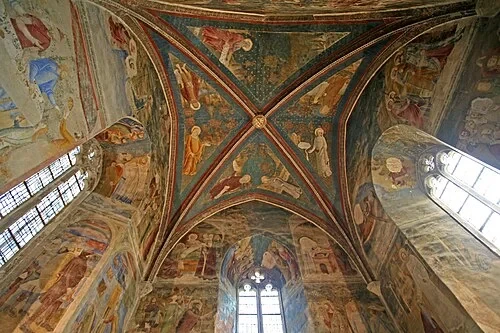 Saint John's ChapelSaint John's Chapel Ceiling
This breathtaking display of color was the work of Matteo Giovanetti, the official court painter for the Avignon Popes. Giovanetti was a priest from Viterbo who directed a massive workshop of artists and apprentices, ensuring a consistent style across the palace's many decorative projects. The vibrant blue background is particularly significant; it was achieved using ground lapis lazuli, a semi-precious stone imported from as far away as modern-day Afghanistan. Using such a costly material was a clear statement of the Pope’s immense wealth and devotion. Within the segments of the vault, you can see detailed figures of prophets and saints, each painted with a level of individuality and expression that was revolutionary for the time. This Italian influence moved away from flat, symbolic figures toward more realistic, three-dimensional depictions. The chapel served as a private place of prayer, and the immersive nature of the frescoes was intended to lift the viewer’s thoughts toward the divine. Despite the passage of time and the palace's later use as a military barracks, the quality of Giovanetti's pigments remains strikingly vivid.
Listen in the appJean-Marc Rosier http://www.cjrosier.com + http://www.gordes-immobilier.com) · CC BY-SA 3.0
08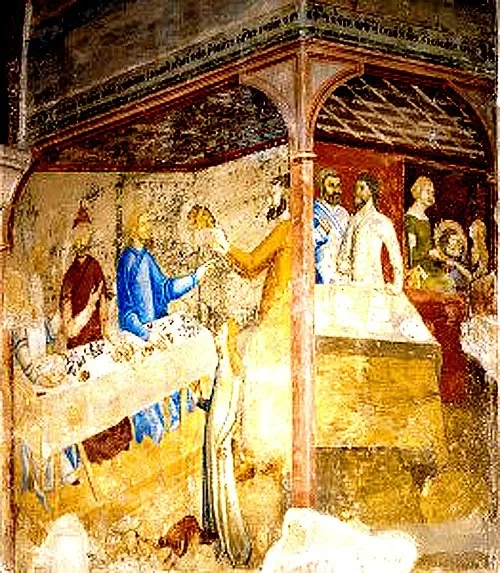 Saint John's ChapelThe Feast of Herod
This fresco is part of a narrative cycle detailing the life of Saint John the Baptist. Notice the naturalism in the figures' expressions; the artist captures the tension and drama of the banquet where Salome requested the saint's head. Beyond the religious story, look at the background architecture depicted in the painting. The artist meticulously rendered 14th-century buildings, arches, and interior spaces that mirror the very style of the palace you are standing in today. This was a common technique used to make biblical stories feel immediate and relevant to the contemporary viewer. The figures are dressed in the fashion of the 14th-century court, providing us with a visual record of medieval life and social hierarchy. By placing holy figures in familiar settings, the frescoes bridged the gap between the divine and the everyday. The level of detail, from the draped tablecloths to the gestures of the guests, showcases the high level of sophistication achieved by the papal court’s artists. It is a masterpiece of storytelling that remains as legible today as it was when first painted.
Listen in the appMatteo Giovanetti · Public domain
09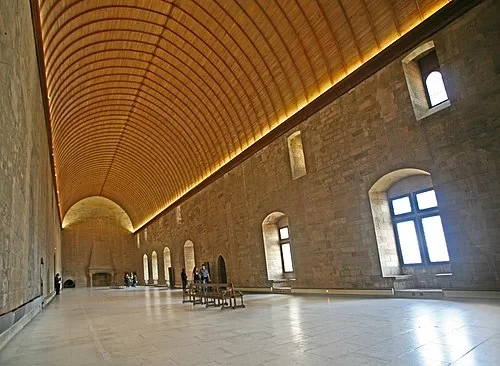 The Grand Tinel (The Great Hall)The Great Hall
This massive space, also known as the Grand Tinel, served several vital functions. It was the primary banquet hall where the Pope hosted visiting royalty and dignitaries at long, lavish tables. It was also the site of papal conclaves, where cardinals were locked away to elect a new successor to Saint Peter. The sheer volume of the room was meant to project the power and majesty of the papacy. If you look up, you will see a massive wooden barrel-vault ceiling. While impressive, this is actually a replacement. In the 14th century, the original ceiling was famously painted a deep, rich blue and dotted with gold stars, creating the illusion of an eternal night sky. Large windows allow natural light to flood the stone interior, which would have been further brightened by colorful wall hangings and the glint of gold and silver serving vessels. The hall is so large that multiple fireplaces were required to keep the air tolerable during the winter months. Today, its empty, echoing space invites you to imagine the sounds of a medieval feast.
Listen in the appJean-Marc Rosier ( http://www.cjrosier.com + http://www.gordes-immobilier.com ) · CC BY-SA 3.0
10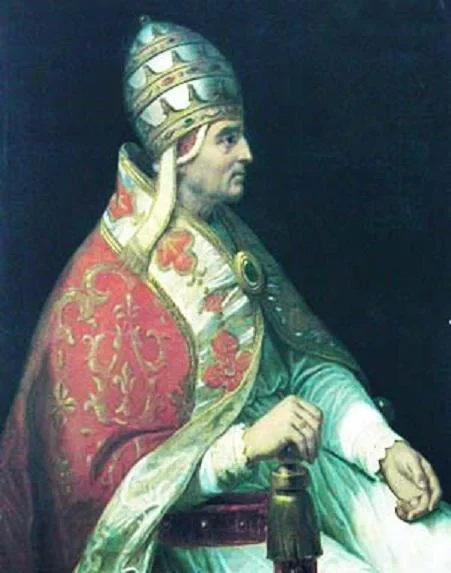 The Grand Tinel (The Great Hall)The 1362 Papal Conclave
Urban V was the sixth of the seven popes who resided here during the Avignon Papacy. He was known as a scholarly man who sought to return the papacy to Rome, though he ultimately returned to Avignon before his death. During his reign, which began in 1362, the administrative power of the Church reached new heights. The palace became the heart of a highly centralized system that managed finances, law, and diplomacy across all of Europe. This portrait captures the formal dignity of the office, showing the Pope in his ceremonial robes and tiara. Under Urban’s leadership, the bureaucracy of the Church was streamlined, making Avignon a more efficient, if sometimes controversial, center of power. The wealth generated by this administrative machine funded the incredible art and architecture you see throughout the palace. Urban was also a great patron of education, founding several universities and supporting scholars. His presence here represents a moment when the papacy was at its most administratively organized, exerting an influence that touched the lives of millions from this single French city.
Listen in the appHenri Auguste César Serrur · Public domain
Palais des Papes
Frequently asked questions
How much does the guide cost?
Free app download. Listed guide price: $3.99. Guide price shown in the app. Audio guide only. Venue admission is separate.
Can I listen without internet?
Yes. Download the guide’s audio, images, and maps in the app before your visit. Your downloaded content is then available offline.
Can I listen in my language?
Stanza supports 15 languages. Check the app for the languages available for this guide.
Do I need to follow a schedule?
No. This is a self-guided experience. Choose your stops, pause whenever you like, and return to a story at your own pace.
At your own pace
Explore Palais des Papes.
Download Stanza, then search for “Palais des Papes”.
Free app download · Guide price shown in the app
Keep exploring
Nearby audio guides
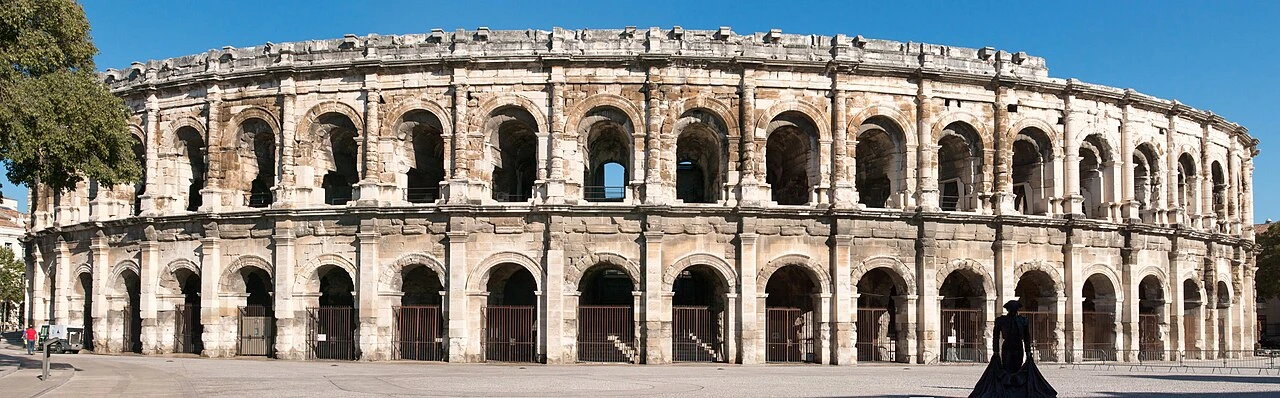
Nîmes
Amphitheater of Nîmes
Content & sources
Daniel VILLAFRUELA. · CC BY-SA 3.0
Paris
Arc de Triomphe de l'Étoile
Content & sources
Jiuguang Wang · CC BY-SA 2.0
Paris
Basilique du Sacré-Cœur de Montmartre
Content & sources
Tonchino · CC BY-SA 3.0
Saint-Denis
Basilique royale de Saint-Denis
Content & sources
Photo: Chabe01 · CC BY-SA 4.0