Stanza · Audio guide
Gračanica Monastery Audio Guide
A place to remember. A story to take with you.
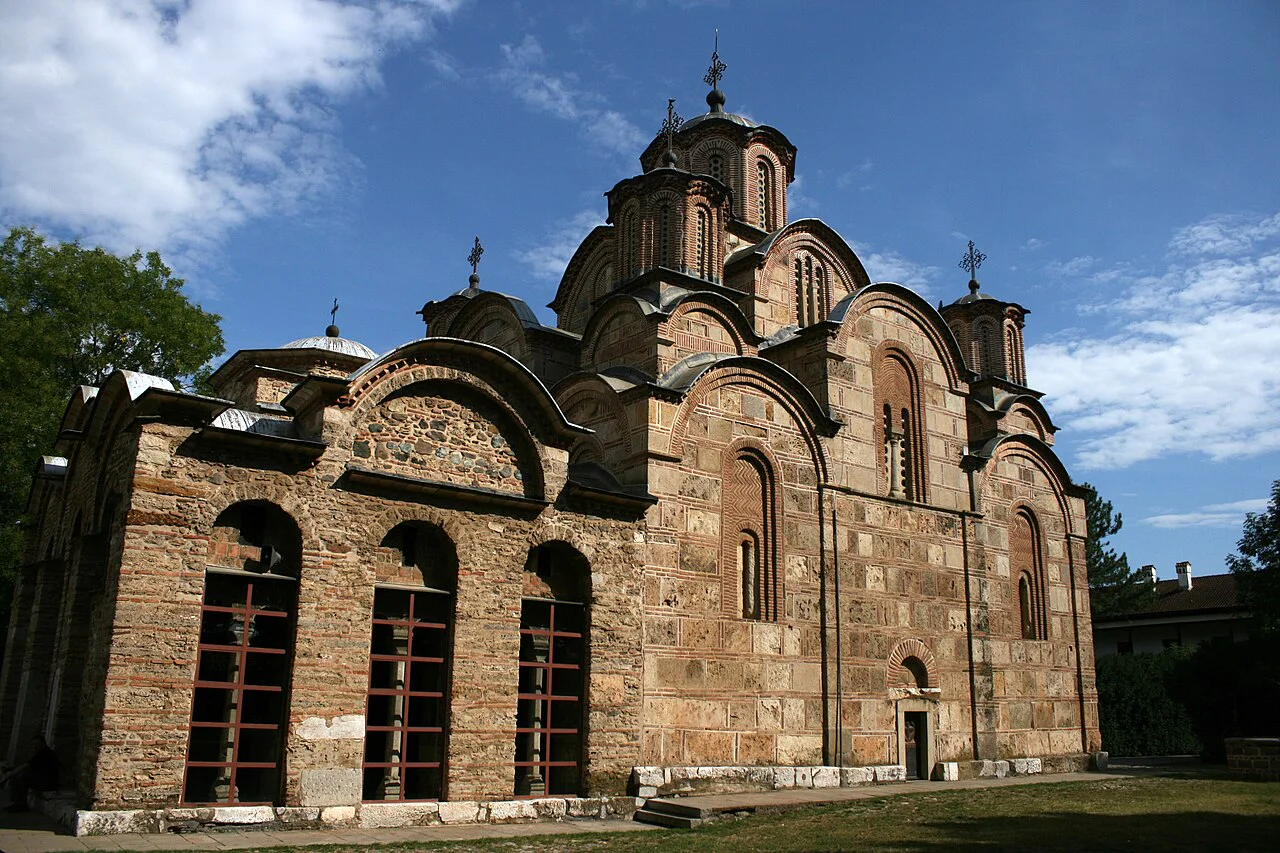
The Gračanica Monastery is a Serbian Orthodox monastery built by the Serbian king Stefan Milutin in 1321. It is a cultural heritage monument that was placed on UNESCO's World Heritage List in 2006.
Download Stanza, then search for “Gračanica Monastery”.
About the tour
One guide. Your kind of visit.
The Gračanica Monastery is a Serbian Orthodox monastery built by the Serbian king Stefan Milutin in 1321. It is a cultural heritage monument that was placed on UNESCO's World Heritage List in 2006.
Ready when you are.
- 01Get the free Stanza app.
iOS & Android
- 02Find your guide.
“Gračanica Monastery”
- 03Download before you go.
Works offline
Audio guide / 11 narrated stops
Inside the guide
Get to know a few of the stories before you go. Open a stop to read more.
01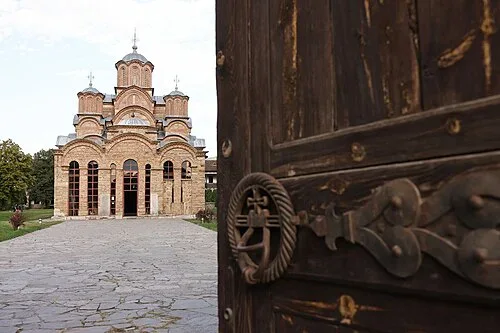 Monastery Courtyard and the Five-Domed Exterior
Through the Monastery Gate
Welcome to Gračanica, a Serbian Orthodox monastery that has stood here since the fourteenth century. The church ahead was built by King Stefan Milutin and finished in 1321. It replaced an older cathedral of the Holy Virgin from the thirteenth century, which had been the seat of the bishops of Lipljan. Milutin had his reasons spelled out in stone. On the southern wall, his words still read: I have seen the ruins and the decay of the Holy Virgin's temple of Gračanica, the bishopric of Lipljan, so I have built it from the ground. He decorated it inside and out, and this church became one of his last great endowments. Seven centuries later, the building is still a working monastery. In 1990 Serbia declared it a Monument of Culture of Exceptional Importance. In 2006 it joined UNESCO's World Heritage List as part of the Medieval Monuments in Kosovo, and at the same time the whole site was placed on the List of World Heritage in Danger. So the gate opens onto both a living church and an endangered one.
BLAGO Fund, Inc. · CC BY 4.0
02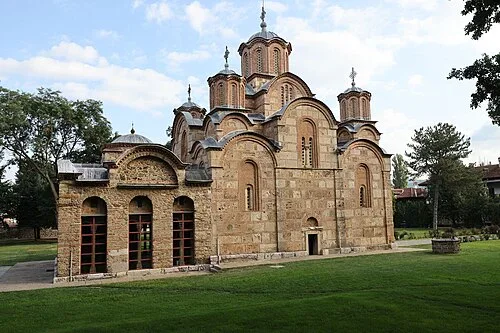 Monastery Courtyard and the Five-Domed Exterior
The Five-Domed Church in Brick and Stone
Gračanica is considered the high point of medieval Serbian building in the Serbo-Byzantine tradition. The plan is a double inscribed cross, one cross set inside the other. The inner cross is what gives the church its vertical push, raising the masses step by step toward the central dome. Above the corners between the cross-shafts sit four smaller domes, which give the whole crowning group its regular rhythm. Together with the tall central dome, that makes five. At the altar end, three three-sided apses project outward, the middle one the largest, giving the east side its gentle distinction. The walls themselves are part of the design, built in alternating courses of brick and stone. That striped pattern was meant to be seen, not hidden under plaster. Late Byzantine church design aimed at exactly this kind of graded, rising silhouette, and Gračanica carries it through to the top.
BLAGO Fund, Inc. · CC BY 4.0
03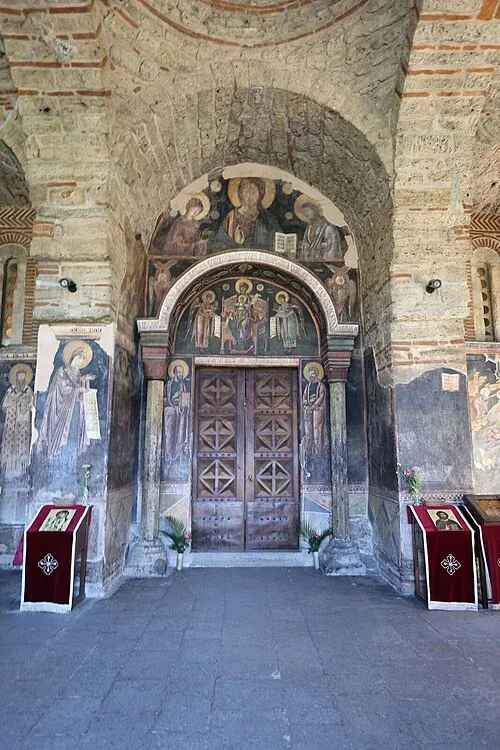 The Exonarthex and Western Portal
The Exonarthex Portal and the 16th-Century Revival
The outer porch, called the exonarthex, was added at the end of the fourteenth century. Its purpose was practical: to shield the frescoes on the west facade of the church from the weather. It originally had double arcades, open arches looking into the courtyard. In the sixteenth century those arcades were walled up, and the walls were covered with new paintings, finished in 1570. That restoration was the work of Patriarch Makarije Sokolović, one of the great figures of the Serbian church under Ottoman rule. The monastery had already proven it could keep working under the new rulers. Under Metropolitan Nikanor, in the years 1538 to 1539, a Cyrillic printing press operated here. It produced the Gračanica Octoechos, a book of liturgical chant. The walled arches around this portal are the visible trace of those Ottoman centuries, when the monastery traded openness for survival.
Listen in the appBLAGO Fund, Inc. · CC BY 4.0
04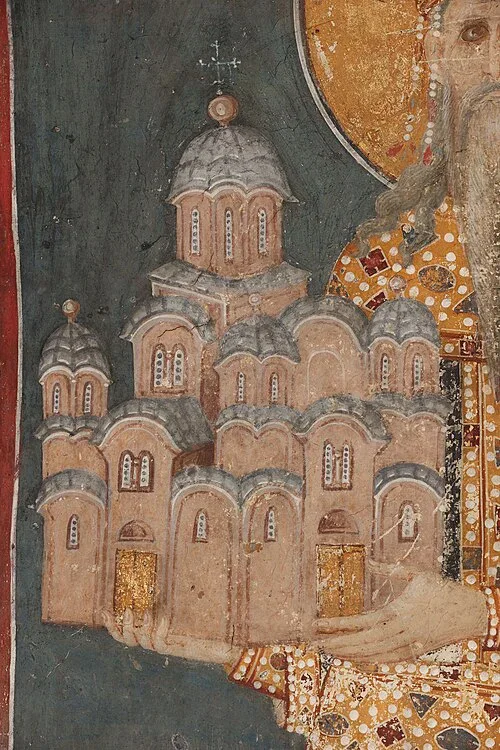 Inner Narthex: Royal Founder Portraits
King Milutin Presents His Church
On the narthex archway, an old king holds up a small five-domed church in his hands. This is King Stefan Milutin, painted around 1321, offering a model of Gračanica itself. In Byzantine and Serbian court culture this was the ktetor portrait, the formal image of a founder presenting his endowment to Christ. The gesture said who paid for the building and placed it under divine protection. Milutin appears here as an old man, near the end of a long reign. The painted model in his hands matches the real building closely, domes and all. A patron could hardly leave a clearer signature.
Listen in the appBLAGO Fund, Inc. · CC BY 4.0
05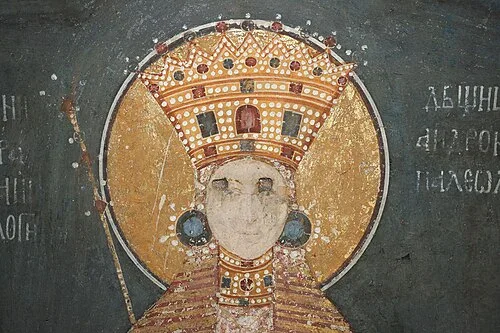 Inner Narthex: Royal Founder Portraits
Queen Simonida Crowned by Angels
Beside the king stands his bride, Queen Simonida, a Byzantine princess and daughter of Emperor Andronikos the Second Palaiologos. In the fresco she is young and crowned by angels, a painted statement of the alliance between the Serbian royal house and the Byzantine imperial family. Her face is damaged, and the damage created one of the most famous legends of Serbian art. The story goes that Ottoman soldiers gouged out her eyes, and the poet Milan Rakić built a well-known poem on that image. Researchers, however, have long doubted that version, and who damaged the face, and why, is still argued over. What remains is the portrait itself: a girl from Constantinople, crowned by angels, on the wall of her husband's church.
Listen in the appBLAGO Fund, Inc. · CC BY 4.0
06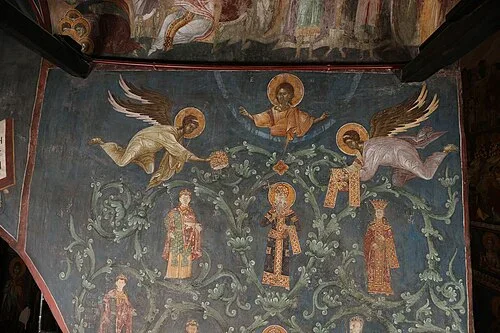 Inner Narthex: Dynastic Tree and the Last Judgment
The Nemanjić Family Tree
Spread across the narthex wall is the genealogy of the Nemanjić dynasty, the first ever painted in medieval art. It grows as a living vine, springing from Stefan Nemanja, the dynasty's founder, and running down the generations to end with Milutin himself. In the upper section, angels lean in from either side, honoring the figures in the branches. The tree worked two ways at once. It was a religious image, placing the royal line among the saints. And it was a political statement, made at the height of Serbian royal power, claiming sacred sanction for the dynasty. The lineage ends deliberately with the man standing in this church. Milutin appears in his own family tree as its living culmination.
Listen in the appBLAGO Fund, Inc. · CC BY 4.0
07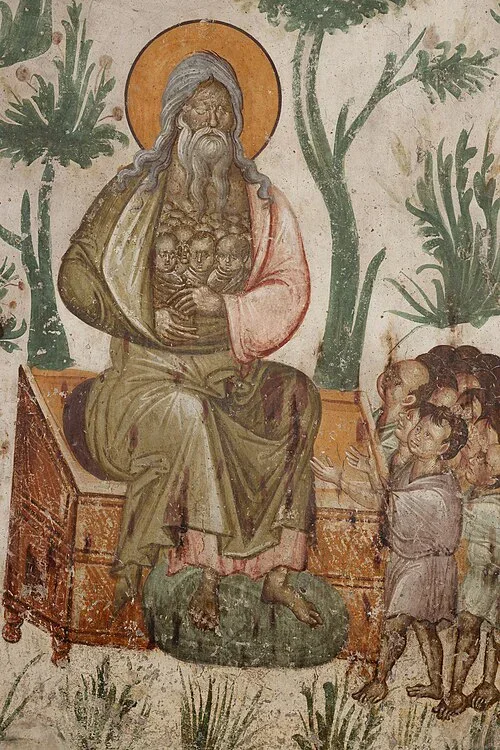 Inner Narthex: Dynastic Tree and the Last Judgment
The Last Judgment in the Narthex
The narthex carries one of the most thorough Last Judgment cycles in medieval painting, done around 1321. On the wall here, a bearded figure sits holding a crowd of small souls against his chest, while a line of people approaches him. This is Abraham in paradise, receiving the righteous. Cycles like this covered everything: paradise, the weighing of souls, and damnation, laid out wall by wall. The narthex was the threshold of the church, the passage between the courtyard and the sacred interior. Every worshipper walked through the story of the end of the world on the way in. The painting made the choice of how to live unavoidable, at the very door of the nave.
Listen in the appBLAGO Fund, Inc. · CC BY 4.0
08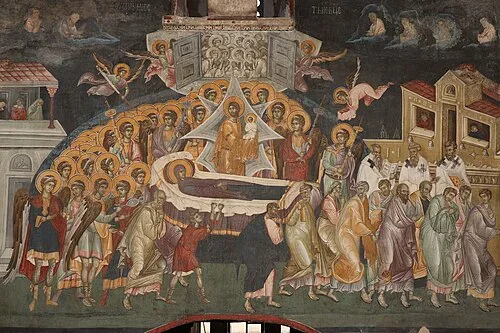 The Central Nave and Feast Frescoes
The Nave: Dormition and the Feast Cycle
Inside the nave, the painting belongs to the church's earliest layer, executed in 1321 and 1322. The compositions deal with the earthly life of Christ and the ecclesiastical calendar, the sequence of feasts through the year. The great scene here is the Dormition of the Mother of God, the falling asleep of the Virgin, and it ties directly to the church's dedication to the Holy Virgin. The work is attributed to the master painters Michael and Eutychios of Thessaloniki, working with their assistants, though the attribution rests on scholarly judgment. Their style belongs to what art historians call the Paleologan Renaissance, the luxurious and emotionally vivid Byzantine manner of Milutin's reign. The paintings of Gračanica rank highest among the achievements of that period. They have also survived remarkably well for seven centuries.
Listen in the appBLAGO Fund, Inc. · CC BY 4.0
09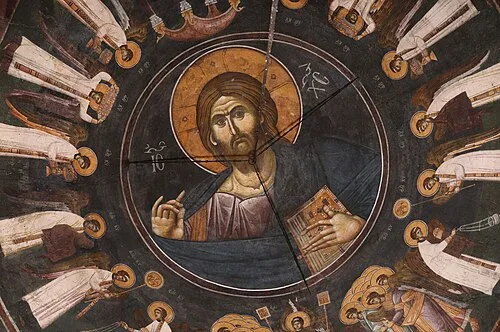 The Central Dome and Christ Pantocrator
Christ Pantocrator in the Central Dome
The whole interior rises toward one point: the central dome, high above the crossing. Inside the cupola, Christ Pantocrator looks down, ringed by heavenly figures around the drum. In Byzantine church decoration, the Pantocrator in the dome was the standard climax, the all-ruling Christ presiding over everything below. What makes this one work is the architecture beneath it. The dome rests on four free-standing pillars, and the double inscribed cross of the plan lifts the vault high above the worshipper. From the floor, the eye climbs through the stepped masses that were built up from outside. Here the vertical promise of the exterior silhouette is fulfilled, with the image at its summit preserved in exceptional condition.
Listen in the appBLAGO Fund, Inc. · CC BY 4.0
10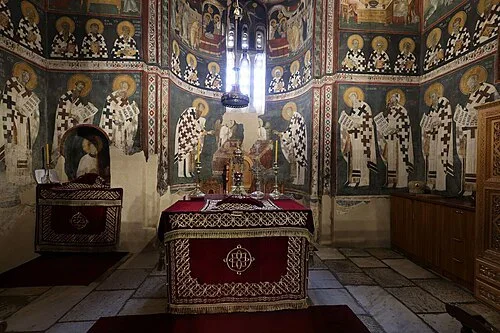 The Sanctuary Apse and Altar Screen
The Sanctuary and the Royal Doors
The eastern end of the church is the sanctuary, where the liturgy has been celebrated since the fourteenth century. The plan here is careful: the diaconicon and the prothesis, the service rooms flanking the apse, are separated by full walls. Rows of frescoed bishops in full vestments line the walls around the altar, and the katolikon itself sits a level higher than the narthex. The fittings in front of you are later, from the Ottoman centuries. The royal doors of the iconostasis were commissioned in 1564 by Metropolitan Dionisije, whose death is painted in the narthex. Under Patriarch Pajsije, who secured the church's leaden roofing, the large cross with the crucifix was made for the iconostasis in 1620. The medieval plan still serves its original rite, uninterrupted.
Listen in the appBLAGO Fund, Inc. · CC BY 4.0
- 11
The Konak: A Living Convent
The residence of a convent that has carried the monastery through plunder and war.
Gračanica Monastery
Frequently asked questions
How much does the guide cost?
Free app download. Listed guide price: $0.99. Guide price shown in the app. Audio guide only. Venue admission is separate.
Can I listen without internet?
Yes. Download the guide’s audio, images, and maps in the app before your visit. Your downloaded content is then available offline.
Can I listen in my language?
This audio guide is available in 15 languages, including English.
Do I need to follow a schedule?
No. This is a self-guided experience. Choose your stops, pause whenever you like, and return to a story at your own pace.
At your own pace
Explore Gračanica Monastery.
Download Stanza, then search for “Gračanica Monastery”.
Free app download · Guide price shown in the app
Keep exploring
Nearby audio guides
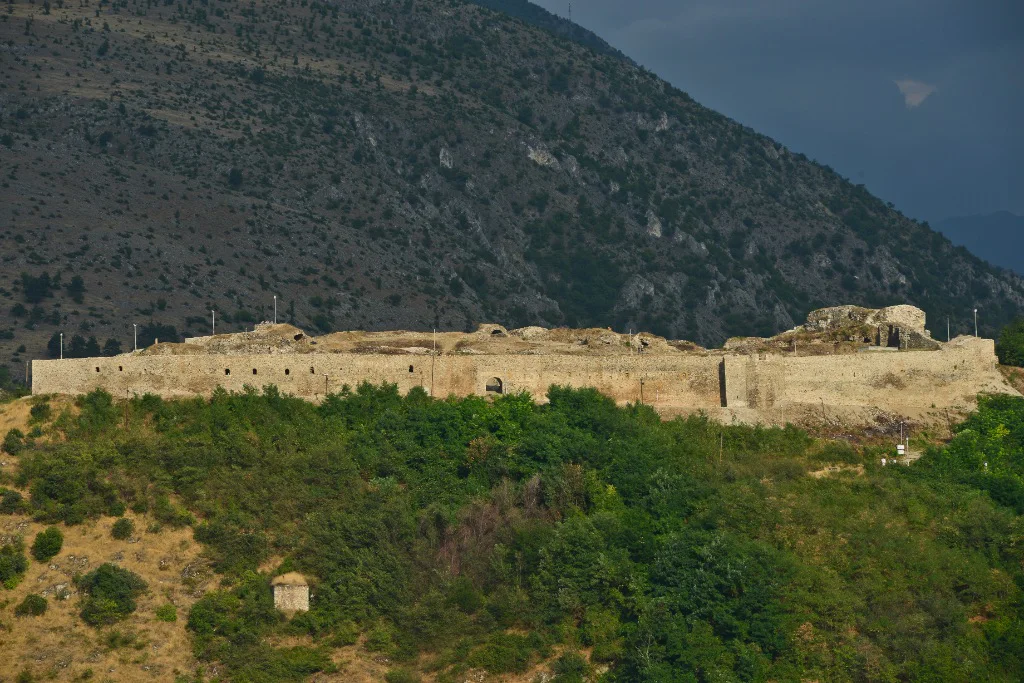
Prizren · 57 km
Prizren Fortress
Content & sources
Photo: Bleart kabashi · CC BY-SA 4.0
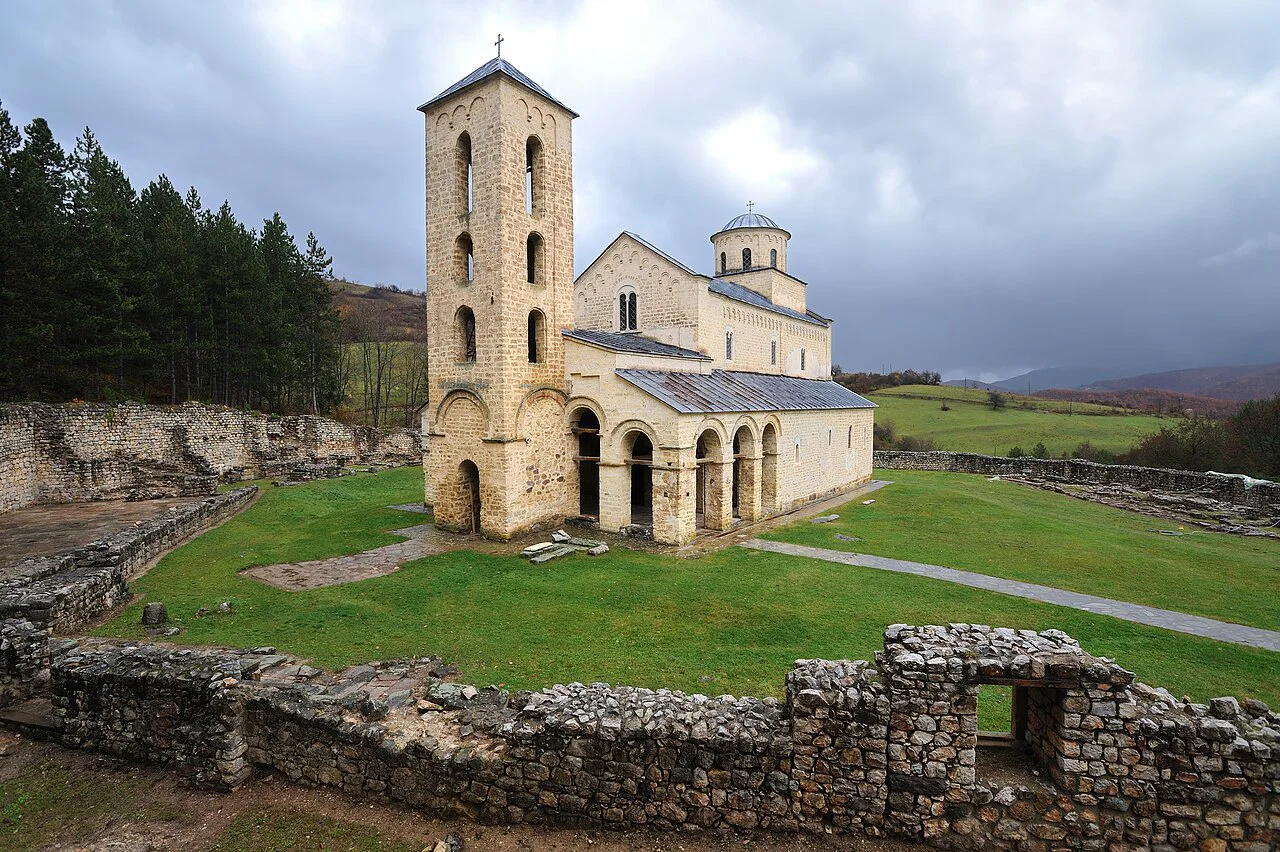
Novi Pazar City · 85 km
Sopoćani
Content & sources
Photo: Pavle Marjanovic · CC BY-SA 3.0
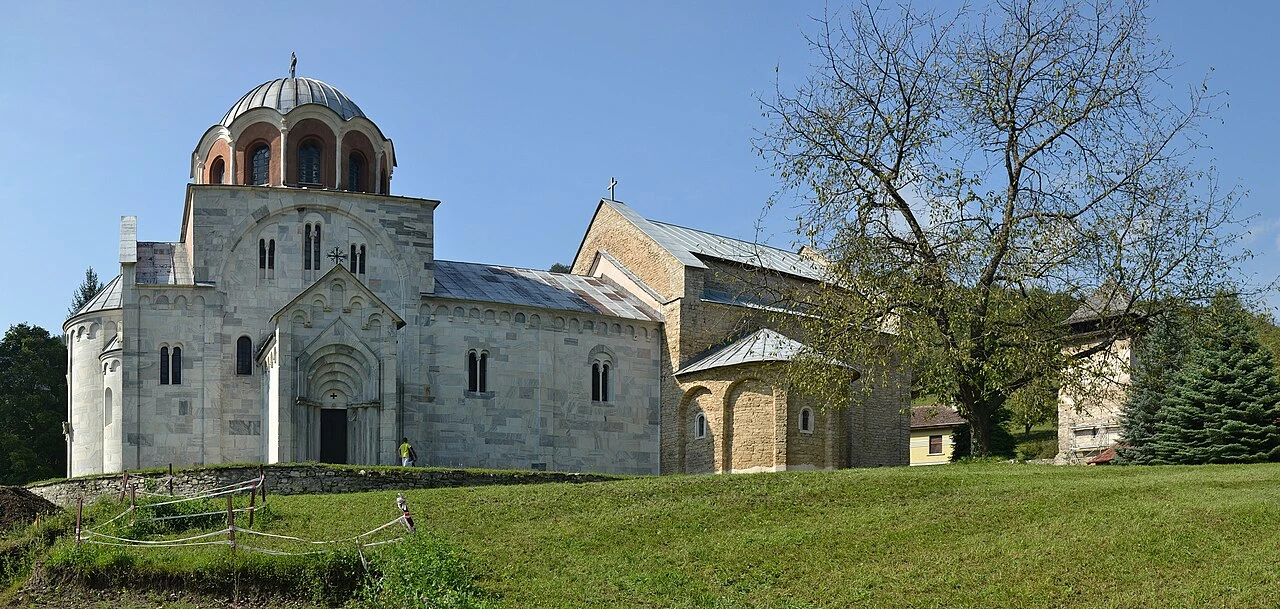
Brezova · 112 km
Studenica Monastery
Content & sources
Pudelek (Marcin Szala) · CC BY-SA 3.0
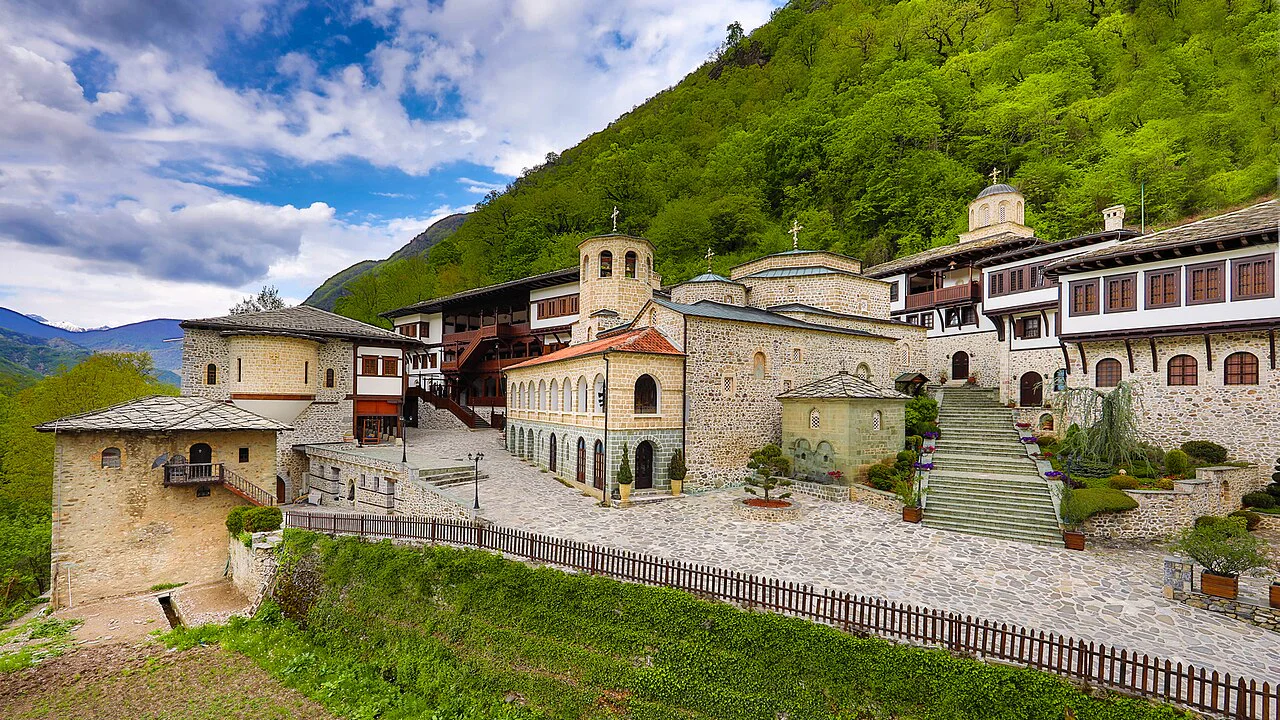
Rostushe · 119 km
Saint Jovan Bigorski Monastery
Content & sources
Photo: BigorskiMonastery · CC BY-SA 4.0