Stanza · Audio guide
Saint Jovan Bigorski Monastery Audio Guide
A place to remember. A story to take with you.
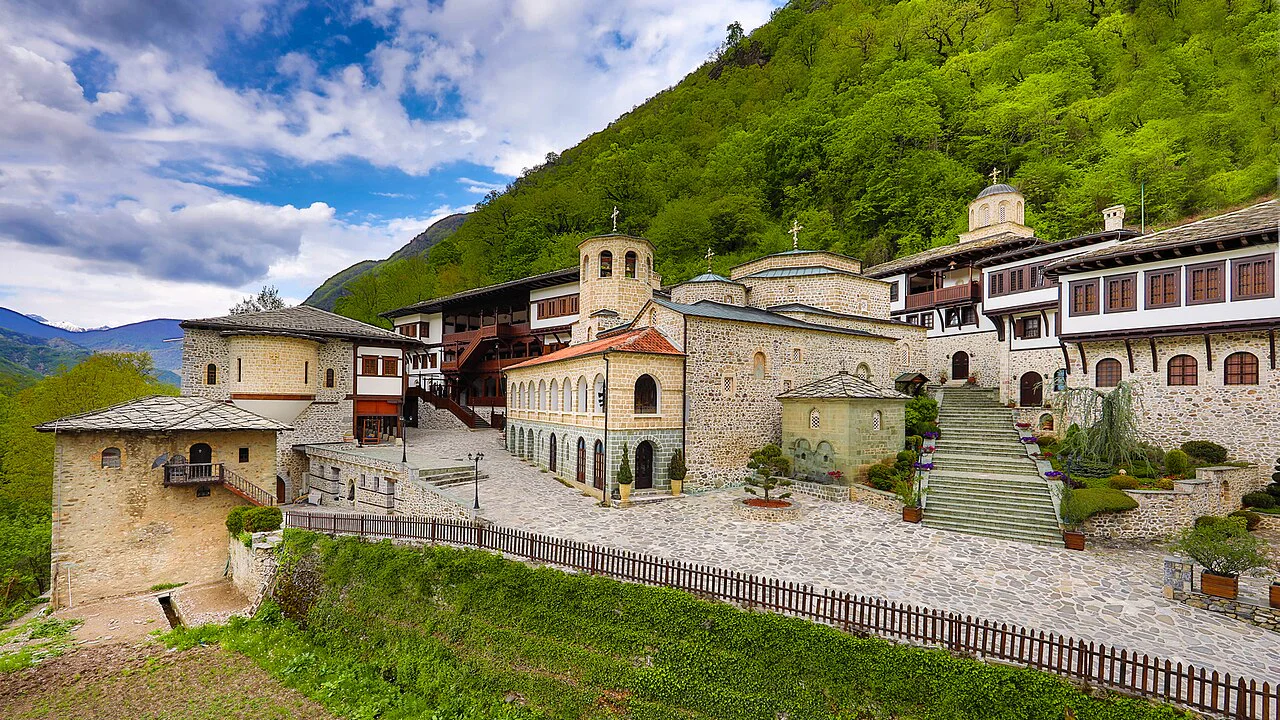
The Monastery of Saint Jovan Bigorski is a Macedonian Orthodox monastery located in western North Macedonia. It is situated near the road connecting the towns of Debar and Gostivar.
Download Stanza, then search for “Saint Jovan Bigorski Monastery”.
About the tour
One guide. Your kind of visit.
The Monastery of Saint Jovan Bigorski is a Macedonian Orthodox monastery located in western North Macedonia. It is situated near the road connecting the towns of Debar and Gostivar.
Ready when you are.
- 01Get the free Stanza app.
iOS & Android
- 02Find your guide.
“Saint Jovan Bigorski Monastery”
- 03Download before you go.
Works offline
Audio guide / 11 narrated stops
Inside the guide
Get to know a few of the stories before you go. Open a stop to read more.
01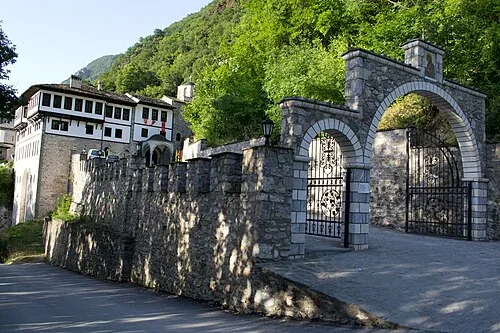 Fortified Main Entrance Gate
The Fortified Gate of the Bigorski Monastery
Welcome to Saint Jovan Bigorski, a Macedonian Orthodox monastery in the steep gorge of the Radika river, near the road that runs between Debar and Gostivar. Its crenellated stone gate and arched entrance rise like a small fortress, and behind them stands a community that traces its beginning more than a thousand years back. Tradition names the founder: a monk called Jovan Debranin, who established the monastery in 1020. Another tradition makes him John of Debar, who became the first Archbishop of Ohrid. Whether the monk and the archbishop are one and the same has been called unproven. What is certain is the dedication, because this whole house belongs to Saint John the Baptist. Through that gate lie a courtyard of pale stone, a church, and a very long story.
Photo: Jovanka.talevska · CC BY-SA 4.0
02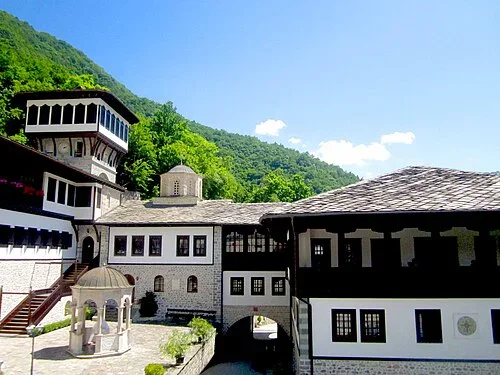 Terraced Courtyard and Fountain
The Terraced Courtyard and Stone Buildings
The pale stone in these walls gives the monastery its name, or so tradition says. It is a soft, porous limestone found in the mountains here, known locally as bigor, and Bigorski simply means the place of bigor. The building itself is a lesson in making do with a steep slope. Instead of one grand block, the monastery climbs the hillside in terraces: multi-story dormitories, galleries and connecting wings, stacked and massed together like a small fortress. A defense tower and a charnel house stand among the buildings too. Much of this facade took shape between the late eighteenth and early nineteenth centuries, when the monastery was at the height of its prosperity. Seen together, the terraces read as one massive stone shape, deliberately built to look unassailable.
Photo: Делфина · CC BY-SA 3.0
03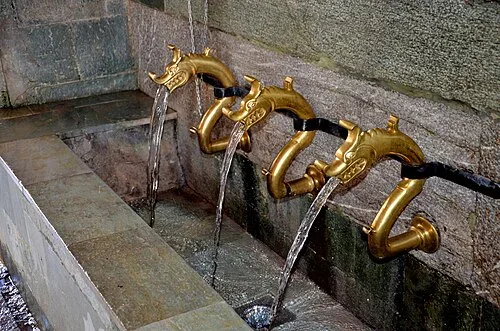 Terraced Courtyard and Fountain
The Courtyard Fountain
Three gilded dragon heads lean out of the stone wall here, each pouring a thin ribbon of water into the basin below. A fountain that never stops running is an old courtesy of Orthodox monasteries, part of the daily rhythm of a community and its guests. This one earned a place in literature as well. Blazhe Koneski, the great Macedonian poet, wrote a poem about it in 1988, called 'Inscription on the Fountain'.
Listen in the appPhoto: Slavica Panova · CC BY-SA 3.0
04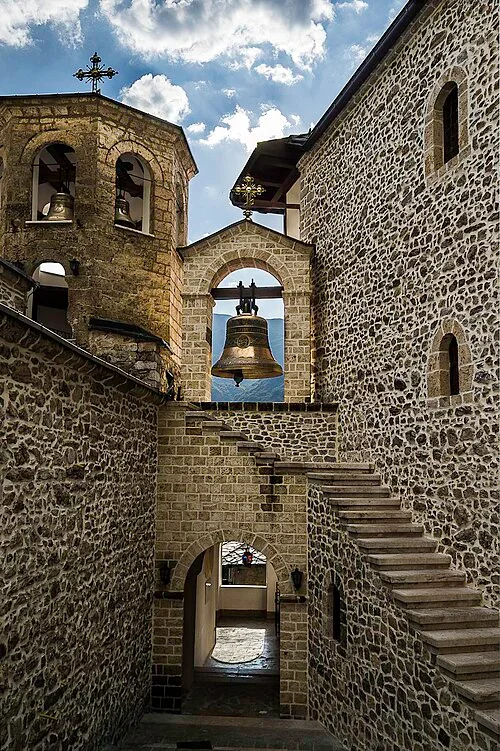 Church of Saint John the Baptist and Belfry
The Church of Saint John the Baptist and Bell Tower
The great bronze bell hangs in a stone archway before the church, a compact building crowned by a single dome. It is dedicated to Saint John the Baptist, and the monastery's great feast is his Beheading, kept on the twenty-ninth of August by the old calendar, the eleventh of September by the new. The community here has had to rebuild more than once. In the sixteenth century, under the Ottoman sultan Selim the Second, the monastery was all but destroyed, and by one account nothing of the complex was left standing. Legend adds a strange detail: the monastery's sacred icon of Saint John vanished before the flames, and later returned unharmed, no one knows how. The revival came in 1743, when a hieromonk named Illarion restored the monastery and gathered a new brotherhood, becoming the first abbot of the renewed community. Through all its history, the people of the surrounding Reka and Debar regions appear as its builders and its restorers.
Listen in the appPhoto: Chesta13 · CC BY-SA 4.0
05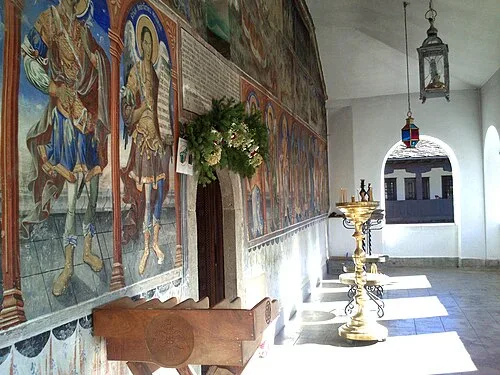 The Open Narthex and Narrative Frescoes
The Open Narthex and Its Frescoes
Before the church door, a long open porch serves as a painted anteroom. Along its outer wall run full-length figures of saints, haloed and richly robed, some in ornate armor, each with an inscription above the head. By 1871 this narthex held a whole procession: Clement of Ohrid and Naum, John Vladimir, the brothers Cyril and Methodius, and the medieval rulers Boris and Ivan Shishman. Painted on the outside of a church like this, where worshippers gathered before entering, the images worked as teaching, a last word of instruction before the threshold. Lanterns hang along the porch to light the figures after dark.
Listen in the appPhoto: Marijav2013 · CC BY-SA 3.0
06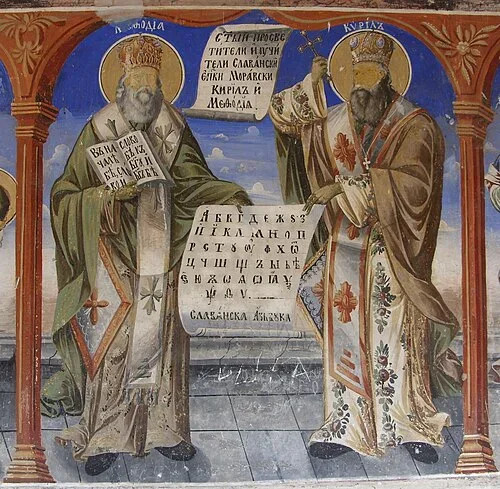 The Open Narthex and Narrative Frescoes
Saints Cyril and Methodius Fresco
Two crowned brothers stand side by side in this fresco, holding open scrolls covered in early Slavic letters. They are Cyril and Methodius, the ninth-century apostles who created the alphabet in which the Slavic peoples first received scripture and liturgy. Their presence ties the monastery to the Ohrid region's long tradition of learning and the written word. The fresco belongs to the porch scheme completed by 1871. One complication deserves an honest mention. A Bulgarian journalist, Svetoslav Terziev, has argued that the figures of the rulers Boris and Ivan Shishman on this porch were repainted under Serbian rule, between 1913 and 1941, and given the names of other saints, Stefan Decanski and Lazar Hrebeljanovic. It remains a reported claim rather than a settled fact.
Listen in the appJulian Nyča · CC BY-SA 3.0
07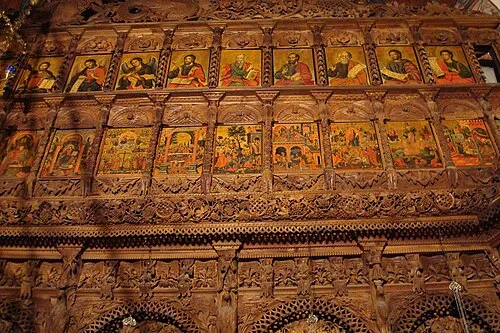 The Mijak Wood-Carved Iconostasis
The Walnut Iconostasis - Overview
Inside the church, the wall between the congregation and the altar is not a wall at all but tiers of carved walnut. In an Orthodox church the iconostasis carries the icons that separate the nave from the sanctuary, and most are flat and orderly. This one is deep relief, tier upon tier, with painted panels set into a framework of foliage and figures. It exists because an abbot wanted it so. Under Arsenius, the monastery set out to build one of the most beautiful iconostases of its time, and engaged the finest woodcarvers of the Mijak region. The work was led by Petre Filipovski-Garkata from the village of Gari, with his brother Marko beside him and Makarij Frchkovski from Galichnik, while Avram Dichov worked with his sons Vasil and Filip. The carving was done between 1829 or 1830 and 1835. Either way, a monument of this scale went up in about six years, entirely by hand.
Listen in the appPhoto: MacedonianBoy · CC BY-SA 4.0
08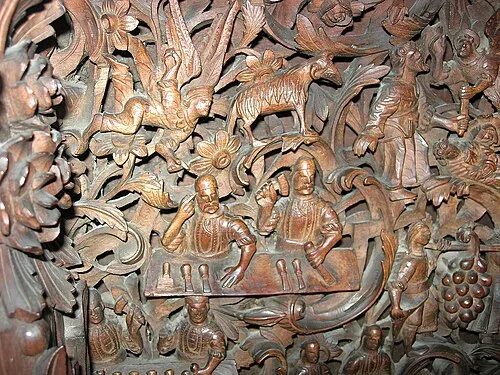 The Mijak Wood-Carved Iconostasis
The Carving Up Close
Up close, the carving almost leaves the wood. Figures stand out from the background in deep relief, some cut nearly free: craftsmen bent over a workbench, riders, animals and birds, grapevines heavy with fruit, all threaded through dense floral ornament. The panels carry scenes from the Old and New Testaments, with animals and birds interwoven among the foliage; which scene is which, the wood keeps to itself. The fame of this work traveled far. In 1895, Damjan Arsov, a former resident of Debar who had walked the whole of Mount Athos, declared that even there, among the great monasteries, there was nothing to match it. Above everything crowns a carved crucifixion cross, with lamias, creatures of evil, at its foot, overcome beneath the cross.
Listen in the appElen Schurova · CC BY-SA 2.0
09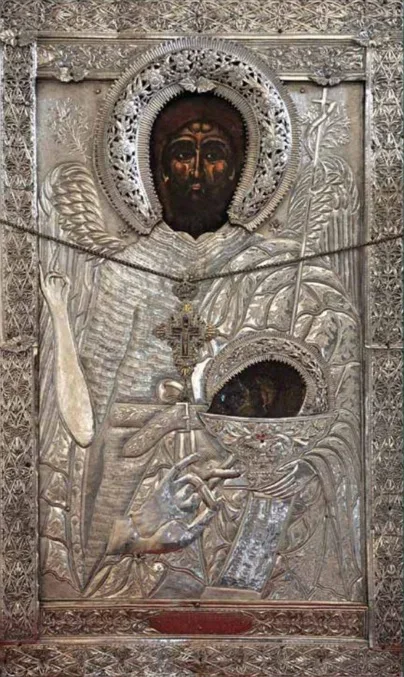 Sacred Treasures: The Miraculous Icon and Reliquary
The Miraculous Icon of Saint John the Baptist
The face in this icon is the only part the silver leaves bare. Saint John the Baptist is wrapped in a richly worked silver cover, chased and engraved, with everything hidden but the painted face. The monastery's writings record that the icon stood unprotected for thirty-five years. Only in 1885 was it clad in silver, under the abbots Michael and Hariton. The cover's own inscription carries a bold claim, that the icon dates from 1020, the year of the monastery's founding. The painted panel itself is judged to be later, from the late sixteenth or early seventeenth century, so legend and wood tell different ages. Tradition gives the icon its strangest feature: John appears as a three-handed saint, and the third hand is a blessing hand, believed to help parents who cannot have children. The classic story of that belief concerns an Albanian bey who came on pilgrimage in the sixteenth century. A son was born to him the next year, and he gave his whole estate to Saint John, promising a permanent supply of olive oil from his lands.
Listen in the appUnknown author · Public domain
10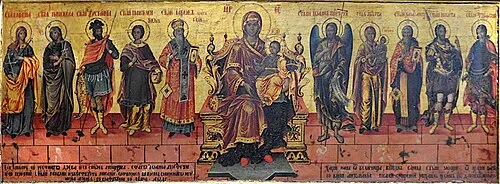 Sacred Treasures: The Miraculous Icon and Reliquary
The Reliquary Cover with the Saints
This painted panel belongs to the great reliquary chest, the kiwot, that stands in the church nave. Across its surface a row of standing saints in painted vestments flanks the Mother of God enthroned with Christ, each figure named by an inscription. The chest itself was made in 1834, on the orders of Abbot Arsenius, the same abbot who commissioned the walnut iconostasis. What it holds took a journey to gather. The relics were brought from Constantinople in 1820 by Hadzhi Nake of Belchitsa, who carried them home to the Radika valley. In the year 2000, a fragment of the True Cross was placed in the kiwot as well, joining the saints it guards.
Listen in the appMichael and Daniel painters · Public domain
- 11
The Great Konak - Fire and Rebirth
The great dormitory wing, the fire of 2009 that gutted it, and the rebuilding that followed within a year.
Saint Jovan Bigorski Monastery
Frequently asked questions
How much does the guide cost?
Free app download. Listed guide price: $0.99. Guide price shown in the app. Audio guide only. Venue admission is separate.
Can I listen without internet?
Yes. Download the guide’s audio, images, and maps in the app before your visit. Your downloaded content is then available offline.
Can I listen in my language?
This audio guide is available in 15 languages, including English.
Do I need to follow a schedule?
No. This is a self-guided experience. Choose your stops, pause whenever you like, and return to a story at your own pace.
At your own pace
Explore Saint Jovan Bigorski Monastery.
Download Stanza, then search for “Saint Jovan Bigorski Monastery”.
Free app download · Guide price shown in the app
Keep exploring
Nearby audio guides
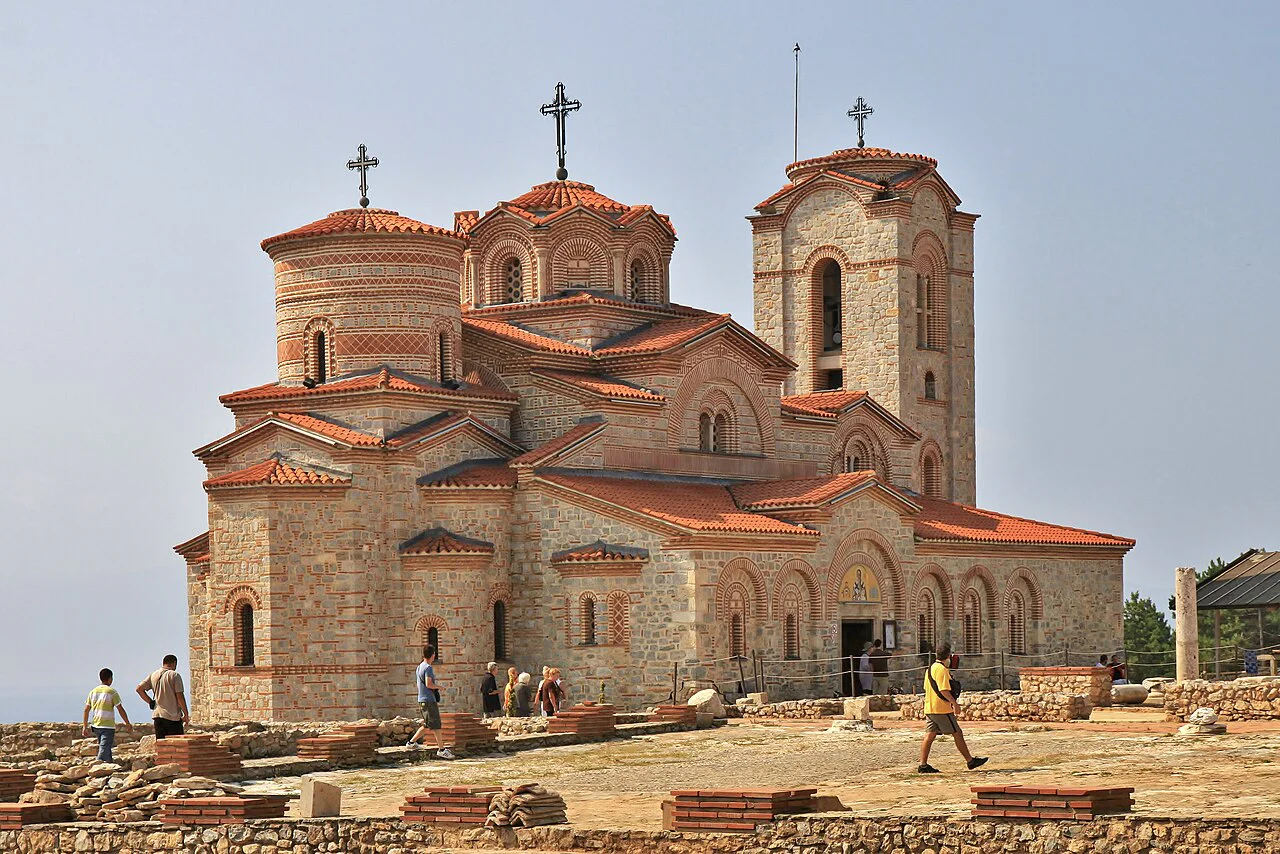
Ohrid · 59 km
Church of Saints Clement and Panteleimon
Content & sources
Marcin Konsek · CC BY-SA 4.0
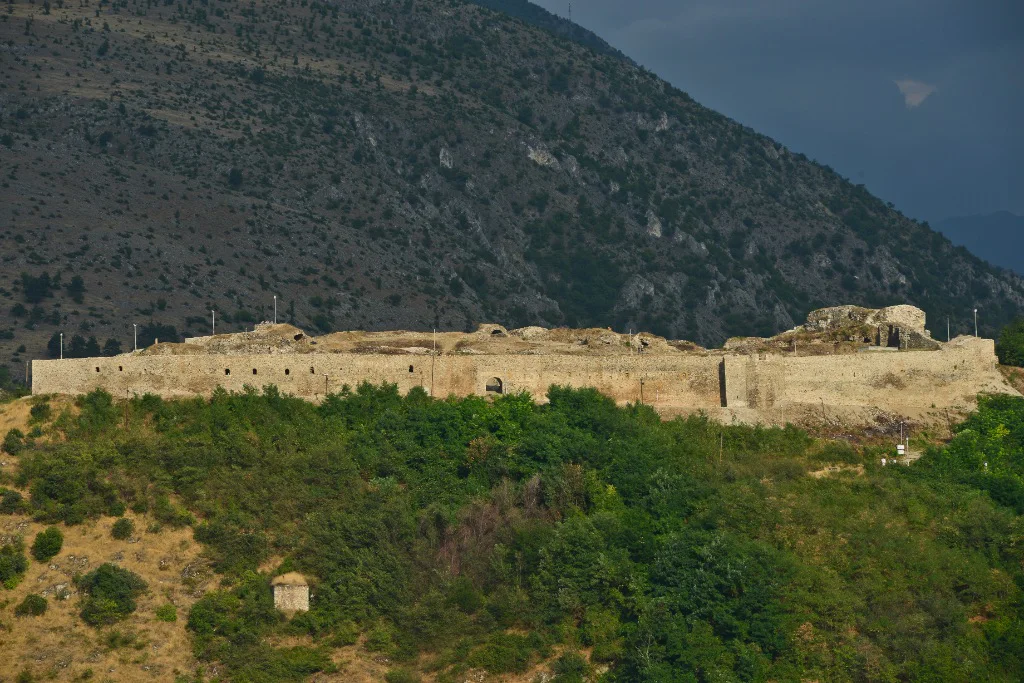
Prizren · 66 km
Prizren Fortress
Content & sources
Photo: Bleart kabashi · CC BY-SA 4.0
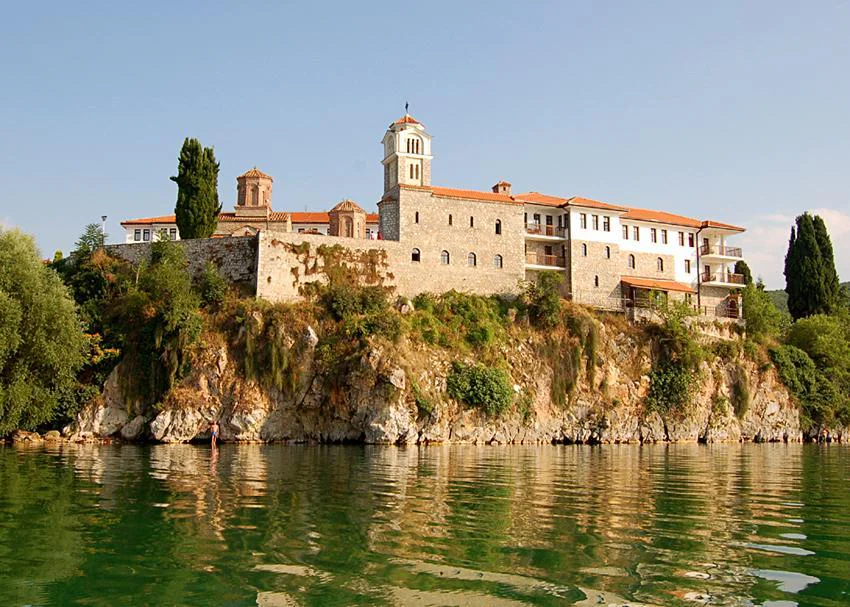
Ohrid · 79 km
Monastery of Saint Naum
Content & sources
Poppit2 · Public domain
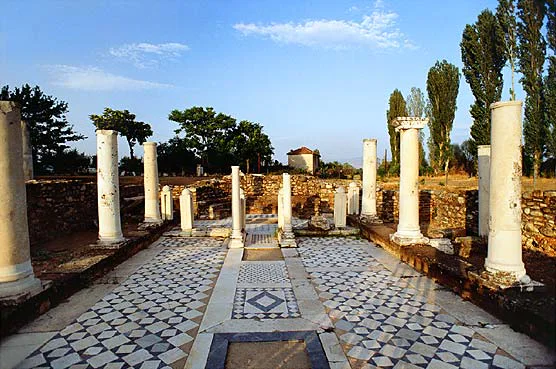
Bitola · 91 km
Heraclea Lyncestis
Content & sources
Revizionist at Macedonian Wikipedia · CC BY-SA 3.0