 Stanza / Audio guide
Content & sources
Stanza · Audio guide
Heraclea Lyncestis Audio Guide
A place to remember. A story to take with you.
Heraclea Lyncestis was an ancient Greek city in Macedon that was later ruled by the Romans. It served as an important episcopal seat and a waypoint on the Via Egnatia during the early Christian period.
Download Stanza, then search for “Heraclea Lyncestis”.
About the tour
One guide. Your kind of visit.
Heraclea Lyncestis was an ancient Greek city in Macedon that was later ruled by the Romans. It served as an important episcopal seat and a waypoint on the Via Egnatia during the early Christian period.
Ready when you are.
- 01Get the free Stanza app.
iOS & Android
- 02Find your guide.
“Heraclea Lyncestis”
- 03Download before you go.
Works offline
Audio guide / 10 narrated stops
Inside the guide
Get to know a few of the stories before you go. Open a stop to read more.
01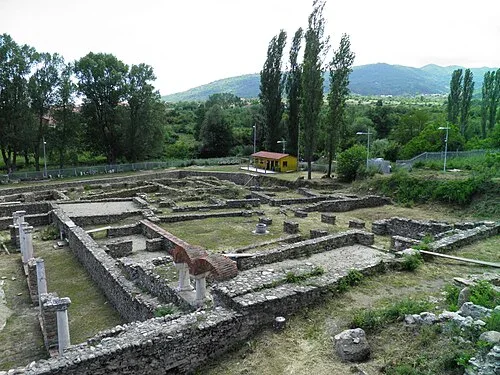 Site Entrance & Pelagonia Plain Overlook
Heraclea Lyncestis: View over the Ruins from the Site Entrance
Welcome to Heraclea Lyncestis, an ancient city in the hills above Bitola. From this high ground the whole excavation spreads out before the mountains: lines of wall, strips of foundation, and green fields running south. Philip II of Macedon founded the city in the middle of the fourth century BC, and he named it for the hero Heracles. The region around it was called Lynkestis, a kingdom Philip had conquered, and the city took its name from that land. The spot was chosen with care. Here the foothills of Baba Mountain meet the open Pelagonia plain, on one of the main routes running east and west between Illyria and Macedonia. A fortress planted on that route stopped Illyrian raiders from coming into Macedon from the west. The city fought through the Macedonian Wars until Rome conquered Macedonia in the second century BC and broke its political power. What follows on this tour is the rest of its life: a rich Roman road town, then a seat of early Christian bishops, and finally a city that emptied out in the sixth century. In all, people lived here for roughly a thousand years.
Carole Raddato from FRANKFURT, Germany · CC BY-SA 2.0
02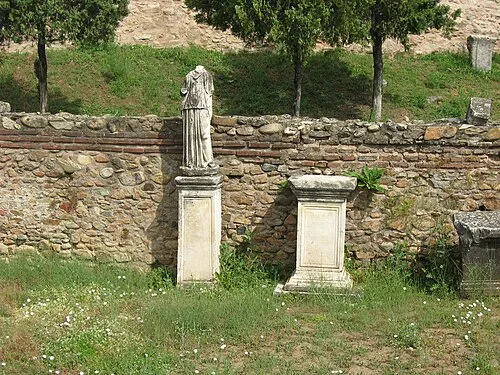 The Forum Portico & Honorific Statues
Forum Portico: Honorific Statue and Pedestals
Rome's conquest changed this city's fortune in an unexpected way: it put Heraclea on a highway. The Via Egnatia was the main Roman road of the southern Balkans, running from the Adriatic port of Dyrrachium all the way to Byzantium, and it passed straight through the town. Heraclea became a significant stop on the route, and the traffic kept the city wealthy. These stone pedestals by the portico wall belong to that prosperous time. In Roman cities across the empire, honorific statues of local benefactors and officials stood in public colonnades like this one, raised on inscribed bases paid for by the community. The carved figure beside them has lost its head, but the tall pedestal and the plain block next to it still carry the shape of the practice: a citizen honored in stone, set up where everyone passing through the forum would see it. Votive monuments from the Roman period have come out of this ground alongside the portico, the baths and the theatre. A road town with money to spend had statues to show for it.
Photo: Explorer1940 · CC BY-SA 4.0
03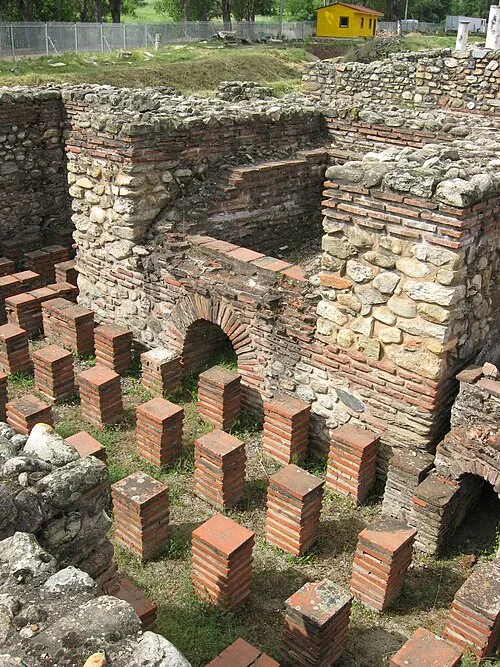 The Roman Thermae
These stacks of red brick, set out in careful rows, once held a floor above them. Roman builders called the system a hypocaust: the floor of the bath rested on piles like these, and hot air from a furnace circulated through the empty space underneath before escaping through vents in the walls. The heat rose through the floor and sometimes up through hollow wall tiles, so bathers walked on warm stone even in winter. Baths like these were a fixture of any Roman city worth the name, and Heraclea, grown rich on the road that ran through it, adopted the habit. The thermae here are counted among the Roman-period structures found at the site, along with the portico, the theatre and the town walls. A bathhouse was more than a place to get clean. Bathing was a daily routine, a social hour and a marker of Roman urban life, all at once. The floor they carried is gone, leaving the skeleton of the heating system standing in the open air.
Listen in the appPhoto: Explorer1940 · CC BY-SA 4.0
04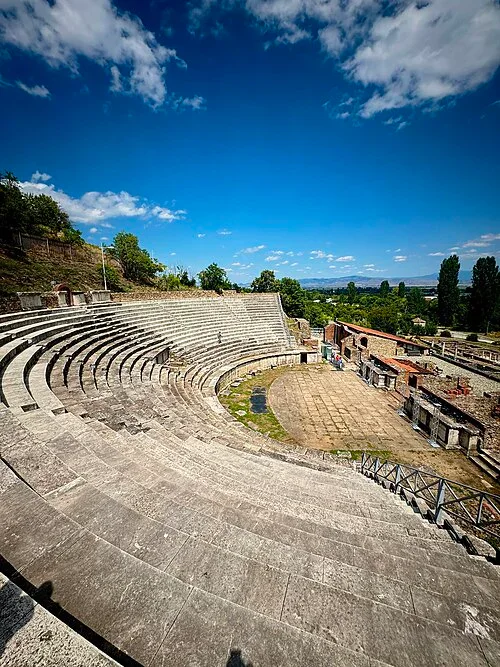 The Roman Theatre
Work on this theatre began under the emperor Hadrian, and the finishing touches were made under Antoninus Pius, so it took shape across the middle of the second century AD. The builders carved the seating directly into the hillside of Baba Mountain. There are twenty rows of seats, split by a walkway called a diazoma, with room for about three thousand spectators of every social rank. A bone ticket for a seat in the fourteenth row, found in 1931, is the earliest known proof the theatre existed; the building itself waited until 1968 to be excavated. The stage had five rectangular rooms behind a richly decorated northern facade. But the theatre served a second purpose as well. Three animal cages stood inside it, and a high wall of orthostats with a metal railing above ringed the orchestra to protect the audience during beast hunts. Local tradition holds that early Christians were thrown to the animals here. That account rests on tradition rather than records, so it is told as the story goes. The theatre went out of use in the late fourth century, when gladiator fights were banned across the Roman Empire as Christianity spread and pagan entertainments fell away.
Listen in the appPhoto: Buli · CC0
05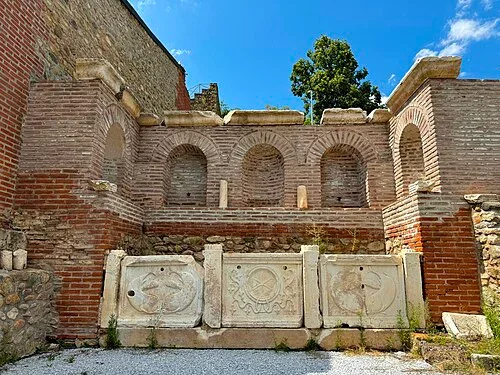 Justinian's Public Fountain
 of 562 AD
This fountain carries a date you can pin down almost to the day. It was a gift from the Byzantine emperor Justinian the First to the city, raised in the thirty-fifth year of his reign and dedicated on the tenth of September, 562, while John served as bishop. A Greek inscription framing three marble relief panels records the dedication. The panels themselves are carved with dolphins and fish around a central flowering christogram, the monogram of Christ drawn as a blooming plant. Together they make a deliberately Paradise-like image: water, living creatures and abundance flowing in a Christian key. The fountain stood east of the theatre, on the city's main square, where public life gathered. A monument like this says something about the city's last centuries. Heraclea was old by then, and trouble was not far off, yet it could still command the patronage of an emperor working from Constantinople. The carved marble has outlasted the plumbing that once fed it, and the inscription still fixes the day the water first ran.
Listen in the appPhoto: Buli · CC0
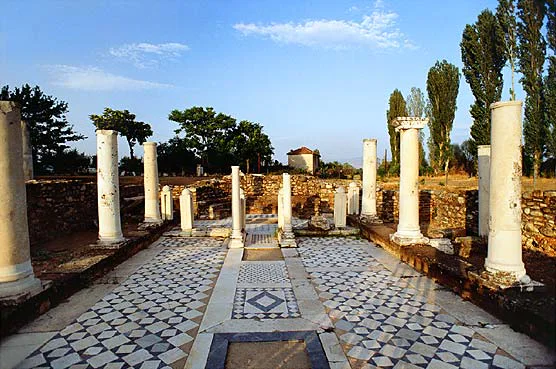
06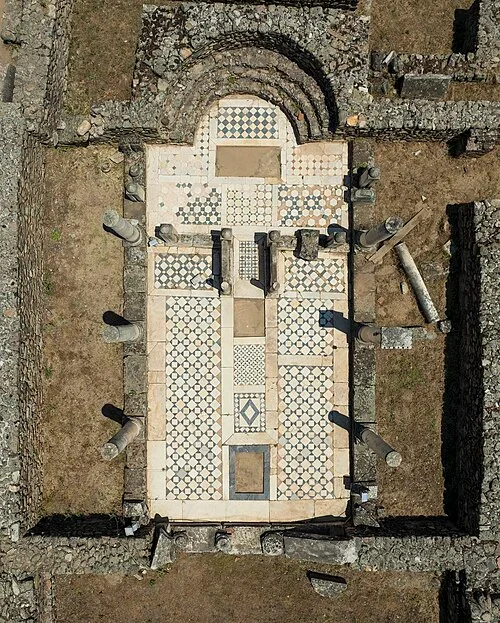 The Small Basilica & Baptistery
The Small Basilica and Baptistery
Diggers in the years before the Second World War got this building wrong. Excavations between 1936 and 1938 uncovered its walls and floors, and at first everyone took it for an ancient palace. Only later research, carried out from 1960 to 1964, made it clear that this was an early Christian basilica, one of the churches of Heraclea's episcopal age. Seen from above, the floor shows two different mosaic crafts. The basilica's decorated floor was laid in opus sectile, a technique of cut stone and marble pieces fitted together like inlay. The second room used opus tessellatum, the familiar mosaic of small tesserae set into patterns. The first room served for baptizing, which made this complex a working liturgical space, not just a hall. When the Great Basilica rose elsewhere on the site, the functions of these rooms changed, as the newer church took over the congregation. You can still see how much of the original floor survived: column bases, thresholds and wide fields of geometric pattern, all laid out where the builders of the fifth and sixth centuries left them.
Listen in the appPetar Milošević · CC BY-SA 3.0
07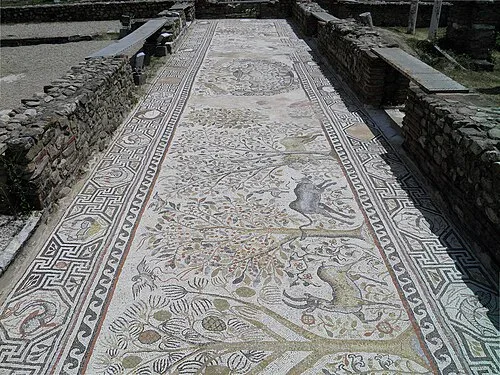 The Great Basilica & Paradise Mosaics
Great Basilica: The Narthex Mosaic Floor
The Great Basilica was a monumental church: a porch of open colonnades, an exonarthex, a narthex, two annexes on the north and three on the south. It was built on top of an earlier basilica that already stood on the spot, sometime between the fourth and the sixth century, so the building is layered like the city around it. Its floors carried mosaics of geometric and floral design, but the narthex floor is the masterpiece. It is a single continuous composition of about a hundred square metres, dating to the sixth century, and it was conceived as one field rather than a set of framed panels. Trees, bushes, birds and beasts spread across it with no dividing borders, so the whole floor reads as a single image of Paradise, the paradeisos. Walking into the church meant walking into that image, across a carpet of stone tesserae that stretched the length of the entry hall. The long view down the floor shows the idea at work: the pattern runs on and on, one world of plants and animals, made to be entered rather than merely looked at.
Listen in the appCarole Raddato from FRANKFURT, Germany · CC BY-SA 2.0
08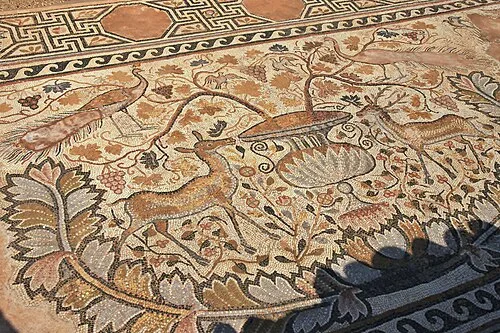 The Great Basilica & Paradise Mosaics
Paradise in Detail: Peacock, Deer and the Tree of Life
Some of the animals in the Great Basilica's Paradise floor carry meanings an early Christian worshipper would have read at a glance. The peacock was a traditional symbol of immortality, its flesh believed by legend never to rot. Two deer stand at a cantharus, the wide vase shown flowering at the centre of the scene, drawing on the image of the soul that thirsts for God coming to the water. Around them spread a flowering tree and scrolling vines, the tree of life and its shoots. Elsewhere in the same composition a red dog appears, described as a symbol of paradise itself, along with beasts that stand for the domain of the earth. The imagery has travelled further than its makers could have guessed. It appears on the reverse of the Macedonian five-thousand-denars banknote, issued in 1996, so the peacock and the deer of Heraclea now pass through hands across the country.
Listen in the appMarcin Konsek · CC BY-SA 4.0
09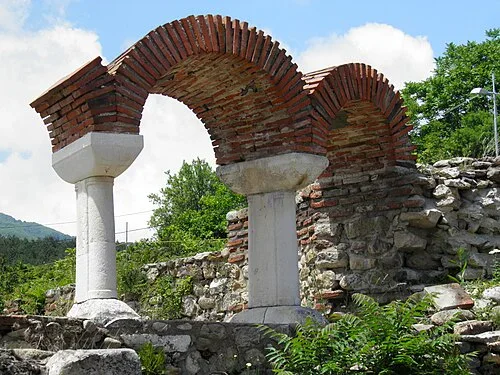 The Episcopal Residence & Well Courtyard
The Episcopal Residence
From the fourth century onward, Heraclea was an important episcopal centre, and this residence was the seat of it. Excavation ran from 1970 to 1975. The western part came to light first, and the southern side of the building sits close against the town wall. The luxury rooms lay in the eastern part, and the second, third and fourth rooms all had mosaic floors underfoot. Between the third and fourth rooms a passage was cut through to the eastern entrance of the residence, made deliberately at some point between the fourth and the sixth century. The triple arches of brick that still rise here, carried on white marble capitals, give a sense of how much of the structure once stood overhead. The bishops themselves appear in the records of the wider church. Evagrius, bishop of Heraclea, is named in the acts of the Council of Sardica in 343. A century later, bishop Quintilinus appears in the acts of the Second Council of Ephesus in 449. Between them, Heraclea's churchmen took part in the great debates of the early Christian world, from a residence on this hillside.
Listen in the appCarole Raddato from FRANKFURT, Germany · CC BY-SA 2.0
10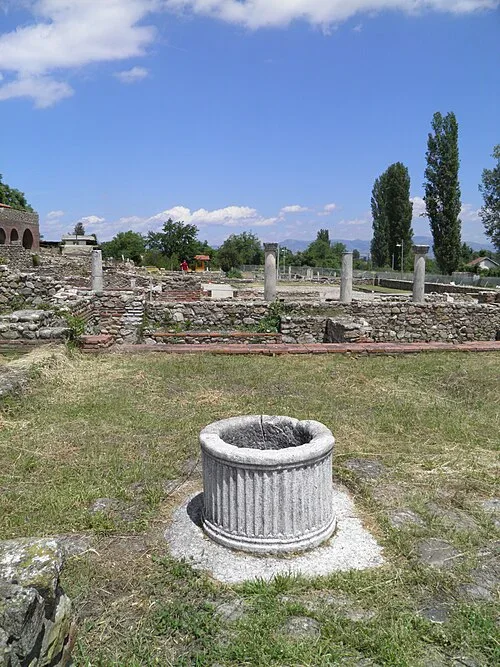 The Episcopal Residence & Well Courtyard
The Well Courtyard and the End of the City
The carved marble well head in this courtyard belongs to the city's last generations, the years when daily life carried on here while the world outside turned against it. In 472, Gothic forces commanded by Theodoric the Great sacked Heraclea. The city's bishop gathered a large gift of money to buy it off, and seven years later the Goths came back and sacked it anyway. Heraclea restored itself in the late fifth and early sixth century, a measure of how much life was still left in it. Then an earthquake struck in 518, and the inhabitants gradually abandoned the city. Coins stop around 585, which suggests the Slavs finally took the place. The Dragovites, a Slavic tribe pushed down from the north by the Avars, settled the area at the eve of the seventh century, and on the ground of the deserted theatre they built huts. A frontier fortress outlived its military purpose to become a road town, a place of spectacles and a seat of bishops, and then quiet.
Listen in the appCarole Raddato from FRANKFURT, Germany · CC BY-SA 2.0
Heraclea Lyncestis
Frequently asked questions
How much does the guide cost?
Free app download. Listed guide price: $0.99. Guide price shown in the app. Audio guide only. Venue admission is separate.
Can I listen without internet?
Yes. Download the guide’s audio, images, and maps in the app before your visit. Your downloaded content is then available offline.
Can I listen in my language?
This audio guide is available in 15 languages, including English.
Do I need to follow a schedule?
No. This is a self-guided experience. Choose your stops, pause whenever you like, and return to a story at your own pace.
At your own pace
Explore Heraclea Lyncestis.
Download Stanza, then search for “Heraclea Lyncestis”.
Free app download · Guide price shown in the app
Keep exploring
Nearby audio guides
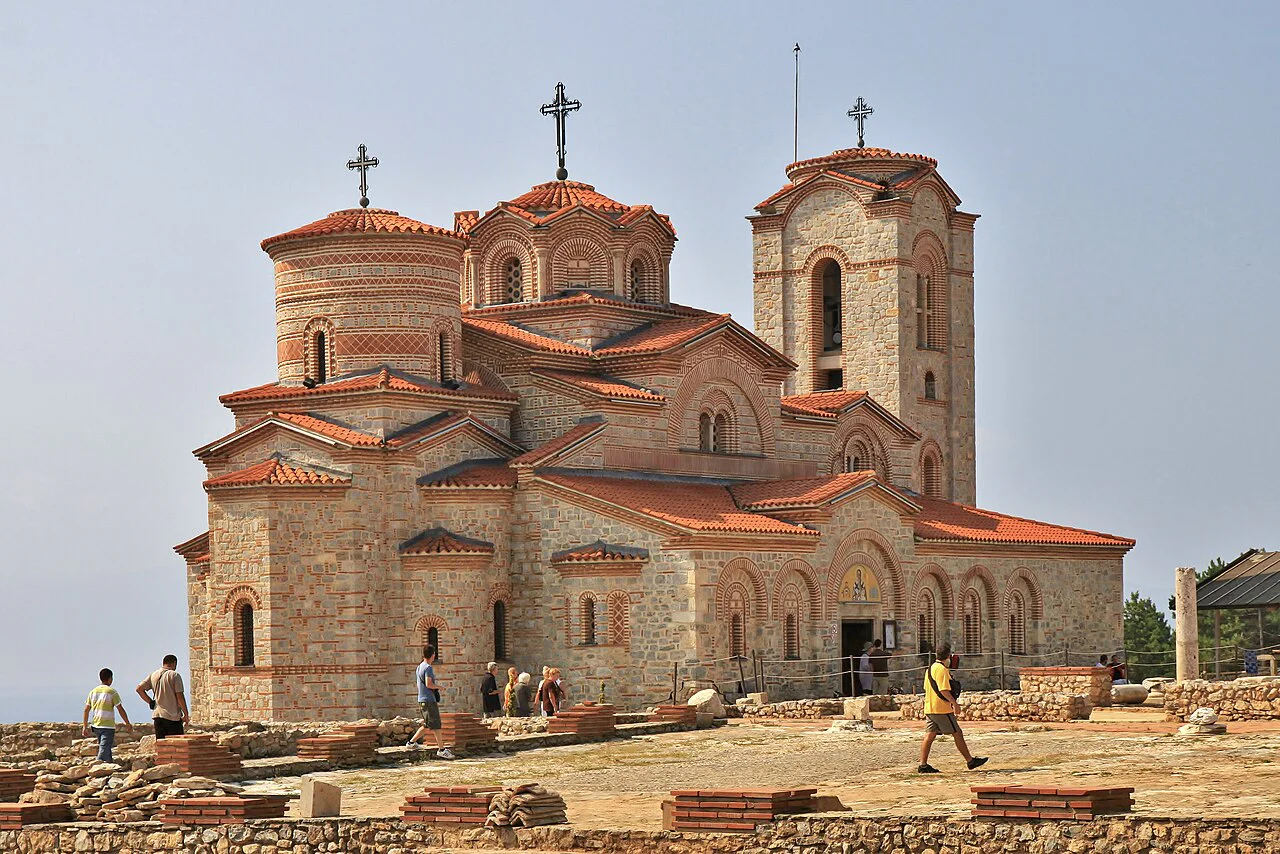
Ohrid · 48 km
Church of Saints Clement and Panteleimon
Content & sources
Marcin Konsek · CC BY-SA 4.0
Ohrid · 52 km
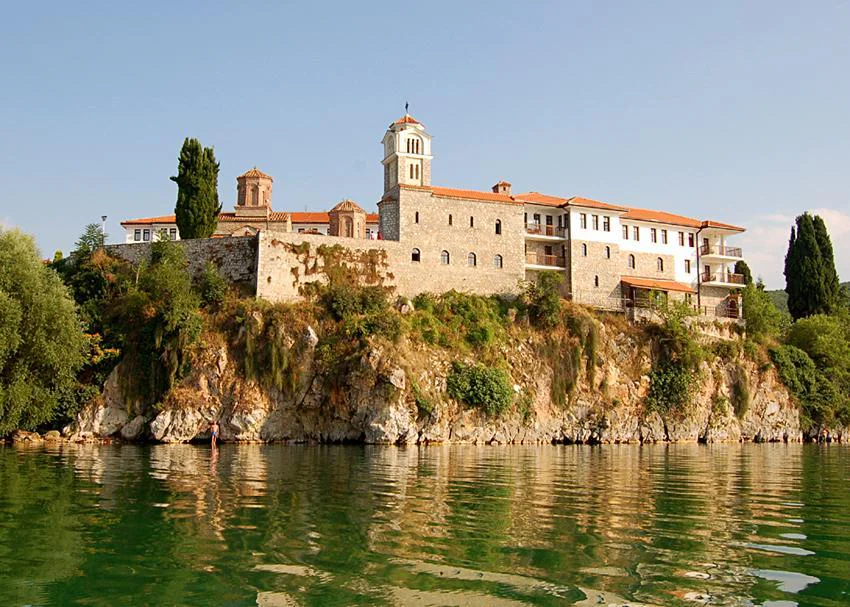
Monastery of Saint Naum
Content & sources
Poppit2 · Public domain
Gradsko · 80 km
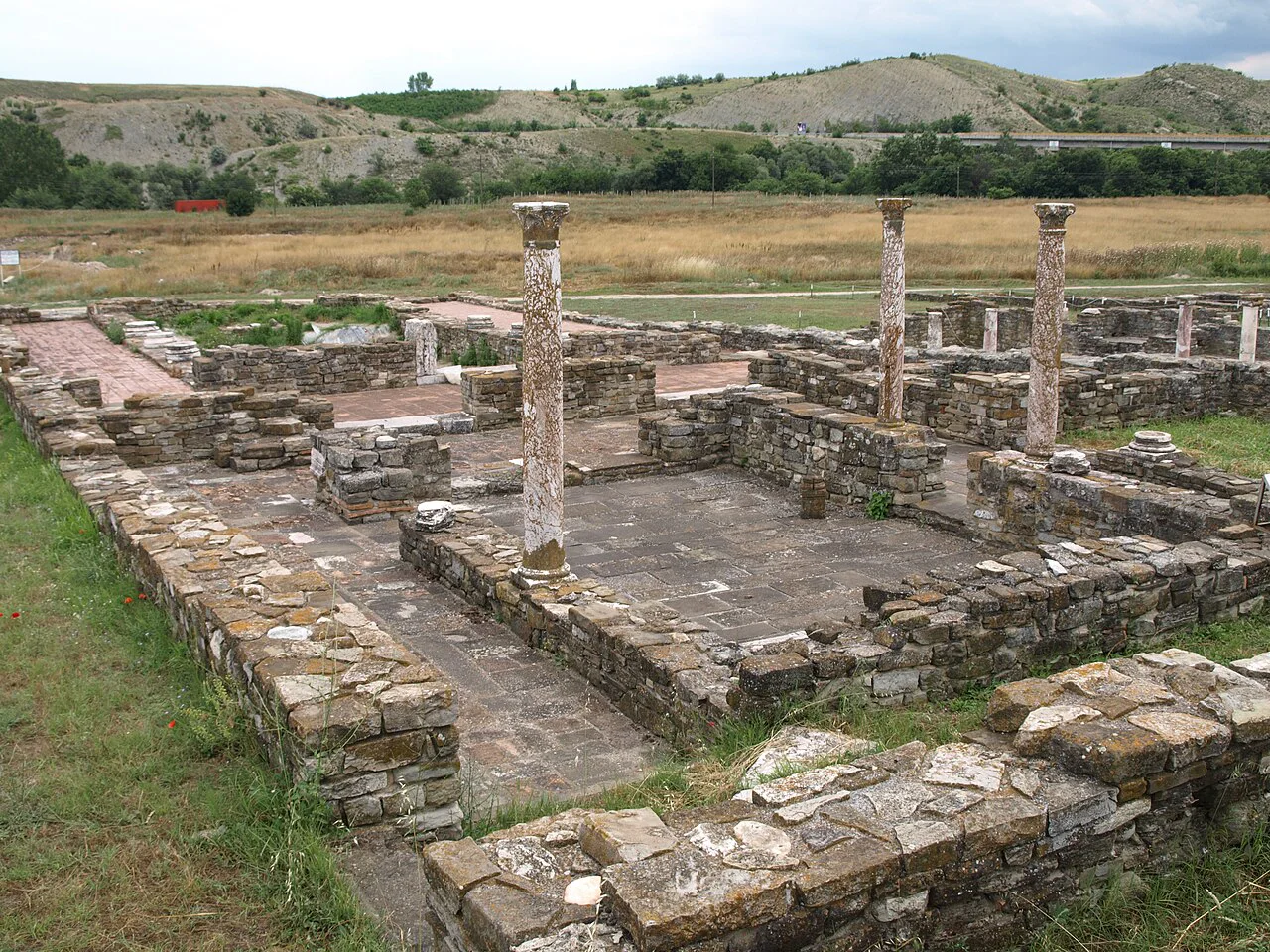
Stobi
Content & sources
Vaurien · CC BY-SA 3.0 de
Rostushe · 91 km
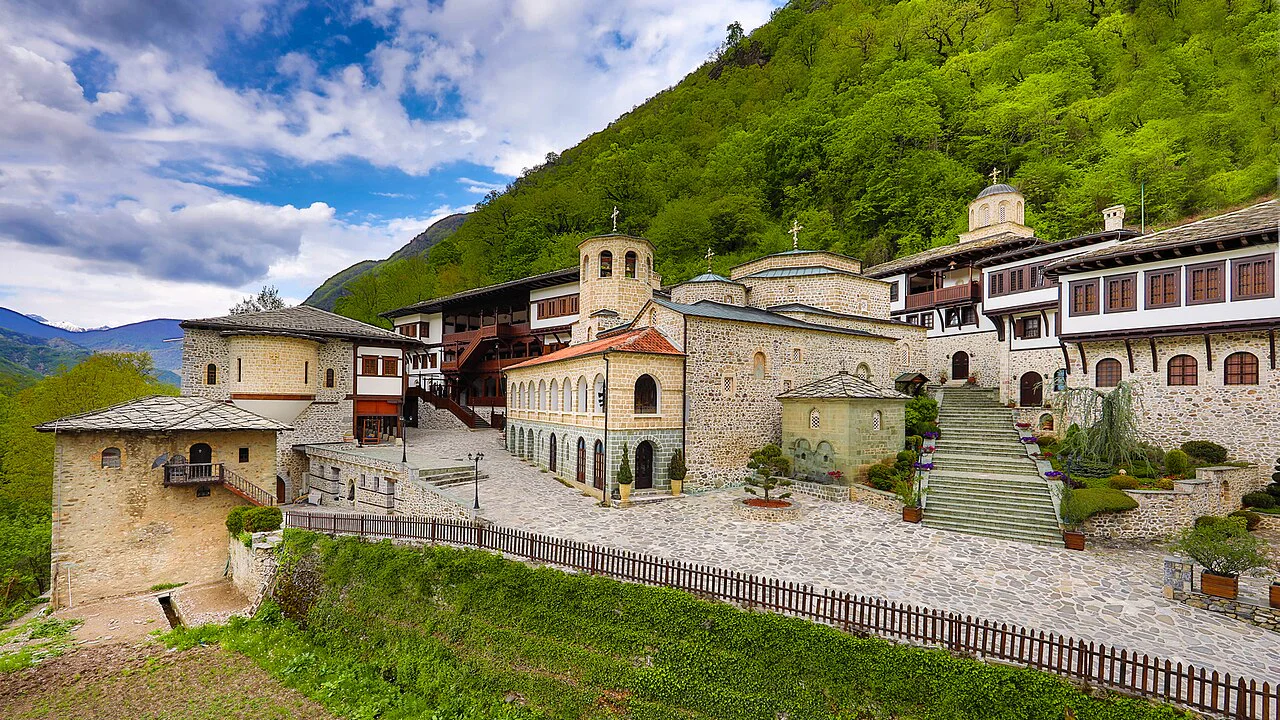
Saint Jovan Bigorski Monastery
Content & sources
Photo: BigorskiMonastery · CC BY-SA 4.0