Stanza · Audio guide
Church of Saints Clement and Panteleimon Audio Guide
A place to remember. A story to take with you.
The Church of Saints Clement and Panteleimon is a Byzantine church located on Plaošnik in Ohrid, North Macedonia. It is attributed to Saint Clement of Ohrid and is believed to be the site where the first…
Download Stanza, then search for “Church of Saints Clement and Panteleimon”.
About the tour
One guide. Your kind of visit.
The Church of Saints Clement and Panteleimon is a Byzantine church located on Plaošnik in Ohrid, North Macedonia. It is attributed to Saint Clement of Ohrid and is believed to be the site where the first students of the Glagolitic alphabet were taught.
Ready when you are.
- 01Get the free Stanza app.
iOS & Android
- 02Find your guide.
“Church of Saints Clement and Panteleimon”
- 03Download before you go.
Works offline
Audio guide / 9 narrated stops
Inside the guide
Get to know a few of the stories before you go. Open a stop to read more.
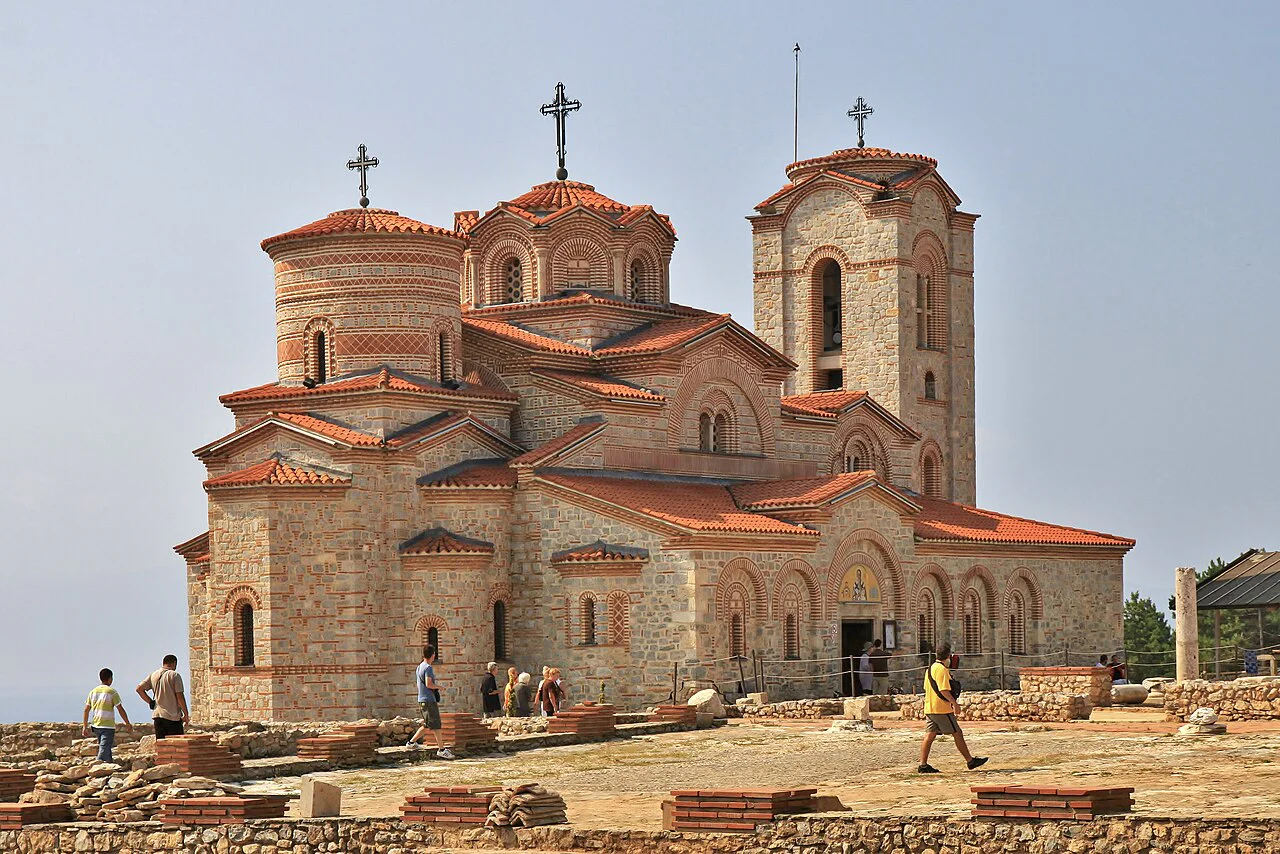
01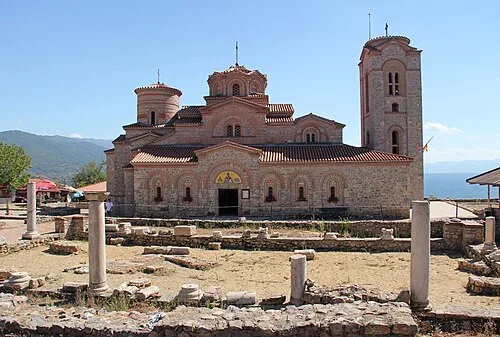 Plaošnik Archaeological Park and 5th-Century Roman Basilica
Plaošnik Hill: The Church of Saints Clement and Panteleimon
Welcome to Plaošnik, the hill that rises above Lake Ohrid in the old quarter of the city. On its top stands a Middle-Byzantine church with a double name: Saints Clement and Panteleimon. The story belongs to a monk named Clement, a disciple of Saints Cyril and Methodius, the men who gave the Slavs their first alphabet. Clement came to Ohrid at the request of Boris the First of Bulgaria, and he found an old church on this hill, which he restored. Around it lay the remains of something far older: a great basilica of five parts, whose pillars and broken walls still lie scattered outside the church today. That is the pattern of this whole place. Beneath the church, an early Christian sanctuary. Above it, Clement's ninth-century foundation. Then centuries of Ottoman rule that left the church in ruins, and a rebuilding finished in 2002. Every layer is still here, one on top of the other.
Photo: BrankaVV · CC BY-SA 4.0
02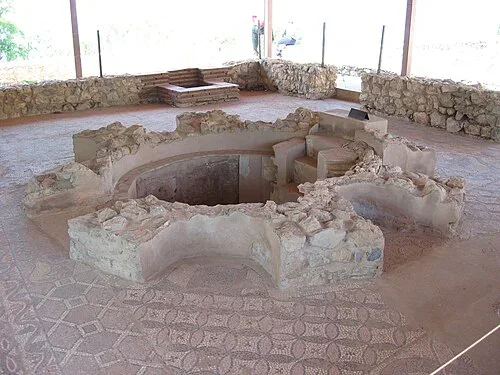 Plaošnik Archaeological Park and 5th-Century Roman Basilica
The Early Christian Baptistery and Its Mosaic Floor
The oldest sacred building on this hill was not Clement's church at all. It was a large early Christian basilica of five aisles, and Clement set his church straight on top of its foundations. Its remains are still visible around the church today. The finest survivor sits under a shelter nearby: a baptistery, the room where new Christians were baptised. Its floor is covered in finely detailed geometric mosaics, laid centuries before Clement was born. Close by stands a stone baptismal font, which tradition says was the font used to baptise his own disciples. For Clement, the choice of this spot was hardly accidental. He was restoring a church that stood on ground already holy, where Christians had gathered and been baptised for hundreds of years. Building over it meant joining his work to theirs.
Photo: Explorer1940 · CC BY-SA 4.0
03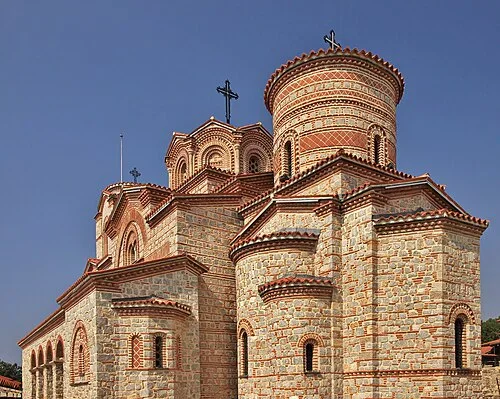 Reconstructed Byzantine Facade and Western Portal
Stone and Brick: The Handcrafted Reconstruction
The striped bands of stone and brick in these walls hold the secret of this building. What stands here is new, yet it was built entirely the old way. Reconstruction began on December 8, 2000, and the church was complete by August 10, 2002. The work was carried out by hand, using the same materials that went into the original church. Machines were brought in for one task only: polishing the interior. The project followed designs by the architect Tanja Paskali Buntašeska of the Ohrid Institute and Museum. To get the look right, the builders studied churches in Ohrid and its surroundings that belong to the same phases of Byzantine building. That is why the domes, the arched openings and the tiled roofs read as genuinely medieval rather than as imitation. The masonry itself was the argument: this church was rebuilt the way Clement's would have been built.
Listen in the appMarcin Konsek · CC BY-SA 4.0
04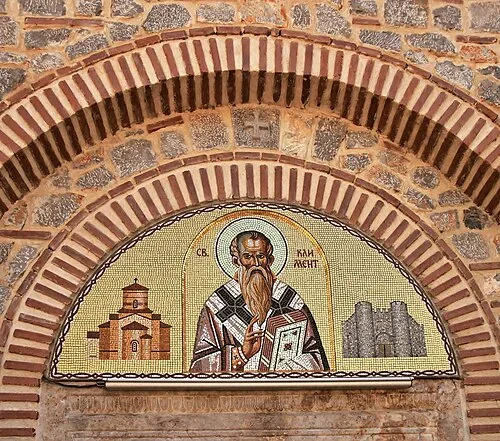 Reconstructed Byzantine Facade and Western Portal
Saint Clement at the Western Portal
Above the entrance sits an icon of Saint Clement with Saint Panteleimon beside him. The image is a statement of ownership, placed at the very door. And it points to an odd detail in this church's name. When Clement arrived, he restored an old church on this hill. But the story goes that he was not satisfied with its size. So he built a new, larger church right over it, and he assigned Saint Panteleimon as its patron saint. Panteleimon gives the church the second half of its double name, which it still carries today. The founder and the patron share the doorway.
Listen in the appMarcin Konsek · CC BY-SA 4.0
05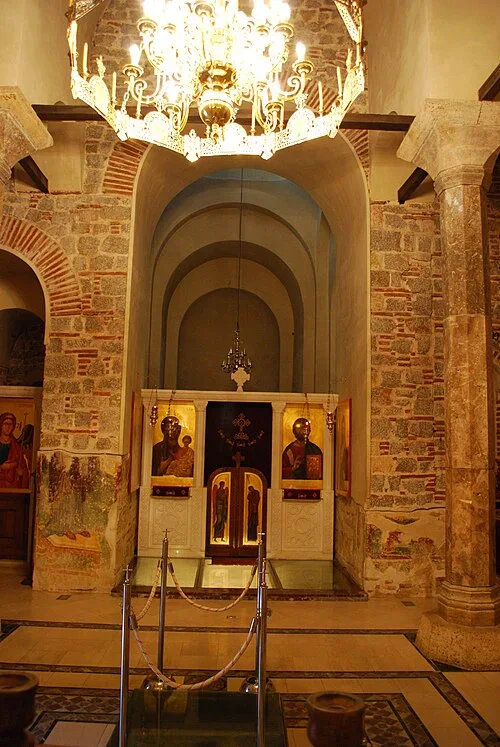 Sanctuary Interior and Byzantine Frescoes
The Nave: A Church Built for Worship and Teaching
This nave was built for two purposes at once. Clement used his church as a liturgical building, and as a place for teaching his disciples in Old Church Slavonic and the Glagolitic alphabet. He did not work alone. Naum of Preslav taught alongside him, and together they trained Christianised Slavs in the letters that carried the Bible into their own language. Archaeologists believe this is the spot where the first students of the Glagolitic alphabet were taught, within the First Bulgarian Empire. Judging by the building's design and layout, researchers say Clement intended it as a literary school from the start. That is why the site is remembered as the first and oldest discontinued university in Europe, though that claim belongs to the researchers rather than to any surviving document. The church still serves its first purpose too. With its iconostasis, its stone columns and its great chandelier, it remains a working place of worship.
Listen in the appThis illustration was made by Rašo. An email to Rašo would be appreciated too. · CC BY-SA 3.0
06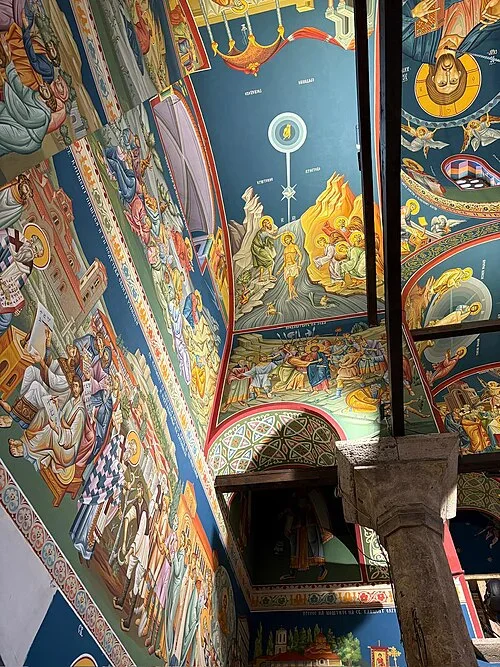 Sanctuary Interior and Byzantine Frescoes
Vaults of the Baptism of Christ
The vaults of this church are painted from top to bottom, in the full Byzantine manner. Saints gaze out of round medallions, and biblical scenes run across the curved surfaces in rich blues and golds. The scene at the centre of the vaults is the Baptism of Christ, with John reaching toward Jesus in the river Jordan and angels gathered at the bank. It is a telling choice of image. This church was raised on the site of an early Christian basilica, with its baptistery close by, the very place where converts once entered the faith through water. Centuries later, the painters set Christ's own baptism over the same ground. Whatever else the fresco programme covers, that one scene answers the building beneath it.
Listen in the appPhoto: Emirrnk1 · CC BY-SA 4.0
07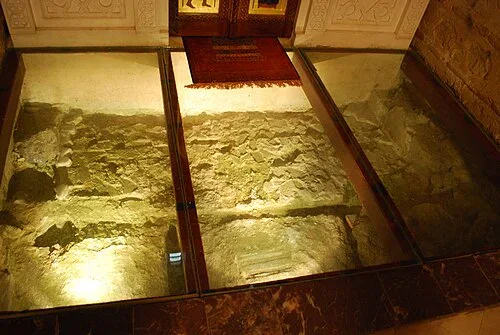 Glass Floor Excavations and Saint Clement's Tomb
Beneath the Glass: Excavations and Hidden Treasures
Set into the floor of this church are panels of glass, lit from below, with old masonry visible underneath. The floor itself has become part of the excavation. The first digging here was carried out in 1943 by Professor Dimche Koco, who uncovered the foundations of Clement's church. Excavations inside the building have since revealed tunnels and crypts. More work is planned, because archaeologists expect further remains below, including more of the old basilicas. The freestanding pillars outside the church support that idea. Then came a modern surprise. On October 10, 2007, archaeologists excavating here found a hoard of roughly 2,383 Venetian coins. Pasko Kuzman, a prominent archaeologist of North Macedonia, said the coins mattered for one reason above all: they show that Ohrid and Venice were commercially linked.
Listen in the appThis illustration was made by Rašo. An email to Rašo would be appreciated too. · CC BY-SA 3.0
08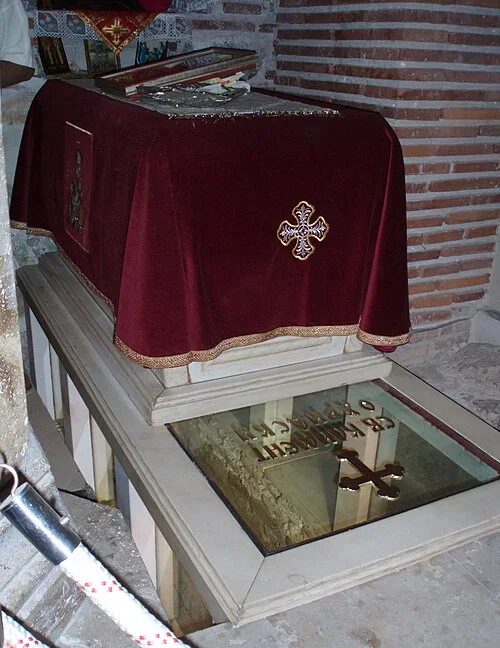 Glass Floor Excavations and Saint Clement's Tomb
The Tomb of Saint Clement
Clement died in 916, and he was buried inside the floor of his own church. According to tradition recorded on this hill, the tomb in the floor was one he had prepared himself, before his death. The shrine here today stands on that old grave structure. The floor around it is entirely glass, and beneath the draped marble sarcophagus an inscribed panel opens onto the grave below. The sarcophagus holds the reliquary with Saint Clement's relics, and icons of Saints Clement and Panteleimon are set at the tomb's south side. The dark red cloth with its gold cross marks the resting place of the man who built this church and taught in it. Most of his relics were returned here after the reconstruction, so that the saint lies once again within his own walls.
Listen in the appPhoto: Brams · Public domain
09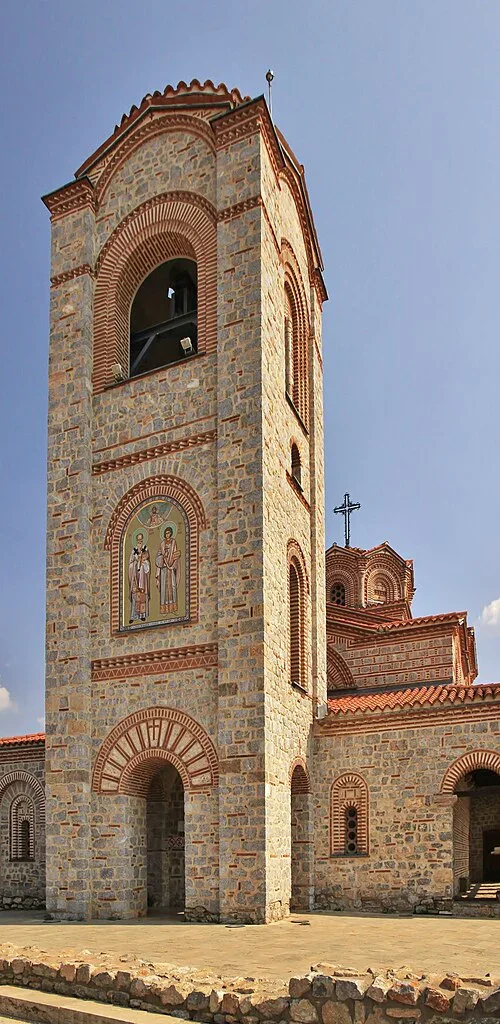 The Stone Bell Tower and Plaošnik Horizons
The Bell Tower and the Hill's Many Histories
The stone bell tower beside the church closes this story, and it carries more than one history. A partially ruined tower on the right side of the church was restored during the rebuilding, and its new bell weighs three tonnes, cast in Verona, Italy. The tower also stands for everything this hill endured. In the 15th century, Ottoman Turks converted the church into a mosque. Early in the 16th century they allowed ruined churches and monasteries to be restored, so Clement's church rose again. Then, at the end of the 16th century or the beginning of the 17th, it was ruined once more, and the Ottomans erected another mosque on its foundations, called the Imaret Mosque. That mosque was torn down in 2000, on the stated grounds that it had been built over the remains of a church here, and it was added to the damaged religious buildings list of the Islamic Religious Community of Macedonia. The Christian sanctuary rose in its place. Today the hill belongs to pilgrims again: thousands of Macedonian Orthodox Christians gather at Plaošnik for Easter and Christmas to celebrate and take part in the liturgies. Few hills anywhere hold so many layers of faith, loss and return in one small summit.
Listen in the appMarcin Konsek · CC BY-SA 4.0
Church of Saints Clement and Panteleimon
Frequently asked questions
How much does the guide cost?
Free app download. Listed guide price: $0.99. Guide price shown in the app. Audio guide only. Venue admission is separate.
Can I listen without internet?
Yes. Download the guide’s audio, images, and maps in the app before your visit. Your downloaded content is then available offline.
Can I listen in my language?
This audio guide is available in 15 languages, including English.
Do I need to follow a schedule?
No. This is a self-guided experience. Choose your stops, pause whenever you like, and return to a story at your own pace.
At your own pace
Explore Church of Saints Clement and Panteleimon.
Download Stanza, then search for “Church of Saints Clement and Panteleimon”.
Free app download · Guide price shown in the app
Keep exploring
Nearby audio guides
Ohrid · 22 km
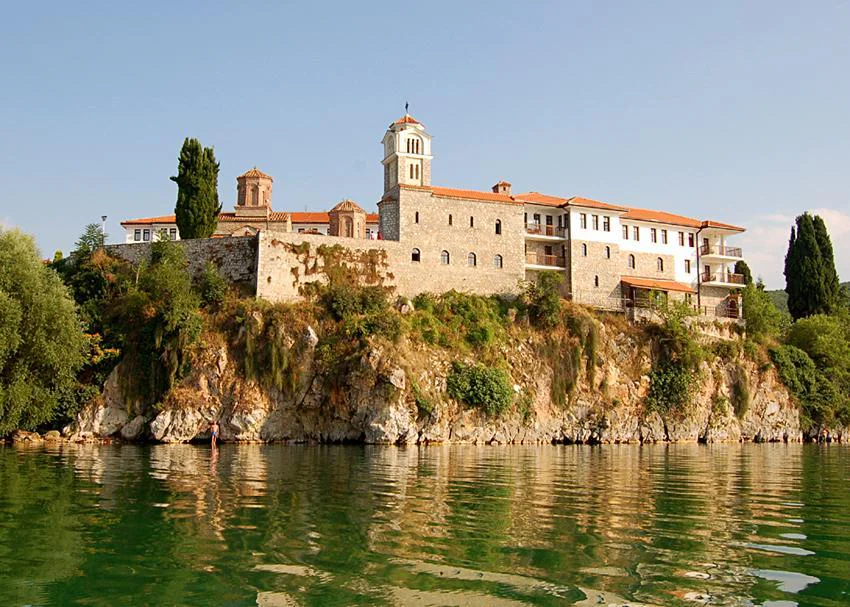
Monastery of Saint Naum
Content & sources
Poppit2 · Public domain
Bitola · 48 km
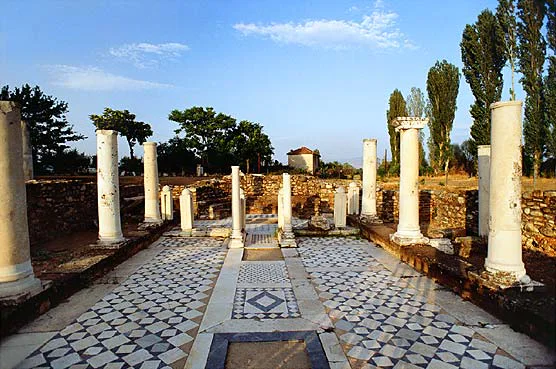
Heraclea Lyncestis
Content & sources
Revizionist at Macedonian Wikipedia · CC BY-SA 3.0
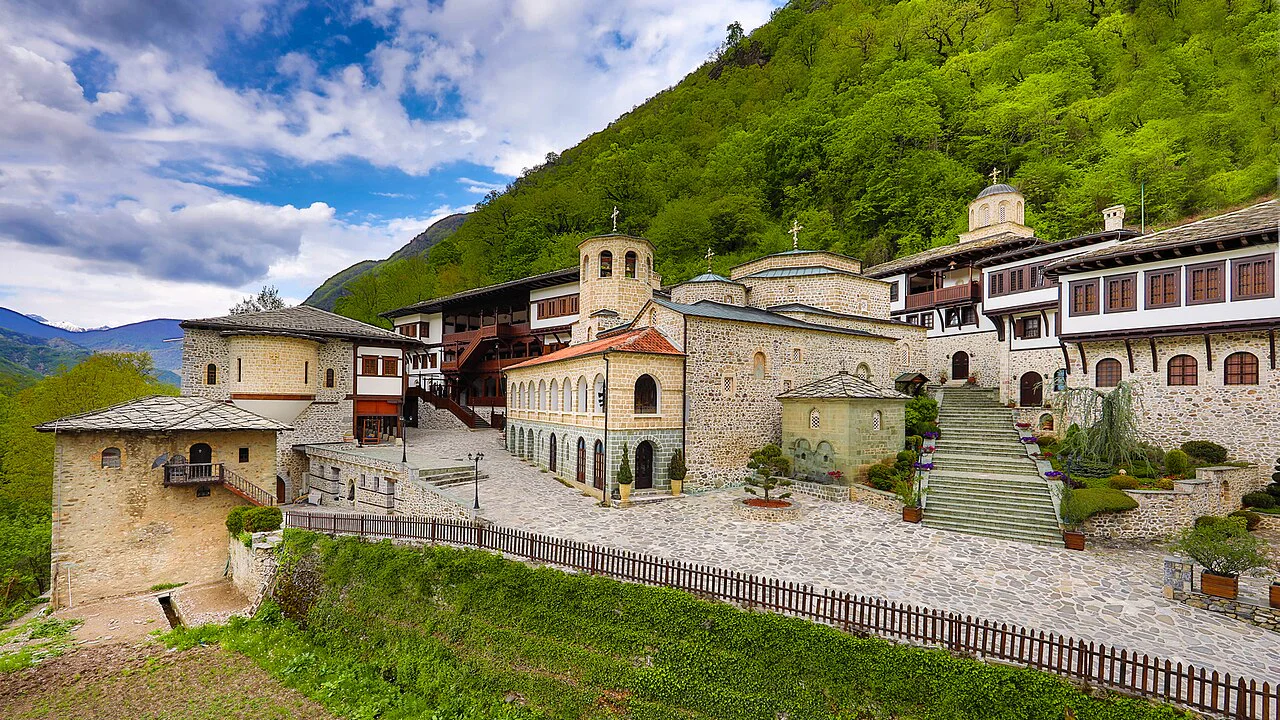
Rostushe · 59 km
Saint Jovan Bigorski Monastery
Content & sources
Photo: BigorskiMonastery · CC BY-SA 4.0
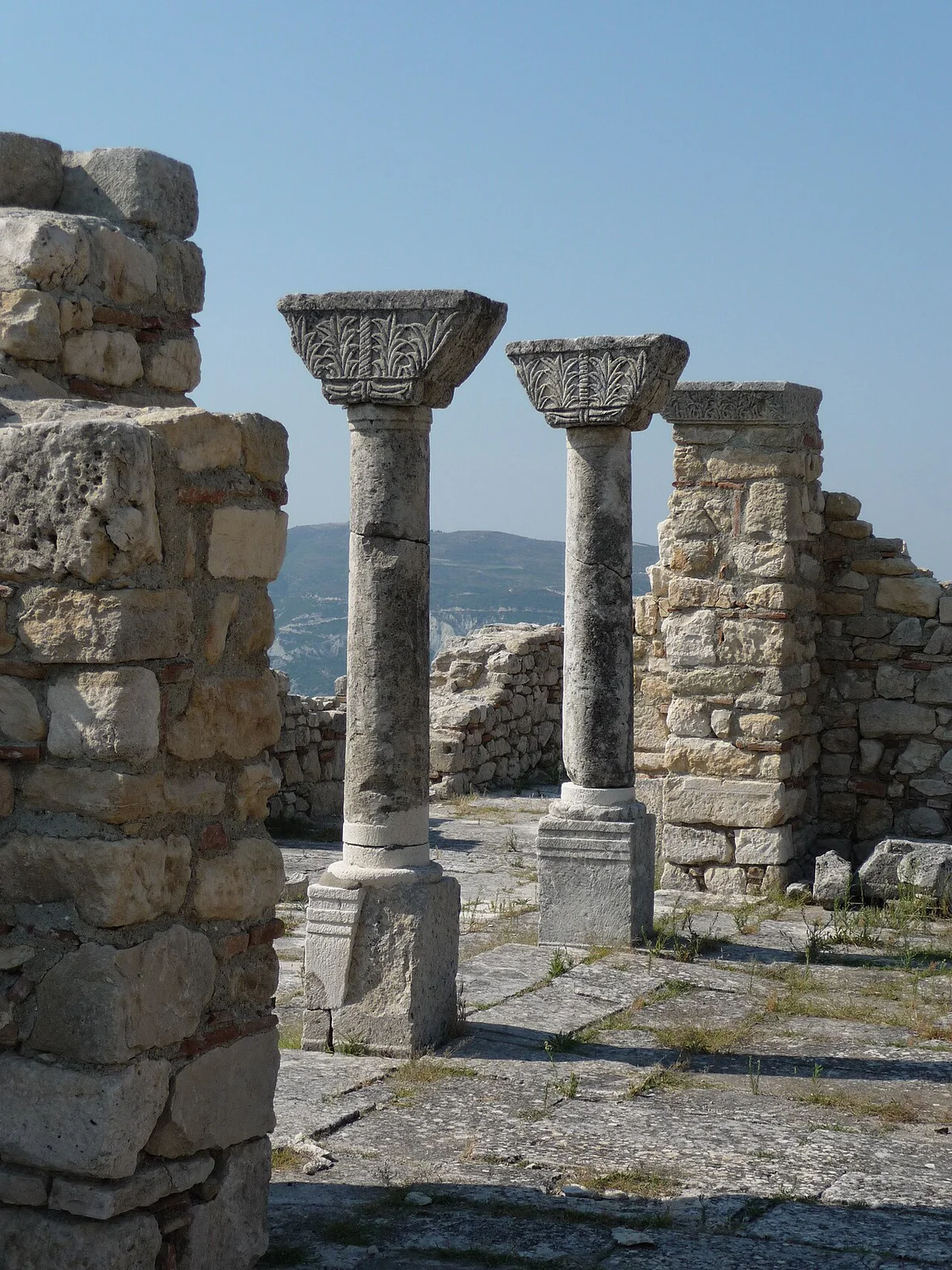
Hekal · 109 km
Byllis
Content & sources
Riet PRINS · CC BY 3.0