Stanza · Audio guide
Stobi Audio Guide
A place to remember. A story to take with you.
Stobi was an ancient town of Paeonia that later served as the capital of the Roman province of Macedonia Salutaris. It was strategically located at the confluence of the Erigon and Axios rivers, making it a…
Download Stanza, then search for “Stobi”.
About the tour
One guide. Your kind of visit.
Stobi was an ancient town of Paeonia that later served as the capital of the Roman province of Macedonia Salutaris. It was strategically located at the confluence of the Erigon and Axios rivers, making it a significant center for trade and warfare.
Ready when you are.
- 01Get the free Stanza app.
iOS & Android
- 02Find your guide.
“Stobi”
- 03Download before you go.
Works offline
Audio guide / 14 narrated stops
Inside the guide
Get to know a few of the stories before you go. Open a stop to read more.
01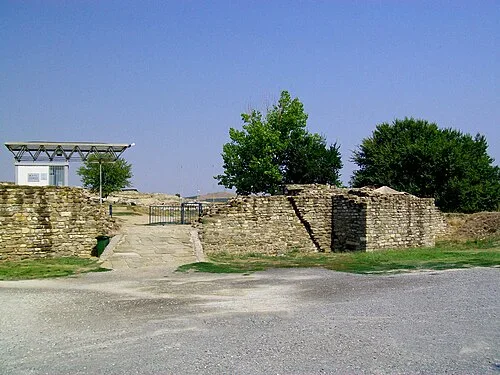 Main Entrance and Arrival
Main Entrance, Stobi
Welcome to Stobi, one of the largest archaeological sites in North Macedonia. This was once an ancient town of Paeonia, and later the capital of a Roman province. The reason a city grew here is written in the landscape. Two rivers meet on this ground: the Erigon, known today as the Crna, flows into the Axios, the great Vardar. The site also sits on the main road that leads from the Danube down to the Aegean Sea. That made Stobi a crossroads for trade, and for war. The first settlement was Paeonian, established in the Archaic period, on the northern side of a terrace. It covered about twenty-five thousand square metres, and it prospered. The central Vardar valley is fertile land, and nearby Mount Klepa supplied good marble. In time, newcomers joined the original Paeonian population. The park you are entering covers roughly sixteen hectares of natural terraces, explored on foot in an hour or two. Across it lie streets, houses, churches and a theater, uncovered layer by layer.
Photo: Делфина · CC BY-SA 3.0
02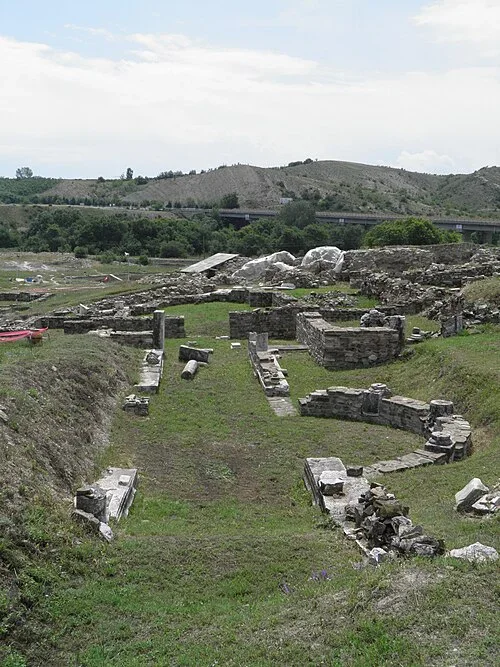 Main Entrance and Arrival
The Excavated City
From this high ground you can read the whole city at once: long trenches of excavated walls, a protective shelter, and the hills beyond. Stobi's rise continued under Rome. The town first enters written history through Livy, who records a victory of Philip the Fifth of Macedon over the Dardani nearby in 197 BC. Rome defeated the last Macedonian king, Perseus, in 168 BC, and divided the land into four republics. In 148 BC those four were joined into one Roman province. Under Augustus the city grew in size and population. Then came the moment that changed its standing: in 69 AD Stobi was raised to the rank of a municipium, a formally recognised Roman town. From that year it struck its own bronze coins, reading Municipium Stobensium, the municipium of the Stobians. Its citizens held Ius Italicum, the prized Italian legal rights, and most were enrolled in the Roman tribes Aemila and Tromentina. In time the city rose further still, to serve as the capital of the province of Macedonia Salutaris.
Carole Raddato from FRANKFURT, Germany · CC BY-SA 2.0
03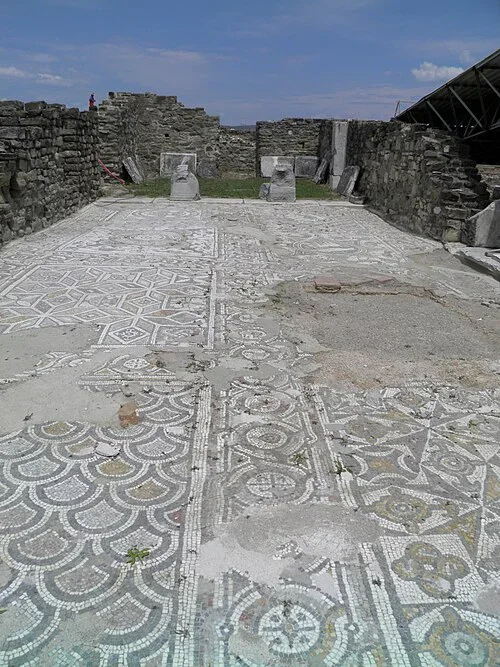 The Northern Basilica
Northern Basilica
Stobi's churches are among the finest things the city left behind. The Northern Basilica was built at the beginning of the fifth century, when Christianity shaped the whole town. It could be entered from the street called Via Principalis Inferior. The building had three main parts: a narthex at the west, an exonarthex beyond it, separated by colonnades, and an atrium constructed mostly of marble. The patterned floor spread across the ruins shows why these churches were famous. From the fourth and fifth centuries, several large churches rose here, known for their mosaics and frescoes, and Stobi remains one of the few late-antique cities to keep so many of them. The basilica's story did not end with the city. In 1955, archaeologists working in its southern part found twenty-three Slavic graves, dating from the ninth to the twelfth centuries. People were living among these ruins centuries after the city itself had fallen silent.
Listen in the appCarole Raddato from FRANKFURT, Germany · CC BY-SA 2.0
04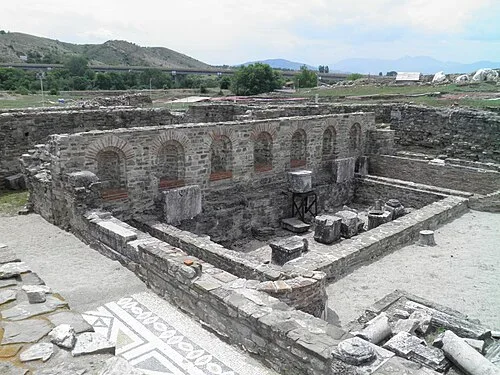 Central Basilica and Synagogue Ruins
Central Basilica and the Synagogue Beneath
Beneath this church lies another place of worship entirely. The Central Basilica was built at the beginning of the fifth century, directly on top of a synagogue. The synagogue's floor was found about a metre and a half below the basilica's level. That fourth-century synagogue was itself a rebuild, replacing an older one from the third century, created by a Roman citizen named Tiberius Claudius Polycharmos. A column inscription preserves his own words. He calls himself the father of the synagogue, and a follower of all Jewish prescriptions. He also left a warning for the future: if anyone should wish to change anything about the buildings, he shall pay two hundred and fifty thousand denarii to the Patriarch, as we have agreed. Inside the synagogue, archaeologists found two vases dating from the years 121 to 125. A bronze seal adorned with a menorah adds further evidence of the Jewish community here. By the close of the fourth century the synagogue was demolished, and the Christian basilica took its place.
Listen in the appCarole Raddato from FRANKFURT, Germany · CC BY-SA 2.0
05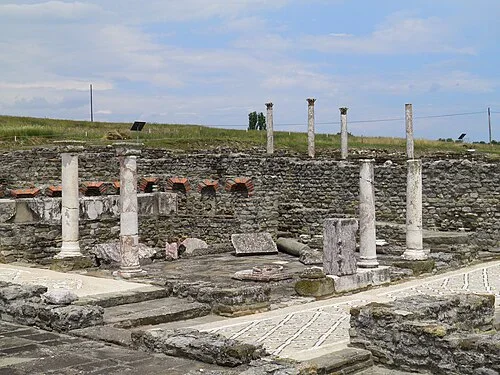 The Residential Quarter: House of Polycharmos and House of Psalms
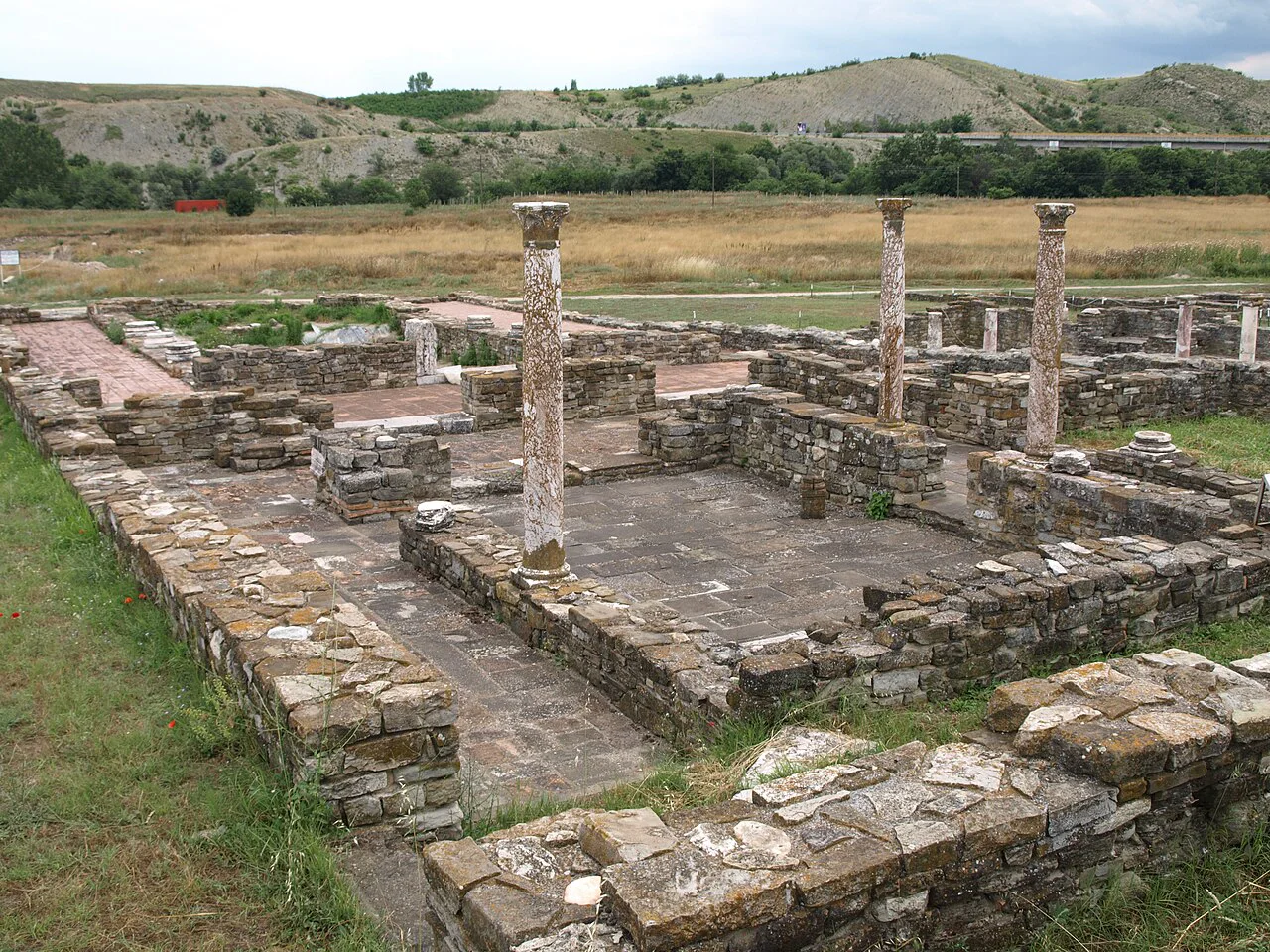
House of Polycharmos Peristyle
A wealthy family in Roman Stobi lived around a courtyard like this one. The arrangement is called a peristyle: a colonnade running on all sides of an open court, here formed by eight columns. Rooms opened onto the colonnade, and the court itself brought light and fresh air into the heart of the house. In grand residences across the Roman world, this was the space for display, where guests were received and the best floors were laid. Stobi's late-antique elite built in exactly this manner. Several luxury villas stood in the city, including one associated with a family named Policharmosius, alongside the villas of Theodosius and Peristerius. Private houses here matched the town's public monuments in ambition, with decorative floors of their own. What the columns frame today is the skeleton of that comfort.
Listen in the appCarole Raddato from FRANKFURT, Germany · CC BY-SA 2.0
06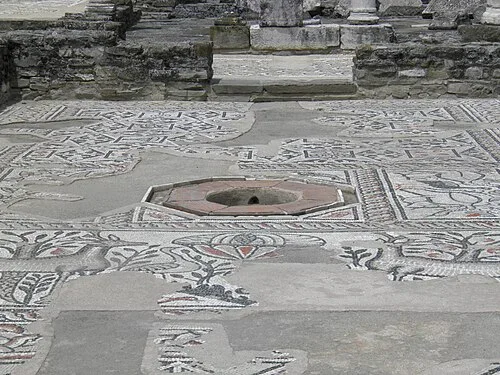 The Residential Quarter: House of Polycharmos and House of Psalms
House of Psalms
The House of Psalms stands in front of the Central Basilica, and it shows how water and decoration worked together in a grand house. Its central room carries a mosaic floor, and there is a further room with colonnades. In the western part of the yard stood a large pool, framed by columns. The floor preserves the arrangement beautifully: an octagonal basin set into the mosaic, its rim of cut stone, with patterned panels and planting motifs spreading around it. A pool like this did more than look fine. Open water cooled the courtyard air in summer, and reflected light onto the colonnade around it. Comfort and display sat side by side here, as they did in the city's other late-antique villas. What exactly the building was used for, a private house or something else, the excavations have not settled.
Listen in the appCarole Raddato from FRANKFURT, Germany · CC BY-SA 2.0
07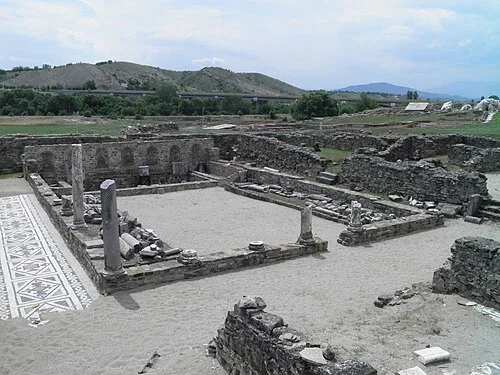 The Palace of Theodosius
Theodosian Palace
In 388, an emperor came to Stobi. Theodosius the First stayed in the city, and the grand residence known as the Palace of Theodosius is named as the place where he first stayed. The palace stands near the street called Via Principalis Inferior, in the quarter of grand houses that also included the residence of Partenius, joined to the palace by a shared wall in an L shape. Its floors were covered with marble blocks, and the peristyle courtyard was decorated with mosaics in the opus sectile technique, cut stone fitted into patterns. The other rooms were decorated as well, and the building dates from the fourth to the fifth century. Whether the emperor actually slept in this particular house is a tradition rather than a proven fact. But the city was important enough by then to host a ruling emperor, and this was one of the grandest residences uncovered in the city.
Listen in the appCarole Raddato from FRANKFURT, Germany · CC BY-SA 2.0
08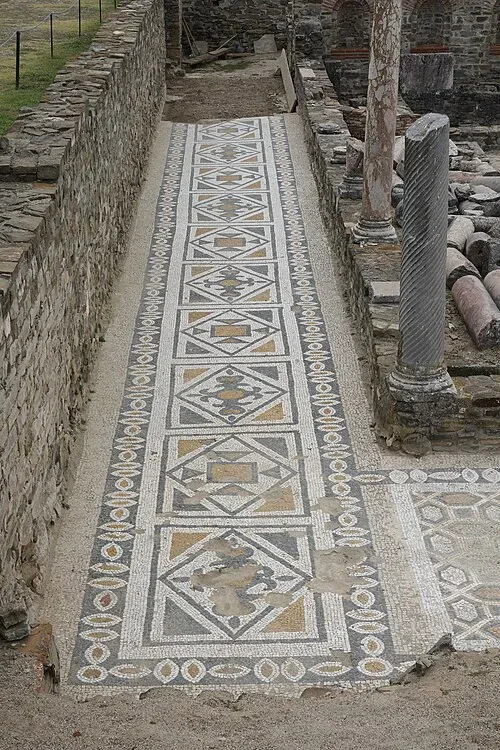 The Palace of Theodosius
Palace Mosaic Walkway
This narrow walkway shows the two crafts that made late-antique Stobi glitter. One is mosaic, the setting of thousands of tiny stone and glass tesserae into patterns. The other is opus sectile, in which larger pieces of coloured stone are cut to shape and fitted together like inlay, for bolder panels and figures. Along this corridor the two run together: framed panels of geometric design, diamonds and circles in white, grey and ochre, bordered by rows of small motifs. Walls of cut stone rise on one side, and columns stand along the other, one of them with a twisted shaft. Floors and walkways like this were expensive, and they signalled wealth as clearly as marble columns did. It is partly for floors like these, in its palaces and villas, that Stobi counts among the late-antique cities richest in interior decoration.
Listen in the appjjmusgrove from Glen Allen, VA, United States · CC BY 2.0
09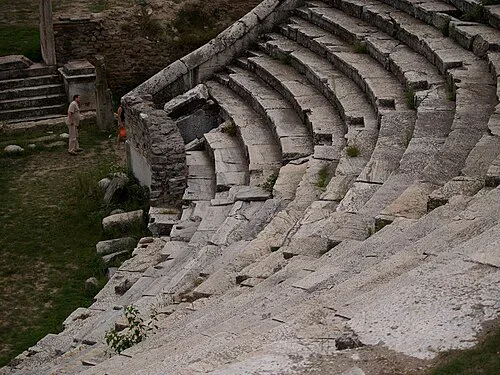 The Roman Theater
Roman Theatre of Stobi
Curved tiers of seating sweep down towards the stage: a Roman theater, built in the third century. It was unearthed by archaeologists from the Museum of Belgrade, which excavated here from 1924 to 1936. In the Roman period the theater held a temple of Nemesis, the goddess who watched over fortune and retribution. Religion ran through the whole city around it. Objects connected with Hygeia and Telesphorus, with Artemis Locheia and Apollo Clarious, and with Jupiter, Dionysus and Hera were common finds from this era. A venue built for staged performance, with a sanctuary inside it, tells you how mixed public life was in a Roman town. The theater was one of the great buildings of the city, and its discovery in the 1930s was among the most significant finds of those early campaigns.
Listen in the appd_proffer · CC BY 2.0
10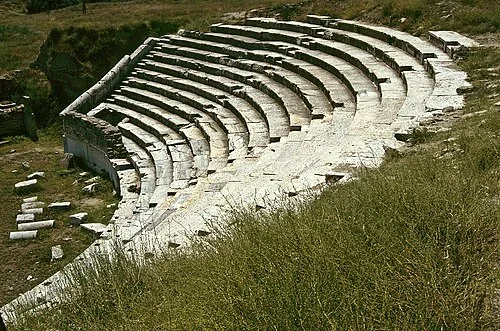 The Roman Theater
Theatre Turned Arena
The theater's use changed as the empire changed. In cities across the Roman world, theaters that had staged plays were adapted in later centuries for gladiatorial fights and beast spectacles, the crowd-pleasing entertainments of the arena. Stobi's theater followed this general pattern. The curved bowl that once focused an actor's voice now framed combat in the orchestra below. That chapter ended too, and the building's fortunes declined with the city's. In its later phases the theater was dismantled, its stone taken away for building material elsewhere in the town. A grand venue, raised for performance and reused for spectacle, ended its days as a quarry. What you see now are the tiers that survived that stripping.
Listen in the appPhoto: Ziegler175 · CC BY-SA 3.0
- 11
Episcopal Basilica Baptistery
Stobi had a bishop by 325, and this baptistery served the grandest of its churches.
- 12
The Peacock Mosaic
The peacock from this baptistery floor now appears on North Macedonia's money.
- 13
Magnae Thermae
The Big Bath, discovered in 1931, served the city into the late sixth century.
- 14
An Ancient Street at Dusk
The end of Stobi: sack, earthquake and invasion, along streets that once tied the city together.
Stobi
Frequently asked questions
How much does the guide cost?
Free app download. Listed guide price: $0.99. Guide price shown in the app. Audio guide only. Venue admission is separate.
Can I listen without internet?
Yes. Download the guide’s audio, images, and maps in the app before your visit. Your downloaded content is then available offline.
Can I listen in my language?
This audio guide is available in 15 languages, including English.
Do I need to follow a schedule?
No. This is a self-guided experience. Choose your stops, pause whenever you like, and return to a story at your own pace.
At your own pace
Explore Stobi.
Download Stanza, then search for “Stobi”.
Free app download · Guide price shown in the app
Keep exploring
Nearby audio guides
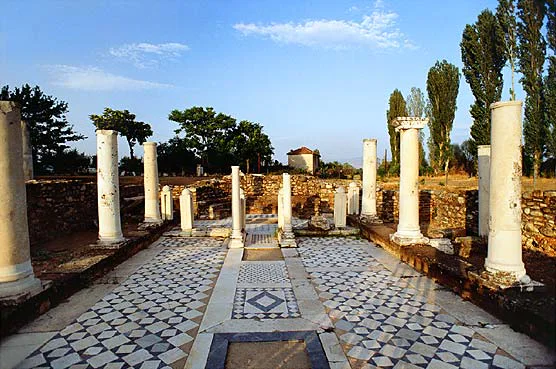
Bitola · 80 km
Heraclea Lyncestis
Content & sources
Revizionist at Macedonian Wikipedia · CC BY-SA 3.0
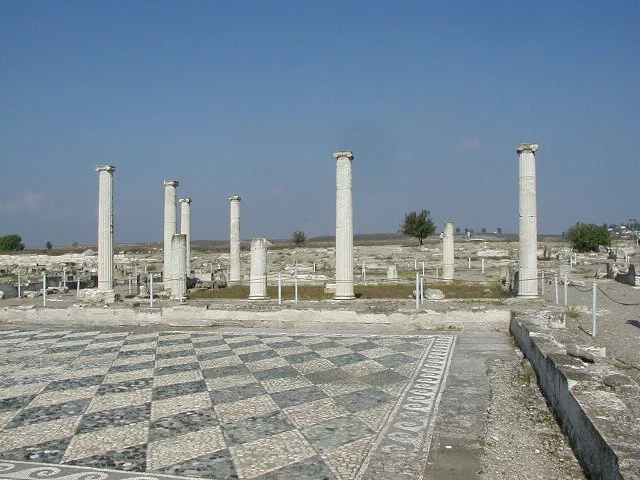
Pella · 99 km
Αρχαία Πέλλα
Content & sources
Brian Donovan · Public domain
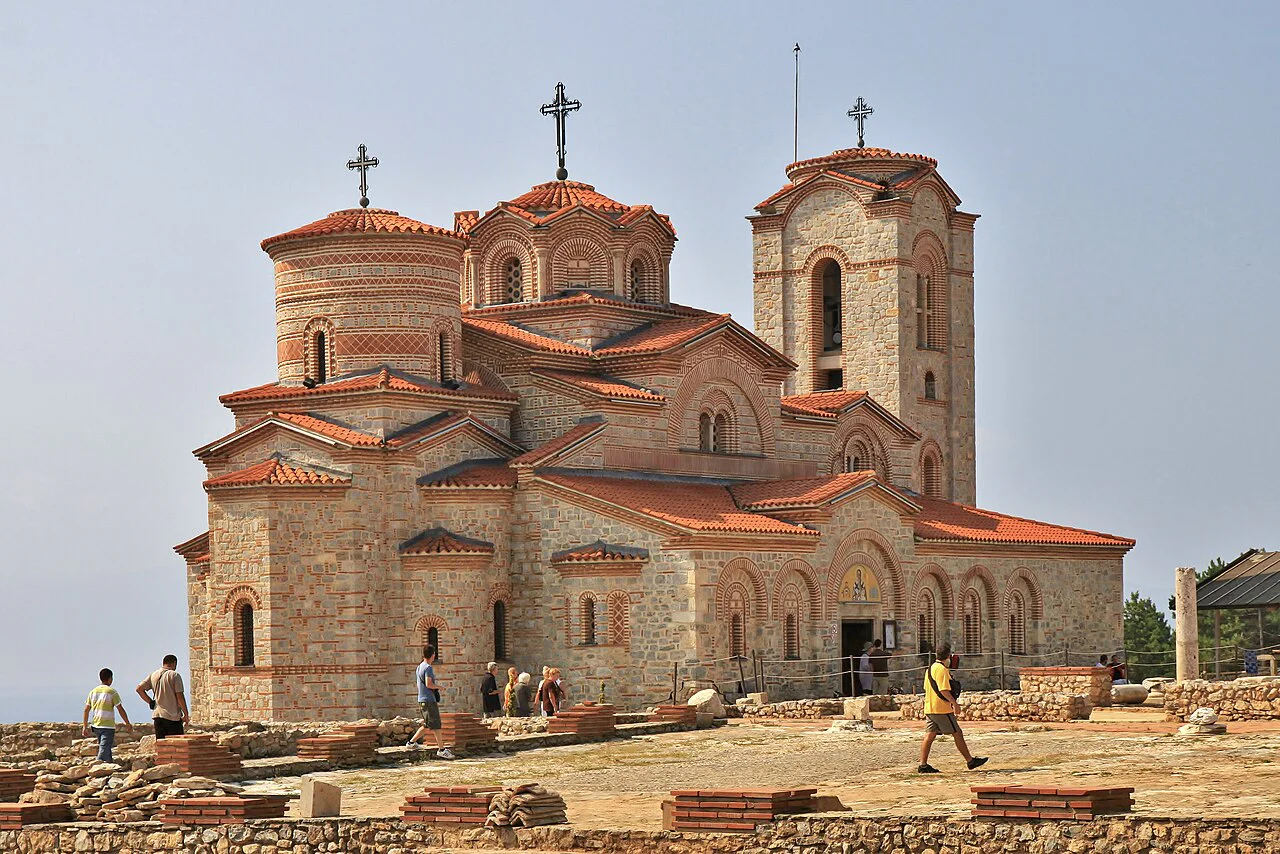
Ohrid · 110 km
Church of Saints Clement and Panteleimon
Content & sources
Marcin Konsek · CC BY-SA 4.0
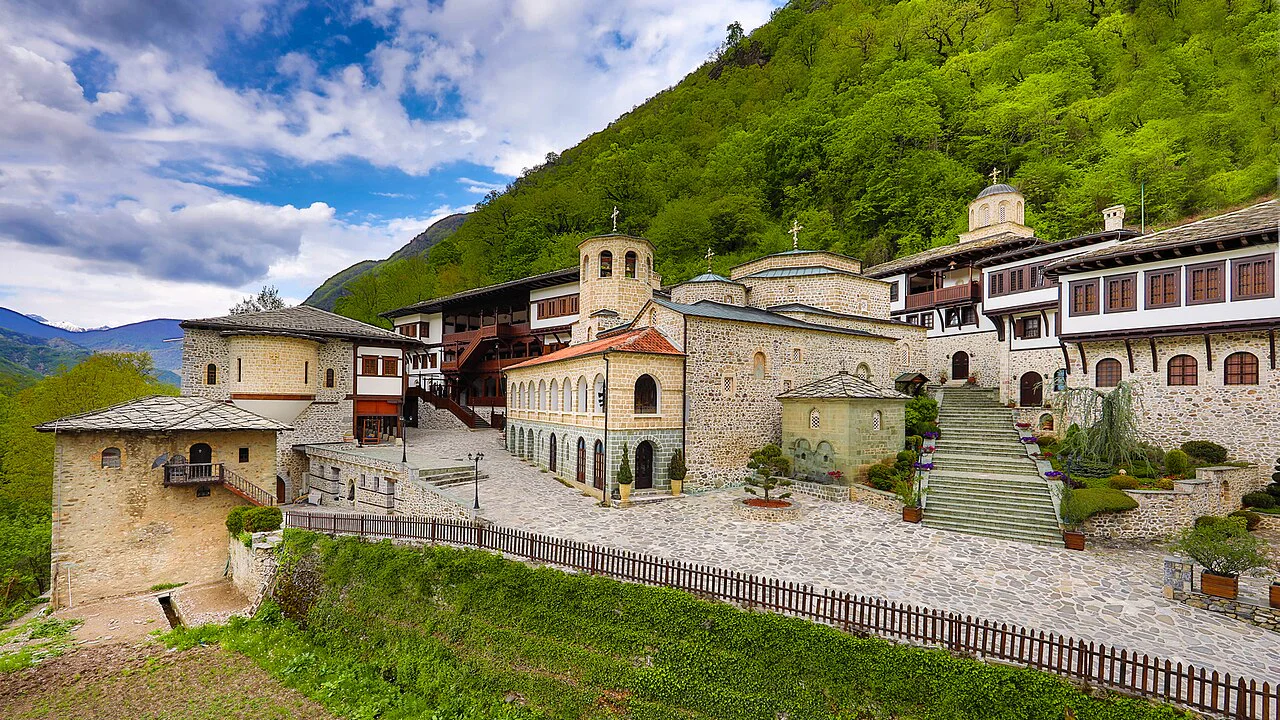
Rostushe · 114 km
Saint Jovan Bigorski Monastery
Content & sources
Photo: BigorskiMonastery · CC BY-SA 4.0