Stanza · Audio guide
Sopoćani Audio Guide
A place to remember. A story to take with you.
The Sopoćani Monastery is an endowment of King Stefan Uroš I of Serbia built between 1259 and 1270. It is a designated World Heritage Site located near the source of the Raška River.
Download Stanza, then search for “Sopoćani”.
About the tour
One guide. Your kind of visit.
The Sopoćani Monastery is an endowment of King Stefan Uroš I of Serbia built between 1259 and 1270. It is a designated World Heritage Site located near the source of the Raška River.
Ready when you are.
- 01Get the free Stanza app.
iOS & Android
- 02Find your guide.
“Sopoćani”
- 03Download before you go.
Works offline
Audio guide / 11 narrated stops
Inside the guide
Get to know a few of the stories before you go. Open a stop to read more.
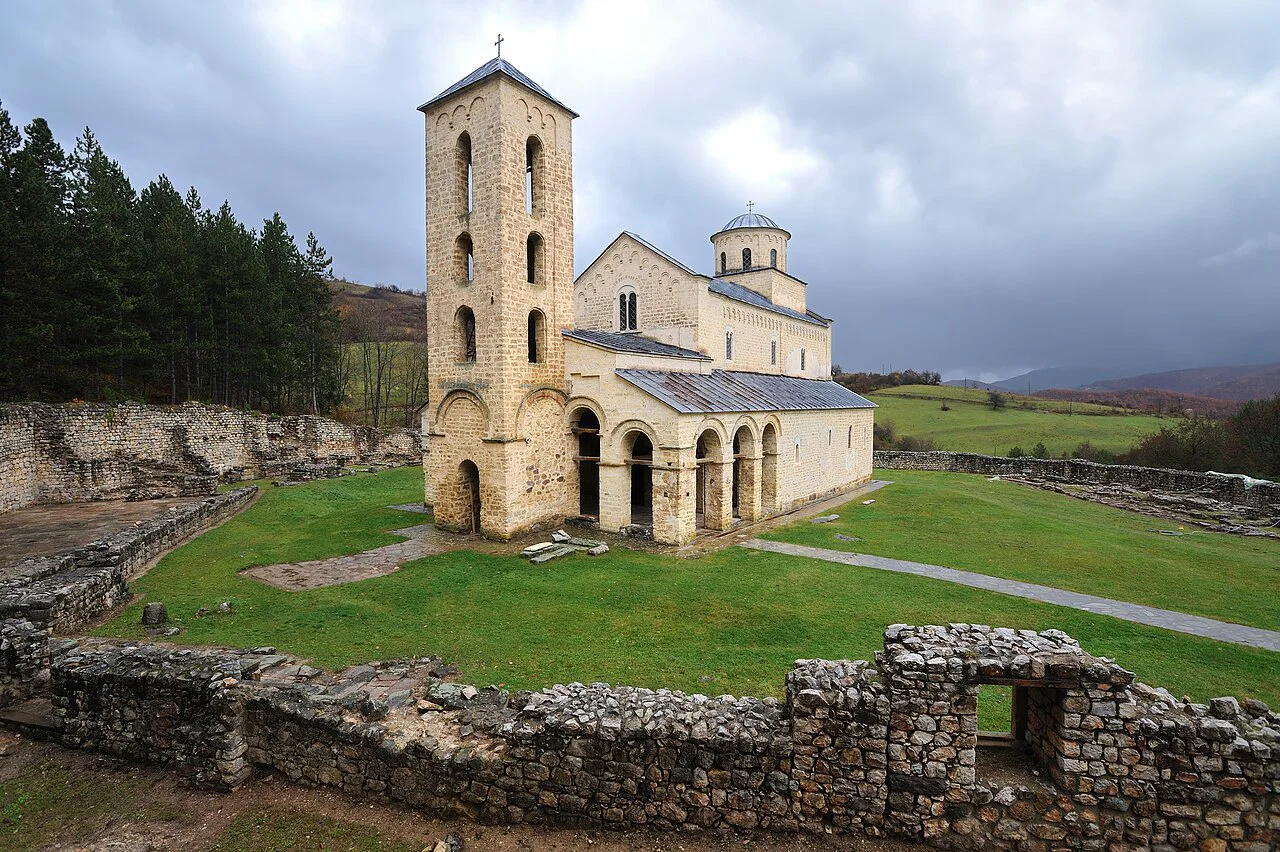
01 Courtyard Approach and Raška Architecture
Church of the Holy Trinity, Exterior View
The Church of the Holy Trinity at Sopoćani is an endowment of King Stefan Uroš the First of Serbia. In other words, he founded it and paid for it. It stands in the region of Ras, the centre of the medieval Serbian state. It lies near the source of the Raška River. The monastery is about seventeen kilometres west of the town of Novi Pazar. Yellow-brown stone walls stand over a grassy courtyard. A tall square bell tower rises above the walls, and a small dome sits on a drum behind it. Some experts on Serbian medieval art consider the frescoes inside the most beautiful of their period. UNESCO added the monastery to its World Heritage list in 1979, in a listing shared with Stari Ras.
Photo: Pavle Marjanovic · CC BY-SA 3.0
02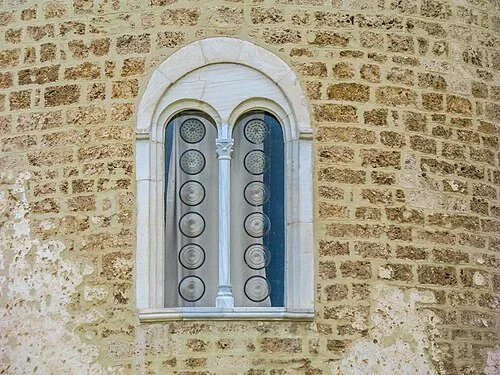 Courtyard Approach and Raška Architecture
Twin-Arched Window with Central Column
The Raška school is a regional style with Byzantine character, and this church is assigned to it. One window in its wall shows that style on a small scale. A pale arch frames the opening. A slender central column divides it into two smaller arches. Each of those arches holds a column of round, ornamental discs, stacked one above another. Twin-arched windows like this turn up in many medieval churches. The stacked discs in each opening are what stand out here.
Photo: CrniBombarder!!! · CC BY-SA 4.0
03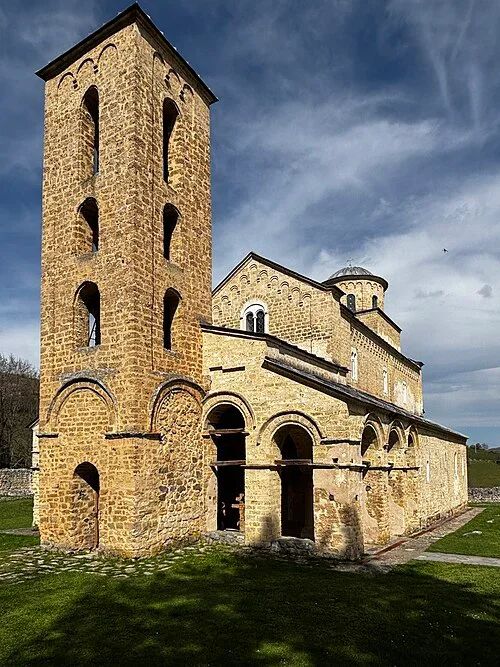 Emperor Dušan's Exonarthex and Bell Tower
Exonarthex and Bell Tower from the Southwest
The church was enlarged under King Stefan Dušan, the great-grandson of its founder. The work is dated between 1338 and 1345. The church took on some features of a cathedral. The painted decoration of its outer porch, the exonarthex, was expanded as well. Open arches at ground level line the exonarthex, next to a tall bell tower. The tower was built in the same campaign.
Listen in the appPhoto: BubaFoton · CC BY-SA 4.0
04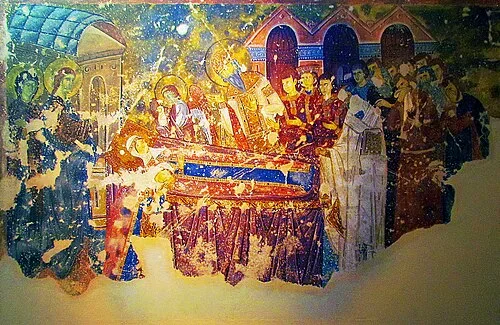 The Narthex and Tomb of Queen Anna Dandolo
Fresco: Death of Queen Anna Dandolo
Queen Anna Dandolo was the mother of King Stefan Uroš the First. A painted scene of her death is on the north wall of the narthex, the entrance hall of the church. She died in 1258. A death year does not mean the scene was painted that same year. A figure lies on a long bier draped in cloth, and mourners stand around it in groups. In places the paint has worn away. Scholars also use this scene as one of the clues for dating the founding of the church to about the 1260s.
Listen in the appGmihail at Serbian Wikipedia · CC BY-SA 3.0 rs
05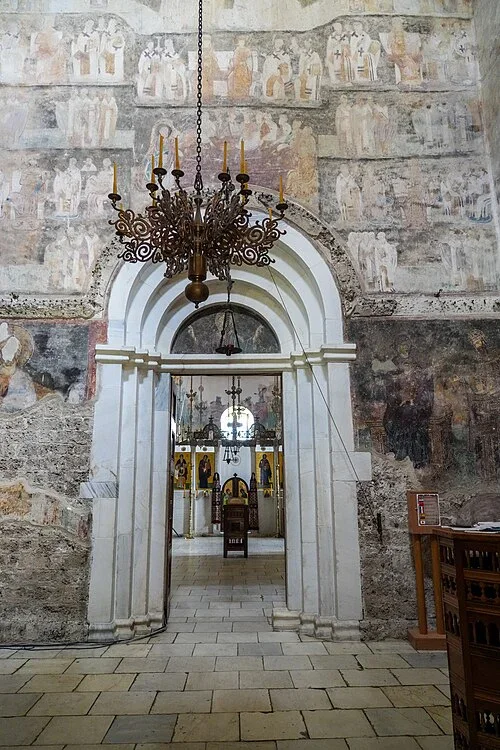 The Narthex and Tomb of Queen Anna Dandolo
Portal Between Narthex and Nave
The painted decoration at Sopoćani was carried out to a plan, and each part of the church has its own set of scenes. The narthex carries Old Testament stories, scenes of the church's core beliefs, and themes of the end of time. The nave, the main body of the church, shows Christ's work of salvation in a cycle of the great feasts of the church year. The chancel, around the altar, carries scenes linked to the services. A stucco garland runs around this arched doorway, and painted figures stand in rows above it, one band above another. A metal lamp hangs on a long chain beneath the arch. Through the doorway, the icon screen of the chancel is visible. The stories run from left to right across the walls, so each one unfolds in order.
Listen in the appPhoto: DjordjeMarkovic · CC BY-SA 4.0
06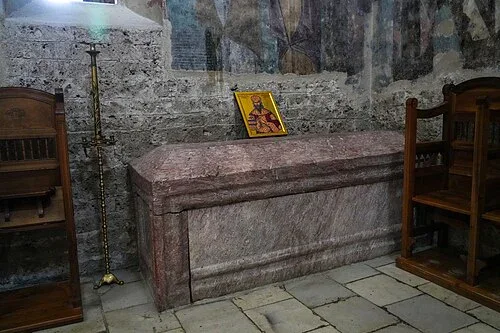 The Central Nave and Royal Mausoleum
Sarcophagus of King Stefan Uroš I
A reddish stone sarcophagus stands in the church, and it is linked with King Stefan Uroš the First. He founded the church, and it was meant to serve as his burial place. His body was moved into the prepared tomb here only after 1282, when his son Milutin came to the throne. Behind the stone, a small framed icon of a crowned figure rests on a stand. The king was the grandson of Stefan Nemanja, who consolidated his power on the throne in Raška in the 1160s.
Listen in the appPhoto: DjordjeMarkovic · CC BY-SA 4.0
07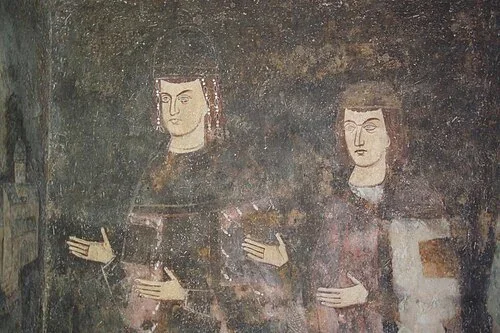 The Central Nave and Royal Mausoleum
Fresco of Two Young Princes
A donor scene in the nave shows King Stefan Uroš the First holding a model of the church, with his sons standing behind him. The two young men shown here wear dark robes and hold out their hands. They are read as Dragutin and Milutin, the king's sons. The king is painted larger than everyone else for symbolic effect, so the boys' heights against him cannot date the scene. Dragutin's apparent age across his portraits offers another clue. In one portrait he looks about ten. In another he looks about fifteen. In a third he looks about twenty. Taking the middle portrait as the reference, the scene points to about 1265. That places the church's building work in the 1260s, as an estimate rather than a firm date.
Listen in the appUnknown Serbian painter · Public domain
08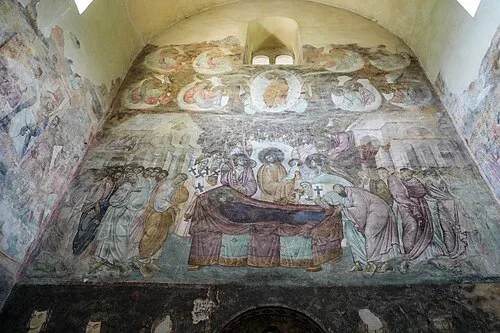 The West Wall: The Dormition of the Virgin
Dormition of the Mother of God, West Wall
The Dormition of the Virgin covers the west wall of the nave, and it is a famous fresco. It shows the death of the Virgin Mary, which the church calls her falling asleep. Her body lies on a bier at the centre. Mourners stand in groups around it. Above them, a row of round medallions holds more figures. The style is late Komnenian, an older Byzantine manner that was passing into the later Palaiologan style. The story unfolds across the wall in a linear style, and the figures are large and stately. In places, the painters left visible division lines and painted over them. Some historians think this was an oversight.
Listen in the appPhoto: DjordjeMarkovic · CC BY-SA 4.0
09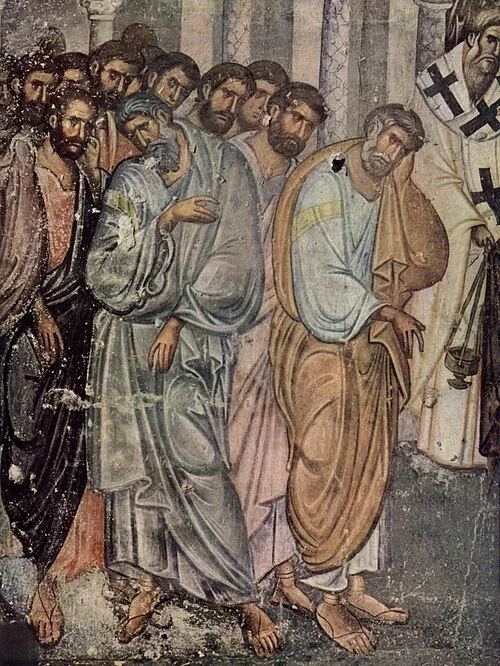 The West Wall: The Dormition of the Virgin
Close Detail of Mourning Figures
The painters of Sopoćani remain unnamed, and their origins are not known for certain. Some scholars hold that they came from Constantinople, though that is not settled. King Stefan Uroš the First is said to have chosen some of the best artists. He also had small pieces of gold leaf applied to the outlines of some of the more prominent frescoes, for a greater sense of grandeur. Several grieving men crowd together here, in layered robes. One bows his head and raises a hand to his face. At the right edge, a bearded figure wears a white vestment marked with dark crosses. Later painters copied this manner, and it became known as the Sopoćani style.
Listen in the appMeister von Sopocani · Public domain
10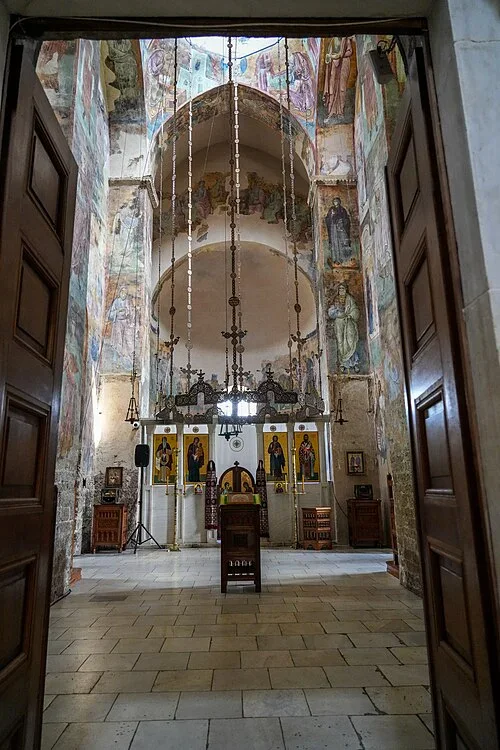 The Sanctuary and Altar Apse
Sanctuary Screen and Apse Seen from the Narthex
Among the painted scenes around the altar is a procession of archbishops, a line of senior churchmen. The identity of one leading figure in this procession is disputed. One account names Archbishop Sava the Second. He became head of the Serbian church in 1263. Another view suggests the figure may be Archbishop Arsenije the First. Lamps hang on chains over the floor. Below them, framed icons line a screen with a doorway at its centre. Above the screen, the rounded apse, the curved wall behind the altar, is painted, and wooden doors frame the view. Which archbishop is meant remains open.
Listen in the appPhoto: DjordjeMarkovic · CC BY-SA 4.0
- 11
Remains of Medieval Buildings Around the Monastery
The low ruins around the church, and the raid that left the monastery empty for over two hundred years.
Sopoćani
Frequently asked questions
How much does the guide cost?
Free app download. Listed guide price: $0.99. Guide price shown in the app. Audio guide only. Venue admission is separate.
Can I listen without internet?
Yes. Download the guide’s audio, images, and maps in the app before your visit. Your downloaded content is then available offline.
Can I listen in my language?
This audio guide is available in 15 languages, including English.
Do I need to follow a schedule?
No. This is a self-guided experience. Choose your stops, pause whenever you like, and return to a story at your own pace.
At your own pace
Explore Sopoćani.
Download Stanza, then search for “Sopoćani”.
Free app download · Guide price shown in the app
Keep exploring
Nearby audio guides
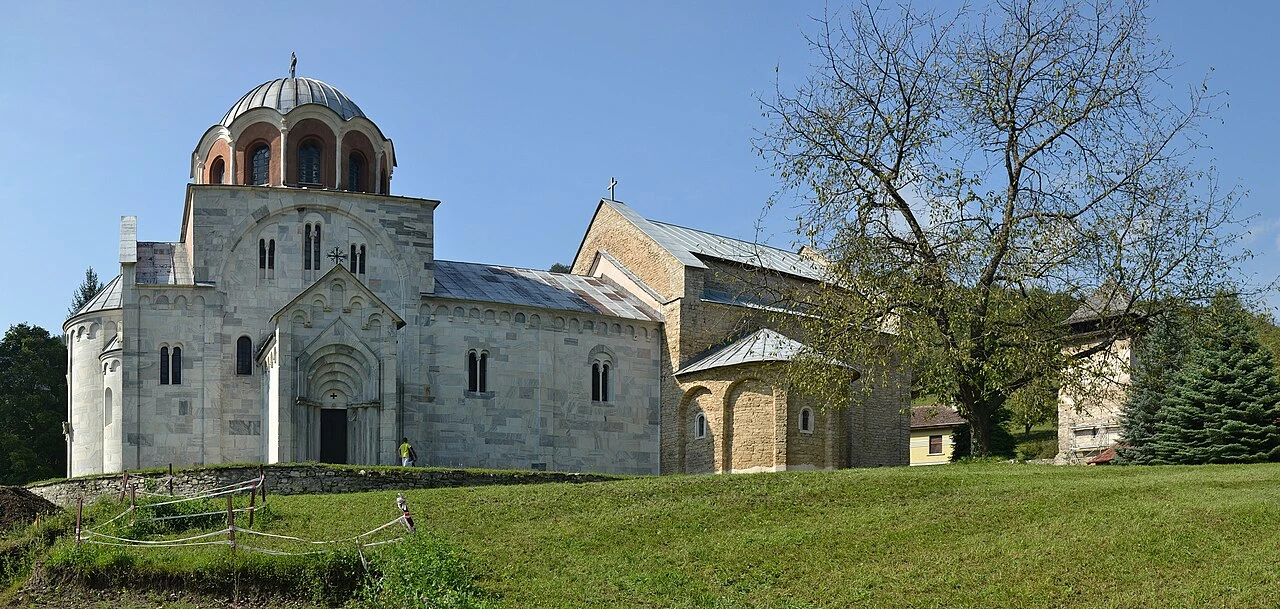
Brezova · 42 km
Studenica Monastery
Content & sources
Pudelek (Marcin Szala) · CC BY-SA 3.0
Deçan · 65 km
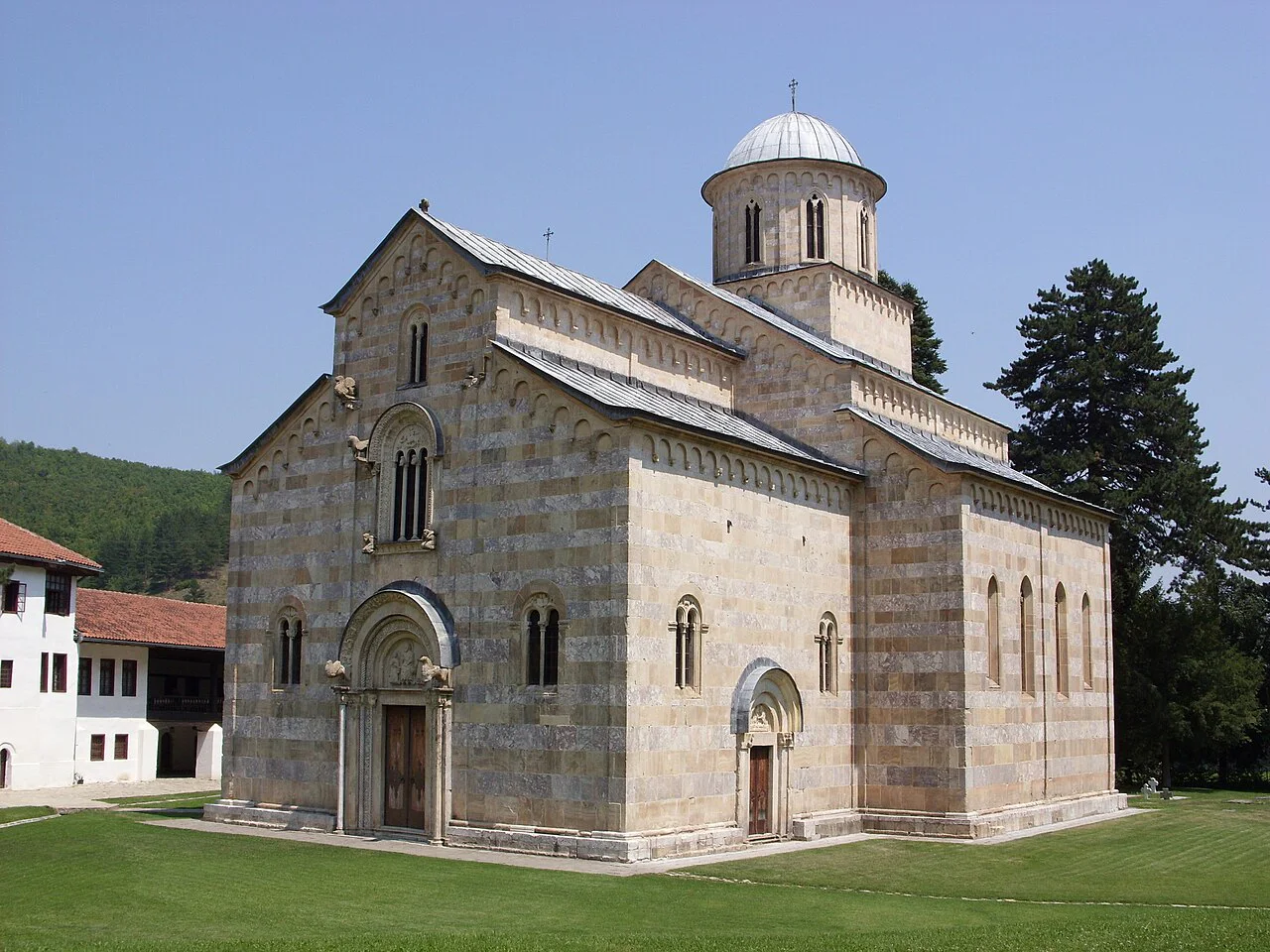
Visoki Dečani
Content & sources
Julian Nyča · CC BY-SA 4.0
Prijepolje Municipality · 69 km
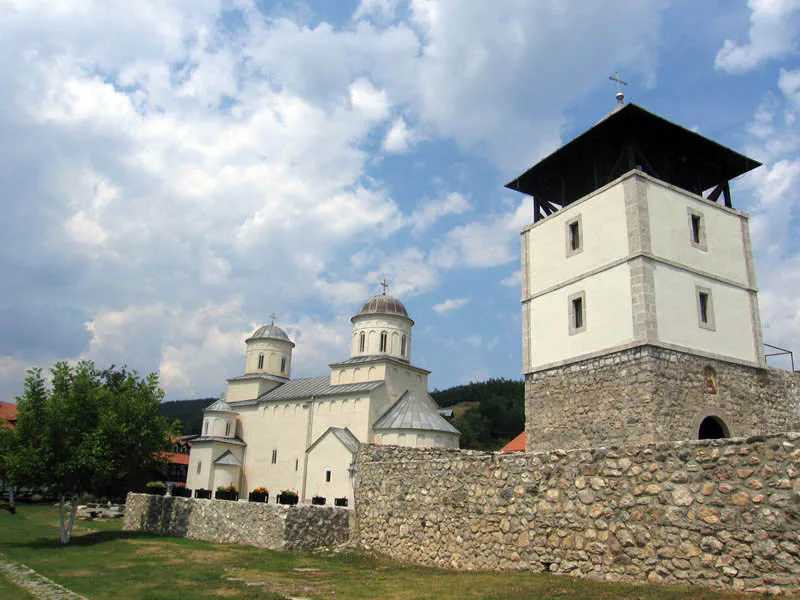
Mileševa Monastery
Content & sources
Snežana Trifunović · CC BY-SA 3.0
Gračanica · 85 km
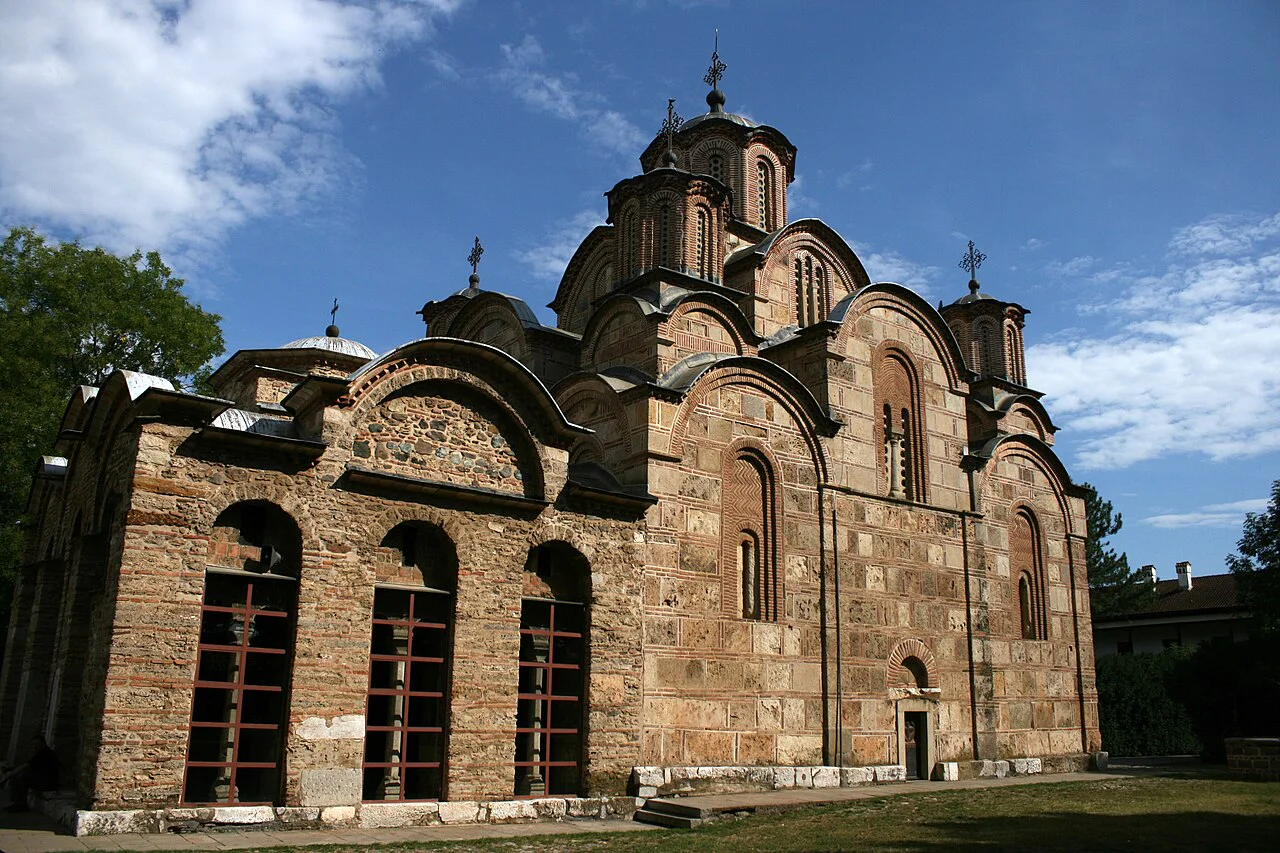
Gračanica Monastery
Content & sources
Quinn Dombrowski · CC BY-SA 2.0