Stanza · Audio guide
西夏陵 Audio Guide
A place to remember. A story to take with you.
The Western Xia mausoleums consist of nine imperial mausoleums and approximately 250 tombs of imperial relatives and officials. This burial complex covers an area of 50 square kilometers at the foot of the…
Download Stanza, then search for “西夏陵”.
About the tour
One guide. Your kind of visit.
The Western Xia mausoleums consist of nine imperial mausoleums and approximately 250 tombs of imperial relatives and officials. This burial complex covers an area of 50 square kilometers at the foot of the Helan Mountains.
Ready when you are.
- 01Get the free Stanza app.
iOS & Android
- 02Find your guide.
“西夏陵”
- 03Download before you go.
Works offline
Audio guide / 14 narrated stops
Inside the guide
Get to know a few of the stories before you go. Open a stop to read more.
01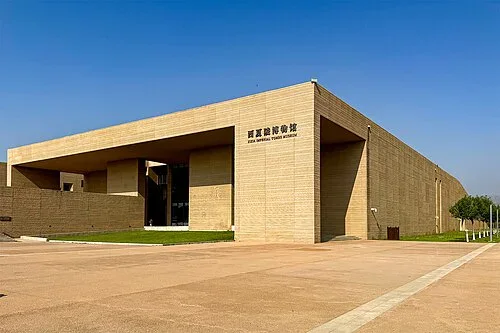 Western Xia Museum: Treasures of the Tangut Realm
Xixia Imperial Tombs Museum Exterior
The museum's name is written on its wall in Chinese and English. The museum is devoted to the Western Xia state and its burial ground. Western Xia was founded by the Tangut people, and it existed from 1038 to 1227. Little is currently known about the Tangut people who founded it. The burial ground holds nine imperial mausoleums. China placed the site on its list of national key cultural relics in 1988. In 2025 UNESCO added it to the World Heritage list, under the name Xixia Imperial Tombs.
Photo: Windmemories · CC BY-SA 4.0
02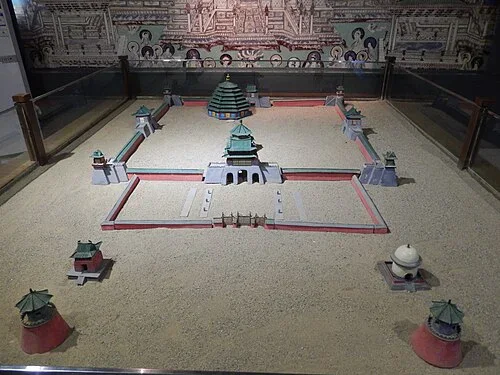 Western Xia Museum: Treasures of the Tangut Realm
Mausoleum Three Precinct Model
The model shows the layout of an imperial mausoleum, and its label calls it a reconstruction of Mausoleum Three. A long rectangular wall encloses the whole precinct. At its southern end stands a pair of gate towers. Inside, a rectangular barbican, a walled forecourt in front of the entrance, leads to a square inner enclosure. Watch towers stand at the four corners. A gate building sits at the centre of the inner walls. Such a plan was typical of the imperial mausoleums. Because it is a reconstruction, it shows the layout as rebuilt, not as the ground looks today. Above the walls at the back, a tall green-roofed tower rises higher than anything else in the model.
Photo: BabelStone · CC BY-SA 4.0
03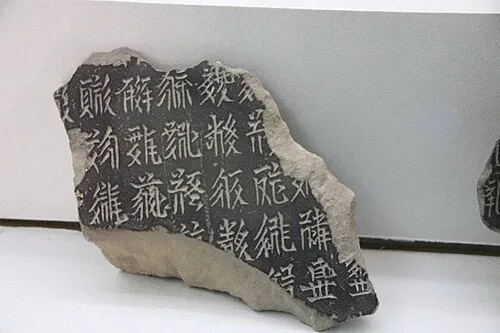 Western Xia Museum: Treasures of the Tangut Realm
Tangut-Script Stele Fragment
Dense rows of characters fill the face of this broken stone. They are written in the Tangut script, the writing of the people who founded the Western Xia state. A stele is an upright stone that carries an inscription, and this fragment is part of one. We do not know where it was found. The characters run right up to the broken edges, so the inscription once continued beyond what survives.
Listen in the appGary Todd from Xinzheng, China · CC0
04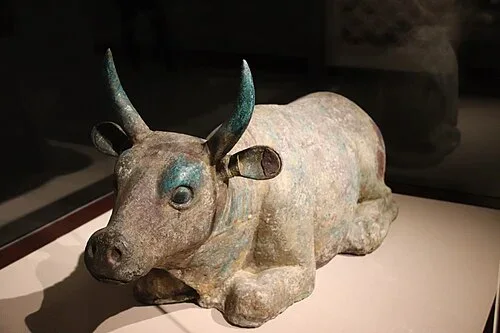 Western Xia Museum: Treasures of the Tangut Realm
Gilded Bronze Ox from the 1977 Excavation
In 1977 an archaeological team chose a tomb that showed no obvious signs of looting. The team had earlier excavated Mausoleum Six, where the underground palace was found completely looted. After eight months of digging, they confirmed that this tomb had been looted too. But in the silt along the east wall of the passageway, about forty centimetres down, they found a bronze ox. It is gilded bronze, and it is one point two metres long. It weighs one hundred and eighty-eight kilograms. The ox had survived the looting, and it is now in the Ningxia Museum, in Yinchuan. Its meaning is still open to interpretation. It lies with its legs tucked beneath its body and its head lowered. Its horns curve upward, and a green-blue patina, the crust that forms on old bronze, shows on the horns and around the eyes.
Listen in the appGary Todd from Xinzheng, China · CC0
05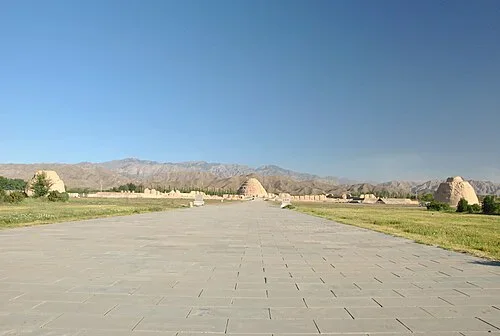 Mausoleum Three: The Spirit Way and Stele Pavilions
Mausoleum Three Approach Avenue
Of the nine mausoleums, Mausoleum Three is the only one so far adequately excavated and studied. Its name is Tailing. It is attributed to Emperor Jingzong, born Li Yuanhao, the first emperor of the state. He ruled from 1038 to 1048. A long paved way runs straight toward the mounds, with dry mountains rising behind them.
Listen in the appPhoto: Jayavarman · CC BY-SA 3.0
06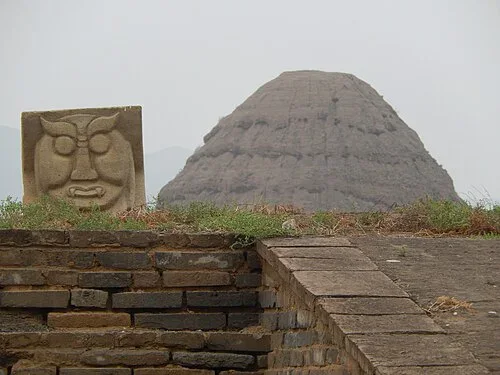 Mausoleum Three: The Spirit Way and Stele Pavilions
Mausoleum Three Stele Base
Imperial precincts had pavilions, usually a pair, that housed memorial steles. The rammed-earth and brick platform is identified as a stele base of Mausoleum Three. A carved face with heavy brows and a wide mouth is set into it. What that face was for is not clear. Outer excavation of Mausoleum Three turned up stone statue fragments, along with bronze fittings. Among the bronze pieces were a bell and a belt buckle.
Listen in the appPhoto: BabelStone · CC BY-SA 3.0
07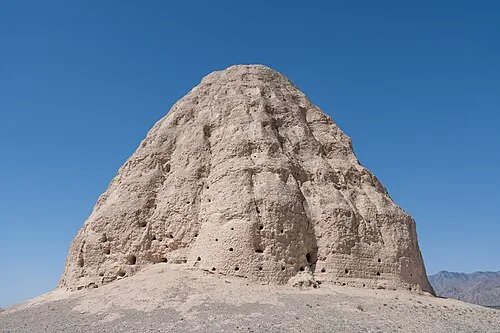 The Tomb Tower (Lingtai): The Oriental Pyramid
Rammed-Earth Tomb Tower
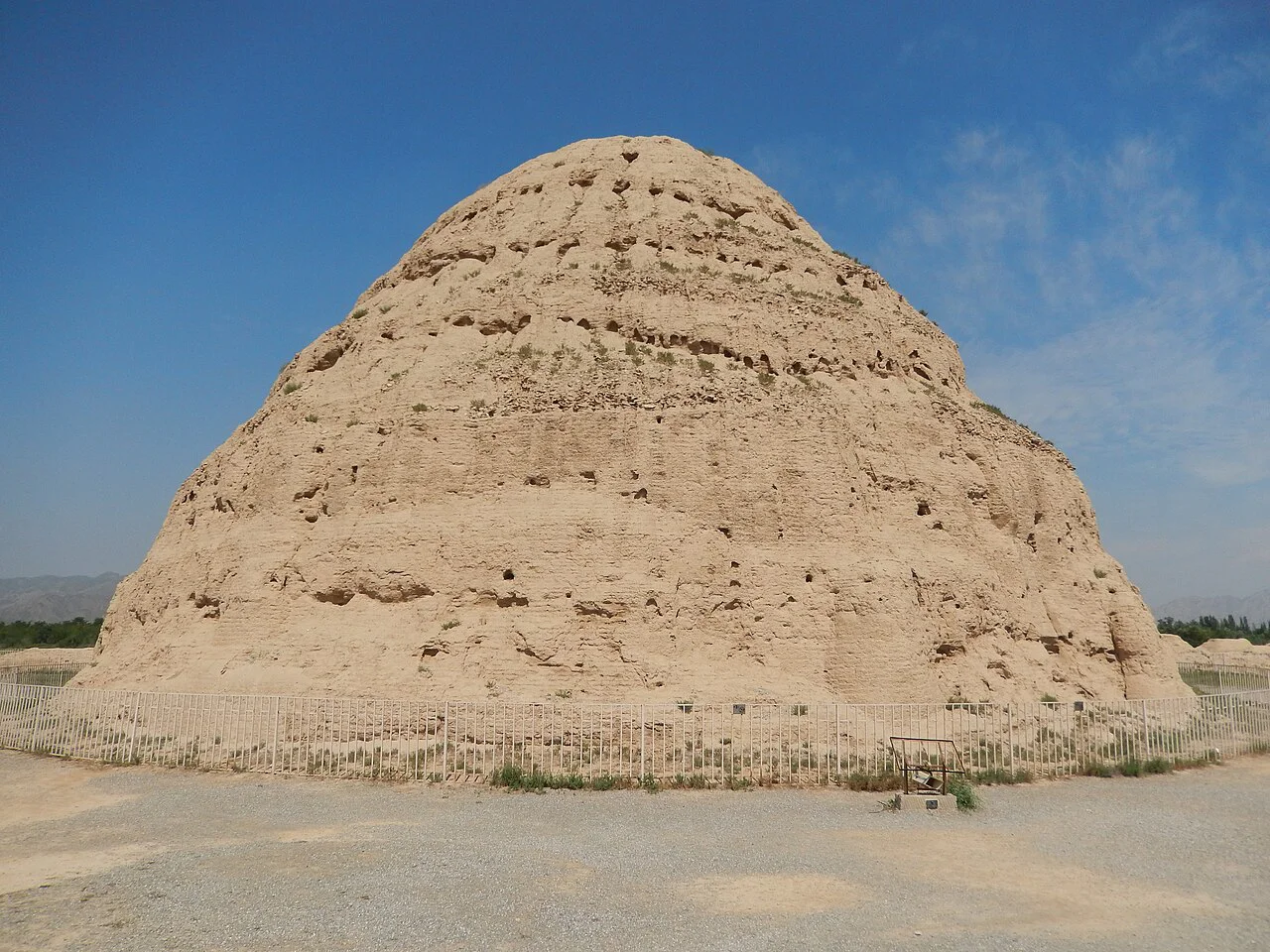
A tomb tower is a solid mound of earth built over the burial. Such mounds are made of rammed earth, which means soil packed down hard in layers. A mound of this kind can be up to thirty metres across. It can rise up to twenty-three metres high. Such mounds stand off-centre, in the north-west part of their inner enclosure. The tomb tower of Mausoleum Three is described as a pavilion-tower, which blends traditional mausoleum and temple styles with Buddhist features. Steep, rounded sides of packed earth rise from the bare gravel.
Listen in the appxiquinhosilva · CC BY 2.0
08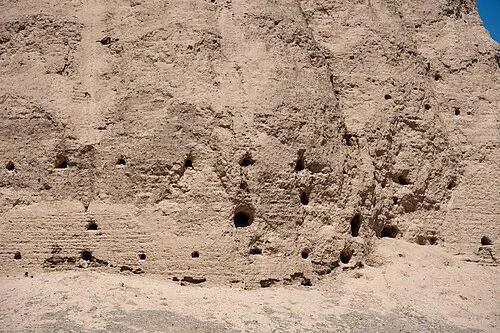 The Tomb Tower (Lingtai): The Oriental Pyramid
Beam Holes in the Tower Wall
Dark holes pock this earthen wall, some round and some wide. Holes like these would have held wooden beams that supported the structure above. Large numbers of tiles have been found at each mausoleum. So the surviving mound is believed to be only the core of a larger monument, coated with brick. The building that once rose above it is no longer standing.
Listen in the appxiquinhosilva · CC BY 2.0
09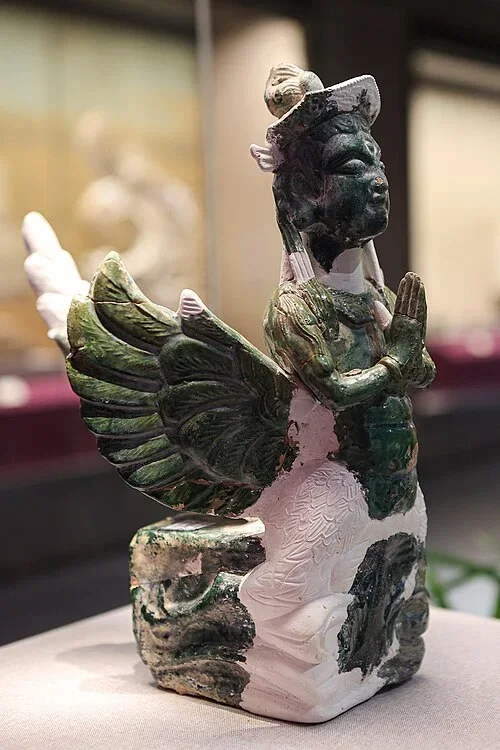 The Tomb Tower (Lingtai): The Oriental Pyramid
Green-Glazed Kalavinka Figure
A winged figure rises from a heavy base, its hands pressed together at the chest. It is a kalavinka, a mythical bird-human being that appears in Buddhist art more widely. Tomb towers like these are believed to have carried tiled eaves and decorative sculpture on each level. We do not know where this figure was found, when it was made, or where it first stood, so it cannot be tied to any one tomb. Green glaze covers the wings and head, and pale patches show on the body beneath.
Listen in the appPhoto: Windmemories · CC BY-SA 4.0
10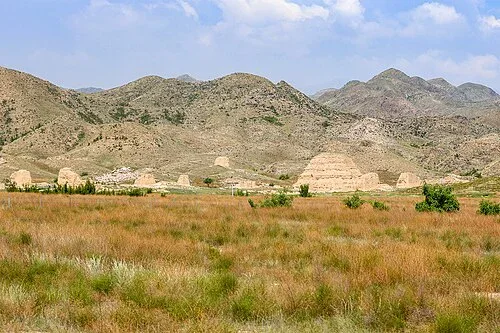 The Desert Necropolis and Helan Mountain Plains
Helan Foothills Burial Plain
The burial ground lies at the foot of the Helan Mountains, about forty kilometres west of the Western Xia capital, Xingqing, now Yinchuan. It covers some fifty square kilometres. The tombs run in a strip along the eastern foothills. That strip is about twelve kilometres long, and at its widest it reaches two and a half kilometres. Besides those nine mausoleums, the site holds subordinate tombs. Archaeologists have counted 254 of them. The count dates to 2014. They belong to imperial relatives and to nobles and officials of high rank. Subordinate tombs lacked the gate towers, corner platforms and offering halls that imperial tombs had. Some mounds are rammed earth, others are heaps of sand and gravel, and some of those have stones stacked on top.
Listen in the appPhoto: Windmemories · CC BY-SA 4.0
- 11
Bare Tomb Mounds on the Plain
How the Western Xia state ended in 1227, and how its tombs turned up in a 1938 book of views from the air.
- 12
Mausoleum One (Yuling)
The mound at the southern tip, believed to hold the grandfather of the first emperor.
- 13
Mausoleum Two (Jialing)
The mound believed to hold the father of the first emperor, standing beside its partner at the southern tip.
- 14
Southern Pair of Mausoleums One and Two from a Distance
The southern pair seen from a distance, and what a cemetery made mostly of earth can still tell us about its builders.
西夏陵
Frequently asked questions
How much does the guide cost?
Free app download. Listed guide price: $0.99. Guide price shown in the app. Audio guide only. Venue admission is separate.
Can I listen without internet?
Yes. Download the guide’s audio, images, and maps in the app before your visit. Your downloaded content is then available offline.
Can I listen in my language?
This audio guide is available in 15 languages, including English.
Do I need to follow a schedule?
No. This is a self-guided experience. Choose your stops, pause whenever you like, and return to a story at your own pace.
At your own pace
Explore 西夏陵.
Download Stanza, then search for “西夏陵”.
Free app download · Guide price shown in the app
Keep exploring
Audio guides — China
Lintong District
Terracotta Army
Content & sources
xiquinhosilva · CC BY 2.0
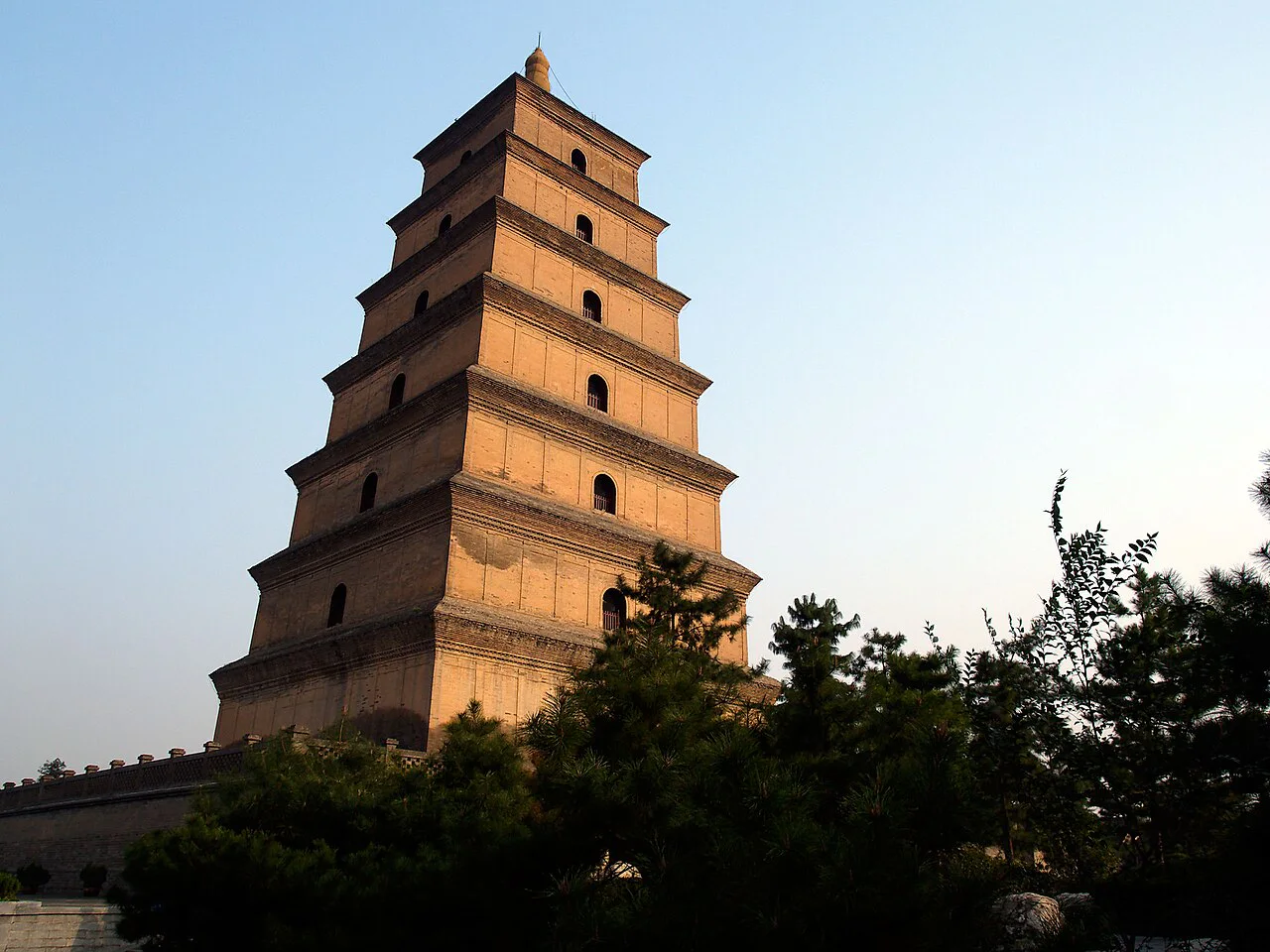
Xi'an
大雁塔
Content & sources
Alex Kwok · CC BY-SA 3.0
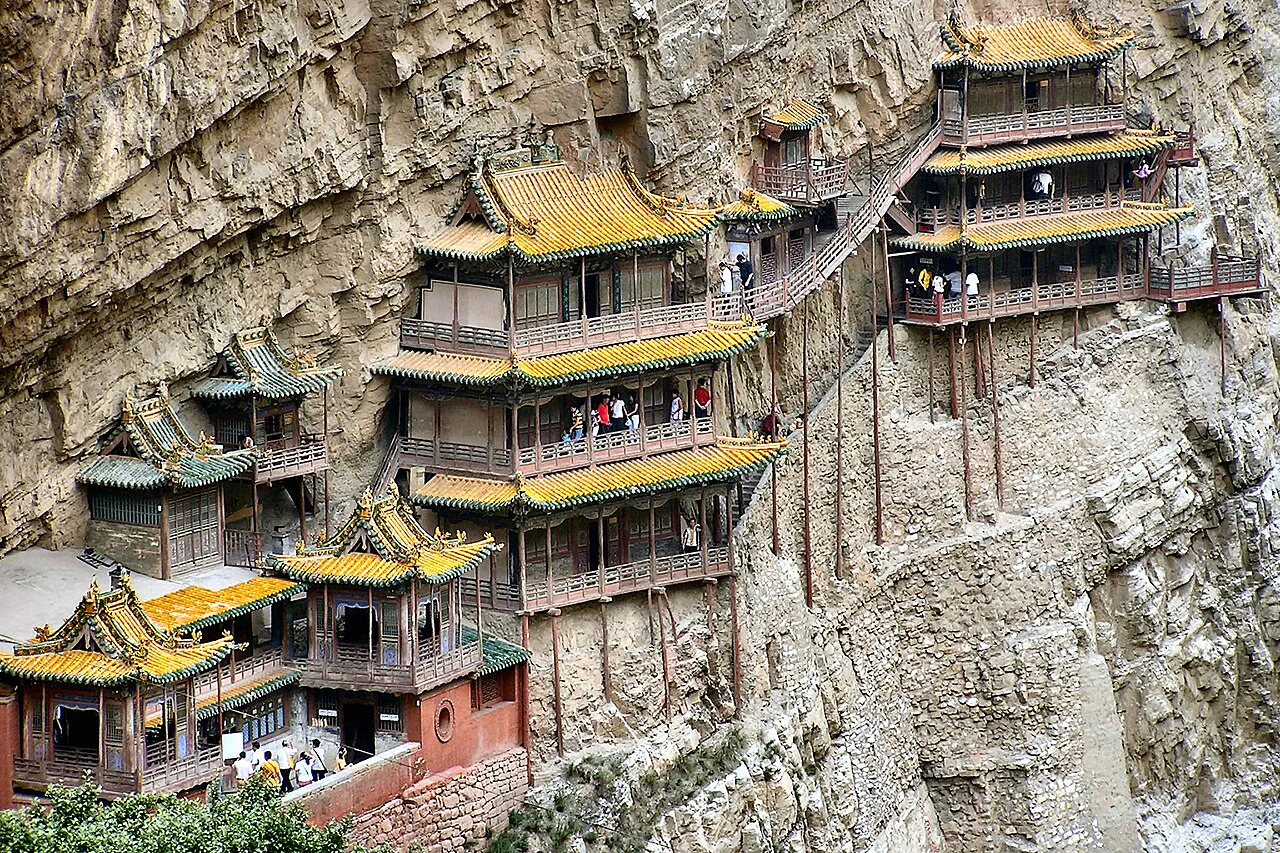
Datong
悬空寺
Content & sources
BRUNNER Emmanuel (Manu25) · Public domain
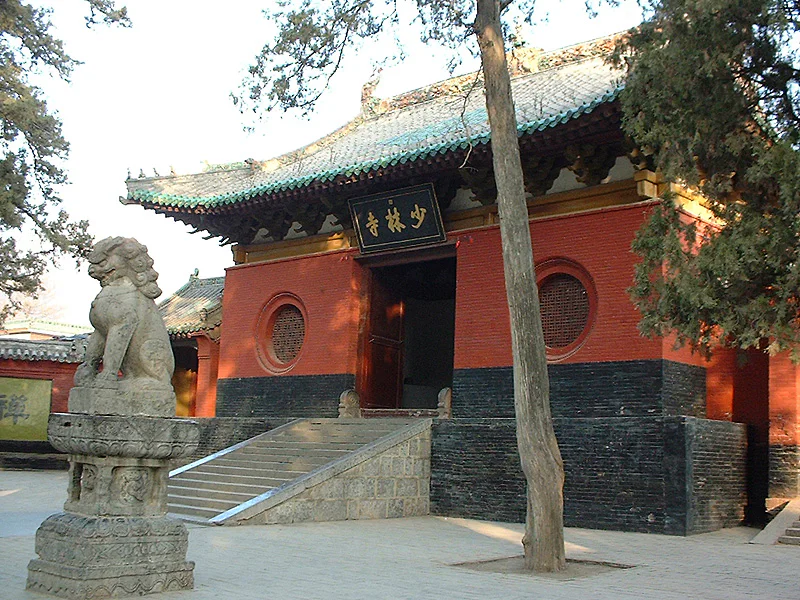
Dengfeng
少林寺
Content & sources
User:Yaoleilei · CC BY-SA 3.0