Stanza · Audio guide
Cathédrale Saint-Pierre-et-Saint-Paul de Nantes Audio guide
A place to remember. A story to take with you.
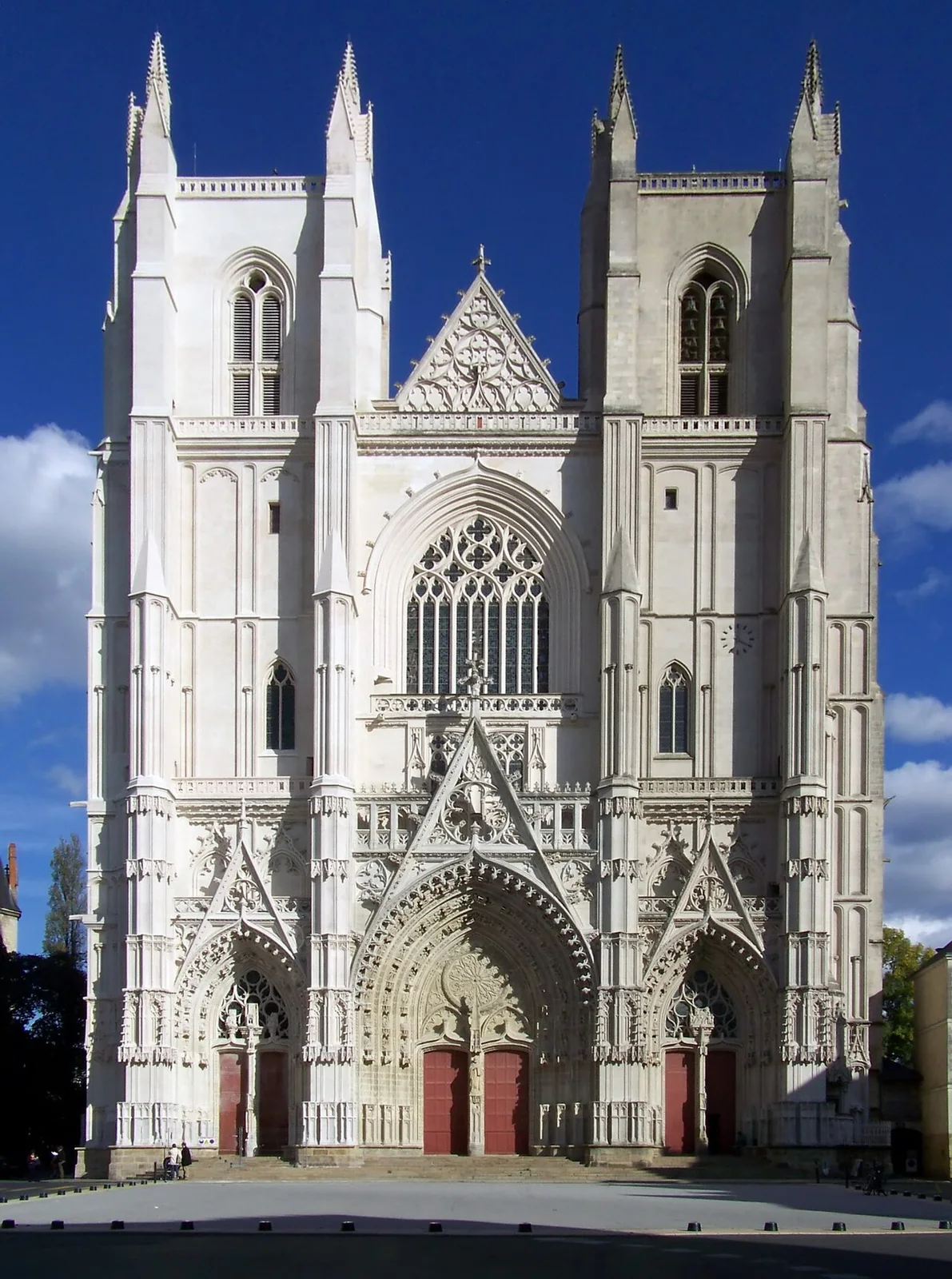
Nantes Cathedral is a Roman Catholic Gothic cathedral located in Nantes, France. Construction of the building began in 1434 and took 457 years to complete.
Download Stanza, then search for “Cathédrale Saint-Pierre-et-Saint-Paul de Nantes”.
About the tour
One guide. Your kind of visit.
Nantes Cathedral is a Roman Catholic Gothic cathedral located in Nantes, France. Construction of the building began in 1434 and took 457 years to complete.
Ready when you are.
- 01Get the free Stanza app.
iOS & Android
- 02Find your guide.
“Cathédrale Saint-Pierre-et-Saint-Paul de Nantes”
- 03Download before you go.
Works offline
Audio guide / 13 narrated stops
Inside the guide
Get to know a few of the stories before you go. Open a stop to read more.
01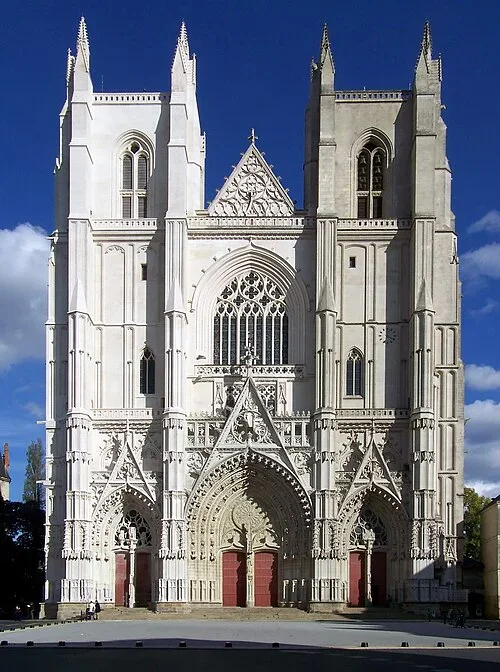 Place Saint-Pierre and the Western FacadeThe Western Facade and the Ducal Foundation
Welcome to the cathedral of Saint Peter and Saint Paul at Nantes. Its foundation stone was laid on 14 April 1434 by John V, Duke of Brittany, together with Jean de Malestroit, Bishop of Nantes. The building was meant as a statement of the wealth and independence of ducal Brittany, raised at a moment when John V was playing a skilful diplomatic game amid conflict with England. Two massive towers flank the facade, climbing about sixty-three metres to an open terrace at the top. In all, building the cathedral took 457 years, far beyond any single lifetime. The towers carry a story of their own. On the night of 10 to 11 November 1940, a young art student named Michel Dabat climbed one of them with a companion and planted a French flag on the summit, in occupied Nantes. A denunciation followed, and a military court sent him to prison for four months. In October 1941 he faced a firing squad with fifteen other hostages, in the reprisals that followed the killing of Karl Hotz. He was twenty years old.
Photo: Eusebius · Public domain
02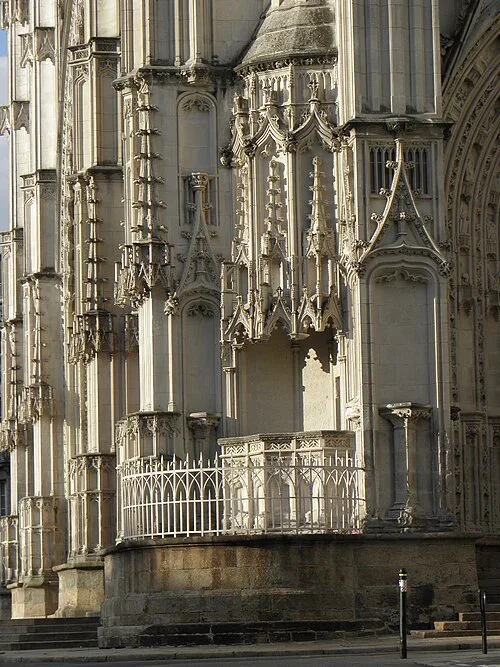 Place Saint-Pierre and the Western FacadeThe External Preaching Pulpit
On the face of the cathedral, the stonework holds something few churches have: a pulpit built for the open air. Clergy could climb it and preach to crowds gathered on the square when the cathedral itself was full. It is a reminder that this building faced the whole city, not only the congregation inside. The square in front has seen history of a sharper kind too. On 5 September 1661, Nicolas Fouquet, the king's superintendent of finances, was arrested here in front of the cathedral, on the orders of Louis XIV. The officer sent to take him was d'Artagnan. Fouquet's fall came without warning, and it played out in public, on this very square.
Photo: GO69 · CC BY-SA 4.0
03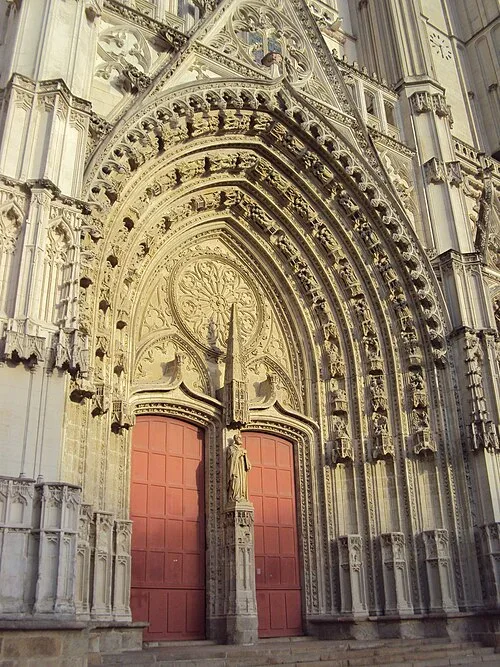 The Portals of the Western EntranceThe Main Portal
The western front has not one grand door but five. Three stand on the facade itself and two more open at the sides, each framed by deeply carved arches. From north to south they are dedicated to the children of Nantes, the martyrs Donatien and Rogatien; to Saint Peter; to the Last Judgment; to Saint Paul; and to Saint Yves. The sculpture in the arches follows the dedicatee, so each doorway works almost like a caption cut in stone. The central door, with its red leaves, carries another distinction. Its bronze decoration was undertaken in 1482, early in the cathedral's long building history, while so much of the church still lay ahead.
Listen in the appPhoto: Adam Bishop · CC BY-SA 4.0
04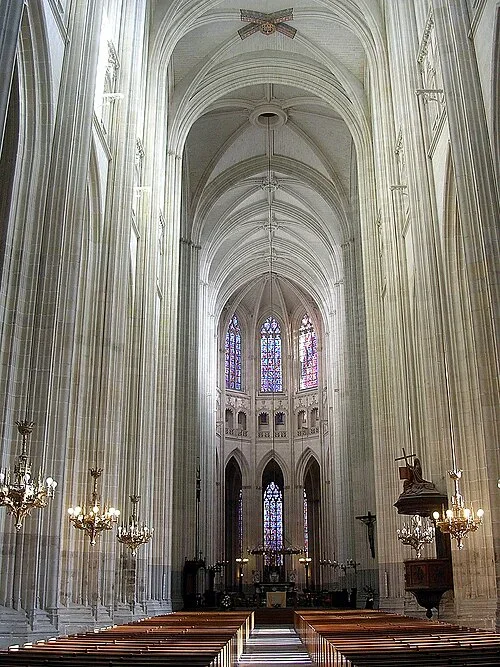 The Soaring Gothic Nave and the Lost Grand OrganThe Gothic Nave
The nave is the architectural heart of the building, and it soars. Its vaults hang nearly thirty-eight metres above the floor, and the stone is white, its polish heightened by recent restoration. The style is Late Gothic, the kind the French call Flamboyant, and it holds from one end of the church to the other: no capitals on the pillars, tracery like a network of flames, shafts that swallow the piers. Builders kept faith with that style across the slow centuries of construction, which is why the interior feels of one mind. Then came 28 January 1972. A gigantic fire broke out on the roof, believed to have been started by a workman's blow torch. Firefighters brought it under control, but the timber framework was severely damaged, and the harm ran deep into the building. What followed was a complete restoration of the interior, finished in 1985. Much of what fills this space today is the work of those years.
Listen in the appPhoto: Jibi44 · CC BY-SA 3.0
05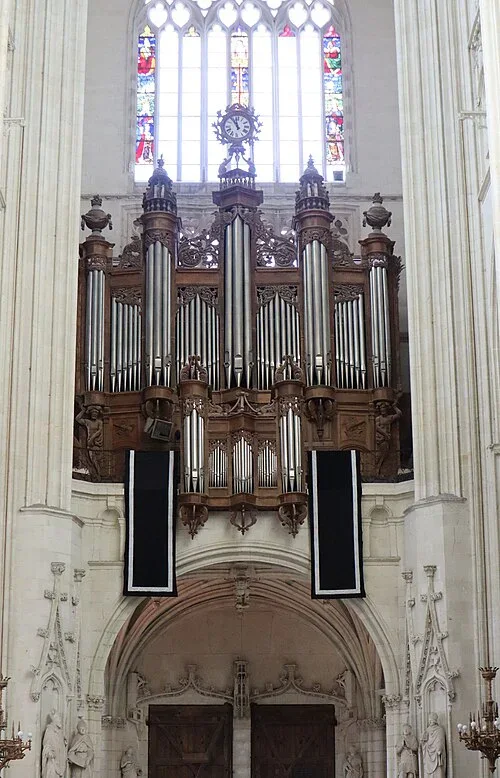 The Soaring Gothic Nave and the Lost Grand OrganThe Grand Organ and the Fire of 2020
At the west end of the nave, high on the wall, stood the cathedral's grand organ, an instrument whose history reached back to the early seventeenth century. In the early hours of 18 July 2020, fire broke out inside the cathedral. It had been set in three places at once: on this great organ, near a smaller organ to the left of the altar, and to the right of the altar. Around a hundred firefighters came. They saved the building, but the grand organ was destroyed, together with the great west window above it. That window had been put in place in 1498, commissioned by the Duchess-Queen Anne, and it showed her beside her mother, Marguerite de Foix. A painting by Hippolyte Flandrin, Saint Clair healing the blind, was lost with them. The damage was assessed at more than forty million euros. The fire chief compared the night with Notre-Dame de Paris the year before, and counted Nantes fortunate: less had burned here.
Listen in the appPhoto: GO69 · CC BY-SA 4.0
06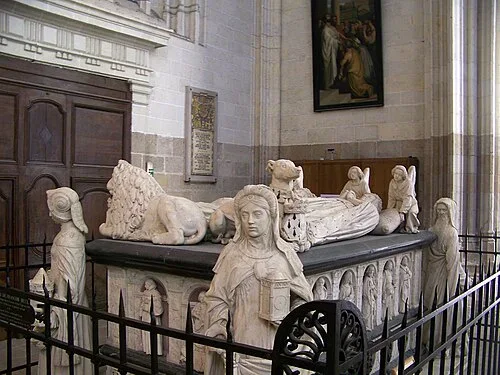 Tomb of Francis II and Marguerite de FoixTomb of Duke Francis II and Marguerite de Foix
In one of the chapels stands the monument many visitors come for: the marble tomb of Francis II, the last Duke of Brittany, and his wife Marguerite de Foix, parents of Anne of Brittany. It was carved between 1502 and 1507 by Michel Colombe, working with Jean Perréal, and the marble alone took Colombe five years. The duke and duchess lie in state on the lid, angels at their heads and a dog at their feet. Below them, twelve apostles and four allegorical women fill the niches, the women standing for the cardinal virtues. The monument is counted a masterpiece of French sculpture, a bridge between the Middle Ages and the Renaissance, where Italian grace meets French style. It was only installed in this cathedral in 1817, three centuries after it was made.
Listen in the appFlorestan · CC BY 3.0
07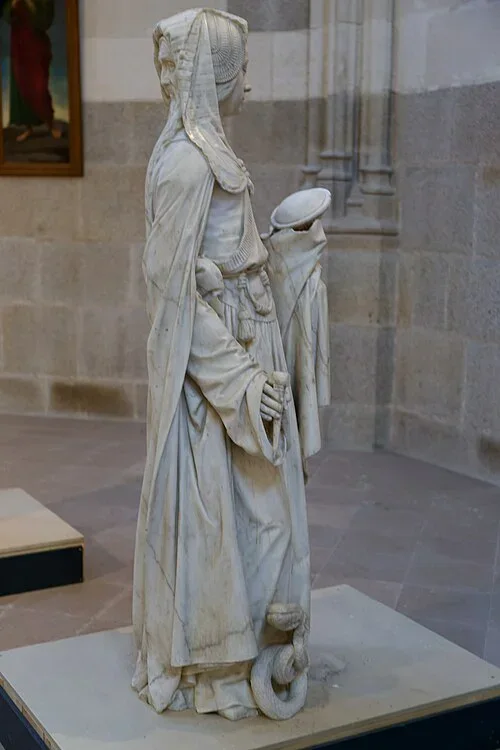 Tomb of Francis II and Marguerite de FoixPrudence, Virtue of the Tomb
One of the tomb's four virtues stands close enough to read in detail: Prudence, in white marble, life-sized. A heavy veil covers her head, and in her hands she holds a mirror. At her feet a serpent coils. She was carved for the tomb of Duke Francis II, one of four figures standing watch over the effigies, alongside Fortitude, Temperance and Justice. Where medieval tombs mourned, this Renaissance programme turns to ideas: the virtues a ruler was meant to live by. The mirror and the serpent are her traditional attributes, emblems of seeing clearly and acting wisely.
Listen in the appPhoto: Eagertourist · CC0
08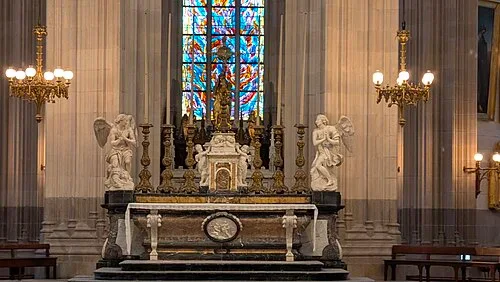 The Choir and High AltarThe High Altar and Choir
The choir and the high altar are the reason the building exists. Through every fire and every bomb this story has touched, worship has continued, at times moving to the Notre-Dame-de-l'Immaculée-Conception chapel while the building was under restoration. The high altar is a wide marble work, framed by tall candlesticks and figures of angels, with stained glass glowing behind it. This is where the cathedral's daily round happens: the masses, the offices, the ceremonies of a working diocese. Ordinary services here are accompanied by the choir organ, the smaller of the cathedral's two instruments, which waits nearby under its own Gothic canopy.
Listen in the appPhoto: Llann Wé² · CC BY-SA 4.0
09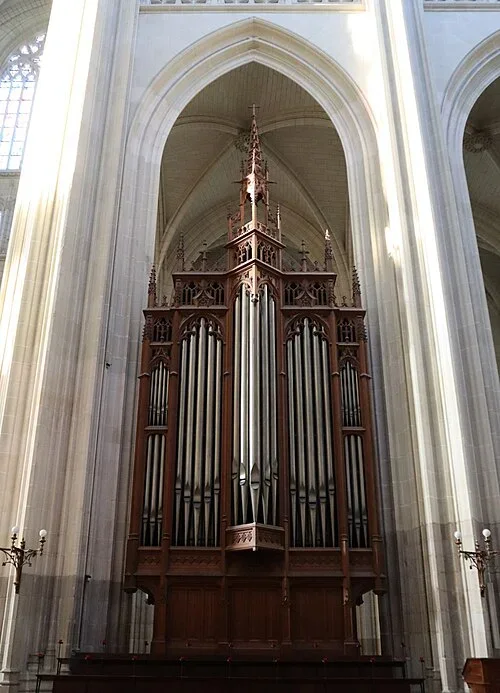 The Choir and High AltarThe Choir Organ
The choir organ has a history of survival. Louis Debierre finished building it in 1897, and with thirty-one stops it remains the largest accompanying organ in France, the instrument that supports the singing rather than leading it. In June 1944, Allied bombing struck Nantes; a bomb hit the cathedral's sacristy and badly damaged the apse and three chapels. The organ was hurt too. It suffered again in the great roof fire of 1972, the one that swept the nave. Restored after each blow, it was returned to its functions in 1985, and its mechanical part was classified as a historic monument in 1987. It still accompanies the cathedral's ordinary ceremonies today.
Listen in the appPhoto: GO69 · CC BY-SA 4.0
10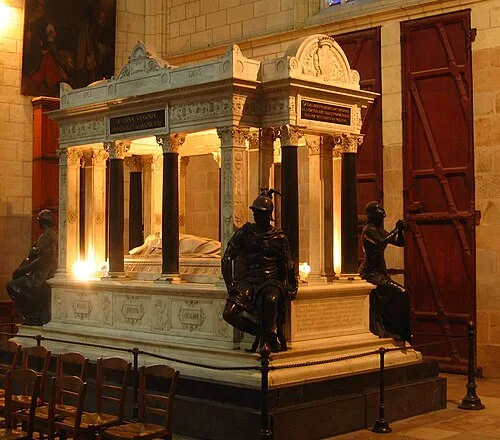 Cenotaph of General de LamoricièreCenotaph of General de Lamoricière
In the north transept, white and black marble build a monument of another century: the cenotaph of General de Lamoricière, erected in 1878. Lamoricière was a son of Nantes, and the monument was raised in papal homage to the services he had rendered. The setting is architectural in the Renaissance manner: columns, an open canopy, and a recumbent effigy ringed by bronze figures. It shows how the cathedral went on accumulating memorials long after the Middle Ages had ended, a nineteenth-century general taking his place among the dukes and bishops of the building's older story.
Listen in the appPhoto: Frederic.chotard · CC BY-SA 3.0
Cathédrale Saint-Pierre-et-Saint-Paul de Nantes
Frequently asked questions
How much does the guide cost?
Free app download. Listed guide price: $0.99. Guide price shown in the app. Audio guide only. Venue admission is separate.
Can I listen without internet?
Yes. Download the guide’s audio, images, and maps in the app before your visit. Your downloaded content is then available offline.
Can I listen in my language?
This audio guide is available in 15 languages, including English.
Do I need to follow a schedule?
No. This is a self-guided experience. Choose your stops, pause whenever you like, and return to a story at your own pace.
At your own pace
Explore Cathédrale Saint-Pierre-et-Saint-Paul de Nantes.
Download Stanza, then search for “Cathédrale Saint-Pierre-et-Saint-Paul de Nantes”.
Free app download · Guide price shown in the app
Keep exploring
Nearby audio guides
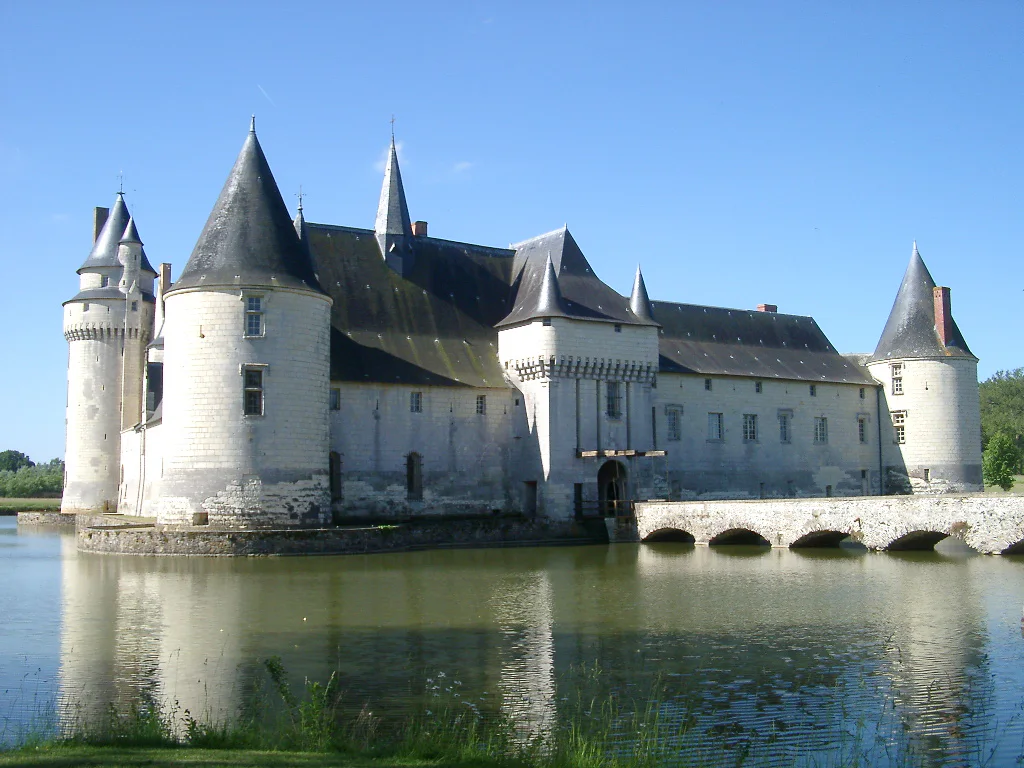
Écuillé · 87 km
Château du Plessis-Bourré
Content & sources
The original uploader was NonNobis at French Wikipedia. · CC BY-SA 3.0
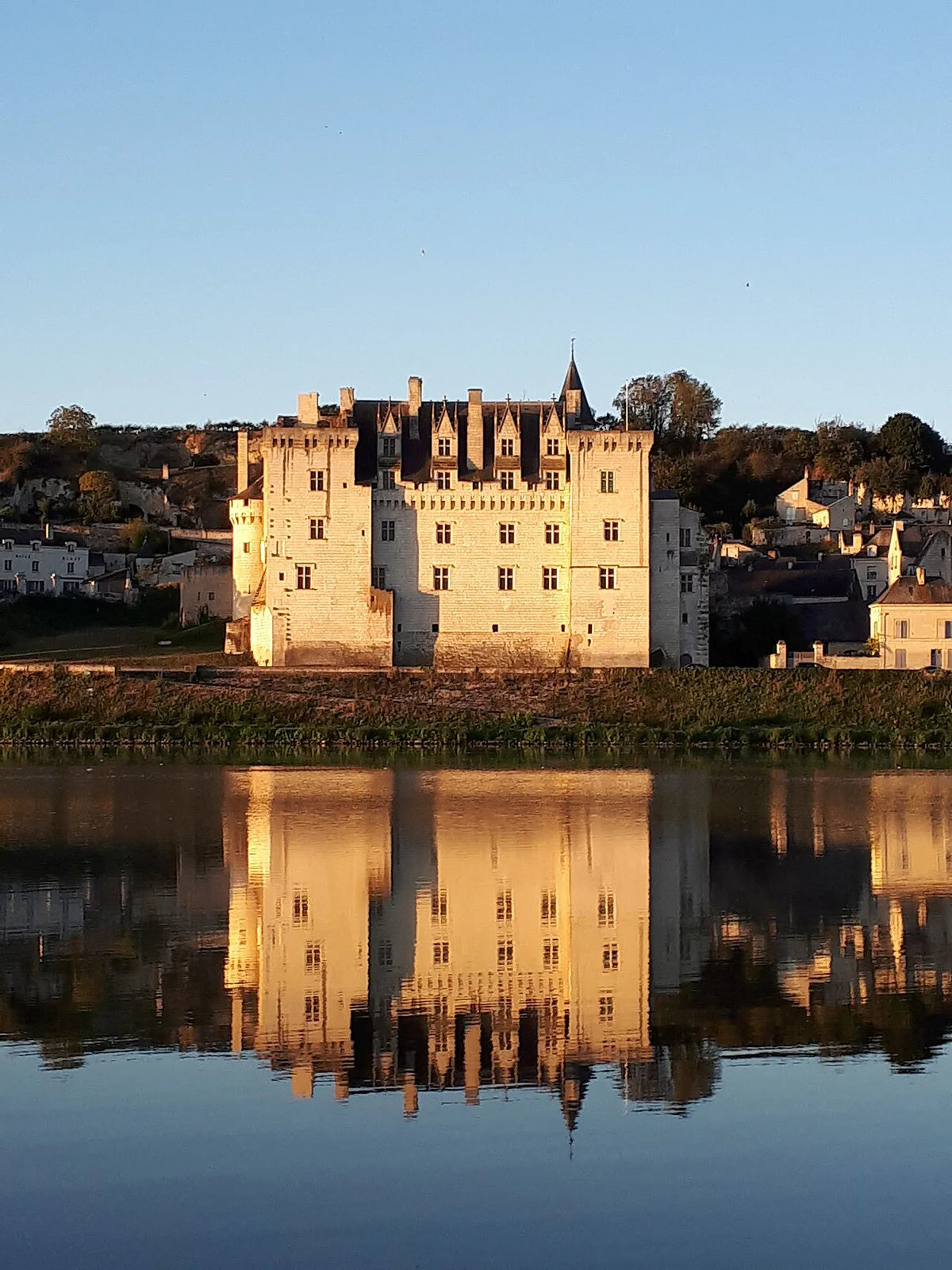
Montsoreau · 122 km
Château de Montsoreau
Content & sources
Photo: Suavemarimagno · CC BY-SA 4.0
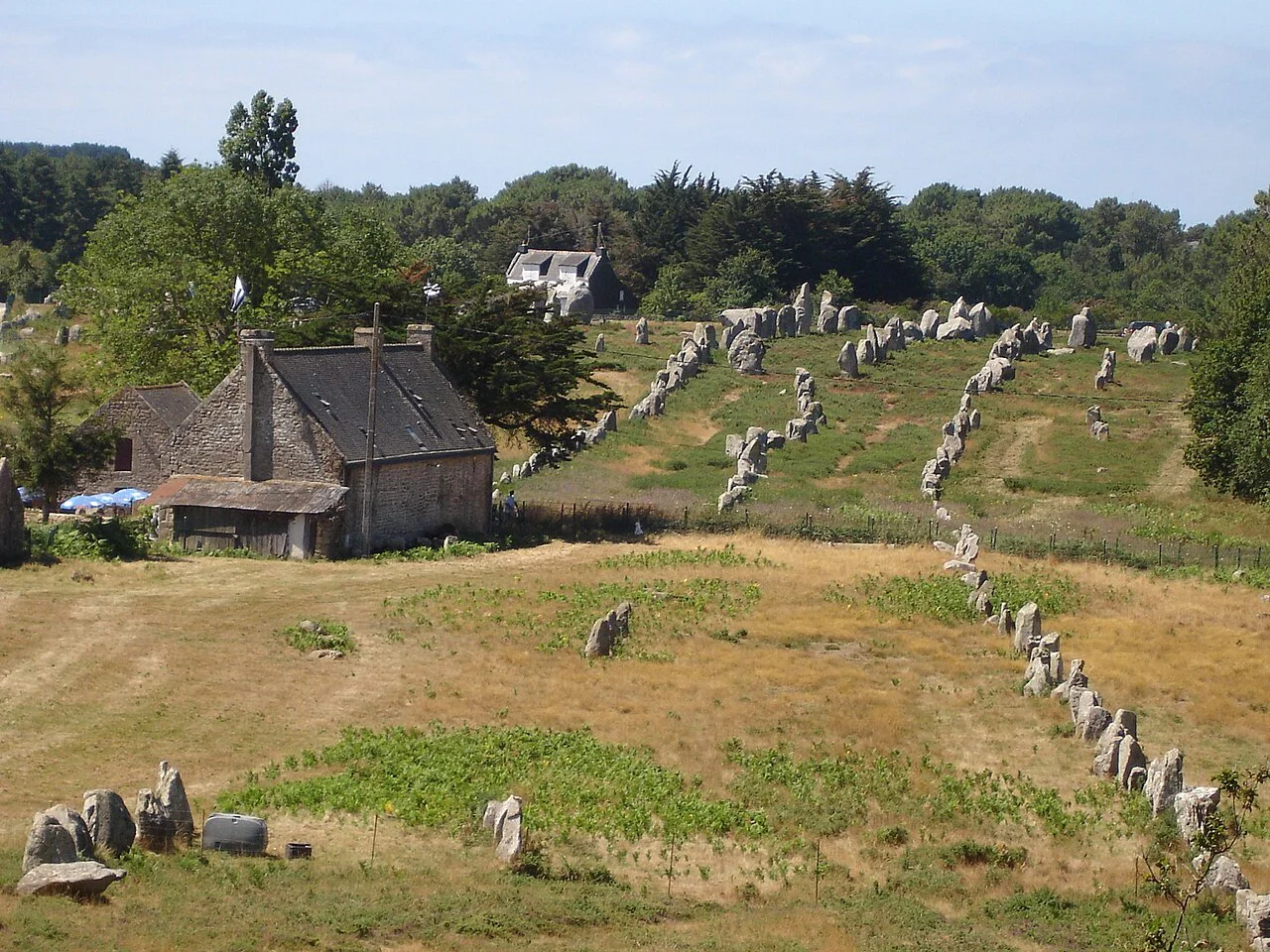
Carnac · 122 km
Alignements de Carnac
Content & sources
--Pinpin 17:43, 1 August 2006 (UTC) · CC BY-SA 3.0
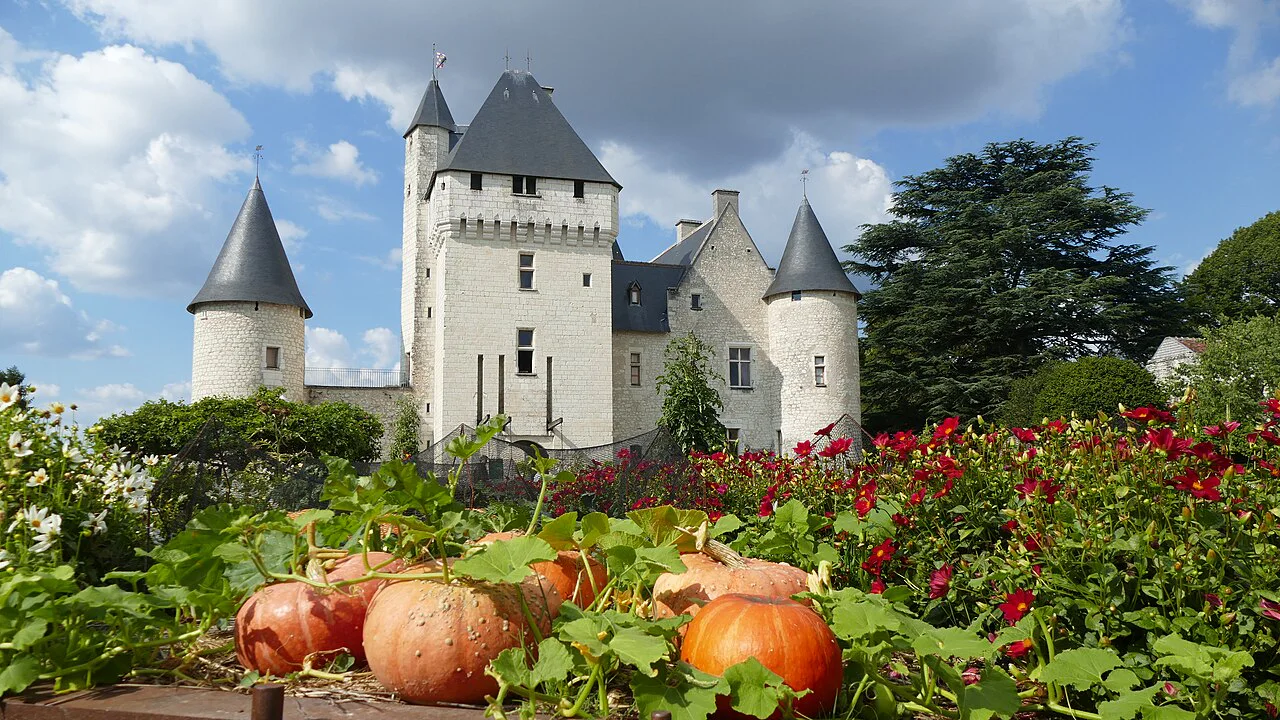
Lémeré · 142 km
Château du Rivau
Content & sources
Photo: Aliasse16 · CC BY-SA 4.0