Stanza · Audio guide
Κάμειρος Audio Guide
A place to remember. A story to take with you.
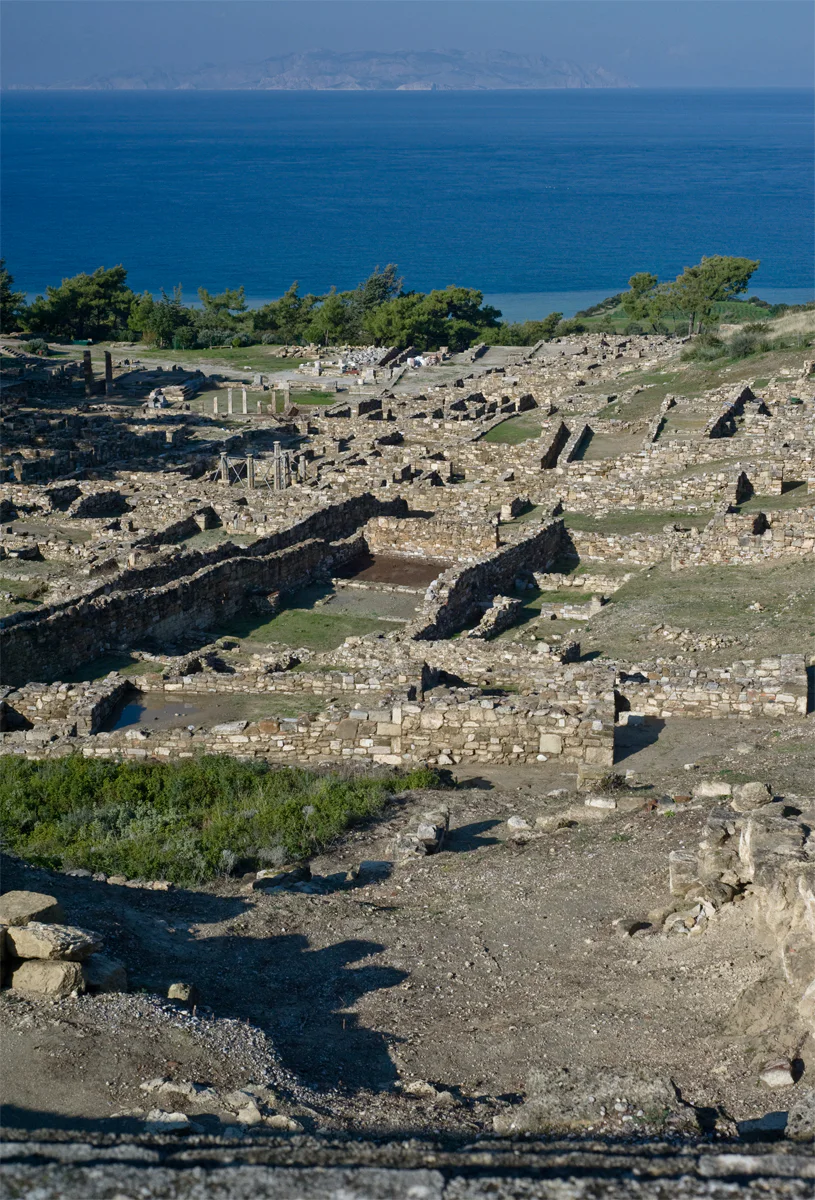
Camirus was a city of ancient Rhodes in the Dodecanese, Greece. Its site is located on the northwest coast of the island, three kilometres west of the modern village of Kalavarda.
Download Stanza, then search for “Κάμειρος”.
About the tour
One guide. Your kind of visit.
Camirus was a city of ancient Rhodes in the Dodecanese, Greece. Its site is located on the northwest coast of the island, three kilometres west of the modern village of Kalavarda.
Ready when you are.
- 01Get the free Stanza app.
iOS & Android
- 02Find your guide.
“Κάμειρος”
- 03Download before you go.
Works offline
Audio guide / 10 narrated stops
Inside the guide
Get to know a few of the stories before you go. Open a stop to read more.
01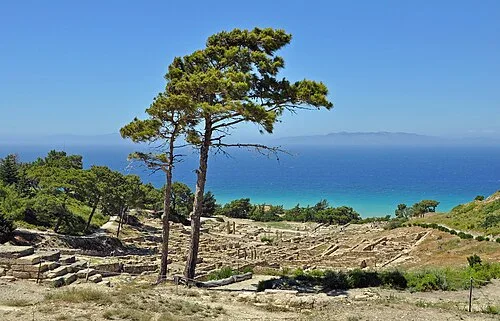 Lower Terrace: City Overview and the Agora
Kameiros: A Dorian City in Three Terraces
Welcome to Kameiros, a city founded by Dorians on the northwest coast of Rhodes. It was one of three ancient cities on the island, alongside Ialysos and Lindos. Long before the Dorians came, Mycenaean Greeks already lived in this area in prehistoric times. The city climbs its hillside in three levels, and the whole plan is readable from here. Public life filled the lowest ground, with its square and its temples. Ordinary families lived on the middle slope, in streets laid out in a grid. At the summit stood the sanctuary of Athena and the city's water works, with the sea all around. That sea gave Kameiros its living, and the hillside gave it its shape.
Marc Ryckaert (MJJR) · CC BY 3.0
02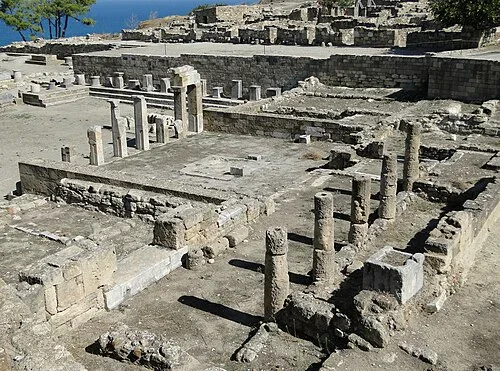 Lower Terrace: City Overview and the Agora
The Agora and Fountain Square
The public heart of Kameiros lay here on the lowest terrace. This stone plaza is the agora, the open square where citizens gathered to talk, trade and settle the business of the day. Against it stood the fountain house, the city's public water point. Water was never guaranteed on a dry hillside, so the city managed it carefully, level by level. The great storage tank up on the acropolis held the city's reserve. From the fountain, people climbed away with jars and skins, and the square filled again with voices. The columns standing here were re-erected during restoration, but the paving and the column bases around them belong to the ancient square. This was where the whole city met.
Bernard Gagnon · CC BY-SA 3.0
03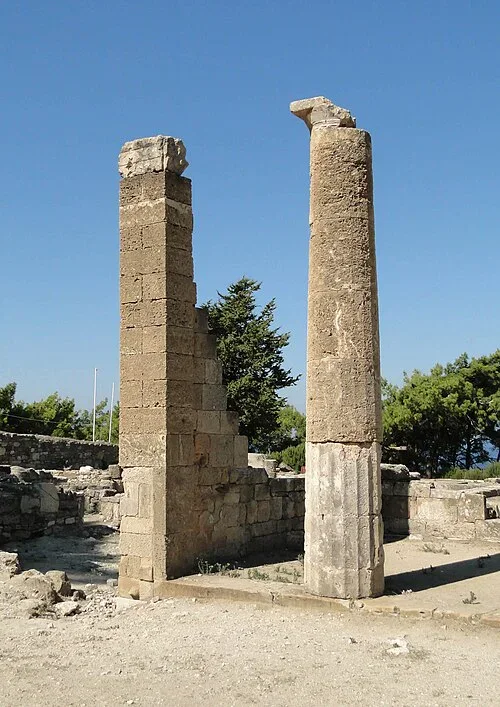 Sacred Precinct: Temple of Apollo and the Altars
Temple of Pythian Apollo
Two columns carry the sky here, all that stands of a Doric temple on the lower terrace. The dedication rests on probability rather than proof: the temple is usually given to Apollo in his Pythian form. A city the size of Kameiros built its temples on a modest scale, and this one was never a giant of Greek sacred architecture. What survives is the working ground of the building, column drums and wall cuttings rather than a rising superstructure. The taller shaft shows how the drums were stacked and fluted, and how much has simply fallen away. Worship here belonged to the same civic world as the square nearby, a neighbourhood sanctuary rather than a distant shrine. The god's name is the one detail still being weighed.
Listen in the appBernard Gagnon · CC BY-SA 3.0
04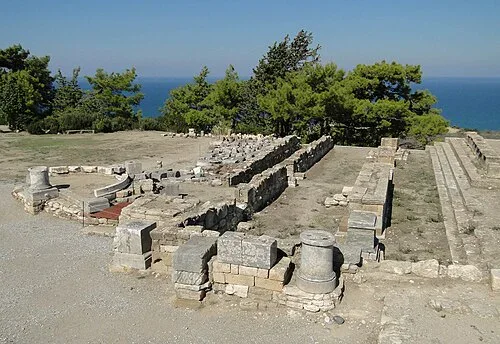 Sacred Precinct: Temple of Apollo and the Altars
The Sacred Precinct of the Altars
An open court with low walls and stone bases did one of the holiest jobs in Kameiros. This enclosure held the altars, and it carried dedications to several deities at once, not to a single god. In a Greek city, sacrifice was a public act. An animal burned on the altar sent smoke up to the god, and the community shared the rest of the meal. Bases and plinths like these held votive gifts, left in gratitude or in hope. The name used for the structure is the Peribolos of the Altars, the enclosure of the altars. The same remains are also known as the Hierothyteion, and which label fits best is still an open question. Either way, the gods of Kameiros were honoured here in the open air, with the sea in view.
Listen in the appBernard Gagnon · CC BY-SA 3.0
05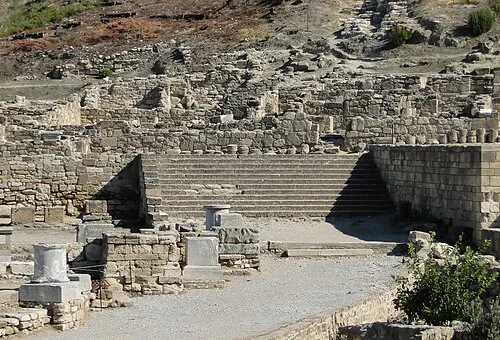 Middle Terrace: Monumental Staircase and Residential Grid
The Monumental Staircase
This part of the hillside was not gently sloped ground. It was engineered. A broad monumental staircase climbs from the public lower terrace toward the residential quarters, cut straight into the rock. Behind it, terraces were held by retaining walls, so the steep slope could carry level plateaus of building land. Here the three-tiered plan stops being a view and becomes a climb. Every level of the city was stitched to the next by works like these. The line the staircase takes is the ancient one.
Listen in the appBernard Gagnon · CC BY-SA 3.0
06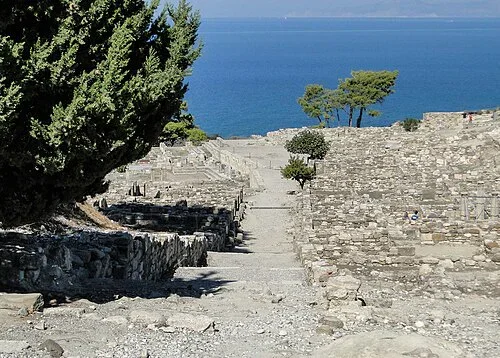 Middle Terrace: Monumental Staircase and Residential Grid
The Residential Grid
Down this long straight street, the middle terrace shows how most people of Kameiros lived. The main settlement occupied this slope, laid out as a grid of parallel streets with rectangular residential blocks between them. The idea of cutting a city into such regular grids is associated with Hippodamus of Miletus. Kameiros follows the principle rather than the man. Along the street, low foundations trace the walls of Hellenistic houses, with the outlines of rooms and courtyards still legible on the ground. Each block held several homes, sharing walls and opening onto the same street. Ordinary domestic life here ran on a fixed plan. The sea closes the view at the end of the street, as it did for the people who lived on it.
Listen in the appBernard Gagnon · CC BY-SA 3.0
07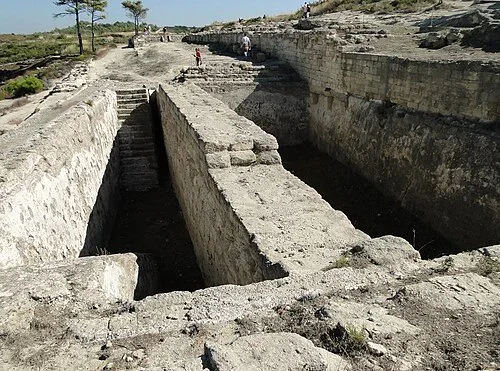 Upper Terrace: The Acropolis, Great Reservoir, and Stoa
The Great Reservoir
The city kept its most valuable possession under the acropolis: water. This deep, stone-lined cavity is a covered reservoir, dug and built about the sixth century BC. Its capacity was six hundred cubic metres, enough for as many as four hundred families. A hillside city with no river running through it could not take water for granted, so Kameiros stored its supply underground. The space was roofed, so the store sat in the dark beneath the sacred summit. Four hundred families meant a whole townful of drinking, cooking and washing, drawn from one hall under the holy ground. Nothing here was accidental. The holiest precinct and the most vital store shared the same hilltop.
Listen in the appBernard Gagnon · CC BY-SA 3.0
08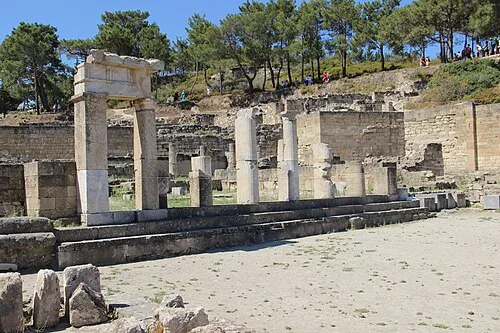 Upper Terrace: The Acropolis, Great Reservoir, and Stoa
The Doric Stoa
Later builders put a colonnade straight on top of the city's covered reservoir. The result was a stoa, a long gallery of two rows of Doric columns, with rooms for shops or lodgings along the back. A stoa was among the most useful buildings a Hellenistic city could own. It gave shade in summer, shelter in winter, and a covered walk with a fine public face. Traders could work from the rooms at the rear, and travellers could lodge there. The re-erected columns give the sense of the original rhythm, column after column down the gallery. All of it stood on the roof of the water store below, so the city shopped above its own drinking supply. The tank came first. The colonnade rose over it later.
Listen in the appVadim Indeikin · CC BY-SA 3.0
09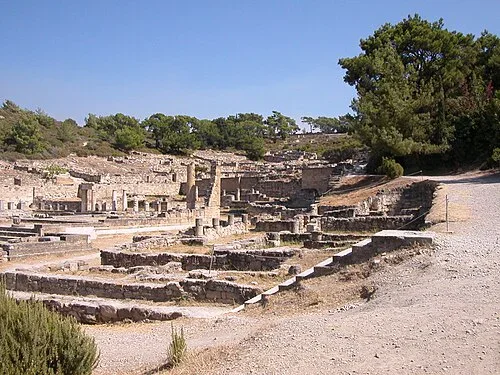 Upper Terrace: The Acropolis, Great Reservoir, and Stoa
The Acropolis and the Temple of Athena Kameiras
The summit belonged to Athena Kameiras, the city's own goddess. Her temple complex stood on the acropolis, and its foundations were laid at least as early as the eighth century BC. This was the spiritual heart of Kameiros and its stronghold at once, the highest ground in a city built on height. Then the ground turned against it. In 226 BC an earthquake destroyed the city and the temple. The same shock is said to have felled the Colossus of Rhodes. Kameiros rebuilt on a grand scale after that disaster, and the Hellenistic city of stoas, tanks and gridded streets that fills this hillside is largely that rebuilding. A second earthquake, usually dated to 142 AD, broke the city again. Repairs followed in the agora and the houses, and the latest remains reach into late antiquity. But the great age of the town was over. From here the view takes in a sanctuary centuries old when the first quake came, and a city that twice rose from its own rubble.
Listen in the appPhoto: Godromil · Public domain
10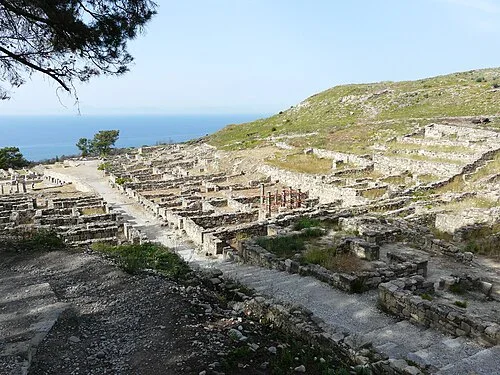 The Summit Overlook: Panoramic Climax and Epilogue
Abandonment and Rediscovery of Kameiros
What happened to Kameiros in the end was not one catastrophe but a slow fade. From about the second century AD the town declined and gradually disappeared as a place of habitation. Some connect that decline with yet another earthquake, around 155 AD. Under Ottoman rule, only fields covered the ground where the city had stood. Yet the site kept its old name locally as Kambiros, and that surviving toponym stirred the curiosity of archaeologists in the mid-nineteenth century. Between 1859 and 1864 the acropolis was excavated by Alfred Biliotti, a consul and archaeologist, and Auguste Salzmann, a French pioneer of archaeological photography. Many of their finds are now in the British Museum in London. From 1928 the Italian Archaeological School began systematic excavation, with restoration work that continued until the end of the Second World War. Because nothing was ever built over the ruins, the ancient plan survives almost whole, with streets, squares and houses in their original positions. That completeness is the gift of the city's abandonment. Kameiros reads today as it was laid out, a whole ancient town with no later city on top of it.
Listen in the appUser:Piotrus · CC BY-SA 3.0
Κάμειρος
Frequently asked questions
How much does the guide cost?
Free app download. Listed guide price: $0.99. Guide price shown in the app. Audio guide only. Venue admission is separate.
Can I listen without internet?
Yes. Download the guide’s audio, images, and maps in the app before your visit. Your downloaded content is then available offline.
Can I listen in my language?
This audio guide is available in 15 languages, including English.
Do I need to follow a schedule?
No. This is a self-guided experience. Choose your stops, pause whenever you like, and return to a story at your own pace.
At your own pace
Explore Κάμειρος.
Download Stanza, then search for “Κάμειρος”.
Free app download · Guide price shown in the app
Keep exploring
Nearby audio guides
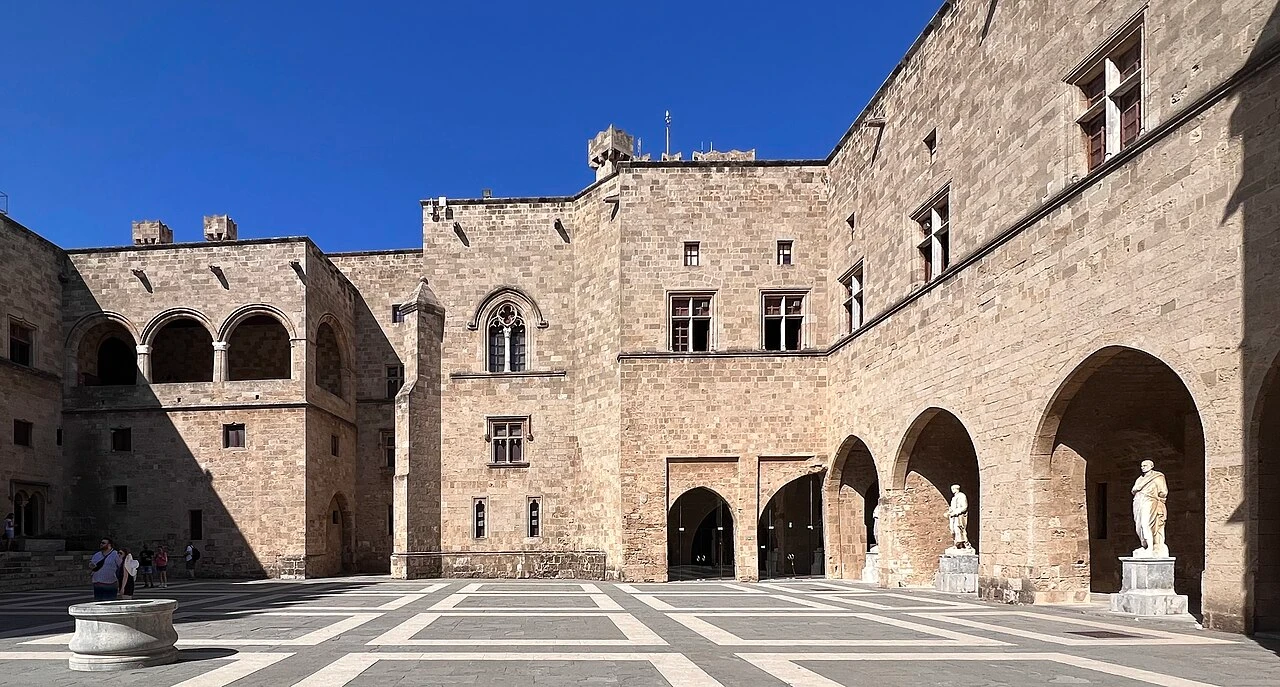
Rhodes · 30 km
Palace of the Grand Master of the Knights of Rhodes
Content & sources
Burkhard Mücke · CC BY-SA 4.0
Datça · 62 km
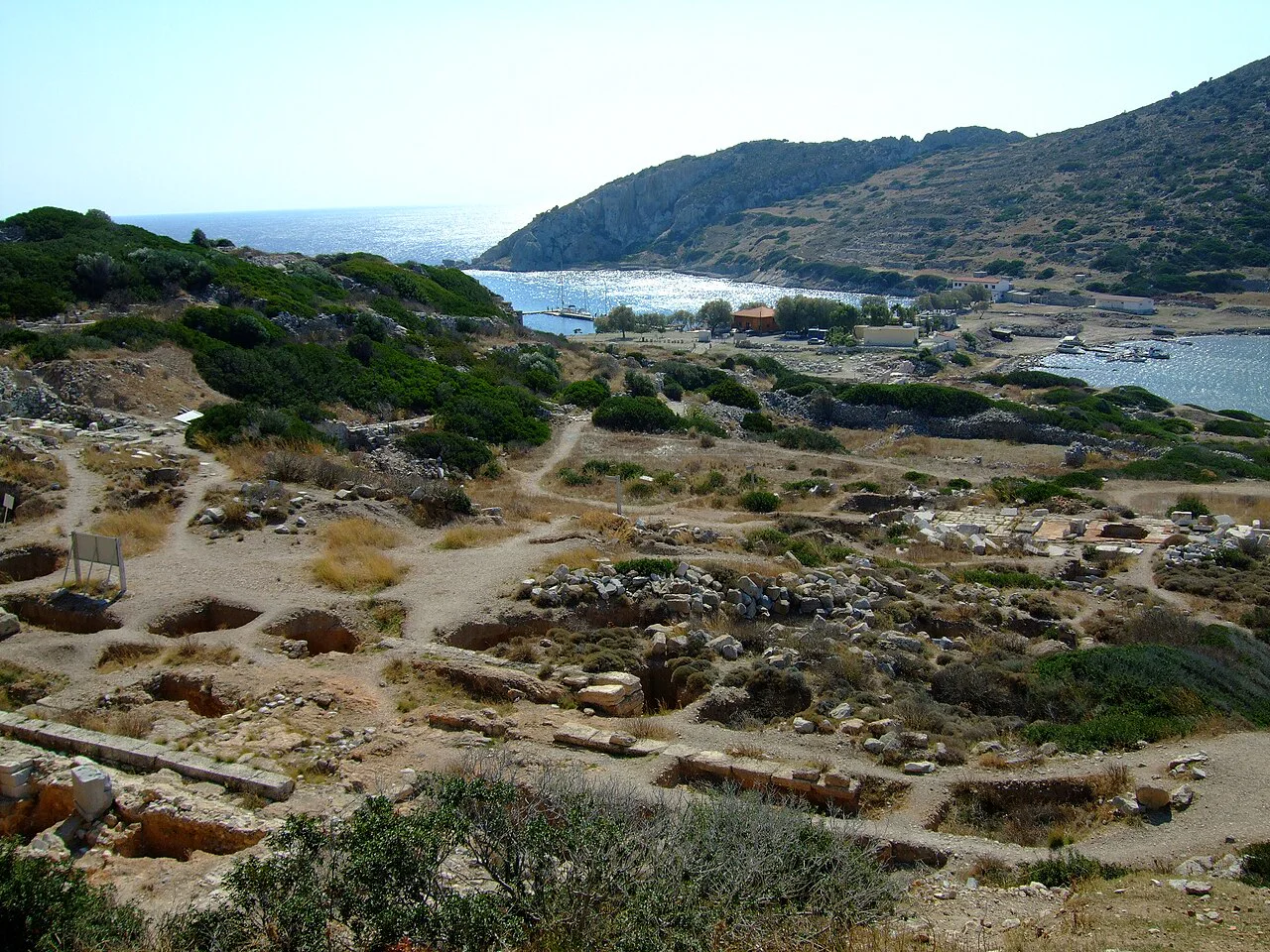
Knidos
Content & sources
Tischbeinahe · CC BY-SA 3.0
Dalyan · 83 km
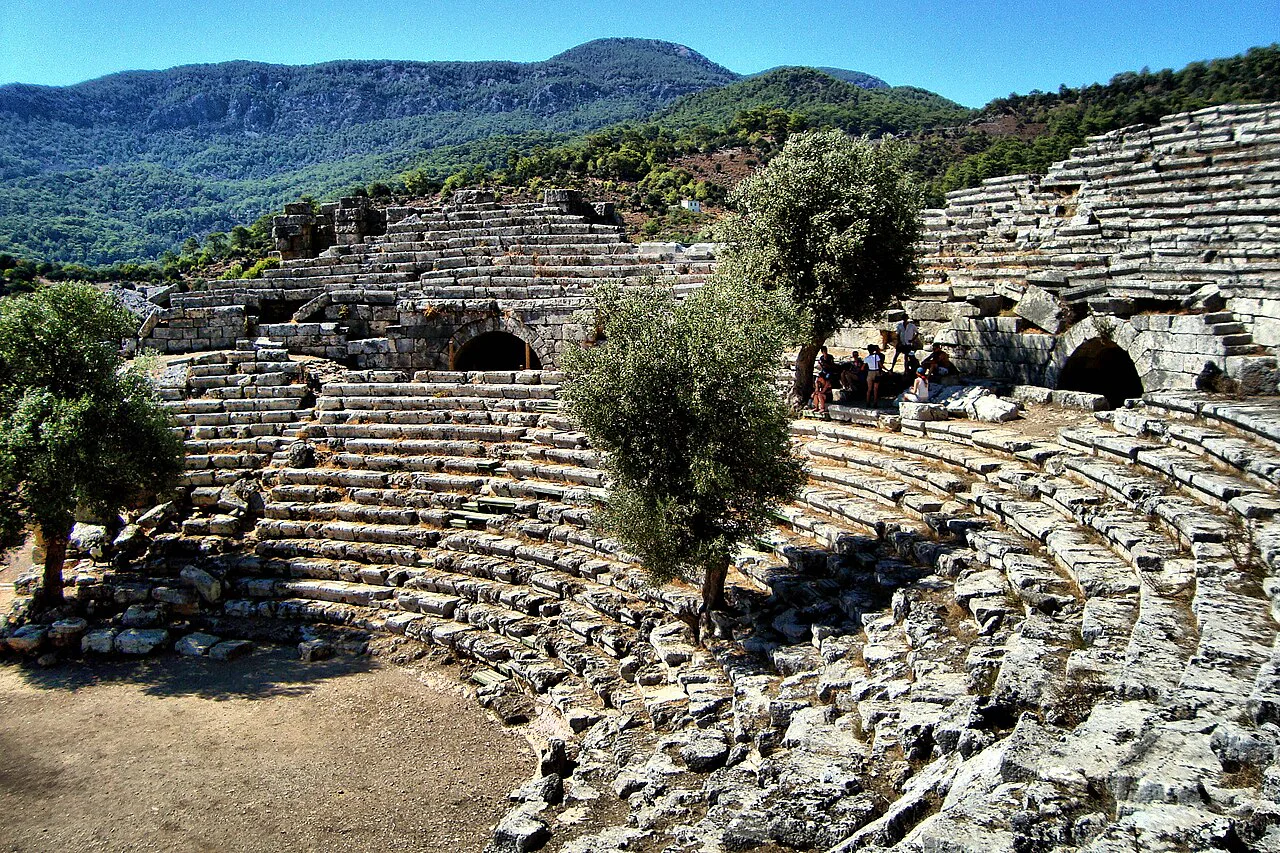
Kaunos
Content & sources
HALUK COMERTEL · CC BY 3.0
Kos · 84 km
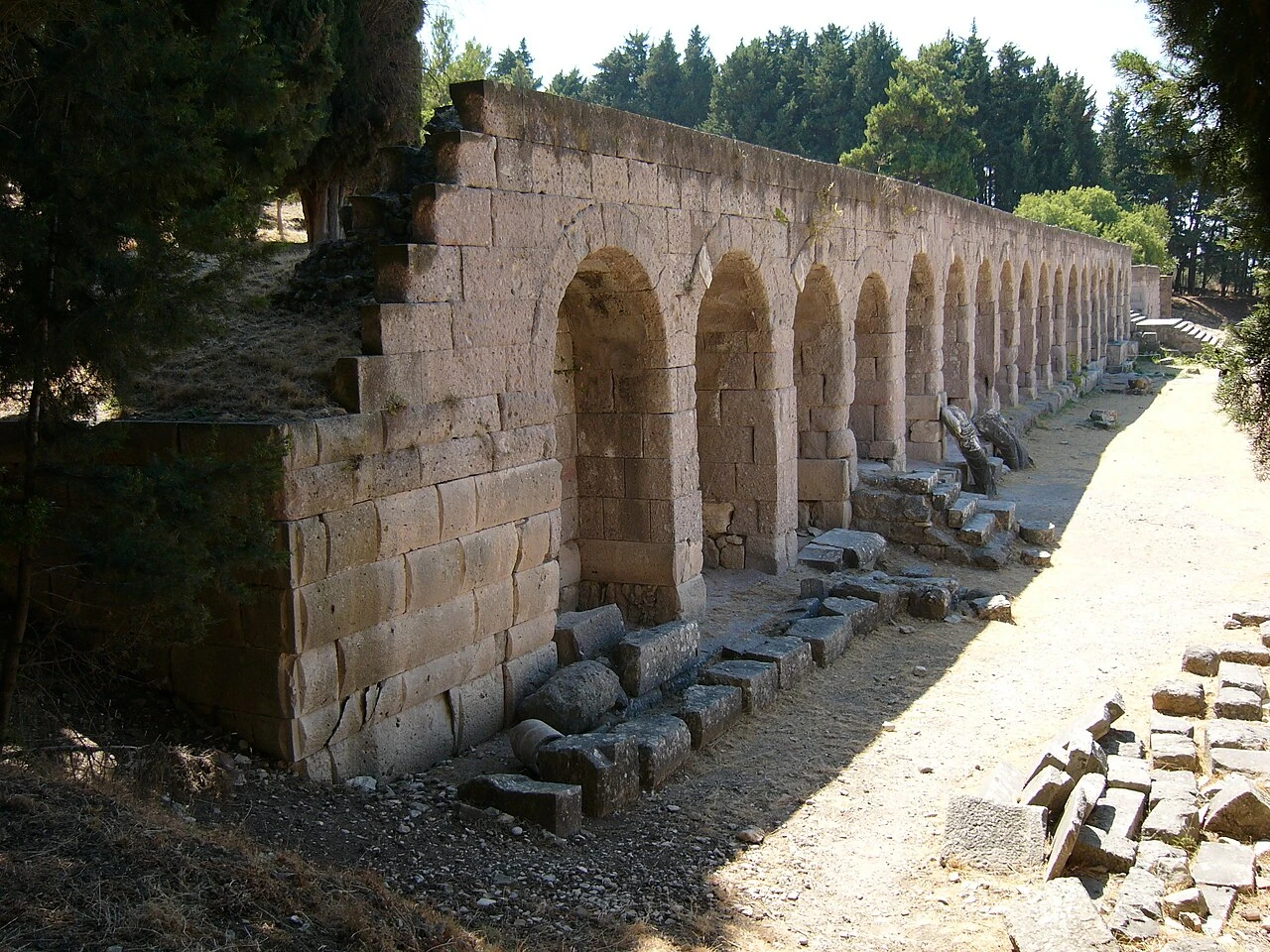
Asclepeion of Kos
Content & sources
Photo: Cup of coffee · CC BY-SA 3.0