Stanza · Audio guide
Edzná Audio Guide
A place to remember. A story to take with you.
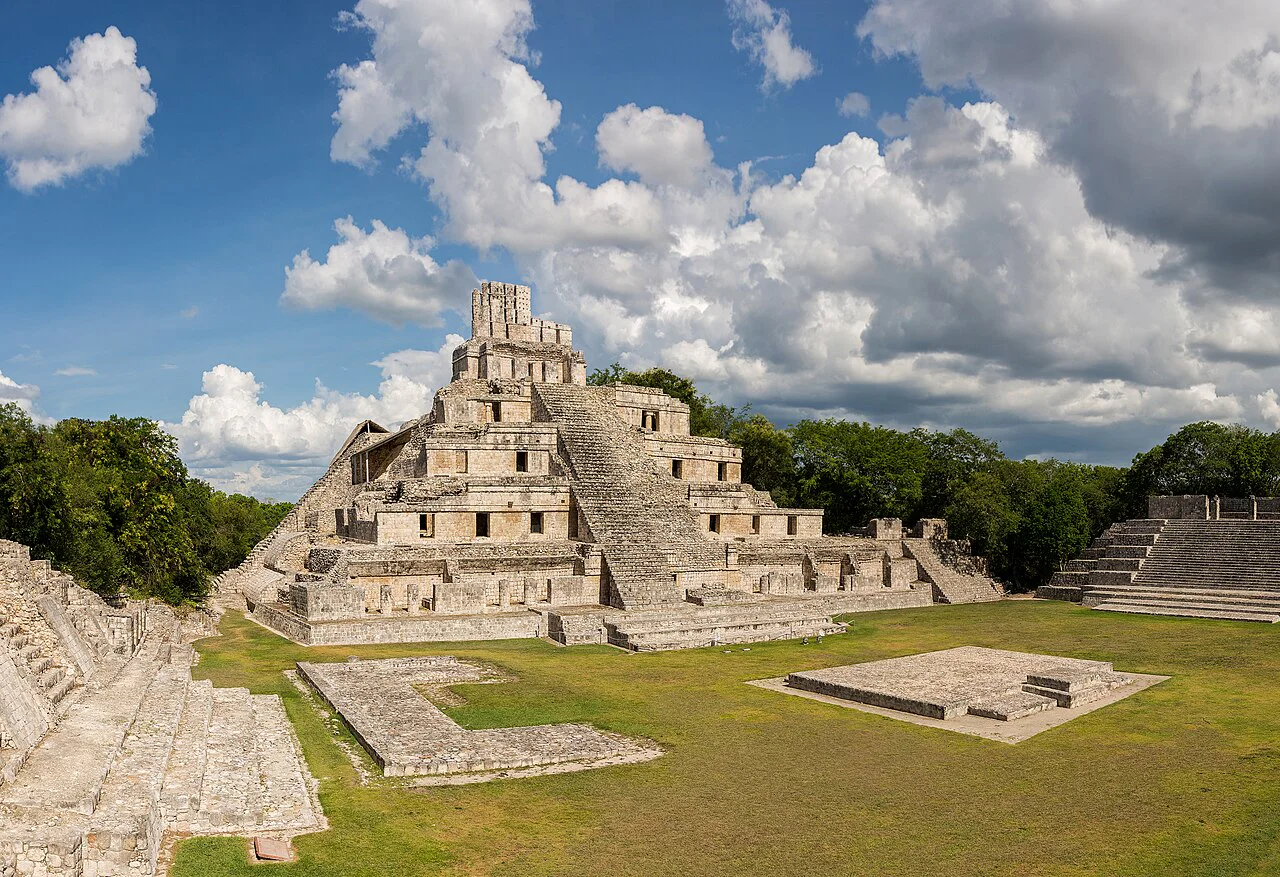
Edzná is a Maya archaeological site in the north of the Mexican state of Campeche. The site has been open to visitors since the 1970s.
Download Stanza, then search for “Edzná”.
About the tour
One guide. Your kind of visit.
Edzná is a Maya archaeological site in the north of the Mexican state of Campeche. The site has been open to visitors since the 1970s.
Ready when you are.
- 01Get the free Stanza app.
iOS & Android
- 02Find your guide.
“Edzná”
- 03Download before you go.
Works offline
Audio guide / 12 narrated stops
Inside the guide
Get to know a few of the stories before you go. Open a stop to read more.
01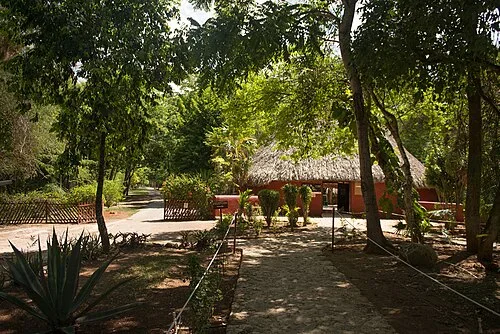 Visitor Center and Entrance Path
Entrance Path to Edzná
Welcome to Edzná, a Maya city in the valley of the same name, in the Mexican state of Campeche. Ahead, the path runs cool and green toward the ancient core. The city's name carries a story of its own. One theory traces Edzná to the older word Ytzná, meaning House of the Itzaes. The Itzá were the lineage of the city's rulers, so the name would speak of the family that governed here. That reading is a suggestion rather than a settled fact. Visitors have been able to walk this ground since the 1970s.
Photo: Ralf Roletschek · GFDL 1.2
02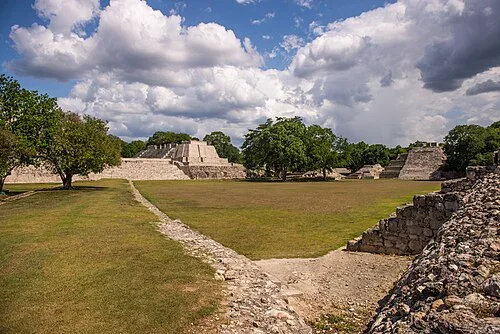 The Main Plaza and Hydraulic System
Main Plaza and the Water Network
This valley has an awkward habit. In the rainy season it floods, and the ground stays damp almost the whole year. The Maya answered with engineering. Canals drained the valley and carried the water off to a lagoon, which they turned into a reservoir behind containment walls. Other channels watered the fields. The system kept the soil workable for intensive farming, and it fed the city a second way as well, because the canals provided fish. At its height, Edzná held some twenty-five thousand people, all of them living off a valley its inhabitants had replumbed by hand.
Photo: Ralf Roletschek · GFDL 1.2
03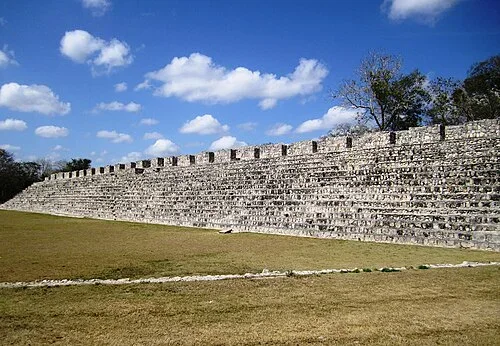 Nohochná (The Grand House)
Nohochná, the Grand House
Nohochná means the Grand House, and the name fits. A single long platform runs along the edge of the plaza, and on top of it lie four long galleries. Entry came through doorways framed by thick pilasters, heavy square pillars still visible in the stonework. Buildings like this were made for gathering rather than worship. From the galleries, overseers could probably watch and organize everything happening on the plaza below. It is a plain, practical idea of government. The wealth such a government managed came from the fields surrounding the city.
Listen in the appPhoto: Elelicht · CC BY-SA 3.0
04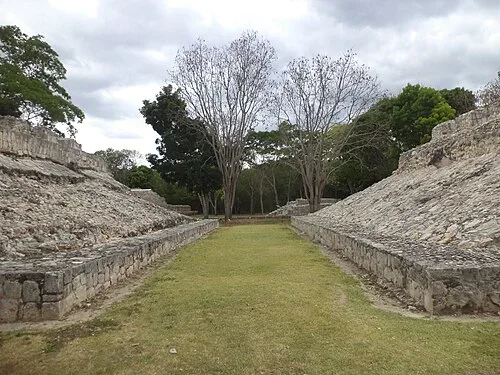 The Ball Court
Two parallel stone walls frame a narrow alley, the playing field of the ball court. Teams across the Maya world kept a heavy ball in play with their hips, a sport heavy with ceremony. The rules changed from city to city, and the games carried meanings well beyond sport. At Edzná, the rooms at the top of these structures may have held something unusual. They possibly stored images of the gods associated with the games, along with the equipment the players needed. Perhaps ritual gear for a match, kept directly above the alley where it would be used.
Listen in the appPhoto: Dge · CC BY-SA 4.0
05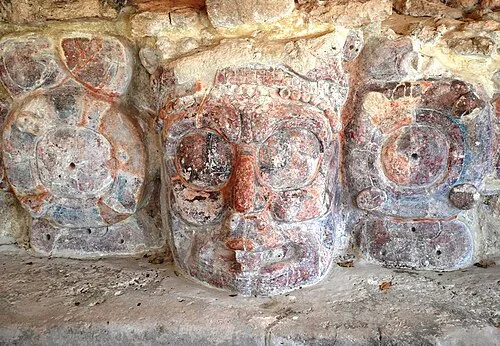 The Temple of the Masks
Painted faces stare out of the old stucco here. The Temple of the Masks carries two images of the sun god, given human features. Those features follow the beauty ideals of the ruling elite. Crossed eyes, teeth deliberately altered, nose ornaments, large ear flares, and towering headdresses shaped like animals. A ruler who showed himself in the god's face was making a claim. In Edzná's government, power was legitimized through the bond between governors and the deities. The mask was theology and politics at once, rendered in painted plaster.
Listen in the appPhoto: Elelicht · CC BY-SA 3.0
06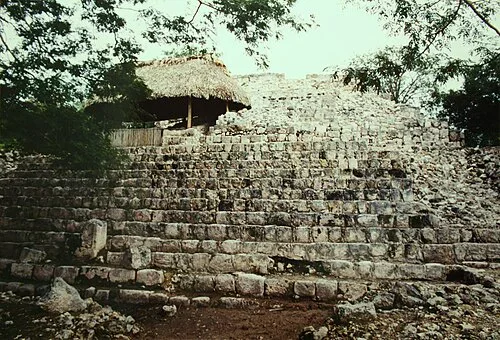 The Small Acropolis
The deepest roots of Edzná lie on this platform. Its base was raised around 200 BC, and four buildings once stood on top around a central patio. Some of the site's oldest treasures come from here. There is a great stucco mask from the Late Preclassic. Three stelae were carved with dates from the eighth baktun, a Maya count running from the years 41 to 435 AD. And there are ceramics even older than the platform itself, from the settlement's earliest generations. A thatched shelter now covers part of the climb, protecting what the centuries left behind.
Listen in the appGary Todd from Xinzheng, China · CC0
07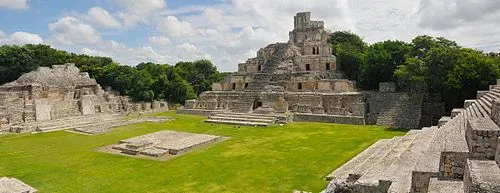 The Great Acropolis Plaza
Around the year 300, the town that already existed here began to become a city. Settlement turned urban, a centralized government took shape, public buildings were enlarged, and great drainage works were raised. The central acropolis, the walled court where rulers staged their power, rose in this era. In the Late Classic, Edzná stood as a regional capital. Its standing rested on an alliance with Calakmul and Piedras Negras, two major Maya powers. From here it governed a territory that held other towns, among them Lubná and Pich. This wide courtyard was the stage on which that authority was displayed.
Listen in the appMatysik · Copyrighted free use
08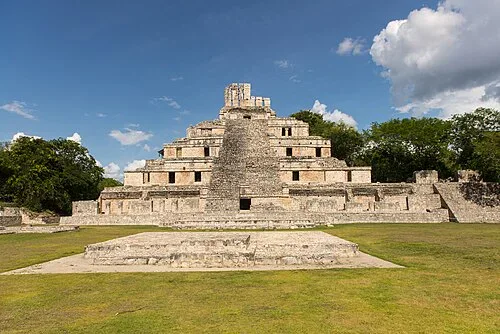 The Five-Story Building (Edificio de los Cinco Pisos)
The Five-Story Building
Five tiers of rooms rise one above the other, and a temple crowns the whole stack. The Five-Story Building is the most remarkable structure at Edzná. Its stepped pyramid carries numerous rooms opening outward on every level, and at the top sits the temple proper. The platform climbs about forty meters above the plaza. Work on it began around the year 600. The sanctuary at the summit has a cross-shaped plan, and its roof comb was once decorated with figures molded in stucco. In 2018, Mexico's National Institute of Anthropology and History finished clearing the building.
Listen in the appPhoto: Ralf Roletschek · GFDL 1.2
09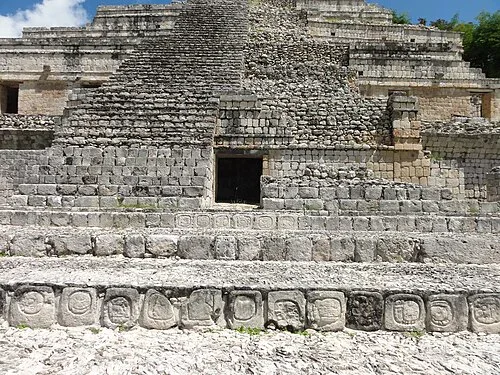 The Five-Story Building (Edificio de los Cinco Pisos)
Carved Glyph Blocks on the Stairway
At the foot of the stairway, small stone squares crowd with carved signs. These glyph blocks belong to a wider change in the city's life. From around the year 600, as the great buildings went up, stone carving and writing intensified at Edzná. Across the Maya world, inscriptions of this kind recorded rulers, dynasties and dates in stone. Exactly what each block here says has not been deciphered. Even unread, they show how writing grew hand in hand with the building boom.
Listen in the appvladimix · CC BY-SA 2.0
10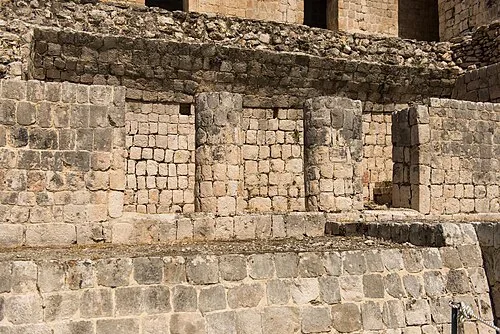 The Puuc Patio and Temazcal
The Puuc Patio and the Temazcal
The Puuc Patio is enclosed by buildings faced with quadrangular, rectangular and cylindrical blocks, all worked with great care. On the north building, triangles and circles in relief form large frames across the wall. From a building with curved taluds here comes a sculpture shaped like a square frame, carved with Chaac, the rain god, and with glyphs showing celestial bands, the day Imix and the month Yax. Just at the entrance to the patio stands the Temazcal. The name is Nahuatl, and in Yucatec Maya it was called chokó sin tumbilhá, a steam bath. Access to it was restricted, because it carried religious importance.
Listen in the appPhoto: Ralf Roletschek · GFDL 1.2
- 11
The South Temple
The South Temple, the city's mysterious end, and the refugees who helped bring it back to light.
- 12
The Overlook: A City in the Valley
One last panorama, where a capital of stone sits as an island in the returning forest.
Edzná
Frequently asked questions
How much does the guide cost?
Free app download. Listed guide price: $0.99. Guide price shown in the app. Audio guide only. Venue admission is separate.
Can I listen without internet?
Yes. Download the guide’s audio, images, and maps in the app before your visit. Your downloaded content is then available offline.
Can I listen in my language?
This audio guide is available in 15 languages, including English.
Do I need to follow a schedule?
No. This is a self-guided experience. Choose your stops, pause whenever you like, and return to a story at your own pace.
At your own pace
Explore Edzná.
Download Stanza, then search for “Edzná”.
Free app download · Guide price shown in the app
Keep exploring
Audio guides — Mexico
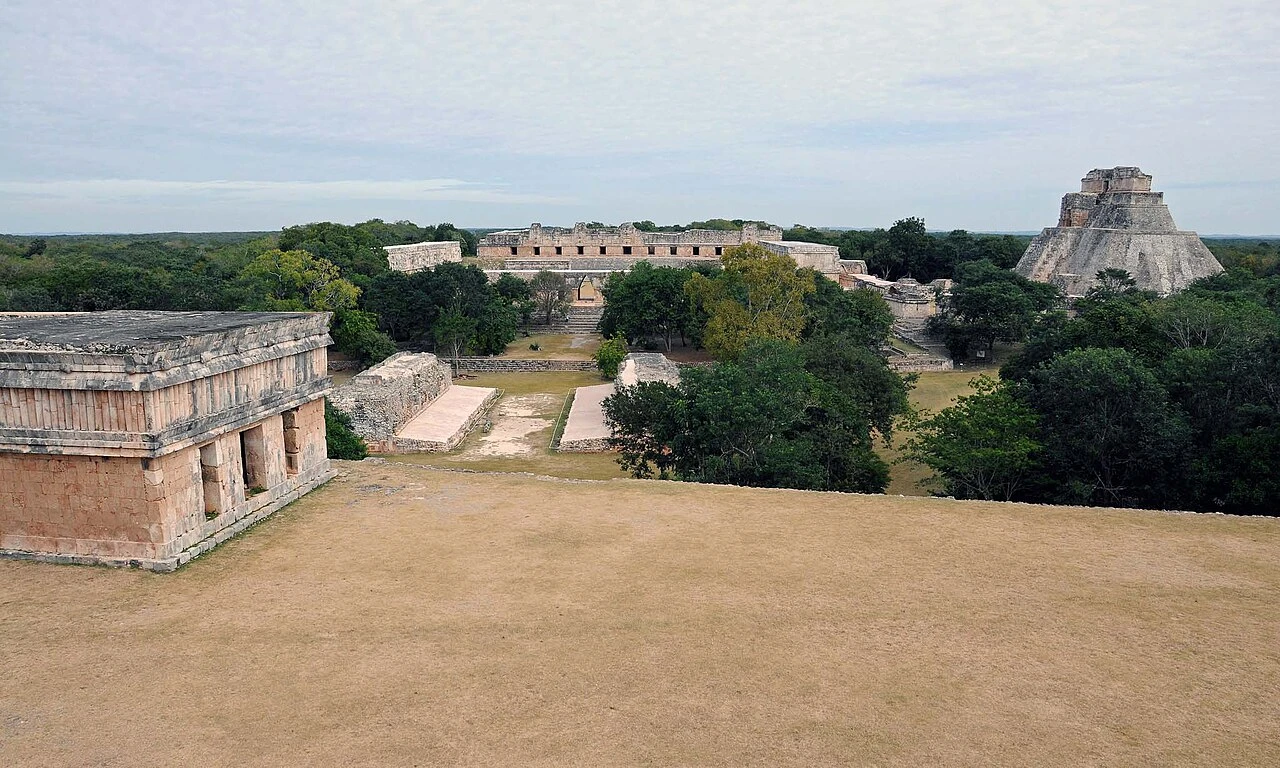
Uxmal · 97 km
Uxmal
Content & sources
Photo: Adrian Hernandez · CC BY-SA 4.0
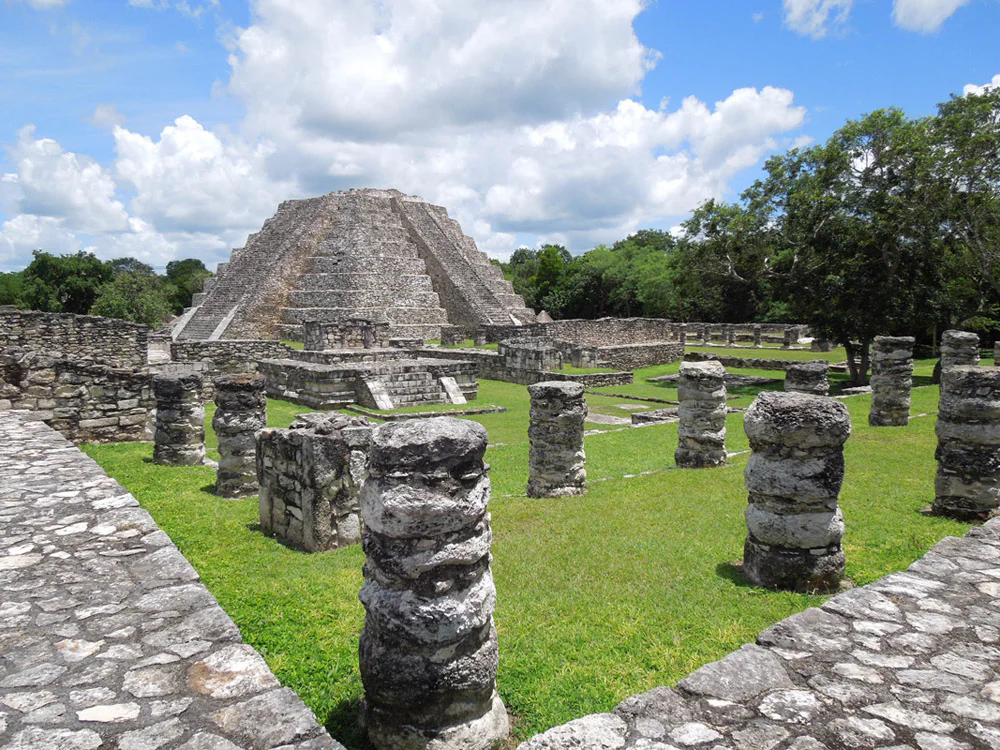
Telchaquillo · 140 km
Mayapán
Content & sources
Photo: Joeldesalvatierra · CC BY-SA 3.0
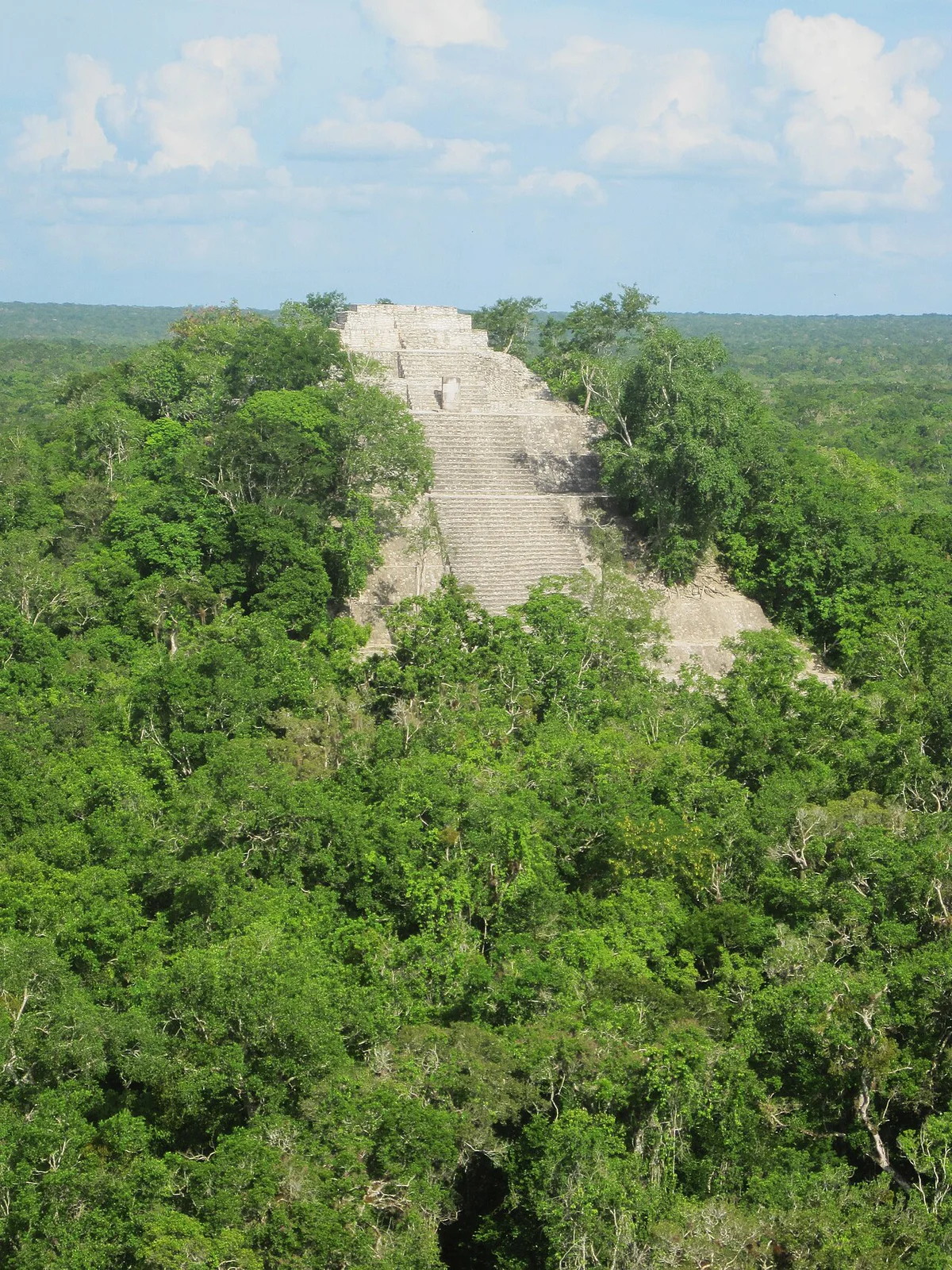
Calakmul
Calakmul
Content & sources
Pavel Kirillov from St.Petersburg, Russia · CC BY-SA 2.0
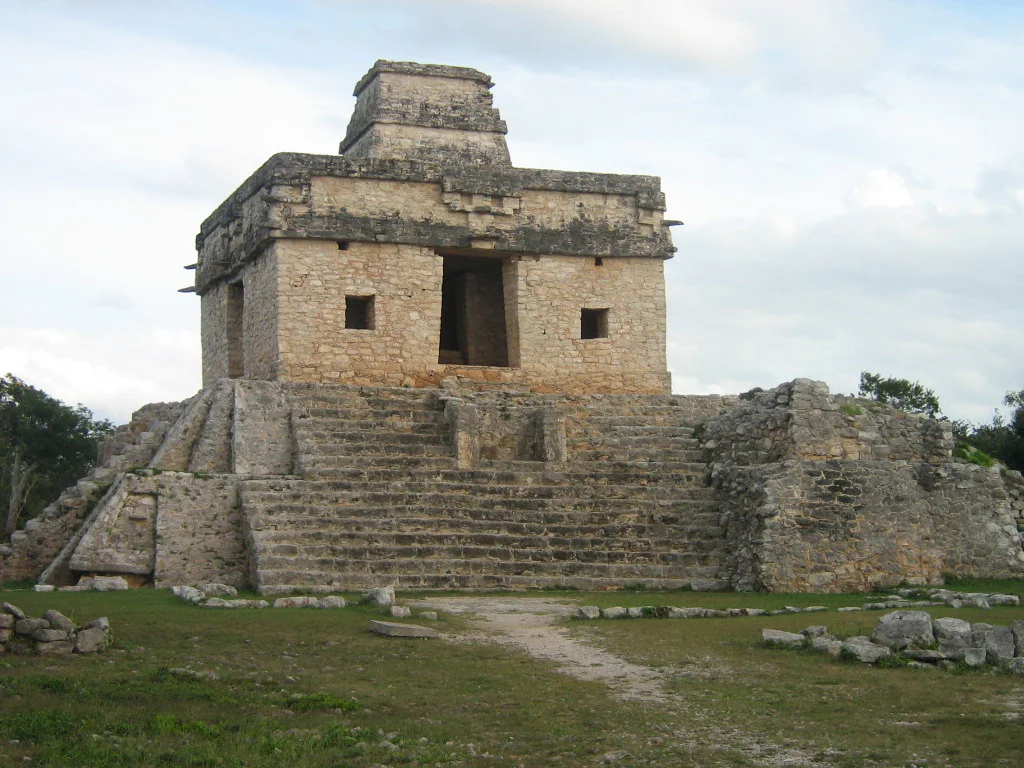
Mérida
Dzibilchaltún
Content & sources
-Luyten- · Public domain