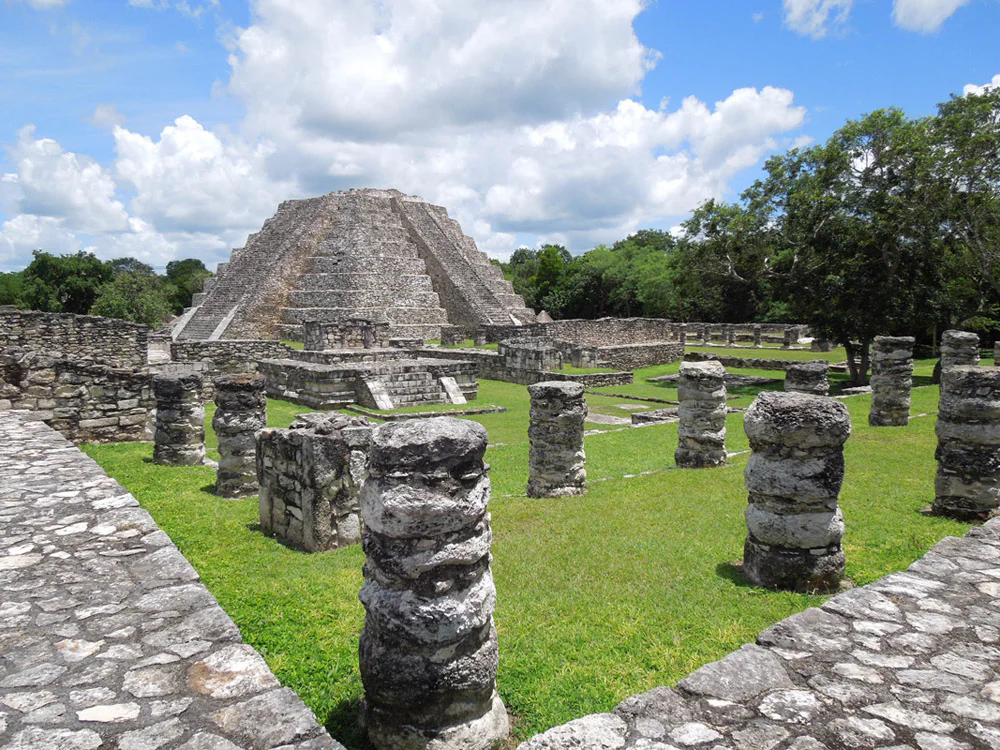
Stanza · Audio guide
Mayapán Audio Guide
A place to remember. A story to take with you.
Mayapan is a pre-Columbian Maya site located in the state of Yucatán, Mexico. It served as the political and cultural capital of the Maya in the Yucatán Peninsula during the Late Post-Classic period.
Download Stanza, then search for “Mayapán”.
About the tour
One guide. Your kind of visit.
Mayapan is a pre-Columbian Maya site located in the state of Yucatán, Mexico. It served as the political and cultural capital of the Maya in the Yucatán Peninsula during the Late Post-Classic period.
Ready when you are.
- 01Get the free Stanza app.
iOS & Android
- 02Find your guide.
“Mayapán”
- 03Download before you go.
Works offline
Audio guide / 13 narrated stops
Inside the guide
Get to know a few of the stories before you go. Open a stop to read more.
01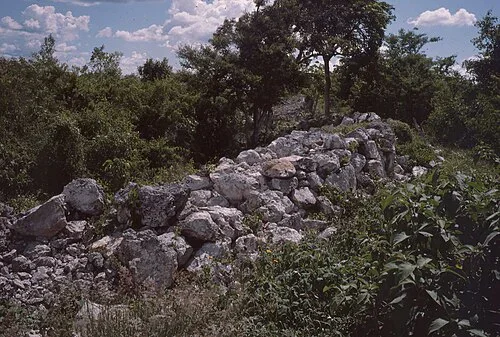 The Defensive Wall and City Entrance
The Defensive Wall of Mayapán
Welcome to Mayapán, the last great capital of the Maya in Yucatán. The tumbled stones here are the remains of its defensive wall, not a proud rampart anymore, but in its day this was a rare thing: a fortified Maya city. The perimeter ran about nine kilometers, enclosing roughly four square kilometers of the capital. Twelve gates pierced it, and seven of those were major entrances with vaulted ceilings. Tradition tells how it came to be. After the fall of Chichén Itzá, the lords of the region met and agreed to build a new capital near the town of Telchaquillo. They raised it inside a wall and named it Mayapan, which means Standard of the Maya people. The chief of the Cocom family, an old and wealthy lineage, was chosen as king. Every other noble house sent relatives to take part in government, which kept them close and kept watch over them at the same time. From the 1220s to the 1440s, this walled city was where the politics of the whole peninsula happened.
Photo: HJPD · CC BY-SA 3.0
02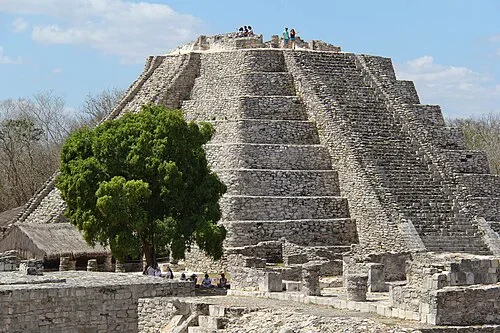 El Castillo de Kukulcán
The Temple of Kukulcán, called the Castillo, is the heart of Mayapán. It is a stepped pyramid with nine terraces, rounded corners, and stairways rising on all four sides. The base measures about thirty meters on each side, and it stands some eighteen meters tall. In form it copies the great Castillo of Chichén Itzá, the capital that came before, at roughly half the scale. The nine terraces are thought to echo the nine levels of the Maya underworld, so the climb to the summit was a climb out of that dark place. The chronicles add a legend to the copying. They tell of Hunac Ceel, the general who defeated the rulers of Chichén Itzá. When his side won, the new capital needed a temple of its own, and this one declared the succession.
Gildardo Sánchez · CC BY 2.0
03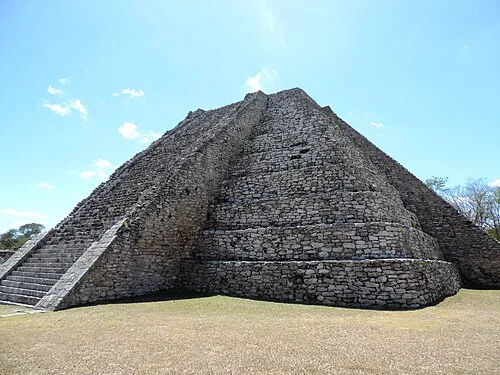 El Castillo de Kukulcán
Building the Castillo: Stone and Dates
The corner of this pyramid shows something about how it was built. Charcoal found in its early construction phase gave a date between the years 1020 and 1170. That sample came from a reliable context, and it matters, because it suggests Mayapán's postclassic story began earlier than the year 1200. The building itself, though, is honest about its ambitions. Writers on the site describe it as an inferior imitation of the Castillo at Chichén Itzá, and the masonry across the city is generally cruder. The proof is overhead, or rather the lack of it. Most or all of the vaulted roofs at Mayapán have fallen in, while many of the better-built buildings at Chichén Itzá still stand intact. The new capital borrowed the old capital's shape with less of its skill.
Listen in the appGlobetrotteur17... Ici, là-bas ou ailleurs... · CC BY-SA 2.0
04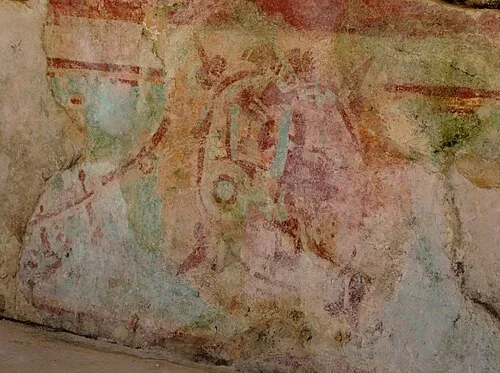 The Hall of the Murals (Sala de los Frescos)
The Sala de los Frescos
Beside the Castillo stands the Sala de los Frescos, the Hall of the Frescoes, and it holds something precious. Wall painting rarely survives in the humid Yucatán, yet here a Late Postclassic mural endures. Its background is red, framed by a green border along the top. The scene shows yellow solar disks ringed with red rays, and two figures dressed in rich clothing. Since 1990, a project at the National University of Mexico has worked to record and study murals like this one across the country, and Mayapán's paintings are part of that registry. Much of the wall has flaked away, so what remains is a fragment of the original scene. Even in fragments, the color still carries: the red ground, the green line, the burning disks.
Listen in the appGlobetrotteur17... Ici, là-bas ou ailleurs... · CC BY-SA 2.0
05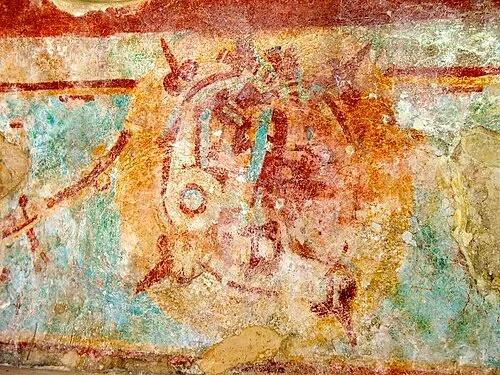 The Hall of the Murals (Sala de los Frescos)
Reading the Solar Disk
The painted disk holds a puzzle. The figure inside it dives headfirst, and that diving posture is a common way of showing a dead warrior. The figure is painted bound, with the heart removed, so many scholars read it as a warrior sacrificed to the sun god. One interpretation goes further and connects the disk to a transit of Venus, an event that happened in either 1152 or 1275. The deity's identity is uncertain, and only part of the mural survives to argue over. What the paintings and sculptures of Mayapán suggest more broadly is contact with the rising Aztec empire of Central Mexico. Some figures here wear Aztec dress, and what appears to be an Aztec deity is carved on an altar at the site. Trade with Tabasco may have carried these fashions and images along the coast, all the way to this hall.
Listen in the appPhoto: A.ruizvelasco · CC BY-SA 3.0
06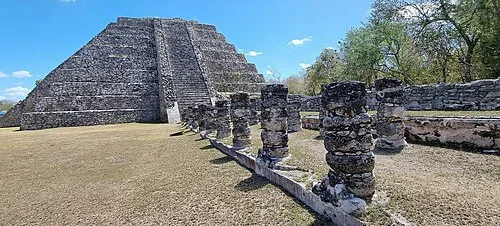 The Colonnaded Halls (Sala de los Reyes)
The Colonnaded Halls
The rows of squat columns in front of the pyramid belonged to colonnaded halls, where the business of the capital was done. Mayapán was ruled by a council, and two figures dominated it. The Jalach winik was the highest ruler, and the aj k'in was the high priest. Below them sat many other officials with their own duties. Mexican mercenaries from Tabasco were hired to keep order and hold power. Around these halls, the ceremonial center packed temples, oratories, shrines, altars and platforms for oration and dancing into a tight cluster. The arrangement held for more than two hundred years, which is a long life for any constitution.
Listen in the appGlobetrotteur17... Ici, là-bas ou ailleurs... · CC BY-SA 2.0
07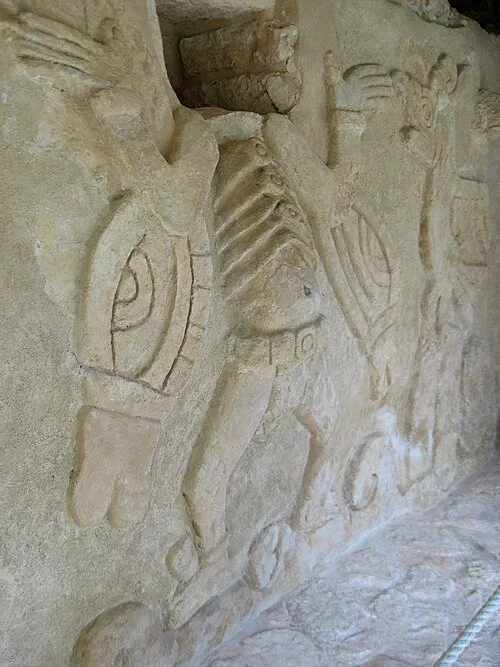 The Colonnaded Halls (Sala de los Reyes)
Stucco Warriors
The columns of the Sala de los Reyes were once dressed in warriors, molded in stucco against a wall finished with geometric frets. Time has taken most of them. On some columns only feet and a few faces remain legible, enough to show how much richer these halls once were. The style itself says something about the city. Mayapán combined lavish stucco with comparatively crude masonry, and that pairing shows up far away too, at Utatlán in the highlands of Guatemala, along with similar temple layouts and effigy censers. The connection points to a wide world of shared ideas across the Late Postclassic. Here at home, the plaster warriors stood in the very halls where the council met, ornament for the people who ran the capital.
Listen in the appcynren · CC BY-SA 2.0
08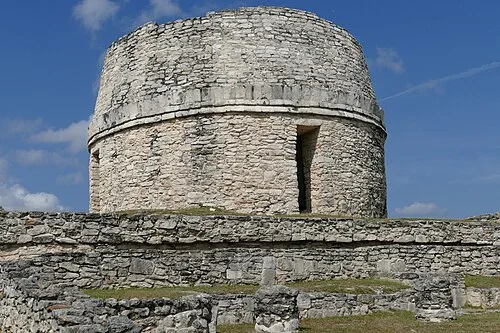 The Circular Wind Temple and Cenote Ch'en Mul
The Templo Redondo: Temple of the Wind God
A drum of stone on a square platform, round in a land of pyramids. Mayapán has three circular temples, which is unusual anywhere in the Maya area. They belong to Kukulcán, the feathered serpent, in his aspect as Ehecatl, the wind god. A round building suits a god of moving air, and the form became a hallmark of the site's postclassic religion. In 1841 the traveler John L. Stephens recorded this temple in an illustration, along with the great pyramid, and he was the first to document parts of Mayapán for the wider world. He started a long line of explorers who sketched these ruins. The first proper survey of the site did not come until 1938, nearly a century later.
Listen in the appBernard DUPONT from FRANCE · CC BY-SA 2.0
09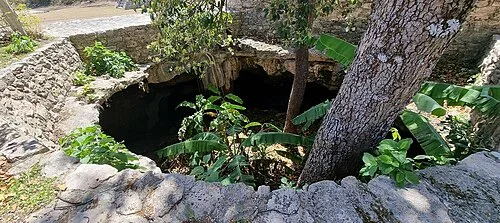 The Circular Wind Temple and Cenote Ch'en Mul
Cenote Ch'en Mul
Behind the stone walls here, the ground opens into Cenote Ch'en Mul, a natural sinkhole with caves radiating out from it. Water in this dry northern Yucatán lives underground, and cenotes are the doors to it. Perhaps forty of them dot the residential parts of the city, and they were the only freshwater sources for everyone who lived here. Settlement clustered thickest where the cenotes were most numerous. What makes this spot remarkable is the pairing. The Castillo stands immediately to the east of this cenote, so the city's great pyramid and its water source, with its passages into the underworld, were placed side by side. The Maya saw cenotes as sacred entrances to that underworld, and here the temple and the portal share one compound.
Listen in the appGlobetrotteur17... Ici, là-bas ou ailleurs... · CC BY-SA 2.0
10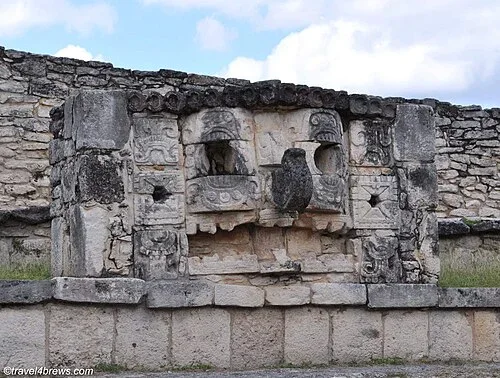 Temple of the Painted Niches and the Missing Ballcourt
The Temple of the Painted Niches
The carved masks and deep niches of this facade belong to the Temple of the Painted Niches. Like many buildings at Mayapán, it was raised in two construction phases. The first used rough stone. The second reworked the building in Puuc style, the ornamental manner of the older Maya cities of the northern hills, with masks and decorated niches carrying the finished face of the temple. After the fall of Chichén Itzá, the builders of the new capital reached back to these older forms and gave them new life. Much of Mayapán's architecture is that kind of reworking, old shapes carrying a young capital's ambitions.
Listen in the appTravel4Brews · CC BY 2.0
- 11
A Crowded Capital Without a Ballcourt
Four thousand buildings, up to seventeen thousand people, and not a single ballcourt anywhere.
- 12
The Fall of Mayapán, 1441
The revolt of 1441 that killed the Cocom line and burned the capital down.
- 13
Closing: What Mayapán Left Behind
The surviving son, the feud that outlived the city, and the work still uncovering Mayapán.
Mayapán
Frequently asked questions
How much does the guide cost?
Free app download. Listed guide price: $0.99. Guide price shown in the app. Audio guide only. Venue admission is separate.
Can I listen without internet?
Yes. Download the guide’s audio, images, and maps in the app before your visit. Your downloaded content is then available offline.
Can I listen in my language?
This audio guide is available in 15 languages, including English.
Do I need to follow a schedule?
No. This is a self-guided experience. Choose your stops, pause whenever you like, and return to a story at your own pace.
At your own pace
Explore Mayapán.
Download Stanza, then search for “Mayapán”.
Free app download · Guide price shown in the app
Keep exploring
Nearby audio guides
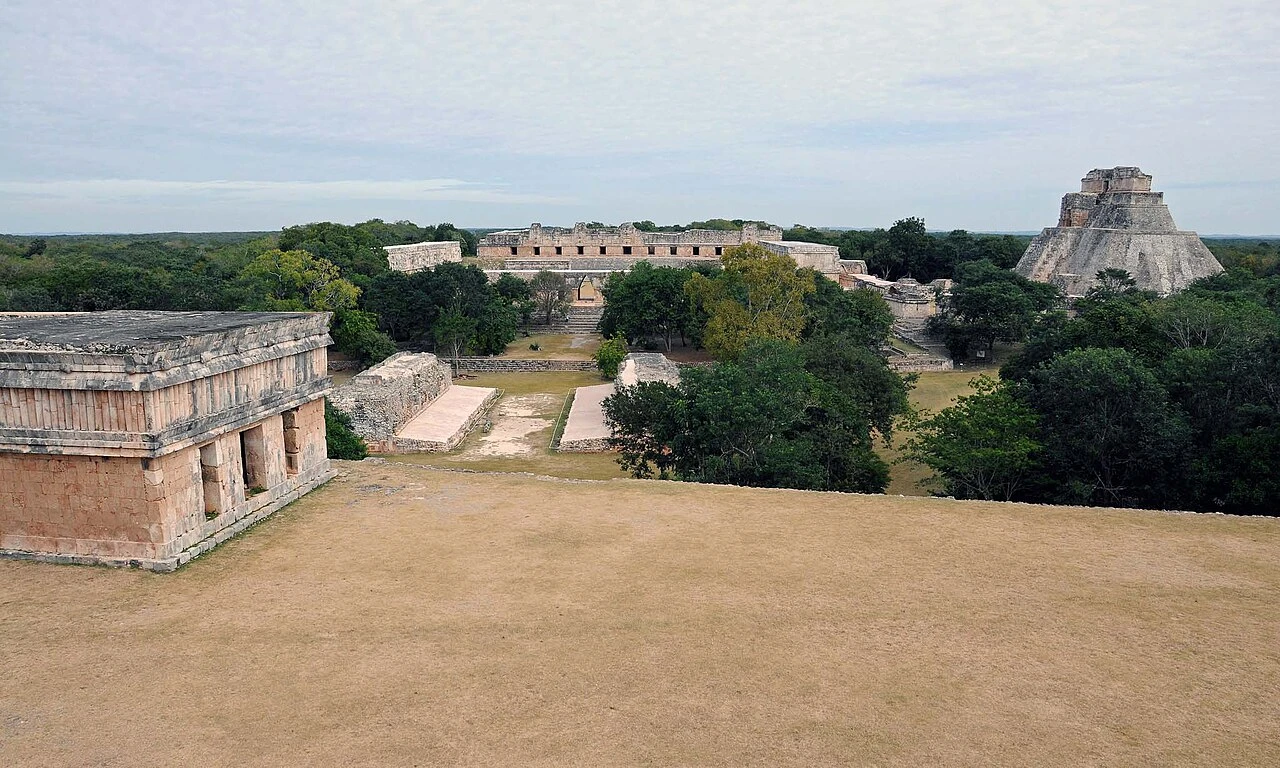
Uxmal · 44 km
Uxmal
Content & sources
Photo: Adrian Hernandez · CC BY-SA 4.0
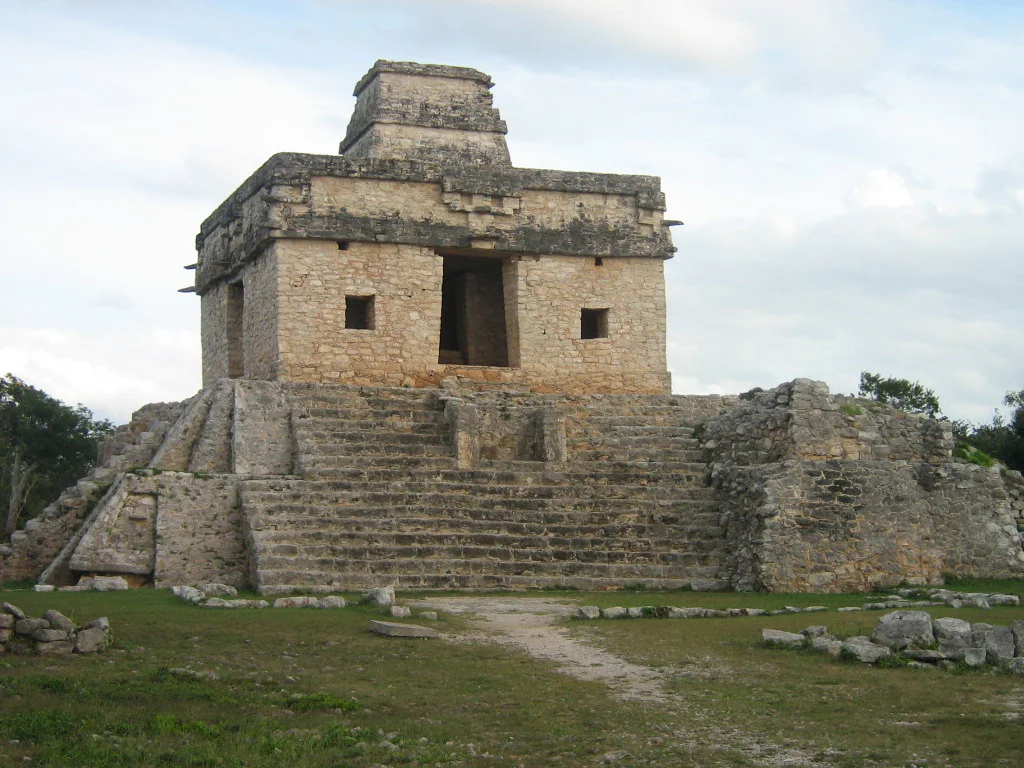
Mérida · 53 km
Dzibilchaltún
Content & sources
-Luyten- · Public domain
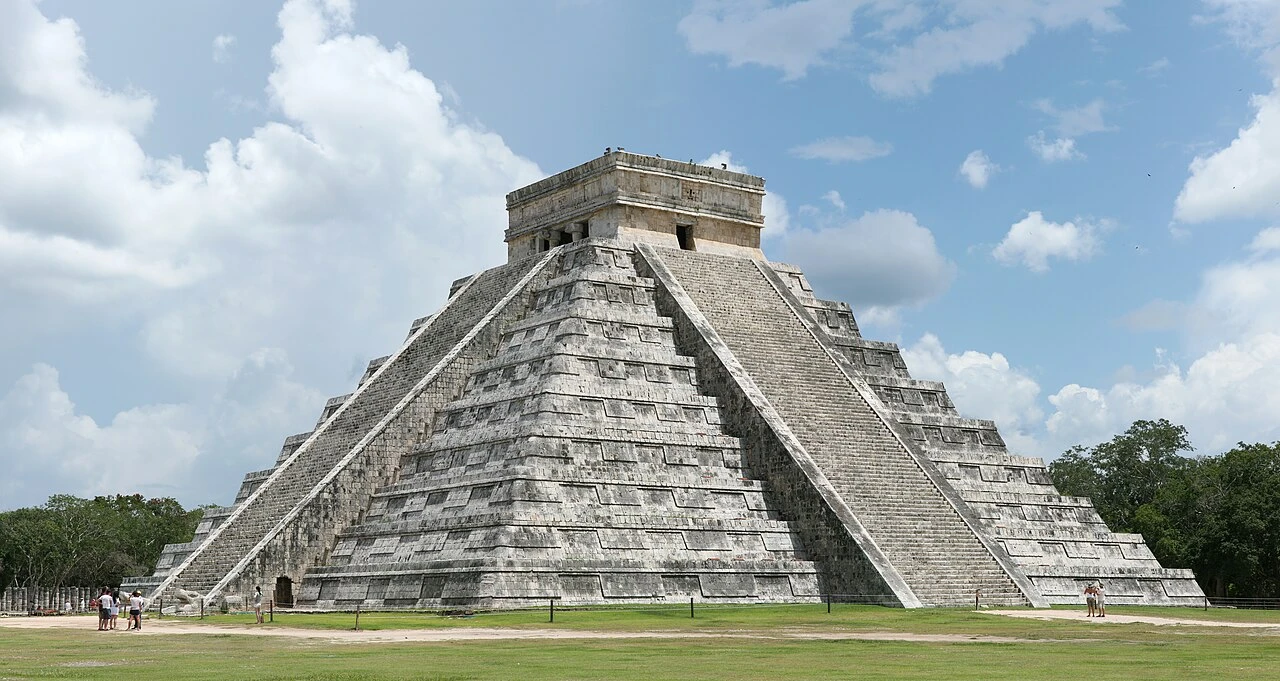
Tinum · 93 km
Chichen Itza
Content & sources
Daniel Schwen · CC BY-SA 4.0
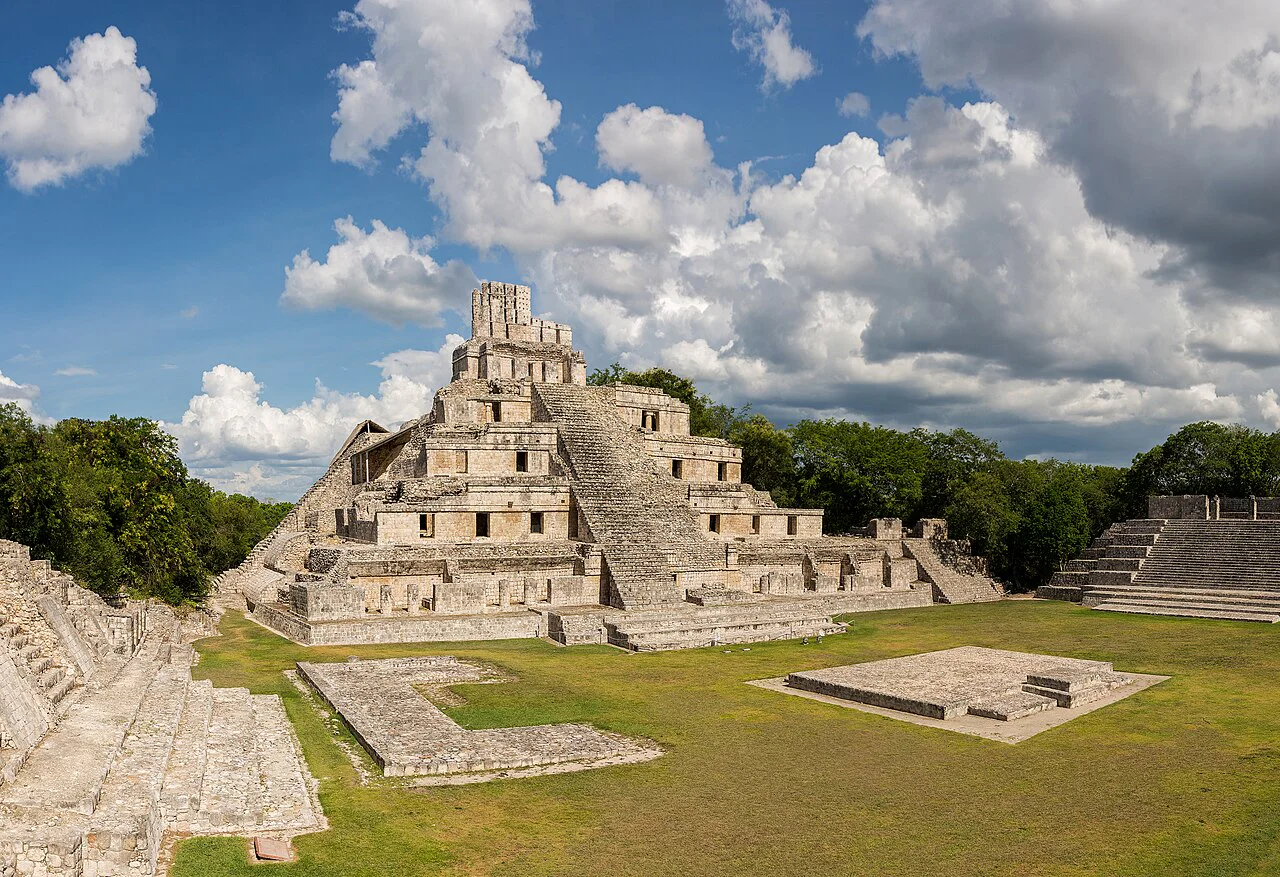
Campeche · 140 km
Edzná
Content & sources
Photo: Ralf Roletschek · GFDL 1.2