Stanza · Audio guide
Catedral metropolitana de Guadalajara Audio guide
A place to remember. A story to take with you.
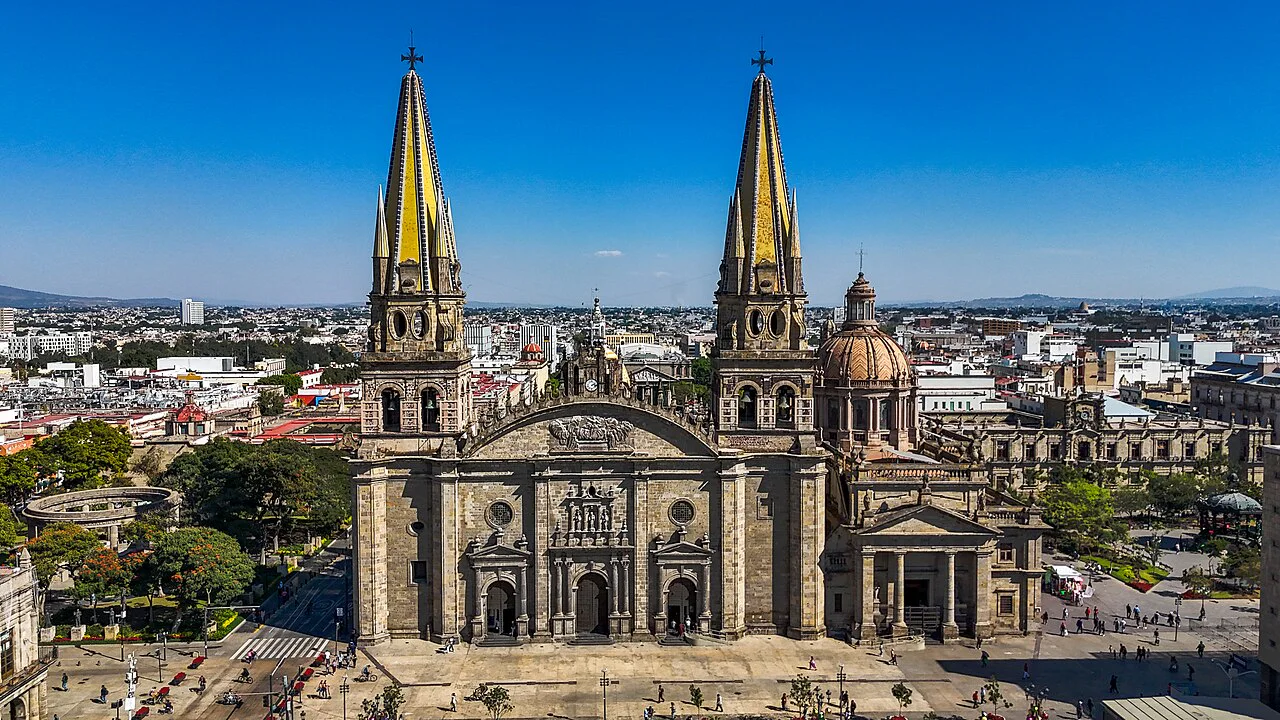
The Guadalajara Cathedral is the Roman Catholic cathedral of the Archdiocese of Guadalajara and a minor basilica. It is among the oldest cathedrals in the Americas and features a Spanish Renaissance style…
Download Stanza, then search for “Catedral metropolitana de Guadalajara”.
About the tour
One guide. Your kind of visit.
The Guadalajara Cathedral is the Roman Catholic cathedral of the Archdiocese of Guadalajara and a minor basilica. It is among the oldest cathedrals in the Americas and features a Spanish Renaissance style with 19th-century neo-Gothic spires.
Ready when you are.
- 01Get the free Stanza app.
iOS & Android
- 02Find your guide.
“Catedral metropolitana de Guadalajara”
- 03Download before you go.
Works offline
Audio guide / 9 narrated stops
Inside the guide
Get to know a few of the stories before you go. Open a stop to read more.
01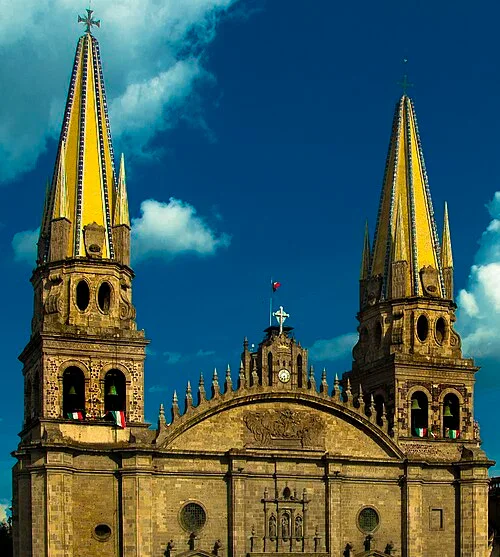 Plaza Guadalajara and the Iconic TowersThe Cathedral of the Assumption from Plaza Guadalajara
Welcome to the cathedral of Guadalajara, the great church at the heart of the city's historic center. Its full name is the Cathedral Basilica of the Assumption of Our Lady, seat of the Archdiocese of Guadalajara. The dedication is to the moment Catholics believe Mary was taken up into heaven. Few churches in the Americas are older. Only a handful, among them the cathedrals of Mérida and Santo Domingo, share that distinction. The body of the building is Spanish Renaissance, sober and geometric, laid out as a basilica. The two slender spires rising over Plaza Guadalajara, yellow against the sky, came later, in the nineteenth century. They have become the symbol of Guadalajara itself. Their story is where this tour goes next.
Photo: Hdlrosa · CC BY-SA 4.0
02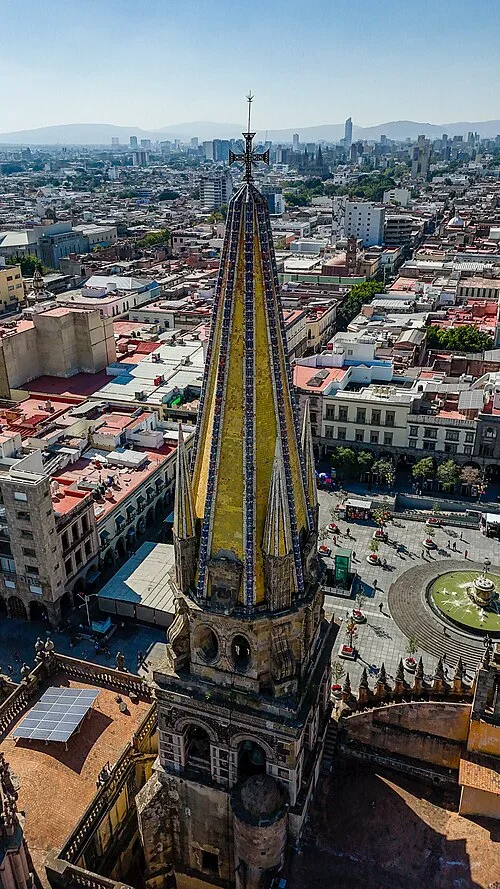 Plaza Guadalajara and the Iconic TowersThe Towers: Rebuilt Against the Earthquakes
The spires of Guadalajara were not always these spires. On the last day of May 1818 an earthquake shook the city, and the towers and dome came down. Their replacements were destroyed by another earthquake in 1849. After years of damage, Bishop Diego Aranda turned to Manuel Gómez Ibarra, a Guadalajara native already known for the dome of the Hospicio Cabañas. Ibarra built the new towers of pumice stone, a volcanic rock light enough to spare the building when the earth moves. Then he clad them in tiles of yellow and blue in the Talavera style, the colors the whole city knows. Work began in mid-1851 and finished three years later, in 1854. It cost about thirty-three thousand pesos. There is also a legend about the shape. The story goes that around 1850, after the Corpus Christi procession, the bishop cooled the June heat with pitayas, a local cactus fruit, served on a platter painted with pyramidal bell towers much like these. It is told as legend, but a beloved one.
Photo: ProtoplasmaKid · CC BY-SA 4.0
03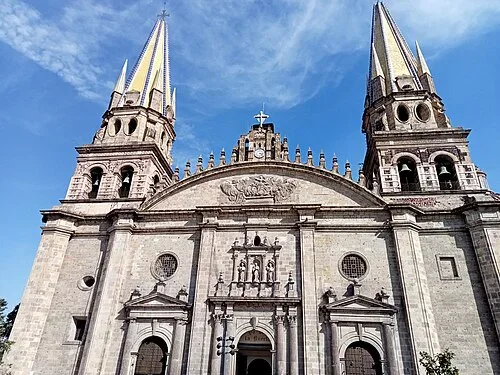 The Main Renaissance FacadeThe Renaissance Facade and the Fire of 1574
Before this stone church there was a humbler one. In 1541 the first cathedral went up on the site of the present Templo de Santa María de Gracia, built of adobe under a thatched roof. In 1548 the Holy See made the region a diocese, and the little adobe church became the city's cathedral. In 1561 King Felipe II authorized a new cathedral in stone, its cost covered by the royal treasury. On the last day of July that year, Bishop Pedro de Ayala blessed the first stone. Construction itself waited until 1571, under the master architect Martín Casillas. Then came disaster. On 30 May 1574, during Mass, neighbors fired celebratory shots into the air. Bullets fell onto the building and started a fire that severely damaged it. The stone church rose in place of the burnt one, slowly, hampered by scarce funds, and was completed in 1618. The facade answers to that Renaissance design. Pilasters of colossal order frame the largest entrance, above semicircular arches. The spires above are a later, neo-Gothic chapter.
Listen in the appPhoto: Covadongino · CC0
04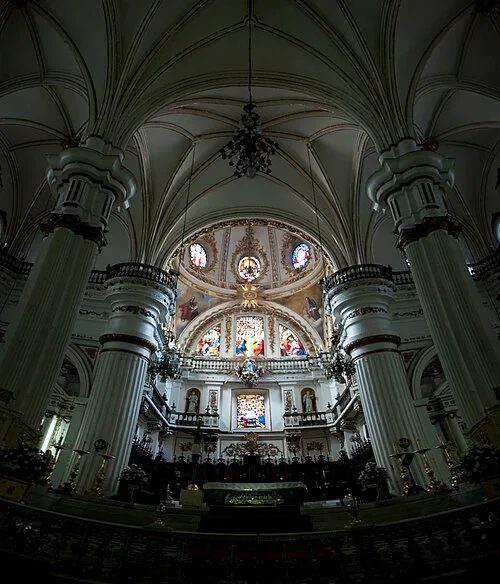 The Central Nave and Altar MayorCentral Nave and Altar Mayor
Inside, the church keeps the basilica plan its Renaissance builders intended: three naves divided by columns. The central nave rises under vaulted ceilings toward the high altar at its far end. That altar, of white marble and silver, replaced an older altar of cypress wood made during the era of the War of the Reform. In the nineteenth century the architect José Gutiérrez removed the gilded baroque retablos, the carved altarpieces, and set neoclassical ones in their place. Light enters through the dome at the rear of the church, where stained-glass windows imported from France show scenes from the Bible.
Listen in the appPhoto: ElPattMedina · CC BY-SA 3.0
05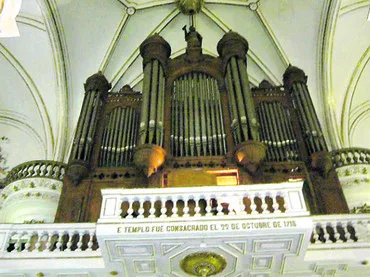 The Great Merklin-Schütze OrganThe Choir and the Merklin-Schütze Organ
Above the main door, in the choir loft, stands one of the great instruments of Mexican church music. The neo-Gothic organ was built in 1893 by the Belgian house of Merklin-Schütze, and it is the second largest organ in the country. At the far end of the church, beneath the apse, is the choir of the canons. Its fifty-two seats of finely carved wood were made by native artisans of Nayarit, at the time part of the state of Jalisco, and inaugurated in 1832. The seats are arranged on two levels. At the center stands the cardinal's chair, carved from cocobolo wood. The inscription on the parapet below records the consecration of the temple on 22 October 1618, the date the building's own carving gives.
Listen in the appPhoto: Alejandro.zabal · CC BY-SA 3.0
06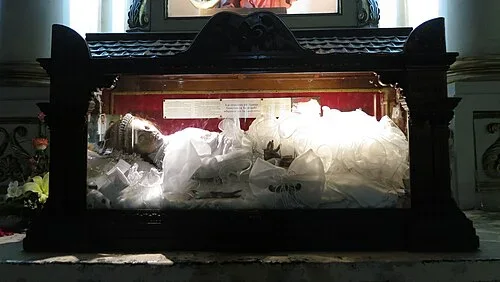 The Chapel of Santa InocenciaThe Relic of Santa Inocencia
In the north nave, beneath the north tower, lies one of the most visited corners of the cathedral. A glass sarcophagus holds the body of Santa Inocencia, a young girl of the eighteenth century. The story told about her is a legend, not a documented life. It tells of a Roman girl who secretly converted to Catholicism and took her first communion against her father's wishes. When he learned of it, the legend says, he stabbed her. Her remains have been venerated here for generations, close to the chapel of El Señor de las Aguas, the Lord of the Waters. Whatever the truth of her story, visitors lower their voices at her case.
Listen in the appPhoto: Nheyob · CC BY-SA 4.0
07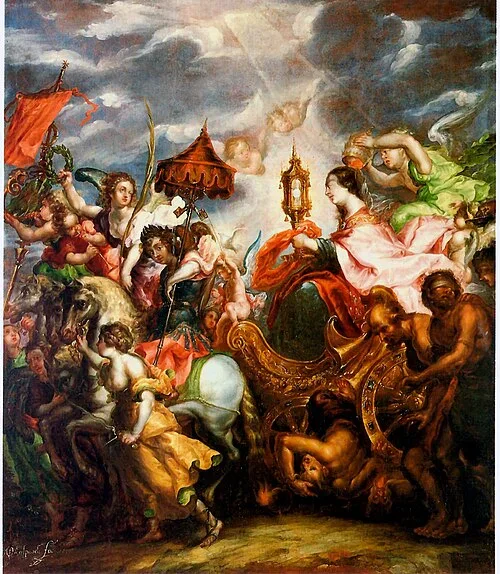 The Sacristy MasterpiecesThe Sacristy Masterpieces
One of the great paintings of colonial Mexico hangs in the cathedral's sacristy. Cristóbal de Villalpando, a painter of New Spain, called it La Iglesia Militante y Triunfante, the Church Militant and Triumphant. It shows the triumph of the faith as an allegory: angels and saints on horseback and on foot, a radiant woman holding a lantern-like reliquary, a golden chariot rolling over the figures of darkness below. Bishop Juan de Santiago y León Garabito commissioned the work for this room. The sacristy keeps worthy company. Another wall holds La Purísima Concepción by Bartolomé Esteban Murillo, the Spanish master.
Listen in the appPhoto: PPazo1995 · CC BY 4.0
08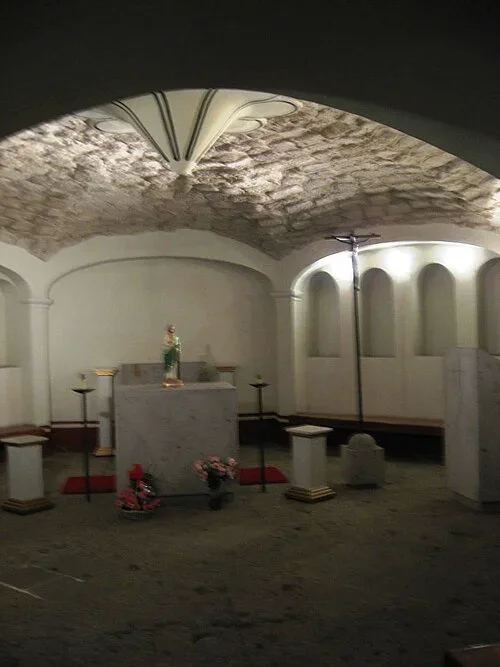 The Archbishop's CryptThe Archiepiscopal Crypt and the Cristero Martyrs
Stone steps lead down from the main floor to the crypts beneath the cathedral. Under what was once the royal chapel lies the crypt of the archbishops of Guadalajara, with burials reaching back to the sixteenth century. A second crypt holds the remains of twenty-three martyrs of the Cristero War. Pope John Paul II beatified them in 1992. The same crypt keeps the heart of Bishop Juan Cruz Ruiz de Cabañas, founder of the Hospicio Cabañas. Cardinals of the archdiocese rest here too, among them Juan Jesús Posadas Ocampo. He was assassinated in 1993 at Guadalajara International Airport, caught in a shootout between drug cartels. The vaulted room is quiet now, an altar at its center and flowers at its foot.
Listen in the appPhoto: Thelmadatter · Public domain
09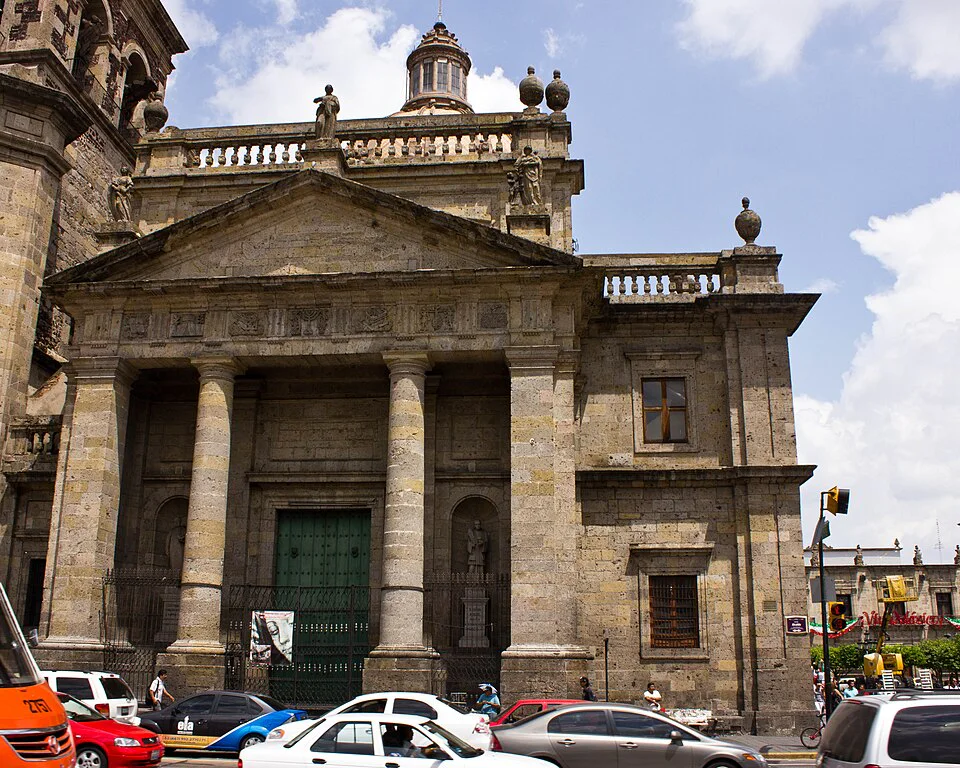 Sagrario MetropolitanoSagrario Metropolitano: Closing the Tour
The cathedral does not stand alone. It heads an ensemble that grew up around it in the centuries after its completion. At the corner of Paseo Alcalde and Morelos rises the Sagrario Metropolitano, the old parish church, its facade built like a classical temple front with carved stone and columns. A door near the cathedral's main entrance leads to it. On another corner stands the archbishop's palace, where the archdiocese still has its seat. Both buildings rose after the cathedral itself. For more than four centuries this corner has been rebuilt, worshipped in, and remembered. It remains the living heart of the archdiocese, and the landmark the whole city knows by its yellow spires.
Listen in the appPhoto: Humberto.García · CC BY-SA 3.0
Catedral metropolitana de Guadalajara
Frequently asked questions
How much does the guide cost?
Free app download. Listed guide price: Free guide. Guide price shown in the app. Audio guide only. Venue admission is separate.
Can I listen without internet?
Yes. Download the guide’s audio, images, and maps in the app before your visit. Your downloaded content is then available offline.
Can I listen in my language?
This audio guide is available in 15 languages, including English.
Do I need to follow a schedule?
No. This is a self-guided experience. Choose your stops, pause whenever you like, and return to a story at your own pace.
At your own pace
Explore Catedral metropolitana de Guadalajara.
Download Stanza, then search for “Catedral metropolitana de Guadalajara”.
Free app download · Guide price shown in the app
Keep exploring
Audio guides — Mexico
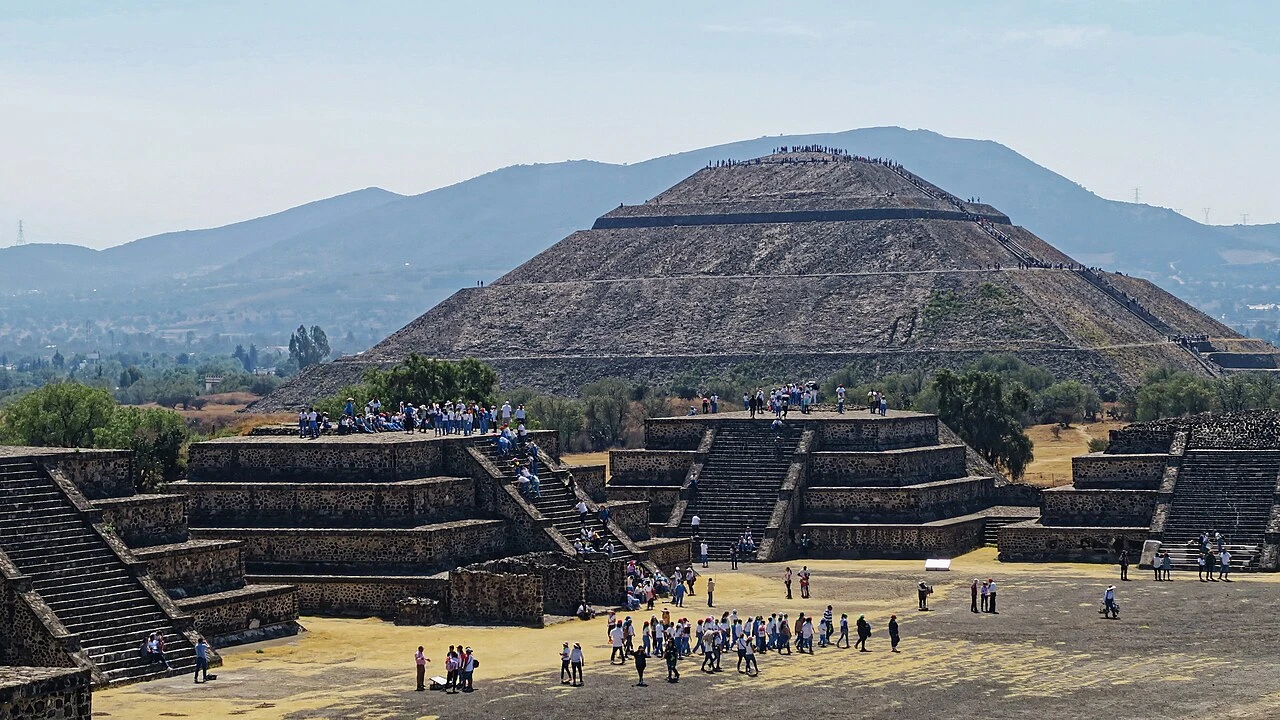
San Francisco Mazapa
Teotihuacan
Content & sources
Burkhard Mücke · CC BY-SA 4.0
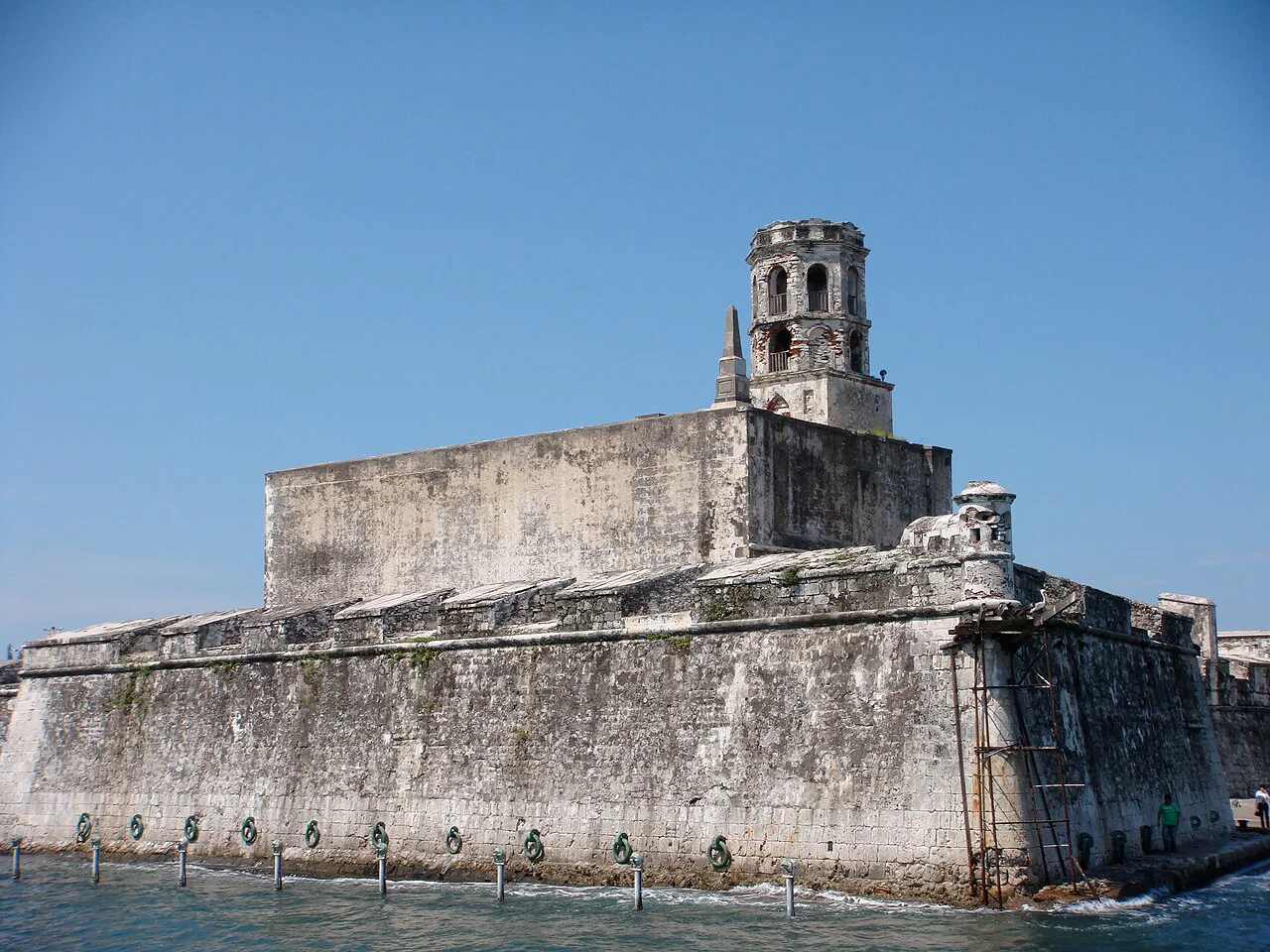
Veracruz
San Juan de Ulúa
Content & sources
Victor Pineda · CC BY-SA 2.0
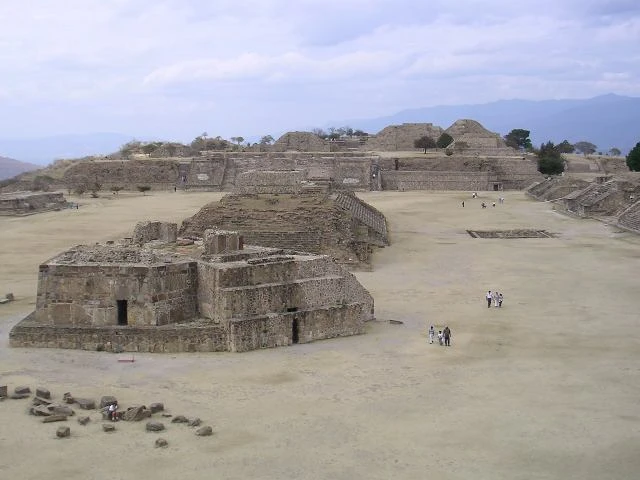
Santa Cruz Xoxocotlán
Monte Albán
Content & sources
Photo: Petrusbarbygere · CC BY-SA 3.0
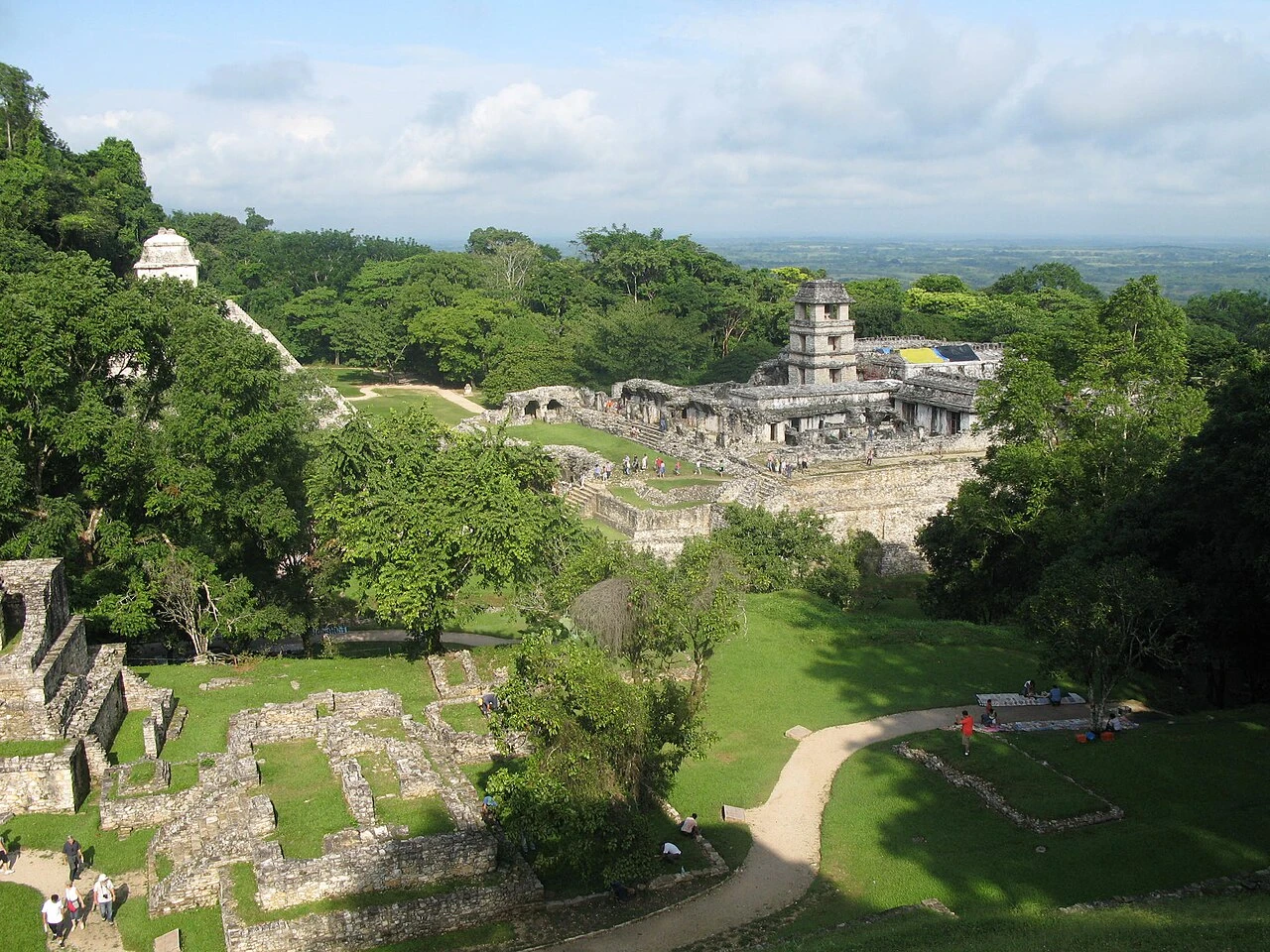
Palenque
Palenque
Content & sources
Ljuba brank at Slovenian Wikipedia · CC BY-SA 3.0