 Stanza / Audio guide
Content & sources
Stanza · Audio guide
Cacaxtla Audio guide
A place to remember. A story to take with you.
Cacaxtla is an archaeological site located near the southern border of the Mexican state of Tlaxcala. It contains a sprawling palace with vibrantly colored murals painted in Maya style.
Download Stanza, then search for “Cacaxtla”.
About the tour
One guide. Your kind of visit.
Cacaxtla is an archaeological site located near the southern border of the Mexican state of Tlaxcala. It contains a sprawling palace with vibrantly colored murals painted in Maya style.
Ready when you are.
- 01Get the free Stanza app.
iOS & Android
- 02Find your guide.
“Cacaxtla”
- 03Download before you go.
Works offline
Audio guide / 10 narrated stops
Inside the guide
Get to know a few of the stories before you go. Open a stop to read more.
01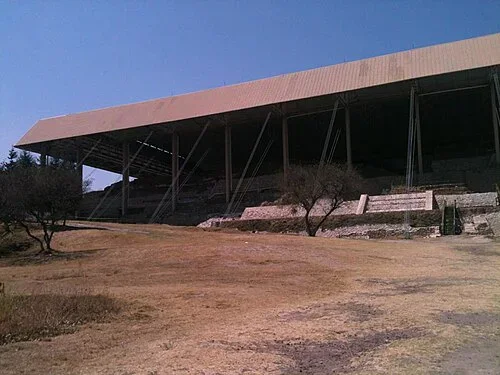 Site Entrance & On-Site MuseumCacaxtla: The Covered Citadel
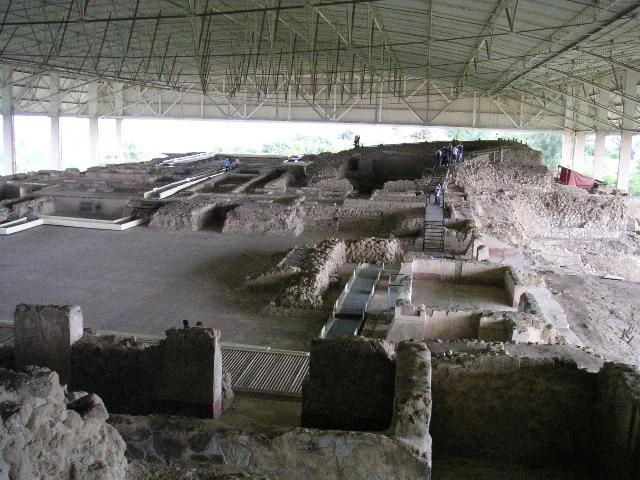
Welcome to Cacaxtla, in the southern reaches of the Mexican state of Tlaxcala. That great sheet-metal roof stretching ahead covers one of the most surprising finds in Mexican archaeology. Beneath it lies a sprawling palace, its walls painted with vibrantly coloured murals in Maya style, deep in the central Mexican highlands. Cacaxtla has long been called the capital of a people known as the Olmeca-Xicalanca, likely settlers from the Gulf coast who arrived around 400 CE, though newer evidence questions whether they made the paintings. Between 650 and 900 CE they prospered here, probably controlling the trade routes through the region with a population of no more than ten thousand. The story of the rediscovery is one of luck. In September 1975, workers clearing land broke into a buried wall, and its bright paint came to light. Archaeologists arrived quickly, led by Eduardo Merlo Juárez, Diana Lopez-Sotomayor and Daniel Molina-Feal, who spent over six years excavating. Lopez-Sotomayor recalled her first sight of the life-sized painted figures as overwhelming. Because the main platform stayed unexcavated until the 1980s, much of the original colour survived in the walls themselves. The roof exists for exactly that reason: to shield the paintings from weather and looters, so they can be seen where they were painted.
Cher Kesh · CC BY-SA 2.0
02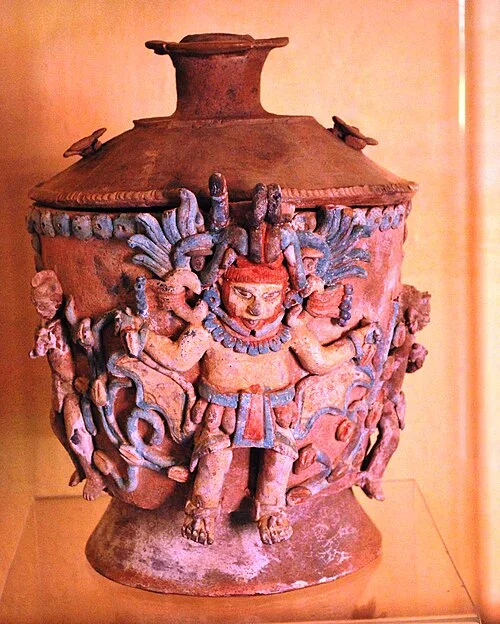 Site Entrance & On-Site MuseumFuneral Urn from the Tlaxcala Regional Museum
Before climbing to the ruins, a piece kept elsewhere gives a taste of the region's older arts. This funeral urn, displayed in the regional museum in the city of Tlaxcala, shows the skill of the area's pre-Hispanic potters. From a single mass of clay the sculptor raised a full figure, arms spread wide, adorned with a collar, a feathered headdress and small attendant forms at the shoulders and sides. The paint still carries reds and blues over the terracotta body, a reminder that these vessels were colour objects, not plain pottery. Such urns held the remains of the dead, and the modelling gave each vessel a presence suited to a tomb. The urn comes from the region's broader funerary tradition rather than from the excavations at Cacaxtla itself. Even so, it sets the tone: in Tlaxcala, clay could be shaped, painted and fired into something meant to last beyond a lifetime.
Thelmadatter · CC BY-SA 3.0
03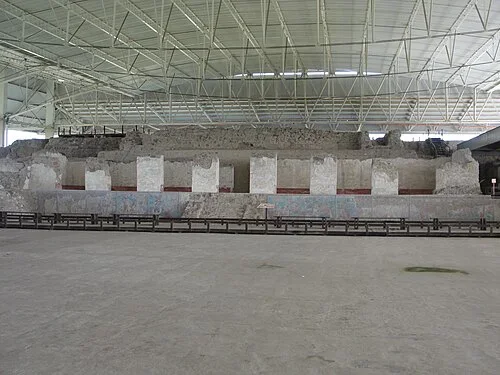 The Gran Basamento PlatformThe Gran Basamento Platform
Everything at Cacaxtla rests on one enormous platform. The Gran Basamento runs about two hundred metres long and rises twenty-five metres above the plain. It is a natural hill, shaped and levelled, chosen for its fine defensive position and its commanding views over the surrounding terrain. The city's main religious and civil buildings stood on top, alongside the residences of the priest class. The citadel was protected by more than height: defensive moats surrounded it, with earthen walls adding a further barrier. The builders never stopped working. Each phase rose over the last, newer rooms and temples laid on top of older ones, so the excavated walls sit at different levels today. Around the main platform, smaller pyramids and temple bases still stand in the near distance. What looks like a single great wall is really centuries of construction, stacked.
Listen in the appPhoto: SSVelasquez · CC BY-SA 3.0
04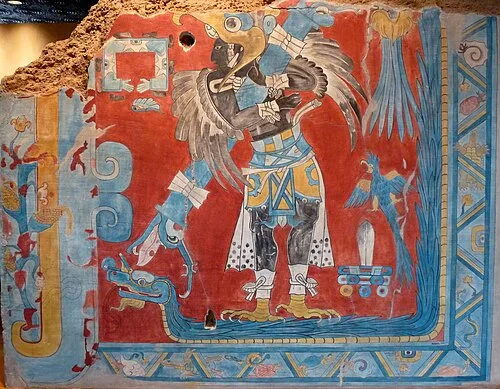 Portico A: The Bird Man and Jaguar Man MuralsThe Bird Man Mural, Portico A
A man in a bird costume and helmet stands on the coils of a plumed serpent, painted the size of a living person. This is the Bird Man of Portico A, the figure whose discovery carried Cacaxtla's name into the world. He is linked to Quetzalcoatl, the generous deity who taught people the arts and agriculture. Many scholars read him as a ruler-priest, one of the leaders of the people who inhabited Cacaxtla between roughly 600 and 900 CE. What makes the murals here singular is their fusion. They combine the symbolism of the Mexican altiplano with the artistry of the Maya, a pairing found nowhere else. Cacaxtla also conserves the oldest mural painting showing a human figure surrounded by symbols of several cultures: Teotihuacan, Maya, Mixtec and Totonac. Whether the Bird Man portrays a specific historical ruler remains an open question. What is certain is the ambition: a ruler shown as a god's own bird, treading on the serpent of the sky.
Listen in the appPhoto: El Comandante · CC BY-SA 3.0
05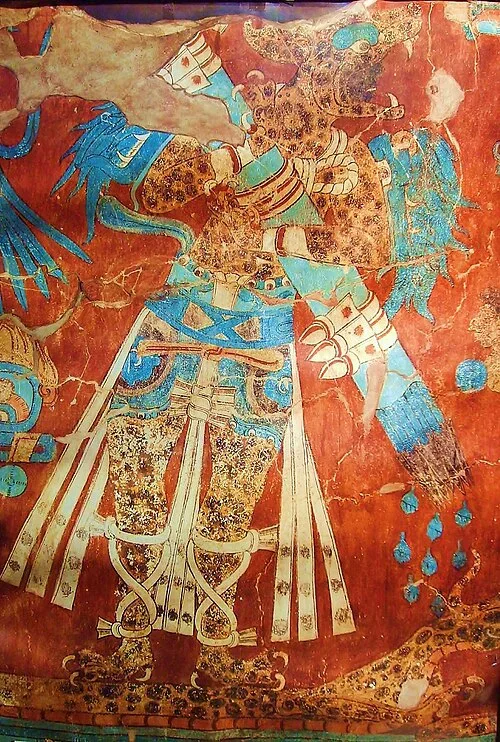 Portico A: The Bird Man and Jaguar Man MuralsThe Jaguar Man Mural
Facing the Bird Man stands his counterpart, painted with the same life-sized scale. This figure wears a jaguar costume and helmet and stands on a serpent whose skin is covered in jaguar markings. Where the bird man belongs to the sky, the feline man belongs to the rains that fertilize the earth. The detail that carries the theme is in his hands: a bundle of darts, with water dripping from one end. Darts that fall as rain, watering the fields instead of wounding the enemy. The doorway jambs nearby deepen the idea. On a blue background, a jaguar-man pours water into a pot of Tlaloc, the rain god, beside a Maya figure holding a snail from which a small red-haired man emerges, probably the sun. Rain and sun, the two things a harvest needs, painted at the entrance of a building. The colours here still astonish: red, blue, yellow, black and white, laid down more than a thousand years ago.
Listen in the appGustavo Velarde · CC BY 2.5
06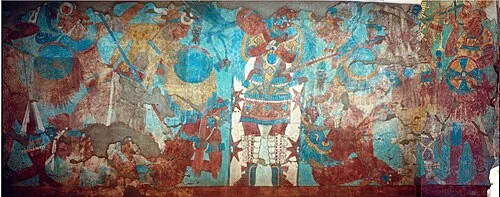 The Battle Mural PlazaThe Battle Mural
The most famous painting at Cacaxtla runs along the sloping limestone wall of a temple base in the northern plaza. It was painted before the year 700, split in two by a central staircase, and stretches more than twenty metres, one of the longest narrative scenes in ancient Mesoamerica. It shows a fight between two clearly different peoples. The victors have greyish-brown skin, large noses and undeformed heads. They carry round shields, obsidian knives, spears and atlatls, the dart launchers of the highlands. The defeated, identified as Maya by their facial profiles and the shape of their skulls, wear only plumes, pectoral vests, earplugs and some jade. They lie unarmed. Most scholars agree the scene is not a record of combat but a staged sacrifice, theatre dressed as battle, honouring either a historical or a mythical event. Some see the death of the Maize God in it, noting the netted costumes, the opened bodies and the corn-shaped skulls of the bird figures. The defeated nowhere defend themselves, which is the strongest sign that this battle was always a ritual.
Listen in the appPhoto: HJPD · CC BY 3.0
07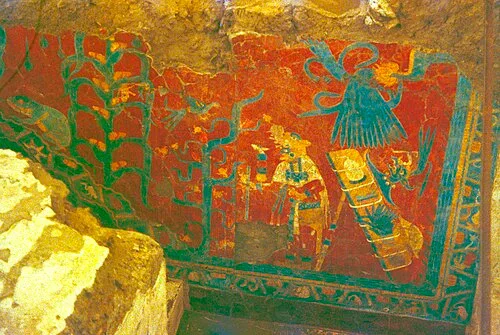 The Red Temple StaircaseThe Red Temple Staircase Mural
Not every mural here speaks of war. This staircase, leading up to the Governors' Room, carries a scene of commerce and creation. An elderly merchant climbs the steps, bent under a huge carrying frame called a cacaxtli, loaded with turtle shells and bird feathers. That frame gives Cacaxtla its name: the place of the merchant's pack. Beside him grows a plant that appears to be cacao, with a green-feathered bird perched on it, an eye set in its wing. Above it rises a stranger plant still: a corn stalk where every ear of corn is a human head, the kernels formed by a netted helmet. The image echoes the Popol Vuh, the Maya account of creation, which tells that in one age of the world people were made from maize dough. Only one side of the staircase is visible to visitors. The painted face on the other side looks onto no walkway at all, and survives as a reproduction in the site museum.
Listen in the appPhoto: HJPD · CC BY 3.0
08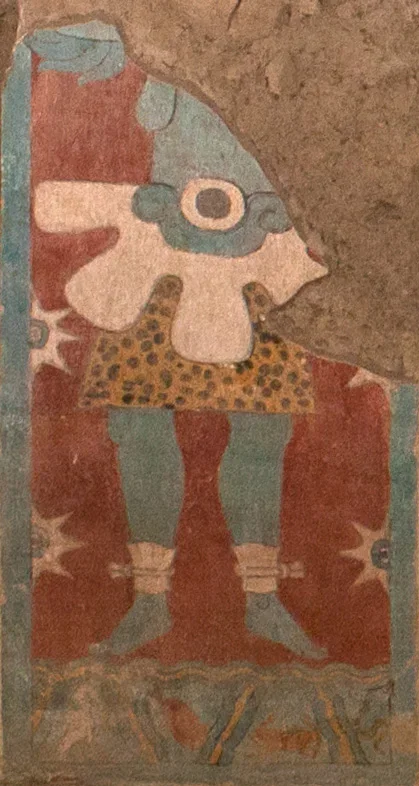 The Temple of VenusThe Temple of Venus: Left Column Figure
Inside the Temple of Venus, two columns carry two figures, and this fragment is one of them. Painted in deep blue against a red ground, the figure wears a spotted, jaguar-like skirt and stands amid star symbols with eyes and blue eyebrows. On the right column of the same temple, a male figure wears a mask over his face, a scorpion tail, and a skirt bearing the Venus symbol at the front. This left-hand fragment probably represents a woman, whose skirt carries the same emblem. The stars are thought to show how these people pictured the planet Venus, which in certain seasons shone as a star in their sky. The repetition of the symbol on both garments and around both figures suggests the murals mark an astronomical or calendrical event tied to the planet. In the world of these painters, Venus was bound to warfare and sacrifice, the same current that runs through the Battle Mural. Here the idea is worn quietly, on the hems of two figures, under a sky of stars.
Listen in the appTim Zaman · CC BY 3.0
09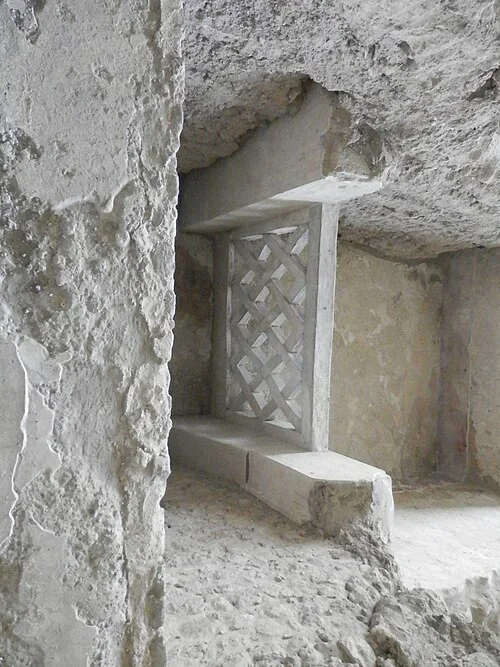 The Palace Residential QuarterThe Celosía: Lattice Window of the Palace Quarter
Away from the temples, the palace quarter shows how the elite actually lived. This room, whose exact use remains unknown, belongs to the same construction phase as the Red Temple corridor and the rooms holding the Venus murals. Its remarkable feature is the lattice screen, called a celosía, which divides the interior from the exterior and admits light into the room. Workers took a structure of branches, coated them in mud, and shaped them into diamond patterns. Over that they applied a covering of lime and sand, sealing the lattice into a single firm surface. The result is both wall and window: a barrier that cools and shades the room, yet lets the sun filter through in diamonds. Rooms like this housed the priest class and the administration of the city, the quieter work behind the painted ceremonies. Ordinary daylight, arranged with care, was part of the architecture.
Listen in the appGunnar Wolf · CC BY-SA 3.0
10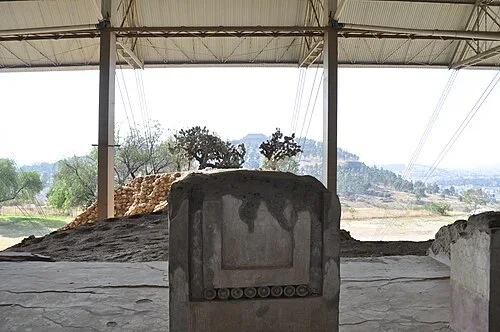 The Xochitécatl OverlookThe Overlook: Cacaxtla and Xochitécatl
From under the great roof, the land opens towards a hill less than a kilometre to the west: Xochitécatl, Cacaxtla's sister city. The two centres worked as a pair. Xochitécatl was the more public ceremonial complex, while Cacaxtla combined a ceremonial and political centre, an elite residence and a fortress in one. Cacaxtla dominated this part of the Tlaxcala-Puebla valley, a power that grew after the fall of nearby Cholula and ended around the year 900. By 1000 the city stood empty. What survived was the earth itself. Later construction buried the painted walls, and the colours lay sealed under soil and stone until their rediscovery in 1975. That accident of burial is the reason the Bird Man, the Jaguar Man and the Battle Mural still show their reds and blues today. Cacaxtla endures as a place where two artistic worlds met on a single hilltop, and the hill still holds them.
Listen in the appPhoto: Lsalgador82 · CC BY-SA 3.0
Cacaxtla
Frequently asked questions
How much does the guide cost?
Free app download. Listed guide price: $0.99. Guide price shown in the app. Audio guide only. Venue admission is separate.
Can I listen without internet?
Yes. Download the guide’s audio, images, and maps in the app before your visit. Your downloaded content is then available offline.
Can I listen in my language?
This audio guide is available in 15 languages, including English.
Do I need to follow a schedule?
No. This is a self-guided experience. Choose your stops, pause whenever you like, and return to a story at your own pace.
At your own pace
Explore Cacaxtla.
Download Stanza, then search for “Cacaxtla”.
Free app download · Guide price shown in the app
Keep exploring
Nearby audio guides
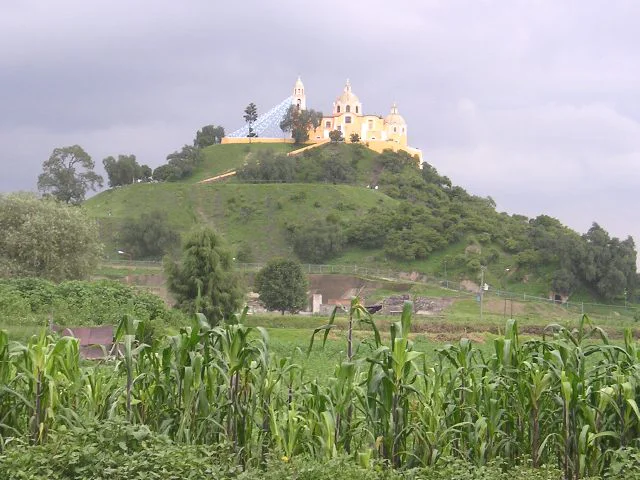
Cholula de Rivadavia · 21 km
Gran Pirámide de Cholula
Content & sources
Photo: Hajor~commonswiki · CC BY-SA 3.0
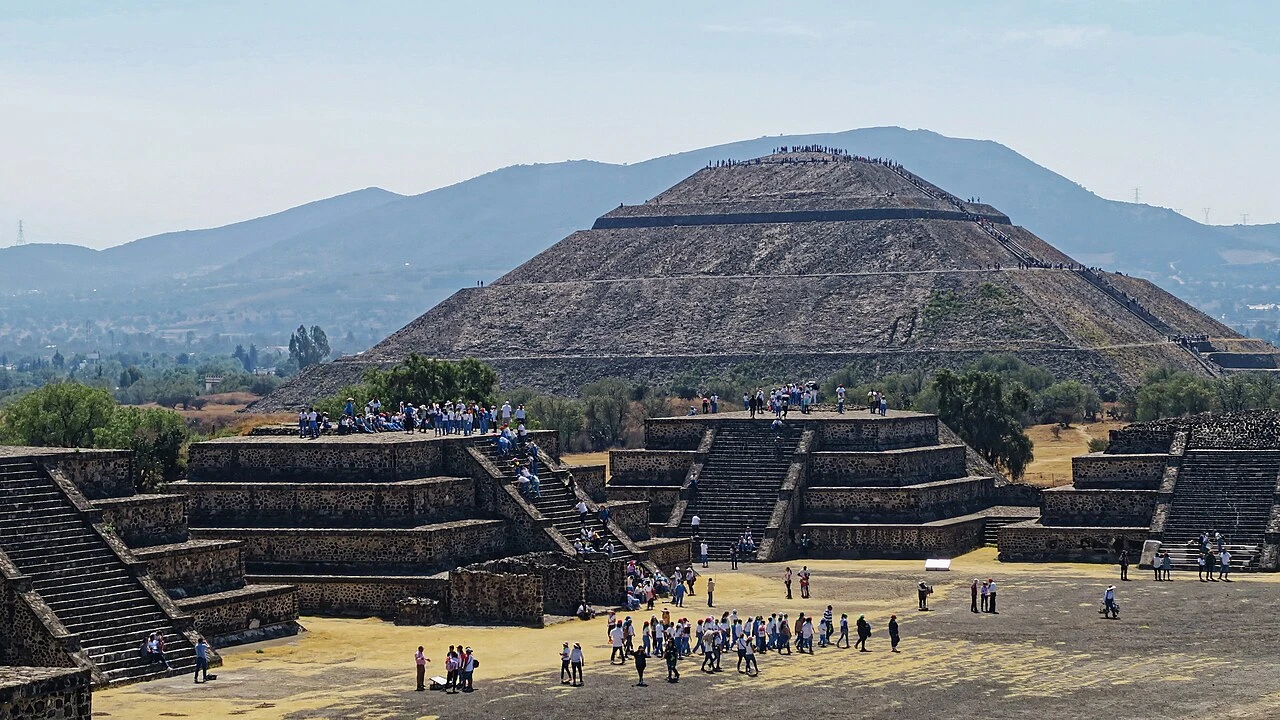
San Francisco Mazapa · 73 km
Teotihuacan
Content & sources
Burkhard Mücke · CC BY-SA 4.0
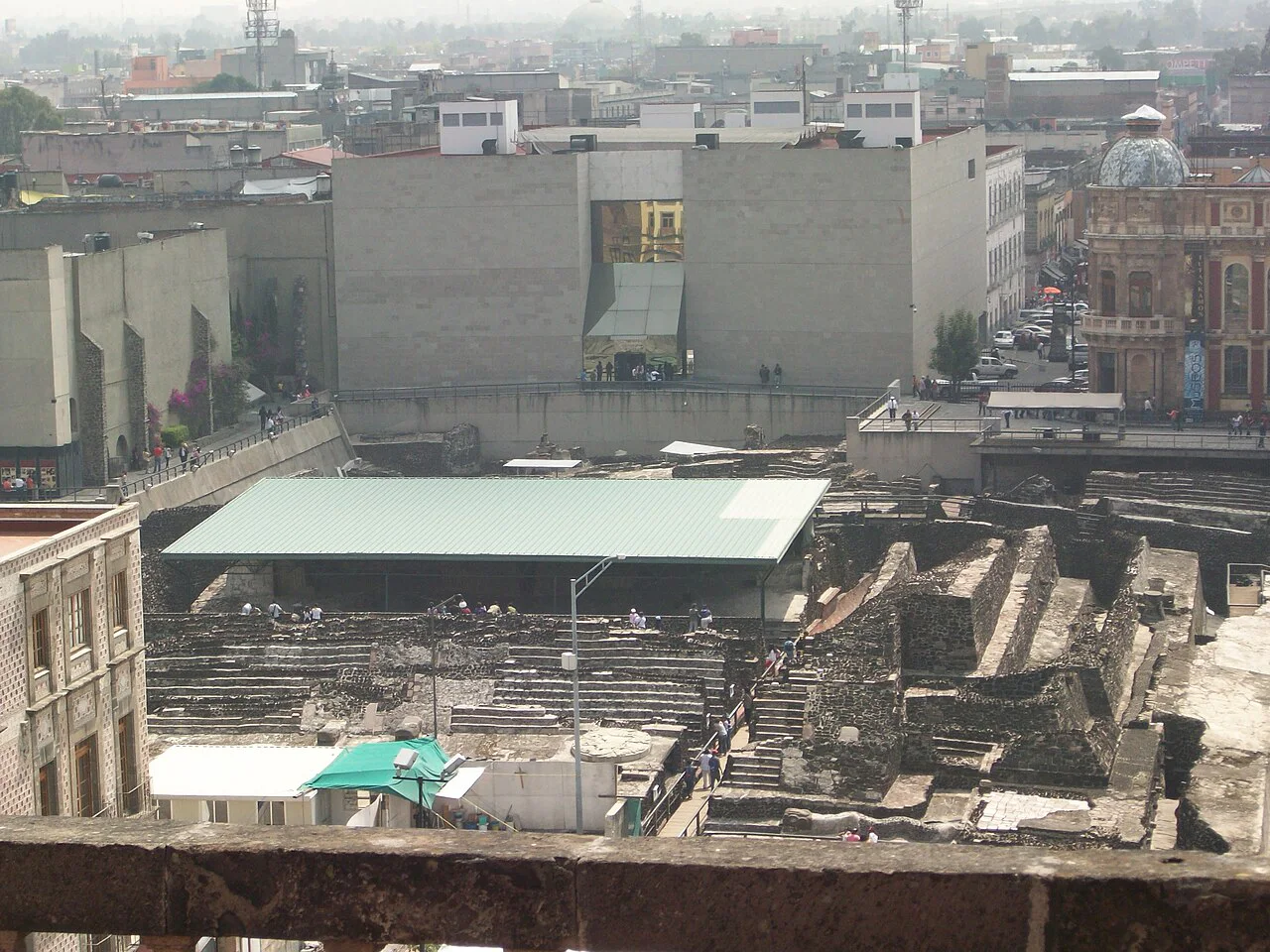
Mexico City · 86 km
Templo Mayor
Content & sources
Photo: GAED · CC BY-SA 3.0
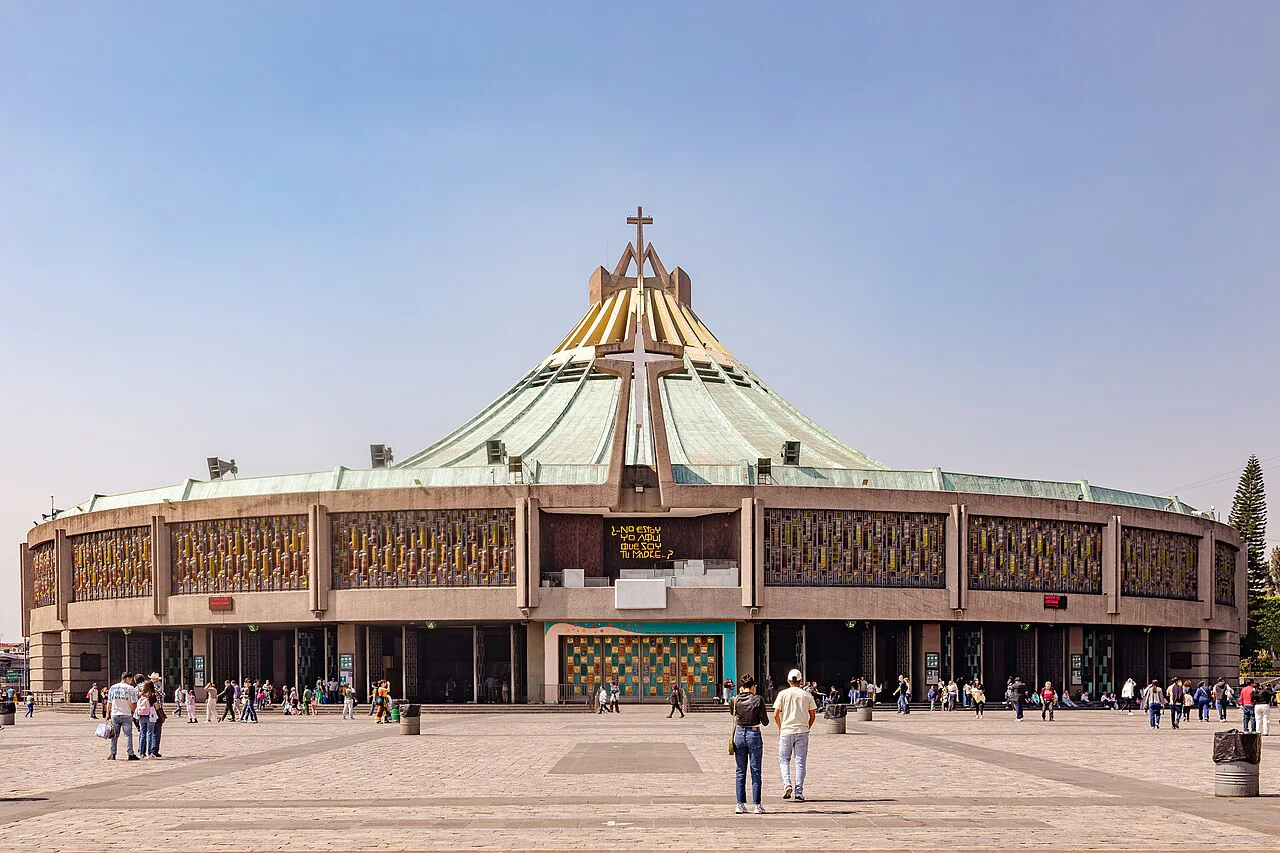
Mexico City · 86 km
Basílica de Santa María de Guadalupe
Content & sources
Photo: Arne Müseler · CC BY-SA 3.0 de