 Stanza / Audio guide
Content & sources
Stanza · Audio guide
Gran Pirámide de Cholula Audio guide
A place to remember. A story to take with you.
The Great Pyramid of Cholula is a complex located in Cholula, Puebla, Mexico. It is the largest archaeological site of a pyramid in the world and the largest pyramid by volume known to exist today.
Download Stanza, then search for “Gran Pirámide de Cholula”.
About the tour
One guide. Your kind of visit.
The Great Pyramid of Cholula is a complex located in Cholula, Puebla, Mexico. It is the largest archaeological site of a pyramid in the world and the largest pyramid by volume known to exist today.
Ready when you are.
- 01Get the free Stanza app.
iOS & Android
- 02Find your guide.
“Gran Pirámide de Cholula”
- 03Download before you go.
Works offline
Audio guide / 15 narrated stops
Inside the guide
Get to know a few of the stories before you go. Open a stop to read more.
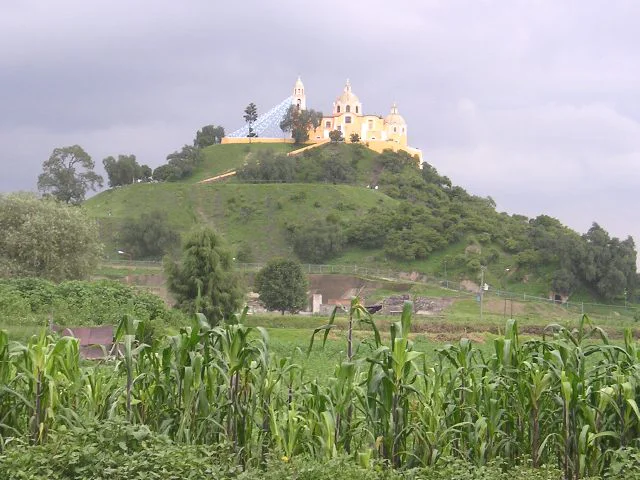
01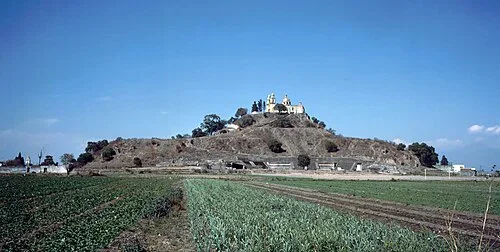 Northern Entrance and Tlachihualtépetl OverviewTlachihualtépetl: The Hill That Is a Pyramid
Welcome to Cholula, in the state of Puebla. The first thing to know about this place is that it hides in plain sight. From across the fields it looks like any green hill in the valley, with a small church on its crest. It is not a hill. It is the Great Pyramid of Cholula, and by volume it is the largest pyramid known to exist anywhere in the world. The Guinness records put it at roughly four and a half million cubic metres of material. That is greater than the Great Pyramid of Giza, though Giza is taller. Its footprint alone covers nearly twice the base area of Khufu's pyramid. Work began in the third century before Christ. Building continued, stage upon stage, into the ninth century of our era. Four great construction phases rose one over the other, each wrapping its predecessor inside a larger temple. The whole mountain was, by tradition, dedicated to Quetzalcoatl, the feathered serpent. And crowning it all today is a Spanish colonial church, which is a story of its own.
Photo: HJPD · CC BY-SA 3.0
02 Northern Entrance and Tlachihualtépetl OverviewThe Slope of the Man-Made Mountain
The people who knew this mountain best gave it the name that still fits: Tlachihualtepetl, in Nahuatl, the hand-made mountain. They chose it because they knew the truth. They believed no sacred being piled this up; human hands did, generation after generation. The city's name carries a memory too. Cholula comes from Cholollan, which means the place of refuge, though some translate the old word as the place of those who fled. As for the hill-like look, that disguise is late. The final building phase buried the last great temple, Building C, deep inside its adobe core. Then, in the eighth century, the pyramid was abandoned. The earthen facing on its slopes collapsed and slid, and soil settled over the ruin. Grass and trees claimed the cone as their own. Above the slope, the towers of a colonial church now crown the old temple summit.
User:padaguan · CC BY-SA 3.0
03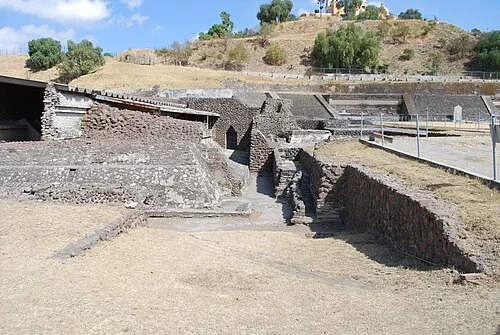 Subterranean Exploration TunnelsThe Tunnel Entrance: How Archaeologists Entered a Hill
In 1931, an architect named Ignacio Marquina began digging into the hill, not from outside but straight through it. The goal was to prove the hill was artificial. The inspiration came from Teotihuacan, where Manuel Gamio's excavations in the nineteen-twenties had been such a success. Marquina had worked with Gamio there, so the project was his. Tunnelling went on for more than two decades. By 1954 the passages ran to roughly eight kilometres, crossing and ringing the whole structure. Only about eight hundred meters are open to visitors today. And there is a reason the pyramid was never stripped and rebuilt in the open, the way Teotihuacan was. The church on the summit is a protected national monument. So the only way in was from below.
Listen in the appPhoto: AlejandroLinaresGarcia · CC BY-SA 4.0
04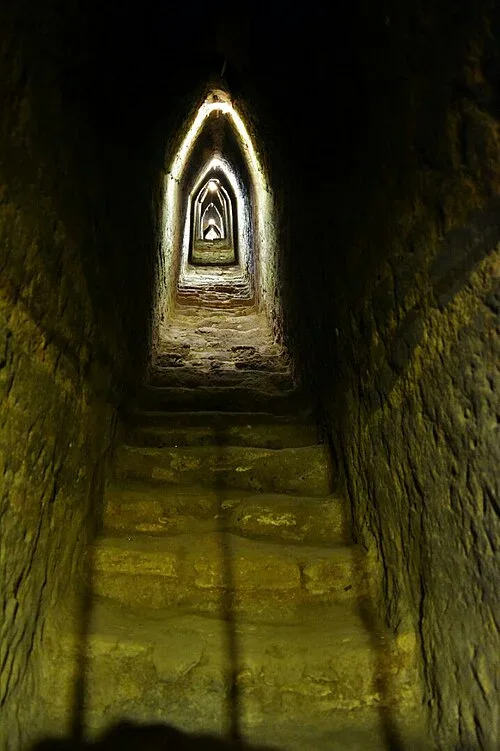 Subterranean Exploration TunnelsThe Adobe Core
The earthen walls of these vaulted passages tell how the mountain itself was built. The base of the pyramid is made of sun-dried adobe bricks, mixed with ceramic, obsidian and gravel so the material would pack solid. It packed so well that the excavators needed no beams or timber supports at all. They cut the passages with false arches, the stepped kind found in Mayan construction, and the earth holds itself up. The tunnellers borrowed their method from mining. Miniature coal cars running on small tracks hauled the debris out of the hill. Some of those little cars are on display at the site museum.
Listen in the appNorberto_Fotografía_Negrete · CC BY-SA 3.0
05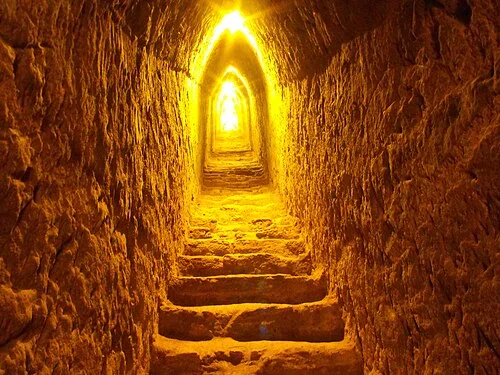 Subterranean Exploration TunnelsThe Mural of the Drinkers
Deep in the pyramid's layers, the tunnel route passes one of Mesoamerica's great paintings: the Mural of the Drinkers. It shows a procession of figures raising vessels to drink, the kind of vessels used for pulque, the fermented drink made from maguey sap. It is the only preserved mural at Cholula that shows human figures at all. The painting survived by being buried. A later building stage covered it, and that covering sealed it away from light and air. It came to light by accident, when a sloping wall gave way during exploration and exposed a strip of color behind it.
Listen in the appdiego_cue · CC BY-SA 3.0
06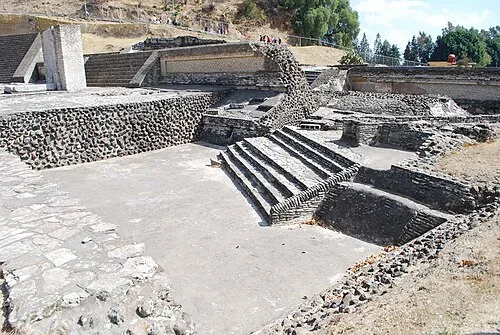 Courtyard of the Altars (Patio de los Altares)The Courtyard of the Altars
On the pyramid's south side lies its great public space, the Courtyard of the Altars, named for the altars found standing here. The open ground alone runs about seventy meters. Across, it measures fifty-four. The pyramid walls it in on the north, and two raised platforms close it on the east and west, which the excavators called the Patio Sureste and the Gran Plaza Suroeste. Those platforms press right up against the pyramid's flank, a choice made to amplify the ritual weight of the space. This was most likely the stage for large public ceremonies, and for rites tied to the passing of power. It was one of the headline finds of the excavation round that began in 1966, when Eduardo Matos Moctezuma started work on the south side.
Listen in the appPhoto: AlejandroLinaresGarcia · CC BY-SA 4.0
07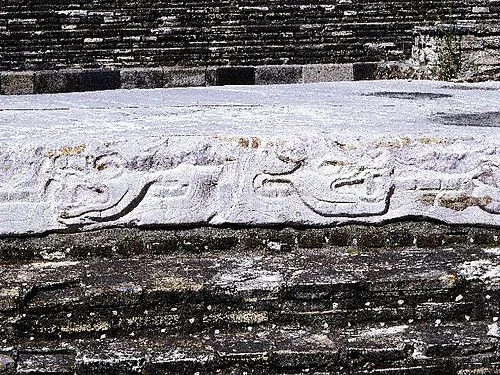 Courtyard of the Altars (Patio de los Altares)The Children of the Rain
Under the slab flooring of this courtyard, excavators found the remains of eight people. Among them were children, deposited in ceramic pots. Archaeologists believe they were messengers to Tlaloc, the god of rain, sent at a time of drought. The mountain was, at its heart, a place that asked for water. Rain and fertility ran through its whole purpose. The carved serpents on the nearby stone belong to that ceremonial world, though what they depict exactly is not settled. In a dry year, this community turned to its gods, and the offering came from its smallest members.
Listen in the appAltevir Vechia at Portuguese Wikipedia · Public domain
08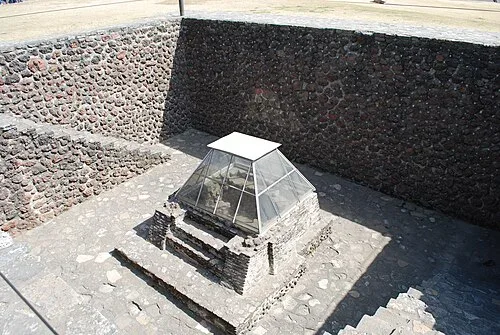 Courtyard of the Altars (Patio de los Altares)The Altar of the Sculpted Skulls
This small altar under its glass roof takes its name from its decoration: the Altar of the Sculpted Skulls, named for three human skulls modeled in clay, bulging-eyed and covered in stucco. The archaeologist Eduardo Noguera reported it in 1937. Its form marks it as a momeztli, an altar set on a ceremonial platform, facing east. It served as a mausoleum. Inside lay a man and a woman. The woman was buried with things of domestic life: comals for cooking, bone needles, spindles, pots. The man was probably a renowned warrior, and his grave goods were richer. They included ritual vessels, an elegant multicolored vase, obsidian arrowheads, and a musical instrument called an omexicahuaztli. There was also a jawbone from a xoloitzcuintle, the hairless dog, which pre-Hispanic people believed guided the dead to the underworld. Across the whole pyramid, more than four hundred burials have been uncovered, most from the Postclassic period. People kept worshipping here long after the temple itself was finished.
Listen in the appPhoto: AlejandroLinaresGarcia · CC BY-SA 4.0
09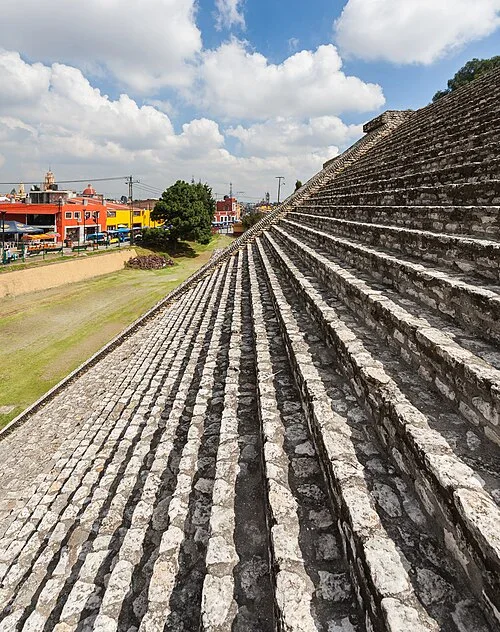 Building F and Western Stepped PlatformsBuilding F: The Worked Stone Pyramid
Building F belongs to the next-to-last phase of the pyramid's construction, between roughly five hundred and seven hundred AD. It is a stone stairway of three levels, with great sloping taluds facing west. Its panels carry a motif that looks like a woven palm mat, an effect made by sculpting stones and setting them like mosaic. That craft gave the building its other name, Piedra Laborada, the Worked Stone. The modern story is less flattering. Archaeologists rebuilt the structure using commercially made cement, and it was nicknamed the Tolteca pyramid, after the cement brand. It has been criticized as over-reconstructed ever since. Most of its paint is gone as well. Only fragments of red, ochre, white and black survive, best preserved on the lower south and north sides, where the color was applied straight onto rock.
Listen in the appDiego Delso · CC BY-SA 3.0
10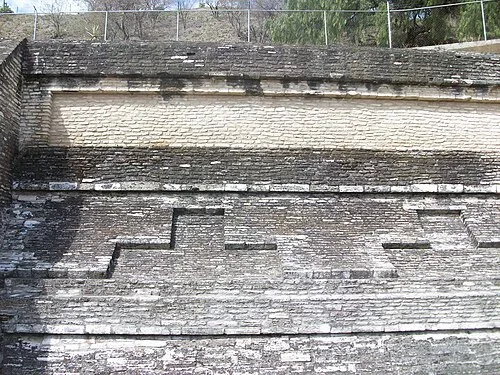 Building F and Western Stepped PlatformsPainted Architecture
Cholula was a city that painted its buildings, and the record here is unusually rich. Archaeologists have discovered twenty-one painted areas at the site. Thirteen still survive in place. Most belong to the Classic period, and nearly all are on outside walls. That placement means they were made for the public, probably to teach and reinforce the religious and political symbols of their day. The tradition changed over time. The oldest painting was plain red, with no figures at all. After two hundred AD, new colors appear, greens, ochres, blues and blacks, along with human figures, animals and geometric shapes. The Courtyard of the Altars shows the same language in its architecture. Its panels were painted with aquatic symbols, and its moldings are shaped like the letter T, a signature of Cholula building.
Listen in the appPhoto: Dge · CC BY-SA 4.0
Gran Pirámide de Cholula
Frequently asked questions
How much does the guide cost?
Free app download. Listed guide price: $1.99. Guide price shown in the app. Audio guide only. Venue admission is separate.
Can I listen without internet?
Yes. Download the guide’s audio, images, and maps in the app before your visit. Your downloaded content is then available offline.
Can I listen in my language?
This audio guide is available in 15 languages, including English.
Do I need to follow a schedule?
No. This is a self-guided experience. Choose your stops, pause whenever you like, and return to a story at your own pace.
At your own pace
Explore Gran Pirámide de Cholula.
Download Stanza, then search for “Gran Pirámide de Cholula”.
Free app download · Guide price shown in the app
Keep exploring
Nearby audio guides
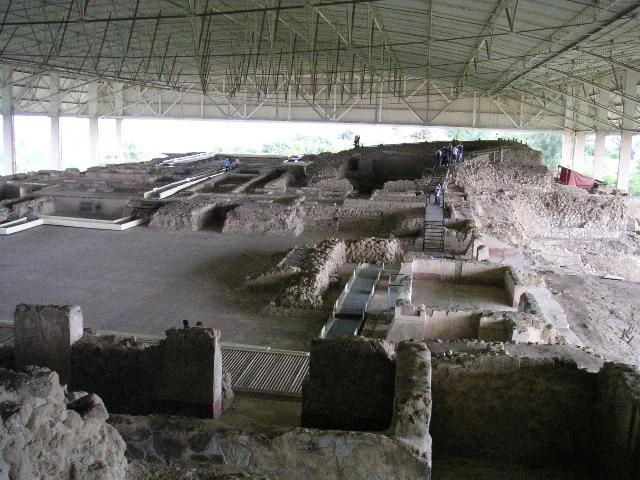
San Miguel del Milagro · 21 km
Cacaxtla
Content & sources
Photo: Hajor~commonswiki · CC BY-SA 3.0
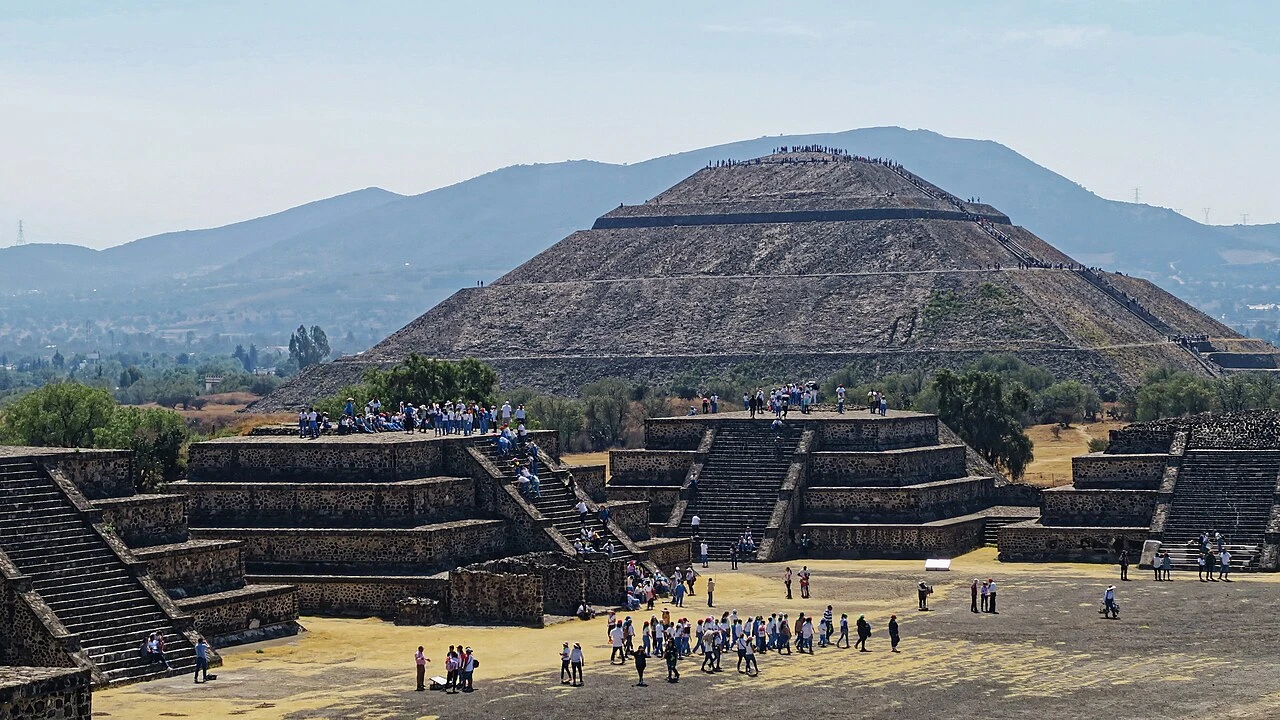
San Francisco Mazapa · 91 km
Teotihuacan
Content & sources
Burkhard Mücke · CC BY-SA 4.0
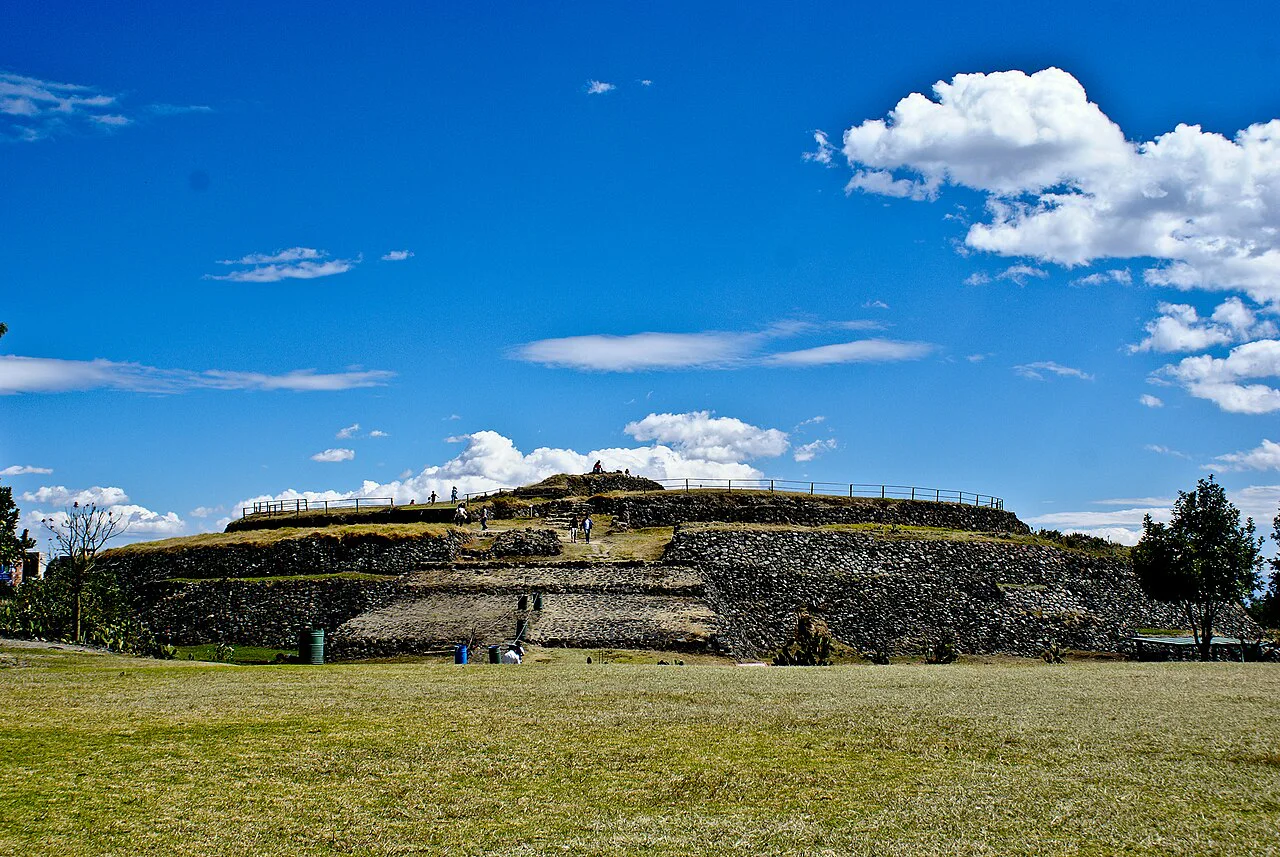
Mexico City · 96 km
Cuicuilco
Content & sources
Photo: Felipe huerta hdez · CC BY-SA 3.0
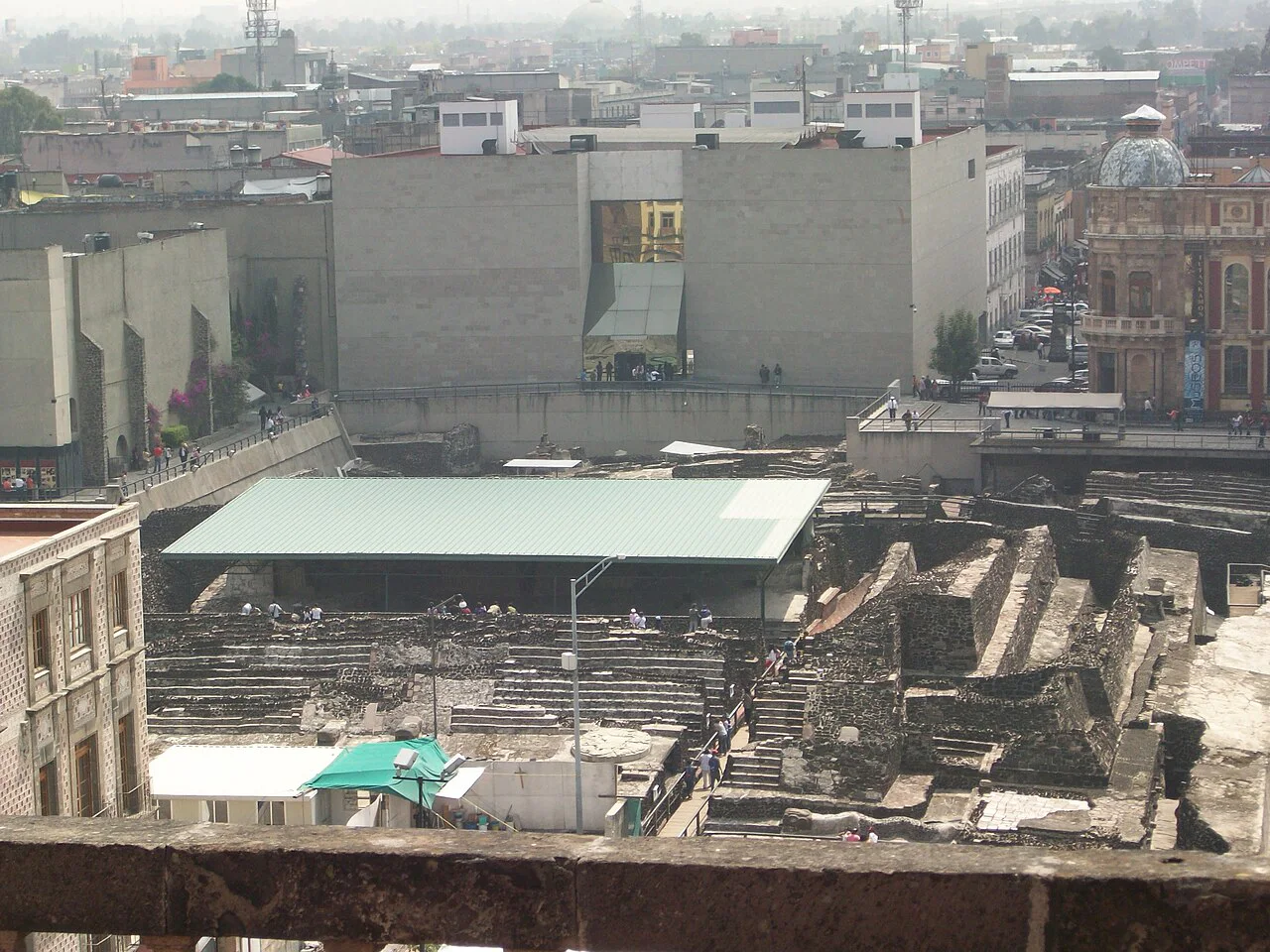
Mexico City · 97 km
Templo Mayor
Content & sources
Photo: GAED · CC BY-SA 3.0