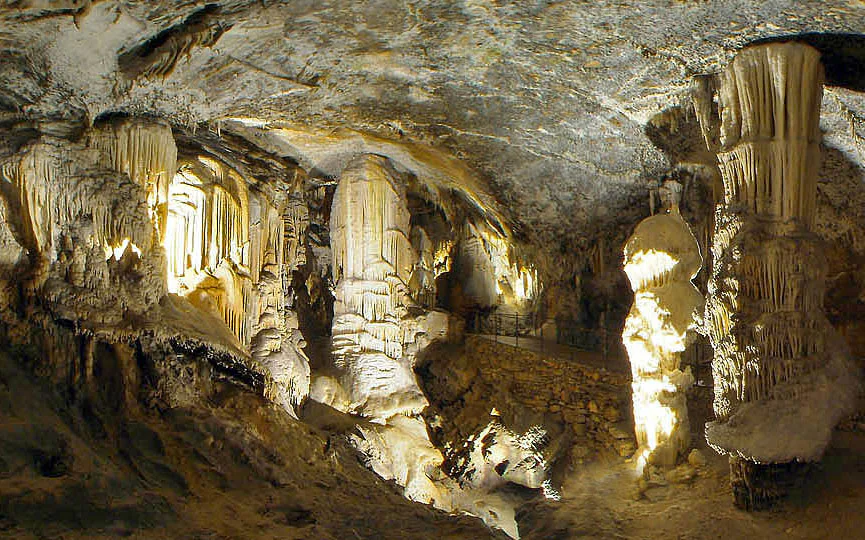
 Stanza / Audio guide
Stanza · Audio guide
Postojna Cave Audio Guide
A place to remember. A story to take with you.
Postojna Cave is a 24.34 km long karst cave system located in southwestern Slovenia. It is the second-longest cave system in the country and serves as a significant tourism site.
Download Stanza, then search for “Postojna Cave”.
About the tour
One guide. Your kind of visit.
Postojna Cave is a 24.34 km long karst cave system located in southwestern Slovenia. It is the second-longest cave system in the country and serves as a significant tourism site.
Ready when you are.
- 01Get the free Stanza app.
iOS & Android
- 02Find your guide.
“Postojna Cave”
- 03Download before you go.
Works offline
Audio guide / 12 narrated stops
Inside the guide
Get to know a few of the stories before you go. Open a stop to read more.
01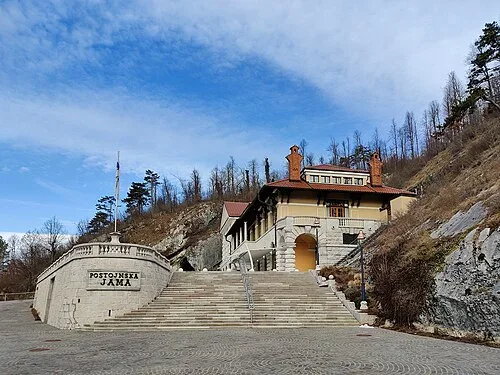 Cave Mansion and the Pivka Sinkhole
Cave Mansion (Jamski dvorec)
A mansion built in 1928 stands at the threshold of Postojna Cave, raised to receive guests in the style the cave's fame deserved. The cave lies in the limestone of southwestern Slovenia, hollowed out of the rock by a river that still runs through it. Its passages stretch for roughly twenty-four kilometers. Only about five of them are open to visitors. The whole tour takes about an hour and a half. Postojna matters for two reasons. It was a pioneer of tourism inside caves, and it is called the cradle of speleobiology, the science of life underground. Until the nineteenth century, naturalists believed caves were lifeless. Then, in 1831, a small beetle was found here, the slenderneck beetle. It was the first cave beetle known to science. Its discovery sent naturalists searching, and in this cave system they went on to describe animal after animal that no one had ever seen before.
Simon Legner (User:simon04) · CC BY-SA 4.0
02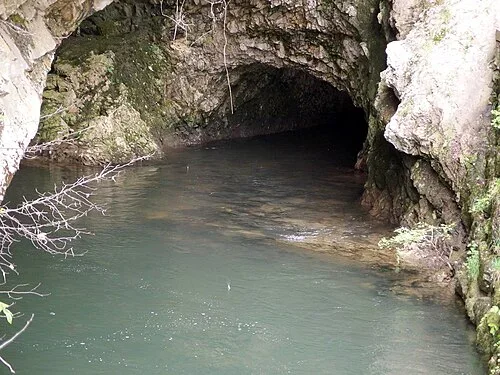 Cave Mansion and the Pivka Sinkhole
The Pivka River's Sinkhole
The Pivka is the river that made this cave. It flows across the Postojna karst plain, and then, at the foot of Sovič Hill, sinks straight into the rock. This green pool is the swallow hole where the water disappears. Over millions of years the river dissolved its way through the limestone, hollowing out passage after passage on several levels. Underground it keeps flowing toward Planina Cave. There it joins the Rak, and the two rivers surface together as the Unica. The cave's original natural entrance, long buried under sediment, was dug open again in the 1860s. Cave divers have been following the water's route into the dark. In 2015 they found an underwater passage leading toward Planina Cave, and two years later they pushed further still. The measured system now runs to about twenty-four kilometers, the second-longest cave in Slovenia. Some four hundred meters of unexplored gap remain. If that ever closes, Postojna will become the longest cave system in the country.
Photo: Mark Ahsmann · CC BY-SA 3.0
03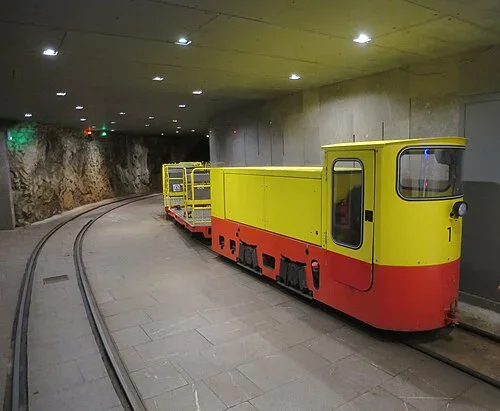 The Underground Cave Railway
The Cave Train
Rails have run through this cave since 1872. That was when the first cave railway was laid, reaching all the way to the foot of Velika Gora, the great hill inside the mountain. Walking the cave was exhausting, so the guides themselves pushed the visitor carts along the tracks. Early in the twentieth century, a gas locomotive took over the pulling. After 1945 the gas engine gave way to electric trains like this one, small and quiet, built to run underground. Today the little electric trains carry visitors along three and a half kilometers of the tour. The ride itself is part of the cave's story, the newest form of a railway that began with guides pushing carts by hand.
Listen in the appPhoto: Reinhard Dietrich · CC BY-SA 4.0
04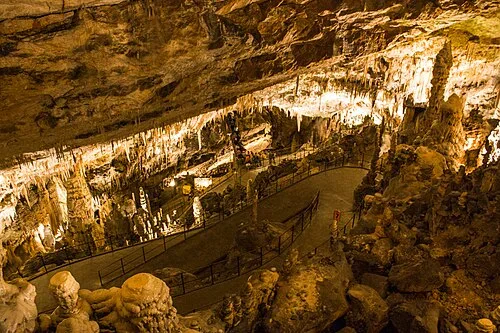 Great Mountain (Velika Gora)
Until 1818, no one knew that the inner halls of Velika Gora, the Great Mountain, existed. The cave known then was only the stretch near the entrance, lit by lamps. In that year the passages were being prepared for a visit by Francis the First, Emperor of Austria. Luka Čeč, a local man whose job was to tend the lamps, climbed further than he was meant to, and stumbled into a whole new world of chambers. The discovery made the cave famous far beyond the region. In 1819 the first paths were laid inside, a Cave Commission was founded to look after the place, and a guiding service was created. Čeč himself became its first official tourist guide. Archduke Ferdinand visited that same year, and from then on Postojna counted as an official tourist destination. In 1884 came another first: electric arc lamps, among the earliest anywhere in the world. The cave had electric light before Ljubljana, the capital of the region, did.
Listen in the appShadowgate from Novara, ITALY · CC BY 2.0
05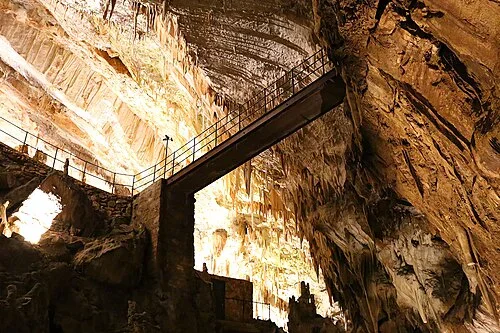 The Russian Bridge
This bridge crosses one of the deepest chasms on the whole tourist route. It was built during the First World War by Russian prisoners of war, brought here and forced to work inside a show cave. The men who built it left their name on the place. Locals still call it the Russian Bridge, and their bridge has carried visitors across the chasm ever since.
Listen in the appHelmut Aschauer · CC BY-SA 4.0
06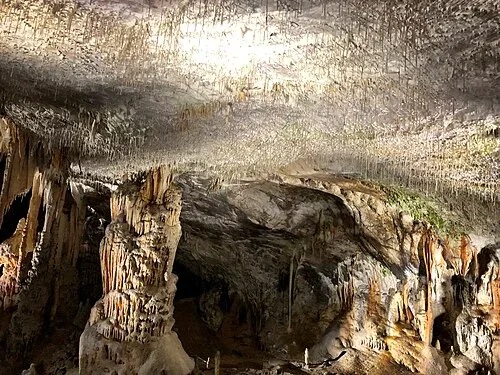 The Beautiful Caves and Spaghetti Hall
The Spaghetti Hall
The ceiling here hangs with thin, hollow tubes, so like noodles that the hall took its name from spaghetti. Every one of them began with a single drop of water. Rainwater seeps through the rock above, gathering a trace of dissolved limestone on the way. When a drop hangs from the ceiling and falls, it leaves behind a tiny ring of calcite. Drop after drop, a straw-thin tube grows downward, and where the drops land, a stalagmite slowly rises from the floor. These soda straws are the most fragile formations in the cave. A single careless touch can end a growth that took centuries, which is why the walkways here keep visitors at a distance.
Listen in the appaiva. · CC BY 2.0
07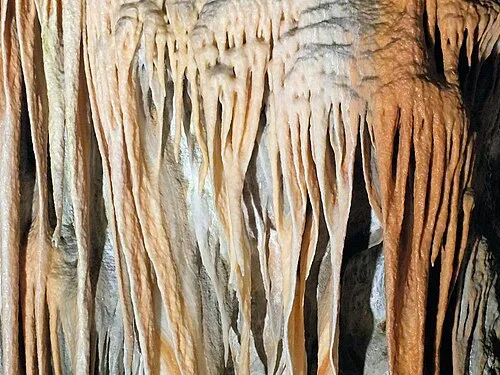 The Beautiful Caves and Spaghetti Hall
Drapery Formations
Where the spaghetti hang straight down, the formations here fall in folds. Water did not drip from a single point to make them. It ran in a thin film along a sloping ceiling, leaving sheets of calcite behind. As the flow wandered, each sheet folded into pleats, like a curtain gathered at the top. In the light they look almost translucent, and the faint bands of color follow the minerals the water carried on its way.
Listen in the appKeith Roper · CC BY 2.0
08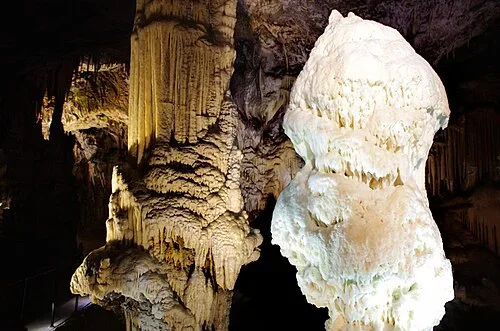 The Brilliant and the Ornate Column
The Brilliant Stalagmite
Every famous cave has one formation that stands for the whole, and this is Postojna's: the Brilliant. It is a stalagmite of almost pure white calcite, glowing where the rock around it is grey and dull. A film of water still slides down its surface, so the stone seems lit from within. Visitors gave it a name to match its shine. The Brilliant, together with the column beside it, became the official symbol of Postojna Cave, the image that stands for the whole underground world beyond it.
Listen in the appToyah · CC0
09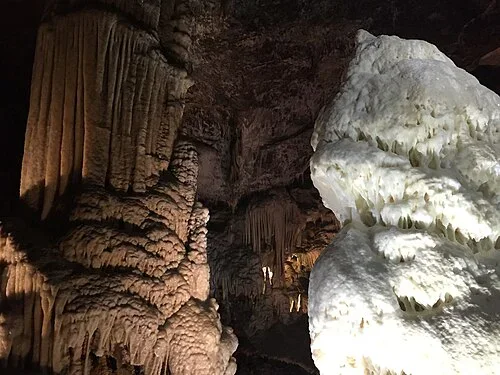 The Brilliant and the Ornate Column
The Brilliant and the Column
The Brilliant does not stand alone. Beside it rises a column, thick and dark, streaked and knotted where flowstone has built up over the ages. The two together are a pair of opposites, the gleaming white stalagmite and the somber pillar at its side. Both grew from the same dripping water in the same chamber, yet one stayed snow-white while the other took on the color and texture of the cave around it.
Listen in the appToyah · CC0
10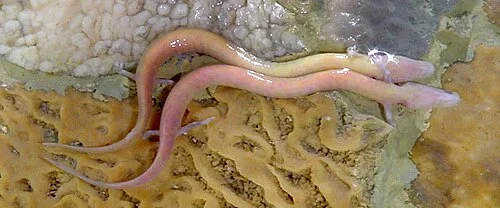 Vivarium: The Cradle of Speleobiology
The Olm in the Vivarium
This pale, slender animal is the olm, Proteus anguinus, the largest cave-dwelling amphibian in the world. The story goes that villagers who found young olms washed out of the caves after floods took them for dragon hatchlings, and the name baby dragon stuck. The real animal is quieter than the legend: pale and slight, made for a life of permanent darkness. It was here that biologists first realized how much life caves hold, and the olm became its most famous creature. A biological station opened in this cave in 1931, one of the earliest laboratories of its kind anywhere. Then came a first no one had managed before. On the thirtieth of January 2016, a female olm in the cave's aquarium began laying more than fifty eggs. From late May to mid-July, twenty-two young hatched safely. Postojna had become the first tourist cave in the world to breed olms in captivity, and the news circled the globe.
Listen in the appBoštjan Burger · Public domain
- 11
The Concert Hall
A chamber the size of a city square, with acoustics good enough for symphony orchestras.
- 12
The Pivka Underground
The river still at work below the walkway, and the wartime sabotage that burned for seven days.
Postojna Cave
Frequently asked questions
How much does the guide cost?
Free app download. Listed guide price: $0.99. Guide price shown in the app. Audio guide only. Venue admission is separate.
Can I listen without internet?
Yes. Download the guide’s audio, images, and maps in the app before your visit. Your downloaded content is then available offline.
Can I listen in my language?
This audio guide is available in 15 languages, including English.
Do I need to follow a schedule?
No. This is a self-guided experience. Choose your stops, pause whenever you like, and return to a story at your own pace.
At your own pace
Explore Postojna Cave.
Download Stanza, then search for “Postojna Cave”.
Free app download · Guide price shown in the app
Keep exploring
Nearby audio guides
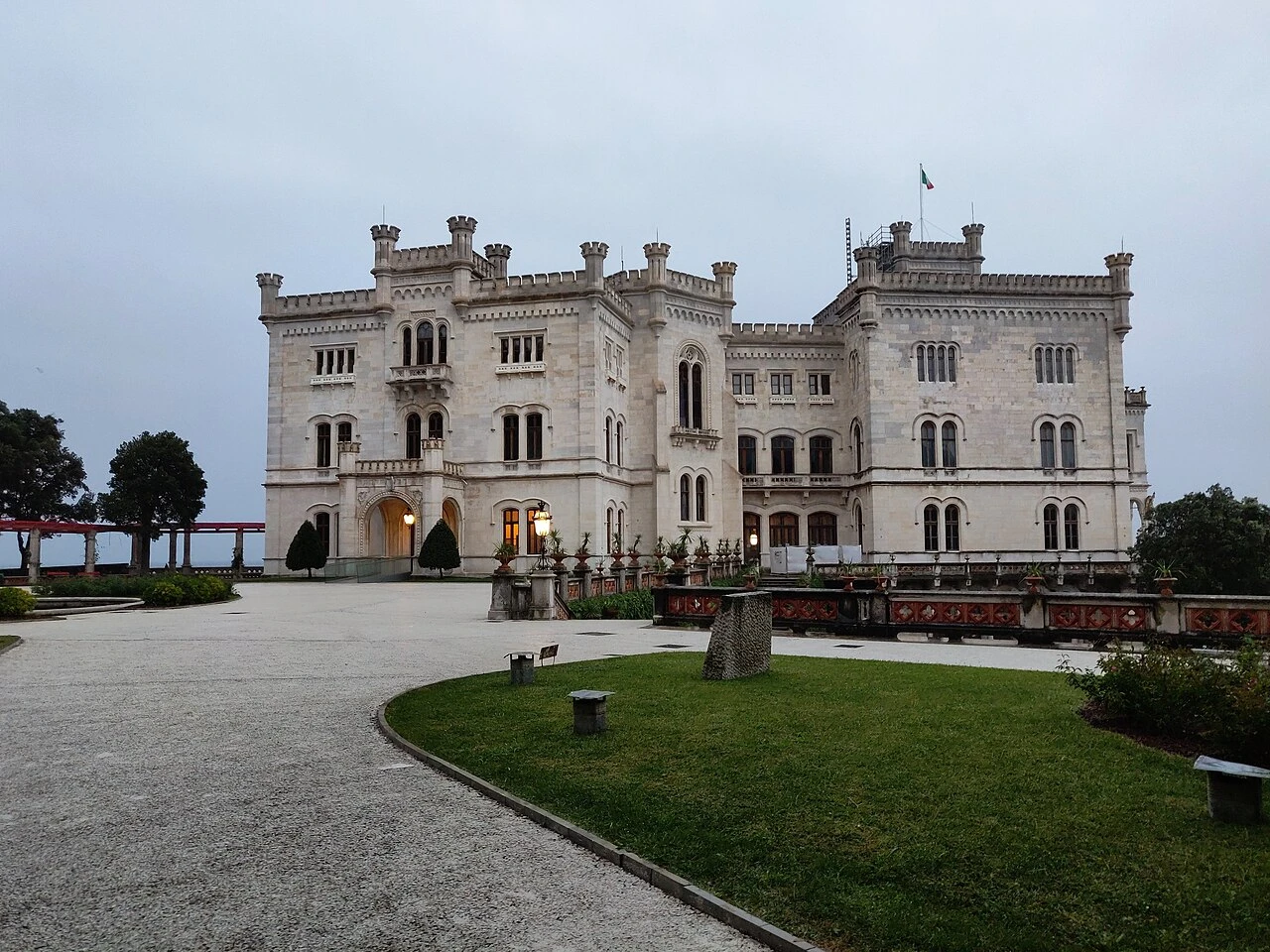
Trieste · 39 km
Miramare Castle
Content & sources
Michał Bulsa · CC BY-SA 4.0
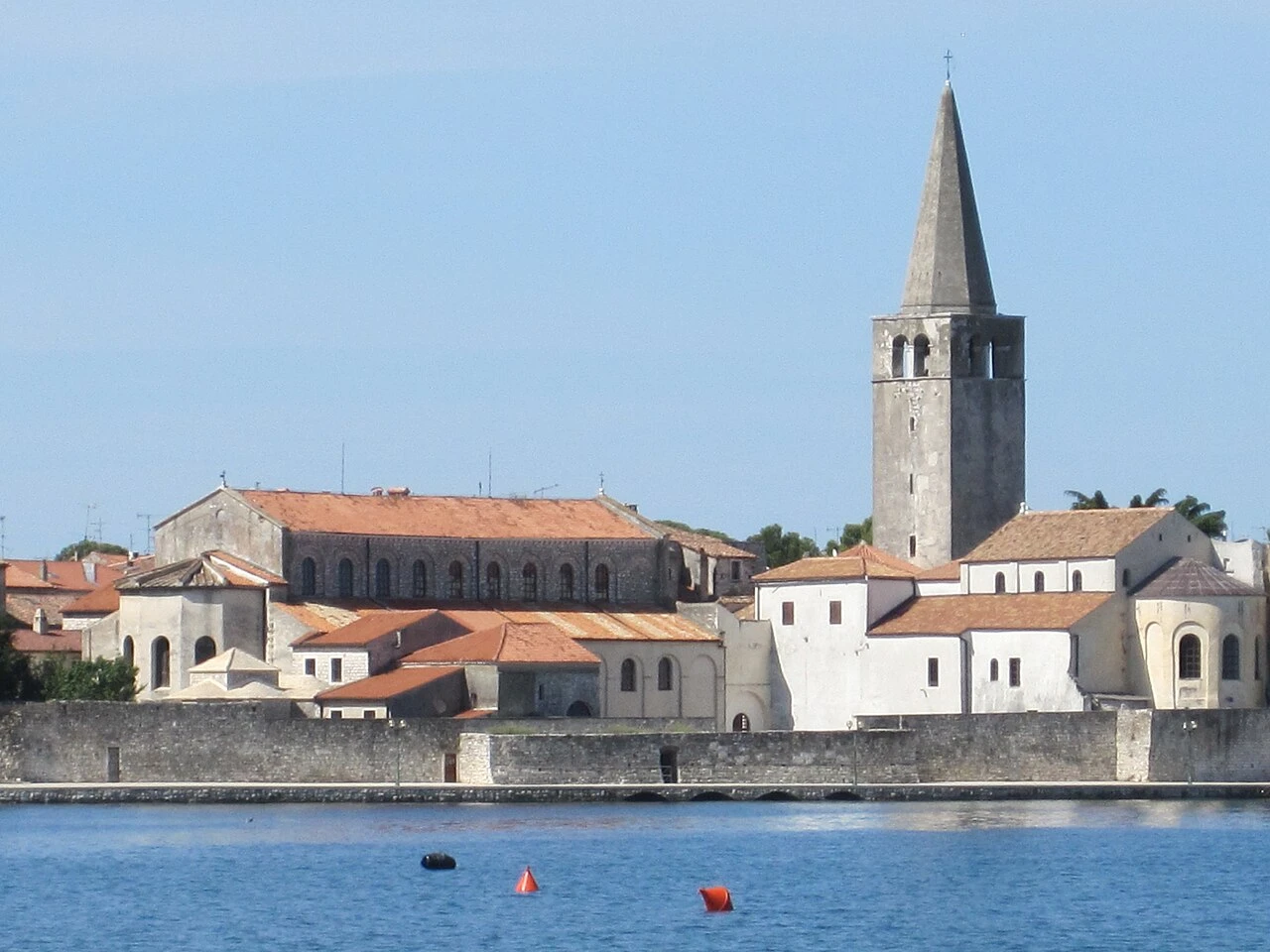
Grad Poreč · 78 km
Euphrasian Basilica
Content & sources
Photo: Tiefkuehlfan · CC BY-SA 4.0
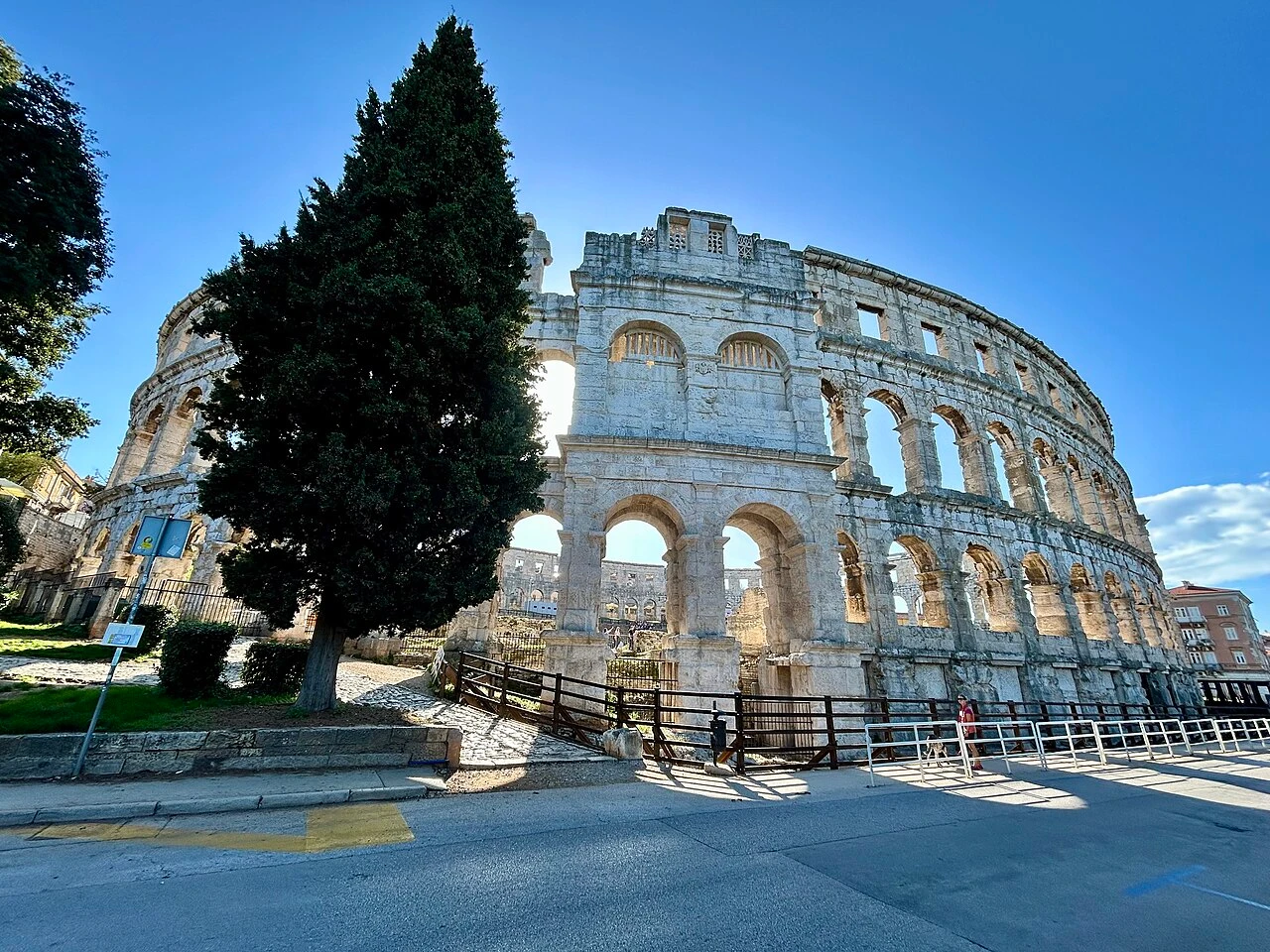
Grad Pula · 105 km
Pula Arena
Content & sources
Photo: Olgierd Rudak · CC BY-SA 4.0
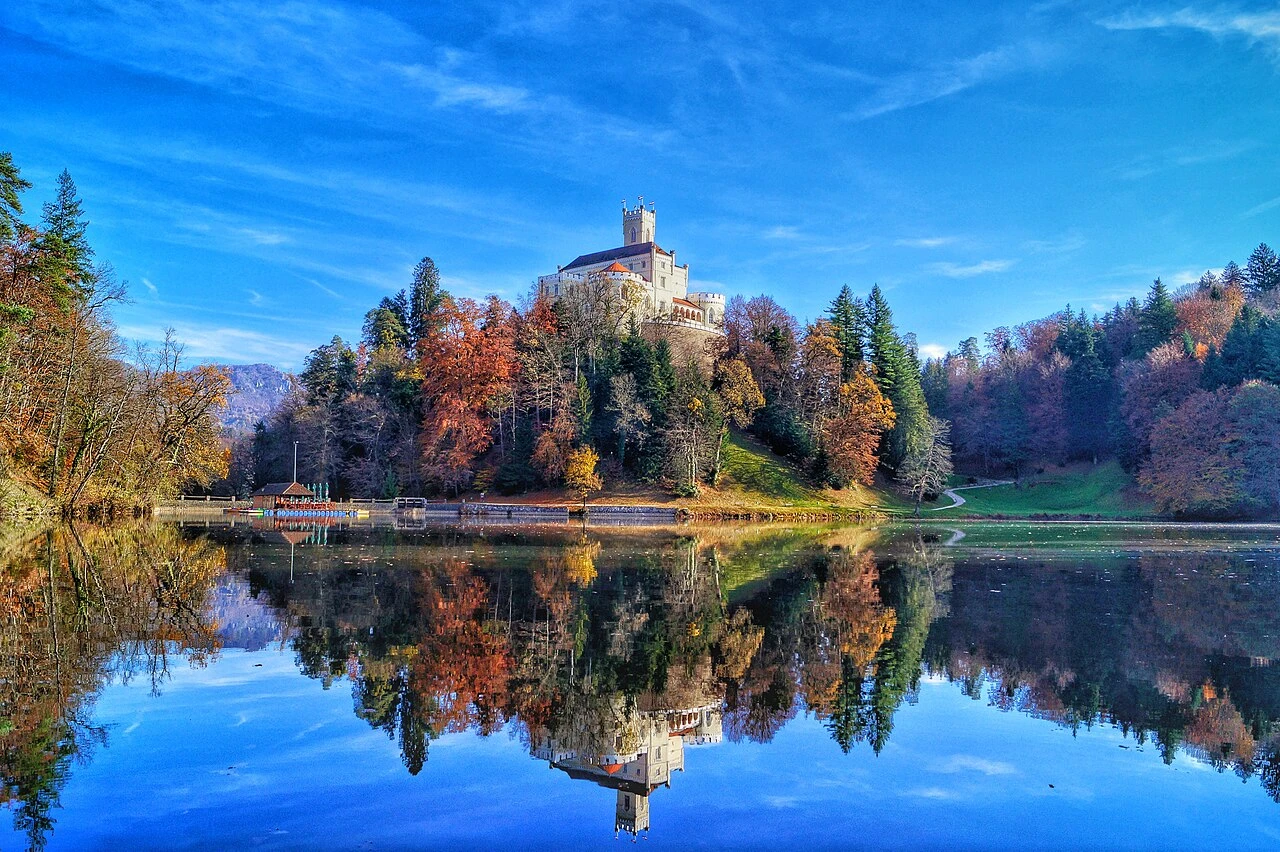
Trakošćan · 145 km
Trakošćan Castle
Content & sources
Drazen Dombaj · CC BY-SA 4.0