Stanza · Audio guide
Caracol Audio Guide
A place to remember. A story to take with you.
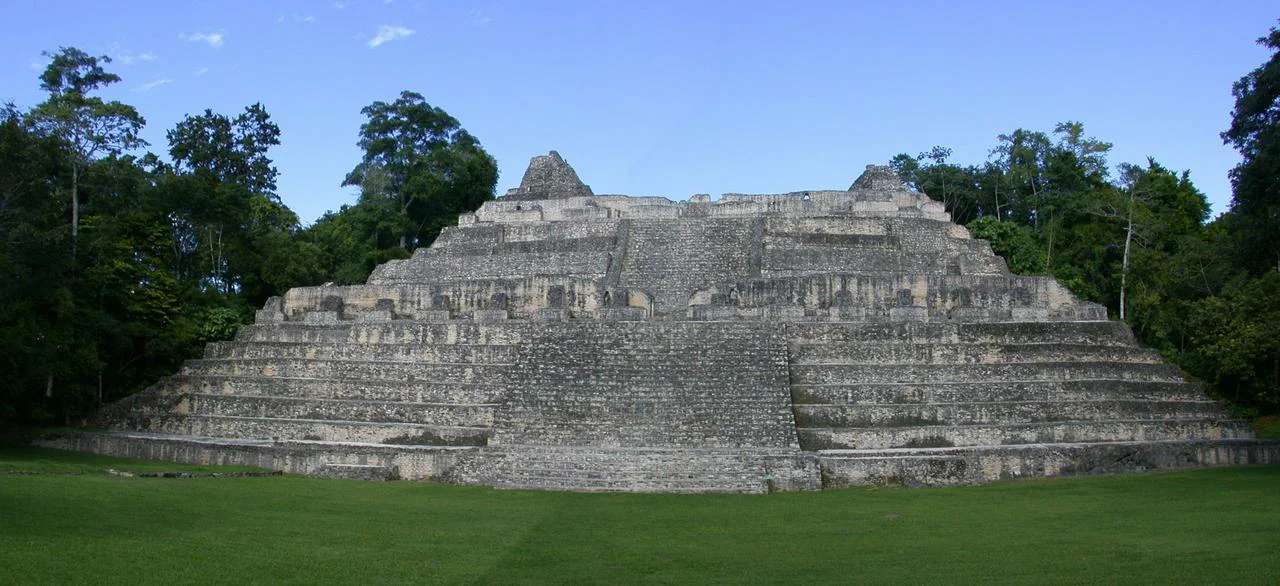
Caracol is a large ancient Maya archaeological site located in the Cayo District of Belize. It was one of the most important regional political centers of the Maya Lowlands during the Classic Period.
Download Stanza, then search for “Caracol”.
About the tour
One guide. Your kind of visit.
Caracol is a large ancient Maya archaeological site located in the Cayo District of Belize. It was one of the most important regional political centers of the Maya Lowlands during the Classic Period.
Ready when you are.
- 01Get the free Stanza app.
iOS & Android
- 02Find your guide.
“Caracol”
- 03Download before you go.
Works offline
Audio guide / 13 narrated stops
Inside the guide
Get to know a few of the stories before you go. Open a stop to read more.
01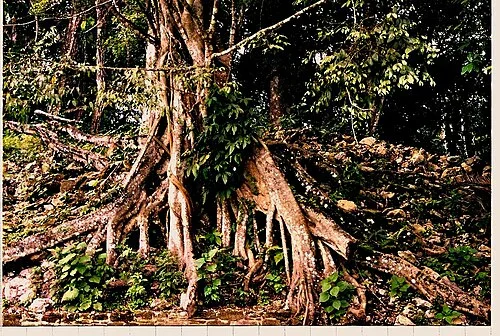 Arrival at Caracol and the Jungle Discovery
Arrival in the Chiquibul Forest
Welcome to Caracol, one of the largest cities the ancient Maya ever built. For centuries it lay hidden under the forest of the Chiquibul, on a plateau in the foothills of the Maya Mountains. Tree roots grip the fallen stone, and the jungle simply grew over the ruins. In 1937 a mahogany logger named Rosa Mai came searching for hardwood and found the remains instead. He reported them to the archaeological commission of British Honduras, the country now called Belize. A year later the commissioner, A. H. Anderson, traveled out to see the place for himself. He gave it its modern name, Caracol, Spanish for snail, after the winding access road that led there. The Maya who lived here knew it as Uxwitza', Three Water Hill.
R Barraez D´Lucca · CC BY 2.0
02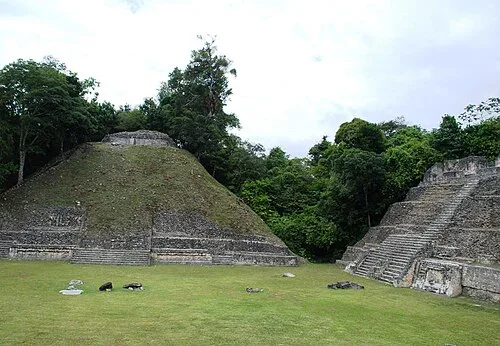 The A-Group Plaza and Astronomical E-Group
The A-Group Plaza and E-Group
This plaza ranks among the oldest ceremonial grounds at Caracol. Temples stand on three sides of it, and a long platform on the west carries six more structures. Underneath lies an earlier complex in the E-Group style of the city of Uaxactun, completed by AD 70. E-Groups were built for the sky. From the western platform, an observer watching the sun rise over the eastern temple could mark the solstices and the equinox. The same arrangement repeats across Maya cities for centuries, a calendar written in architecture. People were gathering here far back in the Middle Preclassic, long before the temples took this final shape. One early temple on the plaza, the Temple of the Wooden Lintel, was constructed and consecrated around AD 70. Ritual deposits were placed in these buildings from the Late Preclassic onward, and burials followed in the Late Classic.
Photo: Elelicht · CC BY-SA 3.0
03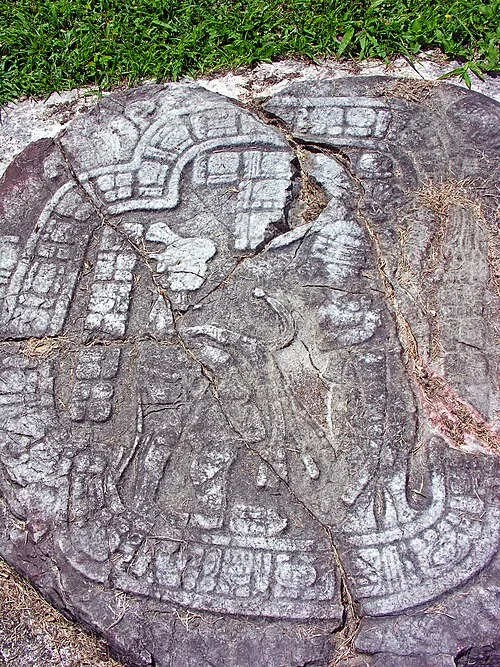 The A-Group Plaza and Astronomical E-Group
A Carved Monument of the Early Dynasty
Caracol's royal history survives largely in stone. The site preserves fifty-three carved monuments. Twenty-five of them are stelae. The other twenty-eight are altars. This round, cracked stone from the A-Group Plaza shows the carvers' craft at its most detailed, a surface crowded with figures and glyph blocks. Texts like these are how anyone knows Caracol's dynastic story at all. One stela here carries enough legible glyphs to place it in the reign of Yajaw Te' K'inich the First, which makes it the second oldest stela at the site. It settles something bigger too. The ruler appears in standard Early Classic pose, holding the ceremonial bar and wearing a god mask, confirming that a royal dynasty governed Caracol. People occupied this area by 1200 BC, though the city center itself was built up later, between 650 BC and AD 950.
Listen in the appDennis G. Jarvis · CC BY-SA 2.0
04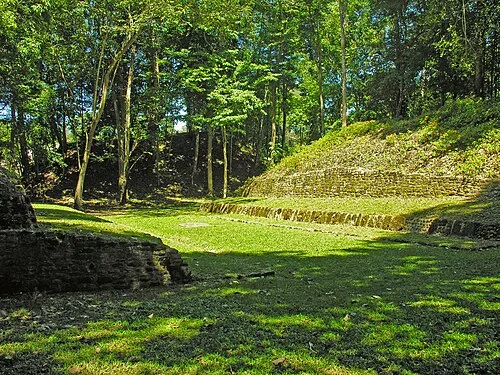 The A-Group Ballcourt and the Tikal Star Wars
The A-Group Ballcourt
Two low parallel buildings frame a narrow alley: a ballcourt, built for the Mesoamerican ballgame. The game ran deep through Maya life. Teams played a rubber ball in formal courts like this one across the lowlands, and the matches carried real weight, tied to ceremony and to rivalry between cities. Caracol's court held a carved stone marker at the center of the playing alley. Markers of this kind were carved with glyphs and images, and a marker's text could commemorate the events a city most wanted remembered. The courts themselves were more than playing fields. They were public stages, where a city displayed its gods and its politics before a crowd.
Listen in the appDennis G. Jarvis · CC BY-SA 2.0
05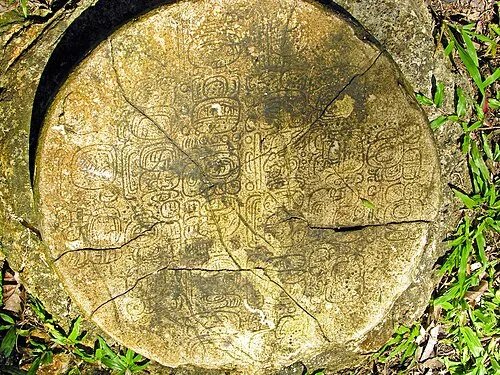 The A-Group Ballcourt and the Tikal Star Wars
Altar 21 and the Star War of 562
In the mid-sixth century Caracol was the junior partner to Tikal, a great city about seventy-five kilometers to the northwest. Caracol's king, Yajaw Te' K'inich the Second, known as Lord Water, took the throne in 553 under the watch of Tikal's lord, Wak Chan K'awiil. Three years later Tikal struck first, defeating Caracol in what the glyphs call an axe war. In 562 Lord Water answered. He enacted the first recorded star war, a form of warfare whose glyph shows a star pouring liquid onto the earth. The star war broke Tikal. Its lord Wak Chan K'awiil was defeated, monuments in Tikal's Great Plaza were destroyed, and the city fell silent for a hundred and twenty years. Caracol rose through that silence, its population and its building both growing. Altar 21, a giant altar carved with the victory's story, stood among the first monuments raised after the war. Its discovery in 1986 made archaeologists re-examine that long quiet stretch at Tikal.
Listen in the appDennis G. Jarvis · CC BY-SA 2.0
06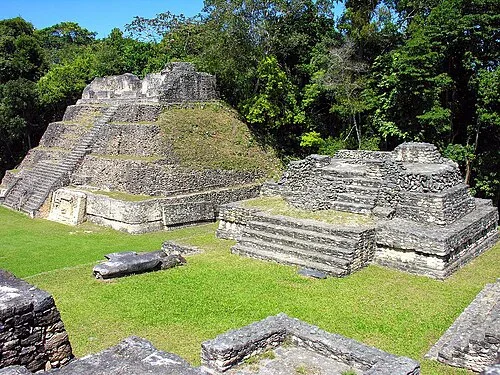 Plaza B and the LiDAR Terrace Network
Plaza B and the City of 200 Square Kilometers
The wars ended, and Caracol boomed. From AD 636 a great building campaign transformed the city, and King K'an II, its most successful ruler, commissioned more monuments than any king before him. What the city became shows best from the air. In 2009 an aircraft flew a LiDAR survey, bouncing laser pulses through the forest canopy, and mapped two hundred square kilometers of ruins. The city proved larger than modern Belize City, with houses, terraces and plazas spread almost evenly across the land. Roughly two hundred and sixty-seven structures crowd each square kilometer. That is about eighty-five percent denser than Tikal. Broad raised roads, the causeways, run outward from the center for about ten kilometers, reaching termini with names like Cahal Pichik, Ceiba and Retiro. Population estimates from the survey run between seventy and a hundred thousand people. The whole landscape was engineered, down to the farming terraces between the houses.
Listen in the appDennis G. Jarvis · CC BY-SA 2.0
07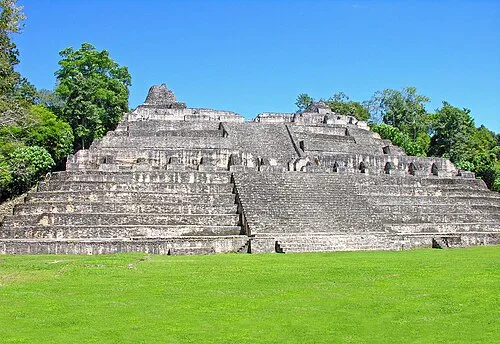 Caana: Climbing the Sky Palace
Caana, the Sky Palace
Caana means sky-palace, and the name fits. It is the largest building at Caracol, and at forty-three meters it remains the tallest manmade structure in Belize. A monumental stairway climbs the front face to a summit of palace rooms rather than a temple shrine. Excavators found no ritual caches along its axis, and its rooms resemble a royal residence. This was the seat of Caracol's royalty at the heart of the city, at the north end of the B-Group Plaza. The latest building phase dates to after AD 800, tying Caana to the city's final great era. Its last construction raised the top floor four meters above the floor before it. The whole mass of it still dominates the site's skyline.
Listen in the appDennis G. Jarvis · CC BY-SA 2.0
08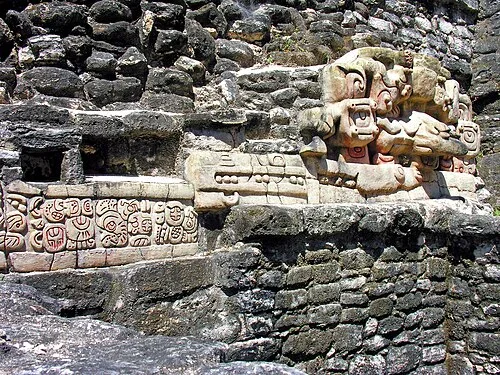 Caana: Climbing the Sky Palace
The Stucco Frieze of Caana
Maya builders did not leave palace walls plain. They modeled stucco, a wet plaster, into portraits of gods and kings, then painted it in bright colors. On an earlier building phase of Caana, excavators found an intact stucco frieze in 1991, sealed and preserved beneath later construction. A surviving mask shows the art at work: a modeled face with curling features, set beside a band of glyph blocks. Facades like this broadcast a dynasty's claims in public, an image of gods and ancestors high over the palace. The exact identity of the figure remains uncertain. The craft is not in doubt. Every curl and glyph was shaped by hand in plaster, meant to be read from the plaza far below.
Listen in the appDennis G. Jarvis · CC BY-SA 2.0
09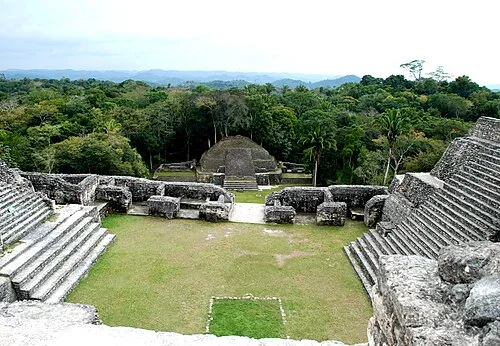 Caana Summit and the Royal Tombs
From the Caana Summit
From the top of Caana, Caracol arranges itself in layers. The plazas of the great groups open out one after another, and beyond them the tree-covered mounds run toward the horizon of the Chiquibul forest. Royal architecture sat at the head of it all, with the city spreading outward from these cores. The same forest that buried the buildings now frames them. On a clear day the view carries to the distant hills, the whole catchment of a Maya capital in a single sweep.
Listen in the appPhoto: Elelicht · CC BY-SA 3.0
10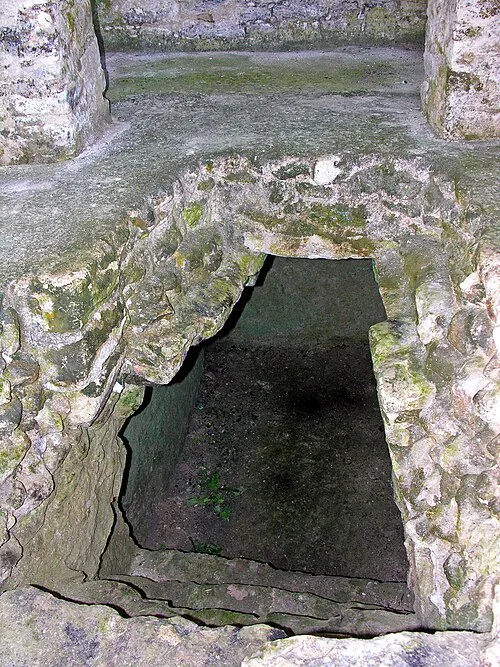 Caana Summit and the Royal Tombs
The Royal Tombs of Caana
Inside Caana, Caracol's royalty were buried in stone chambers, and some of those chambers carry painted writing. Structures B19 and B20 held elite tombs with hieroglyphic texts painted on their walls. The text in Structure B20, dated to AD 537, is the earliest known hieroglyphic writing associated with a Maya tomb. Another painted tomb came to light in 1986, holding a royal woman. The date on its wall corresponds to AD 634. Simon Martin and Nikolai Grube suggest that this text records Lady Batz' Ek', a noblewoman whose arrival at Caracol is recorded in the late sixth century. She bears the emblem of the Snake polity, and the alliance she may have helped build later brought down Naranjo. Caracol buried its dead differently from other Maya cities, reusing special chambers for multiple burials over time. Two more elite tombs turned up at the base of B19 in 2001.
Listen in the appDennis G. Jarvis · CC BY-SA 2.0
- 11
The Barrio Palace Compound
A palace compound still under construction on the day its city was abandoned.
- 12
The North Acropolis and the City's Beginnings
A sealed cremation deposit ties Caracol's royal founding to distant Teotihuacan.
- 13
The Site Model: Two Thousand Years of a City
The site model that condenses two thousand years of a Maya city into one tabletop.
Caracol
Frequently asked questions
How much does the guide cost?
Free app download. Listed guide price: $0.99. Guide price shown in the app. Audio guide only. Venue admission is separate.
Can I listen without internet?
Yes. Download the guide’s audio, images, and maps in the app before your visit. Your downloaded content is then available offline.
Can I listen in my language?
This audio guide is available in 15 languages, including English.
Do I need to follow a schedule?
No. This is a self-guided experience. Choose your stops, pause whenever you like, and return to a story at your own pace.
At your own pace
Explore Caracol.
Download Stanza, then search for “Caracol”.
Free app download · Guide price shown in the app
Keep exploring
Nearby audio guides
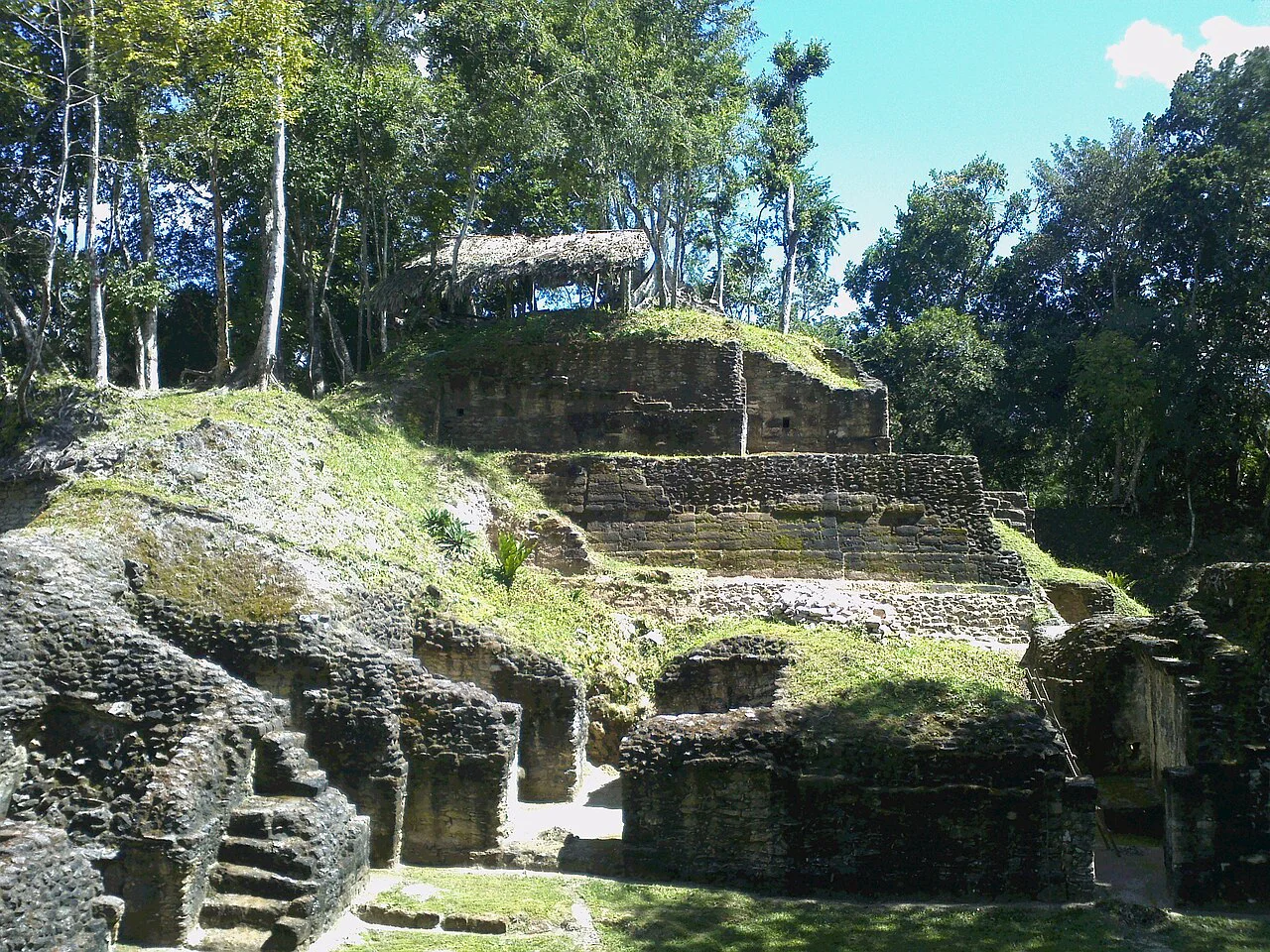
Melchor de Mencos · 44 km
Naranjo
Content & sources
Photo: Rudy Canales · CC BY-SA 3.0
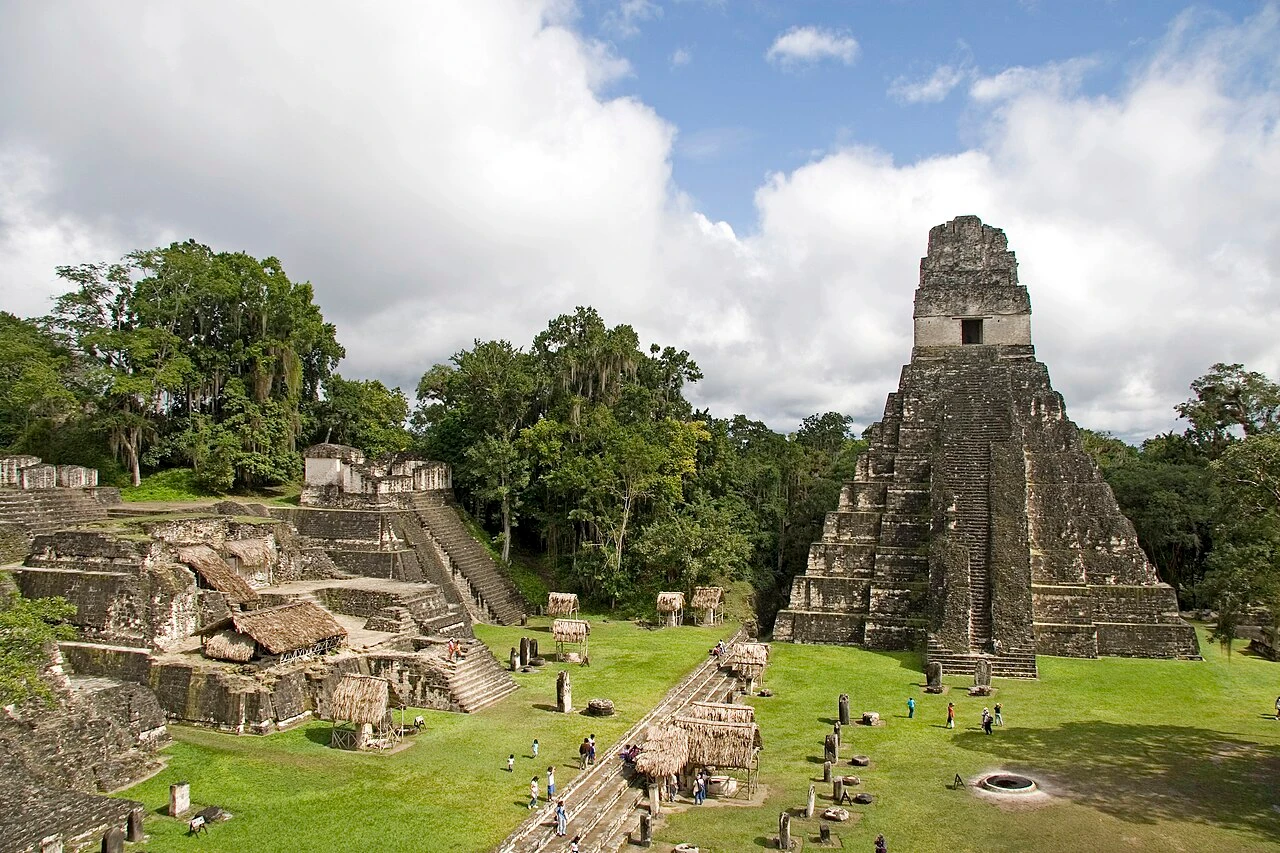
Flores · 74 km
Tikal
Content & sources
Photo: Mundo Maya · CC BY-SA 4.0
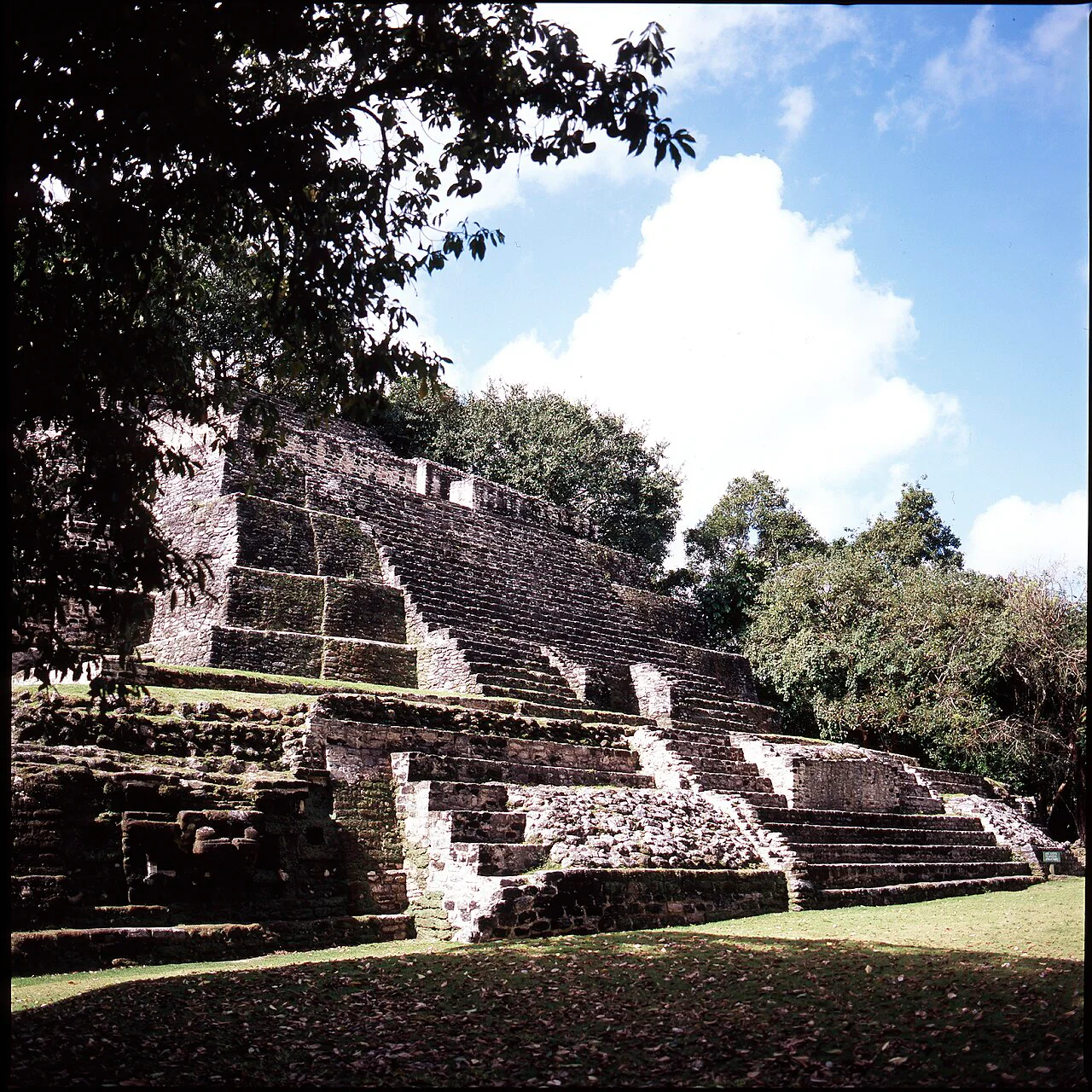
Indian Church · 122 km
Lamanai
Content & sources
Photo: Urbanarcheology · CC BY 3.0
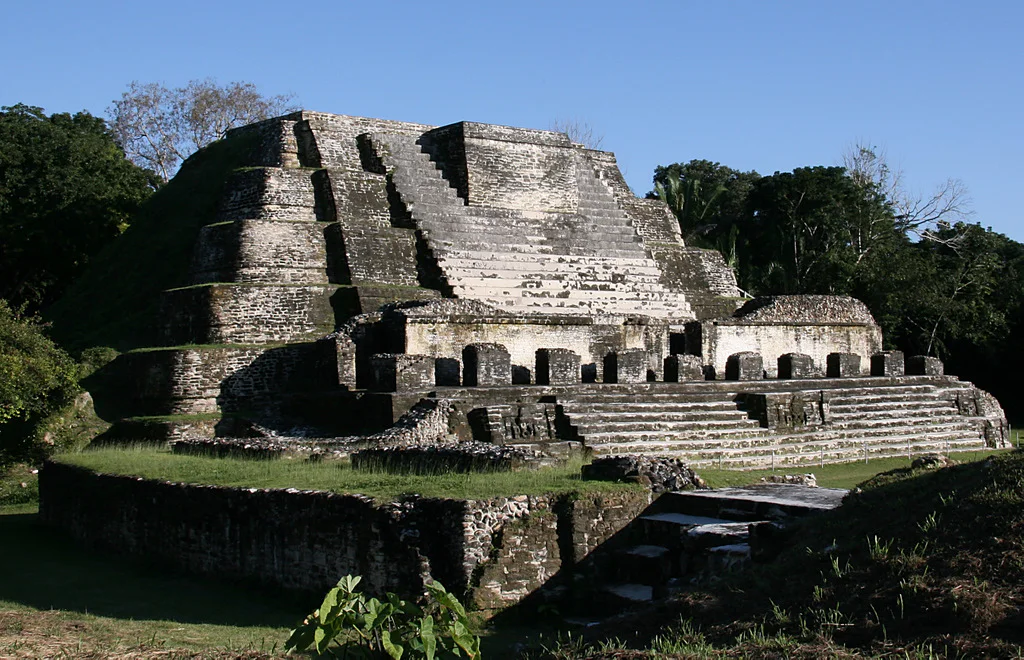
Rockstone Pond · 138 km
Altun Ha
Content & sources
Michael Lazarev (Asmadeus) · CC BY-SA 2.0