Stanza · Audio guide
Stari Most Audio Guide
A place to remember. A story to take with you.
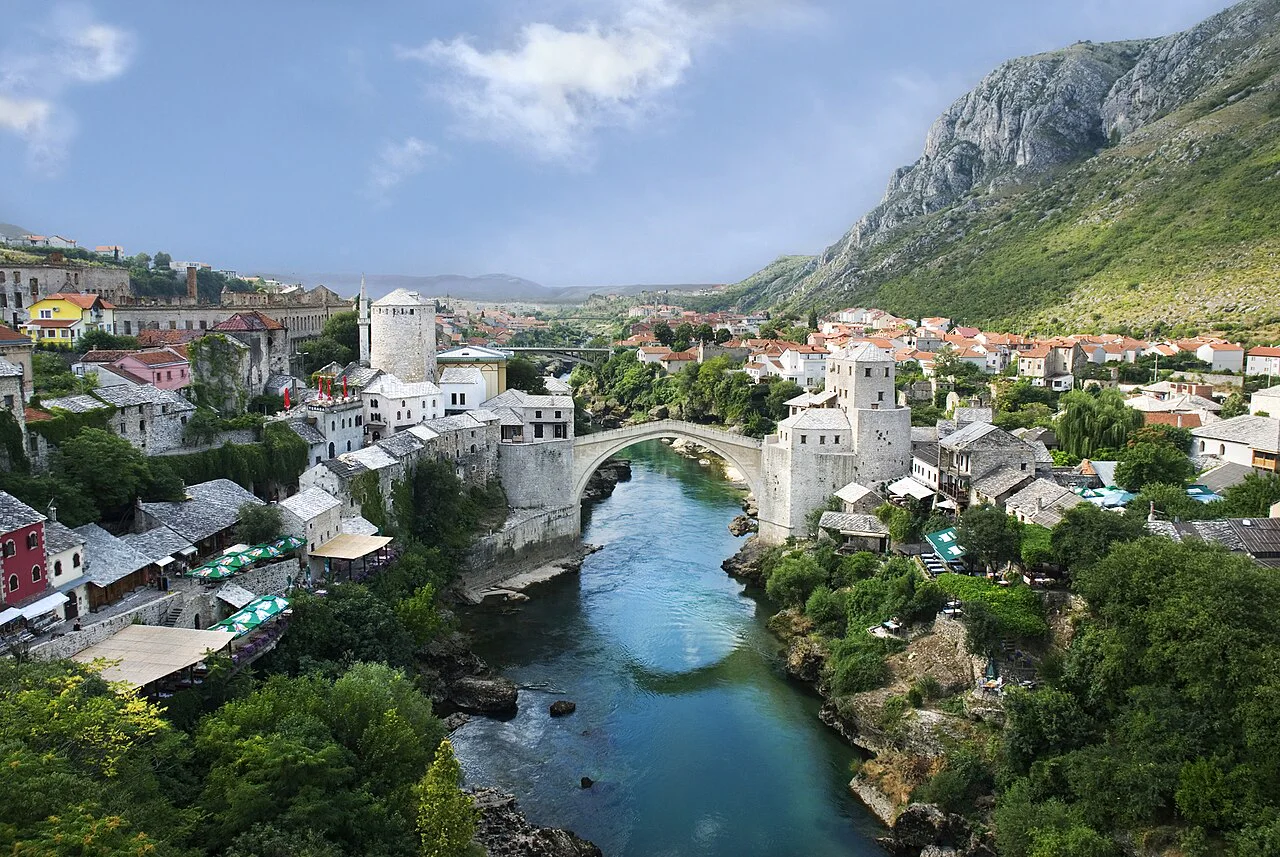
The Old Bridge is a rebuilt 16th-century Ottoman bridge in Mostar that crosses the river Neretva. It is an exemplary piece of Balkan Islamic architecture commissioned by Suleiman the Magnificent.
Download Stanza, then search for “Stari Most”.
About the tour
One guide. Your kind of visit.
The Old Bridge is a rebuilt 16th-century Ottoman bridge in Mostar that crosses the river Neretva. It is an exemplary piece of Balkan Islamic architecture commissioned by Suleiman the Magnificent.
Ready when you are.
- 01Get the free Stanza app.
iOS & Android
- 02Find your guide.
“Stari Most”
- 03Download before you go.
Works offline
Audio guide / 7 narrated stops
Inside the guide
Get to know a few of the stories before you go. Open a stop to read more.
01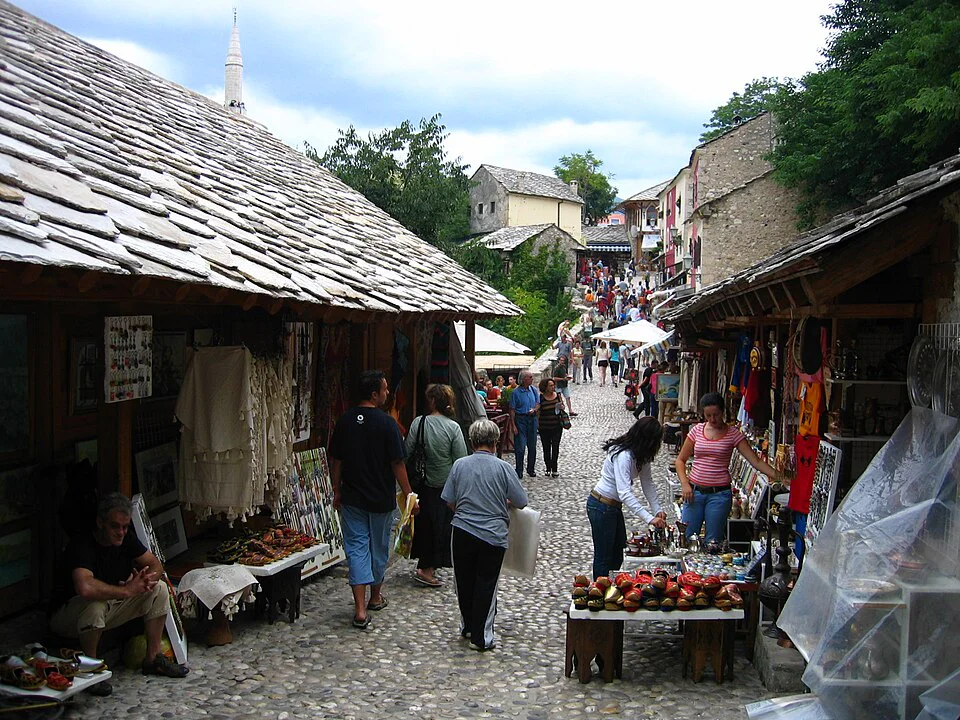 Kujundžiluk Old Bazaar
Kujundžiluk, the Old Bazaar Street
Welcome to Mostar, where a single bridge holds the story of a whole town. The cobbled lane called Kujundžiluk is the historic eastern approach to the Old Bridge, a market street lined with small shops since Ottoman times. Before any stone bridge stood here, the Neretva was crossed by a wooden suspension bridge hung on chains. The Ottoman writer Katip Çelebi described it: it swayed so much that people crossing it did so in mortal fear. As Ottoman rule took hold, the little settlement beside the crossing grew larger and more important, and the market street grew with it. The name Mostar comes from the mostari, the bridge keepers who guarded the old crossing. The town is, in a sense, named after a job. Through the bazaar and down the lane, the first of the bridge's old towers stands waiting at the end of the street.
Photo: Neoneo13 · Public domain
02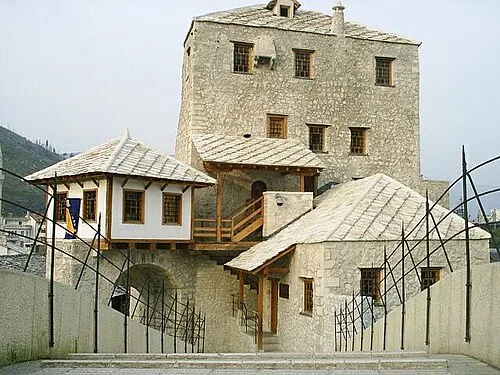 Halebija Tower and Eastern Approach
Halebija Tower, the Eastern Bridge Keeper
Every valuable river crossing needed defenders, and this one got two towers. The Halebija tower rises on the northeast bank, a solid block of stone with small windows and walls built for watching rather than comfort. Across the river stands its partner, the Tara tower on the southwest bank. Together the two were known as the bridge keepers, the mostari. Their garrisons collected tolls from travellers, kept order on the approaches, and controlled one of the key crossings of the Neretva in Ottoman Herzegovina. Whoever held the towers held the way across. Merchants, armies and pilgrims all passed between these walls, and all of them paid or answered to the keepers inside. The towers worked as a pair, a fortified gate at either end of the span.
Martin Brož · CC BY 3.0
03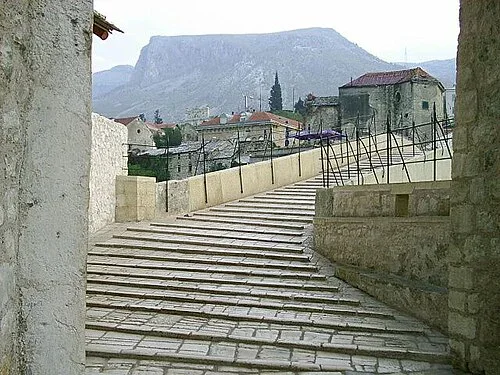 The Arch and Walkway
Crossing the Hump-backed Walkway
The steep climb is the first thing to know about crossing. The deck is hump-backed, paved in polished limestone slabs with raised ridges cut across them to keep feet from slipping. In 1557 Sultan Suleiman the Magnificent commissioned a stone bridge to replace the old wooden crossing. The designer was Mimar Hayruddin, a student and apprentice of the great Ottoman architect Mimar Sinan. Construction took nine years, and an inscription dates the completion to 1566. Very little of the building was written down; what survived are memories, legends, and the builder's name. One tradition holds that the mortar was mixed with egg whites. Another tells that Hayruddin worked under pain of death, charged to build an arch of unprecedented size. The story goes that on the day the scaffolding was removed, he prepared for his own funeral. The arch held.
Listen in the appMartin Brož · CC BY 3.0
04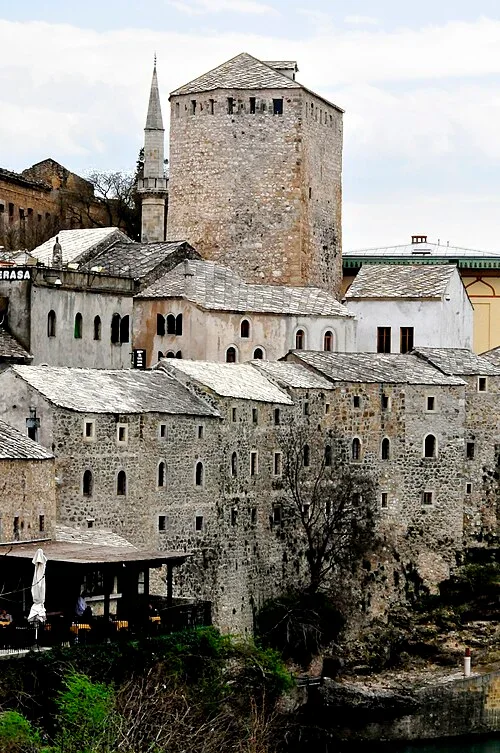 Tara Tower and Old Bridge Museum
Tara Tower and the Old Town Skyline
The Tara tower rises over the old town's stone roofs and minarets, the skyline that once framed the bridge at its feet. On 9 November 1993, during the Croat-Bosniak War, the bridge fell. It was 427 years old. Bosnian Croat forces shelled it after the Bosnian army used the crossing as a military supply line. Newspapers in Sarajevo reported that more than sixty shells struck it before the collapse. The Croat commander, Slobodan Praljak, later claimed an explosive charge had also been detonated under the bridge; most historians dismiss that claim. The war crimes tribunal in The Hague later judged the bridge a legitimate military target. Many scholars saw it differently: a structure of little military value, destroyed as shared heritage. András Riedlmayer called the act killing memory, or memoricide, aimed at what connected the city's communities.
Listen in the appPhoto: LBM1948 · CC BY-SA 4.0
05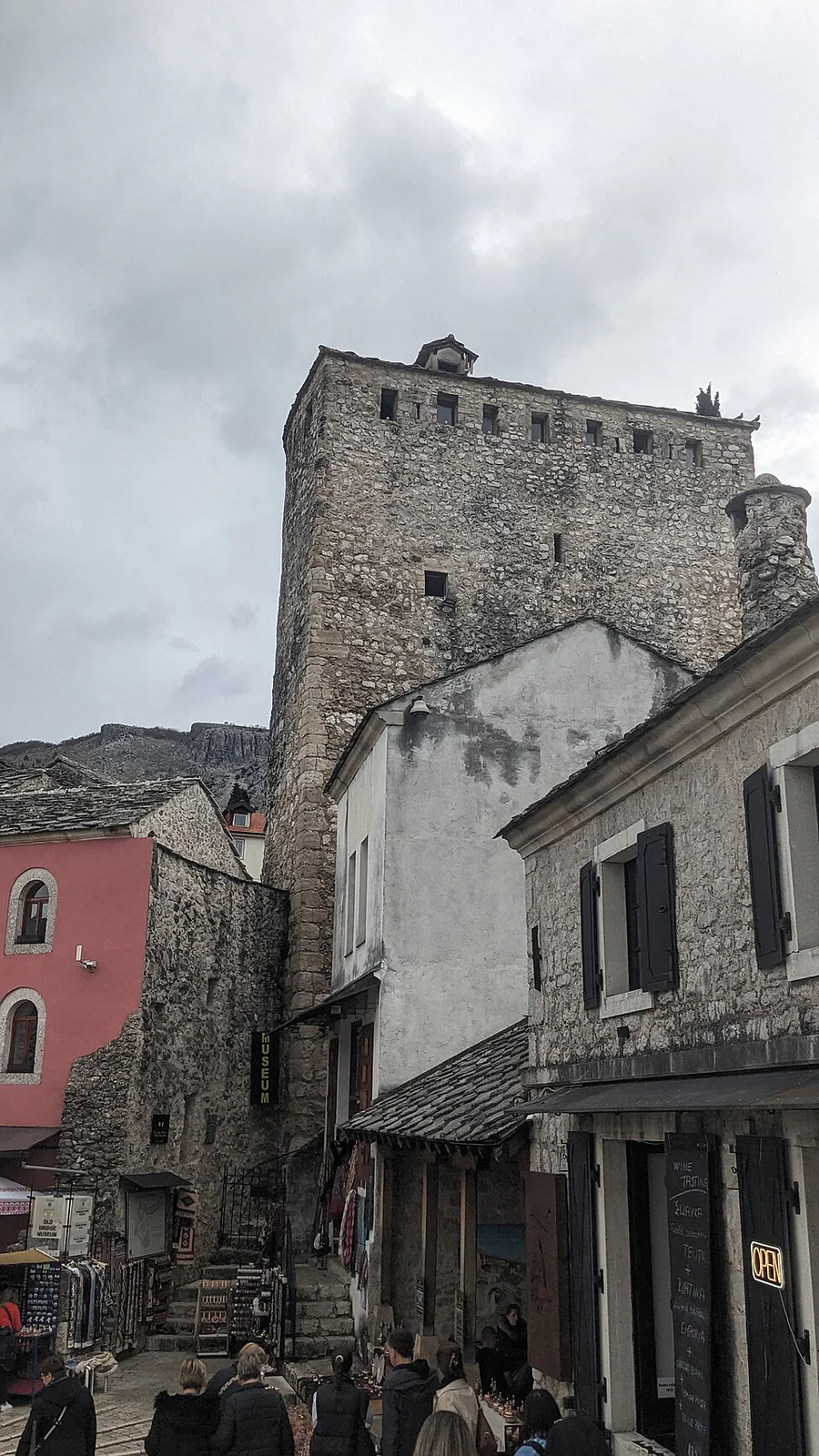 Tara Tower and Old Bridge Museum
Museum of the Old Bridge in the Tara Tower
The museum in the Tara tower tells how the bridge came back. After the war, a coalition formed to oversee the work: the World Bank, UNESCO, the Aga Khan Trust for Culture and the World Monuments Fund, with funding from Italy, the Netherlands, Turkey, Croatia and others. UNESCO gathered an international committee of experts, and the decision was made to rebuild as exactly as possible, with the same technology and the same materials. Hungarian army divers went into the Neretva and lifted blocks of the original bridge from the riverbed. Most were too damaged to reuse. The fine-grained limestone called tenelija came instead from local quarries, and the builders worked with Ottoman construction techniques once again. Reconstruction began on 7 June 2001. On 23 July 2004 the bridge reopened, at a cost of about fifteen and a half million dollars.
Listen in the appPhoto: Vano111ru · CC BY-SA 4.0
06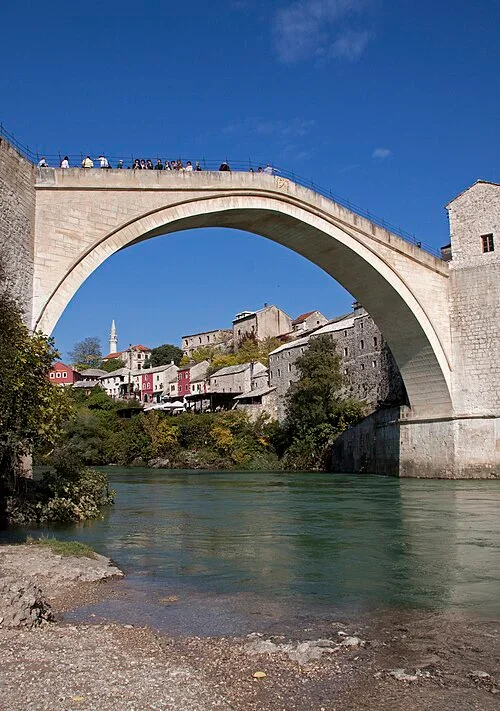 Neretva Riverbank Viewpoint
The Arch from the Riverbank
From the riverbank, the whole shape of the thing finally shows itself. A single stone arch spans about twenty-nine metres of the Neretva, its crown rising some twenty-four metres above the summer water. The walkway across is barely wider than a country lane. The clever part is underneath. The bridge has no foundations sunk in the river. It rests on limestone abutments tied to wing walls running along the cliffs on either bank, so the canyon itself carries the span. The Ottoman traveller Evliya Çelebi crossed here in the seventeenth century and wrote that the bridge is like a rainbow arch soaring up to the skies, extending from one cliff to the other. I, a poor and miserable slave of Allah, have passed through sixteen countries, he wrote, but I have never seen such a high bridge.
Listen in the appTony Hisgett from Birmingham, UK · CC BY 2.0
07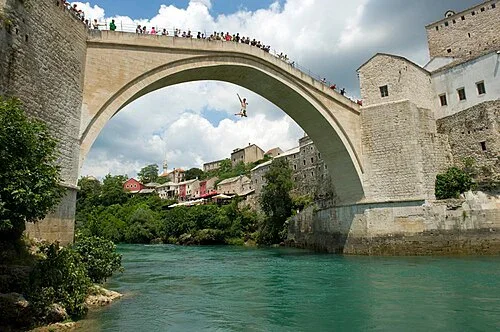 Neretva Riverbank Viewpoint
The Diver from the Bridge
High above the green water, a diver hangs in mid-air, arms spread, while a crowd lines the parapet above. Leaping from the arch into the Neretva has long been a rite for Mostar's young men. The river is very cold, and the jump demands skill and training. In 1968 the town made the tradition official, with a diving competition held every summer in late July. Since 2015 the bridge has also hosted a stop of the Red Bull Cliff Diving World Series, drawing jumpers from across the world. The first person to dive from the rebuilt bridge was Enej Kelecija. A crossing that guards once watched, that fell and was rebuilt stone by stone, is once again a stage for ordinary daring in Mostar, and its two banks are joined.
Listen in the appSven Wolter - mediaeclipse.de/photo · CC BY-SA 3.0 de
Stari Most
Frequently asked questions
How much does the guide cost?
Free app download. Listed guide price: $0.99. Guide price shown in the app. Audio guide only. Venue admission is separate.
Can I listen without internet?
Yes. Download the guide’s audio, images, and maps in the app before your visit. Your downloaded content is then available offline.
Can I listen in my language?
This audio guide is available in 15 languages, including English.
Do I need to follow a schedule?
No. This is a self-guided experience. Choose your stops, pause whenever you like, and return to a story at your own pace.
At your own pace
Explore Stari Most.
Download Stanza, then search for “Stari Most”.
Free app download · Guide price shown in the app
Keep exploring
Nearby audio guides
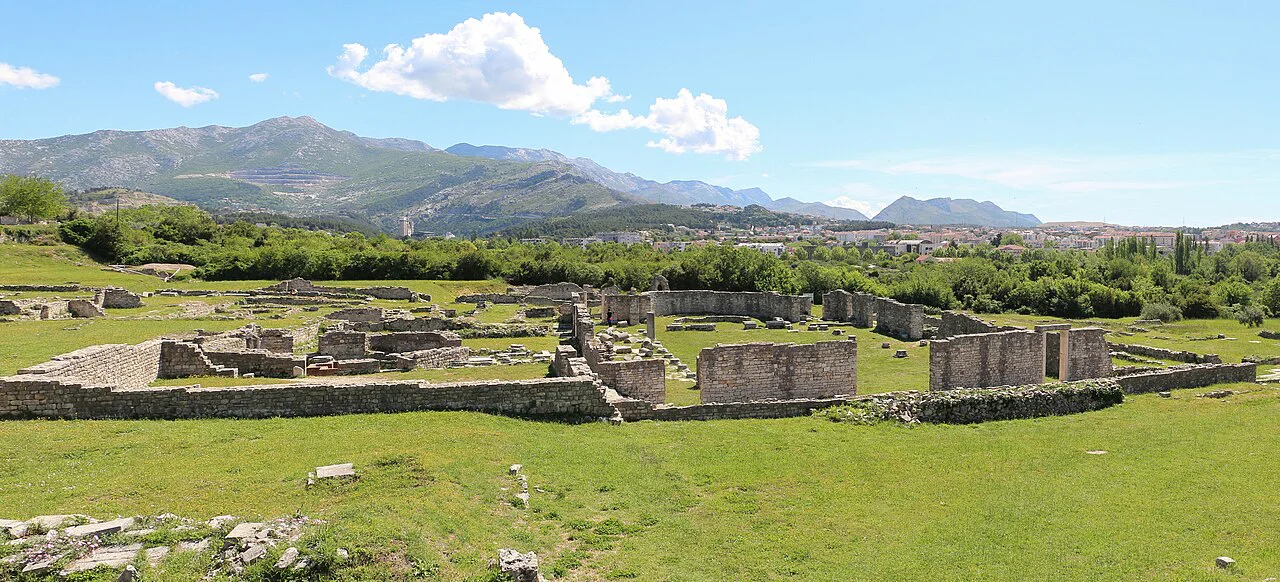
Solin · 110 km
Salona
Content & sources
Bernard Gagnon · CC BY-SA 4.0
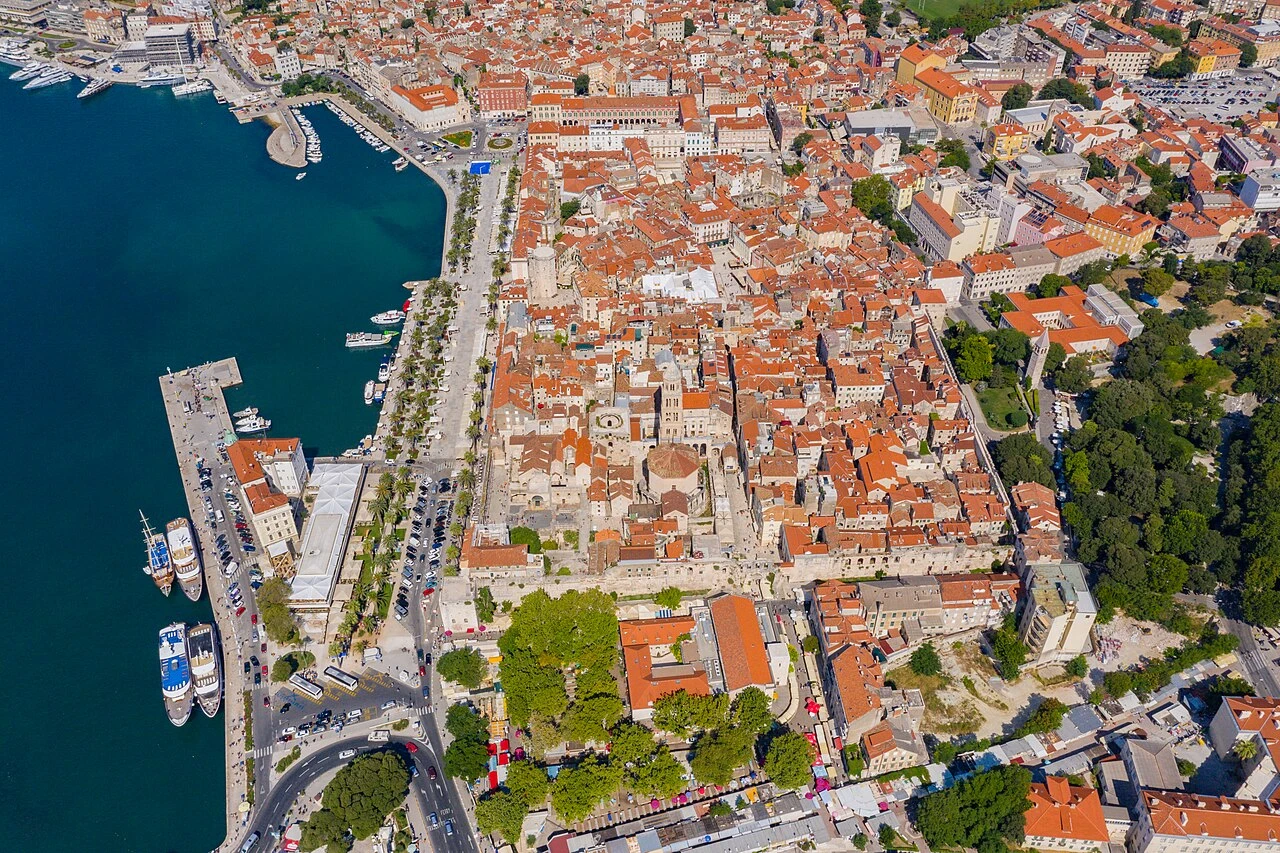
Split · 113 km
Diocletian's Palace
Content & sources
Photo: Dronepicr · CC BY 2.0
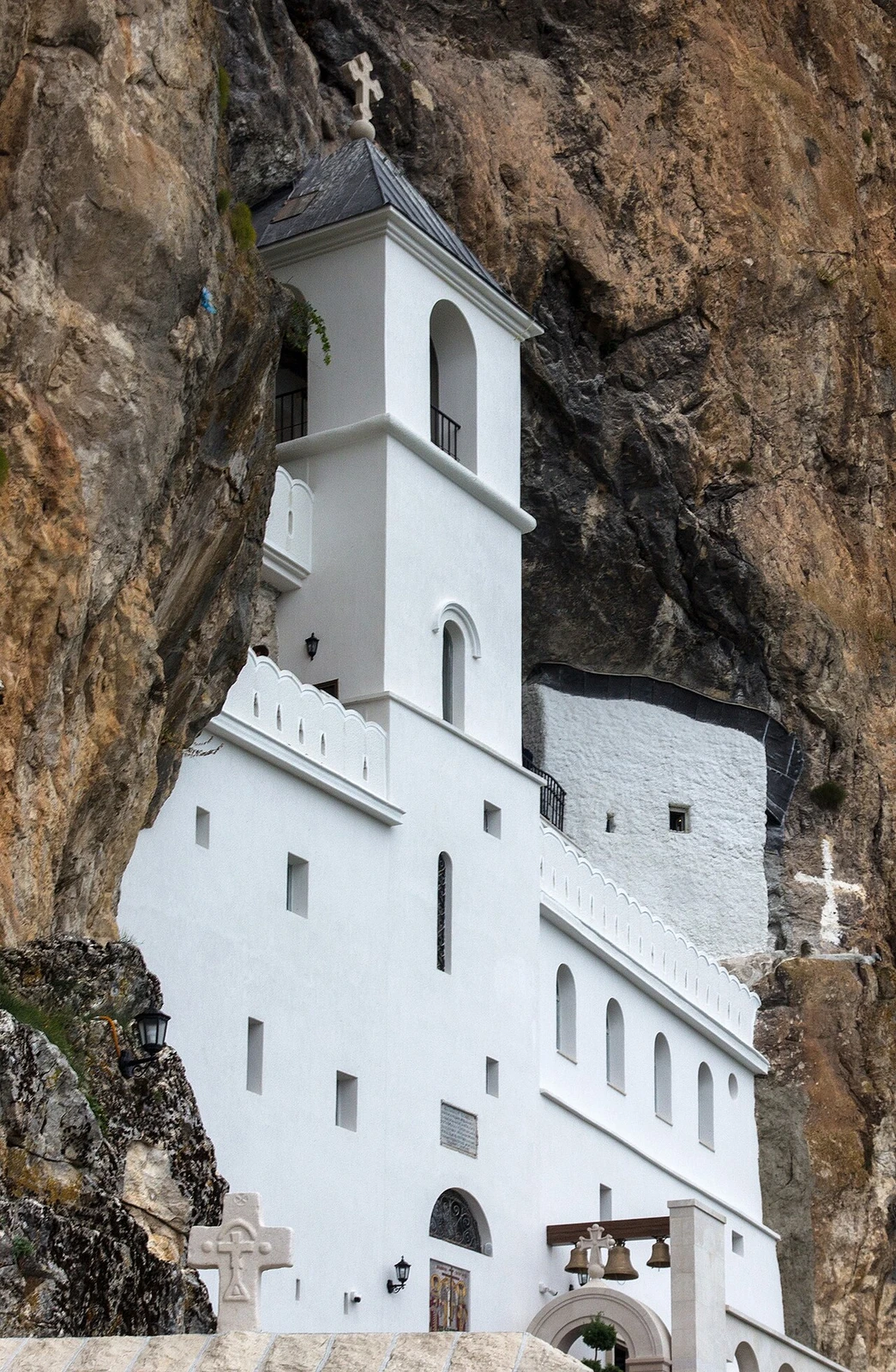
Danilovgrad Municipality · 123 km
Ostrog Monastery
Content & sources
Alexey Komarov · CC BY 3.0
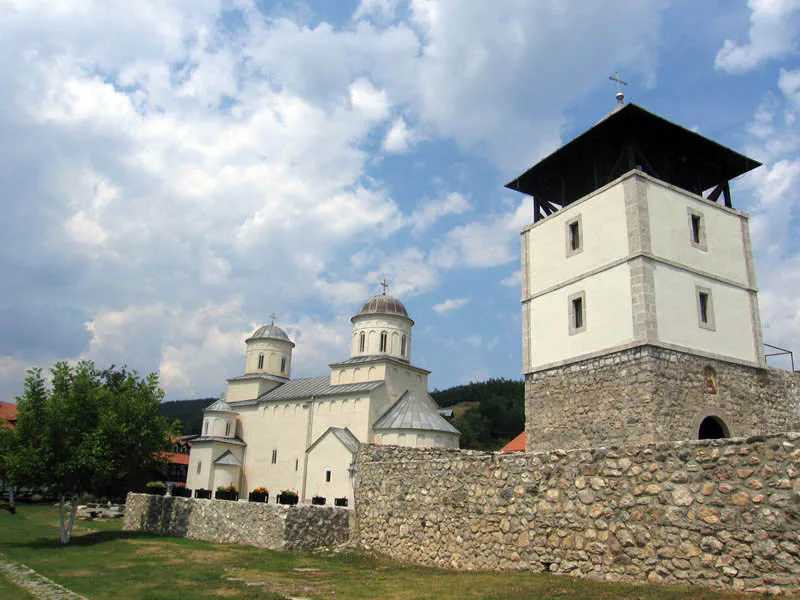
Prijepolje Municipality · 149 km
Mileševa Monastery
Content & sources
Snežana Trifunović · CC BY-SA 3.0