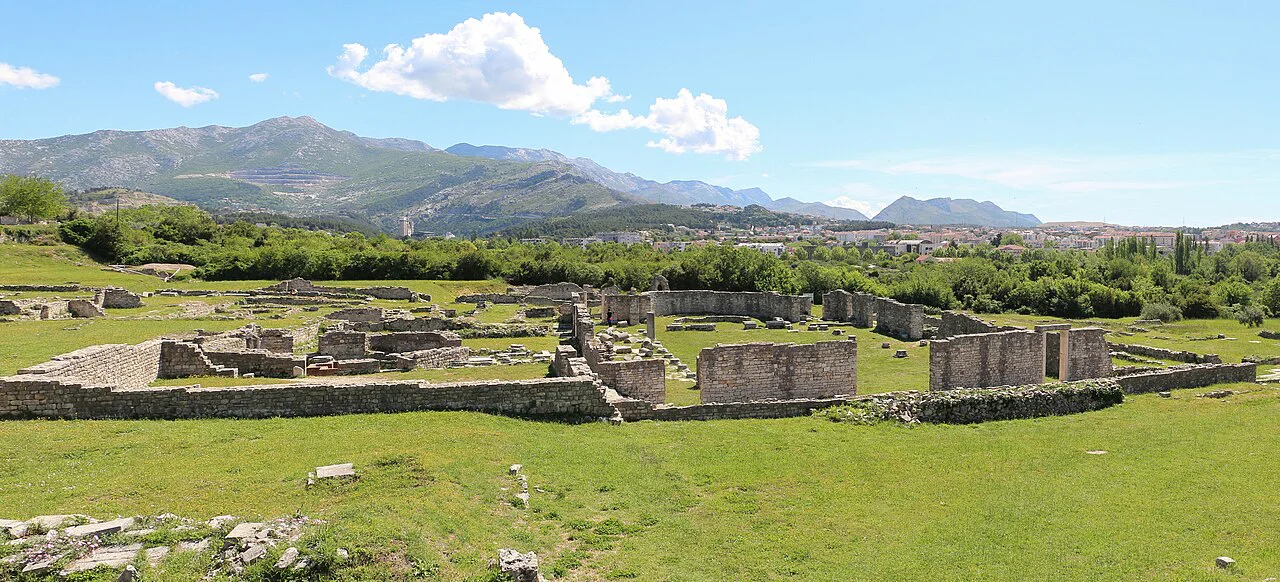
Stanza · Audio guide
Salona Audio Guide
A place to remember. A story to take with you.
Salona was an ancient city and the capital of the Roman province of Dalmatia. It was one of the largest cities of the late Roman Empire and served as the residence of the final Western Roman Emperor.
Download Stanza, then search for “Salona”.
About the tour
One guide. Your kind of visit.
Salona was an ancient city and the capital of the Roman province of Dalmatia. It was one of the largest cities of the late Roman Empire and served as the residence of the final Western Roman Emperor.
Ready when you are.
- 01Get the free Stanza app.
iOS & Android
- 02Find your guide.
“Salona”
- 03Download before you go.
Works offline
Audio guide / 18 narrated stops
Inside the guide
Get to know a few of the stories before you go. Open a stop to read more.
01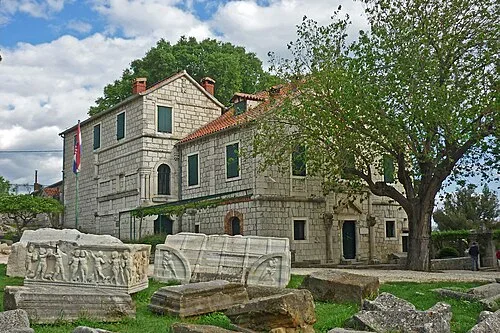 Tusculum Entrance and Archaeological Garden
Tusculum, the Archaeologist's Villa
Welcome to Salona, the largest archaeological park in Croatia. This was the capital of the Roman province of Dalmatia, one of the great cities of the late Roman Empire, with roughly sixty thousand inhabitants. Its ruins spread across the fields of Solin, just inland from Split. The city was founded in the third century BC and destroyed in the seventh, so what lies around the villa covers nine centuries of life. The stone building itself is Tusculum, raised in 1898 and restored in 2008. It owes its existence to don Frane Bulić, a priest who became the pioneer of archaeology here. In the late nineteenth century he led the first major excavations, above all of the early Christian basilicas and cemeteries. In 1894 Solin hosted the First International Congress of Early Christian Archaeology, and four years later Bulić had this memorial collection and workspace built for the Archaeological Museum. The ancient sarcophagus and carved stones set out in front of it were among the finds his digs brought to light.
Photo: SchiDD · CC BY-SA 4.0
02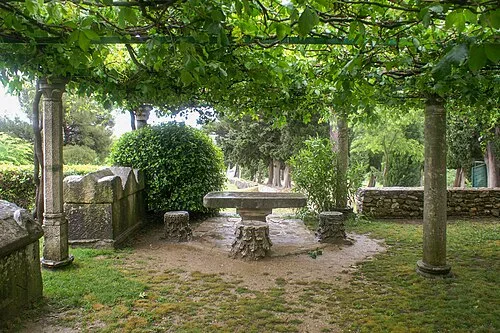 Tusculum Entrance and Archaeological Garden
The Lapidarium Garden
Under this vine pergola, the excavators of Salona set up a garden of gathered stone: old columns, a stone table with stools beside it, and carved fragments arranged on the grass. It is a quiet place, but the stones carry a written record. Many inscriptions in both Latin and Greek have been found inside the city walls, and more in the cemeteries outside them. The two languages together show a population drawn from more than one world, living in a city fully woven into the Roman Empire. The inscriptions also speak of money: they record the families wealthy enough to commission cut stone for their dead. That prosperity is the reason so much of Salona survived to be gathered up at all.
Photo: Bieniecki Piotr · CC BY-SA 4.0
03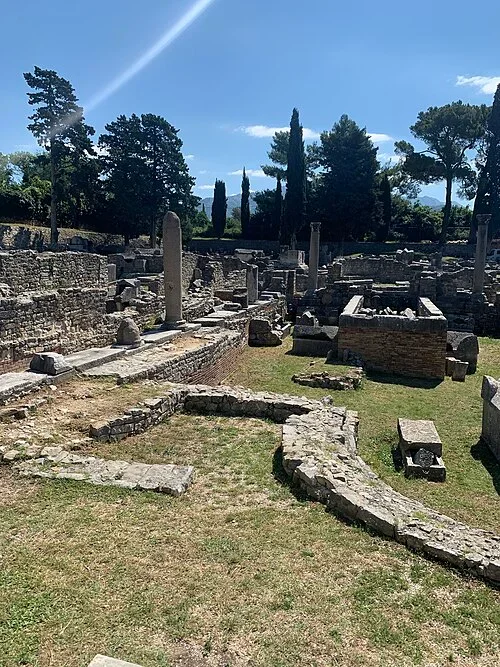 Manastirine Necropolis and Martyr Basilica
Manastirine, the Necropolis Outside the Walls
Roman law forbade burying the dead inside a city. So the people of Salona carried their dead out of the gates and laid them to rest along the roads leading away, which is why cemeteries flank the roads here. This ground is Manastirine, the remnant of a basilica and cemetery outside the town. Its story reaches further back than its Christian fame: the earliest parts date to the second century BC, long before any church stood here. The low walls and broken columns mark centuries of graves and buildings raised over them. What turned this field into a place of pilgrimage belongs to the next part of the story.
Listen in the appPhoto: Akrasia25 · CC BY-SA 4.0
04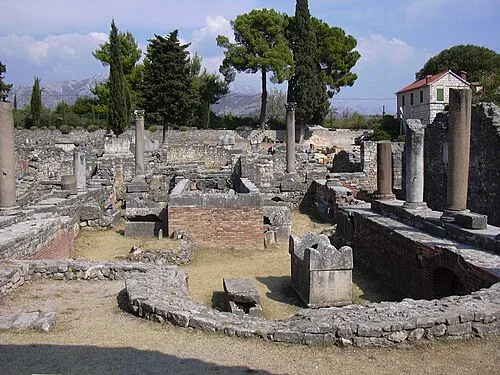 Manastirine Necropolis and Martyr Basilica
The Cemetery Basilica of Saint Domnius
In the year 304, during Diocletian's persecution of Christians, the bishop Domnius was executed in Salona's amphitheatre. He was a bishop and martyr, and he was buried here, in the cemetery outside the walls. His grave gave this ground its fame. Raids damaged the buildings around it at the end of the fourth century, and in the mid-fifth century a three-nave basilica was raised here on top of the ruins. Around the martyr's tomb, a custom took hold that the cemeteries of Salona document well: Christians asked to be buried as close as possible to a martyr, ad sanctos, as the phrase went. A grave near Domnius became the resting place people wanted, and the graves crowded in around his. When the city fell centuries later, the bishop's seat was transferred to Split.
Listen in the appOriginal uploader was BobFog at it.wikipedia · CC BY-SA 3.0
05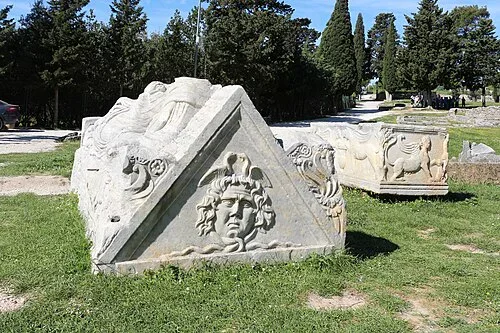 Manastirine Necropolis and Martyr Basilica
A Sarcophagus with Medusa
The carved head in the gable of this sarcophagus lid is Medusa, winged and framed like a mask. It is one of the fine marble sarcophagi that stood in the cemeteries of Salona, cut with figures and ornament for families who could afford the best. Several of the finest pieces from these graves have been moved to the Archaeological Museum in Split; others, like this one, remain where the necropolis keeps them. The Medusa belongs to the long pagan funerary tradition, and it is worth being honest about what that means here: not every tomb in this cemetery is Christian, and imagery like this does not by itself say who was buried inside. Who commissioned this sarcophagus, and when, is not known for certain.
Listen in the appBernard Gagnon · CC BY-SA 4.0
06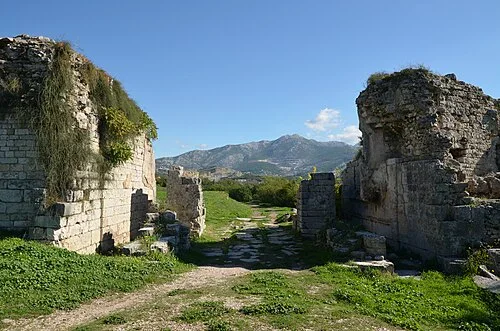 Porta Caesarea and the Roman Aqueduct
Porta Caesarea, the Ceremonial Gate
Porta Caesarea was the ceremonial gate of the oldest part of Salona, built of large regular stones in the reign of Augustus. Two octagonal towers flank it, and it has three passages: a wide one in the middle for carts, and two narrow ones for pedestrians on either side. Grooves cut into the side pylons suggest the central passage could be closed with a movable grid. A reconstruction by the scholar Kähler gives the gate two storeys, the upper one richly decorated with half-columns, composite capitals and window openings, and a small courtyard inside for defence. Its military life did not last. When the city expanded east and west, the gate lost its defensive purpose and became the load-bearing support of the aqueduct instead.
Listen in the appBobFog at Italian Wikipedia · CC BY-SA 4.0
07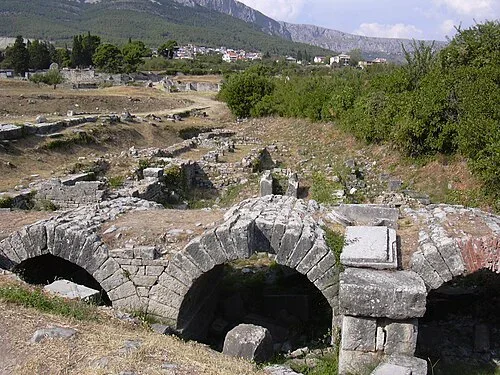 Porta Caesarea and the Roman Aqueduct
The Augustan Aqueduct
Emperor Augustus built Salona its water. The aqueduct ran from the river Jadro into the city, a length of 3,850 metres, and these stone arches belong to that line. Calculations suggest it could supply enough water for about forty thousand people, which gives a measure of how large the capital had grown. The best-preserved stretch of the whole aqueduct lies north of the episcopal centre, where the line of arches and channel can still be followed across the ground.
Listen in the appBobFog at Italian Wikipedia · CC BY-SA 4.0
08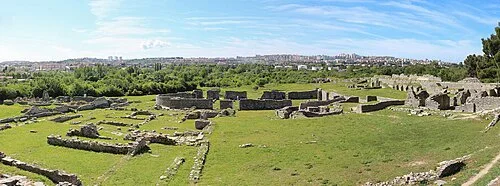 The Episcopal Centre and Baptistery Complex
The Episcopal Centre
In the northwest part of the eastern city, Salona's Christians built their monumental core in the fifth century. The episcopal centre held twin lengthways basilicas, a baptistery and a Bishop's Palace, and its basilica is the largest in the whole of Dalmatia. The building boom came from wealth: Salona's prosperity in the fourth and fifth centuries paid for extensive church construction inside the walls and shrines to the martyrs outside. The standing of the complex matched its size. The bishop of Salona held the rank of metropolitan bishop of Dalmatia, the head of the church across the province. All of this has made Salona a major site for studying how early Christian sacred architecture developed.
Listen in the appBernard Gagnon · CC BY-SA 4.0
09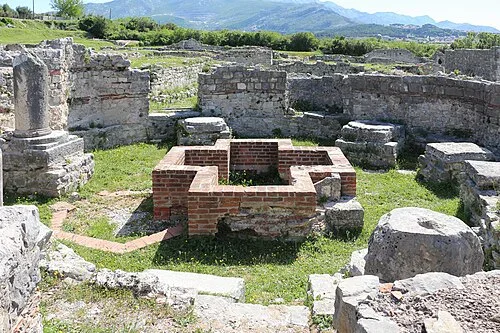 The Episcopal Centre and Baptistery Complex
The Baptistery Font
The red brick structure in the ruins is the baptismal font of the episcopal centre, its cross-shaped plan still easy to trace in the exposed masonry. This was where new Christians entered the community. In the practice of the fifth century, baptism was by immersion: the candidate went down into the water and rose from it as a member of the church. Fonts of this period were often given shapes rich in meaning, and the octagonal form used in many baptisteries was read as a symbol of the new life the rite conferred. From this one room, the whole Christian city took in its newest members.
Listen in the appBernard Gagnon · CC BY-SA 4.0
10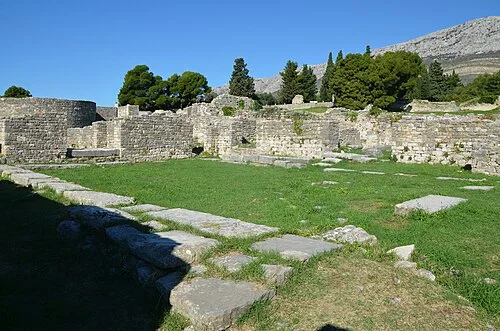 The Great Public Thermae
The Great Thermae, Courtyard and Plan
Salona had several sets of public baths, but the Great Thermae in the eastern part of the city were the largest, and they are the best preserved. They were built in the second century, or at the beginning of the third. The building is rectangular, with three apses arranged symmetrically on the north side and one on the west. The plan can still be traced through the ruins. An elongated room on the north side held a semicircular pool of cold water, the frigidarium. To its left lay two dressing rooms, fitted with benches and with openings in the wall for storing clothes. A room on the west side served for massage, the unctorium. Another room, ending in an apse, worked as a lounge and an exercise space at once. On the right came the hot end of the building: the caldarium, the tepidarium and the sudatorium, the sauna.
Listen in the appCarole Raddato from FRANKFURT, Germany · CC BY-SA 2.0
- 11
Bathing and City Life
Eighty thousand people, ships to Alexandria and Carthage, and a bathhouse built for a city of that size.
- 12
The Roman Theatre
A theatre carved onto Trajan's Column in Rome, built for an audience of three thousand or so.
- 13
The Forum of Urbs Vetus
How backing Caesar in a civil war made Salona a colony, and the forum the seat of its public life.
- 14
The Temple South of the Theatre
A temple whose god nobody can name for certain: Dionysus or Liber.
- 15
The Defensive Walls
Four kilometres of wall and ninety towers, built over centuries to shelter a whole province.
- 16
The Bridge of Five Arches
Five stone arches that carried Salona's main street, its silver and its coin, out into Dalmatia.
- 17
The Amphitheatre of Salona
An arena for up to eighteen thousand, with a goddess shrine beneath the seats and a canvas roof overhead.
- 18
The End of Salona and the Birth of Split
The capital that outlived the Western empire, and whose refugees founded Split.
Salona
Frequently asked questions
How much does the guide cost?
Free app download. Listed guide price: $1.99. Guide price shown in the app. Audio guide only. Venue admission is separate.
Can I listen without internet?
Yes. Download the guide’s audio, images, and maps in the app before your visit. Your downloaded content is then available offline.
Can I listen in my language?
This audio guide is available in 15 languages, including English.
Do I need to follow a schedule?
No. This is a self-guided experience. Choose your stops, pause whenever you like, and return to a story at your own pace.
At your own pace
Explore Salona.
Download Stanza, then search for “Salona”.
Free app download · Guide price shown in the app
Keep exploring
Audio guides — Croatia
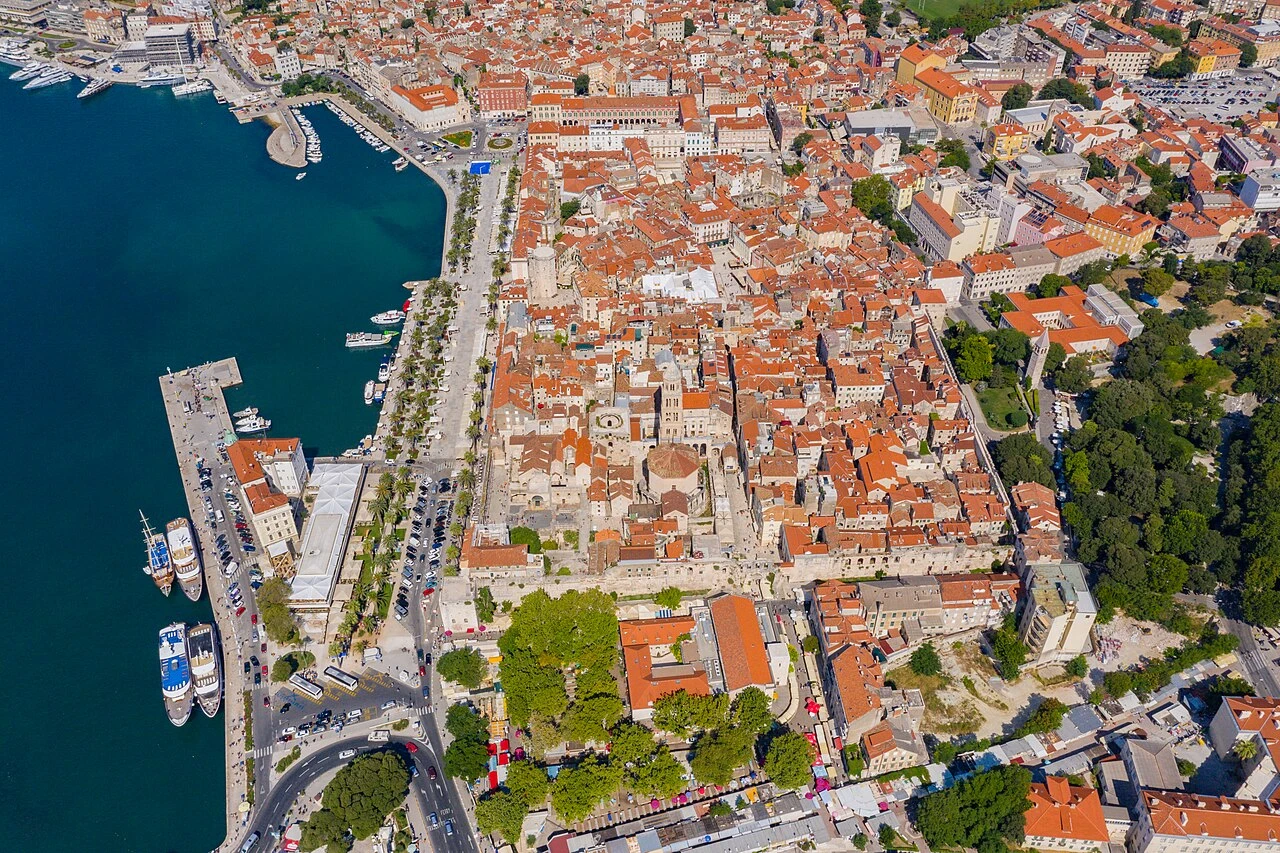
Split · 5 km
Diocletian's Palace
Content & sources
Photo: Dronepicr · CC BY 2.0
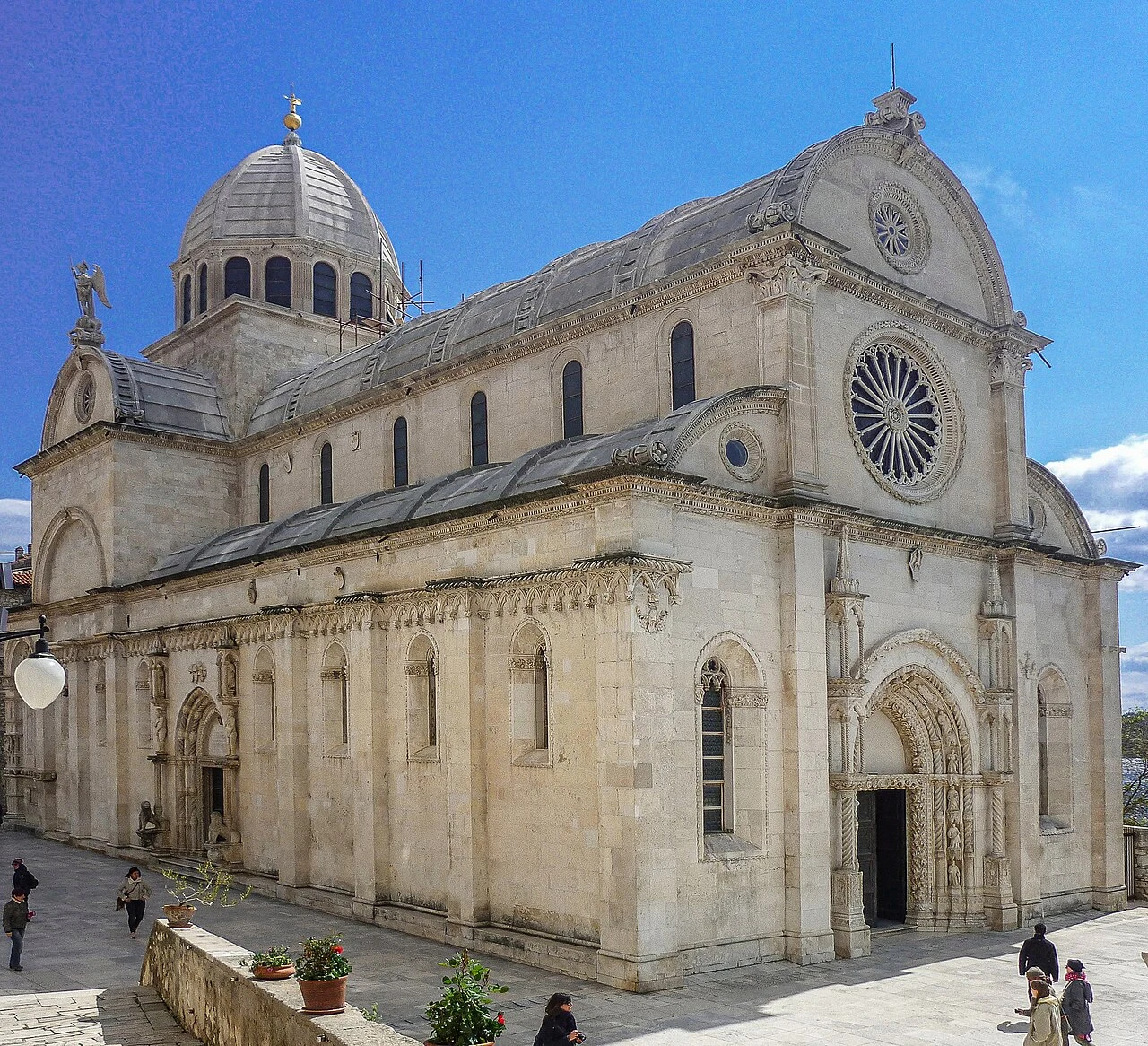
Grad Šibenik · 53 km
Šibenik Cathedral
Content & sources
SchiDD · CC BY-SA 4.0
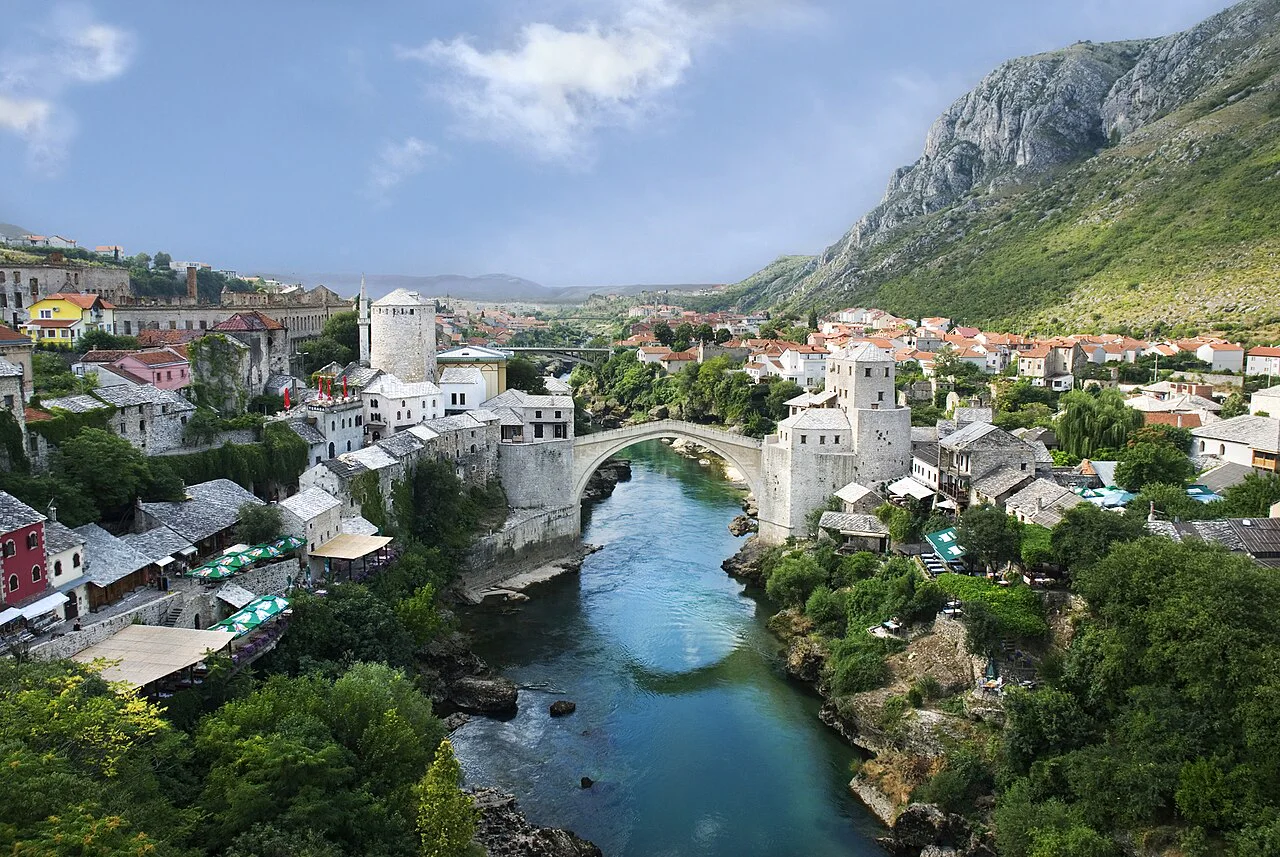
Mostar · 110 km
Stari Most
Content & sources
Ramirez · CC BY-SA 4.0
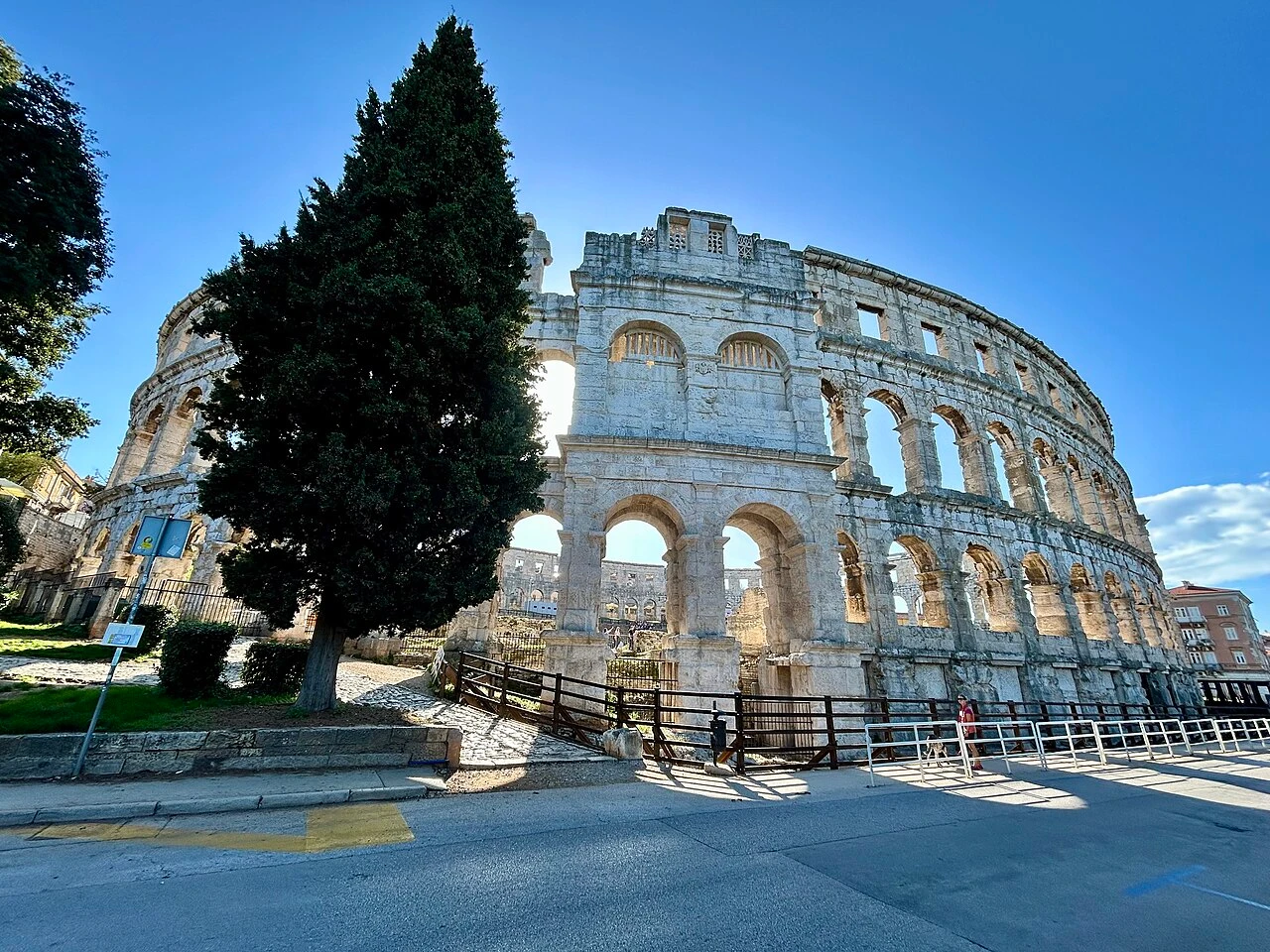
Grad Pula
Pula Arena
Content & sources
Photo: Olgierd Rudak · CC BY-SA 4.0