 Stanza / Audio guide
Stanza · Audio guide
Cairn de Barnenez Audio guide
A place to remember. A story to take with you.
The Cairn of Barnenez is a Neolithic monument located near Plouezoc'h in Brittany, France. It is one of the earliest megalithic monuments in Europe and one of the oldest man-made structures in the world.
Download Stanza, then search for “Cairn de Barnenez”.
About the tour
One guide. Your kind of visit.
The Cairn of Barnenez is a Neolithic monument located near Plouezoc'h in Brittany, France. It is one of the earliest megalithic monuments in Europe and one of the oldest man-made structures in the world.
Ready when you are.
- 01Get the free Stanza app.
iOS & Android
- 02Find your guide.
“Cairn de Barnenez”
- 03Download before you go.
Works offline
Audio guide / 11 narrated stops
Inside the guide
Get to know a few of the stories before you go. Open a stop to read more.
01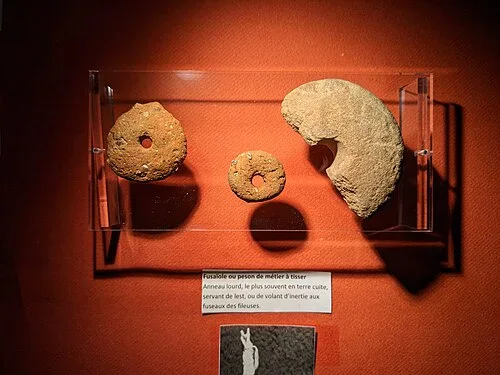 Visitor Center ExhibitionNeolithic Spindle Whorls and Loom Weights
Welcome to the Cairn de Barnenez, in northern Finistère in Brittany. It is a monument of the early Neolithic, built in phases between about 4800 and 4000 BC, one of the oldest megalithic monuments in Europe and among the oldest man-made structures anywhere in the world. It is a huge mound of dry stone hiding eleven passage graves. The story begins with these small objects in the display case, not with the mound. They are spindle whorls and loom weights, tools of the weaver's craft. A whorl sat on a spindle to keep the thread spinning; the weights hung on a loom to hold the warp taut. They belong to a settled farming society, people who kept animals, grew crops and made cloth, not wanderers. It was communities like that, with organised labour and domestic skills, who took on the building of Barnenez. The exhibition here walks through the scientific excavations that revealed the site, and displays objects connected with it. Keep a whorl in mind: the enormous stone mound outside was made by hands that also spun thread.
Photo: Romainbehar · CC0
02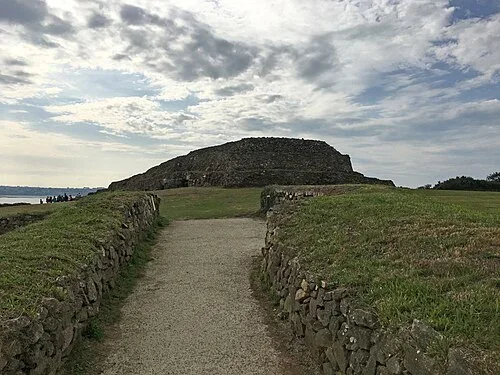 The Approach PathFirst View of the Mound
From the path, the mound ahead rises against the sky like a natural hill. It is nothing of the kind. Every stone in it was carried and laid by hand, in dry stone without mortar. Measured today it runs about seventy-five metres long, up to twenty-five metres wide, and stands more than eight metres high. Its weight has been reckoned at thirteen to fourteen thousand tonnes of stone. What looks like one heap is in fact two cairns, joined together into a single mass. This is a mausoleum, a monumental house for the dead, and one of the largest of its kind in Europe. The two halves each hold their own chambers.
Photo: Quoique · CC BY-SA 4.0
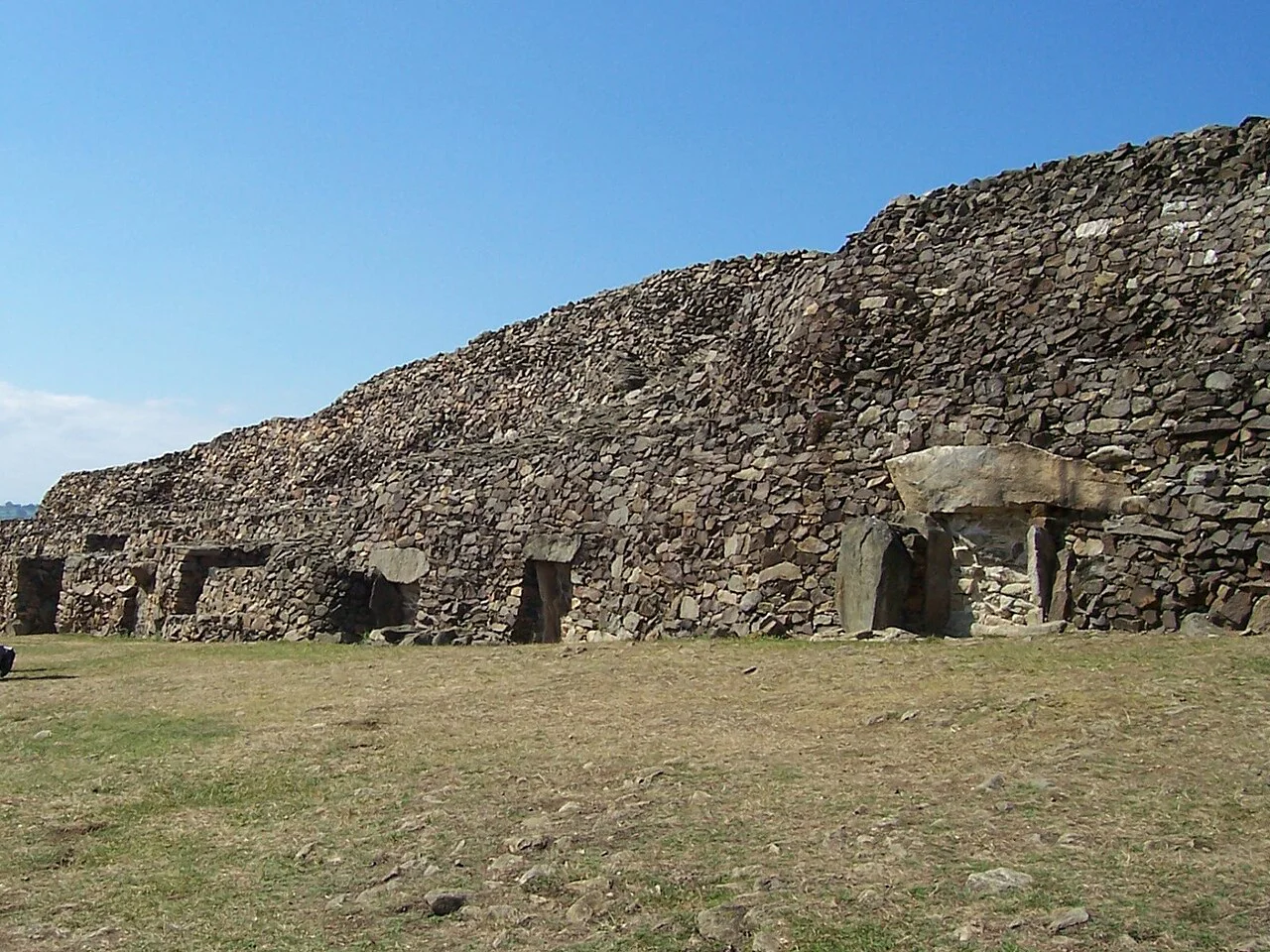
03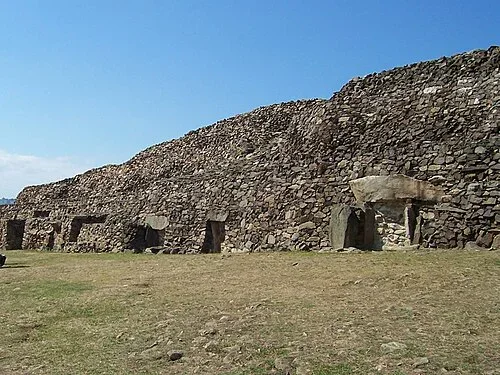 The Stepped South FacadeThe Stepped Facade and Its Eleven Passages
The long south face of the mound was built to be seen. It rises in stepped terraces, with steep facades, and its profile is deliberate architecture rather than a heap. Several internal walls inside the mound are either the remains of earlier facades or braces that hold the mass stable. Along the front runs a row of low doorways, one for each of the eleven chambers. Each chamber is entered separately, from the southeast, through a long narrow corridor, from five to fourteen metres long. The chambers are built of great slabs of slate and granite, while the mound around them is made of small blocks. In the 1960s, during the restoration years, the writer and minister André Malraux saw the stepped face and called Barnenez a megalithic Parthenon. The name has stayed with it ever since.
Listen in the appNo machine-readable author provided. NewPapillon assumed (based on copyright claims). · CC BY-SA 3.0
04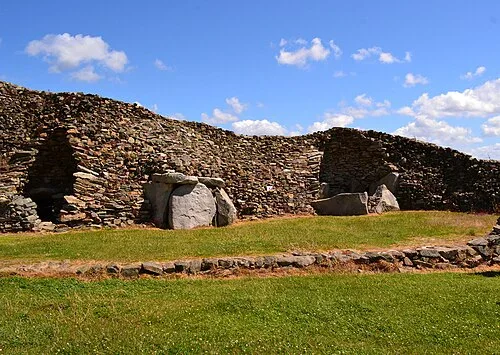 The Exposed Quarry CutawayThe Quarry Cutaway: How Barnenez Nearly Died
This open scar in the side of the mound is the result of an accident that nearly ended the monument. Until the 1950s the cairn was privately owned, and it was used as a quarry for paving stones. In November 1954 a contractor destroyed a smaller neighbouring cairn, Kerdi Bihan, a hundred metres or so away. The following spring he cut into the great cairn itself, gutting the chambers now open to view here. The journalist Francis Gourvil came to write about it for Ouest-France and alerted the prehistorian Pierre-Roland Giot. Giot intervened with the authorities, and the work was stopped. In 1956 the cairn was listed as a historic monument, and rescue excavation and restoration continued until 1968. What quarrying destroyed, it also revealed: a cutaway cross-section of chambers that had been sealed for thousands of years.
Listen in the appFlorent Ls · CC BY-SA 3.0
05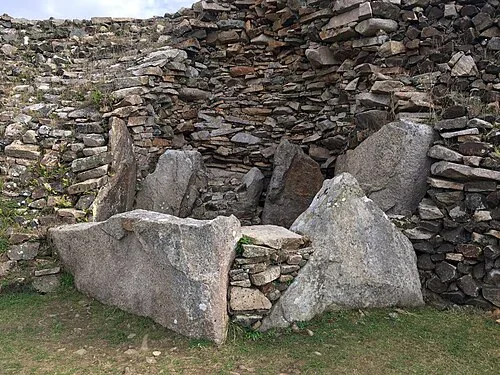 The Exposed Quarry CutawayInside a Corbelled Vault
The quarrymen's cut opened the vault of one of the chambers, and archaeologists could finally study the stonework close up. These chambers are corbelled: courses of flat granite slabs are laid in rings, each course leaning slightly further inwards until the walls nearly meet overhead. The slabs are set radially and tilted a little outwards, with small stones wedged between them as shims where the thickness varies. Building a single square metre of a careful vault like this took roughly one to one and a half cubic metres of granite pieces. Many stones cracked under the weight of the mound above, yet as long as nothing shifts sideways, the whole structure stays stable. It is worth remembering that only the chambers are truly megalithic; the mound itself is of small blocks. Every chamber was once completely hidden inside the stone.
Listen in the appPhoto: Quoique · CC BY-SA 4.0
06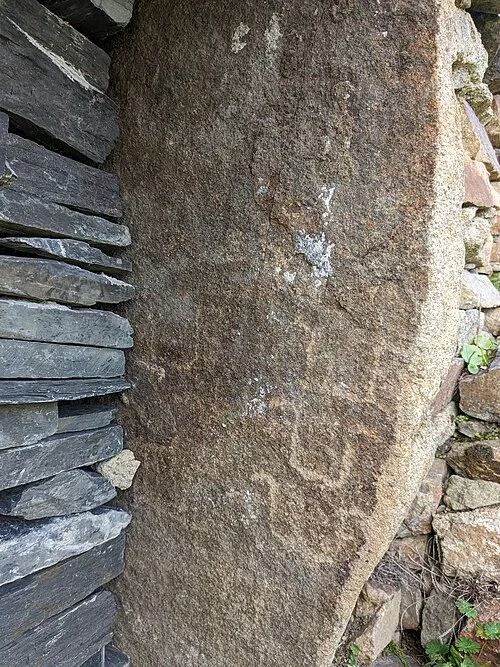 Prehistoric EngravingsEngravings at the Gallery A Entrance
Barnenez is remarkable for its megalithic art, carved into the stones of the chambers and passages. The repertory includes bows, axes, wave or snake-like signs, and a repeated U-shaped sign that some read as cattle horns. One recurring figure is sometimes interpreted as a human form, the so-called Dolmen Goddess, though that reading is a matter of interpretation. At the entrance of Chamber H the signs are carved exceptionally deep, among them three axe-shaped triangles and a bow. Passage J hides another curiosity: an engraved shield-like figure on the underside of a capstone, in an unusual position that suggests the slab was reused from an older structure. One carved block here is indeed known to have been taken from a different monument, a practice also seen at Gavrinis in the Gulf of Morbihan.
Listen in the appPhoto: Romainbehar · CC0
07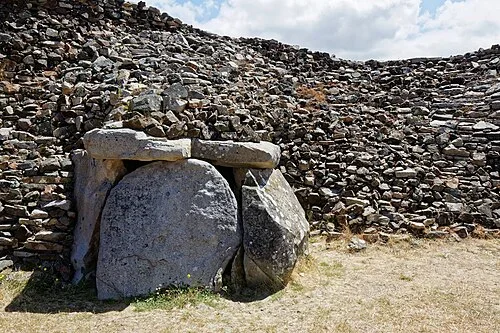 The Secondary Cairn and Corbelled VaultsThe Younger Western Cairn
What reads as one mound is two building campaigns. The western half is an extension, twice the volume of the original cairn, and it carries six further passage graves. When it went up, the builders did not simply add on: they wrapped the older cairn in a wider, taller structure, and its passages had to be lengthened to reach the new surface. More granite was used in this phase, which gives the western end its lighter tones. The dated chambers here run from dolmen F, built around 4300 BC, to dolmen A, around 4200 BC. The chambers opened up by the quarrying on the other side of the mound all belong to this younger half.
Listen in the appPhoto: Thesupermat · CC BY-SA 4.0
08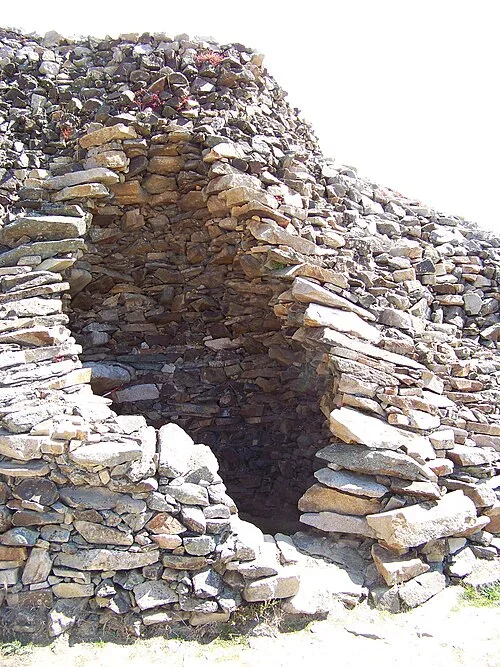 The Secondary Cairn and Corbelled VaultsHidden Paintings in the Sealed Chambers
Since 1968 the chamber entrances have been sealed with slabs of schist, to protect what is inside. That protection paid off. In May 2012 two Spanish archaeologists, Primitiva Bueno Ramírez and Rodrigo de Balbín Behrmann, were allowed to study three of the eleven chambers. In Chamber H they found traces of polychrome painting across about four square metres of wall. The red comes from iron oxide, the black from manganese dioxide. Painted decoration had been found before in megaliths in Spain and Portugal, but this was the first polychromy scientifically confirmed in a Breton megalith. Scattered traces elsewhere in the chamber suggest it once carried a complete painted and engraved decoration.
Listen in the appPhoto: Farz brujunet · CC BY-SA 3.0
09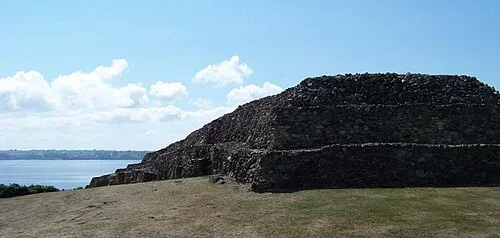 The Primary Cairn (East)The Primary Cairn: Where It Began
The eastern end is where it all started. The primary cairn, with its five passage graves, was raised around 4700 BC, in dark local metadolérite that gives this half its sombre tone. Its volume has been estimated at some two thousand cubic metres of stone, about four thousand tons in all: three thousand tons of dolerite quarried close by, and a thousand tons of granite brought from a nearby island, from Saint-Samson and from further inland. Pierre-Roland Giot reckoned the job at 150,000 to 200,000 working hours; on his admittedly unlikely assumption of a single building campaign, two to three hundred men could have raised it in three months. He suspected that Chamber H, at the centre around which everything is arranged symmetrically, could be the oldest of the dolmens, though he offered that as a suggestion. One comparison gives the scale of the date: this mound went up some 2,100 years before the oldest Egyptian pyramid.
Listen in the appPhoto: Farz brujunet · CC BY-SA 3.0
10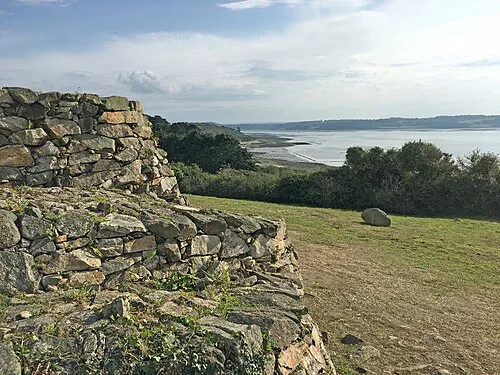 The Bay of Morlaix OverlookOverlooking the Bay of Morlaix
The cairn stands on a rocky promontory of the Kernéléhen peninsula, on the right bank of the Morlaix estuary, dominating the bay. When it was erected, the bay below was probably a fertile coastal plain rather than the water seen today. From this height the view runs across the estuary to Carantec, and along the point of Pen al Lann stretching to the right. On the far horizon stands Saint-Pol-de-Léon, marked by the tower of the Kreisker. A monument of this size does not land by chance on a promontory; the builders put it where the whole bay could read it. The site rises to about forty-five metres above the sea, the highest ground on the headland.
Listen in the appPhoto: Quoique · CC BY-SA 4.0
Cairn de Barnenez
Frequently asked questions
How much does the guide cost?
Free app download. Listed guide price: $0.99. Guide price shown in the app. Audio guide only. Venue admission is separate.
Can I listen without internet?
Yes. Download the guide’s audio, images, and maps in the app before your visit. Your downloaded content is then available offline.
Can I listen in my language?
This audio guide is available in 15 languages, including English.
Do I need to follow a schedule?
No. This is a self-guided experience. Choose your stops, pause whenever you like, and return to a story at your own pace.
At your own pace
Explore Cairn de Barnenez.
Download Stanza, then search for “Cairn de Barnenez”.
Free app download · Guide price shown in the app
Keep exploring
Audio guides — France
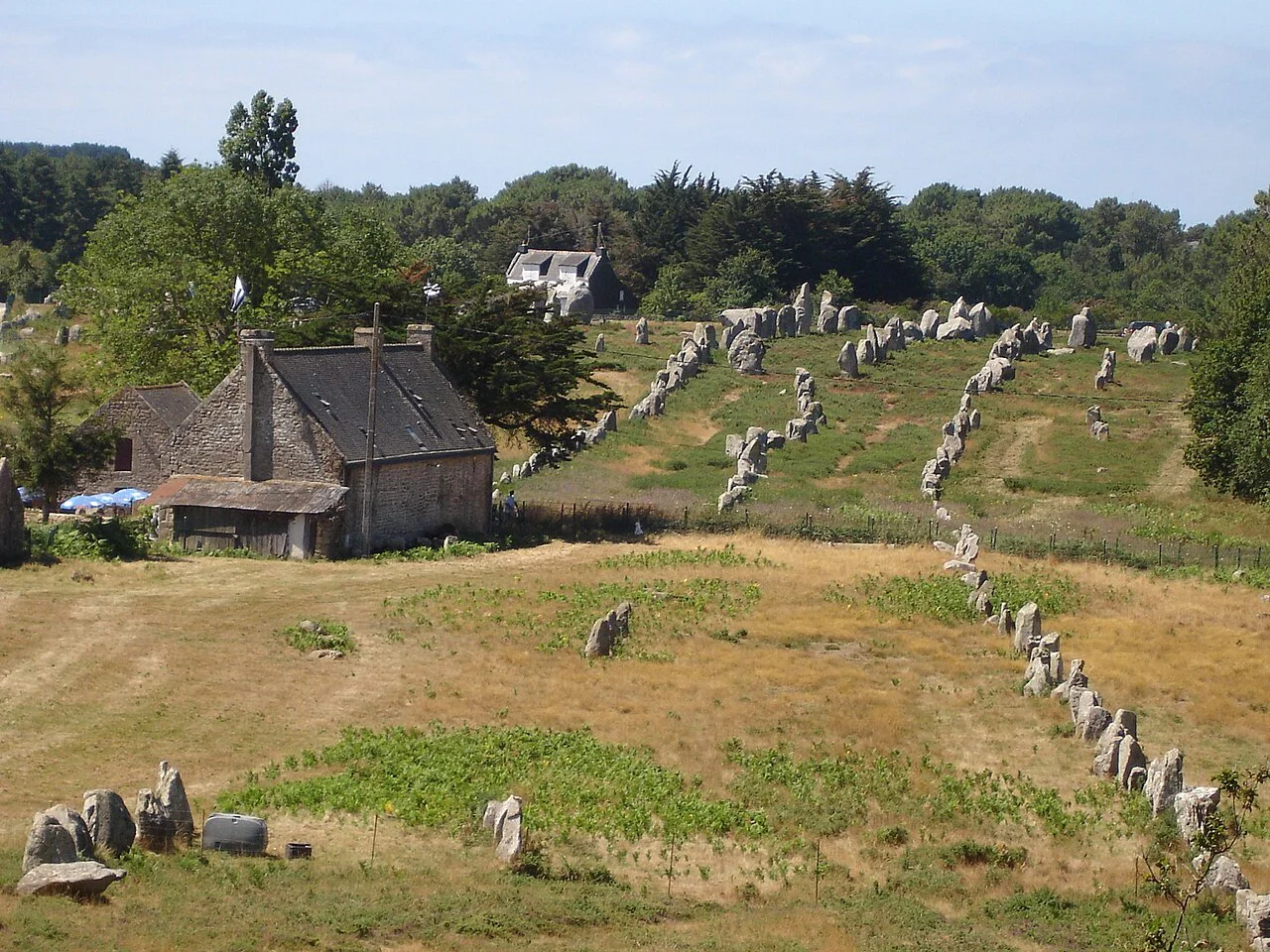
Carnac · 133 km
Alignements de Carnac
Content & sources
--Pinpin 17:43, 1 August 2006 (UTC) · CC BY-SA 3.0

Le Mont-Saint-Michel
Le Mont-Saint-Michel, Mont-Saint-Michel Abbey
Content & sources
Photo: Lynx1211 · CC BY-SA 4.0
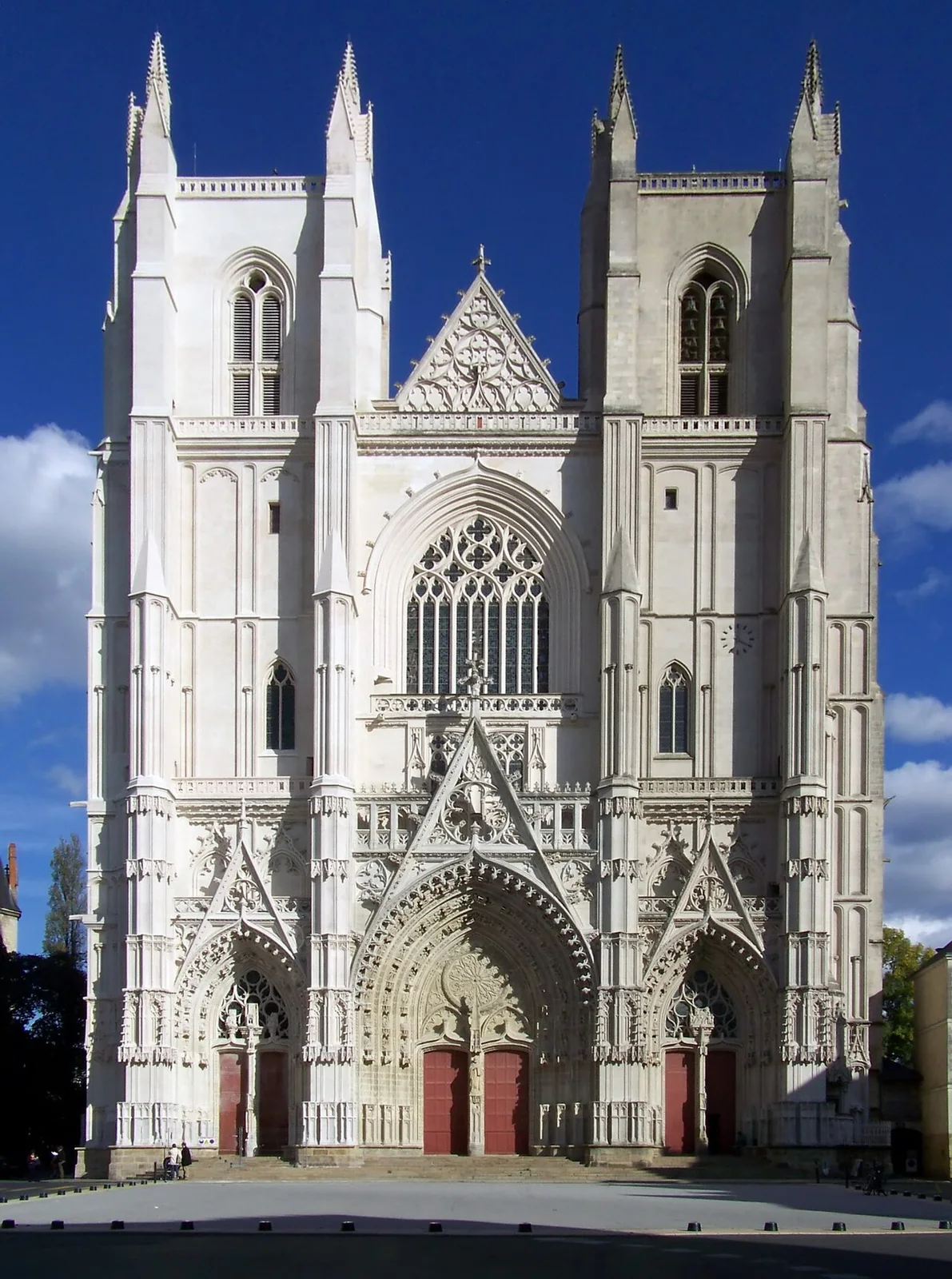
Nantes
Cathédrale Saint-Pierre-et-Saint-Paul de Nantes
Content & sources
Photo: Eusebius · Public domain
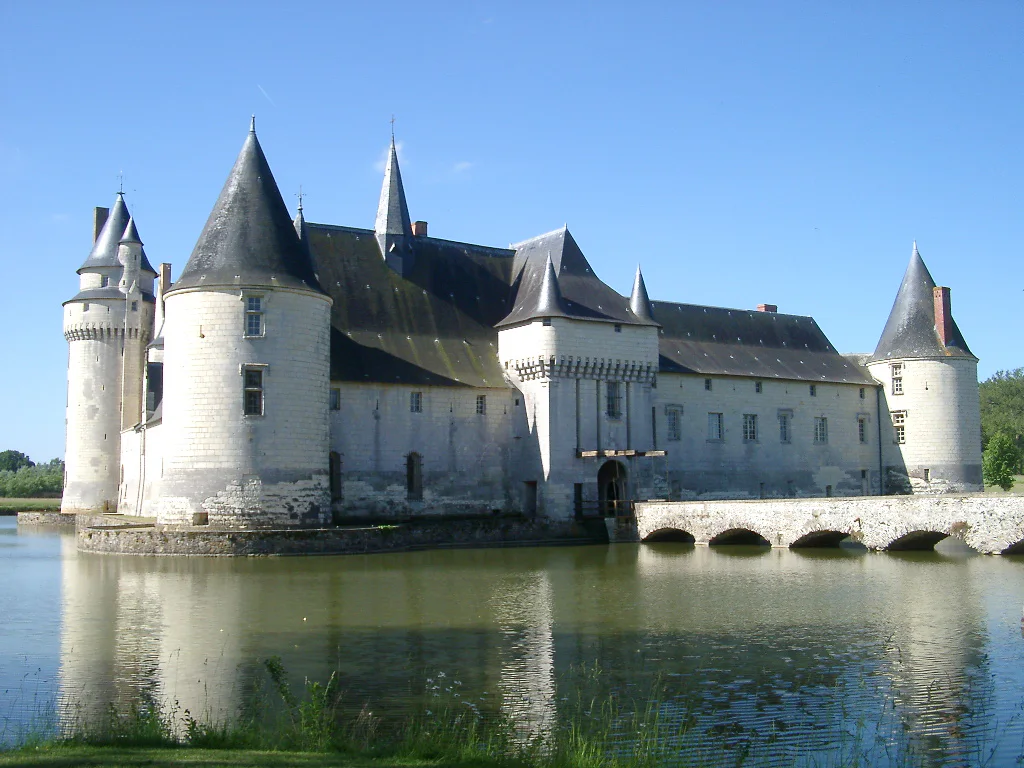
Écuillé
Château du Plessis-Bourré
Content & sources
The original uploader was NonNobis at French Wikipedia. · CC BY-SA 3.0