Stanza · Audio guide
Basilica dei Santi Giovanni e Paolo Audio Guide
A place to remember. A story to take with you.
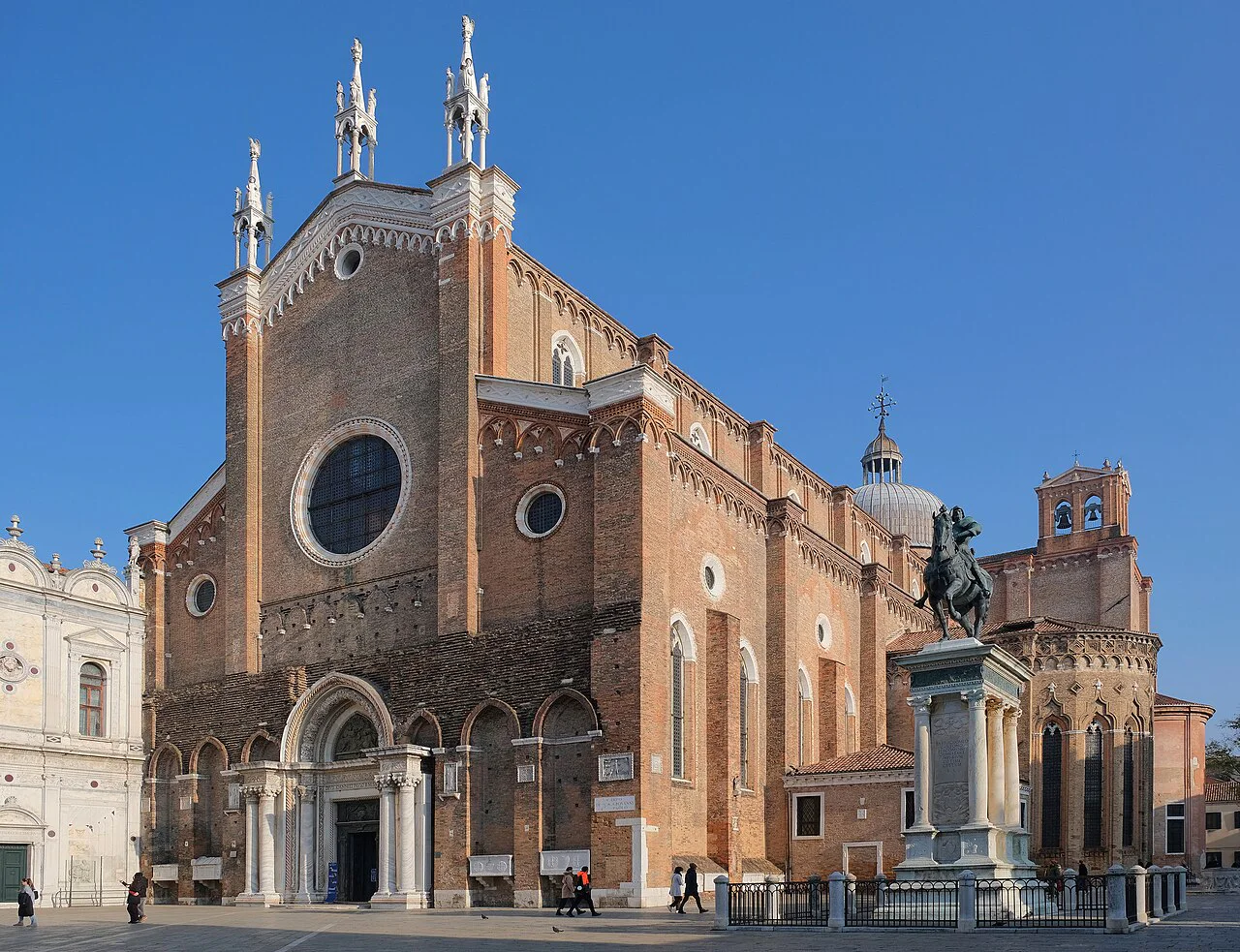
The Basilica dei Santi Giovanni e Paolo is a Catholic minor basilica and Dominican conventual church located in Venice, Italy. It is known in Venetian as San Zanipolo.
Download Stanza, then search for “Basilica dei Santi Giovanni e Paolo”.
About the tour
One guide. Your kind of visit.
The Basilica dei Santi Giovanni e Paolo is a Catholic minor basilica and Dominican conventual church located in Venice, Italy. It is known in Venetian as San Zanipolo.
Ready when you are.
- 01Get the free Stanza app.
iOS & Android
- 02Find your guide.
“Basilica dei Santi Giovanni e Paolo”
- 03Download before you go.
Works offline
Audio guide / 15 narrated stops
Inside the guide
Get to know a few of the stories before you go. Open a stop to read more.
01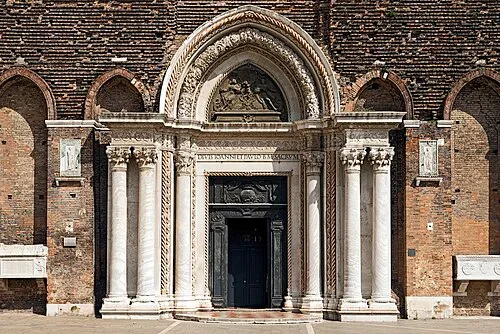 Campo & Main Portal Exterior
The Great Portal of San Zanipolo
Welcome to San Zanipolo, the great Dominican church of Venice. Its full name is Santi Giovanni e Paolo, but nobody in the city says that. The dedication is a puzzle worth knowing before anything else: these are not the apostles John and Paul, but two obscure early Roman martyrs, remembered for their names rather than their deeds. The Dominicans built this as their principal church, made to hold huge crowds for preaching. The facade tells you how it grew. Vast stretches of raw brick were never faced with marble, and against that plain wall the doorway glows. It is the work of Bartolomeo Bon, carved in the mid fifteenth century, while above the doorway, in the spires crowning the facade, stand figures of Dominican saints. This church began as a preaching hall and became the burial place of the doges of Venice. The tour follows that whole story, from the founding legend to the tombs of the rulers themselves. Beside the portal, set against the brick, hangs a plain marble sarcophagus. That tomb of two doges is where the story starts.
No machine-readable author provided. G.dallorto assumed (based on copyright claims). · Attribution
02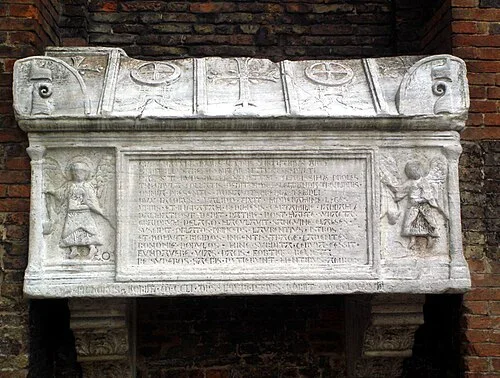 Campo & Main Portal Exterior
The Tomb of Doges Jacopo and Lorenzo Tiepolo
Two doges lie in this plain Gothic sarcophagus on the facade: Jacopo Tiepolo, who died in 1249, and his son Lorenzo, who died in 1275. Jacopo is the reason the Dominicans are here at all. The story the friars loved to tell goes that he dreamed of a flock of white doves flying over this swampy ground, and took it as a sign. In 1246 he donated the land to the order. A painter later set the dream on canvas, the doge asleep with doves wheeling above him. A first church rose here in the thirteenth century, dedicated to the two Roman martyrs. It served the friars for decades, until the growing city outgrew it. In 1333 that church was pulled down to make way for the present one. Notice how modest this tomb is, out in the open air, its carved inscription open to the weather. Inside wait the marble monuments of later doges, and the contrast with this simple stone chest is the measure of how much changed.
No machine-readable author provided. G.dallorto assumed (based on copyright claims). · Attribution
03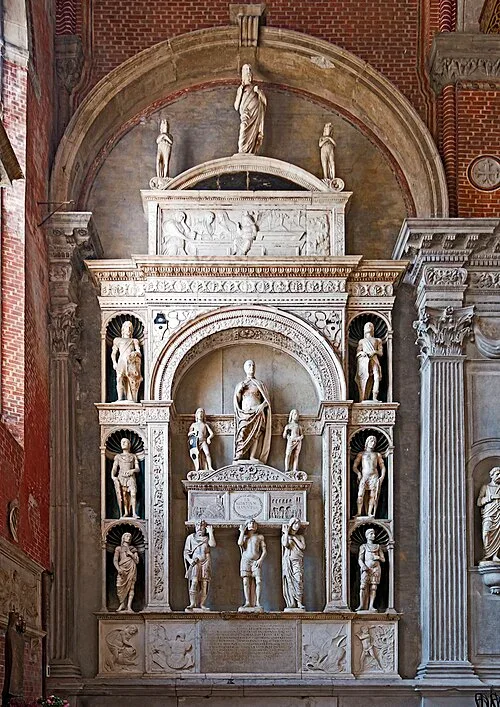 Entrance Counter-Facade
Monument to Doge Pietro Mocenigo
Doge Pietro Mocenigo stands upright on this wall, and that alone would have startled an earlier generation. The monument was finished in 1481 by Pietro Lombardo and his son Tullio, and it marks a break with everything Gothic. Earlier tombs showed the dead lying flat on a sarcophagus, awaiting judgment. Here the doge is carved standing, proud and alive, placed in a straight line beneath the statue of the risen Christ above him. The message is deliberate: he is depicted as already risen, sharing in the resurrection. The whole structure is built like a Roman triumphal arch, split into three parts with columns and a central opening. From this moment, the triumphal arch became the model for the great doge tombs of the city. As the tour continues, its echoes turn up again and again, in the choir and along the aisles. This is where the tour first meets that vocabulary.
Listen in the appDidier Descouens · CC BY-SA 4.0
04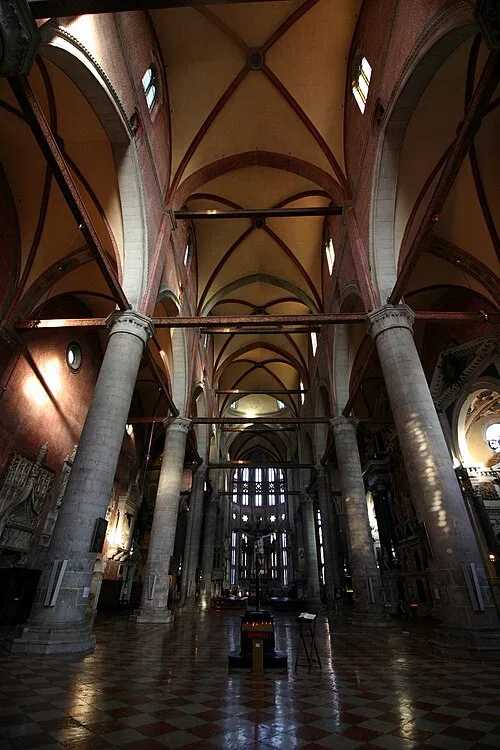 The Gothic Nave
The building itself took nearly a hundred years. Work began in 1333, after the older church proved too small for the crowds the Dominicans drew, and the church was solemnly consecrated on the fourteenth of November 1430. What you see is Italian Gothic at its most sober: brick everywhere, plain and strong, with no marble facing inside. The nave runs the length of a football field and more, over a hundred metres end to end. The vaults soar high overhead, and across them run the heavy wooden tie-beams that give this view its distinctive look. Venice sits on soft lagoon soil, and tall brick vaults push outward as they rise. The beams tie the walls together and hold the whole structure in balance. It was a practical choice, and it shaped the character of the place. The plain brick was no accident. The decoration was left to the paintings and tombs that the city would bring here over the centuries.
Listen in the appJosé Luiz · CC BY-SA 4.0
05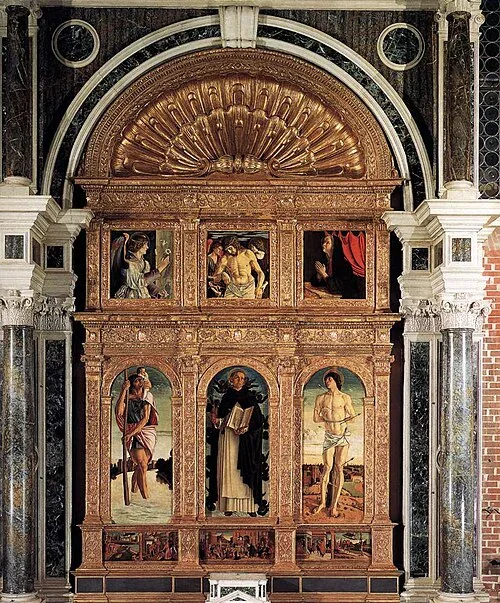 Right Aisle Masterpieces
Bellini's Polyptych of Saint Vincent Ferrer
Giovanni Bellini painted this altarpiece for this altar between 1464 and 1470, and it became one of the most influential works of his early career. It is a polyptych, a great frame of nine separate panels, made for the Dominican saint Vincent Ferrer, a famous Spanish preacher of the previous century. Vincent stands at the centre in his friar's habit, holding an open book. Saint Christopher stands to his left, Saint Sebastian to his right. Above them, angels bear the dead Christ, and at the very top the archangel Gabriel and the Virgin of the Annunciation gaze upward, toward a panel that once crowned the whole work. The row of small panels below tells the miracles of Vincent. In the central one, the sermon of Toledo, the saint raises two dead men so that they can confirm his preaching. On one side he pulls a woman from a river and shields a mother and child from a collapsing building; on the other he revives a child and frees prisoners. The Dominicans built the great hall for preaching. Here, at their own altar, they paid the greatest painter in Venice to paint their own preacher saint.
Listen in the appDidier Descouens · CC BY-SA 4.0
06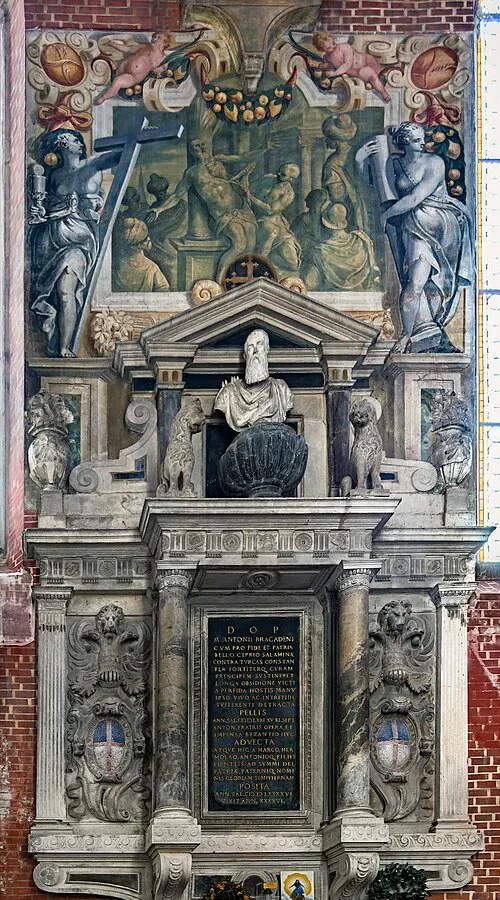 Right Aisle Masterpieces
Monument to Marcantonio Bragadin
This tomb holds one of the hardest stories in Venetian history. Marcantonio Bragadin commanded the defence of Famagusta in Cyprus against the Ottoman army in 1571. When the besieged garrison finally surrendered, terms of safe conduct were agreed. The Ottomans broke them. Bragadin was tortured, and then flayed alive. What remained of his skin was smuggled back to Venice, and in 1596 it was brought to this church and buried here. The tomb contains only his skin. The monument around it was designed by the architect Vincenzo Scamozzi, and the bearded bust was carved by a pupil of Alessandro Vittoria. Above it, a chiaroscuro scene shows his martyrdom, though who painted it is uncertain. The same year that Bragadin died, a Christian fleet destroyed the Ottoman navy at Lepanto. That victory has its own chapel here, and its story comes later on this tour.
Listen in the appDidier Descouens · CC BY-SA 4.0
07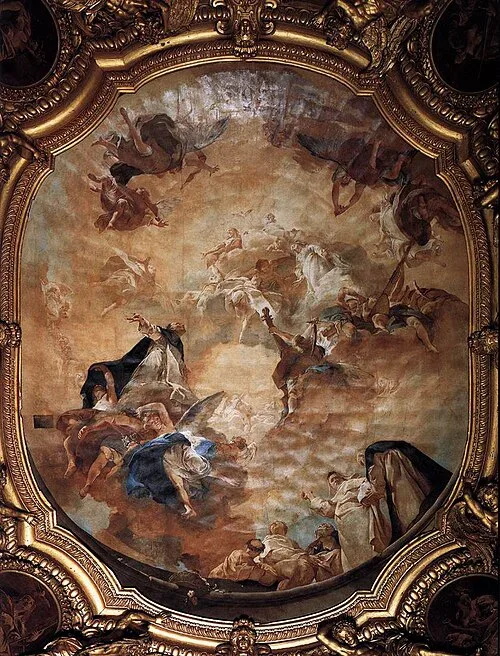 Chapel of San Domenico
 - Piazzetta's Glory of St Dominic
The Dominicans never stopped shaping this church, and this chapel proves it. Built in 1690 by Andrea Tirali, it is dedicated to Saint Dominic, founder of the order. On its ceiling, Giovanni Battista Piazzetta painted the Glory of Saint Dominic, finished in 1727. It is counted among the finest works of eighteenth-century painting in Venice. Dominic rises through a sky crowded with angels and friars, painted in the soft golden light that the Venetian settecento loved. At the four corners of the main picture, Piazzetta added four roundels in chiaroscuro, one for each of the cardinal virtues. Around the walls run six reliefs of episodes from Dominic's life. Five of them are bronze, by the sculptor Giuseppe Maria Mazza; the sixth is wood. Centuries after the order took this swampy ground, its founder still had the finest ceiling in the church.
Listen in the appGiovanni Battista Piazzetta · Public domain
08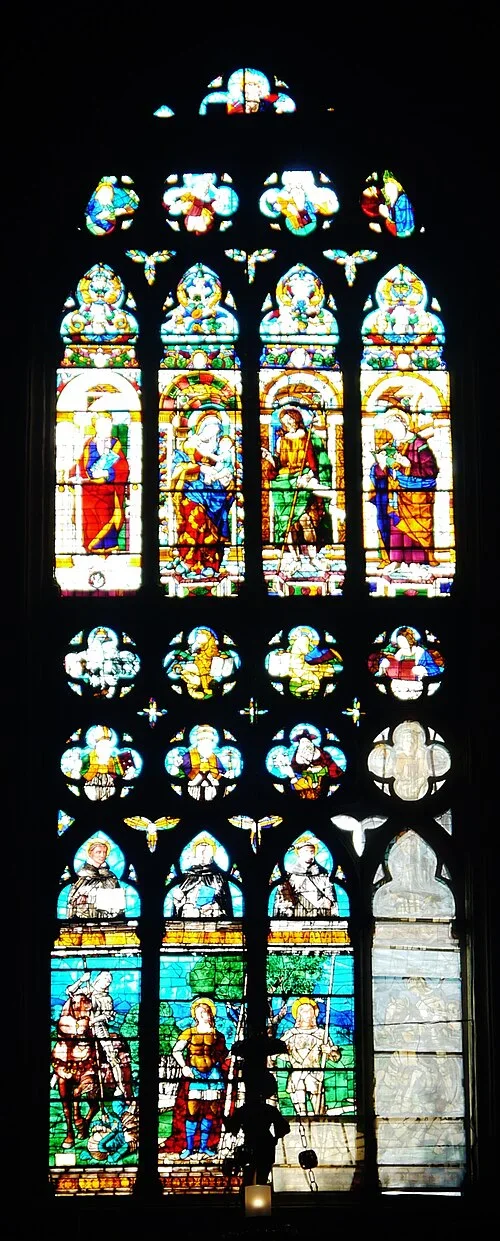 Right Transept & Stained Glass
The Great Stained Glass Window
In a church built of plain brick, this window is where the colour lives. Coloured glass fills a tall Gothic frame, panel after panel of saints and sacred scenes glowing against the dark. The glass was completed by Giovanni Antonio da Lodi, a master from Lombardy. The designs for the figures are attributed to three leading Venetian painters of the day: Bartolomeo Vivarini, Cima da Conegliano and Girolamo Mocetto. Painters drew the cartoons, and the glass painter translated them into light. For a congregation that could not read, windows like this were the picture book of the faith. Here the Virgin and Child shine at the centre, saints and bishops stand in their niches of colour, and knights and martyrs fill the lower panels. Daylight does the rest, changing the window hour by hour. It is the one place in this sober brick hall where the Middle Ages speak in jewel tones.
Listen in the appPhoto: Zairon · CC BY-SA 4.0
09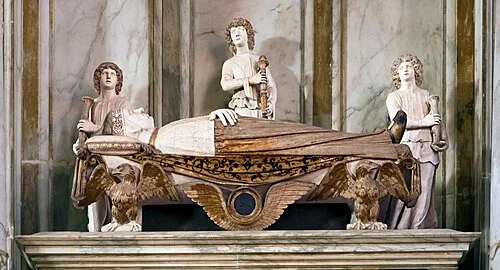 Presbytery & High Altar
Tomb of Doge Andrea Vendramin
The tomb of Doge Andrea Vendramin is considered chiefly the work of Tullio Lombardo, working here on his own, apart from his father Pietro. Compared with the Mocenigo monument heard earlier, everything is calmer. The surfaces are smoother, the decoration restrained, the proportions measured. The roundels above the arch follow the ancient Arch of Augustus at Rimini, and the whole structure reads like a classical building. At its heart is the doge's effigy lying in state, flanked by standing attendants like figures from a Roman relief. The monument has travelled. It was first built for the church of the Servi, which was destroyed in the Napoleonic era, and in 1817 it was brought here and reassembled, not quite in its original form. The statues of Adam and Eve from its niches were left out; Adam ended up in the Metropolitan Museum in New York, and only a later copy of Eve survives in Venice. In their place came figures of Saint Margaret and Saint Mary Magdalene by Lorenzo Bregno, brought from another suppressed church. A masterpiece of one age, patched together from the losses of another.
Listen in the appDidier Descouens · CC BY-SA 4.0
10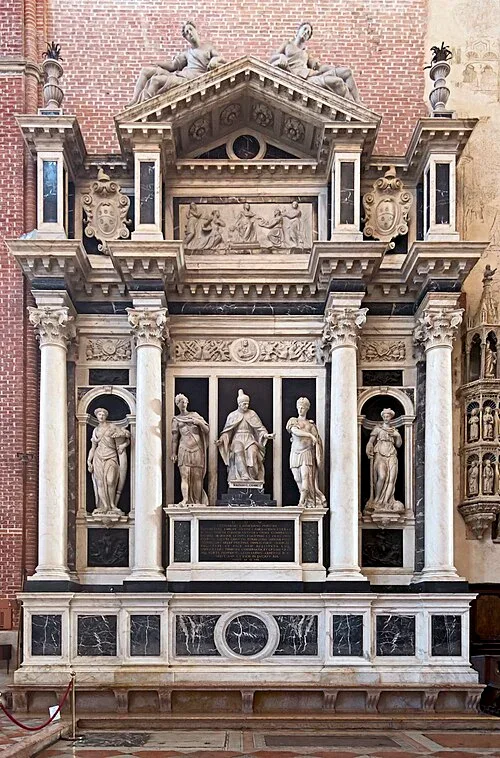 Presbytery & High Altar
Tomb of Doge Leonardo Loredan
Here is the theme that gives this church its state importance. From the fifteenth century onward, the funeral services of every doge of Venice were held in this building. Twenty-five doges are buried here. That is why the Venetians call it their pantheon. The monument to Leonardo Loredan, dated 1572, rises among the tallest in the choir. Its architecture is by Girolamo Grapiglia, and the doge himself was carved by Girolamo Campagna, standing in his ceremonial robes beneath a pediment. Around him, allegorical figures by Danese Cattaneo carry the meaning: Venice on one side, the League of Cambrai that warred against her on the other, with Abundance and Peace filling the spaces between. Loredan had led the Republic through that long war. The tiered architecture and free-standing figures show how late Renaissance Venice still honoured its rulers. Think back to the plain sarcophagus hanging on the outer facade, where the story began. From that bare stone chest to this marble stage, three centuries of Venetian tomb-making are gathered in one church.
Listen in the appDidier Descouens · CC BY-SA 4.0
- 11
The Monumental Clock
A painted octagonal clock in the transept, marking the hours of prayer for a monastic community.
- 12
The Chapel of the Rosary
The Chapel of the Rosary: built to thank heaven for Lepanto, burned by arson in 1867, restored by 1922.
- 13
Veronese in the Chapel Ceiling
Veronese's ceiling canvases, rescued from a suppressed church to fill the chapel the fire had emptied.
- 14
Monument to Doge Pasquale Malipiero
The aisles of the pantheon: doge monuments and commanders lining the nave walls, the Lombardo family all over them.
- 15
Honorius III Approving the Rule of St Dominic
Leandro Bassano's painting of the moment the Dominican order was approved, closing the circle of the whole story.
Basilica dei Santi Giovanni e Paolo
Frequently asked questions
How much does the guide cost?
Free app download. Listed guide price: $0.99. Guide price shown in the app. Audio guide only. Venue admission is separate.
Can I listen without internet?
Yes. Download the guide’s audio, images, and maps in the app before your visit. Your downloaded content is then available offline.
Can I listen in my language?
This audio guide is available in 15 languages, including English.
Do I need to follow a schedule?
No. This is a self-guided experience. Choose your stops, pause whenever you like, and return to a story at your own pace.
At your own pace
Explore Basilica dei Santi Giovanni e Paolo.
Download Stanza, then search for “Basilica dei Santi Giovanni e Paolo”.
Free app download · Guide price shown in the app
Keep exploring
Nearby audio guides
Venice · 1 km
Rialto Bridge
Content & sources
Photo: Kallerna · CC BY-SA 4.0
Venice · 1 km
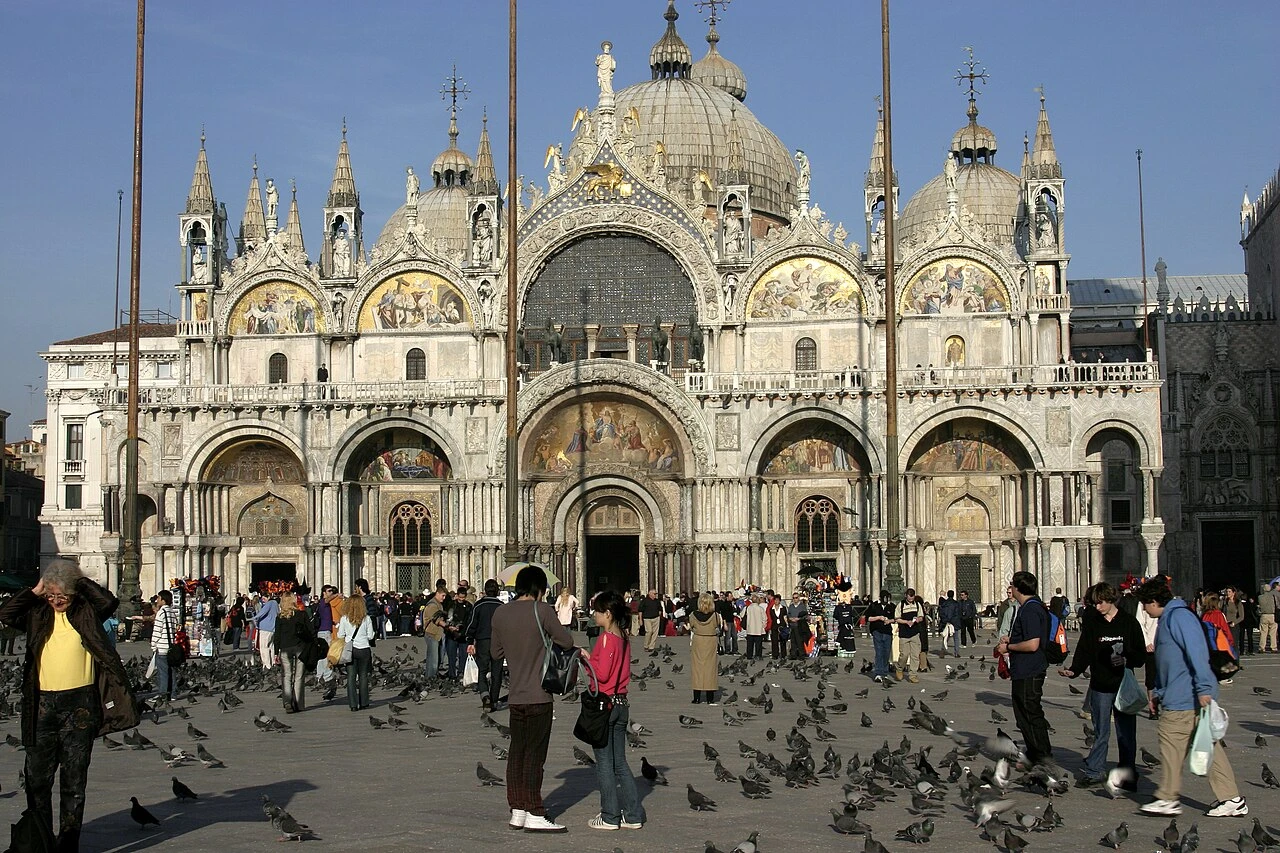
St Mark's Basilica
Content & sources
Photo: Nino Barbieri · CC BY-SA 2.5
Venice · 1 km
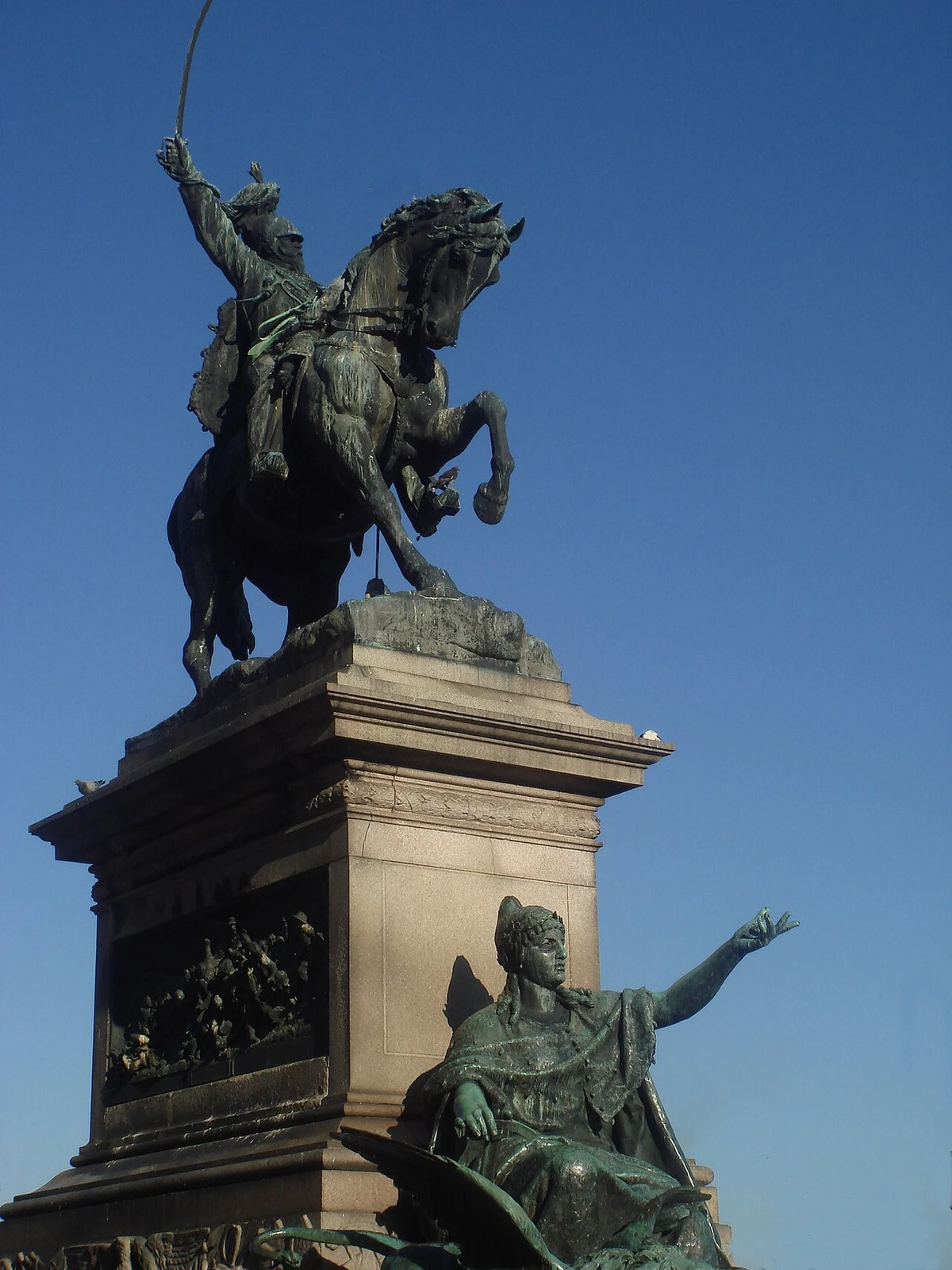
Monumento a Vittorio Emanuele II
Content & sources
Photo: G.dallorto · Attribution
Venice · 1 km
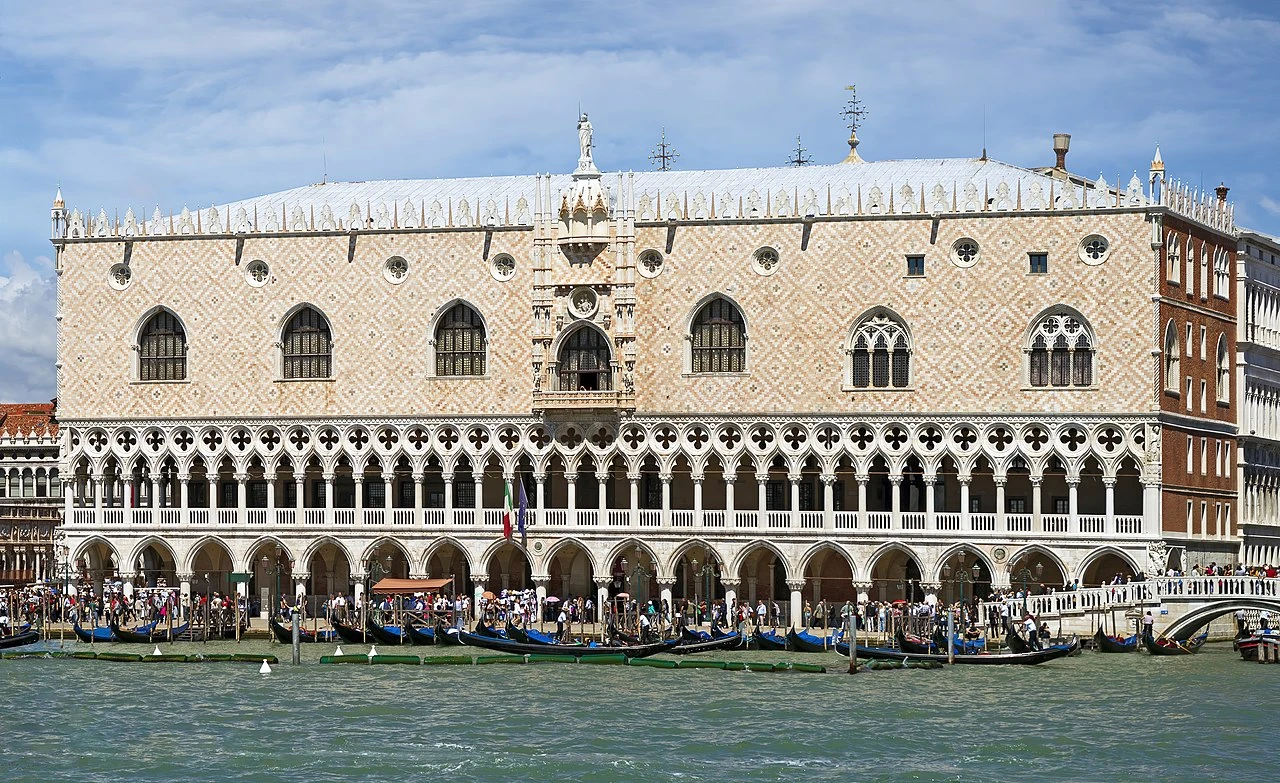
Doge's Palace
Content & sources
Didier Descouens · CC BY-SA 4.0