Stanza · Audio guide
Basilica di San Giorgio Maggiore Audio Guide
A place to remember. A story to take with you.
San Giorgio Maggiore is a 16th-century Benedictine church on the island of the same name in Venice, designed by Andrea Palladio. The church is a basilica in the classical Renaissance style and forms a focal…
Download Stanza, then search for “Basilica di San Giorgio Maggiore”.
About the tour
One guide. Your kind of visit.
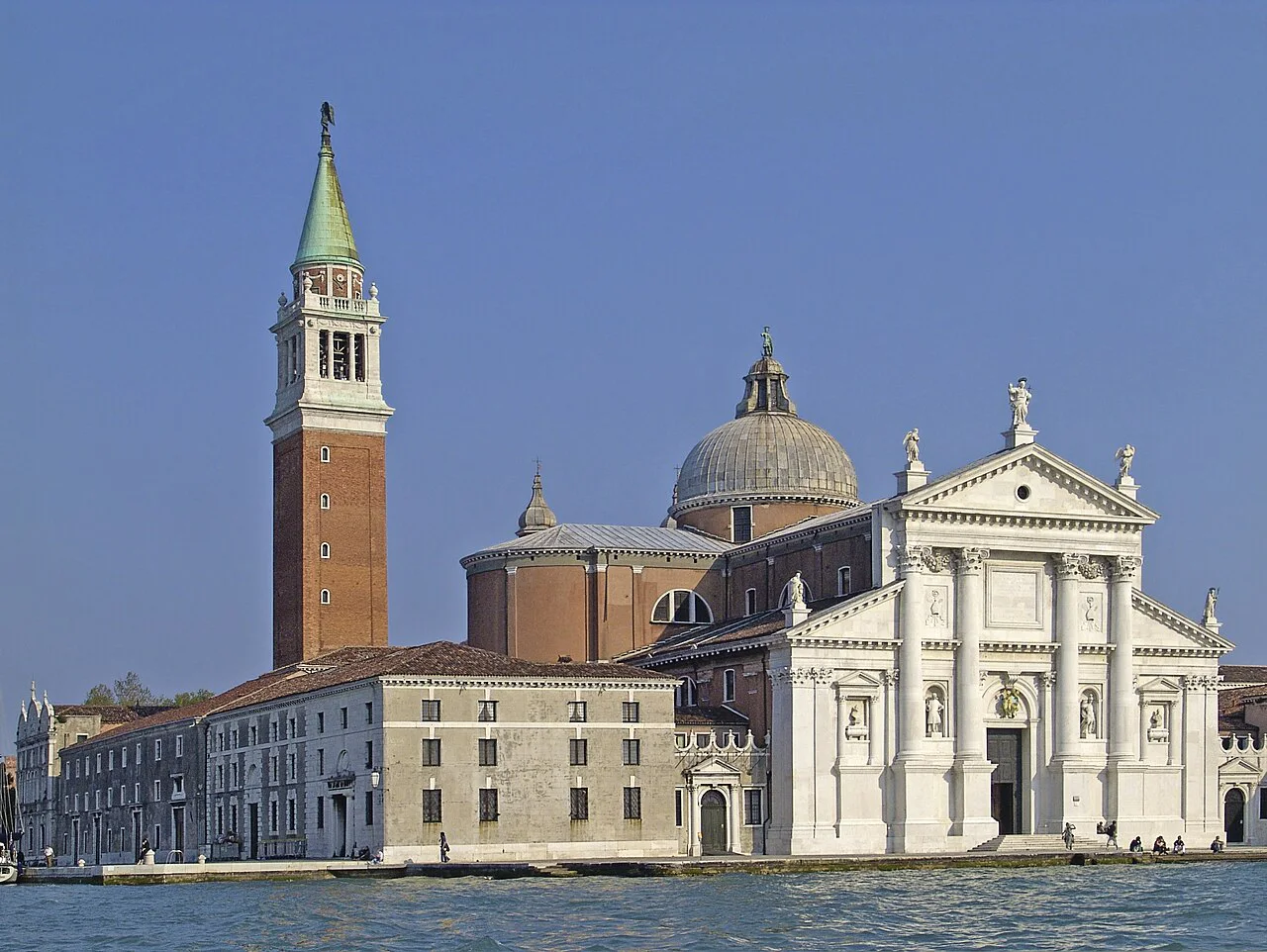
San Giorgio Maggiore is a 16th-century Benedictine church on the island of the same name in Venice, designed by Andrea Palladio. The church is a basilica in the classical Renaissance style and forms a focal point of the view from the Riva degli Schiavoni.
Ready when you are.
- 01Get the free Stanza app.
iOS & Android
- 02Find your guide.
“Basilica di San Giorgio Maggiore”
- 03Download before you go.
Works offline
Audio guide / 11 narrated stops
Inside the guide
Get to know a few of the stories before you go. Open a stop to read more.
01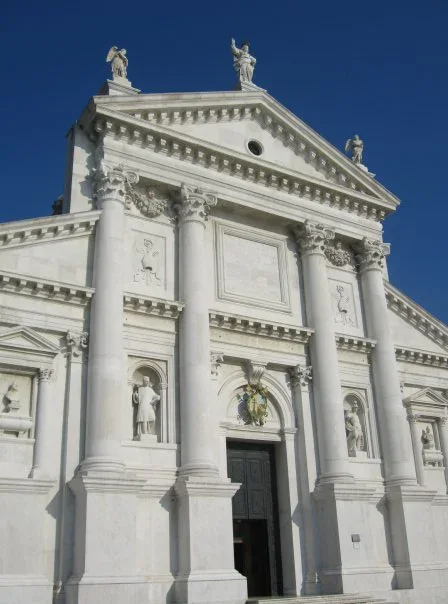 Island Quay & Palladian Façade
The Palladian Façade
Welcome to San Giorgio Maggiore, the abbey church of a Benedictine monastery on its own island in the Venice lagoon. Across the water rises the Piazzetta di San Marco, and this brilliant white front was placed to face it. Andrea Palladio designed the church, and the foundation stone was laid in 1566 in the presence of the Pope. The façade itself was not finished until 1610. Its gleam above the blue water makes it the focal point of the view from the Riva degli Schiavoni. The front also solves a problem that had troubled church builders for centuries. A classical temple face is low and wide, but a Christian church has a high nave over low side aisles. Palladio's answer was to superimpose two temple fronts. A wide pediment with its architrave spans the nave and both aisles, apparently held up by a single order of pilasters. Above it sits a narrower pediment, the width of the nave alone, carried by giant columns on tall pedestals. Beside the central portal stand statues of Saint George and of Saint Stephen, the church's two dedicatees.
Luke N. Vargas. Dontexpect · Public domain
02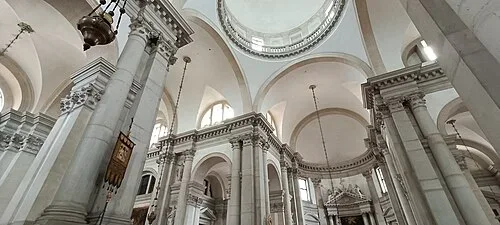 Central Nave & Palladian Interior
The Bright Nave of Palladio's Basilica
Inside, the church is very bright, with massive engaged columns and pilasters rising against undecorated white walls. A long basilican nave is crossed by a cruciform plan with transepts, and a dome marks the meeting of the two axes. The Benedictines wanted light and classical clarity here rather than the coloured ornament of many Venetian churches. The model was approved in 1566. By 1575 the perimeter walls and the drum of the dome already stood. The dome itself was completed in 1576. Palladio died in 1580, before the choir behind the altar and the façade were done. The choir was finished in the years after his death, and the decoration of the interior followed afterwards.
Photo: Misha2101 · CC BY-SA 4.0
03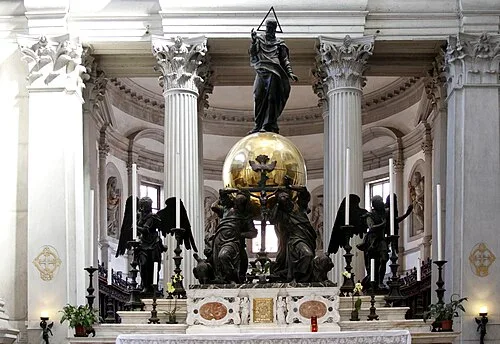 High Altar & Campagna's Bronzes
The High Altar and Campagna's Bronzes
At the head of the nave stands the high altar, its design attributed to Antonio Vasillacchi, called l'Aliense. Crowning it is a bronze group by Gerolamo Campagna from the 1590s. Four dark figures of the Evangelists lift a globe on their shoulders. Above the globe rises Christ, together with the Trinity. The deep bronze stands out sharply against the pale columns of Palladio's architecture behind it. It is the liturgical heart of the whole church, framed by the columns of the sanctuary.
Listen in the appJosé Luiz · CC BY-SA 4.0
04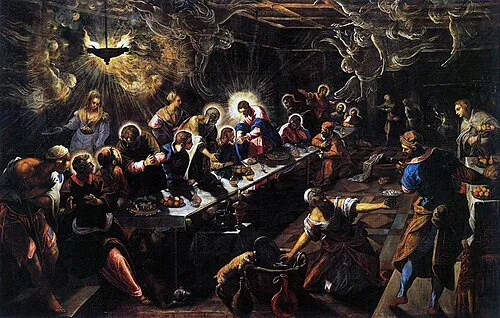 Sanctuary Masterpieces by Tintoretto
Tintoretto's Last Supper
Flanking the presbytery hang two very large canvases by Jacopo Tintoretto, both painted on the institution of the Eucharist. They were placed to be seen from the altar rail. The Last Supper is the darker of the two. A lamp blazes from the ceiling, and beneath it the halo around Christ glows. The table runs diagonally deep into the picture, so the eye travels with the apostles along it. Around the sacred meal move ordinary servants, animals and scattered dishes. That is Tintoretto's late manner at its most dramatic, setting the holy moment inside everyday life rather than apart from it.
Listen in the appJacopo Tintoretto · Public domain
05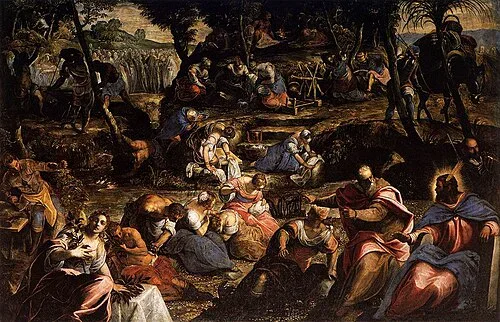 Sanctuary Masterpieces by Tintoretto
The Fall of Manna (The Jews in the Desert)
Across the sanctuary hangs the companion canvas, The Jews in the Desert. It shows the Israelites collecting the manna, the food God sent them in the desert after their escape from Egypt. A whole people gathers, kneels and eats across the crowded, earthy scene. At the right a radiant figure watches over them. In Christian reading the manna foretold the Eucharist, the bread from heaven. That is why the two paintings were hung as a pair in this sanctuary. The Last Supper, its twin, faces it at matching scale, the promise and its fulfilment on either side of the altar.
Listen in the appJacopo Tintoretto · Public domain
06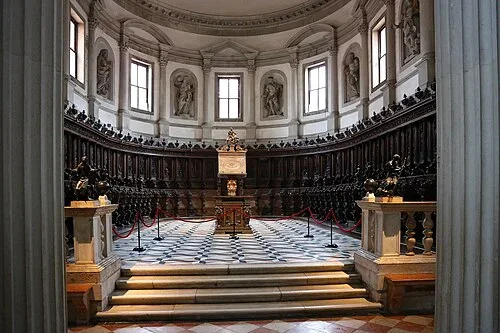 Monks' Choir & Carved Stalls
The Monks' Choir Behind the Columns
Behind the altar, past a screen of columns, lies the reason the whole complex exists: the monks' choir. Palladio designed it in essentials before his death, and it was built between 1580 and 1589. The semicircular room is lined with dark wooden stalls. Bas-reliefs by Albert Van der Brulle run along them. For a Benedictine community the choir is the heart of the day. The monks gather here through the hours to sing the prayers that structure monastic life. Everything else in this church, its nave, its altars and its paintings, stands in service of that rhythm of prayer.
Listen in the appPhoto: Andraszy · CC BY-SA 4.0
07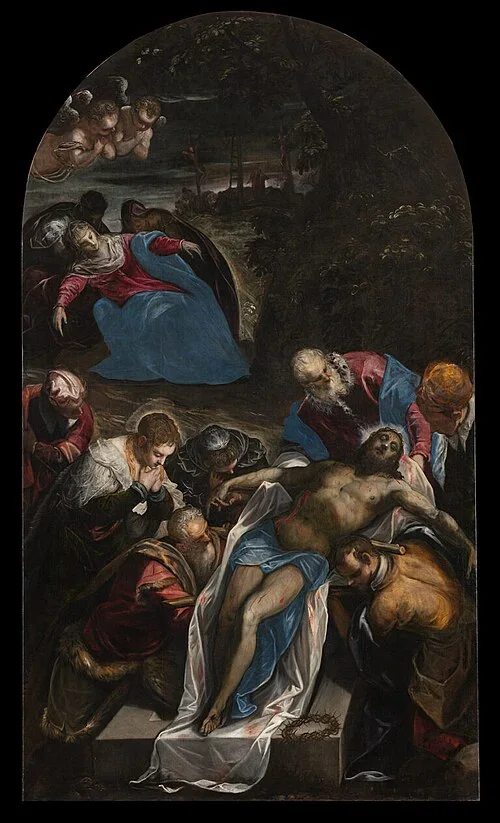 Chapel of the Dead & Tintoretto's Entombment
The Chapel of the Dead and Tintoretto's Entombment
In the Chapel of the Dead hangs Tintoretto's Entombment of Christ, painted in 1594. Christ's body lies on the stone slab, wrapped in white cloth. The Virgin swoons in blue at the upper left, held up by mourning figures. Angels hover in the darkness above the scene. The picture is lit as if by torchlight, mourner pressed close against mourner. It shows a very different Tintoretto from the great sanctuary canvases, intimate and sombre. The painting has been conserved, and its deep colours carry the grief of the scene still.
Listen in the appJacopo Tintoretto · Public domain
08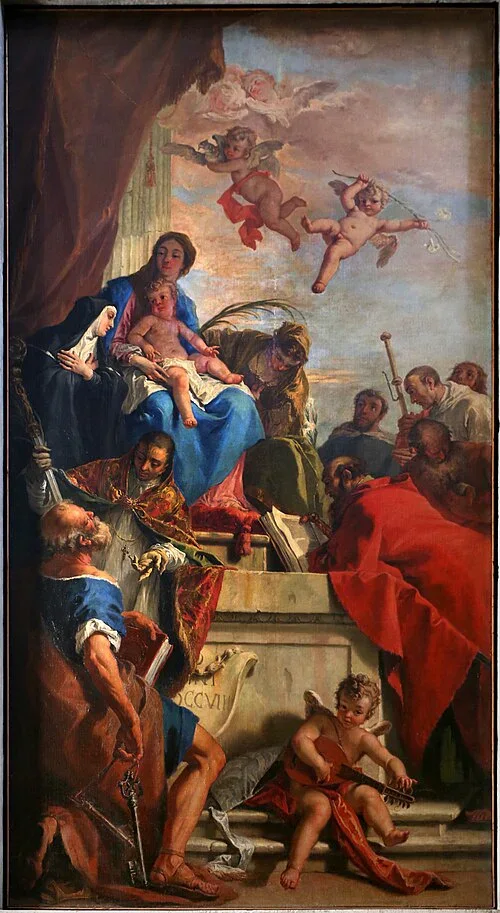 Side Chapels & Venetian Altarpieces
The Bollani Chapel and Sebastiano Ricci's Altarpiece
The chapel to the right of the high altar belonged to the Bollani family. Domenico Bollani had been ambassador to Edward the Sixth of England in 1547, and later became a bishop. In many Venetian churches families bought chapels and decorated them as they pleased. The Benedictines had income from property and were in a stronger position, so they kept control of the chapels and dictated their decoration. After Domenico's death work slowed, and the chapel was still unfinished in 1619, with a poor painting as its altarpiece. A substitute went up in 1693. Only in 1708 did the chapel receive the important work seen there now, the Virgin and Child with Saints by Sebastiano Ricci. It is a lively late-Baroque scene, with the Madonna enthroned among saints and putti tumbling through the sky. At the bottom a little angel strums a lute.
Listen in the appPhoto: Sailko · CC BY 3.0
09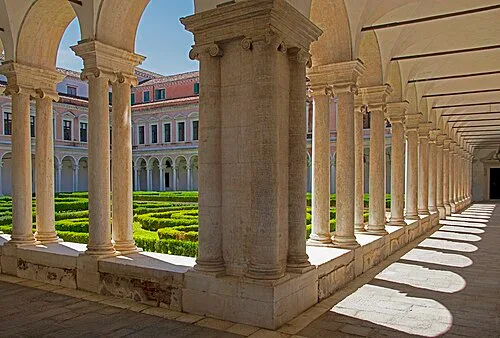 Monastery Cloister & Monastic Legacy
The Benedictine Cloister and the Monastery's Legacy
This island has belonged to the Benedictines for a very long time. In 982 the Doge Tribuno Memmo gave it to the order, and a monk named Giovanni Morosini founded the monastery here as its first abbot. An earthquake in 1223 destroyed every building on the island, and the community rebuilt. Andrea Palladio's first work here was the monastery refectory, rebuilt from 1560. For its back wall Paolo Veronese painted The Wedding at Cana, completed in little more than a year. In 1797 Napoleonic troops looted the picture, cut the canvas up for transport, and carried it to Paris; it hangs in the Louvre today. The monastery's most extraordinary moment came soon after. With Rome occupied and the papacy vacant, the cardinals met in conclave on this isolated island in 1799. They elected Pius VII, who was crowned in this church in March 1800.
Listen in the appPhoto: Orlando Paride · CC BY-SA 4.0
10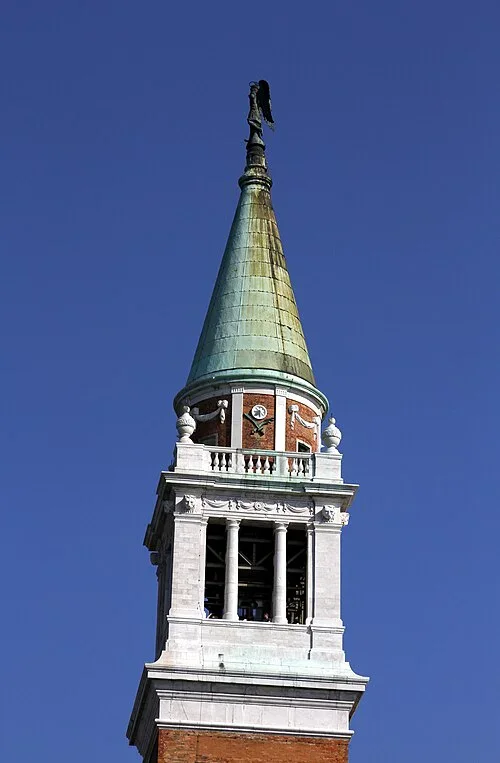 Campanile Summit & Lagoon Panorama
The Campanile
The bell tower first rose in 1467. In 1774 it collapsed, destroying parts of the monastic buildings around it. The tower standing now was finished by 1791, designed in the neoclassical style by the architect Benedetto Buratti. Its square shaft carries a bell chamber of white Istrian stone, crowned by a conical spire. The copper of the spire has weathered to green. The tower rises about seventy-five metres over the lagoon. Ramps make the climb an easy one, and there is a lift as well. From the top there is a fine view across Venice.
Listen in the appJosé Luiz · CC BY-SA 4.0
- 11
From the Bell Tower: Venice and St Mark's
The panorama that explains the whole church, and Forster's line about the island.
Basilica di San Giorgio Maggiore
Frequently asked questions
How much does the guide cost?
Free app download. Listed guide price: $0.99. Guide price shown in the app. Audio guide only. Venue admission is separate.
Can I listen without internet?
Yes. Download the guide’s audio, images, and maps in the app before your visit. Your downloaded content is then available offline.
Can I listen in my language?
This audio guide is available in 15 languages, including English.
Do I need to follow a schedule?
No. This is a self-guided experience. Choose your stops, pause whenever you like, and return to a story at your own pace.
At your own pace
Explore Basilica di San Giorgio Maggiore.
Download Stanza, then search for “Basilica di San Giorgio Maggiore”.
Free app download · Guide price shown in the app
Keep exploring
Nearby audio guides
Venice · 1 km
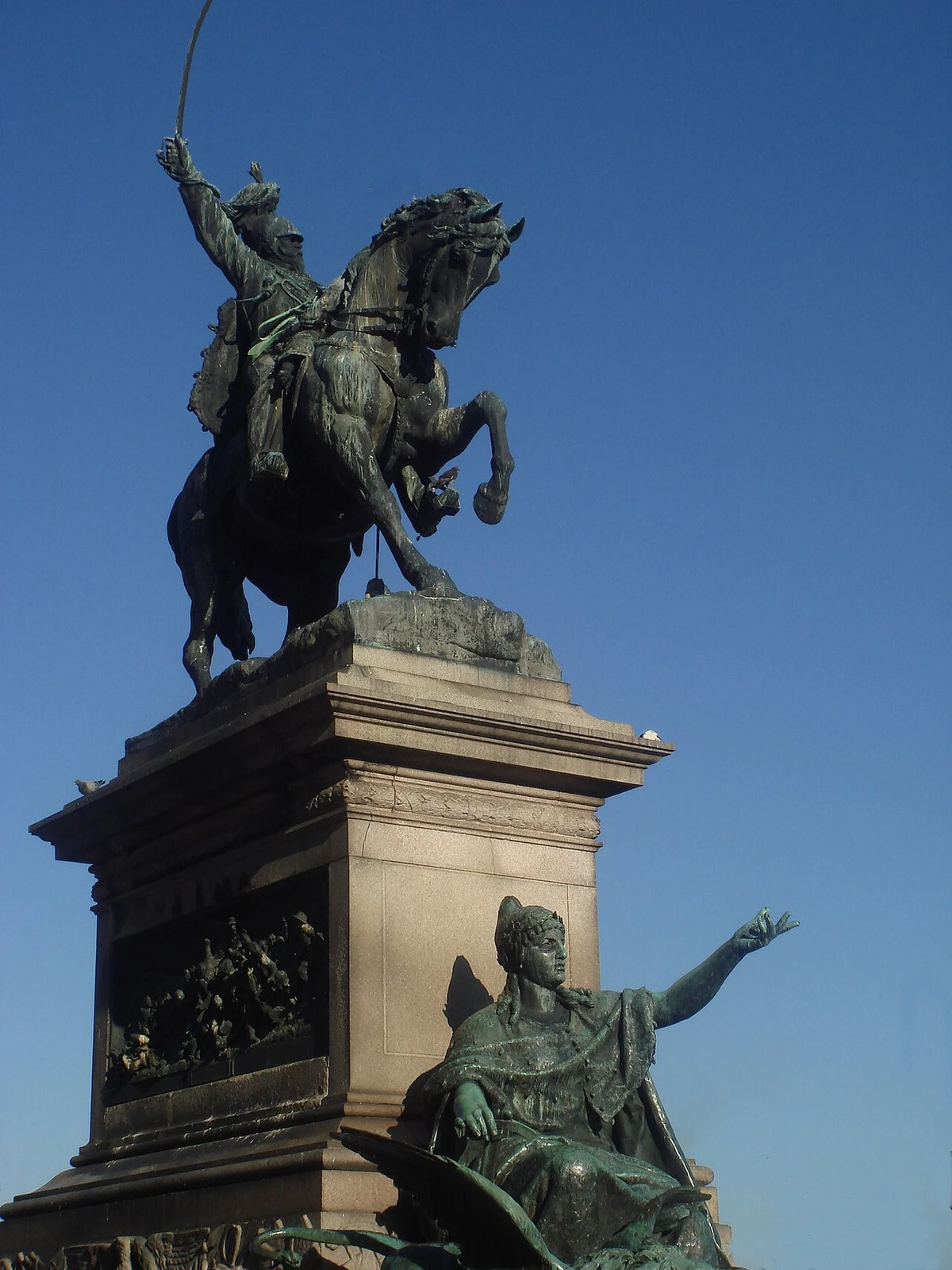
Monumento a Vittorio Emanuele II
Content & sources
Photo: G.dallorto · Attribution
Venice · 1 km
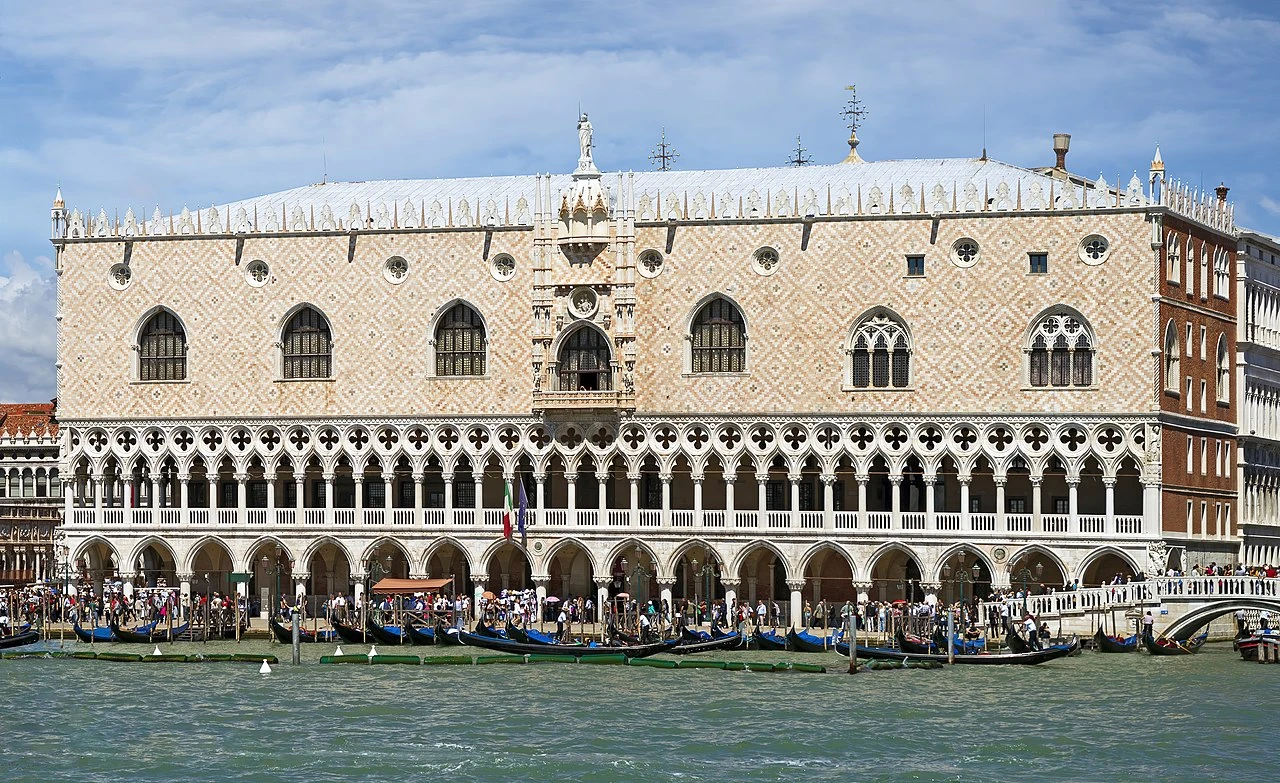
Doge's Palace
Content & sources
Didier Descouens · CC BY-SA 4.0
Venice · 1 km
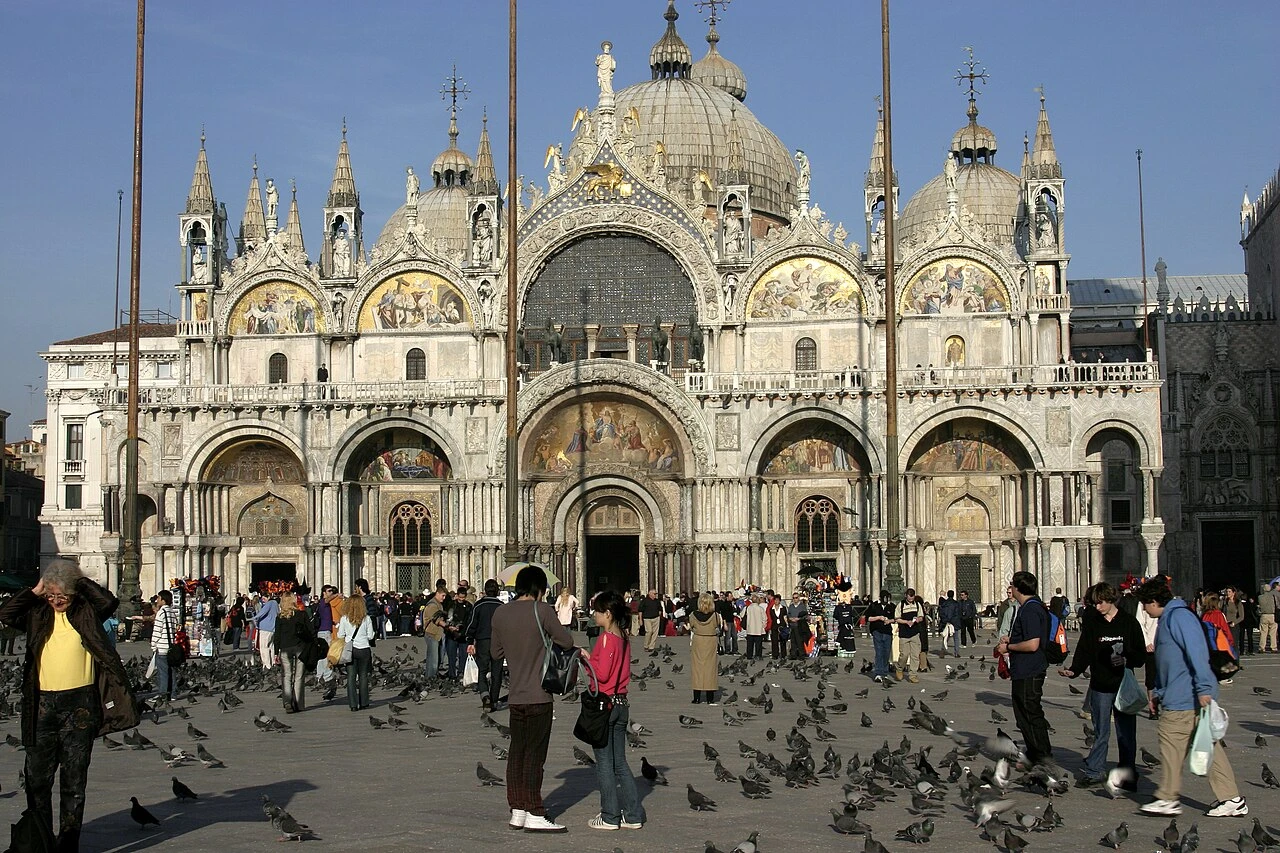
St Mark's Basilica
Content & sources
Photo: Nino Barbieri · CC BY-SA 2.5
Venice · 1 km