Stanza · Audio guide
Mitla Audio guide
A place to remember. A story to take with you.
Mitla is an archaeological site located in the state of Oaxaca, Mexico. It served as the main religious center of the Zapotec culture during a later period.
Download Stanza, then search for “Mitla”.
About the tour
One guide. Your kind of visit.
Mitla is an archaeological site located in the state of Oaxaca, Mexico. It served as the main religious center of the Zapotec culture during a later period.
Ready when you are.
- 01Get the free Stanza app.
iOS & Android
- 02Find your guide.
“Mitla”
- 03Download before you go.
Works offline
Audio guide / 10 narrated stops
Inside the guide
Get to know a few of the stories before you go. Open a stop to read more.
01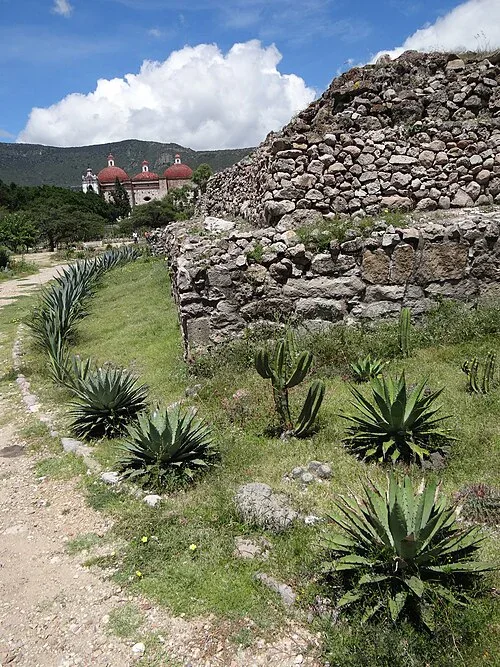 1. Site Entrance and North Group ApproachArrival at Lyobaa, the Place of Rest
Welcome to Mitla, in the high valleys of Oaxaca. This was the sacred burial ground and religious capital of the Zapotec, a people who built their greatest temples here on the floor of a cold mountain valley. The place carries three names, each from a different people. In Nahuatl it was Mictlán, the place of the dead. The Zapotec called it Lyobaa, the place of rest. The Mixtec knew it as Ñuu Ntìì, which also means the place of the dead. Work on the ceremonial center began around the year 850, and the city reached its height around 1200, when the Mixtec had become a power in the valley. Unlike Monte Albán, the older capital on its ridgetop, nothing here climbs a hill. The buildings are low and horizontal, set on the valley floor at nearly fifteen hundred meters above the sea, made for the comfort of the priests and residents who lived among them rather than for spectacle. The path ahead runs past agave plants toward a colonial church with red domes, built right above the old ruins.
Adam Jones from Kelowna, BC, Canada · CC BY-SA 2.0
02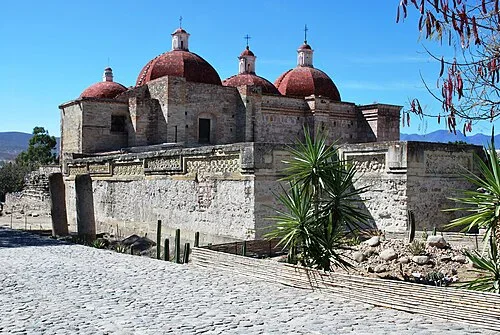 2. Church of San Pablo and Colonial SyncretismThe Church of San Pablo Over the Temple Platform
The red-domed church above these ruins is the Church of San Pablo, and it sits on ground the Spanish went out of their way to claim. In 1553 the Archbishop of Oaxaca, Albuquerque, ordered the destruction of the site. Mitla had held great religious and political power for centuries, and he wanted that power broken. Spanish-directed forces attacked the buildings, dismantling them and sacking them, and few structures were spared. The Zapotec believed that the lord and lady of the underworld lived in this northern group of buildings. The clergy built their church here in the sixteenth century, on top of a large pre-Hispanic platform, to press the point. That platform now serves as the church atrium, the open forecourt where worshippers gather. Spanish clergy even lived for a time in rooms of the sacred precinct, occupying the seat of the underworld lords they had displaced. The old fretworked walls below and the red domes above are two faiths stacked on a single platform.
Photo: Thelmadatter · CC BY-SA 3.0
03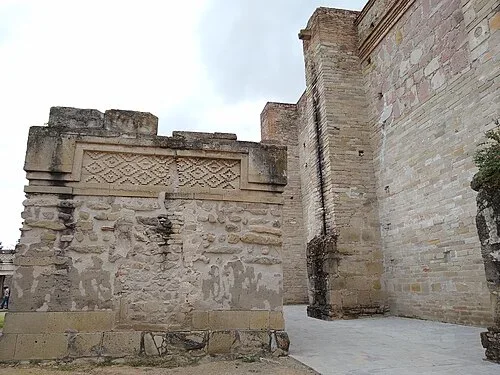 2. Church of San Pablo and Colonial SyncretismStones Taken from the Temples
The side wall of the church tells the destruction in its own masonry. Set into it are large carved stones taken from the pre-Hispanic buildings, including a panel of geometric fretwork that once belonged to a temple wall. The dismantled blocks and remains of Mitla were used as building material for Spanish churches across the region, and San Pablo itself rose directly on part of the ruins. The borrowing traveled far. The north side of the Cathedral of Oaxaca incorporates design features taken from Mitla, a deliberate message that the old culture had been superseded by the new religious order. Here the message is more direct still, because the stones themselves were carried across the plaza and stacked into a Christian wall.
Listen in the appThayne Tuason · CC BY 4.0
04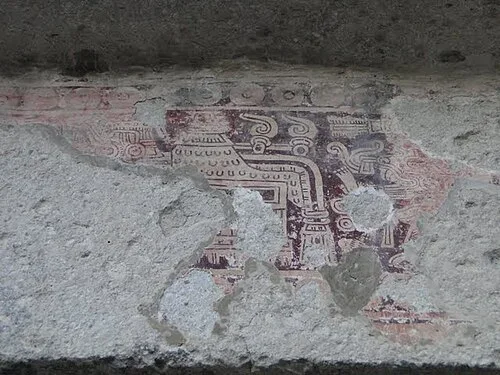 3. The North Group Courtyard and Codex FrescoesCodex-Style Murals of the North Group
Beside all that stone, it is easy to miss that Mitla was once a painted place. The fragments that survive are mostly red, like these traces on a lintel, and they carry the sharp, precise line quality of Mixtec codices, the folded painted books of that people. Mythological scenes and characters once ran across buildings where priests lived and served. The painting was not confined to one hall. Traces of red remain on the pilaster jambs of Patio A in the Church Group and on the pillars of Patio I in the Arroyo Group, on the central water kerbs of the courtyards and at the bases of some walls. Enough of it survives that researchers suppose that most of the buildings may have been painted at one time. Since 1990 a project of the National Autonomous University of Mexico has worked to record and study these pre-Hispanic murals, Mitla's among them.
Listen in the appPhoto: Leon petrosyan · CC BY-SA 4.0
05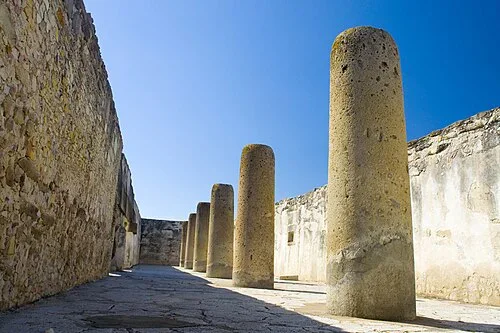 4. The Grand Hall of ColumnsThe Grand Hall of Columns
South of the Church Group lies the Columns Group, and its main building is the Palace, also called the Grand Hall of Columns. The hall runs about thirty-seven meters long and barely six and a half deep. Six columns of volcanic stone stand in the entrance room, each one carved from a single piece of rock. They once carried a heavy wooden roof, and that roof is gone, so the shafts now rise into open sky against whitewashed walls. The group has two entrances to the outside, both facing south, and moving through them meant passing a small corridor into the courtyard beyond. There is one more opening worth knowing. The north wall holds a small gap facing the patio, which is believed to have been used to pass into the afterlife. It is a small hole in a wall, made for a journey no living person was expected to take.
Listen in the appComisión Mexicana de Filmaciones from México D. F., México · CC BY-SA 2.0
06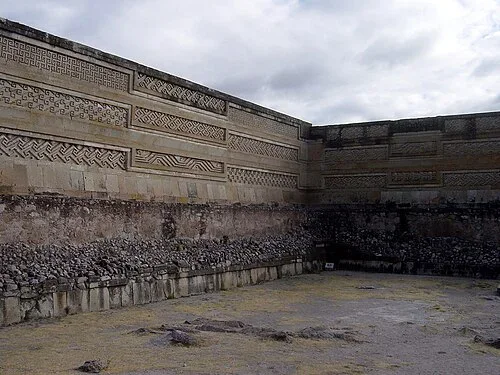 5. The Palace Courtyard (Patio de las Grecas)The Palace Courtyard of the Grecas
The walls around this courtyard carry the decoration that made Mitla famous. The Spanish called the geometric patterns grecas, and they are made from thousands of small, finely cut and polished stone tiles. Not one drop of mortar holds them. Each piece is fitted against its neighbors, and the whole design is held in place by nothing more than the weight of the stones around it. Behind the tiles lies a background of stucco painted red, so the patterns once stood out against color instead of bare stone. The fretwork covers walls, friezes and tombs, and in places entire walls disappear into geometric bands above rougher masonry below. Nothing like it exists anywhere else in Mesoamerica. No other site in Mexico has this decorative work, which is why these quiet courtyards draw travelers from all over the world.
Listen in the appUploaded into English Wikipedia by en:User:Bobak Ha'Eri · CC BY 2.0
07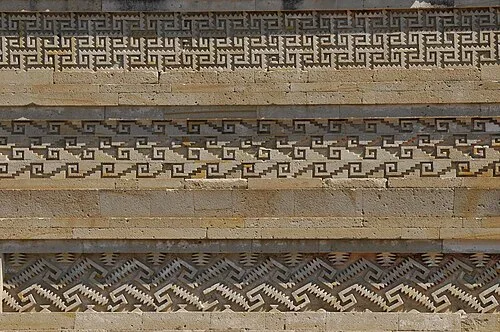 5. The Palace Courtyard (Patio de las Grecas)Reading the Fretwork Up Close
Up close, the grecas reward a slow eye. Band after band of step-frets and interlocking figures run along the walls, each pattern cut with the same care as the last. One detail is easy to overlook. Not a single fretwork design is repeated exactly anywhere in the whole complex. Every panel in Mitla is its own composition. The density and intricacy have struck observers as a kind of Baroque design, centuries before the Baroque, elaborate patterns piling into elaborate patterns until they consume the wall. The craft shows its finest skill in the lintels, the beams over doorways. In some of these lintels, the stone tiles are embedded directly into the solid stone beam itself.
Listen in the appPhoto: LBM1948 · CC BY-SA 4.0
08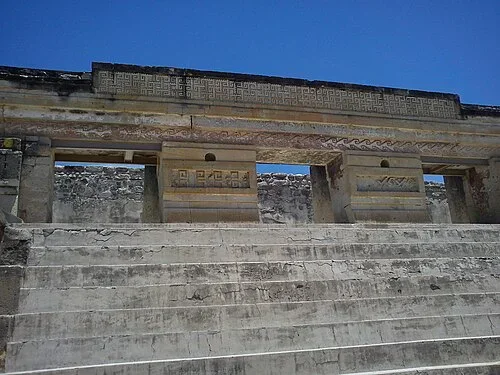 6. The Subterranean Cruciform TombsDescent to the Tombs of the Dead
Under some of these buildings, staircases descend into the earth, and this is the reason Mitla exists. The tombs below are lithic chambers shaped as a cross, reached by stairs leading down from the patios, and their inner walls are decorated with the same mosaic fretwork as the facades above. Two monumental cruciform tombs in Patio F are marked as defining works of the late period, their chambers and antechambers ornamented with carved fretwork friezes like the fronts of the great buildings. The elaborate tombs of the north and east buildings held high priests and Zapotec rulers. Burial here was a consecutive affair, with new dead laid in with their offerings and the remains of earlier deposits moved aside. The nobles buried at Mitla were believed to become cloud people, who would intercede on behalf of the population below. One tomb has an entrance divided by a thick column, known popularly as the Column of Life. The legend says that if a person wraps their arms around it, the space left between their hands shows how much life they have left.
Listen in the appPhoto: Ihiroalfonso · CC BY-SA 3.0
09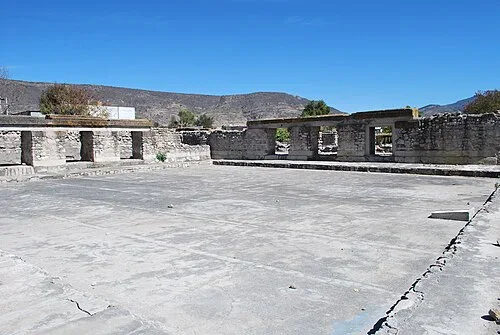 7. The Arroyo Group CourtyardThe Arroyo Group and Older Foundations
Mitla is bigger than its two famous groups. The site holds five: the South, the Adobe, the Arroyo, the Columns or Palace, and the Church or North Group, and the buildings of every group are aligned with the cardinal directions. This courtyard belongs to the Arroyo Group, one of the quieter corners of the site, plainer and less restored than the fretworked halls to the north. Traces of the red mural paint once recorded here marked the jambs of its pillars. At the turn of the twentieth century, the archaeologist Leopoldo Batres worked at Mitla and made a discovery that changed how the site is read. Beneath the Mixtec-style geometric decoration he found older, purely Zapotec foundations. The styles sit in layers because the cultures do: Zapotec builders first, then the Mixtec influence that grew as the city neared its height. What looks like one style of masonry is really two civilizations, one built over the other.
Listen in the appPhoto: Thelmadatter · CC BY-SA 3.0
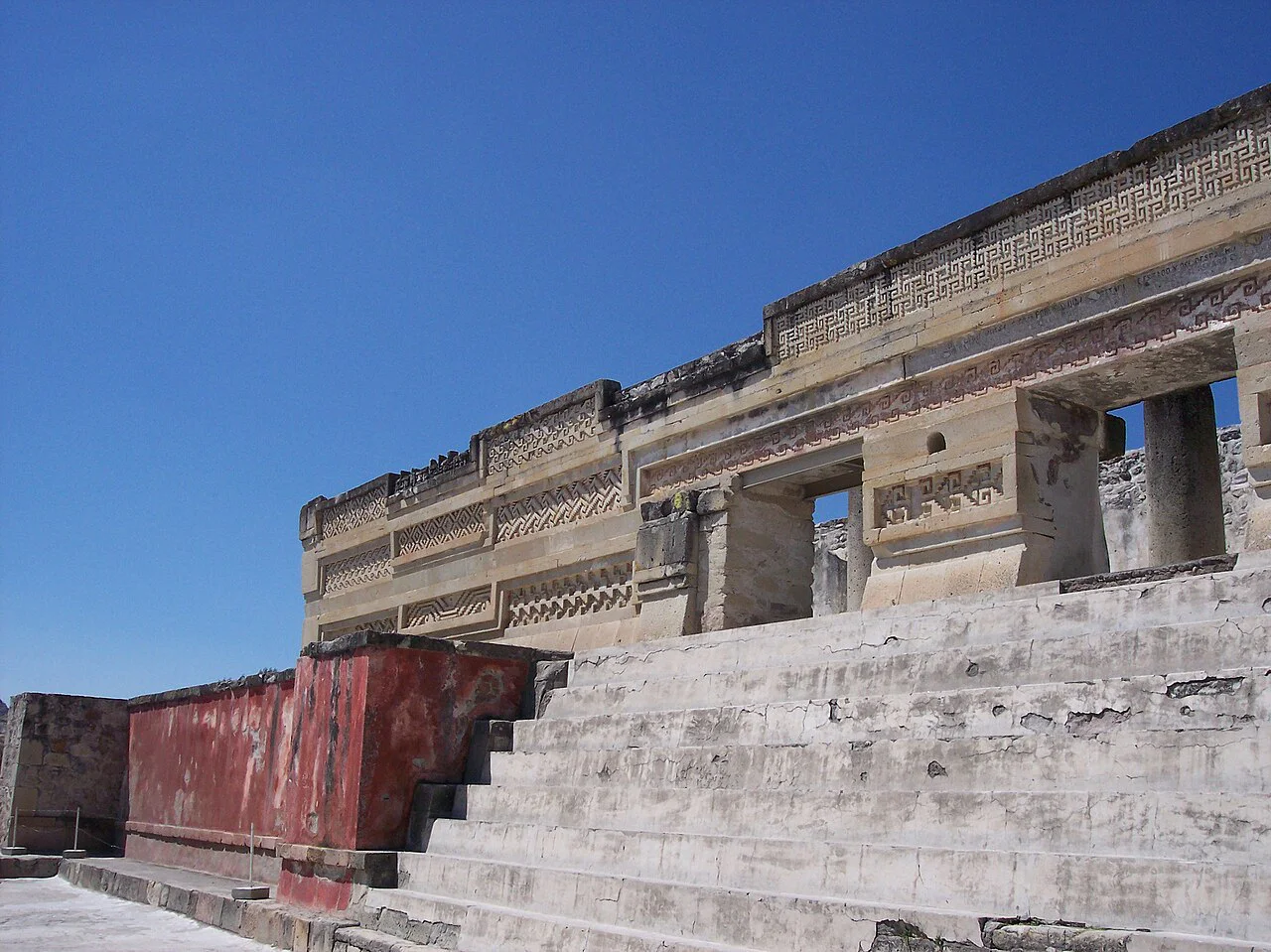
10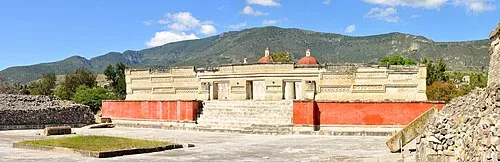 8. Panoramic Palace View and Site ExitGateway Between Two Worlds
A last look across the low palace roofs and the mountains beyond brings the whole idea of Mitla into one frame. This was built as a gateway between the world of the living and the world of the dead. Among the Mesoamerican peoples, death was held to be the most consequential part of life after birth, and a city of temples and tombs like this one stood at the crossing between the two. The panorama holds every layer of the story at once: Zapotec masonry, Mixtec-influenced design, and a colonial church rising over a temple platform, two traditions on one sacred ground. Today Mitla is one of many well-preserved sites in the Oaxaca Valley and the second most visited in the state, after Monte Albán. About five hundred people walk through on an average day, and tourism supports most of the economy of the town of San Pablo Villa de Mitla. Archaeologists such as Nelly Robles have pressed for the site to be recognized as a UNESCO World Heritage Site, and it already stands on Mexico's national heritage list. A city built as a door between two worlds is now a place people travel across borders to see.
Listen in the appPhoto: LBM1948 · CC BY-SA 4.0
Mitla
Frequently asked questions
How much does the guide cost?
Free app download. Listed guide price: $0.99. Guide price shown in the app. Audio guide only. Venue admission is separate.
Can I listen without internet?
Yes. Download the guide’s audio, images, and maps in the app before your visit. Your downloaded content is then available offline.
Can I listen in my language?
This audio guide is available in 15 languages, including English.
Do I need to follow a schedule?
No. This is a self-guided experience. Choose your stops, pause whenever you like, and return to a story at your own pace.
At your own pace
Explore Mitla.
Download Stanza, then search for “Mitla”.
Free app download · Guide price shown in the app
Keep exploring
Audio guides — Mexico
Santa Cruz Xoxocotlán · 42 km
Monte Albán
Content & sources
Photo: Petrusbarbygere · CC BY-SA 3.0
Veracruz
San Juan de Ulúa
Content & sources
Victor Pineda · CC BY-SA 2.0
Veracruz
Cempoala
Content & sources
User:Gengiskanhg · Public domain
La Venta
La Venta
Content & sources
Photo: Alfonsobouchot · Public domain