Stanza · Audio guide
Cempoala Audio guide
A place to remember. A story to take with you.
Cempoala is a Mesoamerican archaeological site located in the Mexican state of Veracruz. It was the first urban settlement encountered by the Spaniards upon their arrival on the mainland of North America.
Download Stanza, then search for “Cempoala”.
About the tour
One guide. Your kind of visit.
Cempoala is a Mesoamerican archaeological site located in the Mexican state of Veracruz. It was the first urban settlement encountered by the Spaniards upon their arrival on the mainland of North America.
Ready when you are.
- 01Get the free Stanza app.
iOS & Android
- 02Find your guide.
“Cempoala”
- 03Download before you go.
Works offline
Audio guide / 10 narrated stops
Inside the guide
Get to know a few of the stories before you go. Open a stop to read more.
01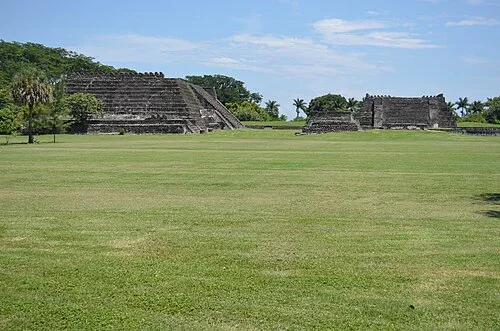 Main Ceremonial Plaza and the Silver LusterThe Main Ceremonial Plaza of Cempoala
Welcome to Cempoala, once the capital city of the Totonac people. The name comes from the Nahuatl Cempoalatl, meaning Twenty Waters. Some read it as a nod to the aqueducts that fed the city's gardens and fields; others take it simply to mean abundant water. Either way, water shaped this place. At its peak, somewhere between twenty-five and thirty thousand people lived here. The Totonac kingdom, Totonacapan, took in some fifty towns. In the early sixteenth century the whole region held roughly a quarter of a million people. The Mexica, who came to dominate the coast, called this city the Place of Accounts. Tribute from the Gulf coast was collected here, counted and sent on to their capital. The town was not one open sprawl but a set of walled perimeters enclosing temples and palaces. This wide green plaza is thought to have been its ceremonial and political heart. The first Spaniards to see it called it Villaviciosa, the fertile town, for its festivals and orchards, and later New Seville, after a city in Spain they thought it resembled.
Photo: Fgera · CC BY-SA 3.0
02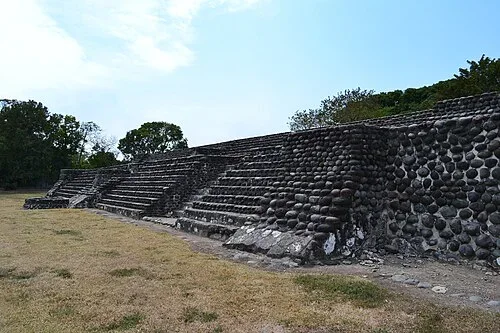 Main Ceremonial Plaza and the Silver LusterRiver-Stone Masonry and the Silver Luster
Every wall at Cempoala is built of rounded river stones. They came from the nearby Actopan River, worn smooth by the water and hauled to the site in their countless thousands. Masons set them in mortar, then coated the finished surface with lime plaster. That lime was burned from seashells and snails gathered along the coast. The result gave the city its fame from afar. Seen at a distance, the plastered buildings shone like silver. When strangers first approached Cempoala, that gleam was what announced it. The stones themselves tell the craft plainly. Each cobble was rounded by the river long before any mason touched it, then laid course by course into the stepped terraces of these temples.
Federico Pizano · CC BY 3.0
03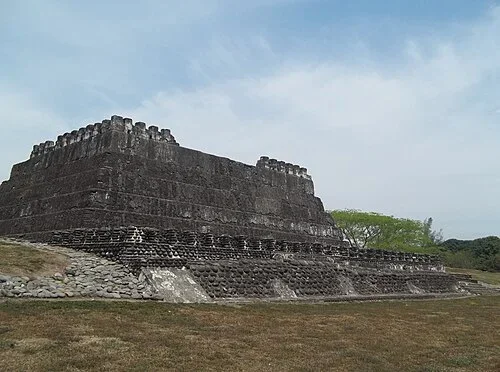 The Great Pyramid (Templo del Sol)Templo del Sol (Great Pyramid)
The Templo del Sol, the Sun Temple, is the great pyramid of Cempoala and probably the most spectacular structure on the site. Its crowning battlements, the stepped blocks along the top edge, give it something of a fortress silhouette. It stands on the same massive platform as the Templo Mayor, the Great Temple, with a broad square between the two. Two more temples shared that platform. One belonged to Quetzalcoatl, the feathered serpent, built as a square platform. The other belonged to Ehecatl, the wind god, and it was round. The great temple itself closely resembles the Sun Temple of Tenochtitlan, the Aztec capital far inland. Building high was an old habit on this low coastal plain. Long before these pyramids rose, the Preclassic town here was built on mounds to protect it from floods.
Listen in the appPhoto: Johanna Paulina Palacios · CC BY-SA 3.0
04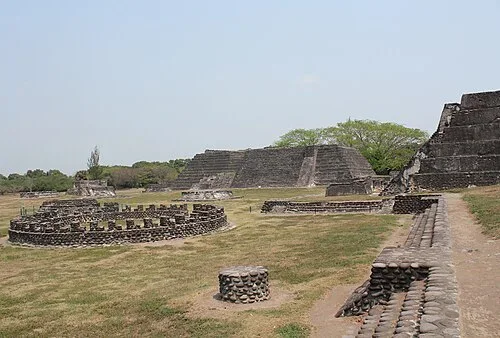 Templo de las Chimeneas (Chimney Temple)Templo de las Chimeneas (Chimney Temple)
Round pillars, about a meter and a half tall, give this building its name. They stand in a row along the Temple of the Chimneys, like great chimneys or drums. That peculiar profile makes it one of the most curious silhouettes on the site. The plaza group around it holds other landmarks. The Great Temple, the Templo Mayor, stands among these same buildings. And the circular enclosure of low stone walls in this group is known as the Circle of Gladiators.
Listen in the appArian Zwegers from Brussels, Belgium · CC BY 2.0
05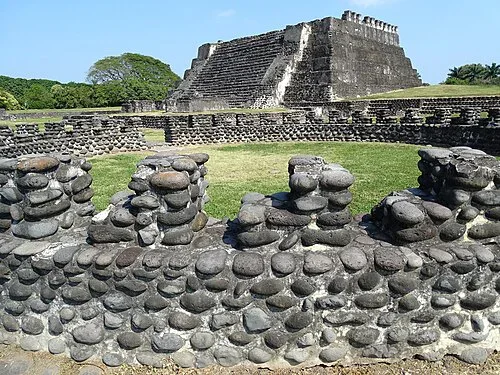 The Three Astronomical RingsThe Three Astronomical Rings
Just below the northeastern corner of the Great Pyramid, three stone rings stand in the central plaza. Each is built of rounded beach cobbles, jointed together into small stepped pillars around the rim. The largest ring carries forty of these pillars. The middle one has twenty-eight, and the smallest thirteen. Those counts are the clue. Archaeologists believe the rings were used to calibrate different astronomical cycles, possibly to keep track of eclipse cycles, worked by Totonac priests. From the top of the main pyramid, all three rings could be watched at once. Some researchers, among them Vincent Malmström of Dartmouth College, have studied the astronomical pattern the three counts create together.
Listen in the appAdam Jones from Kelowna, BC, Canada · CC BY-SA 2.0
06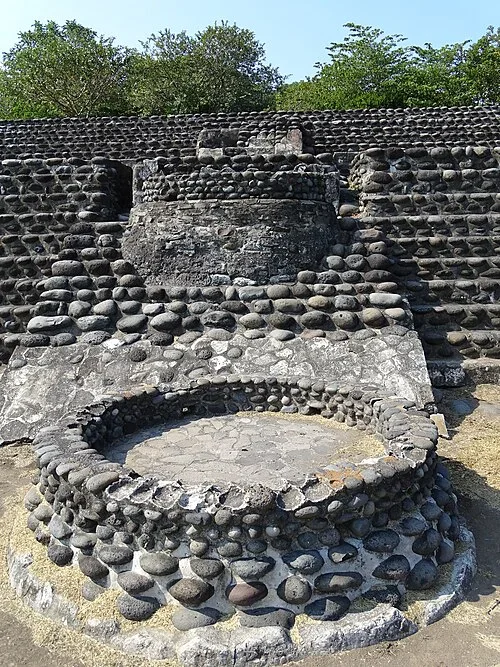 The Three Astronomical RingsA Calendar in Cobbles: Ring Detail
Up close, a single ring shows how it may have worked. Each stepped pillar is a station, one of a circle of them around the rim. The idea is that a priest moved a marker, or a small idol, from one pillar to the next with every day that passed. When the marker completed the full circle, a cycle had closed, whether a month or a stage in an eclipse count. It would have been a calendar run entirely by hand, day after day, priest after priest. The stones are beach cobbles, worn round by the Gulf, each one small enough to fit a workman's grip. Whether this is exactly how the rings served, no one can say for certain. It is the reading archaeologists find most convincing.
Listen in the appAdam Jones from Kelowna, BC, Canada · CC BY-SA 2.0
07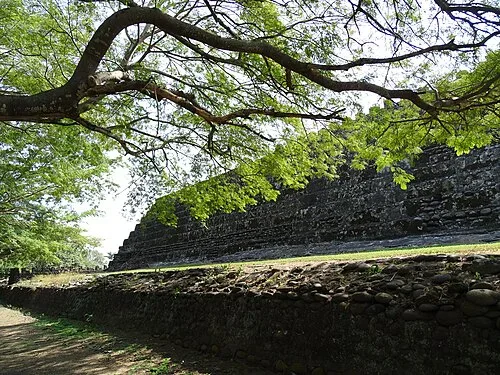 Walled System IV and the Spanish AlliancesWalled System IV and the Spanish Arrival
In 1519, Hernán Cortés and his men lay camped at San Juan de Ulúa on the coast, sick with malaria, when they heard of a town called Zempoala nearby. Cortés marched here with about five hundred conquistadors and sent word of his arrival. Twenty dignitaries came out to meet him at the edge of the city. In town, the tlatoani Xicomecoatl received them, the chief the Spanish called the Fat Chief. He fed them, gave them quarters, and presented gifts that included gold jewelry. He also complained bitterly of Aztec domination and of Moctezuma, for Cempoala had suffered under Aztec rule for years. Cortés promised to look into it. The next day he went on to Quiahuiztlan, another Totonac town to the north, and there the Spaniards and Totonacs forged their alliance against the Aztecs. In August 1519, Cortés set out for Tenochtitlan with forty Totonac captains. By a lower estimate, some eight thousand soldiers marched with him. Four hundred porters carried the loads, following the same routes used to move maize inland. This long wall belongs to one of the city's walled enclosures, the part of the site known as System IV. It was here, within these walls, that Cortés would later face the forces of Pánfilo de Narváez.
Listen in the appAdam Jones from Kelowna, BC, Canada · CC BY-SA 2.0
08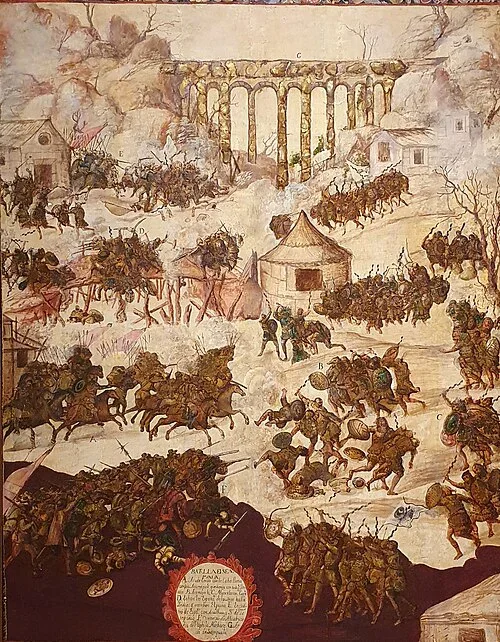 Walled System IV and the Spanish AlliancesThe Battle of Cempoala, 1520 (Colonial Painting)
This painting was made long after the event, in the colonial Mexican workshop of the Gonzalez family, working roughly between 1670 and 1740. It depicts the Battle of Cempoala, fought here on the twenty-seventh of May, 1520. The painter imagined the scene in a European style, with classical arches and massed cavalry, so it should not be taken as a record of how the city actually looked. The battle itself was a quarrel among Spaniards. Pánfilo de Narváez had been sent by the Governor of Cuba to arrest Cortés. Cortés moved first. In a surprise attack, he took Narváez prisoner at the top of one of the city's temples, supported by a small number of indigenous soldiers. Narváez's men then went over to Cortés, swelling his army for the march on Tenochtitlan. The victory consolidated Cortés's leadership in the colonization of Mexican territory.
Listen in the appJosé Luiz · CC BY-SA 4.0
09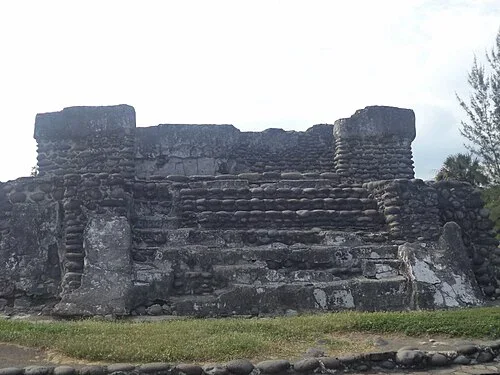 Templo Las Caritas (Temple of the Faces)Templo Las Caritas (Temple of the Faces)
Las Caritas, the little faces, is the nickname that stuck to this temple. It is a two-tier structure, two overlaid basements, standing about two hundred meters east of the Great Temple. Some also call it the Temple of Charity. Its decoration made it famous. The lower decorative belt carries murals of the sun, the moon, and Venus as the morning star. The upper section is decorated with large numbers of small clay faces, little skulls, set into the walls. Stucco faces and painted glyphs covered the lower sections as well. Archaeologists believe the complex was dedicated to the god of death, which suits the skulls.
Listen in the appPhoto: Dge · CC BY-SA 4.0
10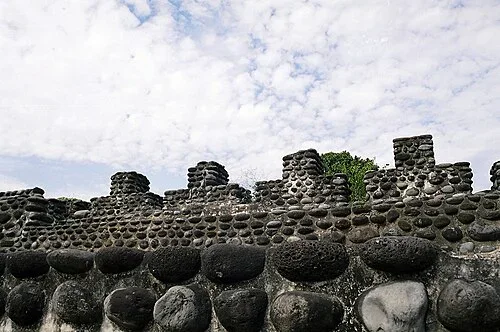 Templo Las Caritas (Temple of the Faces)What Remains: The City After 1519
The end came slowly, and then all at once. After the conquest, the people of Cempoala were relocated and Christianized, and their ancient cults were banned. They were put to work on the new Spanish sugar cane fields. Then, between 1575 and 1577, a smallpox epidemic known as matlazahuatl swept the land. Across Mesoamerica as a whole, an estimated two million people died in it. Cempoala was left empty. The few survivors moved away to Xalapa, and the city was lost to history. It lay forgotten until the archaeologist Francisco del Paso y Troncoso rediscovered it. What remains are these stones: river cobbles built into temples, rings that may have counted the sky, and the little clay faces of a temple of death. A city of twenty waters, abandoned once and found again.
Listen in the appJuan Javier Mora-Rivera · CC BY-SA 4.0
Cempoala
Frequently asked questions
How much does the guide cost?
Free app download. Listed guide price: $0.99. Guide price shown in the app. Audio guide only. Venue admission is separate.
Can I listen without internet?
Yes. Download the guide’s audio, images, and maps in the app before your visit. Your downloaded content is then available offline.
Can I listen in my language?
This audio guide is available in 15 languages, including English.
Do I need to follow a schedule?
No. This is a self-guided experience. Choose your stops, pause whenever you like, and return to a story at your own pace.
At your own pace
Explore Cempoala.
Download Stanza, then search for “Cempoala”.
Free app download · Guide price shown in the app
Keep exploring
Audio guides — Mexico
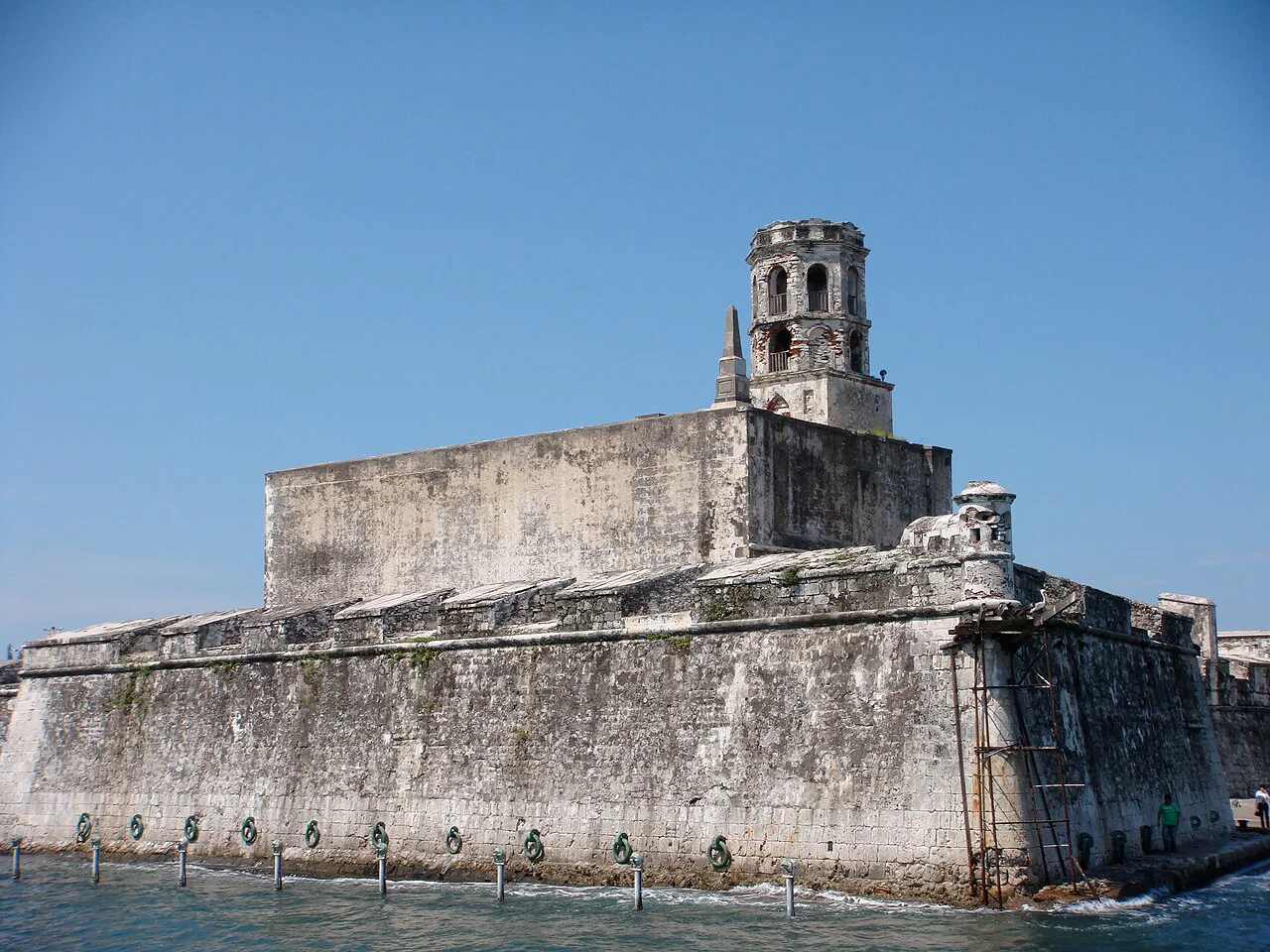
Veracruz · 39 km
San Juan de Ulúa
Content & sources
Victor Pineda · CC BY-SA 2.0
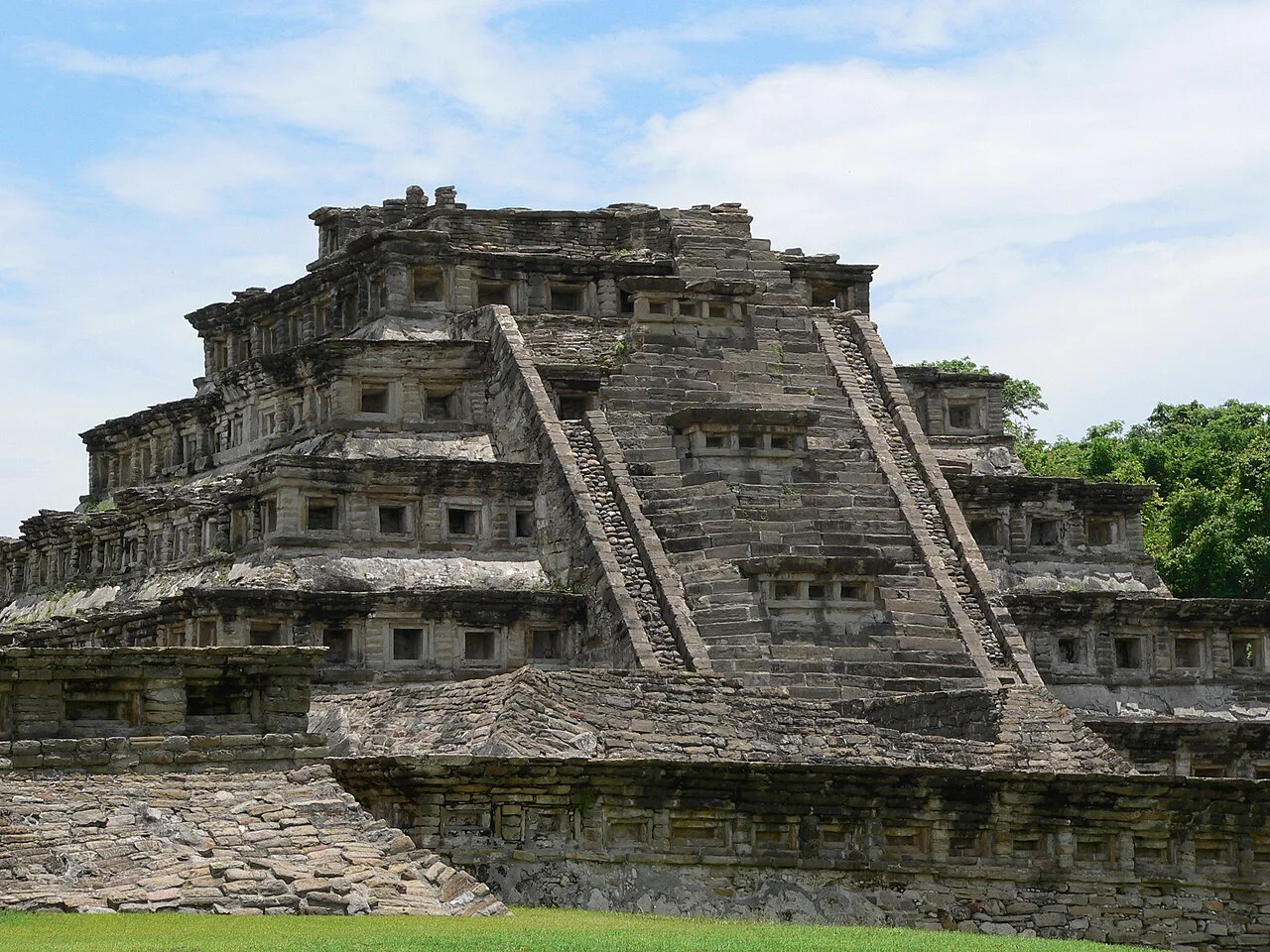
Veracruz
El Tajín
Content & sources
Photograph: Frank C. Müller, Baden-Baden · CC BY-SA 3.0
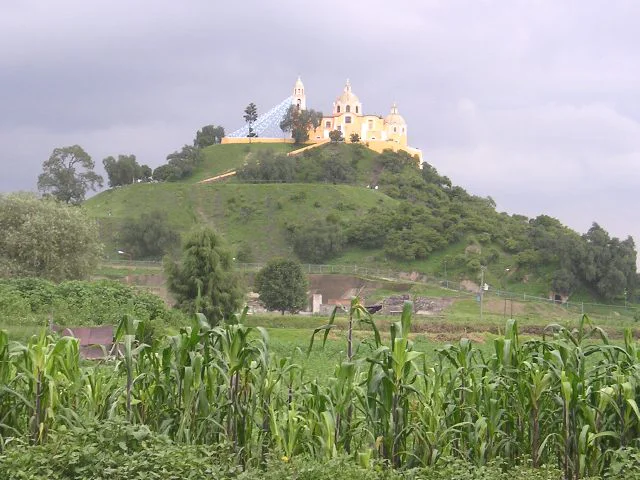
Cholula de Rivadavia
Gran Pirámide de Cholula
Content & sources
Photo: Hajor~commonswiki · CC BY-SA 3.0
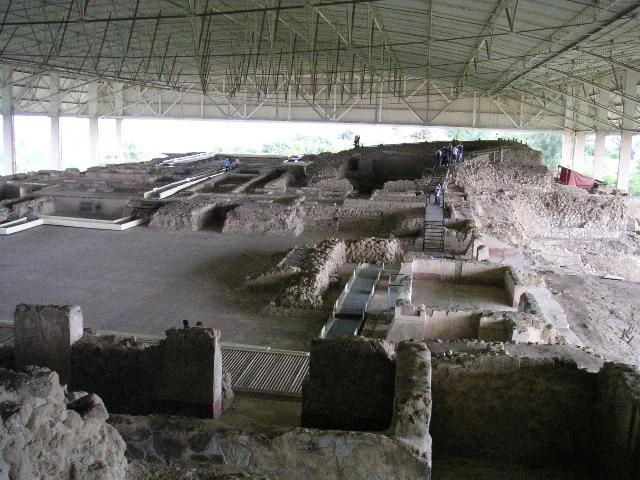
San Miguel del Milagro
Cacaxtla
Content & sources
Photo: Hajor~commonswiki · CC BY-SA 3.0