 Stanza / Audio guide
Content & sources
Stanza · Audio guide
El Tajín Audio guide
A place to remember. A story to take with you.
El Tajín is a pre-Columbian archaeological site located in Veracruz, Mexico. It was one of the largest and most important cities of the Classic era of Mesoamerica.
Download Stanza, then search for “El Tajín”.
About the tour
One guide. Your kind of visit.
El Tajín is a pre-Columbian archaeological site located in Veracruz, Mexico. It was one of the largest and most important cities of the Classic era of Mesoamerica.
Ready when you are.
- 01Get the free Stanza app.
iOS & Android
- 02Find your guide.
“El Tajín”
- 03Download before you go.
Works offline
Audio guide / 16 narrated stops
Inside the guide
Get to know a few of the stories before you go. Open a stop to read more.
01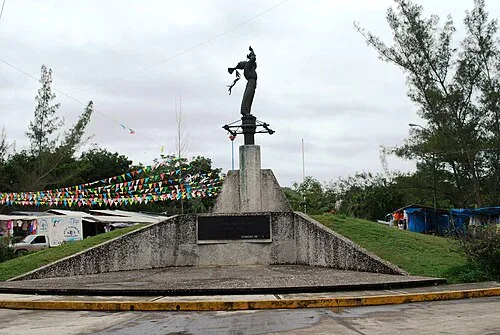 Site Entrance and the Voladores RitualThe Voladores Monument at the Entrance
Welcome to El Tajín, the ancient city tucked into the green hills of Veracruz. The tour begins at its threshold, with a statue of a volador caught in mid-flight, wearing the wide hat and braided sash of the Totonac flying dancers. In their ceremony, performers descend from a tall pole on ropes, turning slowly as they go. This monument honors that dance, and the dance itself is no memory here. Just outside the main gate stands a real pole, where the voladores still perform for visitors. Many consider the performance a requirement for visitors, a proper greeting before entering the archaeological zone. The ritual is far older than this statue, though exactly how old, no one can say. Each March the city also fills with the Cumbre Tajín festival, which sets Totonac tradition alongside modern concerts.
Photo: AlejandroLinaresGarcia · CC BY-SA 4.0
02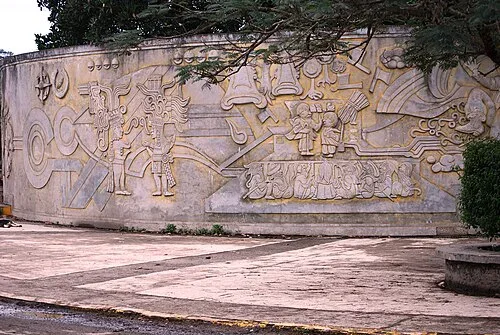 Site Entrance and the Voladores RitualMural of Gods and Ritual at the Gate
The carved wall at the gate is a modern work, but the figures on it are old in spirit. Gods, priests and processions move across the stone in a style that echoes the iconography found throughout the ruins. The city's name comes from the Totonac rain god, Tajín. That name announces what this place was about. Religion here was built on the sky itself, on the movements of the planets, the stars, the Sun and the Moon. Two things held central roles in that religion: the Mesoamerican ballgame, and pulque, the fermented drink of the region. The mural stands at the gate as a first lesson in the city's beliefs, a threshold of rain, gods and ceremony.
Photo: AlejandroLinaresGarcia · CC BY-SA 4.0
03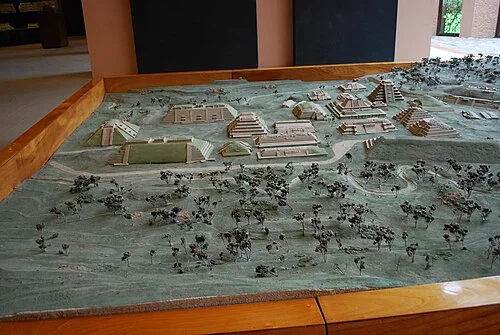 Site Museum and City Scale ModelThe City in Miniature - Site Model
The site museum keeps a model of the whole city, pyramids and plazas spread across a green landscape. In its day El Tajín covered roughly ten square kilometres, and only about half of that has been excavated. The rest still lies under grass and trees. Within the excavated core sit plazas, palaces and administrative buildings. Unlike the rigid grid plans of cities in Mexico's central highlands, the builders here aligned each structure as its own unit, fitted to the land. At its height this was a highly centralized capital, and a cosmopolitan one. More than fifty ethnicities lived in the city itself. Most of the population, though, lived on the hills around it, fed by the lands of the Tecolutla, Nautla and Cazones rivers. Who built all this is still argued over. Some scholars favor the Totonacs and the Xapaneca, yet there is good evidence the Huastec held this area when the city was founded in the first century.
Listen in the appPhoto: AlejandroLinaresGarcia · CC BY-SA 4.0
04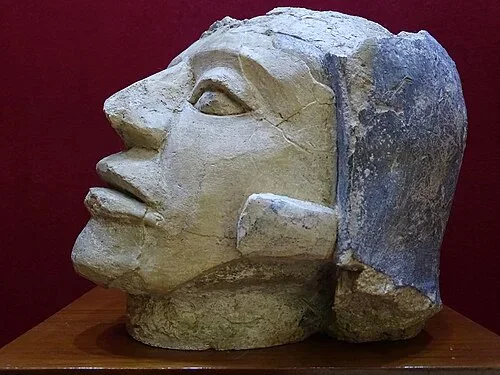 Site Museum and City Scale ModelClassic-Era Portrait Head - Site Museum
A stone face in profile, calm and sharp-featured, carved in the Classic era. Sculpture of this quality is what El Tajín is celebrated for, and finds from across the site are gathered in the museum here. The city itself nearly slipped from the world's memory. After its fall it lay under jungle, yet the local Totonac never lost track of it and always held the place sacred. No European had written a word about it before the late seventeen-hundreds. In 1785 a government official named Diego Ruiz, hunting illegal tobacco plantings in this isolated region, chanced upon the ruins instead. He drew the pyramid and reported his find to the Gaceta de México. Scholars in New Spain and Europe took notice, and some compared the pyramid to the buildings of ancient Rome. Larger fragments, including pieces of carved columns, stand reassembled in the museum's roofed hall.
Listen in the appAdam Jones from Kelowna, BC, Canada · CC BY-SA 2.0
05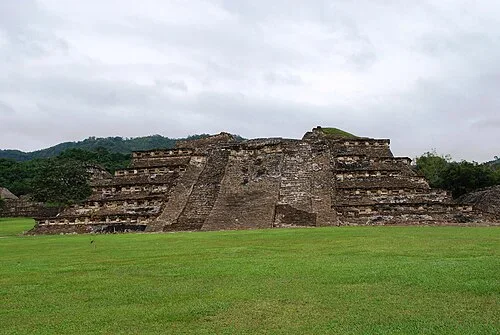 The Arroyo Group PlazaArroyo Group - The Market Pyramid
Two streams wrap around this group of buildings on three sides, which is how it got its name: the Arroyo Group. It is one of the oldest sections of the city. Four temple platforms ring the plaza, uniform in height and nearly symmetrical, each climbed by stairways from the floor. Compared with the rest of the site, the pyramids here are primitive, their niches coarsely formed. What makes the plaza remarkable is what it lacks: no altars, no small structures, nothing to break up a vast open floor. Archaeologists concluded that this was the city's marketplace. Stalls of sticks and cloth once filled the space, offering regional goods such as vanilla alongside imports from across Mesoamerica: jaguar skins, parrots and macaws, quetzal feathers. Slaves for service and sacrifice were sold here as well. A merchant deity found on the spot confirms the trade, with features closer to the gods of the central highlands than to the city's own.
Listen in the appPhoto: AlejandroLinaresGarcia · CC BY-SA 4.0
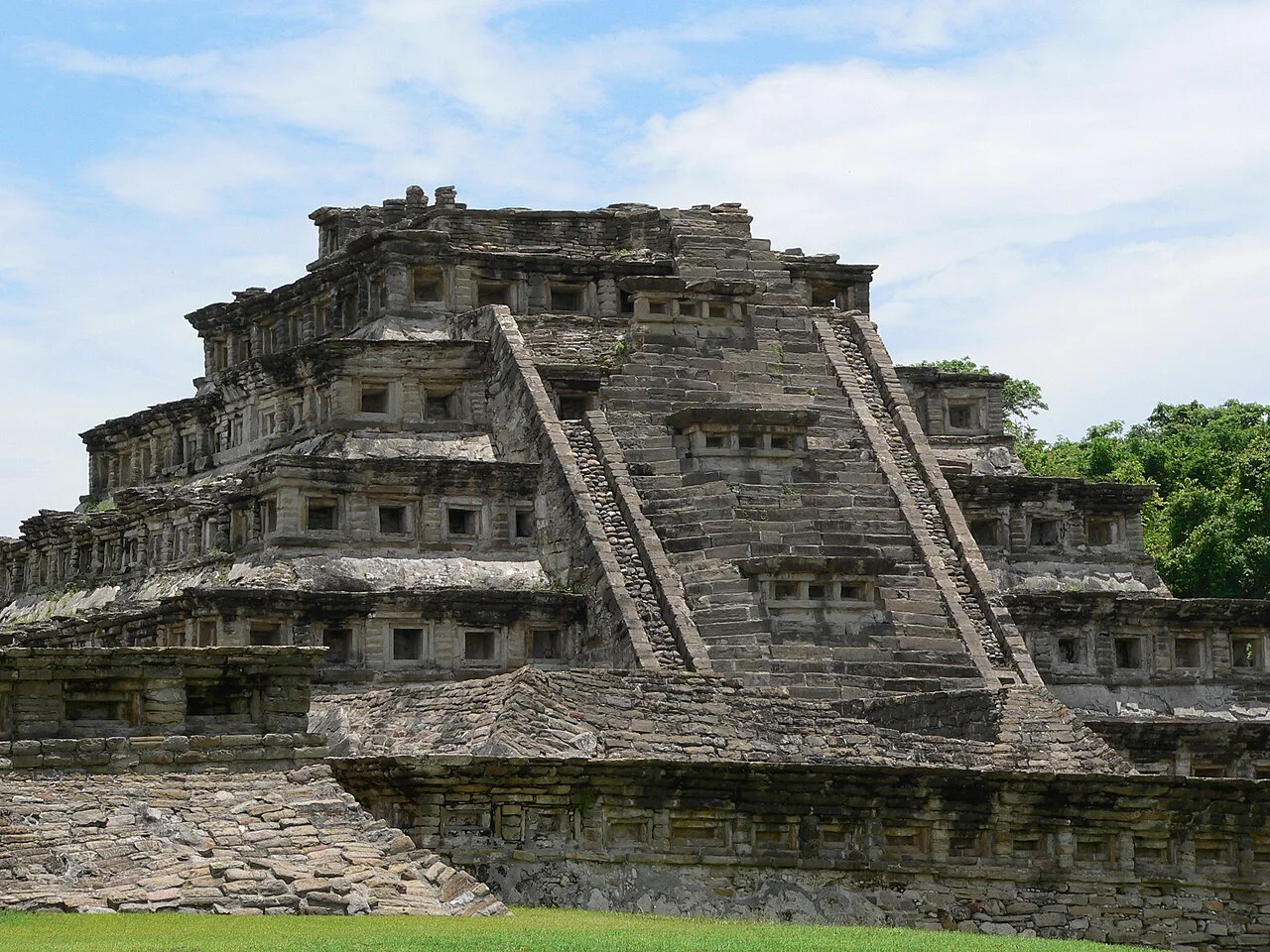
06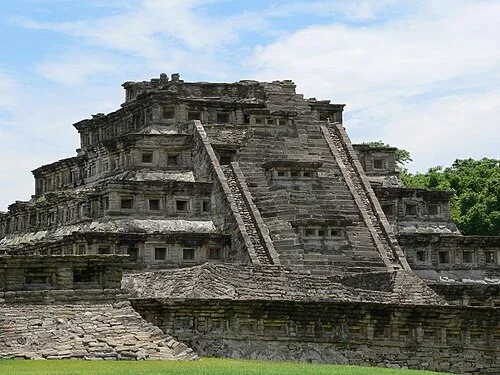 Pyramid of the NichesThe Pyramid of the Niches
Seven stepped stories rise from a square base thirty-five metres on a side, and the whole surface is pocked with small, deep niches. Count the niches on the original structure and there are exactly three hundred sixty-five, one for every day of the solar year. People have called it the Pyramid of the Niches, the Pyramid of Papantla, the Temple of the Niches. Its odd silhouette comes from a detail the archaeologist José García Payon named the flying cornice, a triangular overhang capping each niche. The count suggests a calendar carved in stone, and that is how the building is often described. Yet its ritual purpose was probably not chiefly calendrical. The deep niches imitate caves, and caves in much of Mexico were sacred, treated as passageways to the underworld where many of the gods lived. Offerings of flowers and candles were traditional in such places. As late as the mid-twentieth century, remains of beeswax candles could still be found on the pyramid's first level. Originally the whole structure was painted dark red, with the niches black to deepen their shadows. A popular belief holds that every niche once held an idol, but excavation has ruled that out. The most important part was the temple on top, and that was completely destroyed; little is known of what it looked like.
Listen in the appPhotograph: Frank C. Müller, Baden-Baden · CC BY-SA 3.0
07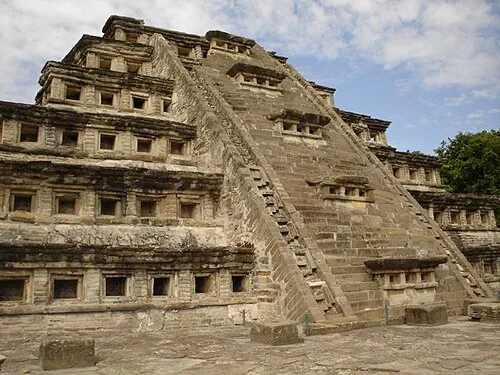 Pyramid of the NichesThe Eastern Staircase and the Sunrise
The great staircase climbs the eastern face, and it was built for the dawn. The pyramid lines up with a mountain east of the site called Cerro de los Mantenimientos. At sunrise the sun emerges over that mountain, and light sweeps down the pyramid tier by tier, taking about seven minutes to reach the ground. A hypothesis holds that the pyramid served as an astronomical marker tied to the farming calendar, and that altars on the mountain honored the descent of Quetzalcóatl at planting time. The staircase itself, though, was not part of the original design. Niches continue underneath it, which shows it was added later, and its balustrades carry stepped-fret decoration. The masonry is monumental: carefully cut flagstones fitted with a minimum of mortar, the largest weighing about eight metric tons. The temple the stair once served, at the summit, is gone. A carved panel recovered from this pyramid shows a ceremony being held at a cacao tree, a trace of the elite ritual once hosted here.
Listen in the appDiego Tirira from Quito, Ecuador · CC BY-SA 2.0
08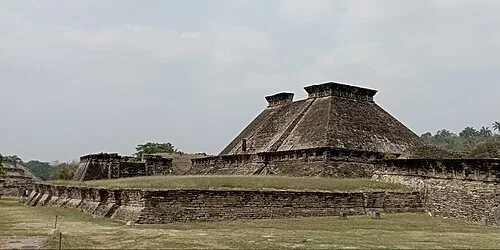 Plaza of Building 5 and the Blue TempleBuilding 5 and the Civic Plaza
Building 5 is considered the stateliest structure at El Tajín. A truncated pyramid rises from a platform more than three thousand square metres in size, with a single stairway on the west side and a double one on the east. Even its top platforms are dressed with stepped frets. That is the detail worth pausing on: in this city, decoration reached everywhere. Niches and stepped frets appear on utilitarian walls and buttresses, not only on showpiece temples. The builders also refused a master grid; each structure was aligned as an individual unit, fitted to its neighbours and the land. The habit of building over the old shows here too. Building 4, a small platform nearby, holds an older structure inside it that may be among the earliest at the site. And Building 15, just to the south, is thought to be the last building here made with niches.
Listen in the appPhoto: Juan Carlos Fonseca Mata · CC BY-SA 4.0
09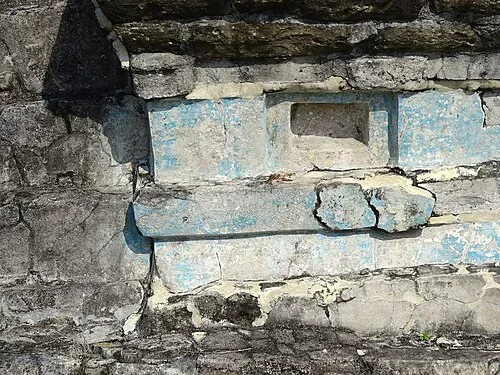 Plaza of Building 5 and the Blue TempleTraces of the Blue Temple
Blue is the color that sets Building 3 apart from every other pyramid here. Most temples at El Tajín were painted red, but this one, known as the Blue Temple, wore blue. It was resurfaced in cement several times over its life, and each new layer was painted blue again rather than the more common red. Traces of that paint still show on part of the stairway and on the side facing Building 23. The building breaks the site's rules in shape as well. Its seven stories are gently sloping walls divided into plain panels, with no niches at all, apart from six benches on the staircase that were probably added later. Blue is the color most often linked with the rain god, but nothing else about the building supports that idea, so the reason for the color remains an open question. Much else is lost too. No sculpture is known to have come from the Blue Temple, and nothing remains of the shrine that once stood at its summit. The unreconstructed north side carries a large gouge dug by looters, back before guards watched over the site.
Listen in the appAdam Jones from Kelowna, BC, Canada · CC BY-SA 2.0
10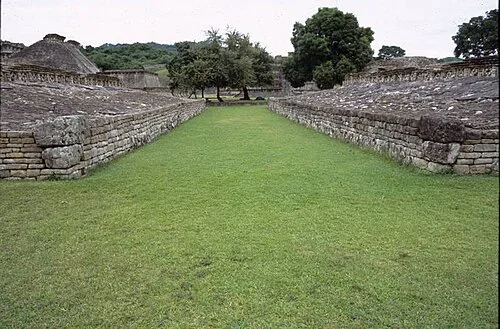 The South BallcourtThe South Ballcourt
Ballcourts are common across Mesoamerica, but no other place comes close to the count at El Tajín. Seventeen have been found here, more than at any other Mesoamerican site. Add the last three, discovered in 2013, and the total reaches twenty. The ballgame stood at the center of the city's religious life. Of all the courts, the South Ballcourt carries the most impressive carved panels. Its playing alley runs between two vertical walls of carefully fitted stone. Set into those vertical surfaces are carved panels showing the game and the ceremony bound to it.
Listen in the appDiego Tirira from Quito, Ecuador · CC BY-SA 2.0
El Tajín
Frequently asked questions
How much does the guide cost?
Free app download. Listed guide price: $1.99. Guide price shown in the app. Audio guide only. Venue admission is separate.
Can I listen without internet?
Yes. Download the guide’s audio, images, and maps in the app before your visit. Your downloaded content is then available offline.
Can I listen in my language?
This audio guide is available in 15 languages, including English.
Do I need to follow a schedule?
No. This is a self-guided experience. Choose your stops, pause whenever you like, and return to a story at your own pace.
At your own pace
Explore El Tajín.
Download Stanza, then search for “El Tajín”.
Free app download · Guide price shown in the app
Keep exploring
Audio guides — Mexico
Veracruz
Cempoala
Content & sources
User:Gengiskanhg · Public domain
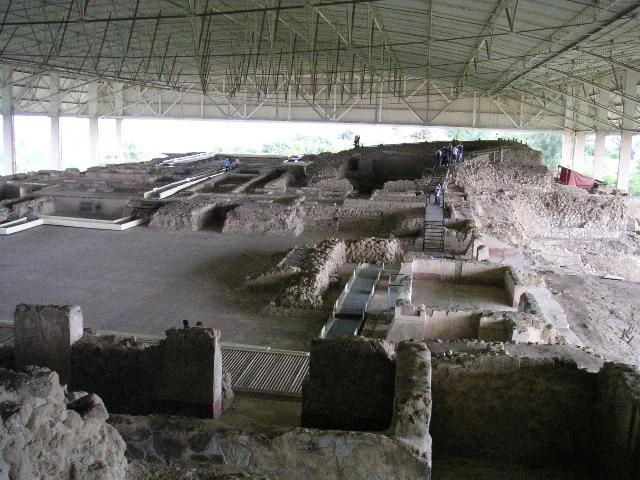
San Miguel del Milagro
Cacaxtla
Content & sources
Photo: Hajor~commonswiki · CC BY-SA 3.0
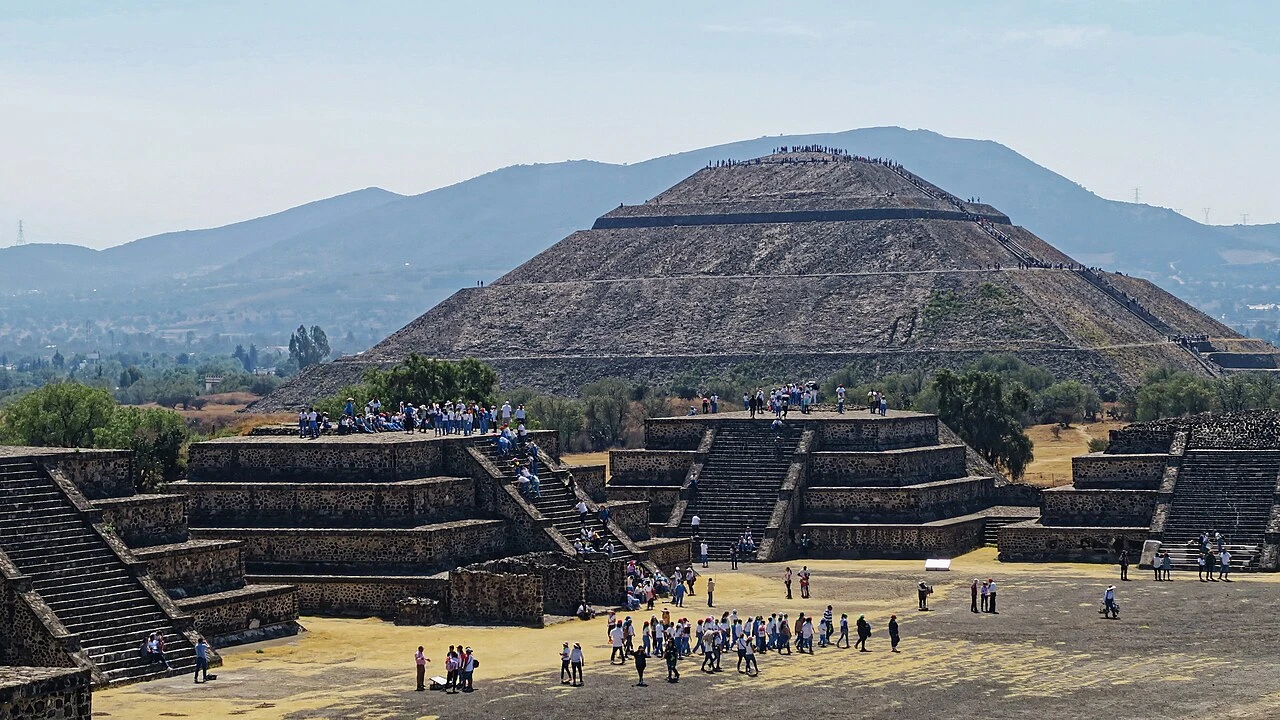
San Francisco Mazapa
Teotihuacan
Content & sources
Burkhard Mücke · CC BY-SA 4.0
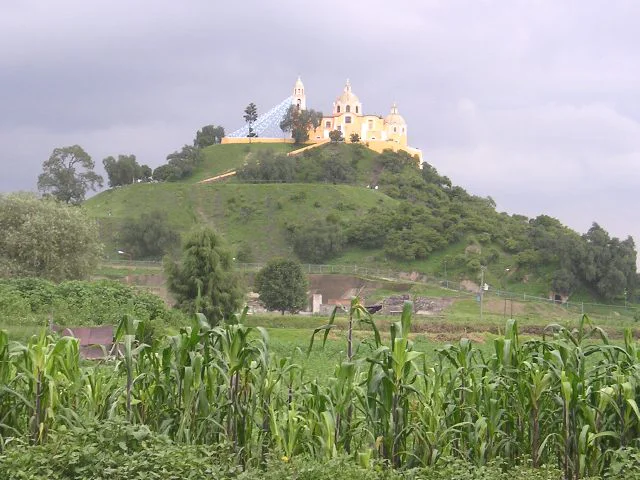
Cholula de Rivadavia
Gran Pirámide de Cholula
Content & sources
Photo: Hajor~commonswiki · CC BY-SA 3.0