Stanza · Audio guide
Apollonia Audio Guide
A place to remember. A story to take with you.
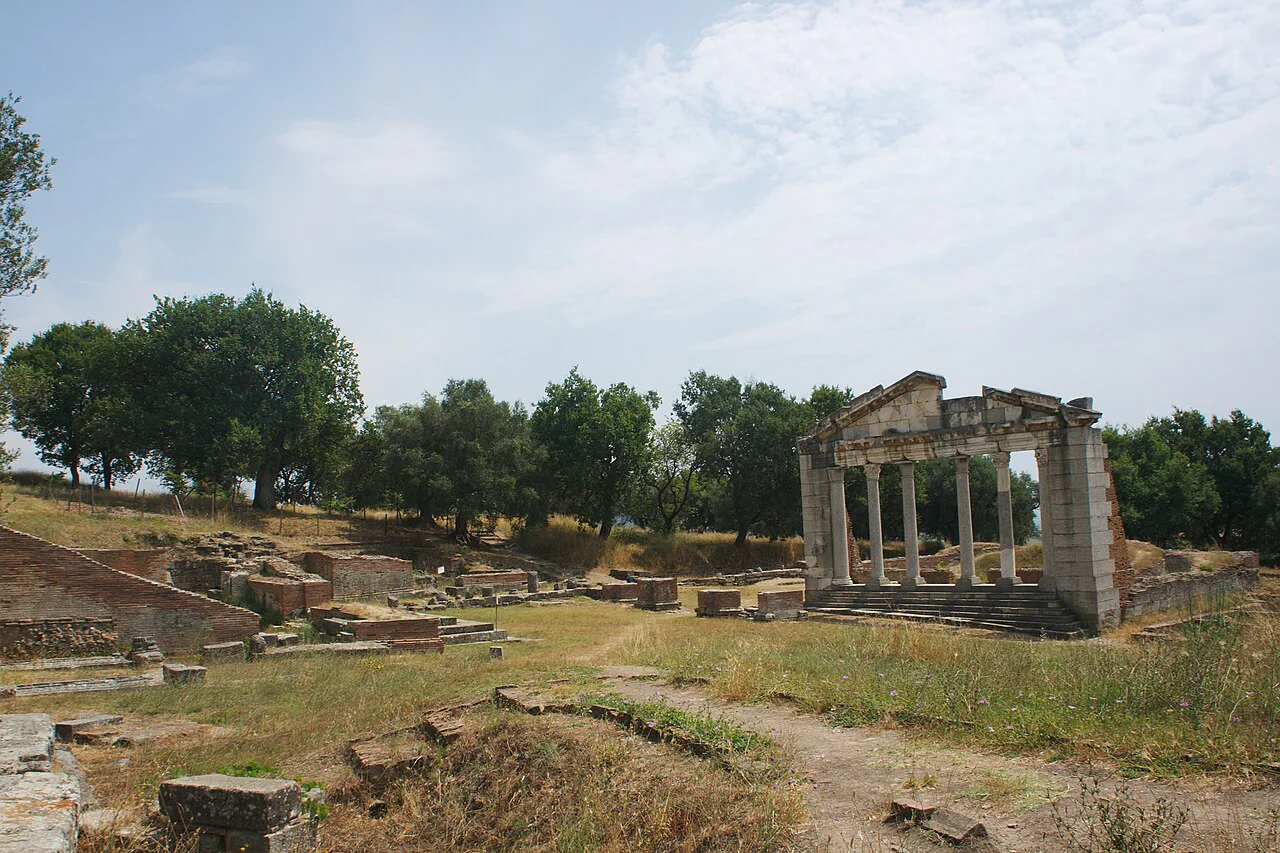
Apollonia was an Ancient Greek trade colony that developed into an independent polis and later a Roman city. Its ruins are located in southern Illyria on the right bank of the Vjosë river.
Download Stanza, then search for “Apollonia”.
About the tour
One guide. Your kind of visit.
Apollonia was an Ancient Greek trade colony that developed into an independent polis and later a Roman city. Its ruins are located in southern Illyria on the right bank of the Vjosë river.
Ready when you are.
- 01Get the free Stanza app.
iOS & Android
- 02Find your guide.
“Apollonia”
- 03Download before you go.
Works offline
Audio guide / 16 narrated stops
Inside the guide
Get to know a few of the stories before you go. Open a stop to read more.
01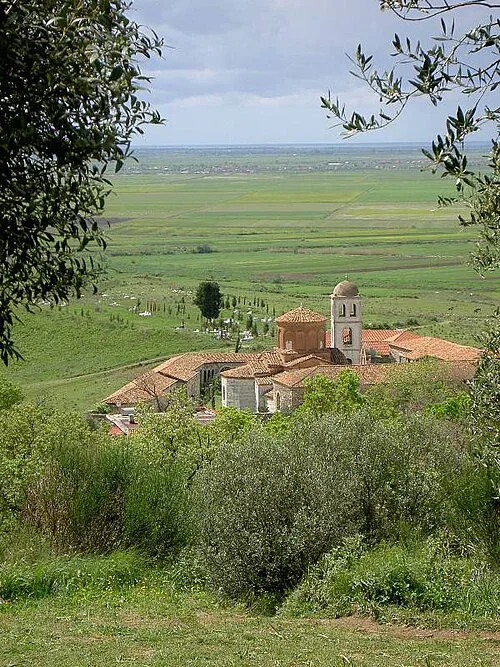 Monastery of Saint Mary
The Monastery of Saint Mary and the Buried City
Welcome to Apollonia, an ancient Greek city that still lies mostly unexcavated. Around 600 BC, a group of some two hundred settlers from Corinth sailed here, led by a founder named Gylax. They came, by ancient account, at the invitation of the local Illyrians, and settled on the navigable Aoos river, a few kilometres inland from the Adriatic. More colonists followed from Corcyra, and the river harbour turned the settlement into one of the great ports of the Illyrian coast. At its height, perhaps sixty thousand people lived here. Roman writers knew its weight well. Cicero called it magna urbs et gravis, a great and important city. Yet only part of the classical city has ever been dug. The park keeps a buried city under the grass, and the walk ahead passes through its monuments.
Photo: Joonasl · CC BY 2.0
02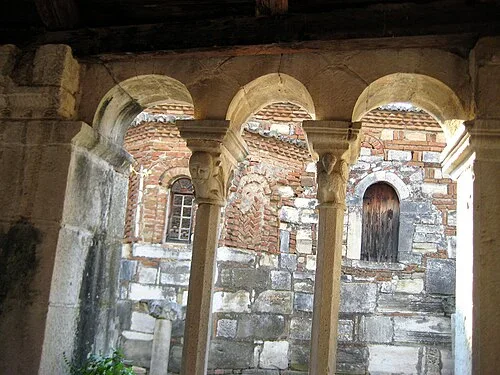 Monastery of Saint Mary
The Monastery Cloister
Apollonia did not simply empty out and disappear. Long after the ancient streets fell silent, a Byzantine monastery took root here, and its cloister still encloses a quiet courtyard. The medieval builders helped themselves to the dead city around them. Dressed stone and carved blocks from classical buildings were set into the piers and walls, and ancient columns now carry medieval arches. The mixed masonry shows clearly in the arcade: fine cut stone beside rougher work, older fragments holding up newer arches. A sacred and residential precinct grew again among the ruins, rooted in the very fabric of the old city.
Photo: Arianit · CC BY-SA 4.0
03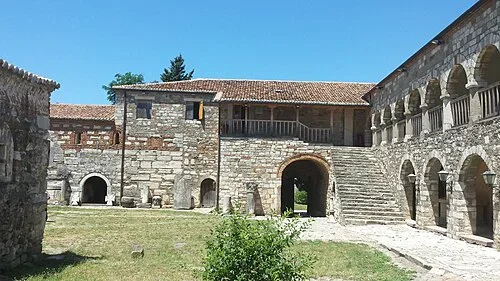 Archaeological Museum of Apollonia
The Archaeological Museum of Apollonia
The museum fills the monastery's old galleries, and the story of the digging here spans more than a century. European classicists rediscovered Apollonia in the eighteenth century, but real digging began with an Austrian team during the occupation of 1916 to 1918. A French team carried the work on from 1924 to 1938, and Albanian archaeologists took over from 1948 onward. The first museum opened here in 1958. Hard times followed. In 1967, heavy machinery and about four hundred concrete military bunkers seriously and permanently damaged the site. When communism collapsed in 1990, plunderers emptied much of the collection and the museum had to close. A new museum, funded through a UNESCO programme, opened in December 2011.
Listen in the appPhoto: InaMyrtollari · CC BY-SA 4.0
04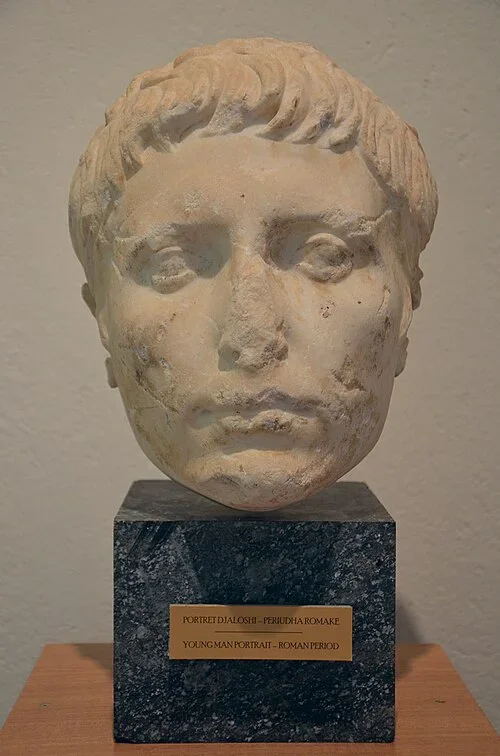 Archaeological Museum of Apollonia
Young Man Portrait – Roman Period
From the second century BC, Apollonia drew students from across the empire to its renowned school of Greek philosophy, rhetoric and military training. Its most famous pupil arrived in 44 BC. He was Octavius, nineteen years old, the future emperor Augustus, and he studied here under the philosopher Athenodorus of Tarsus. It was in Apollonia that news reached him of Julius Caesar's murder. The news sent him across the Adriatic, and the city later received privileges from him as emperor. The marble head here is labelled simply as a young man portrait of the Roman period. Some see a likeness of Octavian himself in the face, but the label makes no such claim.
Listen in the appCarole Raddato · CC BY-SA 2.0
05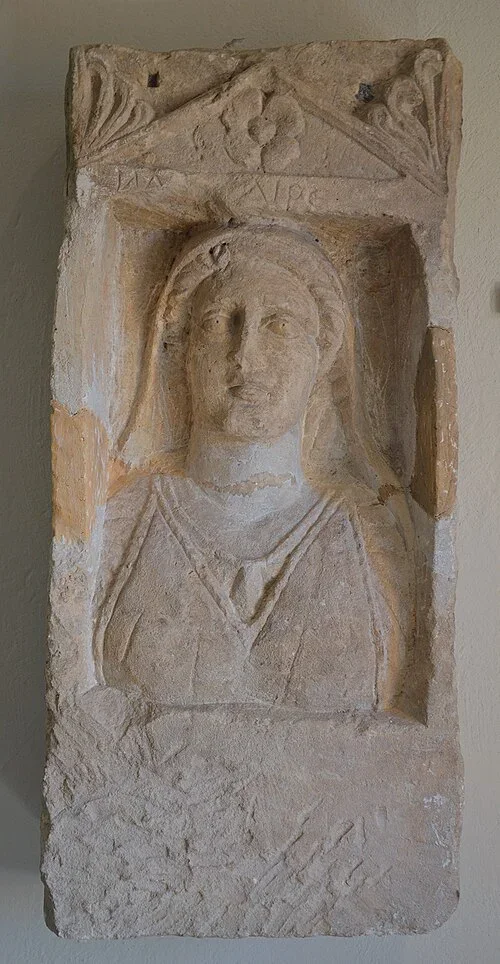 Archaeological Museum of Apollonia
Funerary Stele of a Woman in Illyrian Dress
This grave stele was carved in the second century BC for a woman of Apollonia. Her dress is Illyrian; the carved frame around her and the Greek lettering are Greek, two peoples in one monument. The Greek greeting carved above her reads simply chaire, hail and farewell. Aristotle described the city behind the stone. Its government was a narrow oligarchy, in which the descendants of the original Corinthian colonists, few out of the many in his phrase, held citizenship and office. The population around them was largely local Illyrian. Whether those Illyrians were integrated as serfs or held as slaves remains unclear, though serfdom is thought the likelier. Either way, the privileged circle of founding families kept its grip for some three centuries after the city was established.
Listen in the appCarole Raddato from FRANKFURT, Germany · CC BY-SA 2.0
06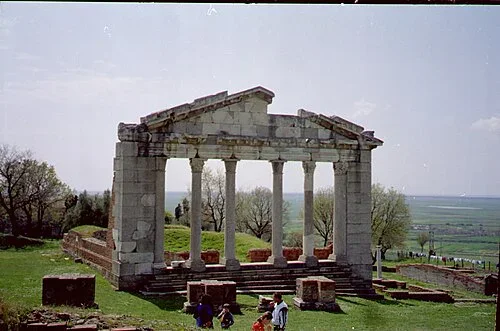 The Monument of the Agonothetes (Bouleuterion)
Monument of the Agonothetes
The grandest ruin on the agora was the city's town hall. Built in the second century BC, it served as the bouleuterion, the chamber where Apollonia's council met. Seats rose in ten tiers around a small semicircular floor, a room for a select few rather than a crowd. That small size is the point. The council was a circle of the privileged few. The building takes its modern name from the agonothetes, the officials who organized public spectacles for the citizens. Their names are carved across the top of the facade.
Listen in the appHelmut Kienzle · CC BY 4.0
07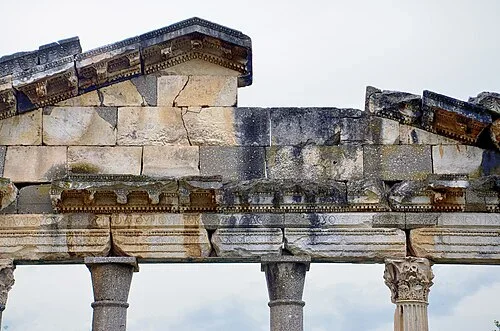 The Monument of the Agonothetes (Bouleuterion)
The Agonothetes Dedication
Carved along the entablature runs the inscription that named this building. The French archaeologist Léon Rey found the monumental facade lying fallen, brought down by an earthquake. He reconstructed it, and on the rebuilt architrave his team read a dedication from two brothers of the Villa family. Both had served as agonothetes, organizing public shows for the city, and Rey baptised the building the Monument of the Agonothetes.
Listen in the appPasztilla aka Attila Terbócs · CC BY-SA 4.0
08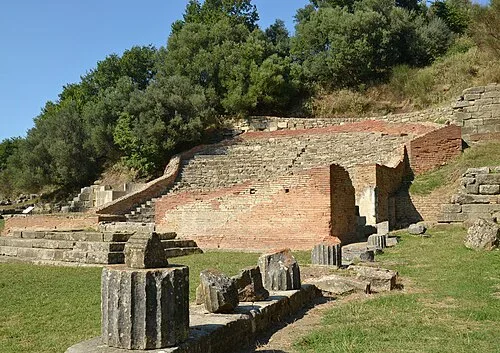 The Odeon and Ancient Theatre
The Odeon
Directly opposite the council house, separated by a triumphal arch, lies a smaller theatre. Léon Rey uncovered it on the slope of the agora and called it the Odeon. It was a roofed venue, built for music, recitation and debate rather than grand spectacle, with tiered seats set into the hillside. Politics and performance stood side by side here: council meetings on one side of the arch, an evening performance on the other. The city's great open-air theatre, built for crowds on another scale altogether, lies further up the hill.
Listen in the appPhoto: Pudelek · CC BY-SA 4.0
09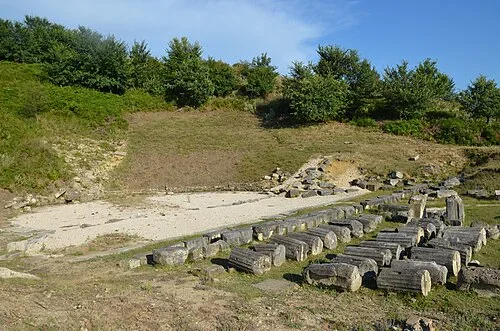 The Odeon and Ancient Theatre
The Ancient Theatre
A hundred metres across, cut into the hillside at the western edge of the agora, this was the great theatre of Apollonia. It was built between the fourth and third centuries BC, when the city was near its height. The tiers of seats wrapped around the orchestra and held an audience of about nine thousand. For the ancient world that was a mid-sized theatre. Nine thousand is a huge share of a city whose people numbered in the tens of thousands. When a play or a festival drew the crowd up this slope, much of Apollonia came with it. The orchestra and a scatter of fallen column drums are what still show above the grass.
Listen in the appCarole Raddato · CC BY-SA 2.0
10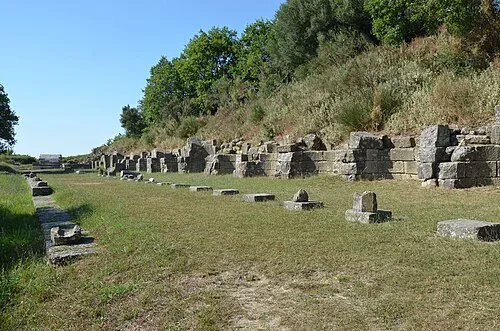 The Great Stoa and Roman Library
The Great Stoa
The Great Stoa ran seventy-eight metres along the agora, the grandest covered walkway in the city. It was twelve metres deep and built in two storeys, a Doric colonnade below and an Ionic one above. Its back wall held up the hillside, and seventeen arched niches were cut into that wall, each one meant to display a statue. From the stoa the view ran out over the plain toward the Adriatic, a calm prospect made for the city's elite to stroll and be seen. Trade paid for all this elegance. Apollonia stood at one of the western starting points of the Via Egnatia, the great road running east toward Thessaloniki and Byzantium. The route into the Illyrian interior was older than the city itself, and Greek goods had travelled it only sparingly before. Apollonia turned that crossroads into a gateway, and the gateway into wealth.
Listen in the appCarole Raddato from Frankfurt, Germany · CC BY-SA 2.0
- 11
The Roman Library
The ruins called the Roman library, and a city famous for Greek learning and astronomy.
- 12
Apollo's Obelisk
A plain stone pillar of Apollo Agyieus, read by some as the navel of the world.
- 13
The Temenos Wall
The sacred precinct of Artemis on the city's highest hill, and its gate with a false arch.
- 14
The Monumental Nymphaeum
Apollonia's greatest monument: a hillside fountain house fed by underground springs.
- 15
The Nymphaeum Facade
The fountain's strange neighbour: fires burning from the earth, and a city rich on bitumen.
- 16
The Eastern City Walls and Valley Overlook
From the eastern ramparts: the earthquake, the lost harbour, and a city preserved under the soil.
Apollonia
Frequently asked questions
How much does the guide cost?
Free app download. Listed guide price: $1.99. Guide price shown in the app. Audio guide only. Venue admission is separate.
Can I listen without internet?
Yes. Download the guide’s audio, images, and maps in the app before your visit. Your downloaded content is then available offline.
Can I listen in my language?
This audio guide is available in 15 languages, including English.
Do I need to follow a schedule?
No. This is a self-guided experience. Choose your stops, pause whenever you like, and return to a story at your own pace.
At your own pace
Explore Apollonia.
Download Stanza, then search for “Apollonia”.
Free app download · Guide price shown in the app
Keep exploring
Nearby audio guides
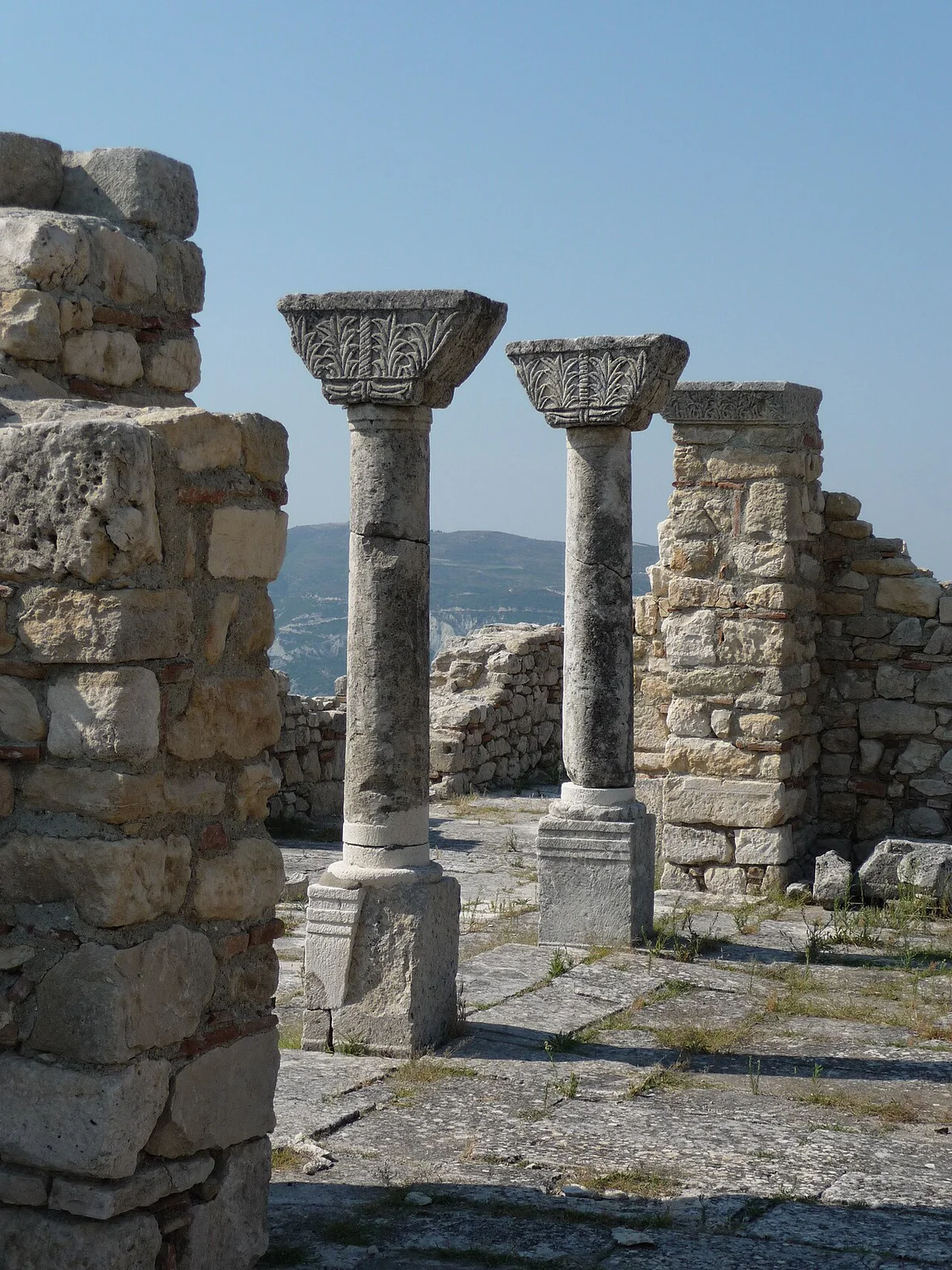
Hekal · 29 km
Byllis
Content & sources
Riet PRINS · CC BY 3.0
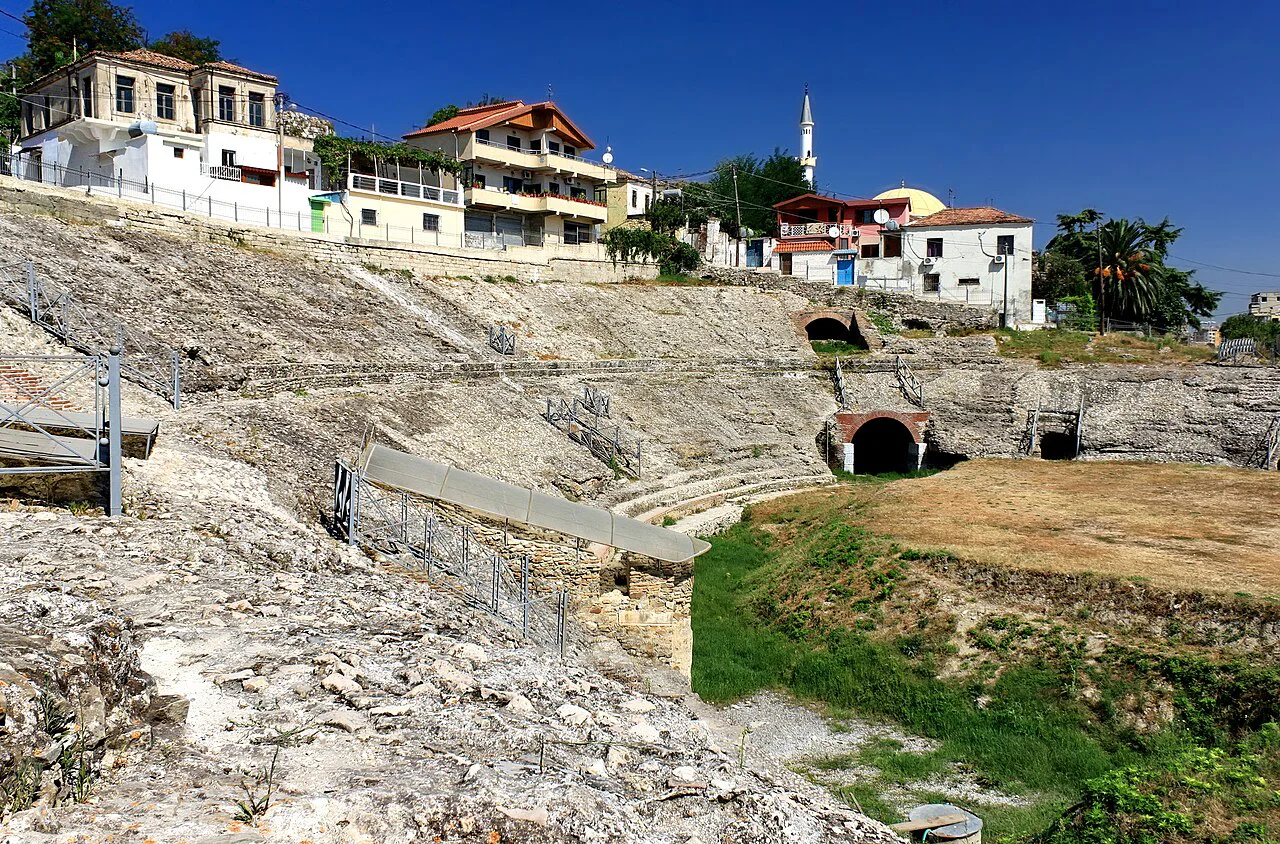
Bashkia Durrës · 66 km
Amphitheatre of Durrës
Content & sources
Marcin Konsek · CC BY-SA 3.0
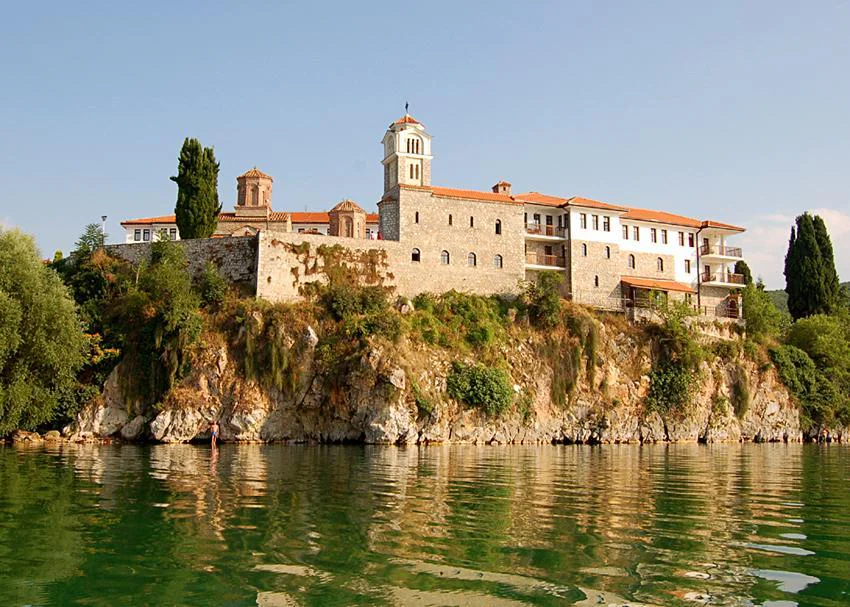
Ohrid · 109 km
Monastery of Saint Naum
Content & sources
Poppit2 · Public domain
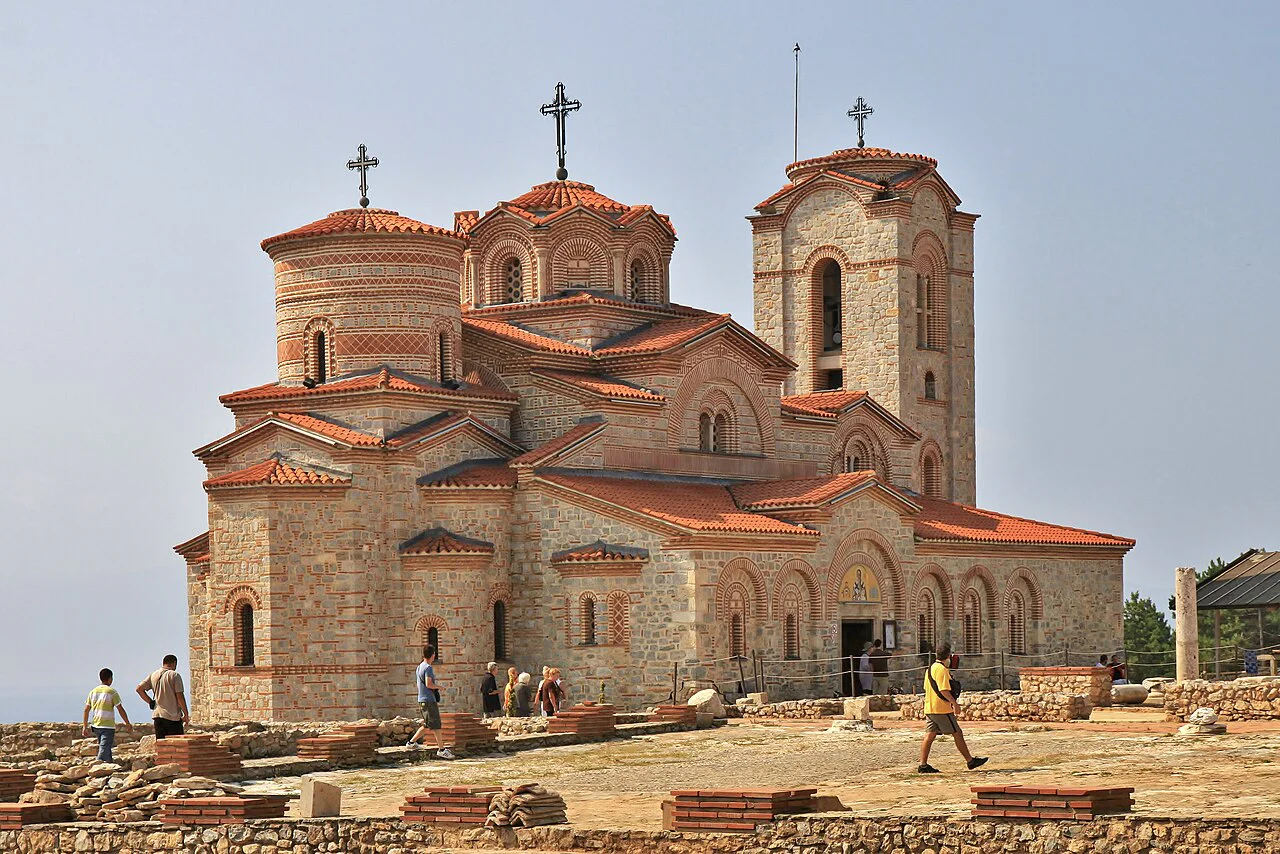
Ohrid · 119 km
Church of Saints Clement and Panteleimon
Content & sources
Marcin Konsek · CC BY-SA 4.0