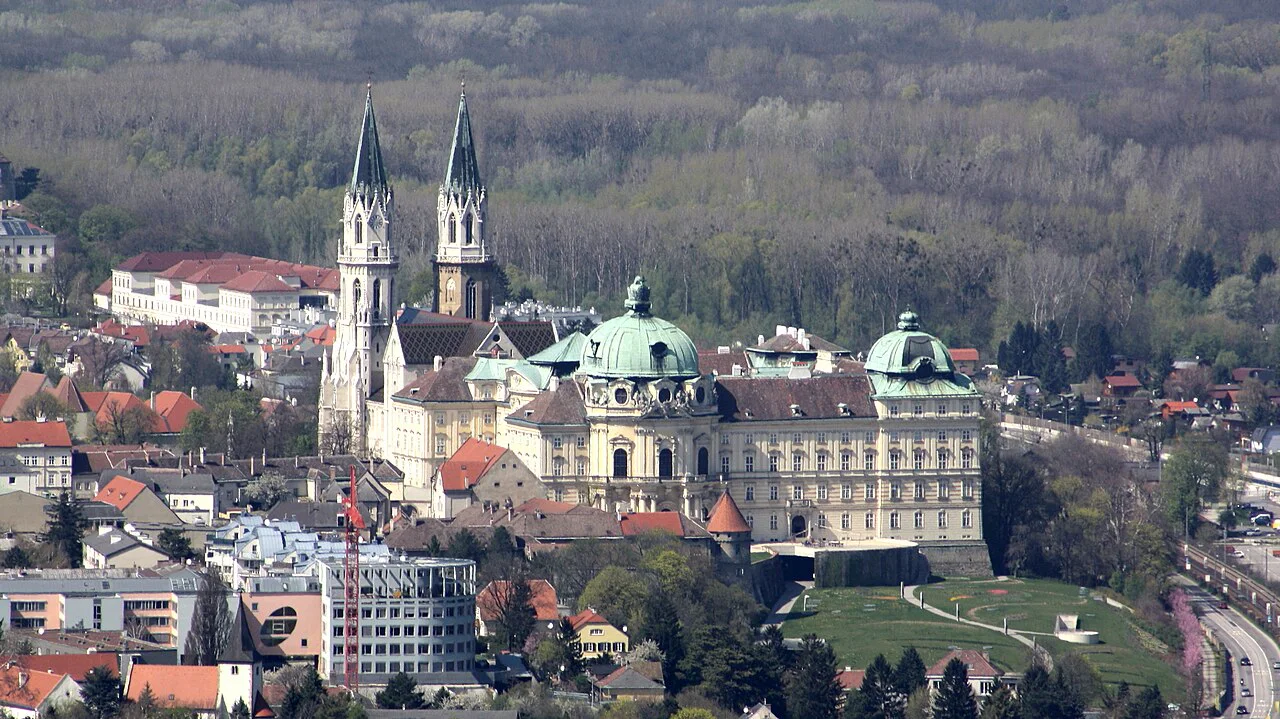
Stanza · Audio guide
Stift Klosterneuburg Audio Guide
A place to remember. A story to take with you.
Klosterneuburg Abbey is a twelfth-century Augustinian monastery of the Catholic Church located in Lower Austria. It was founded in 1114 by Saint Leopold III of Babenberg and his wife Agnes of Germany.
Download Stanza, then search for “Stift Klosterneuburg”.
About the tour
One guide. Your kind of visit.
Klosterneuburg Abbey is a twelfth-century Augustinian monastery of the Catholic Church located in Lower Austria. It was founded in 1114 by Saint Leopold III of Babenberg and his wife Agnes of Germany.
Ready when you are.
- 01Get the free Stanza app.
iOS & Android
- 02Find your guide.
“Stift Klosterneuburg”
- 03Download before you go.
Works offline
Audio guide / 18 narrated stops
Inside the guide
Get to know a few of the stories before you go. Open a stop to read more.
01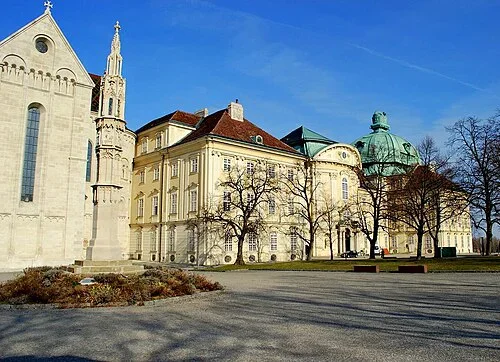 Stiftsplatz and the Imperial Baroque Facade
Stiftsplatz and the Abbey Facade
Welcome to Stift Klosterneuburg, an Augustinian monastery on a ridge above the Danube, just north of Vienna. Margrave Leopold the Third and his wife Agnes founded it in 1114, and their community of canons still lives and prays here. The abbey became a spiritual and economic powerhouse of Austria, and it still runs one of the country's oldest wine estates. A Gothic pillar from 1381 stands on this square, older than most of what surrounds it. The long yellow facade belongs to a residence that was never finished, and the entrance shows it plainly. Visitors pass through the Sala Terrena, a hall meant to be a grotto-like garden hall. Around 1735 the court sculptor Lorenzo Mattielli carved monumental Atlas figures to carry its ceiling. Today the room reads as an exposed Baroque building site, frozen mid-project. Ahead lie the crowned domes, the collegiate church and the Gothic cloister, each with its own chapter of the story.
Photo: Mayerski · CC BY-SA 3.0
02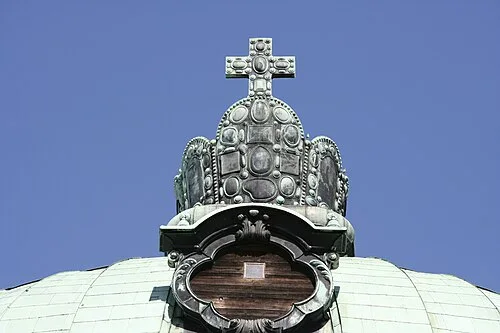 Stiftsplatz and the Imperial Baroque Facade
The Imperial Crown Dome
The crown on top of this dome is the whole ambition of the place caught in a single sculpture. In 1730 Emperor Charles the Sixth set out to rebuild the monastery as a monumental residence, part palace, part church, on the model of the Escorial in Spain. Nine domes were planned for the complex. The work went to the architect Donato Felice d'Allio, drawing on ideas from Joseph Emanuel Fischer von Erlach, the master builder of Vienna. Then in 1740 the emperor died unexpectedly, and the building site came to an abrupt halt. By then only a fraction of the grand design had risen from the ground. Two domes did get finished, and they carry the message in metal and stone. The main dome bears the imperial crown, the smaller one the archducal crown. In the nineteenth century the architect Joseph Kornhäusel completed one of the begun courtyards, but the full Austrian Escorial never came.
Photo: Huberta Weigl · CC BY-SA 3.0 at
03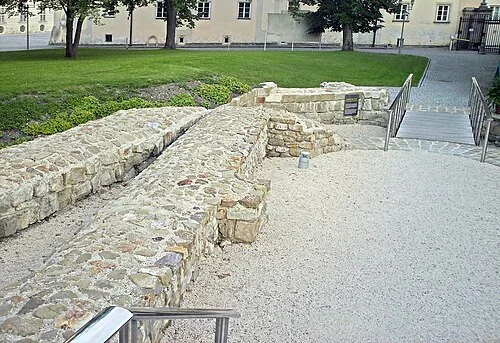 Capella Speciosa and Founding Grounds
Foundations of the Capella Speciosa
These low stone walls are nearly all that is left of one of the most praised buildings of its age. In 1220 Duke Leopold the Sixth brought a master builder from Burgundy to raise a ducal chapel beside the convent. It was called the Capella Speciosa, and it is considered among the most beautiful sacred buildings of its time. The chapel did not survive the centuries; it was torn down in the eighteenth century. What remains is the ground plan, dug out and left visible, so the abbey's deepest layer can be read in open air. The building history here runs in layers. The complex's foundations include a castle tower and a Gothic chapel reaching back to the twelfth century, below everything the Baroque builders added. A ducal chapel, a monastery, an imperial dream, all stacked on the same ground.
Listen in the appVeleius at de.wikipedia · Public domain
04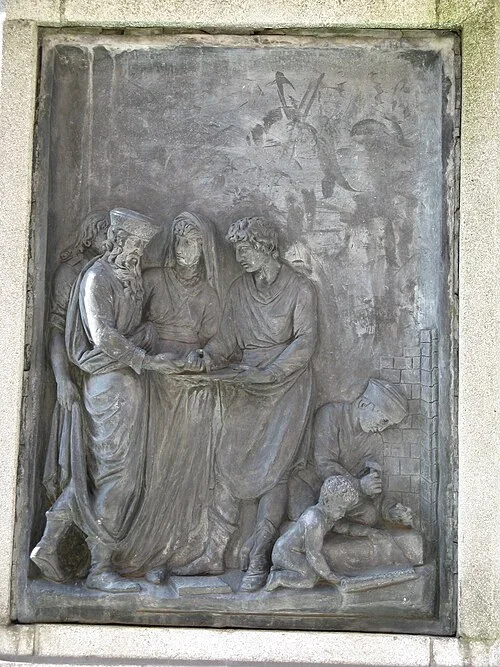 Capella Speciosa and Founding Grounds
The Legend of Agnes' Veil
A bridal veil, a gust of wind, and a monastery. This stone relief at the Leopoldsbrunnen fountain tells the founding legend in carved figures. It begins with a real marriage. In 1106 Emperor Henry the Fifth rewarded Margrave Leopold the Third for his loyalty by offering him the hand of his sister Agnes, the widow of Duke Frederick of Swabia. The match raised Leopold's standing enormously and brought a vast dowry of royal possessions. Leopold built a new residence for his wife and named it Niwenburc, the new castle. The story goes that the couple stood on its balcony when a strong gust tore Agnes' veil away. The search found nothing. Years later, out hunting, Leopold saw a brilliant radiance among the foliage of an elderbush. Inside it hung the veil, undamaged, and a vision of the Virgin Mary told him to build a church and monastery on that spot. What is certain is the masonry: the cornerstone of the abbey church was laid on 12 June 1114, and in 1133 Leopold handed the monastery to the Augustinians.
Listen in the appYair Haklai · CC BY-SA 4.0
05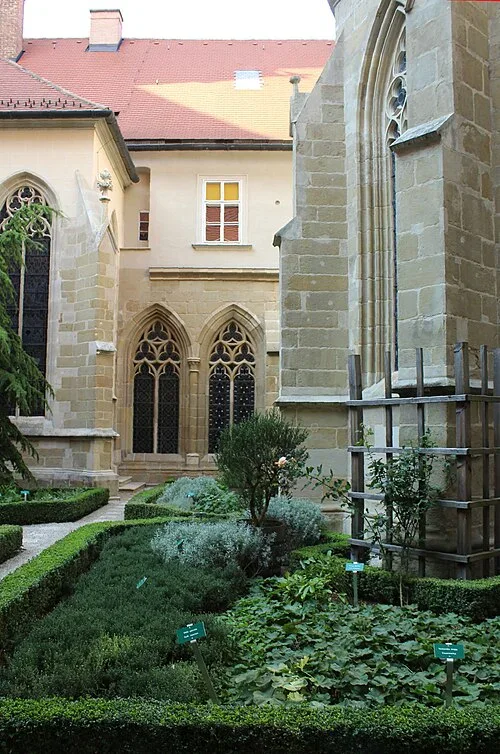 Gothic Cloister and the Seven-Armed Candelabrum
The Gothic Cloister and the Canon Community
Thirteenth-century vaulting shelters this quiet garden, the heart of a community that has run its own affairs for nearly nine hundred years. The Augustinian canons took over the monastery in 1133, and sixty-six provosts have led them since. Their sternest test came in the fall of 1683, when a massive Ottoman army under Kara Mustafa Pasha besieged Vienna and threatened Klosterneuburg. Most of the canons fled to Passau, taking the church treasure with them. Two men stayed behind with the citizens: a priest and a lay brother named Marzellin Orthner. The lower town gave itself up, but the upper town and the monastery were defended successfully. That stand mattered far beyond the walls, because Klosterneuburg shielded the flank of the Christian army that relieved Vienna under King John the Third Sobieski. The community's later trials were quieter but no less real. In 1941 the Nazis suppressed the canonry and seized the buildings, and Provost Alipius Linda, elected in 1937, steered the community through those years and the occupation that followed the war.
Listen in the appPhoto: Dguendel · CC BY 4.0
06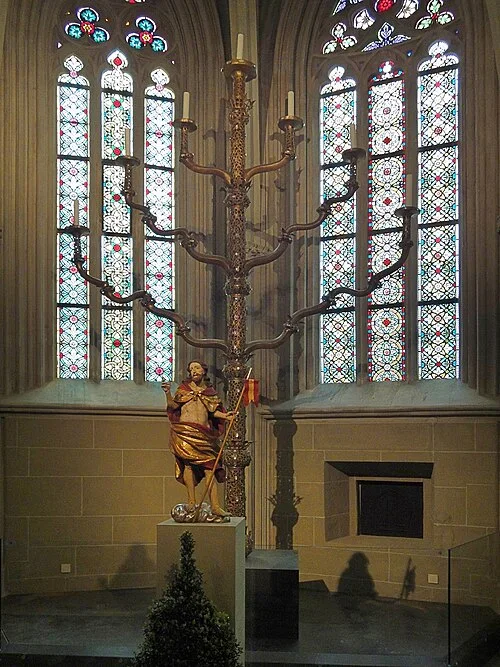 Gothic Cloister and the Seven-Armed Candelabrum
The Seven-Armed Candelabrum of 1135
Seven arms of bronze, cast around 1135, are the oldest surviving furnishing of the abbey church. The candelabrum was probably cast in Verona and given to the monastery by the margravial couple themselves. For centuries it stood in the presbyterium of the Romanesque church, until the Baroque remodeling removed it from there. Because of its tree-like shape, the old sources call it Sambucus, the elder tree. A legend grew around that name, claiming the wood of the very elderbush from the veil story was worked into it. The truth is older and more learned than the legend. The form of the Jewish menorah was deliberately reinterpreted in a Christian sense as the Tree of Jesse, the family tree of Christ. Its seven arms stand for the seven gifts of the Holy Spirit. Since the twentieth century the candelabrum has stood in the former fountain house off the north side of the cloister, a nine-sided room that once held a water basin.
Listen in the appEffi Schweizer · Public domain
07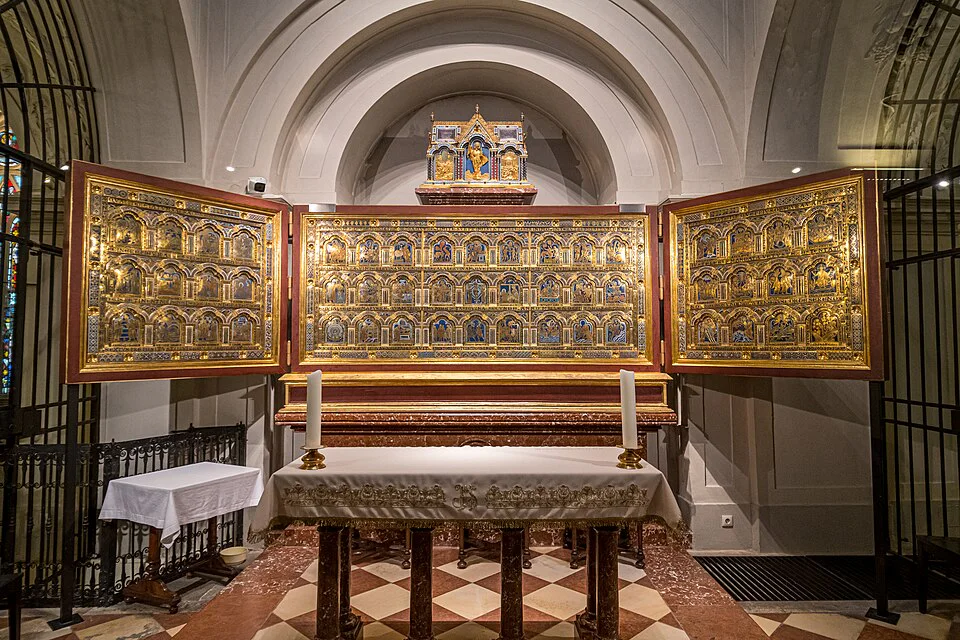 Leopold Chapel and the Verdun Altar
The Verduner Altar
Fifty-one gilded copper plates, glowing with enamel, make up the artistic jewel of the abbey. Nicholas of Verdun made this altarpiece in 1181, working from Byzantine models, and its quality invites comparison with the Shrine of the Three Kings at Cologne Cathedral. The plates are arranged in three rows that march through sacred history. The upper and lower rows hold scenes from the Old Testament, from Adam, Noah and Abraham to David and the Babylonian captivity, and the life of Jesus fills the middle row between them. The real idea lies in the columns, where plates from different eras sit directly beside each other. An Old Testament scene faces its New Testament fulfillment, the medieval way of reading the two as one story. The panels were not made as an altar. Only around 1330 were they assembled into the triptych seen here, opened wide so the enamel fields face the chapel altar.
Listen in the apps.somkuti · CC BY-SA 2.0
08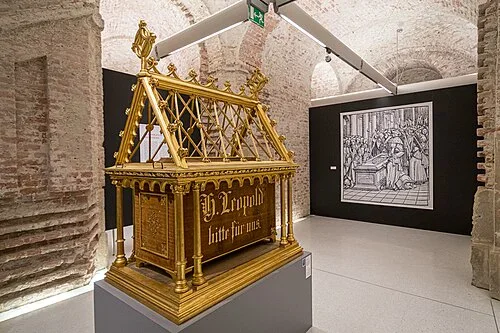 Leopold Chapel and the Verdun Altar
The Shrine of Saint Leopold
The gilded casket carries a simple plea in old lettering: St. Leopold, bitte für uns. Saint Leopold, pray for us. The founding margrave did not stay a mere nobleman in memory. Pope Innocent the Eighth canonized him on 6 January 1485, and Klosterneuburg soon became an important pilgrimage site. His tomb found its place in the chapel of 1318, and his feast falls on 15 November, the day he died in 1136. That date carries a second memory. On 15 November 1616 Archduke Maximilian the Third attended the Leopold festival here and donated the archducal hat to the monastery. From then on the abbey guarded the holy crown of the land, a treasure allowed to leave its keeping only for the hereditary homage ceremony. The founder, the crown and the plea on the shrine all point the same way: Klosterneuburg held the memory of the dynasty and the symbol of the country in one chapel.
Listen in the apps.somkuti · CC BY-SA 2.0
09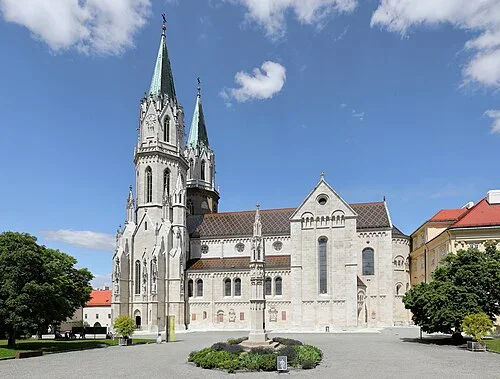 Collegiate Church of the Nativity of the Virgin Mary
The Collegiate Church from Outside
From the outside, the collegiate church reads like a chronicle in stone. It was consecrated on 29 September 1136, after twenty-two years of construction, and the basic form of that Romanesque basilica has survived nine centuries of rebuilding. The towers tell a slower story. The south tower was begun in 1394 and took two hundred years to complete, finished only in 1592. By the 1880s the west towers had become unsafe, and the Vienna master builder Friedrich von Schmidt directed their restoration. Between 1882 and 1893 the originally unequal towers were rebuilt to a unified neo-Gothic height of nearly eighty-three meters, given sculptures by Franz Christoph Erler. The church is dedicated to the Nativity of Mary, and in 1936 Pope Pius the Eleventh granted it the title of minor basilica.
Listen in the appPhoto: Anna Saini · CC BY-SA 4.0
10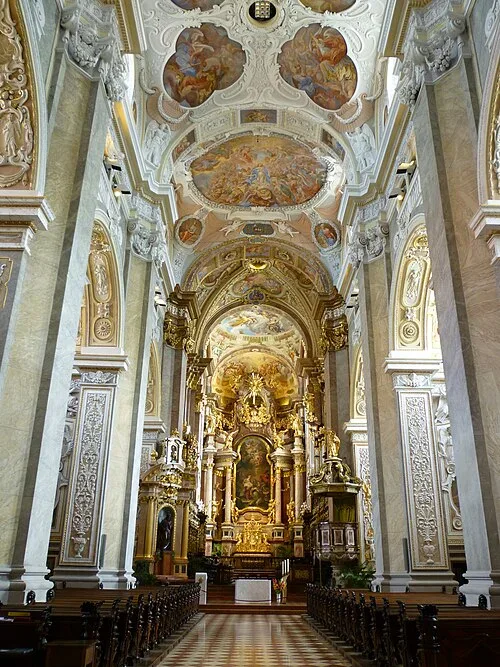 Collegiate Church of the Nativity of the Virgin Mary
The Baroque Nave
Gold pulls the eye down this nave to the high altar, under a ceiling crowded with painted clouds. The walls behind all that glitter are far older. Leopold the Third's basilica still shapes this room. From 1634 the canons began dressing it in the Baroque, in three long phases. Northern Italian artists worked on the first under Giovanni Battista Carlone. The old crossing tower came down in 1636. In its place the north tower rose, built in the Gothic manner of the south tower, and it received a bell of six thousand kilograms, the Leopoldiglocke, named for the founder. The second phase ran to 1702, filling the nave with frescoes, stucco and altars. The last phase brought the presbytery, the choir stalls, the high altar and the pews into their present shape, after designs by Matthias Steinl. A Romanesque hall for prayer had become a Baroque stage for the liturgy.
Listen in the appPhoto: Uoaei1 · CC BY-SA 3.0
- 11
The Freundt Organ of 1642
The 1642 organ by Johann Freundt of Passau, still ranked among the most significant instruments in Austria.
- 12
The Marble Hall and Gran's Fresco
Daniel Gran's 1749 ceiling fresco, which paints three ruling dynasties as one unbroken glory of Austria.
- 13
The Imperial Apartments
The gilded enfilade of the imperial apartments, built for an emperor whose palace was never finished.
- 14
The domed Library
The domed library and Father Pius Parsch, whose People's Liturgy spread from here across Austria.
- 15
The Babenberg Family Tree (1489)
Hans Part's 1489 family tree, the abbey's painted memory of its founding dynasty.
- 16
The Apostle with Eyeglasses (1439)
A 1439 apostle reading his book through riveted spectacles, a small gem of the abbey's painting collection.
- 17
The Historic Wine Cellars
Nine centuries of winemaking in the brick cellars of one of Austria's oldest and largest wine estates.
- 18
Fasselrutschen at the Giant Barrel
The 56,000-liter giant barrel and the Fasselrutschen, the lucky slide down its staves every 15 November.
Stift Klosterneuburg
Frequently asked questions
How much does the guide cost?
Free app download. Listed guide price: $0.99. Guide price shown in the app. Audio guide only. Venue admission is separate.
Can I listen without internet?
Yes. Download the guide’s audio, images, and maps in the app before your visit. Your downloaded content is then available offline.
Can I listen in my language?
This audio guide is available in 15 languages, including English.
Do I need to follow a schedule?
No. This is a self-guided experience. Choose your stops, pause whenever you like, and return to a story at your own pace.
At your own pace
Explore Stift Klosterneuburg.
Download Stanza, then search for “Stift Klosterneuburg”.
Free app download · Guide price shown in the app
Keep exploring
Nearby audio guides
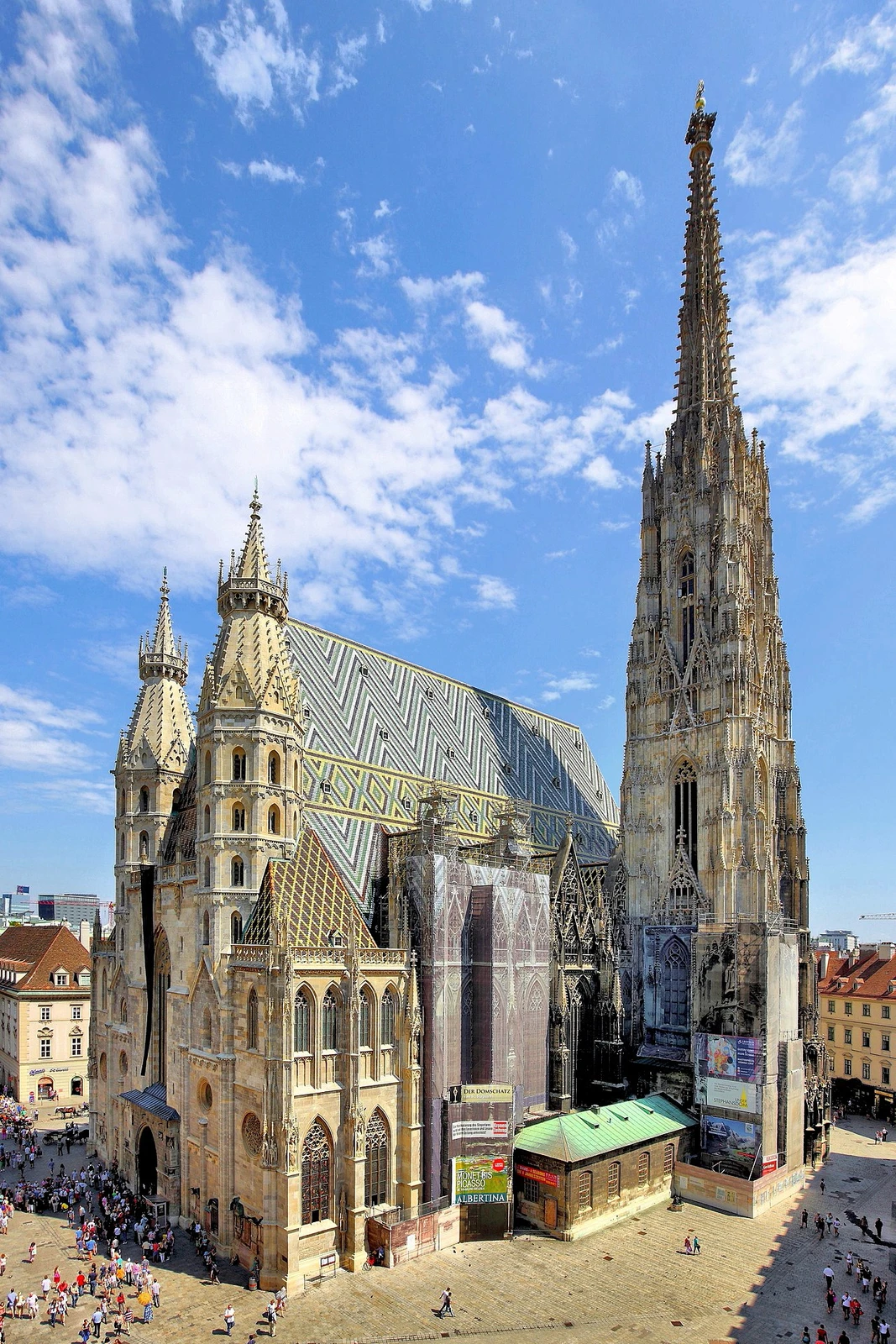
Vienna · 12 km
St. Stephen's Cathedral
Content & sources
C.Stadler/Bwag · CC BY-SA 4.0
Vienna · 12 km
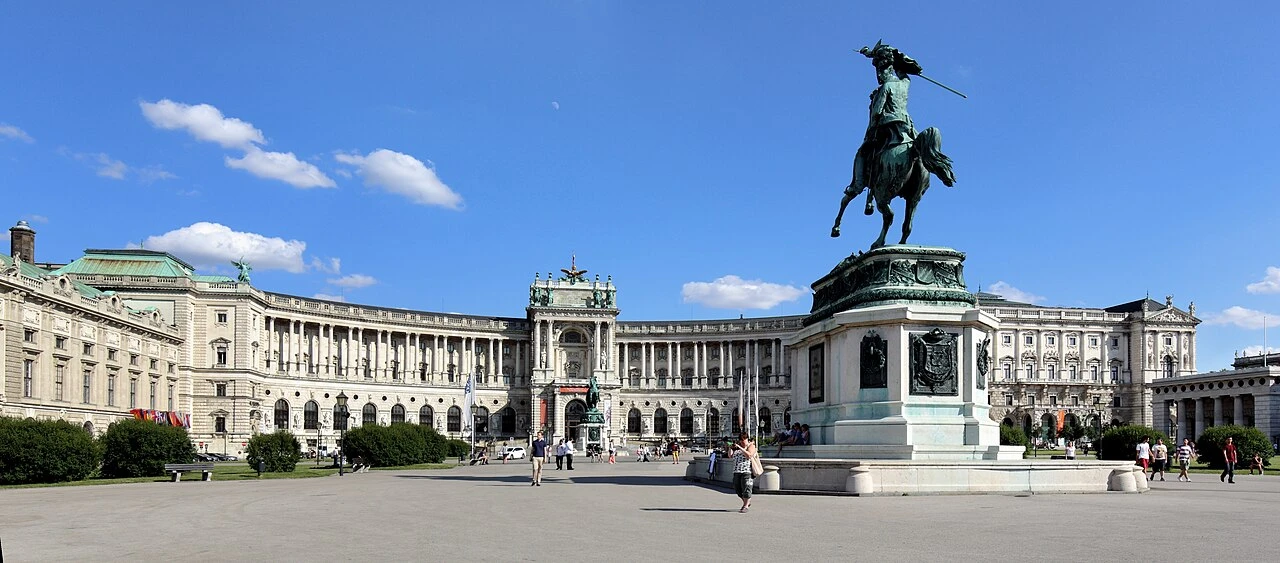
Hofburg
Content & sources
C.Stadler/Bwag · CC BY-SA 3.0 at
Vienna · 12 km
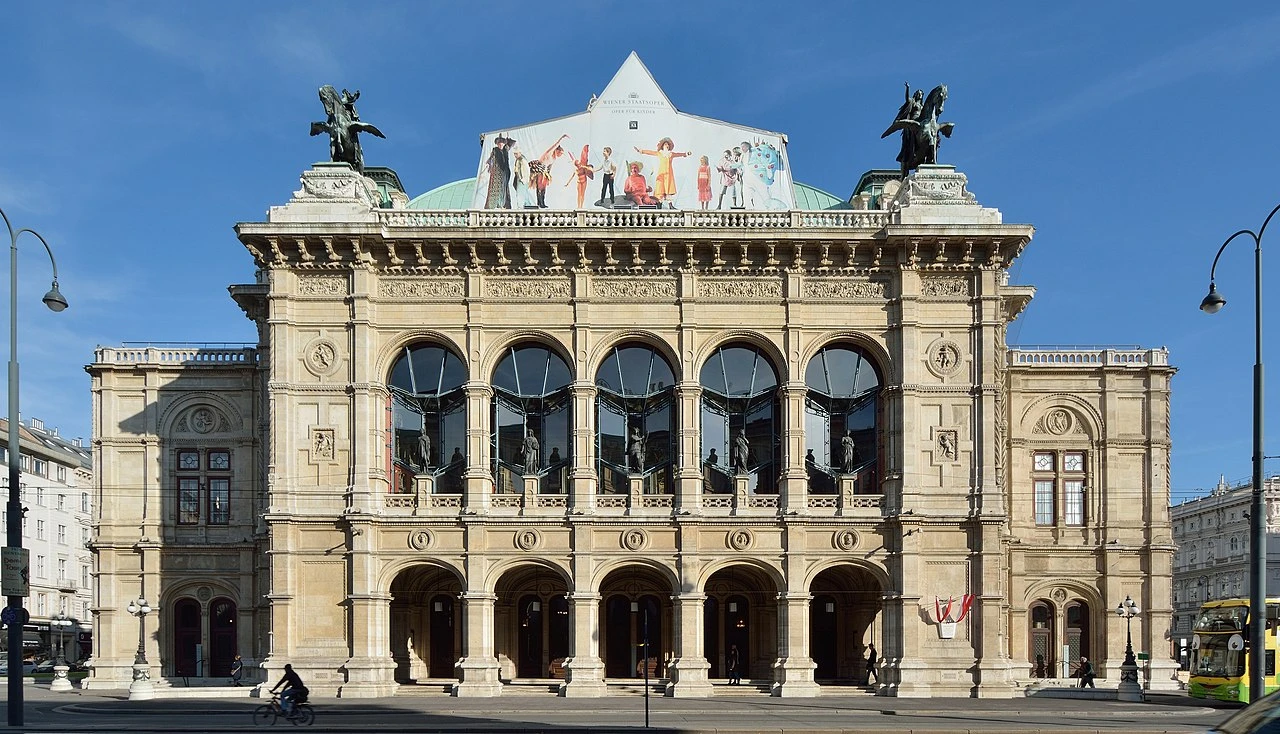
Vienna State Opera
Content & sources
Photo: P e z i · CC BY-SA 3.0 at
Vienna · 13 km
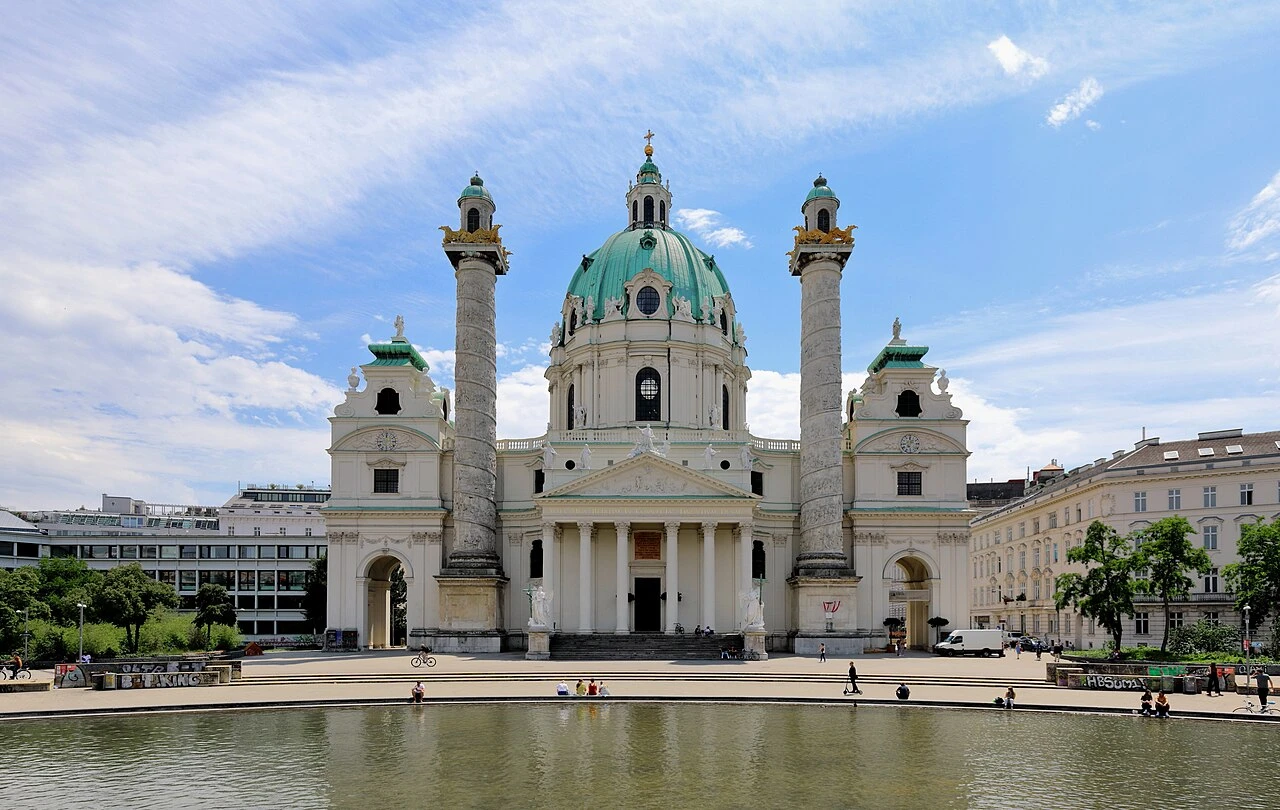
Wiener Karlskirche
Content & sources
C.Stadler/Bwag · CC BY-SA 4.0