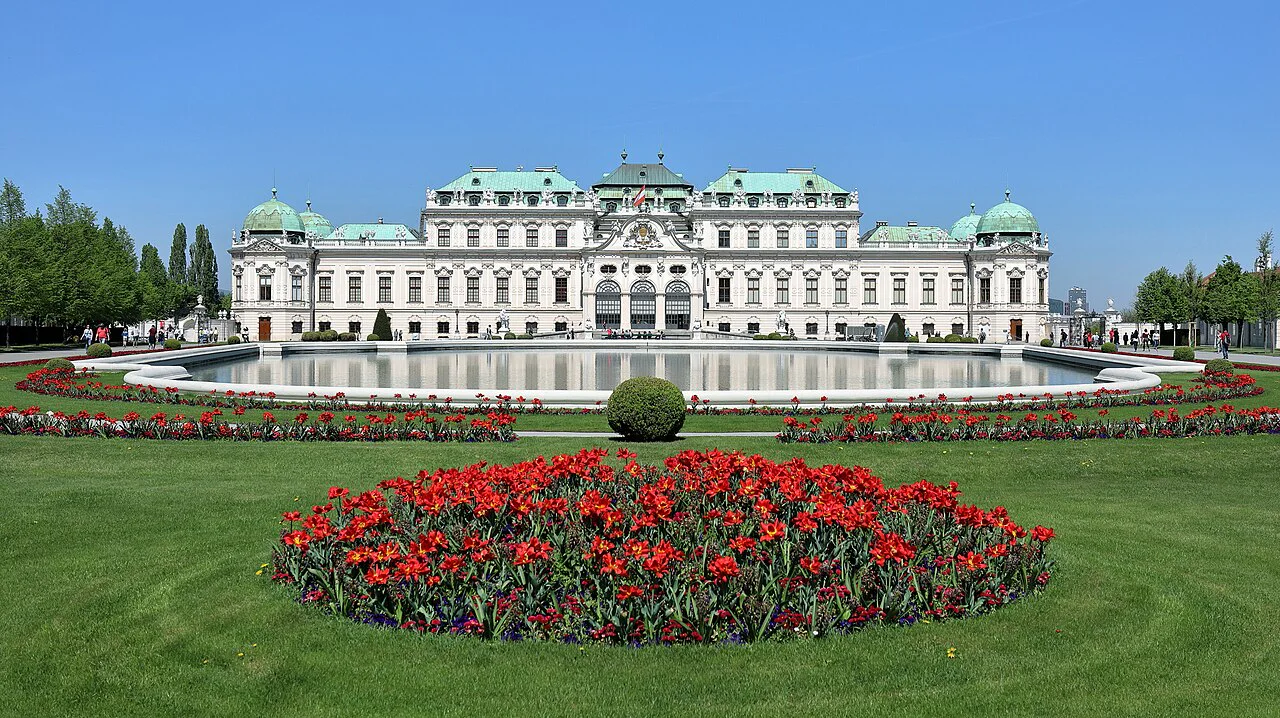
Stanza · Audio guide
Schloss Belvedere Audio Guide
A place to remember. A story to take with you.
The Belvedere is a historic building complex and art museum in Vienna, Austria. It consists of two Baroque palaces, the Upper and Lower Belvedere, which were built as the summer residence of Prince Eugene of…
Download Stanza, then search for “Schloss Belvedere”.
About the tour
One guide. Your kind of visit.
The Belvedere is a historic building complex and art museum in Vienna, Austria. It consists of two Baroque palaces, the Upper and Lower Belvedere, which were built as the summer residence of Prince Eugene of Savoy.
Ready when you are.
- 01Get the free Stanza app.
iOS & Android
- 02Find your guide.
“Schloss Belvedere”
- 03Download before you go.
Works offline
Audio guide / 16 narrated stops
Inside the guide
Get to know a few of the stories before you go. Open a stop to read more.
01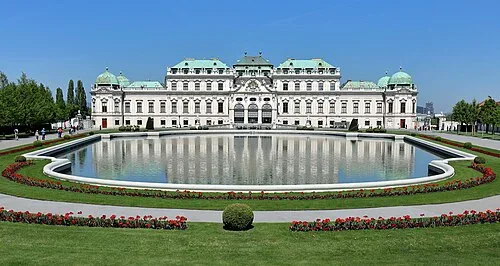 Upper Belvedere Courtyard and South Reflection Pond
Upper Belvedere and the South Reflection Pond
Welcome to the Belvedere. Two Baroque palaces face each other across a formal garden on a hill above Vienna, and this one, the Upper Belvedere, looks down over all of it. It was built as the summer residence of Prince Eugene of Savoy, designed principally by the architect Johann Lukas von Hildebrandt. Eugene wanted representation more than privacy: a stage for ceremonies, receptions and display, high enough to impress. The work was finished in 1723, and even before the interiors were done the palace proved its purpose. In 1719 the prince received the Turkish ambassador, Ibrahim Pasha, here, while the painters and stucco workers were still busy inside. Today the building is one of Austria's major art museums, and the whole ensemble belongs to the World Heritage of Vienna's historic centre. The facade has one further honour: it appears on the Austrian twenty-cent coin.
C.Stadler/Bwag · CC BY-SA 4.0
02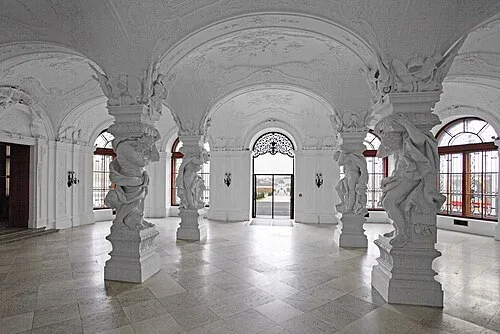 Sala Terrena Entrance Hall
Sala Terrena: The Hall That Nearly Fell
Every palace has one crack in its show of perfection, and here it is. This ground-floor hall was meant to be a single open space, part garden hall and part entrance vestibule, all airy arches and light. Soon after completion, though, the structure began to give trouble. The building had been conceived for show, and the hall's vaulting turned out to be more than the walls could comfortably carry. So in the winter of 1732, the architect Hildebrandt returned to his own building and rebuilt the room. He installed a vaulted ceiling carried on four colossal Atlas pillars, the muscular figures that stand in the hall today. That is why the room looks the way it does: not a stroke of Baroque whimsy, but a repair that became the design. The giants have been holding the ceiling ever since.
Belvedere, Wien · CC BY-SA 3.0 at
03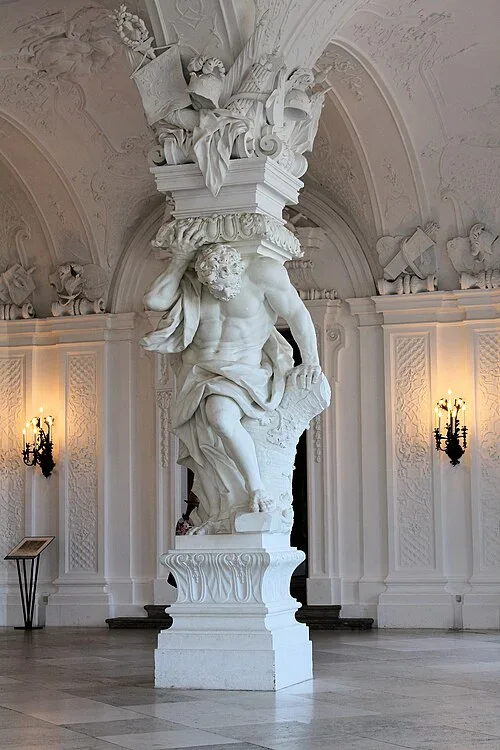 Sala Terrena Entrance Hall
An Atlas Figure, Close Up
This figure is carrying a building. He bends forward, every muscle in his back and legs strained, bracing himself under the arch that rests on his shoulders. Above his shoulder the carver piled up the trophies of war: armour, standards, weapons, all the spoils of a victorious commander. The stone giant is one of four such Atlantes in this hall, each worked from Zogelsdorfer stone, a pale limestone from a quarry town near Vienna. The subject fits the house. A palace built to celebrate a general's victories puts its war trophies in the very pillars, so that even the architecture seems to serve the army. The figure's face looks down and outward, weathered and calm, as if the strain were nothing at all.
Listen in the appPhoto: Dguendel · CC BY 4.0
04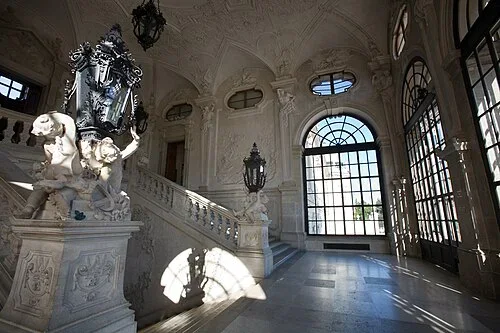 The Grand Staircase
A grand staircase in a Baroque palace was never just a way upstairs. It was a stage, built so that honoured guests would climb slowly toward the state rooms, watched all the way. The decoration is rich with foliage, bandwork, cartouches and emblems, carved in Zogelsdorfer stone. The steps themselves are Kaiserstein, a hard stone with strong blue veining running through it. Until the twentieth century the stair stood open on both sides, a cascade of stone rising through the hall. In 1904 glazed doors and windows were fitted, because the palace had changed its job. The heir to the throne, Archduke Franz Ferdinand, lived here with his family from 1894, and filled the rooms with more than eighteen thousand objects he had collected on his travels around the world. He lived here until 1914, when he and his wife were assassinated in Sarajevo. The war that followed, and the collapse of the monarchy, changed this palace's story completely.
Listen in the appJorge Royan · CC BY-SA 3.0
05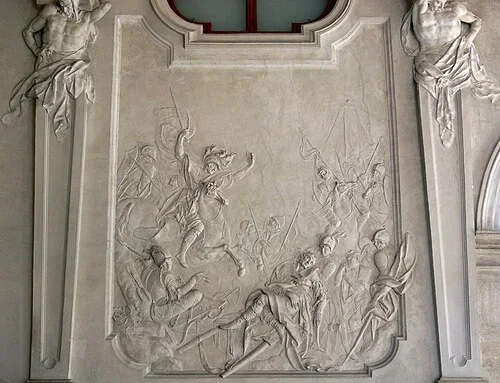 The Grand Staircase
Battle Relief on the Staircase
Horses rear, sabres swing, riders crash into each other in this carved battle panel on the staircase wall. Which fight it shows is not recorded; it stands for the general's wars as a whole. The man who paid for this palace was Prince Eugene of Savoy, and his fame rested on his campaigns against the Ottoman Empire. Those victories brought him wealth, land and prestige, and they brought Vienna a building boom to match. The Belvedere rose in those prosperous years, on a hill above the capital, as a monument to military success. The atlas-like figures flanking the panel hold up its frame the way their brothers downstairs hold up the ceiling. The whole building makes the same claim: the victories came first, and everything beautiful here came after.
Listen in the appPhoto: Andreas Praefcke · Public domain
06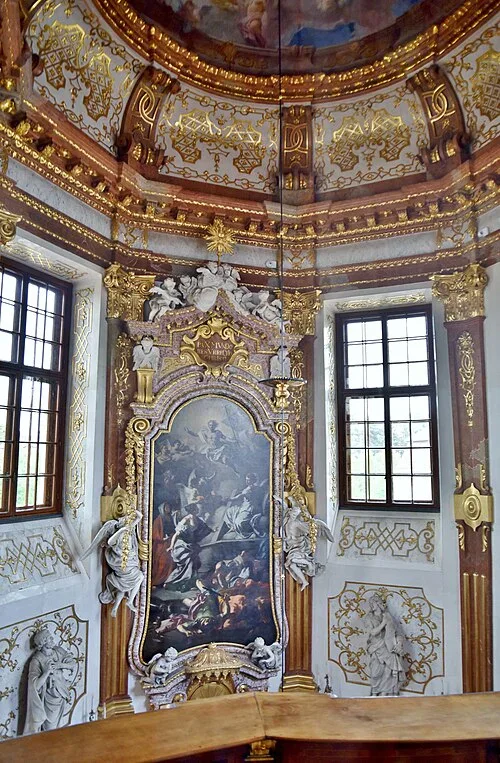 The Palace Chapel
Behind all the state display, the prince kept a room for prayer. This chapel is small and dense with ornament: gilded scrollwork climbing the walls, a dark altarpiece framed in white marble, angels crowding the corners. In 1719 Eugene commissioned the Italian painter Francesco Solimena to paint the altarpiece. The frescoes are by Carlo Innocenzo Carlone, the same painter who would soon take on the great ceiling of the Marble Hall upstairs. Where the state rooms were built for ambassadors and courtiers, this room served the household's private devotion, and the scale of it tells you so. The gilding catches the light from the tall windows, and the whole sanctuary glows like a casket. It is the quietest room in a palace built for noise.
Listen in the appPhoto: Bahnfrend · CC BY-SA 4.0
07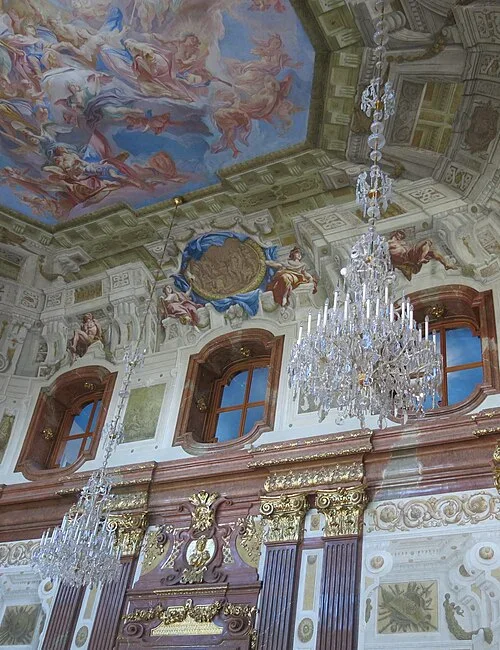 The Marble Hall
This is the heart of the palace, its largest and most magnificent room, and it has kept much of its original state. The walls glow deep red, faced with Adnet marble, and the court stonemason Elias Hügel directed the stone work for the whole building. Crystal chandeliers hang low, and the ceiling opens into painted sky. But this room carries a second life beyond the Baroque. On 15 May 1955, the Austrian State Treaty was signed here, in the Upper Belvedere. That treaty re-established Austria as an independent and democratic state, after ten years of Allied occupation following the Second World War. A room built for the glory of one man became, two centuries later, the birthplace of a whole country's freedom. The marble has seen both.
Listen in the appPhoto: Ирина Шатова · CC BY-SA 4.0
08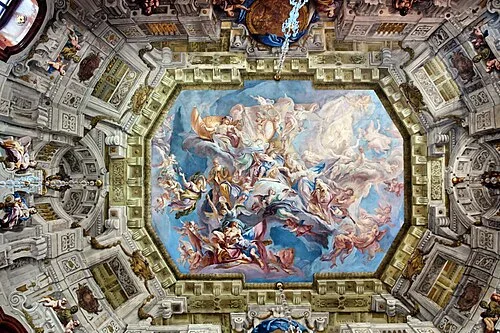 The Marble Hall
Prince Eugene as Apollo: The Ceiling Fresco
The ceiling of the Marble Hall carries the palace's final compliment to its owner. Carlo Innocenzo Carlone painted this fresco between 1721 and 1723, and he did not show Prince Eugene as a soldier. He shows him as a new Apollo, leading the Muses, a hero of the arts rather than of the battlefield. The god of poetry and music, crowned among the clouds, with the prince's features. Around the central picture runs painted architecture, columns and balustrades that seem to open the ceiling into the sky. Who painted that illusionistic framework is a genuine puzzle: one account credits Gaetano Fanti, the specialist in such illusionistic painting, who was commissioned for the Marble Hall in 1719. Another gives the work to Marcantonio Chiarini of Bologna. Both were masters of the trick; the ceiling keeps the secret.
Listen in the apppainting: Carlo Innocenzo Carloni photo: Alberto Fernandez Fernandez · CC BY 2.5
09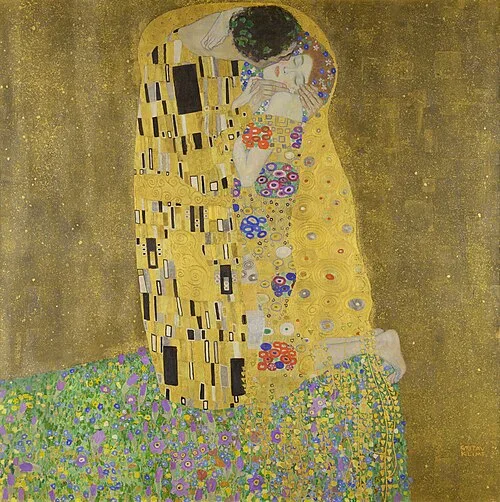 The Gustav Klimt Gallery
Klimt's 'The Kiss'
A couple stands wrapped in gold at the edge of a flowering meadow. The man bends to kiss the woman's cheek, her face turned outward, and both of them dissolve almost entirely into ornament. This is Gustav Klimt's The Kiss, the painting people come to the Belvedere for, and the headliner of an important Klimt collection. The museum's holdings reach from the Middle Ages to the present, with Klimt, Schiele, Kokoschka, Monet, Van Gogh and Rodin among the names. Klimt's golden manner grew out of the Vienna Secession, the movement that broke with the city's official art at the turn of the century. Gold leaf, flat pattern, a shimmering surface: the style reached its climax here, where two figures become one glowing shape. The meadow beneath them is scattered with flowers, and the man's robe is covered in small rectangles, like a mosaic worked in gold.
Listen in the appGustav Klimt · Public domain
10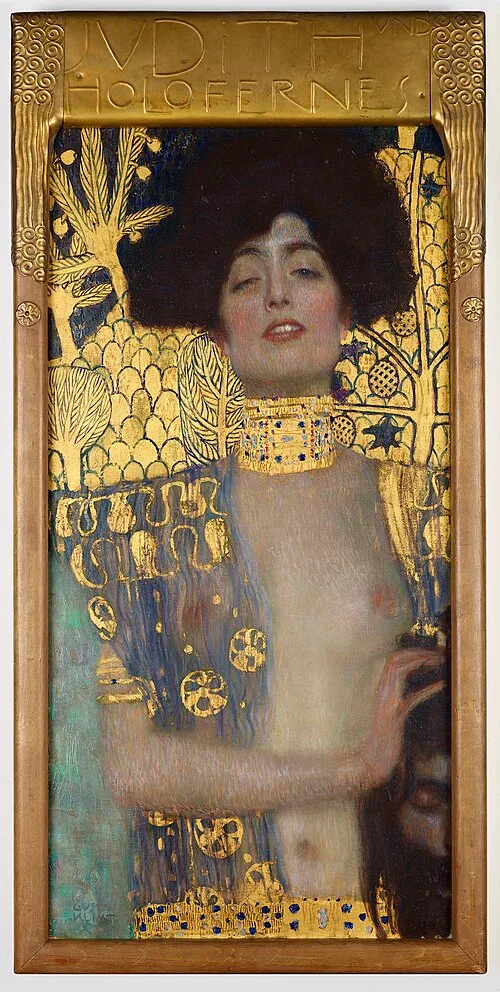 The Gustav Klimt Gallery
Klimt's 'Judith I' and the Museum's Modern History
Nearby hangs a second Klimt, and its frame carries the museum's own story. Judith looks out with half-closed eyes, bare-shouldered, wearing a broad collar of gold and blue, the head of Holofernes half-hidden in the shadows at her side. The inscription on the gilded frame reads Judith und Holofernes, so no viewer could mistake the biblical heroine. In 1903 the Moderne Galerie opened in the Lower Belvedere, the first state collection in Austria devoted to modern art, established partly through the efforts of the Vienna Secession. Early acquisitions included Van Gogh, Monet and Segantini, and in 1912 the museum became the Austrian State Gallery. The hardest chapter came in 2006. After a long legal battle, Austria returned five Klimt paintings to the heirs of Ferdinand and Adele Bloch-Bauer, among them the golden Portrait of Adele Bloch-Bauer the First, because they had been wrongfully seized in the Nazi era. Under Austria's 1998 restitution law the museum still researches the histories of its older works, and hands back what it finds.
Listen in the appGustav Klimt · Public domain
- 11
The View over Vienna Today
The panorama over the gardens and the city, a view with its own name and a say in Vienna's planning debates.
- 12
Bellotto's View of Vienna from the Belvedere
Bellotto's painted view from around 1759, the oldest detailed record of the garden and the city as they once looked.
- 13
The Terraced Baroque Garden
Three terraces by a gardener from Versailles, and the fountains that fell silent for sixteen years.
- 14
A Sphinx in the Parterre
A winged guardian on the parterre, and the year the prince's private garden became everyone's.
- 15
The Lower Belvedere
The first-built palace at the bottom of the hill, where Eugene actually lived and diplomats came calling.
- 16
The Orangery and the Prince's Legacy
The Orangery, a prince's lion, and the legend of the roar that marked his death.
Schloss Belvedere
Frequently asked questions
How much does the guide cost?
Free app download. Listed guide price: $1.99. Guide price shown in the app. Audio guide only. Venue admission is separate.
Can I listen without internet?
Yes. Download the guide’s audio, images, and maps in the app before your visit. Your downloaded content is then available offline.
Can I listen in my language?
This audio guide is available in 15 languages, including English.
Do I need to follow a schedule?
No. This is a self-guided experience. Choose your stops, pause whenever you like, and return to a story at your own pace.
At your own pace
Explore Schloss Belvedere.
Download Stanza, then search for “Schloss Belvedere”.
Free app download · Guide price shown in the app
Keep exploring
Nearby audio guides
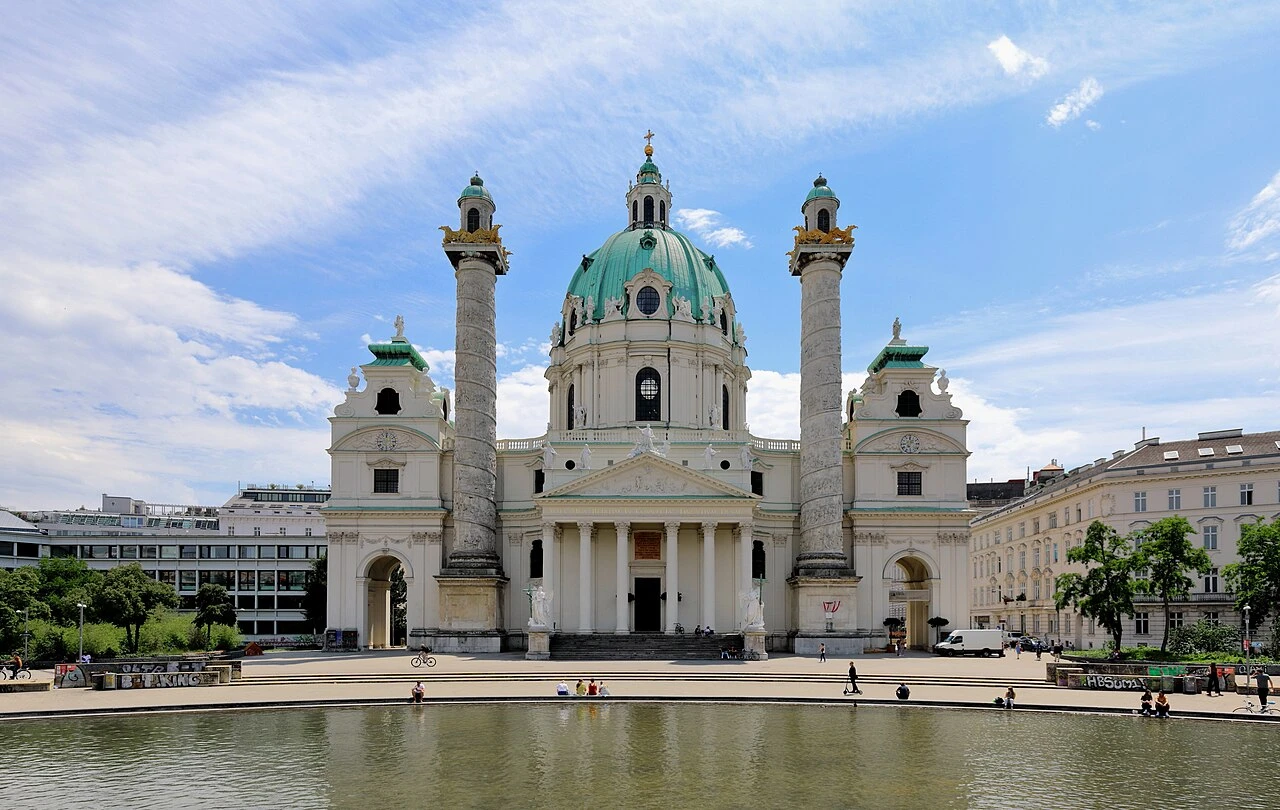
Vienna · 1 km
Wiener Karlskirche
Content & sources
C.Stadler/Bwag · CC BY-SA 4.0
Vienna · 1 km
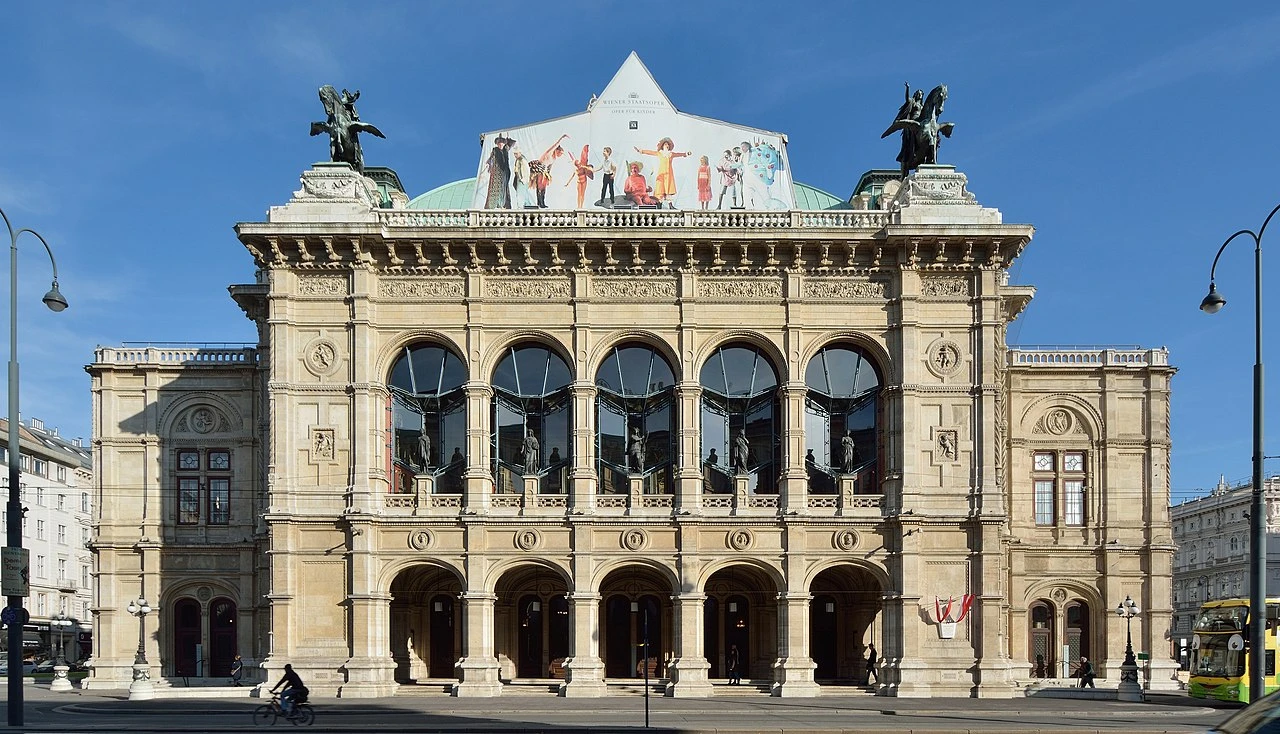
Vienna State Opera
Content & sources
Photo: P e z i · CC BY-SA 3.0 at
Vienna · 2 km
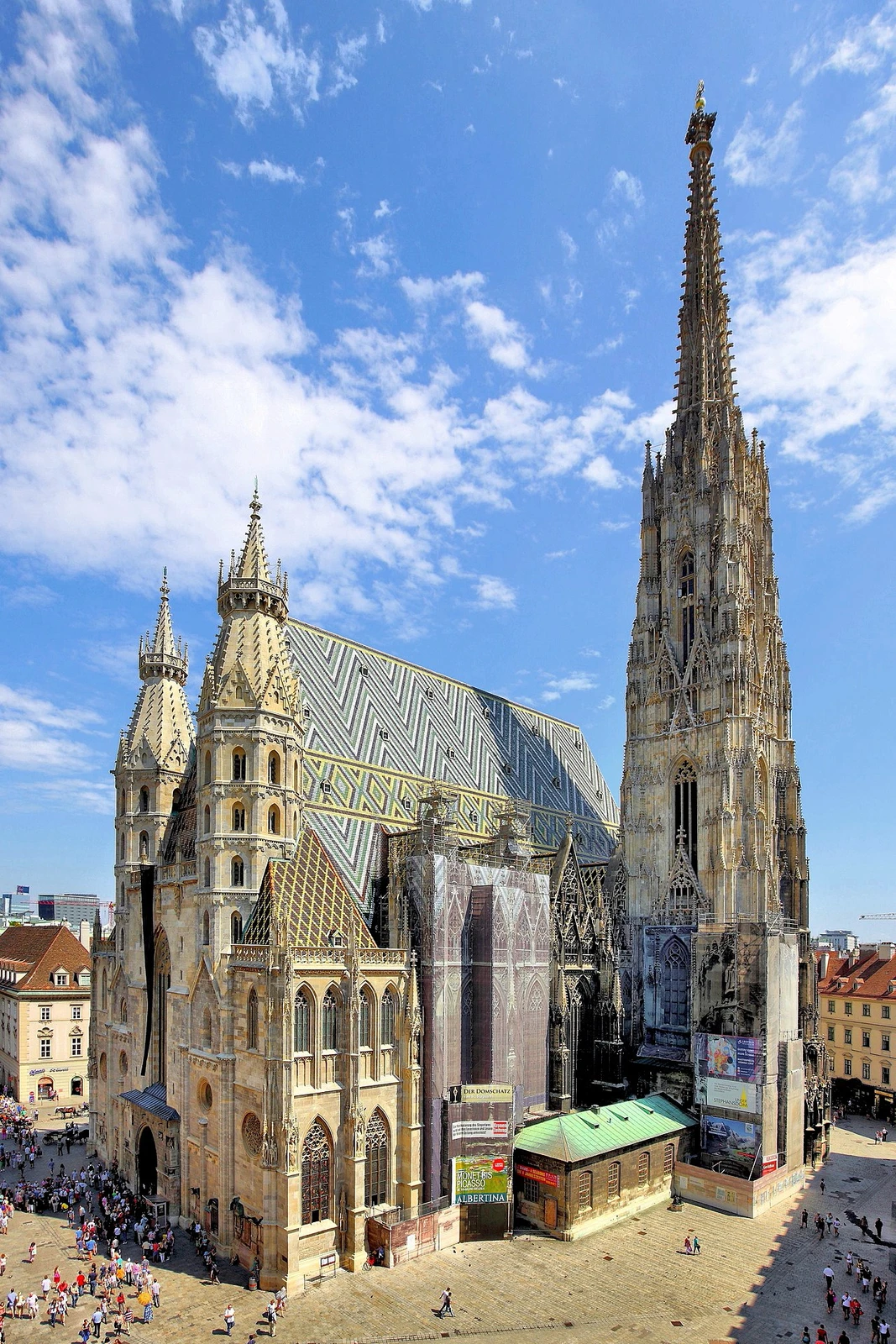
St. Stephen's Cathedral
Content & sources
C.Stadler/Bwag · CC BY-SA 4.0
Vienna · 2 km
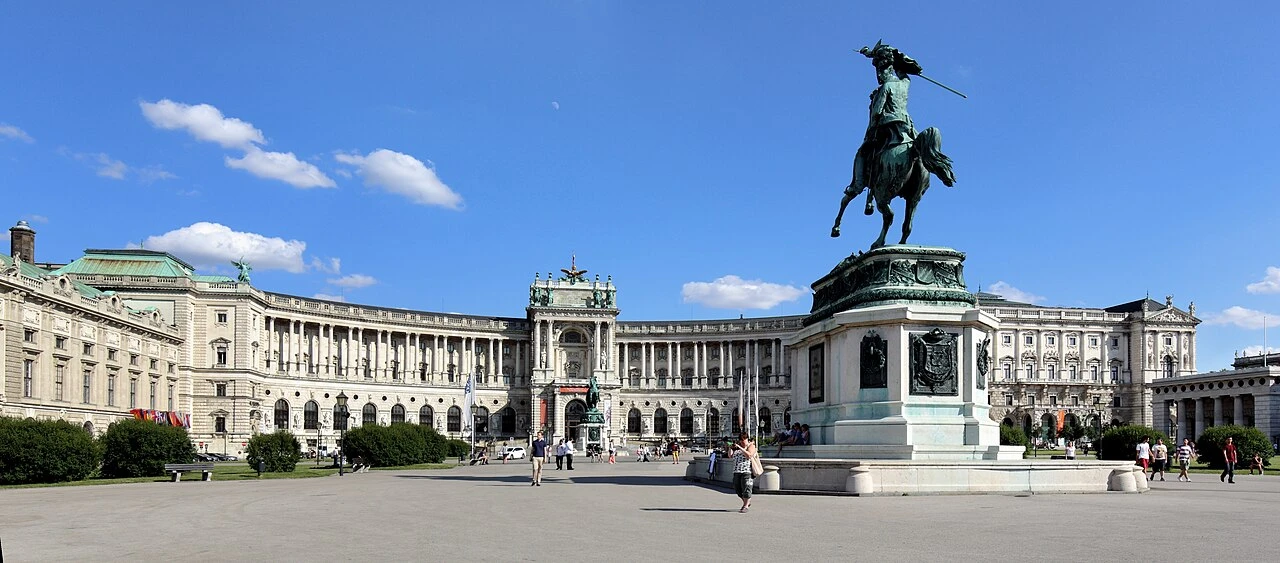
Hofburg
Content & sources
C.Stadler/Bwag · CC BY-SA 3.0 at