 Stanza / Audio guide
Content & sources
Stanza · Audio guide
Ηραίο Σάμου Audio Guide
A place to remember. A story to take with you.
The Heraion of Samos was a large sanctuary dedicated to the goddess Hera on the island of Samos. It is a UNESCO World Heritage Site recognized for its exceptional architecture and historical significance as a…
Download Stanza, then search for “Ηραίο Σάμου”.
About the tour
One guide. Your kind of visit.
The Heraion of Samos was a large sanctuary dedicated to the goddess Hera on the island of Samos. It is a UNESCO World Heritage Site recognized for its exceptional architecture and historical significance as a center of cult activity.
Ready when you are.
- 01Get the free Stanza app.
iOS & Android
- 02Find your guide.
“Ηραίο Σάμου”
- 03Download before you go.
Works offline
Audio guide / 13 narrated stops
Inside the guide
Get to know a few of the stories before you go. Open a stop to read more.
01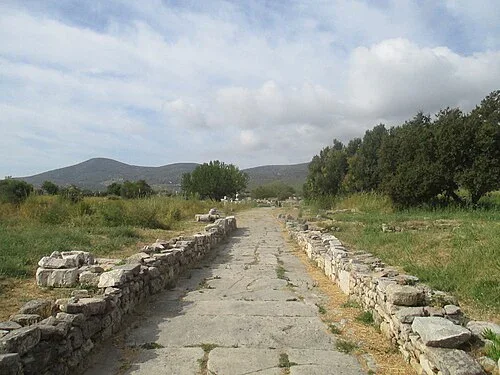 The Sacred Way and Votive Monuments
The Sacred Way
The Heraion of Samos was a great sanctuary of the goddess Hera, on the Greek island of Samos. It lies in a low, marshy basin where the Imbrasos river meets the sea. The site is about six kilometres southwest of the ancient city of Samos, now called Pythagoreion. UNESCO named the Heraion and Pythagoreion World Heritage Sites in 1992. The award recognised their exceptional architecture, and the naval and trading power of Samos in the Archaic period. The Sacred Way was the road that carried processions from the city of Samos up to the sanctuary. Builders first laid it out around 600 BC. Where it crossed the Imbrasos river, they raised a large earthen dam to carry the road and turn the river aside. Before the road was built, people reached the sanctuary by sea, through an entrance on the southeast side. The road changed that. It moved the main entrance to the north, and many of the sanctuary's buildings share its line. Its importance shows in the many votive offerings that once lined it. Low stone walls still border the road on both sides. In the third century AD it was repaved with costly stone slabs, and those slabs are still visible today.
Photo: Tomisti · CC BY-SA 4.0
02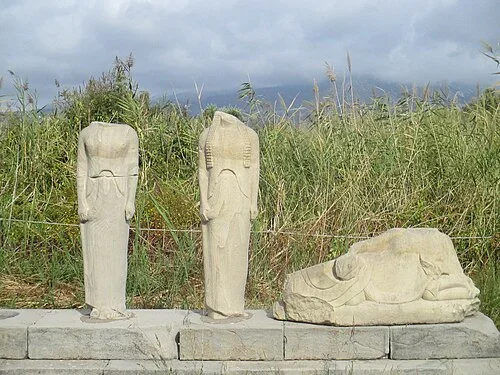 The Sacred Way and Votive Monuments
The Geneleos Group
Six figures are carved into one stone base beside the Sacred Way, and together they show a single Samian family. The sculptor was Geneleos, and the whole group takes its name from him. A seated mother sits at the left end, and an inscription gives her name, Phileia, alongside the sculptor's. At the right end the father reclines as if for a symposium, a drinking party among wealthy men. Between them stand a son and three daughters. The mother's head is lost, and so are the father's head and feet. Aideen Carty reads the sanctuary's many votive offerings as evidence that aristocrats came here to show off their wealth and standing before one another. Anyone travelling the road in procession would have passed this family's display. Two of the daughters survive, though their heads are lost, and inscriptions still identify them. The figures beside the road today are copies; the surviving originals are in the Archaeological Museum of Samos.
Photo: Tomisti · CC BY-SA 4.0
03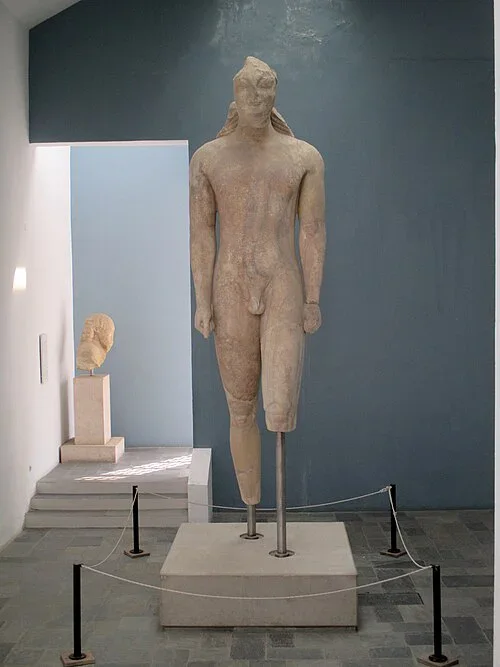 The Sacred Way and Votive Monuments
Kouros of Samos
A kouros is a statue of a naked young man, carved larger than life. The Kouros of Samos is about three times life size, and it is now displayed in the Archaeological Museum of Samos. It was found under Roman-period paving of the Sacred Way, close to where it first stood, near the sanctuary's entrance. It would have dominated the whole sanctuary when it was set up, around 580 BC. An inscription cut into its thigh names the dedicator as Isches, son of Rhesus, probably an important aristocrat. It is the earliest known example of monumental East Ionian sculpture. Finds like it show how important the workshops on Samos were in the development of Greek sculpture. Another aristocrat, Cheramyes, dedicated a group of statues around 560 BC. The group had a kouros and three korai. Korai are statues of young women, clothed and veiled, on a similar scale to the kouroi. One of Cheramyes's korai is now in the Louvre, where it is known as the Hera of Samos. It is no longer thought to show Hera. The figure may be a priestess, perhaps even a relative of Cheramyes himself.
Listen in the appPhoto: Tomisti · CC BY-SA 4.0
04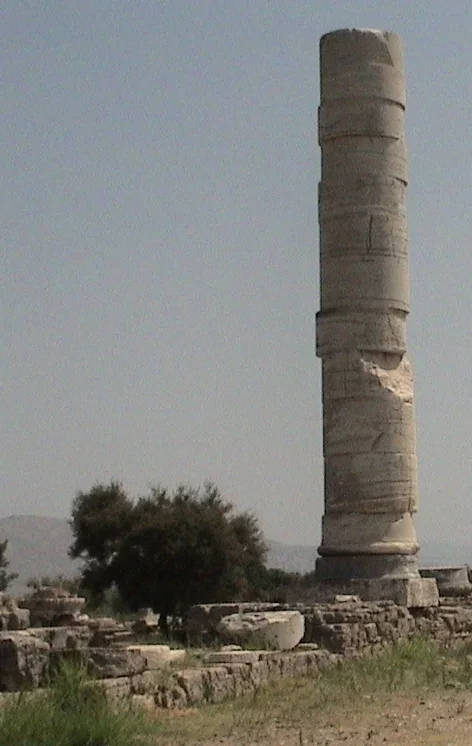 The Great Temple of Polycrates and the Lone Column
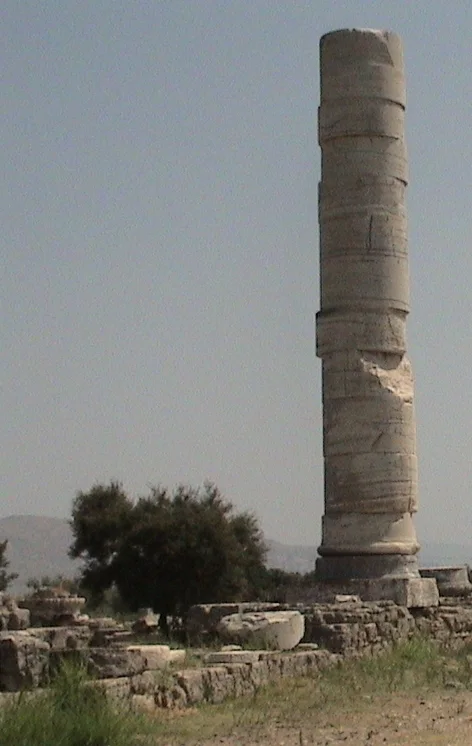
The Lone Column
The great temple of the sanctuary did not survive whole. Throughout the Byzantine period the site served as a quarry. Its stone was taken away until the temple was dismantled down to its foundations. Only one column shaft was left standing. It seems to have been kept as a navigation point for ships, a landmark for sailors. Its stacked drums still show the joints between them. It rises from low block foundations, the footings of the building that once surrounded it.
Listen in the appPhoto: FocalPoint · CC BY 2.5
05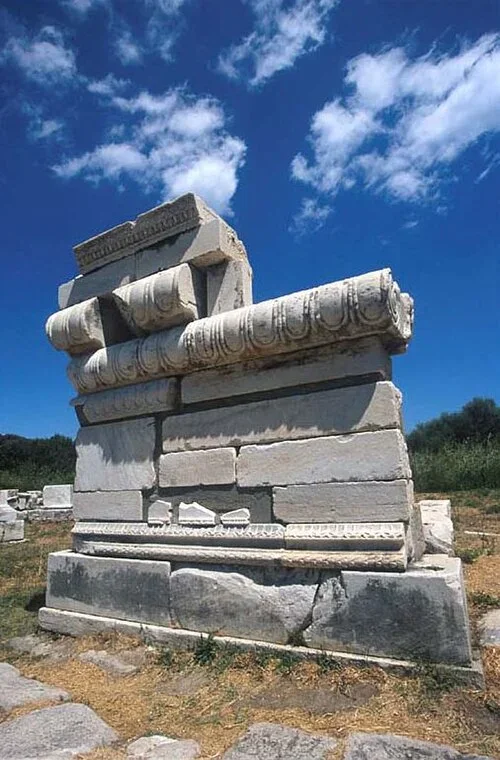 The Great Temple of Polycrates and the Lone Column
Carved Architectural Fragments
Ionic is one of the Greek building styles, and its scrolls give it away. Ionic capitals, the blocks that crown the columns, carry a pair of spiral scrolls called volutes. Carved bands and rounded mouldings often went with them. This stack of stones shows that kind of work, with rolled forms near the top and carved bands below. We cannot say which building these pieces came from, or when they were carved.
Listen in the appNo machine-readable author provided. Ori~ assumed (based on copyright claims). · CC BY-SA 3.0
06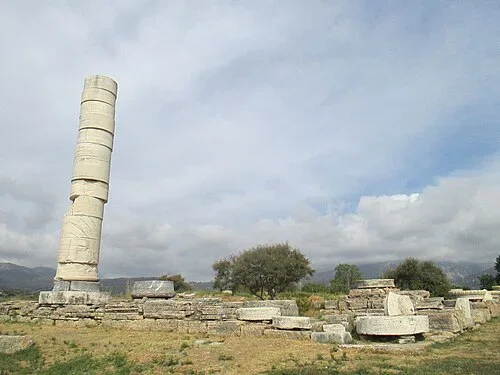 The Great Temple of Polycrates and the Lone Column
The Great Temple of Polycrates
The historian Herodotus called the sanctuary's temple 'the largest of all the temples that we know of'. He placed it among the three great engineering feats of Samos, beside the Tunnel of Eupalinos and the harbour mole at Pythagoreion. The Great Temple was about one hundred and nine metres long. It was about fifty-five metres wide, one of the largest floor plans of any Greek temple. It stood to the west of the great altar, a little west of the earlier temples. The first foundations of its inner room, the cella, were laid in the second half of the sixth century BC. That work is usually linked to Polycrates, the tyrant who ruled Samos around that time. The foundations of the outer ring of columns and of the front porch were not laid until around 500 BC. Column drums lie scattered beside the foundations today. Building carried on into the Roman period, but the temple was never wholly finished.
Listen in the appPhoto: Tomisti · CC BY-SA 4.0
07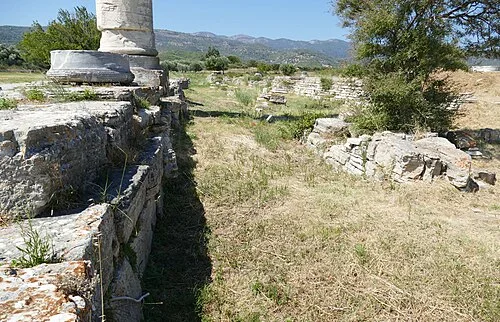 Foundations of the Early Temples: Rhoikos and Hekatompedon
Early Temple Foundations and a Column Base
Rhoikos and Theodoros were the architects of a temple that was the first of the massive Ionic temples. It was about one hundred metres long. It was about fifty metres wide. A double ring of columns ran all the way around it, a plan that architects call dipteral. Later giant temples of this kind, such as the Temple of Artemis at Ephesus, went up in western Asia Minor and the Aegean. Work began in the first decades of the sixth century BC, and it was finished around 560 BC. The Rhoikos temple stood for only about a decade. Around 550 BC it was destroyed. An earthquake may have toppled it. Or it may have been dismantled, because the marshy ground and poor foundations made it dangerously unstable. For a long time its date was disputed, until excavations in 1989 settled it. This stone base may come from the early foundations, but it cannot be linked to the Rhoikos columns. Much of its stone went into the Great Temple that replaced it.
Listen in the appPhoto: Bukvoed · CC BY 4.0
08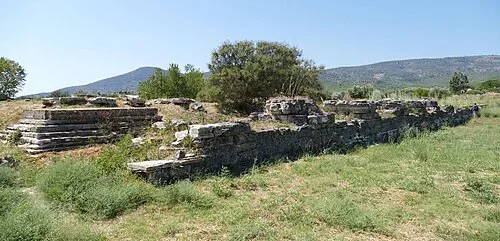 Foundations of the Early Temples: Rhoikos and Hekatompedon
Stepped Foundations and Long Wall
Religious activity here goes back to around 1700 BC. The first monumental building on the site was the Hekatompedos, put up in the eighth century BC. It was a long, narrow building of mudbrick, with a row of columns down its centre to hold up the roof. The stepped platform and the long wall may be early foundations, but we cannot be sure they belong to that first temple. Since antiquity the water table has risen, and the wet, airless soil has kept wood from rotting. As a result the sanctuary has yielded wooden offerings from the Archaic period, which is rare. Almost no other wooden objects from that period have been found in Greece. They range from fine wooden sculpture and furniture down to roughly carved spoons, and they show what less wealthy visitors offered. About forty curved wooden objects have turned up. They are abstract models of boats, perhaps offered by shipowners, or used in a special ritual. A full-size ship's hull from the late seventh century BC, about twenty metres long, was also found. A few miniature stools, intricately carved with horses, were found as well.
Listen in the appPhoto: Bukvoed · CC BY 4.0
09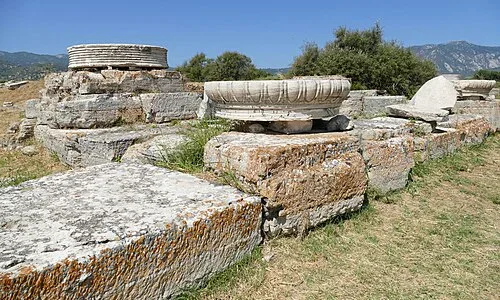 The Monumental Altar of Hera and the Imbrasos Basin
Column Drums and Stone Blocks
Among these column drums and stone blocks, the story is the altar, the heart of the sanctuary's ritual. Its first version was a rough, undecorated stone structure, about two and a half metres long, built in the ninth century BC. Some centuries later, in the second quarter of the sixth century BC, a much larger monumental altar was built. It was roughly thirty-five metres long. A staircase covered its western side and led up to a flat platform, where the sacrifices were performed. Low walls ran along the north, east and south sides. Carved reliefs of flowers and animals ran around the altar wall. The altar and the Rhoikos temple shared one alignment and one axis. Cups and dishes used at sacrificial feasts turn up all around the sanctuary, and some are marked with what appears to be Hera's name. The altar was rebuilt again and again. It stayed in use after the Rhoikos temple was destroyed, and it was renovated in the Roman period.
Listen in the appPhoto: Bukvoed · CC BY 4.0
10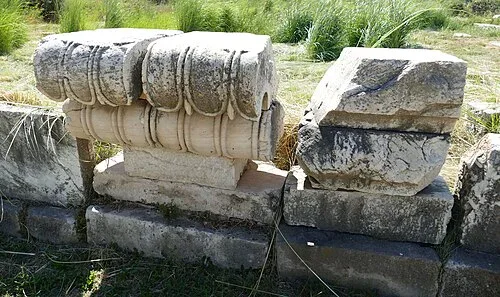 The Monumental Altar of Hera and the Imbrasos Basin
Carved Stone Block
This carved stone block is a small piece of a sanctuary that was once full of statues. Writing at the start of the first century AD, a geographer described it as 'open to the air and full of the best statues'. Among them were three colossal works by the sculptor Myron, set together on a single base. Antony took the three away. Augustus, whom the geographer calls Sebastos Caesar, later put two of them back on the same base. Those two were the Athena and the Herakles. He moved the Zeus to the Capitol instead, and built a small shrine there for it. Later, in the Roman period, a smaller temple was built east of the Great Temple to house the cult image.
Listen in the appPhoto: Bukvoed · CC BY 4.0
- 11
Coin of Samos
The sanctuary's birth myth beneath a sacred tree, and a 1963 claim to have found its stump that did not hold up.
- 12
Arched Stone Recess
The end of worship in AD 391, and a church built from the stone of the old Roman temple.
- 13
Panoramic View of the Sanctuary Ruins
What centuries of rebuilding and rivalry left across the sanctuary's ruins, with one lone column still standing in the distance.
Ηραίο Σάμου
Frequently asked questions
How much does the guide cost?
Free app download. Listed guide price: $1.99. Guide price shown in the app. Audio guide only. Venue admission is separate.
Can I listen without internet?
Yes. Download the guide’s audio, images, and maps in the app before your visit. Your downloaded content is then available offline.
Can I listen in my language?
This audio guide is available in 15 languages, including English.
Do I need to follow a schedule?
No. This is a self-guided experience. Choose your stops, pause whenever you like, and return to a story at your own pace.
At your own pace
Explore Ηραίο Σάμου.
Download Stanza, then search for “Ηραίο Σάμου”.
Free app download · Guide price shown in the app
Keep exploring
Nearby audio guides
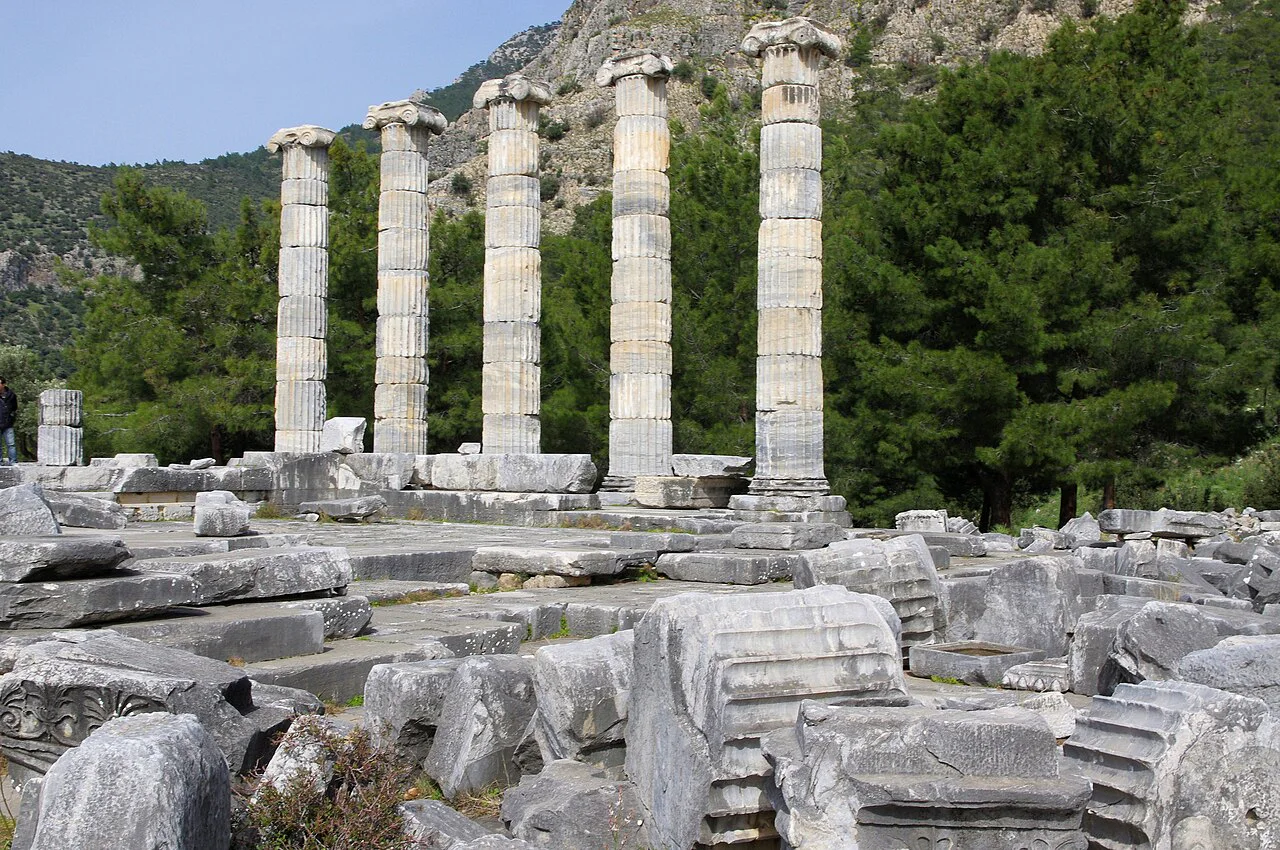
Söke · 36 km
Priene
Content & sources
Ken and Nyetta · CC BY 2.0
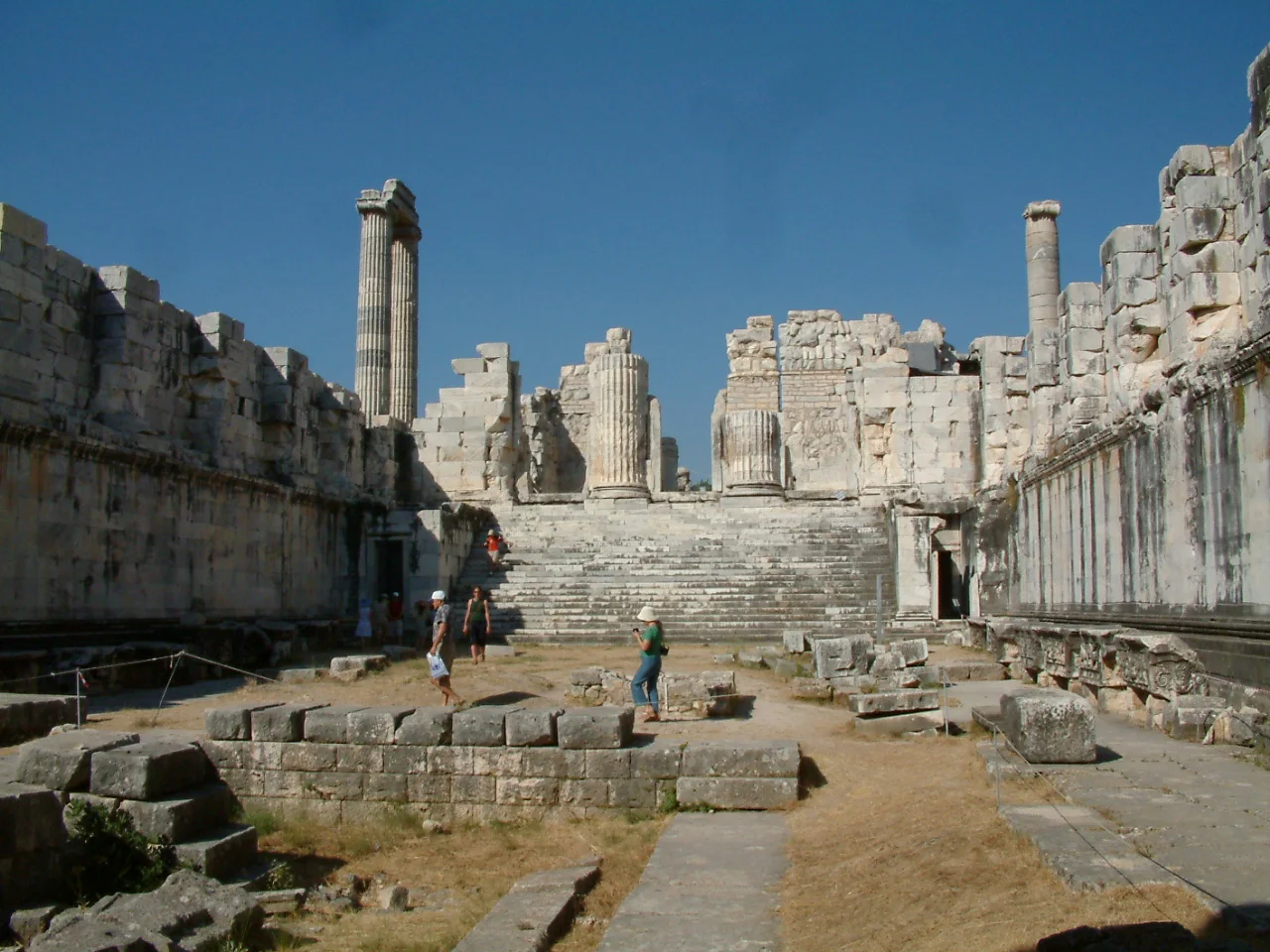
Didim · 46 km
Didyma
Content & sources
Photo: Radomil · CC BY-SA 3.0
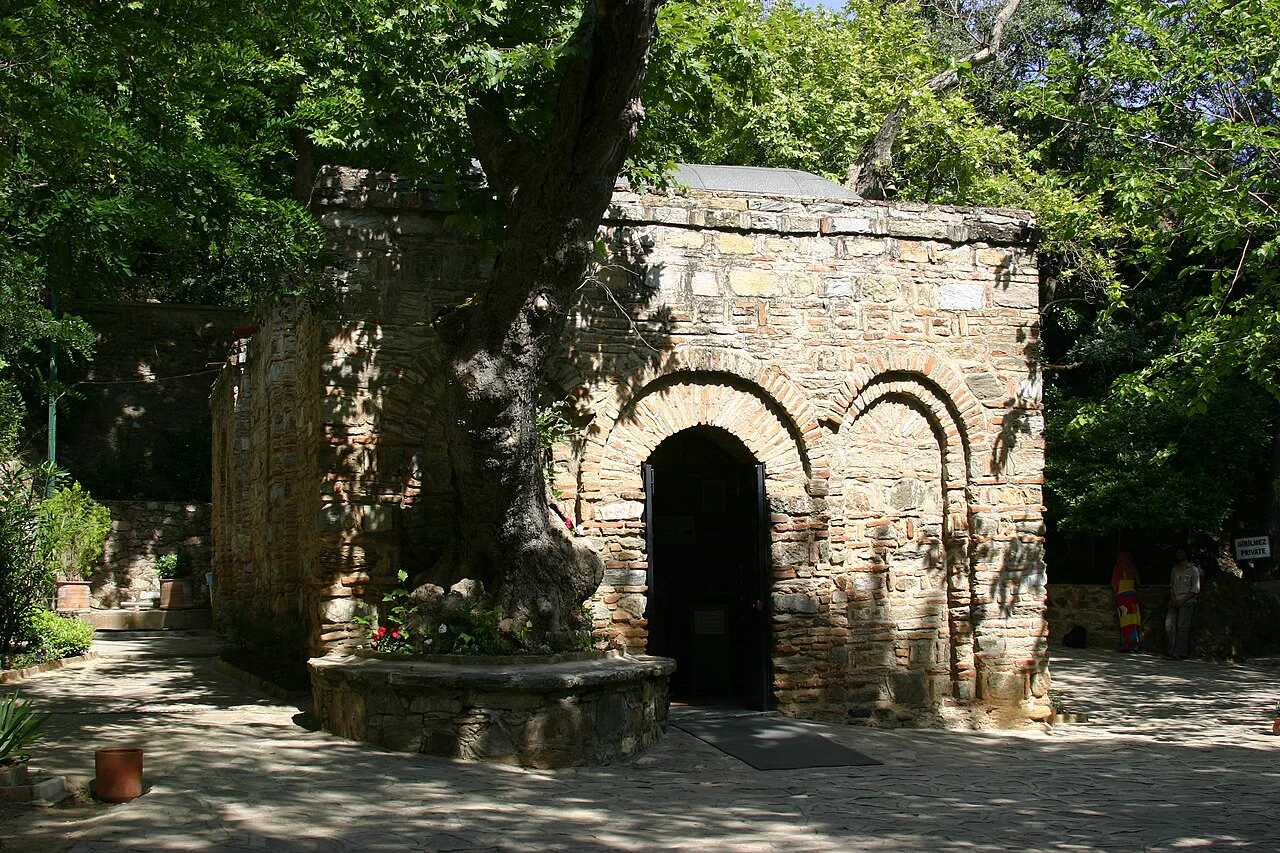
Selçuk · 48 km
Meryem Ana Evi
Content & sources
No machine-readable author provided. Mfryc assumed (based on copyright claims). · CC BY-SA 2.5
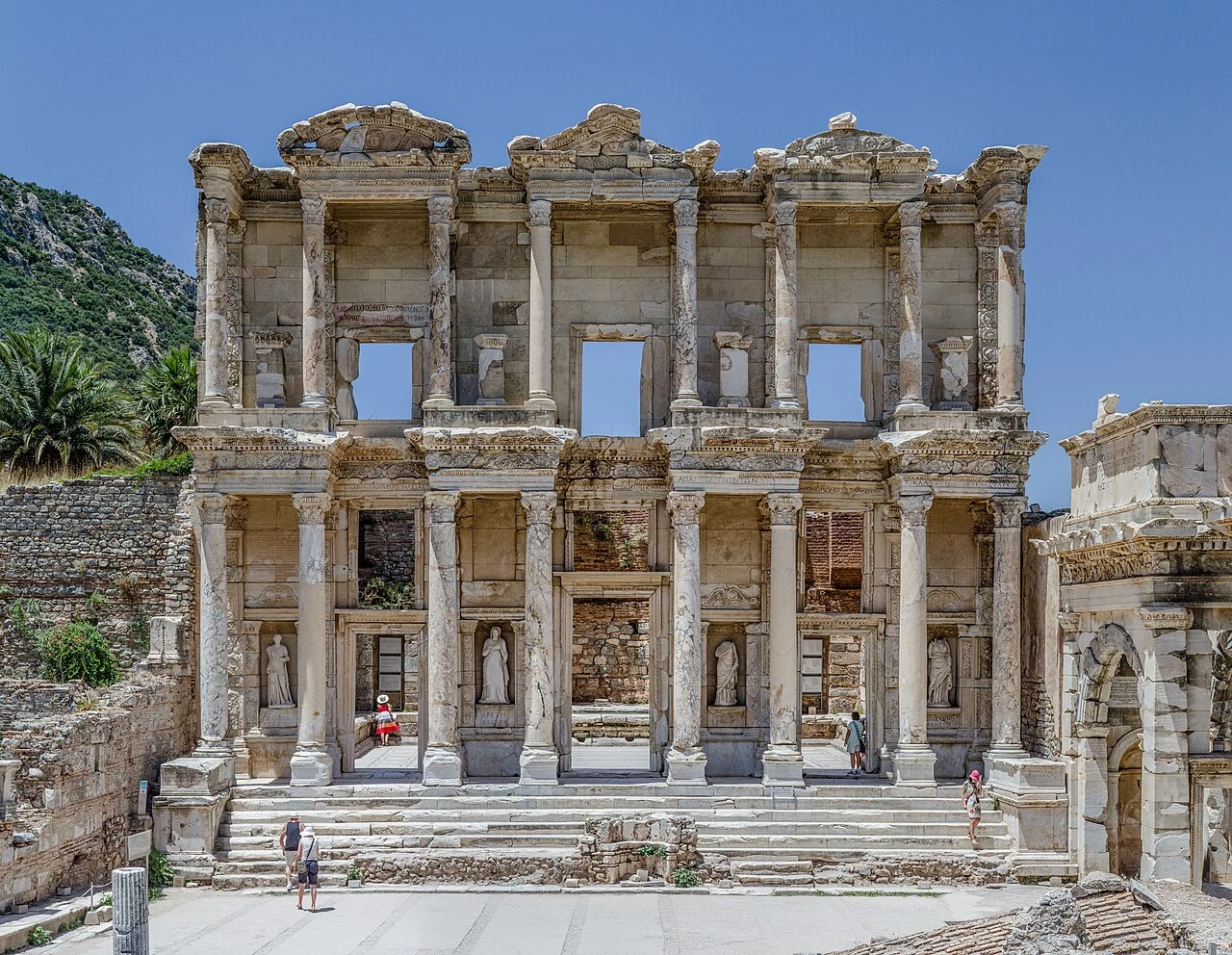
Selçuk · 50 km
Ephesus
Content & sources
Benh LIEU SONG · CC BY-SA 3.0