Stanza · Audio guide
Augustus Tapınağı Audio Guide
A place to remember. A story to take with you.
The Temple of Augustus and Rome is an augusteum located in the Altındağ district of Ankara. It is known for the Monumentum Ancyranum, which is the most complete surviving copy of the Res Gestae Divi Augusti.
Download Stanza, then search for “Augustus Tapınağı”.
About the tour
One guide. Your kind of visit.
The Temple of Augustus and Rome is an augusteum located in the Altındağ district of Ankara. It is known for the Monumentum Ancyranum, which is the most complete surviving copy of the Res Gestae Divi Augusti.
Ready when you are.
- 01Get the free Stanza app.
iOS & Android
- 02Find your guide.
“Augustus Tapınağı”
- 03Download before you go.
Works offline
Audio guide / 8 narrated stops
Inside the guide
Get to know a few of the stories before you go. Open a stop to read more.
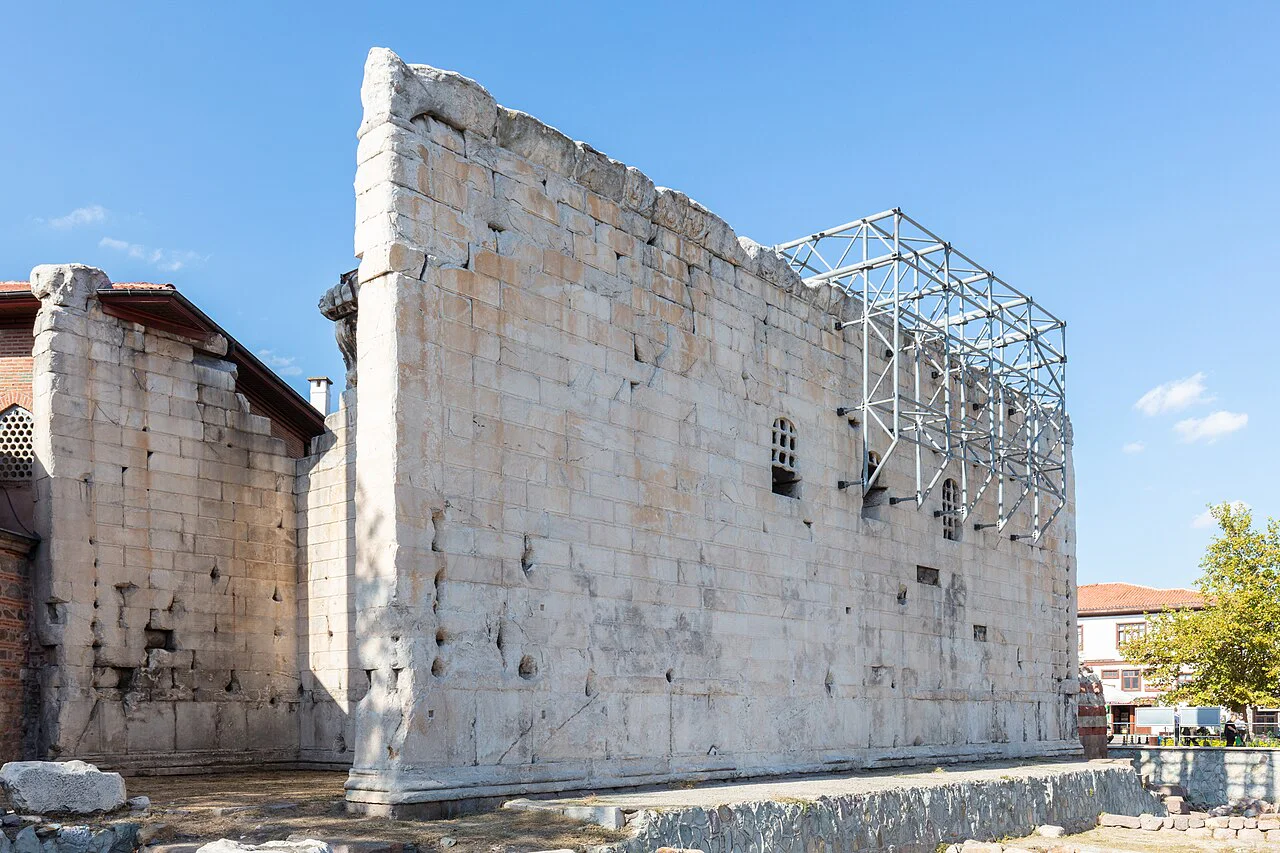
01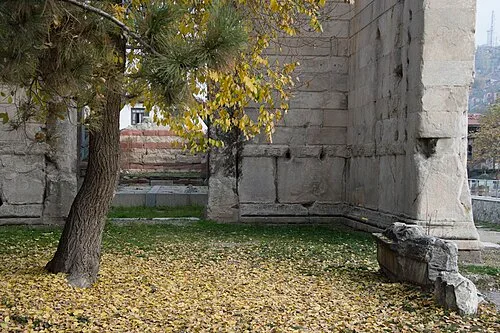 Hacı Bayram Square and the Ancient Sanctuary
The Temple of Augustus and Rome
Welcome to the Temple of Augustus and Rome, in the old heart of Ankara. These weathered walls of white marble have watched over this square for more than two thousand years. Rome built the temple around 25 to 20 BC, soon after its armies took central Anatolia. The city then went by its older name, Ancyra, and it became the capital of the new province of Galatia. The building was an augusteum, a temple for the worship of the goddess Roma and of Augustus himself, the first Roman emperor. That may sound like a cold political gesture, but the walls hold something remarkable. Cut into the stone is the fullest surviving copy of the record Augustus wrote of his own deeds. The temple also shares this ground with a working mosque, whose minaret rises just beside the ruins. Ahead lie the great carved doorway, the famous inscriptions, and the story of how the two holy places came to share one wall.
Photo: Dosseman · CC BY-SA 4.0
02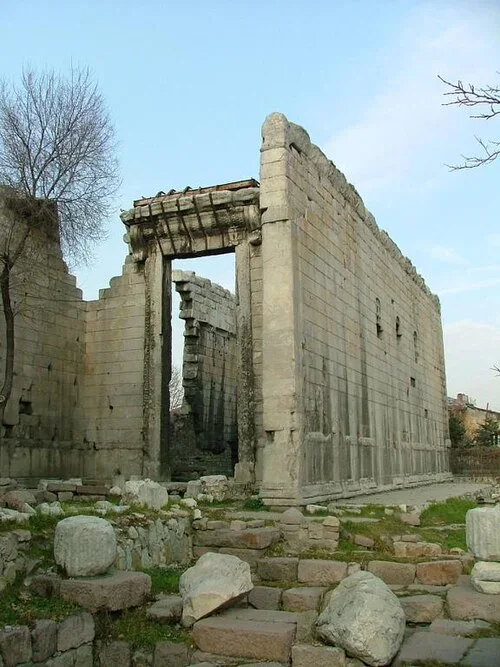 The Ornate Marble Doorway
The Cella Doorway
The great doorway and the side walls are essentially all that is left of this building. Everything else has fallen, yet the entrance still shows its original scale and carved frame. The ground beneath it was sacred long before Rome arrived. Scholars believe an earlier sanctuary stood here, dedicated to the Phrygian goddess Cybele and the god Men, and that it was destroyed after heavy damage over the years. The Roman temple was then raised deliberately on top of the older holy place. The commission carries a human story. Pylaemenes, son of Amyntas, the last king of the Galatians, had the temple built in honor of Augustus. It was meant as a monument of loyalty, a gesture from a conquered dynasty to the emperor who had absorbed their lands. So the newest religion here was planted on the ruins of the oldest, and the doorway you see was the threshold of that new beginning.
Photo: Telo · Public domain
03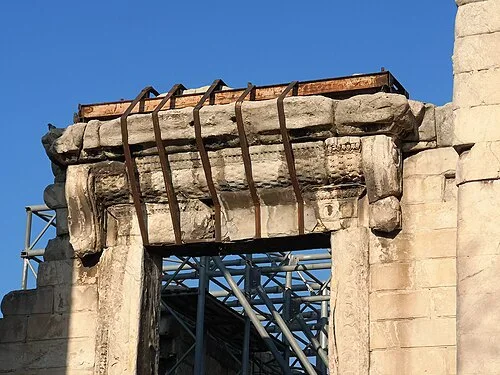 The Ornate Marble Doorway
The Carved Door Lintel
The lintel above the doorway carries some of the finest carving left on the building. The nineteenth-century scholar Charles Texier drew and engraved this temple in his works on Asia Minor. He compared it often with the Roman temples of Italy, and judged this building more showy than the buildings of Rome itself. High praise for a provincial city. The metal straps crossing the carved stone are part of the bracing that holds the fragile frame together. The temple's survival became urgent in this century. The World Monuments Fund placed it on its watch lists in 2002 and again in 2004, to push for restoration before the walls were lost. With money donated by the American philanthropist Robert W. Wilson, Turkey's Ministry of Culture and Tourism and Middle East Technical University carried out a joint survey of the stone and marble surfaces. In 2007, experts funded through the Kress Foundation met to work out how to fight the ongoing wear on the carvings.
Listen in the appGargarapalvin · CC BY 4.0
04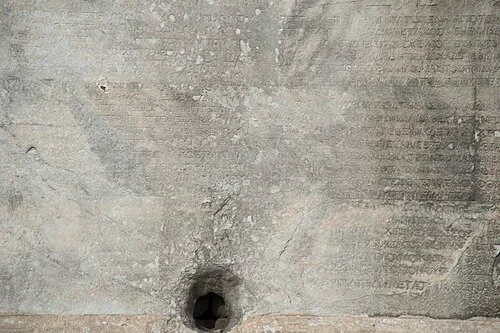 The Monumentum Ancyranum and the Latin Inscription
The Monumentum Ancyranum
These faint lines of Greek lettering are part of one of the most famous inscriptions in the world. When Augustus died in AD 14, a copy of his Res Gestae Divi Augusti, the record of the deeds of his reign, was carved here. The Latin text begins inside the porch on the north wall and runs on to the south wall. The Greek translation was cut on the outside of the cella wall, the inner sanctuary. The original version stood on bronze pillars in front of Augustus's mausoleum in Rome, and it has long since vanished. Two other copies of the text survive elsewhere, but both are incomplete. Only this one is whole, which is why historians call these walls the Monumentum Ancyranum. The German scholar Theodor Mommsen gave the inscription its most famous title, the Queen of Inscriptions. The Western world learned of it again through Ogier Ghiselin de Busbecq, the Flemish diplomat sent by Ferdinand the First to Sultan Suleiman. He recognized the emperor's testament on the walls, and his companion Janos Belsius copied it out. Busbecq noted that the top lines still read well, while the lower parts were already destroyed, much as the stone shows today.
Listen in the appPhoto: Dosseman · CC BY-SA 4.0
05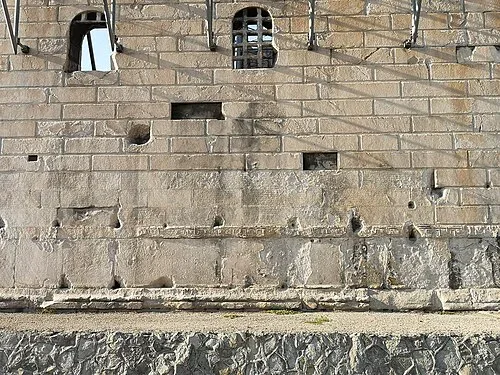 The Southeast Wall and the Byzantine Windows
The Cut Windows
The openings in this wall were never part of the Roman design. They were cut straight through the solid marble blocks, and grilles now cover them. The building's later lives changed its body completely. These windows are generally traced to the temple's time as a Byzantine church, when the pagan building was turned to Christian use. Metal tie rods stretch across the masonry above, holding the old wall together. The sixteenth-century traveler Hans Dernschwam, a German merchant, described what he found here. The roof was gone, and three high windows closed with iron bars opened in the south face. Inside, ten small rooms had been built for the local imams. So by his day the ruin was half shelter, half shrine, a Roman temple housing the clergy of a mosque.
Listen in the appGargarapalvin · CC BY 4.0
06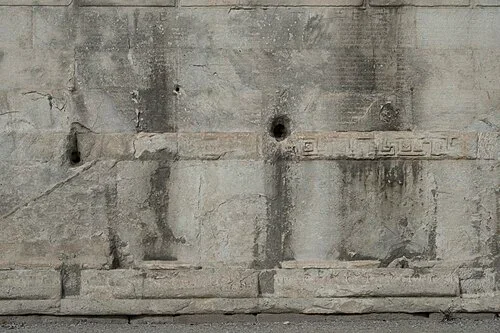 The Southeast Wall and the Byzantine Windows
The Meander Frieze
A band of geometric meander pattern still runs across this wall, crisp in places even now. The marble around it is another matter, pitted and streaked dark by centuries of wear. Two forces have done most of the damage. Repeated earthquakes broke the walls over the ages, and the air pollution of a modern city has slowly eaten into the inscriptions. In the eighteenth century, the French king Louis the Fourteenth sent Paul Lucas to Ankara as his expert on antiquities. Lucas described two great rows of wall standing beside the Hacı Bayram Mosque, adorned with column bases and capitals. He also believed the temple's walls had been built with material carried over from still older buildings, stones given a second life in a second monument.
Listen in the appPhoto: Dosseman · CC BY-SA 4.0
07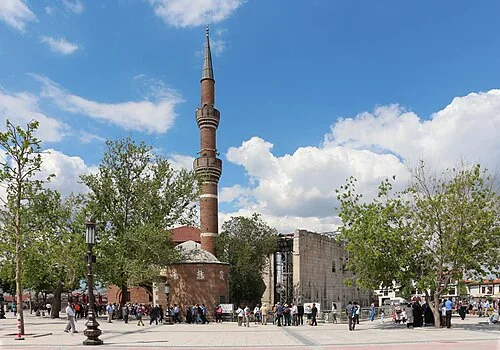 The Mosque-Temple Boundary
Hacı Bayram Mosque
The minaret of the Hacı Bayram Mosque rises right against the temple wall, and the two buildings share a single enclosure. A mosque of the Ottoman era and a Roman temple of the imperial cult stand shoulder to shoulder, joined by one wall. The layering here runs deep, and the mosque is the latest layer. And the sequence has not ended. Worship continues here every day, and the square fills with worshippers and visitors moving between the mosque and the ruins. Few places anywhere hold so many centuries of prayer in so small a space.
Listen in the appBernard Gagnon · CC BY-SA 3.0
08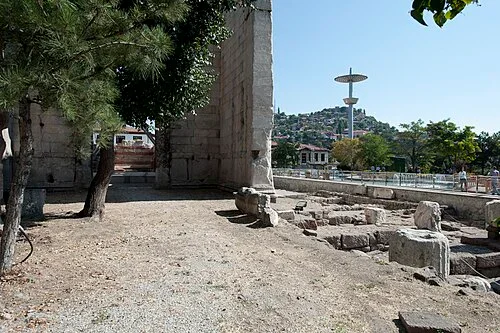 The Colonnade Footprints and Temple Legacy
The Colonnade Footprints
Fallen blocks and stumps of columns lie scattered across the ground here. Only the side walls and the ornamented door frame of the temple survive above ground, but the positions of the columns can still be made out at this level, marking where the great colonnade once stood. The temple's afterlife took an ironic turn. Rome's own copy of Augustus's testament is lost, but the Ankara text became so famous that it came back to Rome. The text became so identified with this city that for the 1911 world exhibition in Rome, a life-size reproduction of the temple's porch was built, complete with the text of the Deeds. After the fair it went into storage, was shown again in 1937, and after the Second World War found a permanent home in Rome's Museum of Roman Civilization. Rome now keeps a copy of Ankara's walls. Conquerors and the conquered, imams and ambassadors have all left their marks here, on one set of walls that has never quite stopped being sacred.
Listen in the appPhoto: Dosseman · CC BY-SA 4.0
Augustus Tapınağı
Frequently asked questions
How much does the guide cost?
Free app download. Listed guide price: $0.99. Guide price shown in the app. Audio guide only. Venue admission is separate.
Can I listen without internet?
Yes. Download the guide’s audio, images, and maps in the app before your visit. Your downloaded content is then available offline.
Can I listen in my language?
This audio guide is available in 15 languages, including English.
Do I need to follow a schedule?
No. This is a self-guided experience. Choose your stops, pause whenever you like, and return to a story at your own pace.
At your own pace
Explore Augustus Tapınağı.
Download Stanza, then search for “Augustus Tapınağı”.
Free app download · Guide price shown in the app
Keep exploring
Audio guides — Turkey
Ankara · 1 km
Ankara Kalesi
Content & sources
Bernard Gagnon · CC BY-SA 3.0
Ankara · 3 km
Kocatepe Camii
Content & sources
Photo: A.Savin · FAL
Polatlı · 82 km
Gordion
Content & sources
Stipich Béla · CC BY 2.5
Alaca
Alacahöyük
Content & sources
Bernard Gagnon · CC BY-SA 3.0