Stanza · Audio guide
Derinkuyu Yeraltı Şehri Audio Guide
A place to remember. A story to take with you.
Derinkuyu is an ancient multi-level underground city in Turkey that extends to a depth of approximately 85 metres. It is the largest excavated underground city in the country and was once capable of…
Download Stanza, then search for “Derinkuyu Yeraltı Şehri”.
About the tour
One guide. Your kind of visit.
Derinkuyu is an ancient multi-level underground city in Turkey that extends to a depth of approximately 85 metres. It is the largest excavated underground city in the country and was once capable of sheltering 20,000 people.
Ready when you are.
- 01Get the free Stanza app.
iOS & Android
- 02Find your guide.
“Derinkuyu Yeraltı Şehri”
- 03Download before you go.
Works offline
Audio guide / 10 narrated stops
Inside the guide
Get to know a few of the stories before you go. Open a stop to read more.
01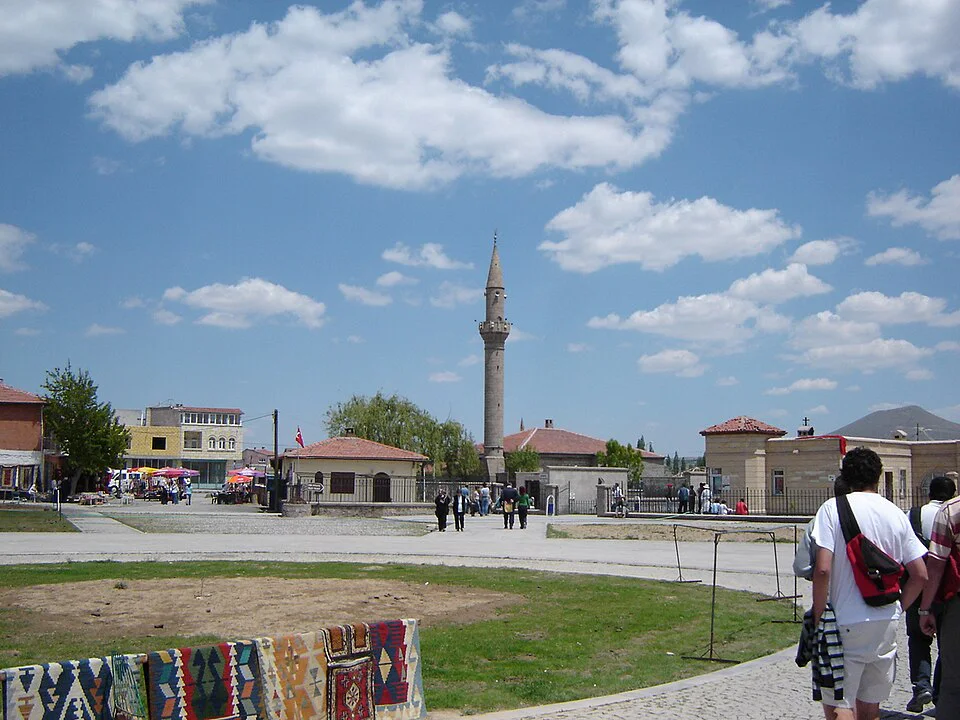 The Entrance and Upper Stables (Level 1)
The Town Above: Derinkuyu's Surface Entrance
Welcome to Derinkuyu, and to the story of a city built entirely underground. It is the largest excavated underground city in Turkey, reaching roughly 85 metres down. At full stretch it could shelter some 20,000 people, along with their livestock and food stores. Yet the whole thing lay forgotten beneath the living town until 1963. That year, a resident renovating his house knocked through a basement wall and found a mysterious room behind it. Further digging uncovered a passage into the tunnel network, and the site opened to visitors in 1967. Since then, more than 600 separate tunnel entrances have come to light. Some of them hide under the basements of private houses in the town above. The town square itself gives nothing away, with its minaret, its market stalls and carpets spread out for sale.
Chanilim714 · CC BY-SA 3.0
02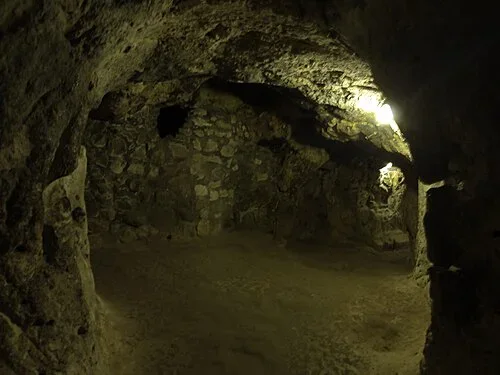 The Entrance and Upper Stables (Level 1)
Carved from Volcanic Tuff: Origins of the Deep City
Every room in this city was carved out of tuff, a rock formed from compacted volcanic ash. It lies across Cappadocia in thick beds, and it is soft enough to work with simple hand tools. That softness is what made the whole venture possible. Tunnels and rooms here were probably first cut by the Phrygians, in the eighth or seventh century BC. Over the centuries that followed, later communities kept enlarging what they found, adding levels, chapels and Greek inscriptions. No single architect designed the place. It grew the way a town grows, one family and one room at a time. The vaulted ceiling and squared walls of these early rooms show the work was deliberate, not just crude dug-out shelter.
Nevit Dilmen (talk) · CC BY-SA 3.0
03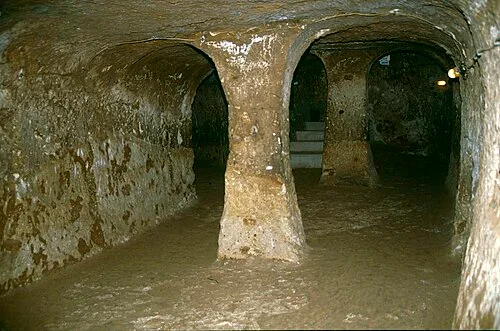 The Barrel-Vaulted Missionary School (Level 2)
The Barrel-Vaulted School (Level 2)
Derinkuyu was not built for a night of hiding. It was built for whole lives lived underground, and the great hall on the second level makes the point. That hall has a barrel-vaulted ceiling, a long tunnel-like arch carved straight out of the rock. Nothing quite like it has been reported in the other underground complexes of Cappadocia. It is said to have served as a religious school, with the rooms to its left used as studies. A school, on the second floor of a city meant to outlast a siege. Families expected children to keep learning, and worship to carry on, while danger lasted above. The carved pillars and arches show how masons shaped a grand hall out of stone that began as soft ash.
Listen in the appPhoto: Ziegler175 · CC BY-SA 4.0
04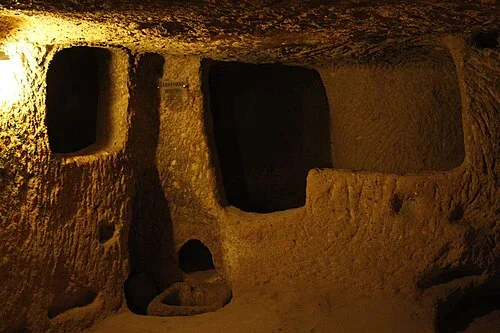 The Subterranean Winery and Kitchens
The Underground Winery
Food and drink had to come from somewhere, and the answer was to make them underground. Derinkuyu's amenities included wine and oil presses, cellars, storage rooms and refectories for shared meals. The winery is one of the more memorable corners of the city. Grapes went into the carved pressing basin, and the juice ran down into reception pits below. There were kitchens too, equipped with ovens called tandoor, set into the floor. Tandoor ovens of the same kind are still used in Cappadocian villages today. A community that could press wine, store grain and bake bread down here had no need to surface while danger lasted.
Listen in the appJosé Luiz · CC BY-SA 3.0
05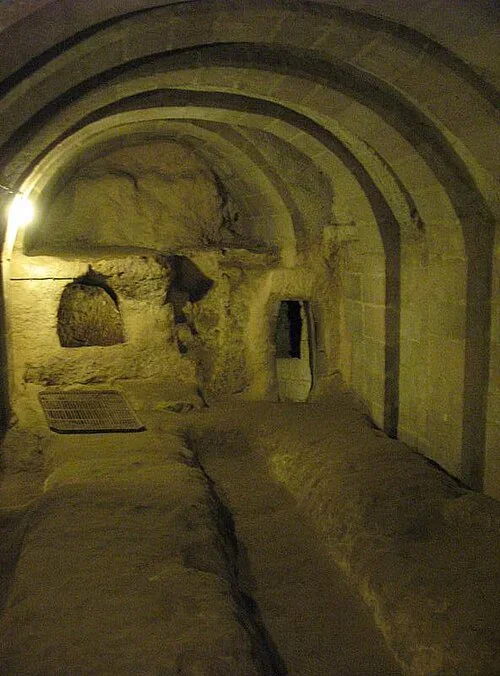 The Subterranean Winery and Kitchens
Upper-Level Stables
The upper levels were set aside for animals as well as people. Rooms like this one, with trough-like features carved from the rock, are traditionally read as stables. Livestock stood near the entrance levels, protected much as their owners were. Sheltering the animals mattered as much as sheltering the families, since herds and food stores had to survive the siege too. The vaulted ceilings gave the beasts headroom, and the soft rock made every trough quick to cut.
Listen in the appMartijn Munneke from Netherlands · CC BY 2.0
06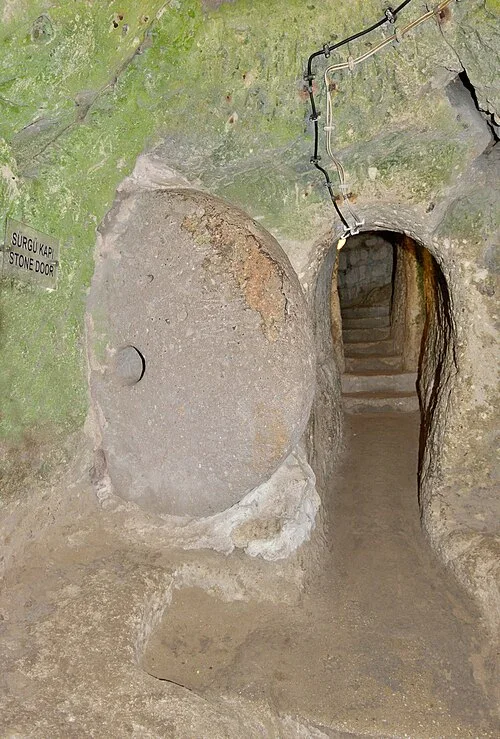 The Rolling Stone Defense Doors
The Rolling Stone Doors
A corridor like this could be shut in seconds. The huge round stone is a rolling stone door, shaped like a millstone and seated in a slot cut for it. Rolled across the passage, it sealed the corridor, and it could only be operated from inside the city. Each floor could be closed off separately, so a breach on one level did not open the rest. Doors of this kind were built for a long age of raids. The city was significantly enlarged during the Arab-Byzantine wars, roughly 780 to 1180, when local Christians sheltered from Umayyad and later Abbasid raider armies. It was probably then that Derinkuyu came closest to its full capacity.
Listen in the appElena Pleskevich from Moscow, Russia · CC BY-SA 2.0
07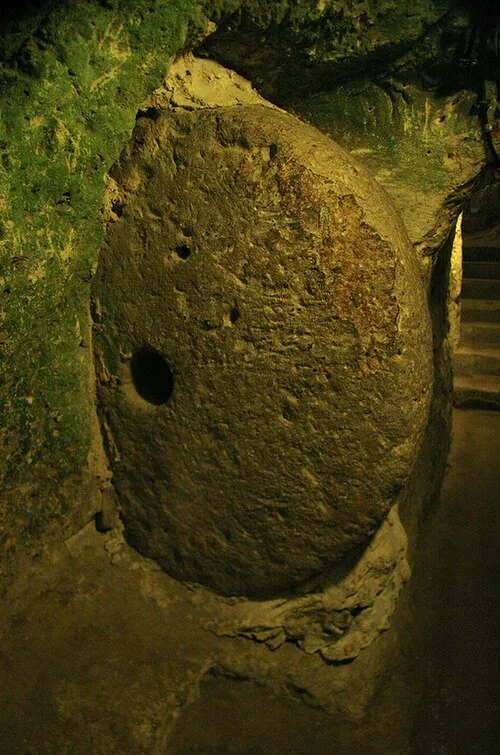 The Rolling Stone Defense Doors
A Fortress in Stone: Sealed Sections and Escape Routes
A single sealed door was only the beginning of the defense. Inhabitants could still move internally between the areas that remained open. And if part of the city was breached, the defenders could even mount organised counterattacks from within. There was an escape as well as a defense. Derinkuyu was connected to the neighbouring underground city of Kaymakli by roughly eight to nine kilometres of tunnels. That link allowed communication and escape between the two settlements, deep beneath the plain. Each door was one piece of a system that worked like a fortress laid on its side.
Listen in the appElena Pleskevich from Moscow, Russia · CC BY-SA 2.0
08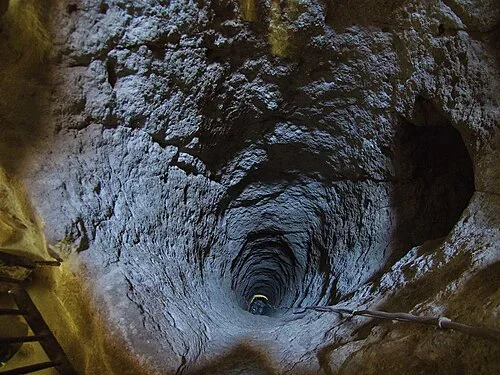 The Deep Ventilation Shaft and Well
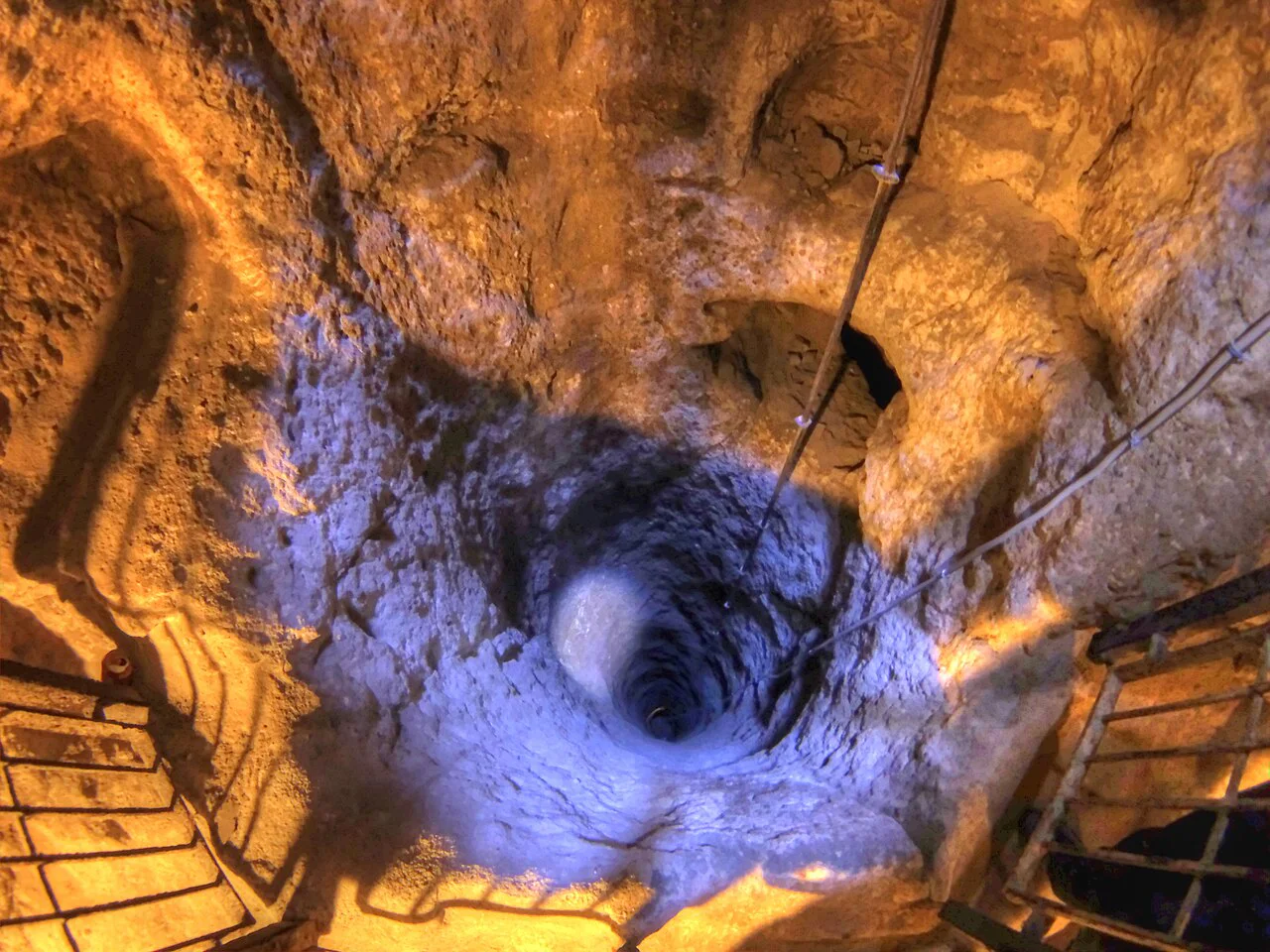
Air and water reached every level of this city, and both came down the same kind of shaft. Vertical ventilation shafts run through the complex, small ones linking individual rooms and wider central shafts serving many levels. The main central shaft is about three metres wide, and it connects to several levels. Its openings are arranged so that no two levels ever overlap, a layout that appears deliberately engineered to maximise airflow. A shaft about 55 metres deep appears to have served as a well. It supplied water to the villagers above, and, when the surface was not safe to reach, to those in hiding. The town's name records that role: Derinkuyu means deep well. Its older Greek name, Malakopia, probably comes from malakos, meaning soft, a nod to the easily worked tuff.
Listen in the appJoe Wallace · CC BY-SA 2.0
09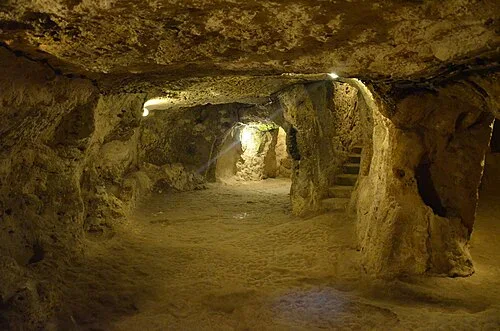 The Deepest Passages and Cruciform Church (Levels 5 to 8)
The Rock-Cut Church and the Deepest Levels
Staircases beginning between the third and fourth levels led down to a church on the lowest, fifth level. Carved from the rock, it was the spiritual heart of the community in hiding. Worship went on underground through centuries of danger. The cities sheltered Christians from the Seljuk invasions of the eleventh century, and from the Mongolian incursions of Timur in the fourteenth. Use of the refuges ran right into modern times. The Cambridge linguist Richard MacGillivray Dawkins, researching the region from 1909, recorded what happened when news came of the massacres at Adana. A great part of the population at Axo took refuge in these underground chambers, he wrote, and for some nights did not venture to sleep above ground.
Listen in the appAhmet KAYNARPUNAR · CC BY-SA 3.0
10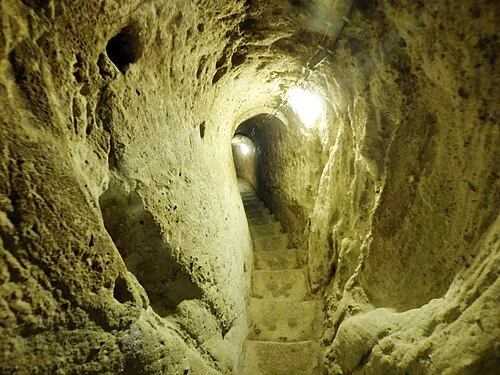 The Deepest Passages and Cruciform Church (Levels 5 to 8)
Ascent and Farewell: What Derinkuyu Tells Us
The narrow stairway back up was cut by hands that needed a way down in a hurry. Derinkuyu's long life as a refuge ended in 1923. Under the population exchange between Greece and Turkey, the region's Christian inhabitants were expelled and resettled in Greece. When they left, the underground city was abandoned. Every level had been dug without machines, by people preparing for the worst. The whole city, every room and stairway, was cut by hand from the soft volcanic rock of Cappadocia.
Listen in the appNevit Dilmen (talk) · CC BY-SA 3.0
Derinkuyu Yeraltı Şehri
Frequently asked questions
How much does the guide cost?
Free app download. Listed guide price: $0.99. Guide price shown in the app. Audio guide only. Venue admission is separate.
Can I listen without internet?
Yes. Download the guide’s audio, images, and maps in the app before your visit. Your downloaded content is then available offline.
Can I listen in my language?
This audio guide is available in 15 languages, including English.
Do I need to follow a schedule?
No. This is a self-guided experience. Choose your stops, pause whenever you like, and return to a story at your own pace.
At your own pace
Explore Derinkuyu Yeraltı Şehri.
Download Stanza, then search for “Derinkuyu Yeraltı Şehri”.
Free app download · Guide price shown in the app
Keep exploring
Audio guides — Turkey
Nevşehir district · 10 km
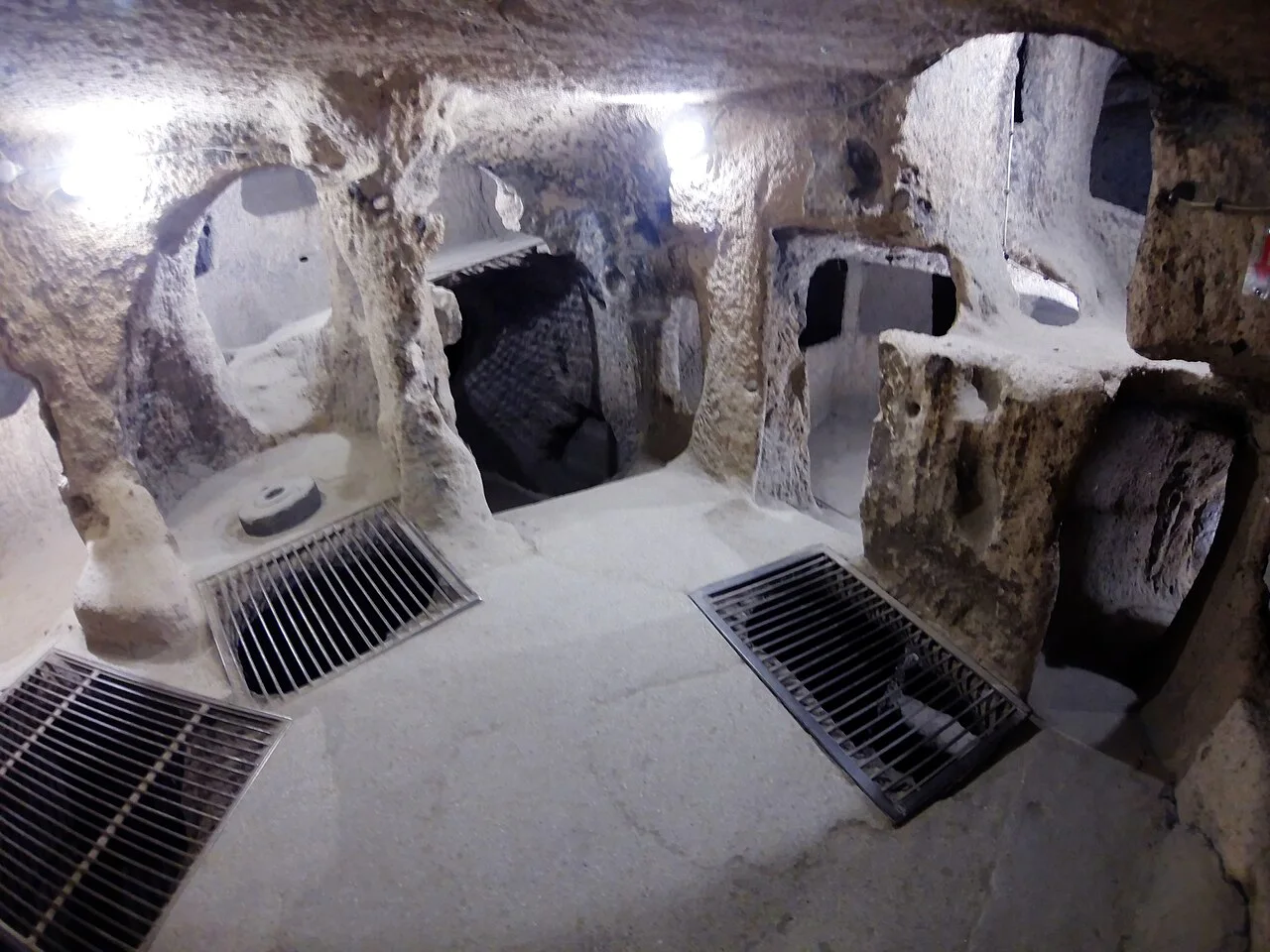
Kaymaklı Yeraltı Şehri
Content & sources
Nevit Dilmen (talk) · CC BY-SA 3.0
Konya
Alâeddin Camii
Content & sources
Photo: Christian Mathis · CC BY-SA 3.0
Alaca
Alacahöyük
Content & sources
Bernard Gagnon · CC BY-SA 3.0
Erdemli
Korikos
Content & sources
The original uploader was Artaxiad at English Wikipedia. · CC BY-SA 3.0